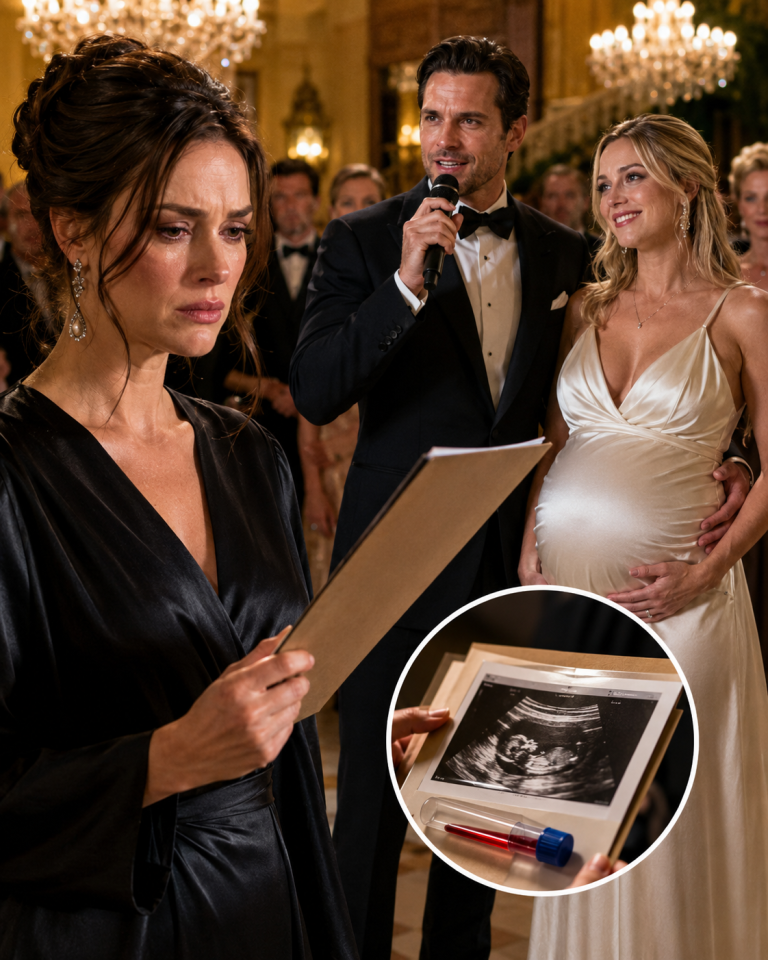
My CEO Husband Slid Me a Black Credit Card and Told Me to Disappear — He Never Noticed the Notary Who Secretly Owned His Building

—
PART 1
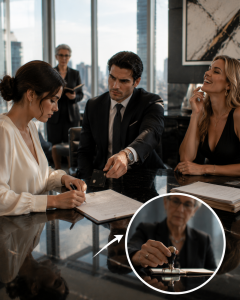
The ink on the divorce documents had barely dried when my husband, Nathan Pierce, leaned back in his leather chair with a smug grin. He flicked the black American Express card across the polished mahogany table like he was tossing scraps to someone beneath him.
“Take it, Emma,” he said. “It should pay for some tiny apartment for a few weeks. Consider it compensation for wasting two years of my life.”
Across the room, Madison laughed softly without an ounce of shame, discussing CloudAxis’s algorithm as if she’d created it herself, already acting like she owned my place beside Nathan.
They all believed I was nothing more than a former coffee shop waitress who had gotten lucky. No one paid attention to the frail elderly notary sitting quietly in the corner in a faded tweed jacket. None of them knew that appearance was carefully crafted. None of them knew he secretly owned the skyscraper where this meeting was taking place, or that his connection to me ran far deeper than anyone in that boardroom could imagine.
“Let’s keep this simple, Emma,” Nathan said, pushing the paperwork toward me. “We’re both exhausted, and we both know this marriage turned into a terrible investment.”
“A terrible investment?” I quietly repeated.
“Don’t pretend you’re innocent. When I met you, you were serving coffee in a neighborhood café. I believed I was giving you a better life. Instead, you never fit into this world. You’re just boring.”
Madison didn’t even look up from her phone. “She really is, Nathan. Remember the homemade beef stew for your marketing executives? I’ve never been so embarrassed.”
“Exactly,” Nathan said. “CloudAxis is meeting our fifty-million-dollar investors at two this afternoon. I’ll look much stronger entering our IPO as a single man.”
“So after two years together, I’m nothing more than a liability on your balance sheet?”
“It’s business,” he replied. “The prenup gives you nothing. But I’m feeling generous.” He shoved the black card closer. “Take it. Disappear somewhere cheap. I’ll even let you keep the old Honda.”
Then he snapped his fingers toward the notary. “Come on, old man. Wake up and stamp the papers already.”
I never reached for the card. I never argued. I never shed a single tear.
That was the first sign something inside that room wasn’t unfolding the way Nathan imagined.
—
The old notary in the corner shifted slightly — a small movement no one else noticed. Only I saw the way his fingers closed around the worn leather folder in his lap.
Arthur Bell had known me since I was seven years old. He had been my grandfather’s closest adviser, the man who brought paper bags of oranges to our kitchen when my mother was sick, who taught me chess on rainy afternoons, who called me “little sparrow.” Today, he had come because I asked him to. Not to destroy Nathan. To witness the truth.
“Mr. Bell, is everything in order?” Nathan asked impatiently.
“The signatures are in order,” Arthur said. “Mrs. Pierce, before I notarize these documents, I must confirm one final detail. The name under which the petitioner signed.”
“Her name is Emma Pierce,” Madison scoffed.
“The document lists her as Emma Claire Pierce, formerly Emma Claire Bennett.”
“That’s correct,” Nathan said. “Bennett was her maiden name.”
“No,” Arthur said softly. “It was not.”
Something in the room changed. No thunder. No gasps. But Nathan went very still.
“My records indicate that Emma Claire Bennett was a legal name used for personal privacy,” Arthur said. “Before that, and still in several sealed family trusts, she is listed as Emma Claire Whitmore.”
Madison’s phone stopped moving. Nathan stared at Arthur as if he’d begun speaking another language. “Whitmore,” he repeated, and I could see him searching, connecting the name to something useful.
“Whitmore Holdings,” Arthur said. “Founded by Elias Whitmore. Current assets include commercial real estate, logistics infrastructure, biomedical patents, and several private investment funds.”
“You never told me that,” Nathan said, and there it was — not regret, not humility, only the sharp sting of information withheld from him.
“I tried to tell you who I was many times,” I said. “You only listened when the subject was useful to you.”
Arthur slid another paper across the table. “This building was one of them. The Pierce Tower lease was negotiated twelve years ago. The ownership entity is Halcyon Trust. Miss Whitmore is its primary beneficiary.”
“Are you saying Emma owns this building?” Madison asked, standing so fast her chair rolled backward.
“I am saying the trust that Miss Whitmore controls owns the building,” Arthur said.
“You let me rent office space from you?” Nathan asked.
“I didn’t let you. CloudAxis signed a lease years before we met.”
“And you said nothing?”
“I wanted a marriage, Nathan. Not a negotiation.”
Arthur pulled one more envelope from his folder — cream-colored, sealed with a small red mark I recognized instantly. My grandfather had used that seal on letters he considered important enough to outlive a mood.
“This was to be delivered only upon the dissolution of your marriage,” Arthur said.
My breath caught. And that was only the beginning of the morning that ended Nathan Pierce’s perfect afternoon.
—
PART 2
Arthur pressed his notary seal onto the divorce document. A click. A stamp. A thin finality. And just like that, I was no longer Mrs. Pierce.
Nathan stared at the stamped papers. Then Arthur slid a slim flash drive onto the table.
“I received this from Miss Whitmore’s grandfather’s archive three months ago,” he said. “It contains the original CloudAxis conceptual model submitted six years ago under the name E. C. Whitmore.”
“That’s impossible,” Madison whispered.
Six years ago, I had been twenty-three, working mornings at the café and nights on an idea I barely knew how to explain — a system that could predict where computing resources would be needed before strain appeared. I had sent the proposal under my legal initials, nervous, the Whitmore name feeling too heavy. Months later, a polite rejection arrived from a junior review board. I filed the disappointment away and told myself people like me could imagine things, but people like Nathan built them.
Then I met him. At the café. Three weeks of black coffee by the window, asking about my books, my schedule, my dreams.
My dreams.
“What did you know?” I asked him.
His silence told me more than a confession could have.
“You knew who I was,” I said.
“Not at first,” he said. Too quickly.
I remembered the night, three months into our marriage, when he’d found my old blue notebook at the kitchen table. *You’re full of surprises,* he’d said, and I had thought he meant my messy diagrams were charming. Maybe he had been measuring me.
Nathan’s phone buzzed. Then Madison’s. Then the conference room phone lit up. Victor Lang, the lead investor, was calling to postpone the two o’clock presentation — his legal team had received an anonymous summary that morning suggesting CloudAxis’s core technology might be tied to an undisclosed prior submission.
“Who told him that?” Nathan demanded.
No one answered. Then the conference room door swung inward.
A young woman stood there, breathless, clutching a canvas messenger bag. “My name is Lily Hart,” she said, her voice trembling but clear, “and before anyone signs another document, Emma needs to know that her grandfather didn’t reject her proposal.” She pulled out a blue notebook — my notebook, the one I’d thought lost for years. “He funded it. Secretly. Through someone else.” Her eyes filled with tears. “And I think that person was Nathan.”
—
PART 3
For several seconds, no one in the conference room moved. The city kept glimmering beyond the windows, indifferent and bright, unaware that thirty-seven floors above them, the careful story of Nathan Pierce’s life had just split open.
Lily Hart stepped inside, though Nathan’s assistant lingered anxiously behind her. “Your assistant tried to stop me,” Lily said, “but I told her this couldn’t wait.”
“Lily,” Nathan said, his voice low, “this is not the time.”
“That’s what you said three years ago. And two years ago. And last winter.”
Arthur’s hand slowly closed over the back of a chair. “You know her.” Nathan didn’t answer. “You’re Margaret Hart’s granddaughter,” Arthur said.
At the name, something moved inside me. Margaret Hart — my grandfather’s housekeeper for nearly twenty years, who’d lived in a small cottage behind the estate, who always smelled of lavender soap and cinnamon tea. “She died before my grandfather,” I said.
“She did,” Lily said. “But before she died, she gave me a box and told me not to open it until Mr. Whitmore was gone too.” She reached into her coat and pulled out a small brass key, tagged in my grandfather’s sharp handwriting: *Sparrow.*
Arthur removed his glasses. “Dear God.”
Lily placed the notebook in front of me. I opened the cover. My handwriting filled the first page — *Cloud elasticity prediction map. Draft 4.* Beneath it, in my grandfather’s hand, a sentence I had never seen: *She sees patterns before others admit there is one.*
Between two pages, a letter rested, sealed with red wax. Lily nodded toward it. “That’s the one I found tucked inside. I didn’t read all of it. Just enough to understand that Emma had to see it.”
I broke the seal.
*My little sparrow. If this letter has reached you, then one of two things has happened. Either you have discovered the truth before I found the courage to tell you, or the people around you have tried to turn your own brilliance into something you doubt.*
*You believed your proposal was declined. Officially, that is true. I allowed the review board to reject it because I needed to know whether the idea could survive without my name wrapped around it. That was a mistake. A proud old man’s mistake. I formed a private development fund afterward. I placed the initial grant through a young entrepreneur with unusual technical skill and considerable hunger. His name was Nathan Pierce.*
*Nathan was told the original architect wished to remain anonymous until she was ready. He was contracted to develop the infrastructure, not claim authorship. He agreed to this. If Nathan has honored that agreement, then I hope he became someone worthy of your trust. If he has not, I am sorry, Emma. More sorry than these words can carry.*
“You knew,” I said.
Nathan didn’t deny it. The absence of denial was its own confession.
“At first, yes,” he admitted, when Arthur pressed him. “When Elias approached me, I had nothing. He offered funding, contacts, infrastructure — everything. But there were conditions. The original architect stayed anonymous. I was to build, report, document, and wait. I thought it was temporary. I thought whoever wrote it didn’t want it. Months passed. Then a year. I built the team. I turned theory into a working product.”
“And then you found out it was me,” I said.
“Yes.”
“When?”
Lily shook her head. “No. Before.”
Everyone turned to her. She pulled a plain gray folder from her bag. “My grandmother kept copies of correspondence marked with the sparrow seal. This is an email from Nathan to my grandfather — sent six weeks before Nathan met Emma at the café.” She handed me the page.
*If the architect is unwilling to participate directly, I request permission to approach her under ordinary circumstances. Understanding her thought process may help preserve the integrity of the model.*
My body went cold. Six weeks before black coffee by the window. Six weeks before daisies in the rain.
“You approached me?”
“Elias refused that request,” Nathan said.
“But you did it anyway.”
He closed his eyes.
—
Madison’s voice was thin. “Why would you have her notebook?”
“I wanted to understand you,” Nathan told me.
“You wanted to study me.”
“No — not by the end.”
“By the end,” I repeated. What a small phrase to place over two years of marriage.
Lily lowered her gaze. “I’m sorry.”
“You don’t owe me an apology,” I said. “Why did you come today?”
She hesitated, glancing at Arthur. “Because someone else is looking for the Sparrow Box.”
Arthur went completely still. “A private archive,” he explained to Madison. “Materials relating to Emma’s protected assets and certain trust instructions.”
“Where is it?” I asked.
“I believed it was in the Whitmore estate vault,” Arthur said.
Lily shook her head, lifting the brass key. “My grandmother’s letter says it was moved. To a place Emma would go when she had nowhere else.”
The cottage. Margaret’s cottage, behind the estate.
—
By the time Nathan’s phone stopped ringing with the board’s questions, he looked, for the first time all morning, simply human — a man who had run too fast for too long and discovered the road behind him wasn’t as solid as he’d imagined.
“I can still fix this,” he said.
“What does fixing it mean?” I asked, and gave him the answer myself. “You go to your board. You tell them the presentation is postponed because there are authorship and contractual issues that must be reviewed. You tell them an independent investigation is needed. No speeches about misunderstanding. No blaming me. No blaming Lily. No blaming a dead man who trusted you.”
“You want me to walk into my boardroom and dismantle my own company.”
“I want you to stop building it on my silence.”
That was the sentence that changed him. I saw it land.
“I don’t know how to be someone who loses,” he said quietly.
Madison stepped forward. “Nathan, I’ll go with you. Not to protect you. To tell the truth about what I know. And what I don’t.” Then she turned to me, and instead of an apology, she said, “The beef stew was good.” A fragile laugh rose in my chest and faded into tears before it fully formed. “I was embarrassed because I wanted to belong here,” she admitted. “You already did, and I hated that I could feel it.”
At the door, Nathan turned back. “Did you ever love me?”
“Yes,” I said. “I loved the man I thought was brave enough to be true.”
He nodded once and left. Madison paused at the threshold. “Emma. Be careful with the notebook. If Nathan wasn’t the only one who knew about your proposal, there may be other people waiting to claim pieces of it.” Then she was gone.
—
Arthur pulled out the chair beside me. “I should have told you more.”
“Did you know Nathan approached me deliberately?”
“No. But I knew there were sealed instructions. I knew Elias worried about the company after your marriage began. I did not know why.”
“He didn’t trust Nathan?”
“Elias trusted potential more than people sometimes,” Arthur said. “He saw what a person could become and forgot to guard against what they already were.”
Lily set the brass key on the table. “My grandmother loved your grandfather. Not romantically. She believed in him. She said he carried too much guilt after your parents died.” She looked up. “He visited her before he passed. She was already sick then. He gave her the box and told her that if anything happened, she should protect ‘the sparrow’s sky.’ I didn’t understand what that meant.”
“The estate,” I whispered.
“We need to go to the cottage,” I said.
In the lobby, sunlight poured over marble floors. Near the entrance stood a large arrangement of white lilies beneath the building directory. Lily gave a small, embarrassed shrug when she noticed. “My grandmother used to say your grandfather planted signs everywhere. I thought she meant flowers.”
Outside, my phone buzzed. An unknown number. *Do not go to the cottage with the girl.* Then: *Ask Arthur what happened the night your parents died.*
The street seemed to tilt. I handed Arthur the phone. His face changed — not confusion. Recognition.
“Emma,” he said, his voice barely audible, “there are parts of your grandfather’s story I was sworn never to tell.”
Across the street, a black sedan idled at the curb. Then my phone buzzed one final time. A photograph — old, faded, taken on the steps of my grandfather’s estate. My parents stood smiling beside Elias Whitmore. Arthur was there too, younger, serious. And standing half-hidden behind my father, one hand resting on his shoulder, was a young man I recognized immediately.
Nathan Pierce. Except the date stamped in the corner was fifteen years before I had supposedly met him.
—
We did not go to the cottage that afternoon. Arthur insisted on the estate’s old carriage house instead, a smaller and more defensible building with a single locked door and no windows facing the road, and he made the calls himself, in a voice I had never heard him use — clipped, precise, the voice of a man who had spent decades quietly managing things he never let anyone see him manage.
“Sit,” he told me, once we were inside, the brass key still warm from Lily’s hand. “You deserve the whole story before another anonymous message decides how much of it you get.”
The story began, Arthur said, not fifteen years ago, but closer to twenty.
Elias Whitmore’s automotive components division — a small, unglamorous corner of Whitmore Holdings that most people, including me, had forgotten existed — had once supplied a braking assembly used across several commercial fleets. Eighteen months before my parents died in the crash that took them, an internal engineer flagged a defect rate in that assembly well above safety thresholds. That engineer’s name was Daniel Pierce.
Nathan’s father.
Daniel had pushed the recall up the chain three times. Three times, it had been quietly buried by a division head eager to protect a supply contract worth more than his own annual salary — a man named Victor Lang, Arthur said, the same investor Nathan had spent months courting for CloudAxis’s IPO.
“Victor,” I said, the name landing with sudden, sickening weight.
“Victor Lang has spent twenty years becoming exactly the kind of man who survives his own worst decisions,” Arthur said. “He fired Daniel Pierce before Daniel could escalate the recall outside the company. He falsified the incident reports himself. And eight months later, the vehicle carrying your parents suffered the exact brake failure Daniel had warned about.”
The room felt very far away.
“Elias didn’t order it covered up,” Arthur said, watching my face carefully. “He didn’t know, not at the time. When he learned, months later, what Victor had done — what had been done in his company’s name, to protect his company’s numbers — he was the one who quietly ensured Daniel Pierce received a settlement large enough to disappear his family’s financial troubles, and who ensured Victor never rose past division head again inside Whitmore Holdings. But he could not undo what had already happened. And he could not prosecute Victor without the story becoming public in a way that would have destroyed the very fleet contracts that thousands of Whitmore employees depended on. He made a hard, ugly, imperfect choice. He chose containment over justice. I helped him make it. I have carried that every day since.”
“And Nathan?” I asked, my voice barely functioning.
“Nathan was seventeen when his father was fired,” Arthur said. “He watched his family nearly collapse under a debt his father hadn’t caused and a blacklisting no one would explain. Elias, guilt-stricken, quietly funded Nathan’s education for years afterward — anonymously, through a scholarship fund with no Whitmore name attached, the closest thing to amends he allowed himself. That photograph was taken the one time Nathan visited the estate as a scholarship recipient, the year before your parents died. He would have been sixteen.”
I stared at the photograph again. A boy, not yet the man who’d slide a black card across a table. Standing near my father’s shoulder, in a life he did not yet know had already been rearranged by the same family that would, decades later, rearrange his again.
“Did Nathan know,” I asked slowly, “that his father had been telling the truth about the brakes? That the crash that killed my parents was the same defect?”
Arthur’s silence answered before he spoke. “I believe he learned it only recently. I believe that is precisely why Elias engineered your meeting the way he did — not merely as a test of Nathan’s character with your idea, but because he wanted the two of you, eventually, to arrive at the truth together, and to decide together what justice should look like, once both of you were strong enough to survive knowing it.”
“He used us,” I said. “Both of us. As some kind of long, quiet apology to a family he’d helped destroy.”
“He used you as a chance,” Arthur said gently. “Whether either of you became worthy of it was always going to be your choice, not his.”
—
Lily had gone very pale during all of this, her hand still around the brass key. “The Sparrow Box,” she finally said. “It has everything. Doesn’t it? The falsified reports. My grandmother’s testimony. Whatever Victor is trying to bury now, before this goes anywhere near a courtroom or a headline.”
“Yes,” Arthur said.
The anonymous texts made sudden, cold sense. Victor Lang, hearing whispers of postponed investor meetings and unnamed prior submissions, had assumed — correctly, as it turned out — that old ghosts were being disturbed in the same week his newest, most lucrative investment was collapsing. He did not know exactly what Emma Whitmore might find in a cottage behind an old estate. He only knew he could not afford for her to find it.
We called the police that evening, not dramatically, not with sirens, but through a quiet, careful channel Arthur had cultivated over decades of protecting things that needed protecting. Two detectives arrived at the carriage house the next morning to take statements and to begin, at last, the process of reopening a file that had been closed under Victor Lang’s signature twenty years earlier.
It took the better part of a year. There was no single dramatic hearing, no courtroom scene where a guilty man broke down and confessed. Victor Lang’s lawyers fought every subpoena, delayed every deposition, tried every maneuver men like him have always been able to afford. But paper, once it exists, is very hard to make disappear twice. The Sparrow Box held Daniel Pierce’s original engineering reports, Margaret Hart’s notarized account of what Elias had told her in his final year, and a ledger, in Elias’s own hand, itemizing exactly what Victor had been paid to make the recall vanish.
Victor Lang was indicted eleven months later on charges related to falsifying federal safety records and obstruction. Whitmore Holdings’ automotive division, long since absorbed and forgotten inside the larger trust, issued a public accounting of the original defect and the families affected by it — mine among them, though by then I understood my grandfather had already spent two decades quietly trying to be the kind of amends that public accountings rarely manage to be.
—
Nathan did not fight any of it.
I want to be honest about that, because it would have been easy, once Victor Lang’s name entered the story, to let one villain’s cruelty erase the smaller, quieter cruelties of the people standing closer to me. Nathan had still approached me deliberately, against explicit instructions not to. He had still built two years of marriage on a silence he chose to keep long after he no longer had to. His father’s suffering explained why he might have wanted, badly, to understand the family that had both destroyed and quietly saved his own. It did not undo the calculation in the way he’d sat by that café window for three weeks before ever saying hello.
He testified anyway, fully and without a subpoena forcing him to, once the investigation reached the automotive division. He handed over the email Lily had already found, and others besides. He resigned as CEO of CloudAxis the same week Victor Lang was indicted — not because the board demanded it, though eventually they would have, but because, as he told me in the one conversation we had after that day in the conference room, he had finally understood the difference between building something and deserving it.
“I used to think if I built something big enough, it wouldn’t matter how I got the first brick,” he said. We were sitting in a nearly empty diner near the old estate, neither of us dressed for anywhere important. “I don’t believe that anymore. I don’t know if that makes any of it better.”
“It doesn’t,” I said. “But I believe you mean it.”
We did not reconcile. I want to be clear about that too. Understanding why a person becomes who they are is not the same as choosing to stay beside them. Nathan’s father had been wronged terribly, and Nathan had carried that wound in ways I finally understood, and none of it changed the fact that I had spent two years shrinking myself smaller and smaller in rooms he controlled. Compassion and consequence are not required to cancel each other out.
CloudAxis survived, restructured under new leadership, with formal authorship credit finally, publicly restored to E. C. Whitmore on every patent filing that mattered. I took a board seat, not out of triumph, but because Lily convinced me — rightly — that walking away entirely would leave the company’s future in hands no more trustworthy than the ones that had built it on my silence in the first place.
Madison stayed on as chief strategy officer, under the new board’s watchful eye, and to her credit, she earned every ounce of the trust it took to keep her there. She sent me a card the following spring, on the anniversary of the day the divorce was finalized. *The stew really was good,* it read. *I hope you’re building something that’s entirely yours now.* I kept it.
—
The cottage, when we finally did go, in early spring, smelled of dust and dried lavender and years of careful silence. Margaret’s rosebushes had gone wild over the fence, exactly as I remembered. Behind a loose floorboard beneath the kitchen window, exactly where Lily’s grandmother’s letter had described, we found the Sparrow Box — small, unremarkable, its lid stamped with the same red seal as every letter that had found me that year.
Inside, beneath the documents that would eventually help convict Victor Lang, was one more envelope, addressed simply: *To whichever sparrow found her way home.*
*My dear girl,* my grandfather had written, in a hand grown shakier than the one in the earlier letters, closer, I understood now, to the end. *If you are reading this, you have already survived more truths than I ever wanted to leave you. I am sorry I built so much of your safety out of secrets instead of honesty. I told myself, for years, that protecting you meant deciding for you what you could bear to know. I was wrong about that, the way I was wrong about so many things I only understood too late. You were always stronger than my fear allowed me to believe. Build whatever you build next in the daylight, little sparrow. Nothing you make will need my shadow to survive in it.*
I read it standing in the doorway of the cottage where I had once learned to mend a button and tell bread by its crust, and for the first time since the conference room, since the black card, since the notary’s quiet click of a stamp, I let myself cry the way I had never allowed myself to in front of Nathan — not from grief exactly, and not only from relief, but from the strange, steadying feeling of finally standing in a story with every wall lit.
Arthur found me there an hour later, unsurprised, unhurried, exactly as he had been my whole life.
“He would be proud of you,” he said.
“He built me a fortune out of guilt,” I said. “That’s not the same as pride.”
“No,” Arthur agreed. “But he also built you a chance to decide what to do with both. That part, at least, was always entirely yours.”
Outside, the estate grounds had begun, quietly, to come back to life — the first daylilies pushing up along the old fence line, the wind chimes Margaret had hung decades ago still singing faintly in the spring air, as if the whole property had simply been waiting, patient as an old notary in a faded jacket, for someone to finally come home and open every locked drawer in the light.
THE END