SHE WORE MY DRESS TO ANNOUNCE HIS BABY — SHE DIDN’T KNOW HE’D NEVER FATHERED A CHILD IN HIS LIFE

## PART ONE
The smell hit me before the meaning did.
Gardenia. My gardenia. The perfume I’d stopped wearing the year Julian started coming home late and smelling like someone else’s bathroom soap.
I was standing in the doorway of my own foyer at eleven in the morning, holding my phone, staring at a photograph a stranger had sent to a number she shouldn’t have had. In it, a woman I’d never officially met stood beneath my chandelier, one palm pressed to a stomach shaped more like a costume than a pregnancy, wearing a dress I could have described with my eyes closed. Ivory silk. Fourteen pearl buttons, not twelve, I’d counted them in the shop. A ribbon low beneath the bust that I’d asked the seamstress to double-stitch because I planned on this dress mattering.
*Looks better on the body that’s actually using it for something,* the caption read.
I set the phone face-down on the console table, the way you’d put down a knife you didn’t want to look at anymore.
Then I did the thing I’d trained myself to do for seven years of marriage to Julian Ashworth. I got dressed for the evening as though nothing in my chest had just been rearranged.
—
You should know two things about the town of Seacliff before I tell you what happened at the Kestrel Hotel that night.
The first is that everyone in it worships the Ashworth name the way smaller towns worship a church. Three generations of pharmaceutical money, two senators bought and sold like furniture, a foundation gala every June that functioned less as charity and more as a public inventory of who still mattered.
The second is that I used to be someone before I became “Mrs. Ashworth.” Margot Calloway, junior counsel, Boston, twenty-six years old and stupid enough to think a man who quoted poetry at dinner and remembered how I took my coffee was falling in love with *me* and not simply acquiring a wife who photographed well and argued less than he expected.
I’d met Julian when I was twenty-four, still young enough to believe intelligence was a kind of armor, ambitious enough to mistake his attention for devotion. He was twelve years older, charming in the particular way winter sunlight is charming — bright, cold, and gone by four in the afternoon. He sent orchids to my office before I’d given him my address. He flew me to Napa on a Tuesday because, he said, Tuesdays deserved better than they got. He quoted Didion over dinner and listened to my answers like each one was a secret he’d spent his whole life waiting to hear.
When he proposed on a terrace overlooking the harbor six months later, I said yes before I understood the difference between men who choose a wife and men who acquire one.
The first year of our marriage felt like walking through a museum after closing — hushed, gleaming, priceless. Then came the small corrections. *Not that dress, darling. Don’t mention the firm at dinner, people find it exhausting. My mother thinks your laugh carries a little too far.* By the third year I’d left the practice of law entirely. By the fifth, I’d learned to stand beside him at events without taking up any space at all. By the seventh, he was coming home smelling like someone else’s perfume, and I had already stopped asking whose.
By the time the car dropped me at the Kestrel, I’d rebuilt my face twice in the visor mirror. Calm. Soft. A woman who has absolutely nothing to prove, which is the most dangerous kind of woman there is, though nobody in that ballroom knew that yet.
The room was glass and candlelight and the low roar of people pretending not to watch each other. I found a spot near the back wall, took a flute of champagne I had no intention of drinking, and watched my husband climb the small stage to accept an award for something called Legacy in Community Leadership, which was the kind of phrase rich families invented so no one had to say *inherited*.
He looked magnificent up there. He always did. That was never the problem.
The problem walked up beside him in my dress.
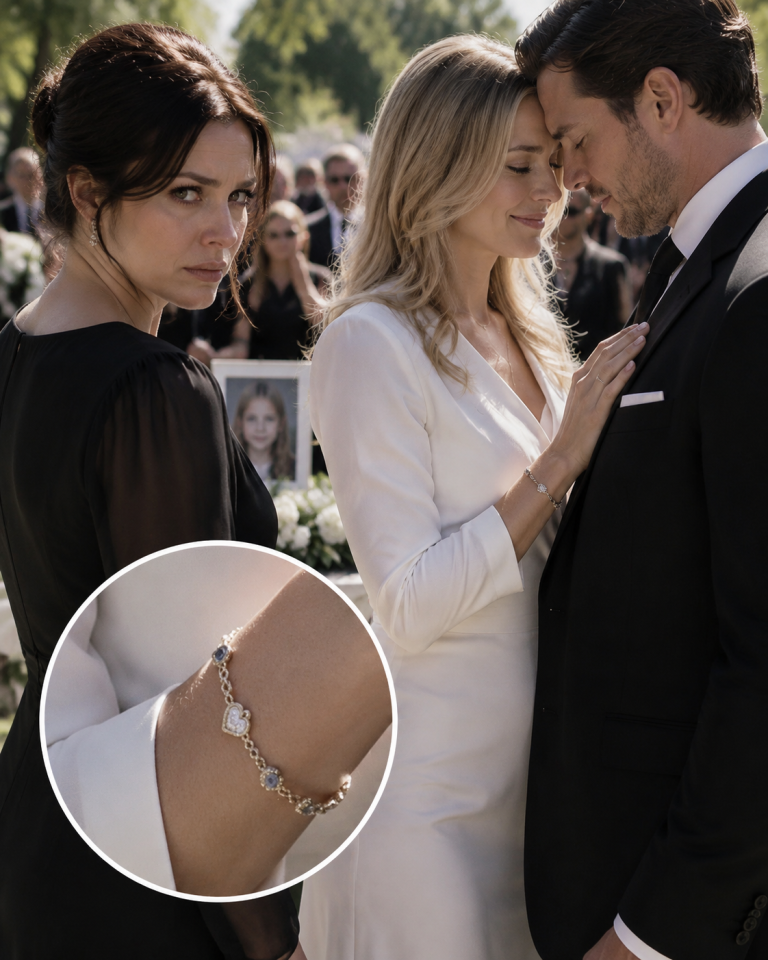
Simone Feld. Twenty-five, maybe twenty-six, blonde in the calculated way that costs more than it looks, wearing my ivory silk with a confidence that told me she believed she’d won something. Diamond studs in her ears that I recognized instantly, because they’d slept in my jewelry safe for three winters.
The room inhaled. Three hundred people learned, in that half-second, not to stare directly, the way you don’t stare directly at a car accident — you glance, you sip, you let your eyes slide past like you didn’t see anything at all.
Julian found me across the ballroom. For exactly one heartbeat, something in his face slipped.
Then he leaned into the microphone, and said the word his whole family had built a religion around.
“Legacy.”
He talked about lineage, about the responsibility of carrying a name forward, about how blessed — that was his word, *blessed* — he felt to be building a future for the Ashworth line.
Then he reached for Simone’s hand.
“This winter,” he said, “we welcome the next generation.”
The applause came in stages. Confused first. Then thunderous, because wealth trains a room to clap the instant someone with money tells it to.
Every head turned toward me. I understood, standing there with an untouched glass of champagne going warm in my hand, that this had been staged. Not the affair — men had affairs, ugly as that was, it was almost boring by now — but *this*, the performance, the timing, the dress. Someone had wanted me to break in public, cleanly, on camera, so the story would already be finished by morning: barren wife, fertile mistress, a family saved.
I didn’t break.
I lifted my glass to Simone across the room, and I smiled at her. Not a kind smile. The kind of smile that makes a woman’s hand twitch against silk she thought she’d earned.
Then I set the glass down and walked out before the applause finished, because I already knew something neither Julian nor his mistress did.
Three weeks earlier, a courier had delivered a sealed folder from Dr. Elise Marsh, the fertility specialist who’d once examined Julian at his own mother’s insistence, back when Constance Ashworth had decided my “biological timeline was becoming an embarrassment.”
I had read every page in that folder twice.
*Azoospermia. Zero measurable sperm count. Natural conception not medically possible without surgical retrieval and IVF.*
No retrieval had been scheduled. No procedure had occurred. I would have known — I still had access to the calendar, the accounts, the small quiet paper trail a wife accumulates without anyone noticing she’s paying attention.
Whatever Simone Feld was carrying, it was not my husband’s child.
And as I stood on the marble steps of the Kestrel Hotel with the Atlantic wind pulling my hair loose, I understood there were exactly two possibilities left standing in that ballroom.
Either Julian Ashworth had just announced a miracle he knew, with absolute medical certainty, could not be real —
Or someone else had handed him a lie and told him to smile for the cameras.
I didn’t yet know which one terrified me more.
## PART TWO
I didn’t cry that night. I didn’t throw anything, didn’t call a single friend, didn’t give the internet the breakdown it was clearly hoping to harvest from the gala footage already circulating online.
I went home and stood in my closet in front of an empty hanger where the ivory dress used to live, and I started making calls no one in that ballroom would have expected from me.
By 2 a.m. I’d pulled the foyer security footage — the one Julian always forgot existed — timestamped to the exact hour Simone had stood in my house wearing my clothes. By sunrise I’d copied the gala livestream, archived her message, and moved every financial record I could still reach into a drive with my name on it and no one else’s.
Julian came home at seven, reeking of whiskey and something floral that wasn’t mine.
“That got out of hand,” he said, from the doorway of the breakfast room, like he was describing weather.
“Did it.”
“She’s pregnant, Margot.”
“With your child.”
A pause just half a second too long. “Yes.”
I have sat across a table from enough witnesses in my old life to know what a lie sounds like when it’s cold. His was arctic.
“She’s due in December,” he said, before I’d asked.
“Interesting,” I said. “You were in Zurich most of March.”
Something moved behind his eyes — not guilt, calculation. “I flew back.”
“No,” I said. “You didn’t.”
He straightened his jacket, the way he did whenever a conversation stopped going his way. “You don’t want to do this, Margot.”
Not *it isn’t true.* Not *I’m sorry.* A threat, dressed up as concern for my own good — and that, more than anything he’d done that night, was the sentence that told me everything.
What Julian didn’t know — what none of the Ashworths knew, because they’d spent seven years treating me like a well-dressed piece of furniture that occasionally spoke — was that before I became his wife, I’d spent three years drafting trust structures for families exactly like his. I knew how to read a holding company. I knew what a shell inside a shell inside a foundation looked like from the outside.
His mother invited me to lunch four days after the gala, which in that family passed for a declaration of war. Constance Ashworth had spent seventy years turning disappointment into posture, and she chose The Kestrel’s private dining room for the ambush, ordering for both of us before I’d so much as opened the menu.
“We need to discuss optics,” she said, once the waiter had gone.
“Of course we do.”
“Julian has behaved imperfectly.” She said it the way other people said *the weather has turned.*
“Adultery is such a gentle word for what happened in that ballroom.”
Her mouth thinned. She slid a cream envelope across the tablecloth. Inside was a settlement — a number with more zeroes than I’d expected, a Manhattan apartment, a nondisclosure agreement, and a prepared statement describing our marriage’s end as *mutual and amicable.*
“We want dignity,” she said.
“You want silence. Those aren’t the same thing, Constance.”
“You came from nothing, Margot.” She said it softly, almost kindly, which made it worse.
“I came from Cleveland,” I said. “You’re thinking of somewhere else.”
I left the envelope on the table, unsigned, and told her I’d think about it — mostly because I wanted to watch her spend the next several days wondering whether I meant it.
Julian came to my bedroom that same night, the first time in eight months he’d bothered knocking on a door he usually treated as optional.
“You met with my mother.”
“I did.”
“She says you were hostile.”
“She offered me hush money over veal.”
“She offered you a way out.”
I turned from the mirror where I’d been unclasping my earrings. “A way out of what, exactly? Being humiliated, or being believed?”
“Take the settlement, Margot. No one is going to believe you over me. You have no children. No career left to speak of. No real friends in this circle who wouldn’t sell the story by morning.”
It was, I realized, the first entirely honest sentence he’d spoken to me in years.
“You already decided humiliation was the plan,” I said. “The moment you put that dress on her.”
He laughed, short and cold. “You think you’re smarter than everyone in this house.”
“No,” I said. “Just smarter than you were counting on.”
And I knew his grandmother, Vivienne, better than any of them realized.
Three days after the gala, I sat across from her in the private wing of Ashworth House, a cashmere blanket over her knees and a mind sharper than every man in her family combined.
“Terrible dress,” she said, before I’d even taken a seat. “For a scandal, I mean. Ivory reads virginal. She should have worn red.”
“It was mine.”
“I know.” Her cloudy eyes found me. “That’s what made it cruel.”
I placed the medical folder on the table between us.
Vivienne read it without expression. Then she reached into the drawer of her side table and slid a second folder toward me — one I hadn’t asked for, one that had clearly been waiting.
“Before you go further,” she said, “you should know precisely what you’re standing on.”
Inside was a private trust, drawn up twelve years earlier, amended quietly after Julian’s first affair. A controlling stake in Ashworth Pharmaceuticals — not in Julian’s name. Not in his father’s.
Mine. Activated, apparently, the moment Julian introduced a fabricated heir to the public.
“You’ve owned the ground under his feet for years,” Vivienne said, “and he never once thought to check.”
I was still holding that folder, still hearing the particular silence of a woman realizing she has far more power than she was ever told she had, when my phone buzzed against the table.
A text from a number I didn’t recognize.
*It’s Simone. We need to talk. He knew things about me before we ever met. I don’t think I was the one who found him.*
I stared at the screen until the words blurred.
If Simone hadn’t chosen Julian — if someone had chosen *her* — then this had never been an affair at all.
It had been a plan. And I still didn’t know who’d built it.
## PART THREE
Simone wanted to meet somewhere no one would recognize her, which by then meant nowhere in a fifty-mile radius of Seacliff. We ended up at a diner off Route 1, fluorescent-lit, smelling of burnt coffee, the kind of place the Ashworth name had never once touched.
She looked younger up close. Younger and frightened in a way that had nothing to do with cameras.
“I was six weeks pregnant when I met him,” she said, turning a mug in slow circles without drinking from it. “Someone else’s baby. Someone who wanted nothing to do with either of us. I had no money, no family who’d take my calls. Julian found me at exactly the right moment to look like rescue.”
“Did he tell you he couldn’t father children?”
“He told me *you’d* made that up. That you were unstable, that you couldn’t accept him moving on, that the medical file was a fake you’d planted out of jealousy.” Her hands were shaking. “I believed him because believing him meant I got to keep the apartment. The clothes. A story where I was loved instead of used.”
I sat with that for a long moment, watching the neon sign outside flicker against the window glass.
“Who found you, Simone? Before Julian ever did.”
She swallowed. “A woman hired an investigator to run my background. Debt, the pregnancy, the fact that I had nobody who’d fight for me if things went wrong. Julian showed up two weeks later like it was fate.” She laughed once, bitterly, at herself. “I remember thinking it was the luckiest coincidence of my life. He knew my coffee order the first time we met. He knew which bar I went to on Thursdays. I thought that meant something. I didn’t understand yet that being studied and being loved can look identical from the inside, right up until they don’t.”
I thought of my own version of that sentence — orchids sent to an office before I’d given out my address, a proposal on a terrace timed so precisely it had felt, at twenty-four, like fate instead of engineering. I said nothing about it. Some griefs aren’t meant to be shared, only recognized.
“I’m not asking you to feel sorry for me,” Simone said. “I know what I did. I put on a dead woman’s future and called it my own. I just need you to know I didn’t build the trap. I only walked into it, same as you did, years before I ever showed up.”
“Do you have proof of that?”
“Emails. Forwarded to me by accident, before they scrubbed the account.” She slid her phone across the table. “I didn’t understand what I was looking at until last week.”
I read the header of the first message, and the diner went very quiet around me.
*From: Constance Ashworth. To: [investigator]. Subject: Candidate confirmed — pregnancy timeline works in our favor. Margot will never contest a baby.*
My mother-in-law. Not Julian’s idea. Hers.
—
Before any of it reached a courtroom, my attorney — a sharp, unsentimental woman named Renata Cole who billed by the wound and was worth every dollar of it — laid Simone’s forwarded emails beside the fertility file and the security footage and looked at me across her desk for a long moment.
“You understand what you’re about to do,” she said. “You’re not just ending a marriage. You’re pulling the floor out from under an entire company.”
“I know.”
“Whitmore men — sorry, *Ashworth* men,” she corrected herself, half-smiling, “always confuse cruelty with strategy. You’re about to teach this one the difference.”
“I don’t want it messy,” I told her. “I want it clean.”
“Clean costs more,” Renata said. “But it lasts longer.”
The paternity petition moved through Providence family court on a gray, rain-slick Thursday. I wore navy wool and pearl studs and the diamond necklace Vivienne had sent that morning with a note: *Wear something sharp enough to reflect them.*
Julian’s attorney fought the testing order on privacy grounds, which told the entire courtroom everything it needed to know before Judge Patricia Harlan even ruled. She ordered it anyway.
Julian offered me a new settlement the week before the results came back — the Nantucket house this time, a number that would have made most people weep with relief, a lifetime of silence attached like a leash. I declined. He sent flowers to my office that afternoon, an apology dressed as roses. I had them delivered to Simone instead, no card, no explanation, because some gestures only make sense to the person who understands exactly what they cost.
The results came back sealed, and were opened on a Thursday two weeks later in a courtroom smelling of wet coats and consequence.
Julian Ashworth was not the father.
The sound that moved through the gallery wasn’t quite a gasp — it was closer to the sound of a story tearing cleanly down the middle. Simone covered her mouth. Constance sat rigid as marble. Julian didn’t look at either of them. He looked straight ahead, and in that single unguarded moment I understood exactly how much he had never loved anyone in that room, including himself.
I didn’t feel triumphant. I felt like a woman finally allowed to put down something impossibly heavy.
—
I called the final gathering myself — as controlling trustee of Ashworth Pharmaceuticals’ voting shares, a title none of them had bothered to notice I now held until the invitations went out under my name, to the very same glass ballroom at the Kestrel where Julian had once announced a child that was never his.
I wore silver that night. Not black. Silver, and no wedding ring.
Vivienne arrived in a wheelchair, wrapped in white cashmere, smiling like a woman who had personally arranged the weather.
I stood at the microphone in that same glittering room, the same chandeliers, the same low murmur of the Atlantic against rock far beneath the windows, and I said, “Good evening. Six weeks ago, in this exact room, my husband introduced a woman as the mother of his child. Many of you expected me to respond with tears. I understand the disappointment when I didn’t. Public pain is so much easier to consume when the woman bleeding performs it correctly.”
A ripple of nervous laughter moved through the crowd, uncertain whether it was permitted.
“I have always preferred documents to drama,” I said, and let the first screen behind me light up.
I let the timeline speak instead of my anger — the Zurich dates, the fertility file Julian had been shown and ignored, the wire transfers to a media company registered in Simone’s name, the messages: *No one needs to know the real dates. By the time anyone asks, she’ll have signed.*
Then the last slide. An email chain no one but Vivienne and I had seen.
*Constance Ashworth, to a private investigator: She’s already pregnant. Perfect solution. Margot will never fight a baby.*
The ballroom didn’t gasp this time. It simply came apart, quietly, in the particular way rooms full of powerful people fall silent when they realize the person they should have been afraid of was never the man on the stage.
“Effective tonight,” I said, “Julian Ashworth resigns all strategic roles at this company. Constance Ashworth is removed from every foundation position by unanimous written consent.”
Constance turned toward Vivienne, betrayal and disbelief warring across her face.
Vivienne only lifted her cane an inch off the floor, and smiled the smile of a woman who had lit this particular match years before anyone thought to hand her a lighter.
“My dear,” she said, loud enough to carry, “don’t mistake my age for absence.”
—
Later, on the terrace, with the Atlantic churning black beneath the moon, Simone found me alone.
“I’m sorry,” she said. It wasn’t enough — apologies rarely are, they’re paper cups thrown at house fires — but I heard the truth in it anyway.
“I know,” I said.
“What happens to me now?”
“That depends entirely on what you decide to do with what you know.”
She had a daughter that December. Not Julian’s, not an Ashworth by blood or by lie — a furious, red-faced little girl named Lily who arrived, as her mother put it, already holding strong opinions about the chaos she’d been born into. Simone sent me one photograph: an infant fist wrapped around her finger, nothing performed about it at all.
*Thank you,* she wrote.
I thought for a long time before I answered. *Be better than what happened to you.*
—
The divorce closed nine months later. Julian lost far more than money — invitations stopped, calls went unreturned, his portrait came down from the foundation’s donor wall within the week. Men who had once laughed too loudly at his jokes began using phrases like *complicated situation* whenever his name came up. Ashworth Pharmaceuticals survived the scandal, because companies, unlike marriages, always prefer a clean amputation to a slow infection. Constance relocated to Palm Beach and told anyone who’d listen that she’d been betrayed by ungrateful women, which was almost funny, considering how carefully those same women had kept their receipts.
I moved out of the house on the bluff within the month. I didn’t take the silver, or the paintings, or the car with the leather seats that still smelled faintly of a marriage I no longer wanted preserved. I took my grandmother’s letters, my old law books gathering dust in a box in the attic, and the empty hanger from the closet, which I have never quite been able to explain to anyone, including myself.
Vivienne lived long enough to see the settlement finalized. She died in her sleep six weeks after, and left me her pearls, her voting shares, and a letter that began: *Margot — grief isn’t proof you chose wrong. Sometimes it’s only proof you stayed long enough to learn something worth knowing.*
I read that letter more times than I can count that first winter, on nights when the new quiet of my own house felt less like peace and more like an unfamiliar room I hadn’t yet learned to walk through in the dark. Vivienne had never once told me she loved me, not in seven years, not even at the end. She hadn’t needed to. She’d simply handed me the one thing that mattered more than affection ever could have: the truth about where the power in that family had actually been sitting the entire time, waiting for someone patient enough to pick it up.
I went back to practicing law — not corporate law this time, but the kind where women walked into my office holding prenups and burner phones and stories that started with *you’ll think I’m foolish for believing him.* I never once thought that. Women aren’t foolish for believing love. They’re simply never taught the difference between being chosen and being useful.
I bought a small house near Beacon Hill with tall windows and a kitchen that caught the morning light in a way our old marble halls never had. I adopted a scruffy, badly behaved rescue dog named Judge, who despised men in loafers on sight and had a particular talent for stealing pastries out of my bag. On Sundays I walked the river with coffee in one hand and no ring on either, and some mornings that felt like nothing at all, and other mornings it felt like the entire point.
A woman stopped me outside a bookstore that winter, hesitant, holding her own coat closed like it might not be enough. “I watched the footage from that gala the same week I found my husband’s second phone,” she said. “I didn’t know what to do with what I found. Then I saw you.”
“Are you safe now?” I asked her.
She nodded, and then she cried, quietly, right there on the sidewalk, and I stood with her until she was ready to walk on. That, I’ve come to understand, is the part no one tells you about getting even. The satisfaction was never in watching them fall. It was in becoming someone other women could look at and see a way out.
One spring afternoon, a package arrived at my office with no return address. Inside, folded in tissue paper, was the ivory silk dress — cleaned, the pearl buttons gleaming under the office light, a note from Simone tucked into the fabric.
*I thought wearing it meant I’d won something. Now I understand it was never mine to wear at all.*
I didn’t burn it. That would have made a better story than a true one. I had it altered instead — the ribbon removed, the waist reshaped, the hem shortened — until it became something that belonged only to me.
I wore it the following summer, to the dedication of a small garden behind what used to be Ashworth House, now a trust funding new beginnings for women rebuilding their lives after exactly the kind of quiet financial cruelty that had almost swallowed mine. Simone came too, Lily balanced on her hip, standing near the back like she still wasn’t sure she was allowed to.
The roses were white. The wind moved warm off the water.
“I used to think the truth arrived like lightning,” I told the small crowd gathered there. “Loud, sudden, impossible to miss. I was wrong. Truth is a thread. Thin enough to overlook. Strong enough, if you’re patient enough to keep pulling, to unravel an entire empire.”
Somewhere behind me, a dog barked at a gull, and everyone laughed, and for the first time in longer than I could remember, the laughter didn’t feel like something I owed anyone.
She wore my dress once, believing it made her someone else.
I wore it home again, and finally, it just made me myself.