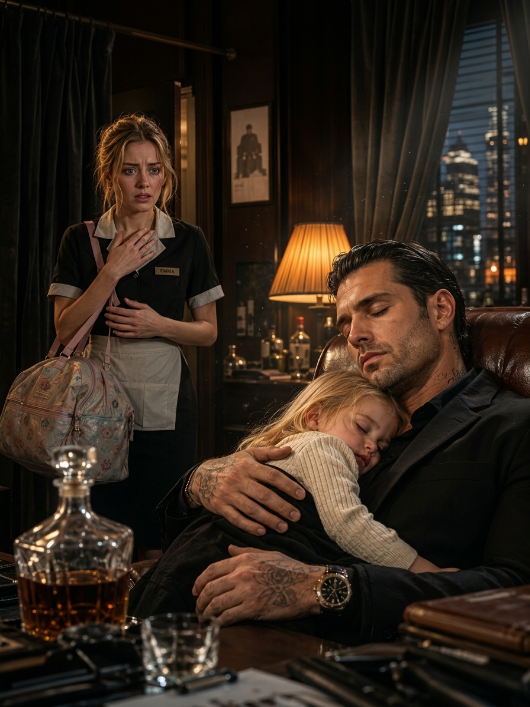
“Don’t Expect Love From Me,” the Mafia Boss Said—Then He Fell for Her Completely

## PART 1
The tip was the first strange thing.
Two hundred dollars, tucked beneath an empty espresso cup.
I stood at table nine holding the cup and staring at the folded bills like they might rearrange themselves into an explanation. The man who had left them was already gone — he and his two security guards had walked out of the Blue Hour Café four minutes ago, and the door had sealed behind them with the same quiet certainty that everything in his orbit seemed to carry.
“Close your mouth, Rosie,” said Dev from behind the counter.
I closed my mouth.
The café had been loud before he came in. The usual Tuesday afternoon noise: the grinding of the machine, the clatter of cups, the ambient conversation of students and freelancers who treated our back tables like private offices. When the door opened, the noise did not stop exactly. It tapered. Like a room full of instruments dropping one by one out of a melody, until only the espresso machine remained, hissing steam at nothing.
His name was Luca Ferrante.
I did not know it then. Dev told me after, his voice low and carrying the particular pitch of someone narrating danger from a safe distance.
“The Ferrante family,” he said, watching the window long after the black car had pulled away. “They own property in every neighborhood in this city and businesses nobody writes about in the news. Three generations.”
I was still holding the money.
“What kind of businesses?”
“The kind that don’t need to advertise.”
I had heard rumors, the way everyone who lives in a city long enough hears things. Buildings changing hands overnight. A councilman who reversed his position on a zoning vote with no public explanation. A competing restaurant that had a sudden, unrecoverable health inspection. The name Ferrante appeared nowhere in any of these stories. That, I would come to understand, was the point.
At the time, I filed it under: not my problem.
The two hundred dollars went into the communal tip jar. My hands stopped shaking by the end of the shift.
I had served him a doppio espresso with a small pour of oat milk — not almond, he had corrected me gently, with the patience of someone accustomed to being disappointed but not inclined to make theater of it — and a glass of still water on the side. He had watched me prepare it from the counter, which almost no one did, and when I set the cup down he had looked at it for a moment before looking at me.
“You’re new,” he said.
“Covering for someone.”
His eyes were dark and entirely focused, the kind of eyes that had learned to read rooms as a professional practice rather than a social skill.
“What’s your name?”
No one asked for the servers’ names at the Blue Hour unless they were regular customers working on being regulars. He was not regular. He was, based on every signal in the room, exactly the opposite of regular.
“Rosie,” I said. “Rosie Callahan.”
He nodded once. Said nothing else. Turned back to his phone.
I retreated to the counter and told myself the interaction meant nothing.
I was still telling myself that three days later, when the door opened near closing time and he walked back in alone, rain darkening the shoulders of his coat, and set a small silver bracelet on the counter in front of me.
My bracelet.
My grandmother’s bracelet, the one with the tiny bird charm that I had worn every single day for six years without removing, which I apparently had removed at some point in the past seventy-two hours without noticing.
I reached for my wrist reflexively. Bare.
“It was near my table,” he said. “One of my men found it.”
I picked it up carefully. The clasp was intact. The charm was fine. My hands had started doing the shaking thing again.
“Thank you,” I said. “I didn’t even realize.”
“Family piece?”
“My grandmother’s. She died three years ago.”
Something shifted in his expression. Almost imperceptibly. The kind of movement you only catch if you have been watching closely, and I had been watching closely, which I would later identify as the beginning of the problem.
“Things like that should be looked after,” he said.
“I know. I’m sorry. Thank you.”
“You’re closing alone.”
It was not a question. He had looked around the café when he came in and done some rapid accounting that I did not interrupt.
“My manager left early.”
“Walk carefully,” he said. “The blocks between here and the residential buildings are poorly lit on the east side.”
Then he left.
I stood at the counter for a full minute after the door closed, my grandmother’s bracelet in my fist, thinking: he knows which direction I walk home.
That thought should have landed as a threat.
It landed as something considerably more complicated.
The envelope arrived the following morning.
Under my apartment door, cream paper, a wax seal stamped with a capital F in a clean serif font. Inside, a card in handwriting that was precise and slightly formal, the way handwriting looks when someone learned it from deliberate practice rather than convenience:
*Rosie,*
*I require a private barista for a dinner gathering this Saturday. Your manager has agreed to the arrangement. A car will collect you at seven. Dress accordingly.*
*L. Ferrante*
No question mark. No please. The words *your manager has agreed* carrying the full weight of a done deal, presented as information rather than request.
I sat on the edge of my bed and read it three times.
Dev had, apparently, already been called.
*Sorry*, he texted when I sent him a photo of the card. *He’s paying your rate times four. I couldn’t really—*
I did not finish reading the message.
Four times my rate would cover the month of expenses I had been quietly rearranging in my head since the heating bill arrived. It would cover two months, carefully managed.
I put the card on my kitchen table and made coffee and sat with the decision for the length of time it took to drink it.
Then I typed one word back to Dev.
*Fine.*
I did not know, folding the card and tucking it into the drawer, that the word *fine* had just opened a door I would spend the next several months walking through in increasingly unfamiliar directions.
I did not know that by Saturday evening, I would be standing in a kitchen that cost more than my building, making espresso for men who spoke in low voices about things that weren’t coffee.
And I did not know that in three weeks, on a rooftop above a city of lights, Luca Ferrante would say the words *tell me to stop* and wait with absolute patience for my answer.
But Saturday was coming regardless.
And I had said fine.
—
## PART 2
The car arrived at precisely seven, as promised.
Black, tinted, the kind that announces itself by the specific absence of anything identifying. The driver said nothing when he took my bag. Said nothing during the forty-minute drive through neighborhoods that grew progressively quieter and more expensive as we moved toward the edge of the city.
The house was built into a hillside, glass and pale stone with the bones of something much older underneath. Lights ran along the paths through grounds I could barely see in the dark, leading toward an entrance that was deliberately understated — no columns, no gates, just a door that opened before I reached it.
A woman named Vittoria showed me to the kitchen.
It was the kind of kitchen that made me, who had worked behind espresso machines since I was seventeen, feel genuinely respectful. Everything designed for function first, beauty as a consequence. A Slayer machine in the corner with the Sicilian blend already labeled and waiting, just as Dev had described his preferences to me that morning in a rapid, nervous briefing that had included the phrase *whatever he asks for, just do it correctly the first time.*
I set up my station.
The guests arrived in small groups, all men, all wearing the careful expression of people in rooms where what is said matters. They came to me for coffee with the brief acknowledgment of people accustomed to staff, and I gave them excellent espresso without making conversation, and I heard enough to understand the shape of the world I had entered without understanding its specific geography.
Luca moved through the room like the point around which everything organized itself.
He came to my station once, near the end of the evening, and took a cup from me without the formality he used with his guests.
“Adequate?” I asked, before I could stop myself.
“Perfect,” he said. Then: “You’re not uncomfortable.”
“Should I be?”
His eyes held mine for a moment.
“Most people are.”
“Most people don’t know where to put their hands when they’re nervous. I have a machine to tend. It helps.”
He looked at me with the expression I would come to recognize as genuine attention — not the performance of listening but the real thing, the kind that arrives rarely and registers in the body.
“Your rate will be transferred by morning,” he said. “I’ll be in touch.”
He returned to his guests.
At midnight, when the last car pulled away from the grounds, Vittoria appeared with my coat and the driver waiting at the door.
In the car, I pressed my palm flat against my thigh to stop the trembling, watched the city lights rearrange themselves through the glass, and understood that *I’ll be in touch* had not sounded like a professional courtesy.
It had sounded like a fact.
My phone lit with a message from an unknown number at 12:43 AM.
*The coffee was the best I’ve had in this city. Three mornings a week, if you’re willing. Same terms.*
I read it twice.
Then I read it a third time, because the second reading had not settled the flutter in my chest the way I needed it to.
I typed back: *When do I start?*
The answer came in under a minute.
*Monday. Seven a.m. Dress for comfort, not occasion.*
I set my phone face-down on the seat and watched the dark move past the window and thought: I should ask more questions before agreeing to things.
Monday arrived before I did.
—
## PART 3
### What Three Mornings a Week Looked Like
The penthouse was on the thirty-first floor of a building in the financial district whose lobby smelled of cold marble and deliberate quiet. The security guard checked my name against a list each morning with the same brisk nod, the same key card slid into the private elevator’s panel, the same soft mechanical ascent.
Luca’s penthouse was nothing like the hillside house. Where that had been warm materials and organic shapes, this was precision: white walls, concrete floors, furniture that looked like it had been selected by someone who understood that a chair could make an argument. Floor-to-ceiling windows looking out over the harbor. Everything controlled, including the light, which came from fixtures designed to replicate certain hours of the afternoon regardless of actual weather.
The kitchen was stocked before I arrived each morning. The espresso blend labeled. Whole oat milk in the refrigerator. A glass always prepared with still water.
Some mornings he was there, working at the long dining table with papers and a laptop and his phone propped in a stand, speaking occasionally in Italian to someone I never saw. On those mornings, he said good morning when I arrived and nothing else until the coffee appeared at his elbow, at which point he would say *thank you* in a voice that sounded like he meant it specifically.
Some mornings he had already left, and I made coffee for whoever came to the penthouse for meetings, men and occasionally women who regarded me with the neutral assessment of people deciding whether I was relevant, always concluding I was not, which suited me fine.
I learned his patterns the way you learn the topography of a place you visit regularly. He worked in silence for the first hour. He read at the table rather than at a desk, books propped against whatever was nearest — history, mostly, and philosophy, and one volume of Portuguese poetry I saw him return to several times. He did not eat breakfast but ate lunch punctually at noon, always something his housekeeper had prepared rather than ordered in, which struck me as specific.
He was courteous with me in a way that felt deliberate rather than reflexive. The questions he asked were not small talk. He wanted to know about my grandmother, about the years she had raised me after my parents died when I was nine. He asked about the English degree I had finished and never used, about what I had wanted to do with it before wanting things had become less urgent than paying rent.
“I thought about teaching,” I told him once. “Before I understood what teaching paid.”
“What stopped you besides money?”
I considered it. No one had asked me that version of the question before.
“I’m not sure I have enough patience for people who don’t want to learn,” I said finally. “I have a lot of patience for people who do. But the other kind wears through me fast.”
He looked at me over his coffee cup.
“That seems self-aware,” he said.
“It took me a while.”
In these fragments, across three mornings a week, a shape emerged. Not friendship exactly — the architecture was wrong for that, the power differential too visible, the silence between us too considered. But something real, something that did not fit the word *employer* any better than it fit the word *friend*.
I did not ask about his business.
He did not volunteer.
I heard enough in passing to understand the contours without needing the map — property, influence, old family structure, the particular respect that accrues to people who have been powerful long enough that power itself has become a kind of tradition. I heard the name Cattaneo once, in a tense call conducted at the kitchen doorway while I pretended to be absorbed in cleaning the steam wand, and I filed it the way I had learned to file most things in that apartment: present, noted, not mine to pursue.
It was on a Wednesday morning, five weeks in, that I made the mistake of asking about his bruised hand.
He had come in later than usual. The bruise across his knuckles was three days old at minimum, fading at the edges into yellow-green. He sat at the table with papers and did not look up when I set his coffee down. I noticed the hand when he reached for the cup.
“That looks like it hurt,” I said.
He looked at it.
“A disagreement,” he said.
“Did the disagreement win?”
Something moved across his face. Not quite a smile but in the neighborhood of one.
“No.”
“Good,” I said, and returned to the kitchen, and spent the rest of the morning wondering why I had said *good* as though I had a stake in the outcome.
He followed me into the kitchen twenty minutes later.
“Why good?” he asked.
“Because you seem like someone who usually knows what he’s doing,” I said, which was honest and more revealing than I intended.
He stood at the kitchen doorway with his arms folded and looked at me for a moment.
“You’re not afraid of me,” he said.
“I’ve been afraid of you,” I clarified. “I’m less afraid now.”
“What changed?”
“I learned your coffee order. People who take their coffee a specific way and don’t make a production out of it when it’s wrong are usually manageable.”
This time the almost-smile became an actual one, brief and genuine, and I understood in that moment why people found it so disarming — it arrived like something he had not planned to give and did not quite know what to do with once it appeared.
“That’s the strangest metric I’ve encountered,” he said.
“It’s served me well.”
He went back to his papers. I cleaned the machine. We did not speak again that morning, but something in the quality of the silence had changed, like a room after a window opens.
—
### The Envelope
I arrived on a Thursday to find the penthouse empty except for a note on the kitchen counter.
Not an envelope this time. Just a page torn from something, his handwriting in black ink.
*Rosie — called away. Back by the weekend. I need you to deliver the attached to the address below. 2:00 pm today. Come alone. The man’s name is Bernardo. Tell him it’s from me.*
Attached was a sealed envelope, smaller than a paperback, closed with a wax stamp.
I stood at the counter and held the note and the envelope and thought about the clear line I had drawn in my mind between what I was hired for and everything else.
This was everything else.
I also thought about the fact that he had written *I need you to*, which was different from *I require you to* or *please deliver*, and that the difference was probably not accidental.
At 1:50 I was in a taxi heading to an address in a neighborhood I did not know well.
The restaurant was called Soletta and had the look of a place that had been successful a long time ago and found a sustainable level of dignity in the years since. A man with a gray beard and the careful eyes of someone who had spent decades reading rooms looked up when I came in.
“We’re closed,” he said.
“I have something from Luca Ferrante.”
His expression changed. Not dramatically, but the assessment behind his eyes shifted from neutral to engaged.
“This way,” he said.
He led me to an office at the back where he read the contents of the envelope with a stillness that reminded me of Luca — the same quality of absorbing information without performing a reaction to it.
“Tell him Bernardo agrees,” he said finally. “And that he has interesting taste in couriers.”
I was already turning toward the door when he spoke again.
“Signorina.”
I looked back.
“The Ferrante boy has been trying to change things for three years.” He folded the papers carefully. “It is slow work. Dangerous work. The people who resist change in families like his do not do so politely.”
He looked at me with the directness of someone who had decided I could handle the truth.
“He needs people around him who are not afraid of what he is. But who also understand what it costs.” A pause. “You seem like you might be one of those people. I wanted you to know the context.”
I thanked him and left.
In the taxi back, I turned the conversation over in my mind. *Changing things.* The bruise on his knuckles. The name Cattaneo, spoken with the particular tension of an ongoing problem.
I understood more than I was supposed to.
—
### The Rooftop
He came back on Saturday.
I was not scheduled to work Saturdays. I had nevertheless been awake since six, which I noted with the private irritation of someone who had not yet admitted to themselves why.
My phone buzzed at two in the afternoon.
*Rooftop. If you’re free.*
The if you’re free was new.
I took the private elevator to thirty-one and then the stairs to the roof, which opened onto a terrace garden that somehow existed forty floors above the street — herbs in raised planters, a small table, two chairs, and a view of the harbor that made the city look like something you could put your hands around.
Luca was at the edge of the terrace looking out at the water.
When he turned, I saw the bruising on his jaw.
“Business disagreement again,” I said before he could frame it differently.
“Yes.”
“Is the business going to keep disagreeing with you?”
“For a while,” he said. “The Cattaneo family doesn’t adapt easily. They consider what I’m attempting a betrayal.”
“What are you attempting?”
He gestured to the second chair, and we sat. He poured wine from a bottle already open on the table — something dark and considered, the kind of wine that had been chosen rather than grabbed.
“Legitimate operations,” he said. “Property, development, hospitality. Real businesses that stand without the architecture my family built underneath them.” He turned the glass slowly in his hand. “My father built the Ferrante name on things I cannot defend. I can maintain them or I can dismantle them. I’ve been choosing dismantling for three years.”
“And Bernardo?”
He looked at me.
“He told you.”
“He told me the context. He said you needed people who understood what it costs.”
Luca was quiet for a moment.
“Bernardo was my uncle’s consigliere. He’s the most respected living figure among the old families in this city. His endorsement of what I’m building buys me the time to build it.”
“And the envelope was—”
“Documentation of the first fully legitimate hotel acquisition under the new structure. No laundered capital. No protection involvement. A real transaction, verifiable, with clean provenance.”
He said it simply, with none of the weight a man performing his virtue would have given it. Just information. Just the truth about where he was and what it had taken to get there.
“That’s why Cattaneo is fighting you,” I said.
“He benefits from the old structure. Most of the old families do. Transparency is an existential threat to what they’ve built.”
I drank my wine. Around us, the city hummed forty floors below, indifferent to the specifics of anyone’s transformation.
“Why did you ask me to deliver it?” I said. “You have people.”
“Bernardo wouldn’t have trusted them. He was assessing what I’m becoming, not just what I’m doing. An ordinary courier would have told him nothing.” He turned to look at me directly. “You told him something.”
“I barely said a word.”
“You arrived alone. You were calm. You didn’t perform composure, you had it. In his world, that reads.” He paused. “I knew it would.”
The evening had gone golden while we talked, the harbor catching the last light in long horizontal strips. I thought about what Bernardo had said: *He needs people around him who are not afraid of what he is.*
I thought about the question I had been not-asking myself for five weeks.
“I called you a man with a complicated business,” I said. “To myself, in my head. When I was deciding whether to take the Saturday job.”
“That’s accurate.”
“It wasn’t meant charitably.”
“I know.”
“But the complicated part isn’t what I thought it was going to be.” I looked at my hands on the table. “I thought complicated meant I would spend time in rooms where bad things got organized. Instead I’ve spent five weeks making coffee for a man who reads Pessoa at his kitchen table and takes his grandmother’s recipe pasta to meetings because he finds catered food dishonest.”
He was very still.
“That last part was specific,” he said.
“I notice things.”
“Yes,” he said. “You do.”
The silence that settled between us had the quality of the moment before something changes — not tense exactly, but charged, a held breath.
“Tell me if this isn’t—” he started.
“It’s not,” I said. “I mean, it is. That’s the problem.”
He reached across the table and his hand covered mine, warm and still.
“I warned you,” he said. “About what I can and can’t offer.”
“You said don’t expect love from you.”
“Yes.”
“I think,” I said carefully, “that was something you needed to say rather than something that’s actually true.”
For a long moment, he looked at me with the expression I had catalogued on those three mornings a week — the genuine attention, the one that arrived rarely. Then he turned my hand over in his, palm up, his thumb resting against my wrist where my grandmother’s bracelet sat.
“If I’m wrong about what I can offer,” he said quietly, “you would be the person I was wrong about it for.”
It was the least romantic declaration I had ever received and somehow the most honest.
“The city is going to keep being complicated,” I said.
“Yes.”
“And Cattaneo.”
“Will be resolved. One way or another.”
“I don’t need to know the details of that.”
“No,” he agreed. “You don’t.”
I looked out at the harbor, at the city lights beginning to appear in the early dark.
“I’m going to need a better job title,” I said. “Barista stops fitting after a certain point.”
He turned to look at me with something in his expression that I would take a long time getting used to — the warmth underneath the control, visible when he chose to let it be.
“What did you have in mind?”
“I’ll think about it,” I said.
He did not push. That was one of the things I had come to understand about him — the patience was real, not strategic. He had learned to wait because most things worth having required it.
We stayed on the rooftop until the city fully lit itself against the dark.
—
### Sicily
Three weeks later, there was another envelope under my door.
This time I recognized the wax seal immediately. Inside: a travel document and a brief note in his handwriting.
*My family’s house in Sicily. I’d like you to see it. One week, no obligations. A car will come Sunday at noon. Come or don’t — the choice is entirely yours.*
The *come or don’t* sat with me for two days.
I went.
The drive from the airport took an hour through coastal roads where the Mediterranean appeared and disappeared between hills. The house was not what I expected — not the modernist precision of his city life, but something older, stone-walled and jasmine-covered, built into a hillside that had been in his family’s possession for four generations.
A woman named Agata made me breakfast on the terrace and told me, unprompted, that she had worked for the Ferrante family for thirty-two years and that Luca as a child had been the one who fixed the hinge on her kitchen cabinet every time it broke, which he did approximately once a season from age eight until he left for university.
I filed this piece of him carefully.
He arrived that evening.
Not in a suit. Linen trousers and a dark shirt with the sleeves already rolled, and for the first time since I had known him, he moved into a space without the particular quality of assessment I had come to associate with every room he entered. Here, he did not need to read the room. Here, he already knew it.
We sat on the terrace until after midnight.
He told me about the version of himself he had been at nineteen, studying literature, believing he might spend his life in universities. He told me about his cousin’s death and the morning he had left school and the long process by which he had understood that his life would be something other than what he had planned — not as a tragedy but as a fact, and then eventually as a choice, because there had been a moment, years in, when he could have walked away from it all, and he had not.
“Why not?” I asked.
“Because the people depending on the Ferrante name wouldn’t have survived the vacuum,” he said. “And because I thought I could change it from inside more effectively than abandoning it and watching someone else inherit the damage.”
“Do you still think that?”
“I think I’m three years into a ten-year process,” he said. “I think Bernardo’s support means the next phase is possible.” He looked out at the sea. “I think the answer to your question depends on whether I can protect the people close to me while I do it.”
The *people close to me* landed specifically and he let it.
“I don’t need protecting,” I said.
“I know.” He turned to look at me. “I need to not cause you harm. That’s different.”
“Is it?”
“Protection is something you do to someone. Harm avoidance is something you do for them.” He said it without drama. “I’ve spent enough time around people who confused the two.”
The night was warm and the sea was visible from the terrace as a dark movement at the horizon, audible below the jasmine and the silence.
“Bernardo told me you need people who aren’t afraid of what you are,” I said.
“He said that?”
“He also said it costs something.”
Luca was quiet for a moment.
“Everything does,” he said finally. “The question is what you’re willing to spend it on.”
I reached across the table and put my hand over his, reversing the gesture he had made on the rooftop.
He looked down at it, then up at me.
“I’m not offering normal,” he said. “I want to be clear about that.”
“I’m not asking for normal,” I said. “I’m asking for honest.”
“Honest I can do.”
“Then we’re fine.”
He turned his hand over and held mine, and we sat like that for a long time while the Mediterranean moved somewhere in the dark below us, and the jasmine kept doing what jasmine does regardless of what people decide on terraces above it.
—
### What Came After
The ten-year process took closer to six.
Three years after Sicily, the Cattaneo challenge collapsed — not through violence, in the end, but through the systematic removal of the financial structures that had made their position tenable. Luca had been patient and thorough and had leveraged Bernardo’s network with a precision that I, by then working as the Ferrante organization’s legal compliance director, had helped design in the structural details if not the broader strategy.
The title had been my invention, which Luca had accepted without negotiation.
*You need someone who understands both sides of what you’re building*, I had said. *Internal and external. Someone who can document the legitimate operations in a way that protects them and make sure the rest gets managed down cleanly.*
*Do you want to be that person?*
*I want you to ask me properly*, I had said. *With a job description and a salary and no ambiguity about what it involves.*
He had laughed. The real kind, the one that arrived before his control caught it.
I had started Monday.
We were not always easy. He had spent decades building walls and I had spent the same time learning to work around structures that weren’t meant to admit me, and the combination produced friction that was occasionally productive and occasionally exhausting and required, on the worst days, the kind of conversation that neither of us defaulted to naturally. But we had made the agreement on that terrace — honesty — and we kept it, not perfectly but with genuine effort, which turned out to be enough.
On a Sunday morning three years after Sicily, in the same terrace garden where we had first sat with wine and careful truth-telling, he put his grandmother’s ring on the table between us.
No velvet box. No speech. Just the ring, and: *What do you think.*
I had laughed.
“You couldn’t get that right if you tried,” I said.
“I know. I wasn’t going to try.”
“Say the actual question.”
He picked up the ring and held it out.
“Rosie Callahan,” he said, his voice doing the thing it only did in private, warm and unguarded and entirely for me, “will you stay.”
It was the same question he had asked that first morning in Sicily, in a different form, with all the intervening years folded into it.
I took the ring.
“I’ve been staying,” I said. “Keep up.”
He put it on my finger and we sat in the terrace garden for a long time while the city moved below us, unchanged and changing, full of its old complications and its new ones and all the work still left to do.
My grandmother’s bracelet was on my wrist, where it had been every day for nine years.
The tiny bird charm caught the morning light.
I thought about a Tuesday afternoon in a small café, a man walking in who changed the temperature of a room without trying, a tip that was more than tips were, a question asked in a low voice with the faint trace of somewhere old underneath it.
*What’s your name?*
The first strange thing.
The first in a long sequence.
*Rosie*, I had said. *Most people call me Rosie.*
And he had nodded once, as if filing it somewhere permanent, and turned back to his phone.
I had not known, carrying empty cups back to the counter, that he already had.
**THE END.**
—
—