His Pregnant Mistress Sent Me a Gift Basket in My Hospital Bed, Calling Me “The Previous Chapter” — I Put My Wedding Ring Inside It

—
PART 1
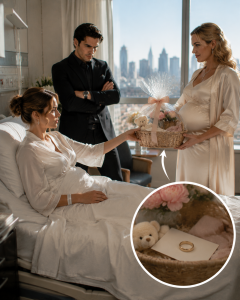
My husband, Graham Whitaker, stood beside the window in a charcoal suit that probably cost more than the monthly salary of half the people keeping me alive. He smelled like bergamot, expensive wool, and a woman’s perfume that did not belong in a room where I was still attached to an IV. His fingers tightened around the metal bed rail when he saw the envelope.
“Do not read it out loud,” he said.
So I did exactly that.
My abdomen burned beneath the surgical dressing. The operation had been urgent, messy, necessary — I had collapsed in our kitchen, and a surgeon had told me the mass was benign, but the damage was not small.
“To The Previous Chapter,” I read, my voice so calm even I nearly failed to recognize it. “Wishing you a graceful recovery. Graham deserves a future that does not smell like hospital sheets, disappointment, and unfinished dreams. Rest well, Madeleine. Some women are meant to be remembered. Others are meant to be chosen.”
The nurse froze. Graham whispered, “Maddie.” He did not deny anything.
That was when I understood something pain teaches better than love ever can. Betrayal is rarely sudden. It is prepared in quiet rooms. It wears fragrance. It practices tenderness in advance. It waits until you are too weak to be rude.
I placed the card on the blanket and smiled at it. Then I asked the nurse for a pen.
Her name tag said Alana. “Mrs. Whitaker, I can remove this if you would prefer.”
“No,” I said. “Leave it where my husband can see it.”
I was thirty-eight, married nine years to a hotel heir business magazines called visionary because they’d never seen him apologize. He had held my hand after I woke from anesthesia. Kissed my forehead. Told me I looked beautiful, a strange thing to say to a woman with cracked lips and blood drying beneath a bandage. Then he’d taken calls in the hallway. Investors, he said. Architects. His father.
Now I knew one of those calls had been from Celeste Ray — twenty-nine, honey-blond, an interior designer Graham had hired to redesign the lobby of his new luxury hotel. That was the official story. The unofficial story had arrived in a white wicker basket with orchids and cruelty.
“Maddie,” Graham said, softer now. “You are medicated. This is not the moment to make a scene.”
A scene. I had stitches inside my body. His pregnant mistress had sent me a floral announcement for the death of my marriage, and he was worried about manners.
“How long?” I asked.
“This is not the time.”
“That means long enough.”
“You have been through a lot,” he said. “We both have.”
“We?”
“I mean the marriage.”
There it was. The beginning of the speech I imagined him practicing with Celeste in some hotel suite. Tell Madeleine he’d been lonely. Mention the treatments. The miscarriages. The distance. Turn adultery into a sad little boat that drifted because the shore had failed to wave hard enough.
“I did not want you to find out this way,” he said.
“How considerate.”
“What happened with Celeste—”
“Happened?”
“The relationship.”
The word sat down like an invited guest.
“She was not supposed to contact you,” Graham said. “Because I planned to tell you when you were stronger.”
“How romantic. A betrayal with discharge instructions.”
He flinched. Good. Not enough.
“I care about you,” he said. “But we have to be honest about what we became.”
“What did we become?”
He looked at the basket. “Different people.”
No, I thought. I became sick. You became available. I did not say it aloud. Silence, used properly, can be sharper than screaming.
I looked down at my left hand. The ring had always been slightly too grand for me — a square emerald-cut diamond he’d chosen himself because, he said, it reminded him of me. *Classic. Beautiful without trying too hard.* I had believed him then. I had believed most things then.
“Hand me the basket,” I said.
“Maddie, you need to rest.”
“I need many things. Rest is no longer at the top of the list.”
He lifted the basket and set it across my lap. The ribbon slipped sideways, revealing a small silver tag embossed with Celeste’s logo. A woman who decorated homes had sent a gift to help dismantle mine.
I slid the ring from my finger.
His breath changed. Not a gasp — men like Graham didn’t gasp — but something in him faltered. He had expected tears, anger, bargaining, the wounded dignity of a wife asking what Celeste had that she didn’t. He had not expected me to make the choice before he did.
“Maddie,” he said, low. “Don’t do that.”
I placed the ring inside the basket, nestled between the honey jar and the almond biscuits.
“Return it to her.”
“What?”
“Return it to her. Since she is so fond of chapters, let her have the punctuation mark.”
“That ring belongs to you.”
“No,” I said. “It belonged to a marriage that no longer exists.”
He said Celeste was pregnant. Twelve weeks. I counted backward without meaning to — a charity dinner in March, Graham “late from Chicago,” Easter at his mother’s house where he’d rested a hand on my shoulder while I answered questions about why we still didn’t have children.
“Were you going to tell me before or after the baby shower?”
“That is not fair.”
“No. It is not.”
“What do you want from me?” he finally asked.
Nine years of marriage. Four years of fertility appointments. Two miscarriages. One failed adoption inquiry that ended when “the timing was too complicated.” And now, after all that, he wanted a request.
“I want you to leave,” I said. “Take the basket. Take the ring. Go to Celeste. Tell her she misjudged me.”
“In what way?”
“She thought I was the previous chapter because she had reached the next page. She does not understand the book was never hers.”
He left without another word. The door closed softly. That was the cruelty of expensive hospitals. Even the endings were quiet.
—
PART 2
By evening, I had managed three spoonfuls of broth and one decision. I called my brother.
“Graham has been having an affair,” I told Julian. “She is pregnant. She sent a gift basket to my hospital room.”
“I am coming.”
By morning he arrived carrying coffee I couldn’t drink and croissants I couldn’t eat, looking like he’d slept in his clothes because he had. When his thumb passed over the empty space on my ring finger, he stopped.
“I put it in the basket,” I said.
“Please tell me Graham was holding it at the time.”
“He was.”
“Good.”
My mother-in-law, Evelyn Whitaker, arrived not long after — composed, gloved, carrying no flowers. “Madeleine, I came as soon as Graham told me you were awake.”
“Then Graham told you late,” Julian said.
Evelyn asked to speak with me privately. I said no. “Graham has made a serious mistake,” she said. “But decisions made in distress often create consequences one regrets.”
She mentioned the hotel opening, the foundation gala, the press. I told her plainly: “You came here to protect the family name. I was only ever considered part of it when convenient.”
Then, unexpectedly, she reached into her coat and produced a cream envelope. “I did not come to fight. I came to give you this. Information you should have had years ago. About Graham.”
Inside were three items: a folded letter, a photocopy of an old medical invoice, and a photograph — Graham at twenty-one or twenty-two, unguarded and unvarnished, his arm around a young woman with dark curly hair. On the back: *G and L, Maine, August.*
The letter, in Evelyn’s hand, was dated that day.
*Before Graham married you, he was engaged unofficially to a woman named Lila Hart. She became pregnant. Richard handled the matter. Graham was told she chose to leave. I was told there was no child. I later discovered that may not have been true. Graham does not know what I know. If Celeste is pregnant, Richard will move quickly. He will not protect the woman. He will protect the Whitaker name. Do not assume Graham is the only person making decisions.*
The medical invoice read: *Lila Hart. Prenatal consultation. Portland Women’s Clinic.* Dated a little more than twenty-two years earlier — a fact I only understood the full weight of later.
“Graham might have a child,” I said.
That evening, a courier delivered a padded envelope addressed not to Mrs. Whitaker, but to Madeleine Vale — my maiden name, reclaimed before I’d even signed a document. Inside: a photograph of a young woman, mid-twenties, on a rocky beach, dark curly hair, a broad smile, and Graham’s eyes. And a note, written in a hand I didn’t yet recognize as Lila’s own, though the words were unmistakably a mother’s.
*Your husband was told I disappeared. He was not told who made me run. Ask Richard Whitaker what he offered the doctor the night I gave birth.*
Later, when I finally spoke to the young woman in the photograph, she would tell me she had sent the envelope herself, on her mother’s behalf, because Lila’s hands had grown too unsteady to trust a courier form. “She dictated every word,” the young woman said. “I only carried it.”
Graham stared at the photograph as if I’d removed an organ and laid it among evidence. “Who sent that?” he asked, and his voice had changed. It was no longer the voice of a husband managing consequences. It was the voice of a son realizing the house he’d inherited might have been built over someone else’s life.
—
PART 3
Graham confessed what little he knew, haltingly, over the following hour. Lila Hart had painted sets for a summer theater in Maine. She’d had blue paint on her wrist and told him his shoes were too clean for a man pretending to like art. She hated how the Whitakers spoke in codes — *every Whitaker sentence comes with a locked drawer,* she used to say. She’d told him once that if he ever became like his father, she wouldn’t stay to watch.
Then she got pregnant, and Richard told Graham she was trying to trap him, and lawyers appeared, and Lila stopped answering his calls, and eventually his father told him she had ended the pregnancy and taken money to leave.
“Did you believe him?” I asked.
“I let myself believe him.” It was the most honest thing Graham had said since the basket arrived. Not because it excused him — it did not — but because it held no polish. He had chosen not to know, because not knowing let him keep going.
I understood that more than I wanted to. Had I not also chosen not to know? The late calls. The changed passwords. The faint perfume I told myself belonged to a hotel lobby.
“I need to find her,” Graham said. “Both of them.”
“Not tonight,” I said. “Not by calling your father.”
My lawyer, Sloane Mercer — silver-jawed, unshockable, once made a billionaire apologize in writing twice — arrived and laid down rules before anyone did anything rash. Photograph everything. Secure the originals. No calls to Richard. When Graham argued this concerned his family, Sloane said flatly, “Mr. Whitaker, that is precisely why I said it.”
The courier had been paid in cash at a Brooklyn dispatch office, no usable sender name. Sloane traced Lila Hart to an old lease in Portland, then a forwarding address in New Haven — then nothing under that name. She had changed it, at some point, to Nora Lane. Not the daughter. Never the daughter. Lila had become Nora — a woman who signed her letters simply *N.*, or later, more warmly, once she trusted the person she was writing to, *with care, always, Nora.*
I insisted on speaking to Celeste, over Julian’s objections. “I want to stop becoming like them,” I told him, and that quieted him, because that was the line, wasn’t it — the place where pain either makes a person honest or teaches them new ways to be cruel.
Celeste appeared on the video call in an oversized cream sweater, no diamonds, no lipstick, no champagne laugh — younger than I’d imagined, young enough to have mistaken being chosen by a powerful man for being safe.
“I owe you an apology,” she said. “The basket was unforgivable. I was angry and scared and humiliated… I thought if I made myself impossible to ignore, he would finally choose. It was childish and cruel.”
“You did not hurt me because you loved him,” I said. “You hurt me because you wanted proof that you mattered.”
“Yes,” she whispered.
She told us Richard had visited her two days earlier. He’d mentioned “a girl who once tried to use a pregnancy to secure a place in the family” — that he’d “handled it” — that Celeste should learn from her mistake. He’d offered her money to disappear quietly, and when she hesitated, he’d reminded her, almost gently, that he could produce a doctor willing to dispute the child’s paternity in any custody proceeding that followed, whether or not it was true. Celeste had not taken the money. Had not signed anything. But she was frightened in a way that made her voice go thin over the call, and I understood, watching her, that Richard had simply run the same playbook twice and expected the same silence twice.
“He said women like Lila always think changing their name makes them free,” Celeste recalled. “Then he said, ‘But paper follows people.'” She remembered a folder, a tab with a name she’d only glimpsed. “Harbor something. Harbor Lane? Harbor House?”
Sloane, listening from her square on the screen, made a note but said nothing yet.
Julian went very still. “Maddie. When Mom was sick — the hospice volunteer. The one who brought watercolor postcards. She signed them N. Later, once she trusted us, Nora.”
The memory surfaced in fragments: our mother in her last winter, a woman at the kitchen table with dark curls threaded gray, painted cards of lighthouses and gray beaches. My mother had never explained how she knew this woman, only that they’d met “through the clinic” years earlier, back when my mother still worked shifts as a maternity nurse at a Portland hospital before she retrained and moved into hospice work. I had always assumed it was an old colleague. I had never asked hard enough to learn it was a woman she had once helped disappear.
“Harbor Lane,” Sloane finally said, “isn’t a place. It’s a name. I’d bet the folder tab is the alias Lila used on the lease records — Nora Harbor Lane, or some version close to it, before she shortened it to Nora Lane. Richard has apparently been tracking every name she’s used for over twenty years.”
“I think Lila became Nora,” I said. “And her daughter is someone else entirely.”
—
That night, Julian retrieved the boxes of our mother’s things from the apartment I still shared, for now, with Graham. Tucked into the last postcard, beneath a corner of tape, was a folded receipt from a self-storage facility in Portland, and beneath that, in our mother’s hand, a phone number with no name attached.
Julian called it. A woman answered on the fourth ring, introduced herself only as a hospice colleague of our mother’s, and confirmed she still held one item our mother had asked her to keep, in case it was ever needed, “for Madeleine, when necessary.” She said she’d bring it to the hospital herself within the hour.
Inside the boxes, beneath birthday cards and a lemon cake recipe in our mother’s slanted hand, were the postcards — a decade of them, gentle and careful, a life documented in glimpses. *She started school today. Brave face, new shoes, no tears until the bus turned the corner. The sea was wild this morning. She asked if fathers can be stories. I told her sometimes, but stories can be rewritten. We are safe. That is still the miracle.*
On the last postcard, dated six months before our mother died: *If anything ever happens, tell Madeleine I was sorry I could not explain. One day, she may understand why silence protected more than one child.*
An hour later, our mother’s old colleague arrived at the hospital, exactly as she’d promised, carrying a small blue wooden box with a broken brass clasp.
Inside was a sealed lab envelope from a Portland fertility clinic, an older photograph, and a short unsigned note.
The photograph showed two men on a dock in Maine, arms around each other’s shoulders in the easy way of people who don’t yet know what one of them will cost the other. One was a much younger Richard Whitaker — unmistakable, even thirty years younger, the same square jaw Graham had inherited. The other was a man I did not recognize, laughing, sunburned, entirely unguarded. On the back, in the same hand as the postcards: *Richard came to the theater that August too. He told me Graham was ‘practicing,’ that it meant nothing, that a summer romance wasn’t worth protecting. I believed the child was Graham’s the whole pregnancy. Richard didn’t tell me otherwise. He waited until she was born, ran the test privately, and then used what he learned to control me instead of confessing what he’d done.*
The lab envelope held the paternity report, completed within weeks of the baby’s birth. Two names on it: Richard Whitaker. Lila Hart.
I sat with it for a long, ringing moment before I understood what I was holding.
Richard — not Graham — was the father of Lila’s daughter, a woman I would soon come to know as Maeve.
Every ugly piece rearranged itself at once. Why Richard had been so relentless about erasing Lila rather than simply managing an inconvenient grandchild. Why he’d threatened my mother into silence before my own wedding, needing Graham safely and permanently married before anyone could ask why the family patriarch had spent a summer in Maine paying such close attention to his son’s girlfriend. Why “Richard handled it” had always meant Richard controlling the story, not merely protecting it. He had let his own son believe, for over two decades, that he had a daughter he’d abandoned — because the truth, that Richard himself had fathered the child and let his son carry the shame to bury it, was a scandal even the Whitaker name could not survive twice.
Graham had spent more than twenty years quietly grieving a daughter who was, in fact, his half-sister.
Sloane, when I called her at midnight and read her the paternity report over the phone, was silent for three full seconds — the longest silence I ever heard from her.
“Well,” she said finally. “That’s the folder tab explained. And considerably worse than I’d guessed.”
What Richard had done to Graham explained some of the man he became. It did not excuse what Graham had chosen to do to me. I want to be clear about that, because it would have been easy, in the days that followed, to let Richard’s monstrousness make Graham look small and forgivable by comparison. He was not forgivable simply because someone in his family was worse. He had still let his mistress mail cruelty into a recovering woman’s hospital room. He had still waited for me to be weaker before telling me the truth. Whatever his father had done to him as a boy did not undo what he had done to me as a husband.
—
Richard Whitaker did not go quietly. He never had.
When Sloane, with my authorization, sent a formal notice requesting he preserve all records relating to Lila Hart and any related financial settlements, his response arrived within hours — not from him, but from three different law firms simultaneously, each claiming a different jurisdictional angle, each demanding the “malicious and unsubstantiated” allegations be withdrawn.
Graham read the notices standing in my hospital room, and something in his face went past shock into a kind of grief I hadn’t seen from him before — not for me, not even for himself, but for the version of his childhood he’d have to relive now with different furniture in every room.
“He let me think I had a daughter I abandoned,” Graham said quietly. “For over twenty years. Because it was easier than admitting what he’d actually done.”
“Yes,” I said.
“I have spent my whole life being ashamed of a mistake I didn’t make.”
I did not comfort him. I had run out of comfort to spend on Graham Whitaker, and besides, this grief was his to carry now, the way mine had been mine.
Two weeks later, once I was discharged and strong enough to sit through a meeting without an IV pole beside me, we found Maeve — twenty-two now, not the young woman glimpsed once in a photograph but a person with her mother’s directness and, Julian noted quietly, absolutely nothing of Richard’s face in her at all, which felt like its own small mercy. She was training as a marine biologist on the coast of Maine, the same gray water in every postcard her mother had apparently been sending mine, and then, after my mother died, occasionally sending no one at all, just keeping a private record of a life built without any Whitaker in it.
She had known, for years, exactly who her biological father was. Lila had told her the truth when she turned sixteen, because Lila — unlike every Whitaker in this story — believed silence should never be inherited past the person it was meant to protect.
“I didn’t send you those photographs to blow up your life,” Maeve told me, when we finally spoke, her voice steady in a way that reminded me she had grown up entirely outside the family’s gravity. “My mother dictated every word of that note. Her hands aren’t steady enough for that kind of thing anymore. I just carried it. She didn’t want to go without someone besides me knowing what Richard Whitaker actually did. She thought you deserved to know before it became a headline instead of a truth.”
Lila Hart — Nora Lane, to nearly everyone who mattered to her now — had stage-four ovarian cancer. She did not want money. She did not want an apology delivered through lawyers. She wanted the record corrected, quietly, permanently, in whatever rooms still controlled the Whitaker name.
Richard Whitaker’s empire did not collapse in a single dramatic hearing. It eroded the way these things actually do — a board member here, an investor there, a hotel opening quietly postponed, a foundation gala that suddenly needed “restructuring.” Sloane built the case methodically: the paternity report, the medical invoice, my mother’s letter, Celeste’s preserved messages, Evelyn’s written admission. It took months, not one triumphant afternoon. But it took.
Richard resigned from the board of the family holding company in the spring. He did not go to prison — the statute of limitations and the quiet, exhausting machinery of money saw to that — but he lost the one thing men like him actually fear losing: the story. The version where he was the visionary patriarch. Evelyn left him that same year, not out of any late-blooming courage, I think, but because staying no longer served any purpose she could name.
—
Graham and I did not reconcile.
I want to be honest about that, because I know what these stories are supposed to do — supposed to end with the wounded wife discovering some deeper truth that makes forgiveness inevitable, some grand villain who, once exposed, restores the marriage to its original shine. That is not what happened.
Graham had grown, in the space of a few terrible weeks, into someone more honest than the man who’d married me. He came to see me once the divorce was final, in a coffee shop instead of a hospital room, and he did not ask me to come back.
“I don’t think I know how to be married to someone without also managing them,” he said. “I learned that from watching my father manage everyone. I don’t want to learn how to stop doing that while you’re the one paying for my education.”
It was, possibly, the most self-aware sentence he had ever said to me.
“I hope you learn it anyway,” I told him. “Just not on me.”
He nodded. We did not hug. We did not promise to stay friends. Some doors close not because there was cruelty in the closing, but because there was finally, mercifully, nothing left to argue about.
Celeste did not have an easy time of it either, in the months that followed. Richard’s threat about the paternity dispute had cost her something — she told me later, in one brief and awkward conversation, that Graham had wavered for weeks, unwilling to fully commit to the child until he was certain no lawsuit would follow. It was, she said, the moment she finally understood what she’d traded her dignity for. She had her baby in the spring — a boy, innocent of every older Whitaker secret except for having been born into its aftermath, no longer employed by any Whitaker property, raising him in an apartment far from Madison Avenue. She sent me, of all things, a card. Not a gift basket. Just a card. *Thank you for not letting me become what I was trying so hard to be.* I did not write back, but I did not throw it away either.
I moved out of the apartment I’d shared with Graham and into a smaller one in Brooklyn Heights, with windows that caught the harbor light in a way that reminded me, not unkindly, of watercolor postcards. I went back to using my mother’s maiden name for everything that mattered — Vale, not Whitaker, not the previous chapter of anyone’s story but the current chapter of my own.
Maeve and I stayed in touch. Not as family, exactly — we had no obligation to invent a closeness neither of us needed — but as two women who had been quietly shaped by the same family’s silence and had each, in our own way, refused to keep carrying it. She sent me a postcard the following spring: a gray beach, the tide coming in steady and unbothered by any of it.
*Some days I still think leaving means losing,* she wrote, echoing her mother’s old words back across a distance neither of them had chosen. *Then I remember that staying would have cost us both more.*
I keep it on my windowsill, where the harbor light finds it every morning.
I healed. Not quickly, and not in the tidy arc hospital dramas promise — the surgery scar still aches in cold weather, and some nights I still reach for a ring that isn’t there. But I built a life that fit the size of the person I actually was, instead of the size the Whitaker name required me to shrink into.
The last thing I keep from that hospital room is not the memory of Graham’s face when I handed him the basket, or Evelyn’s envelope, or even my mother’s letter. It’s something smaller.
It’s Alana’s voice, steady and kind, the day she corrected my name without being asked.
*Ms. Vale, then.*
That was the moment the previous chapter ended, and mine — finally, entirely mine — began.
THE END