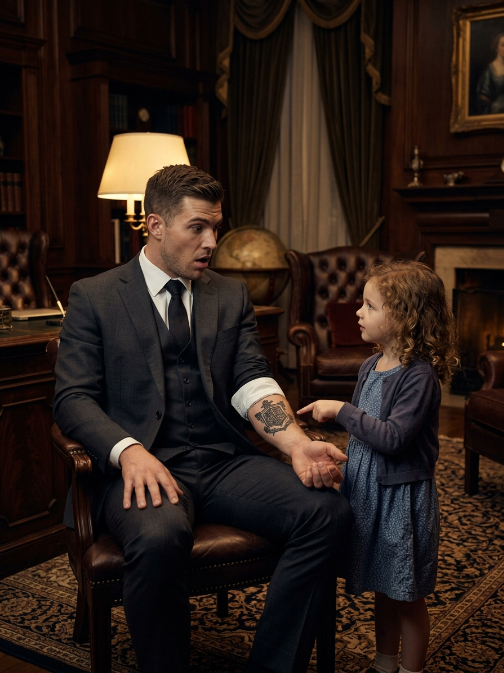
The Mafia Boss Rejected Every Beautiful Woman in Chicago—Until the Maid He Never Noticed Sang Behind a Locked Door

PART 1
The night Mara Shen almost lost her nerve, she was standing in a hallway she wasn’t supposed to be in, outside a door that wasn’t supposed to be open, holding a feather duster like it might protect her.
She had been humming without realizing it.
That was the thing about grief — it came out in whatever small sounds you made when you thought no one was listening. A song her mother had taught her. Nothing formal. Something June Shen used to sing over the kitchen sink in their apartment in Gloucester, Massachusetts, one hand moving through soapy water, the other keeping time against the counter. The kind of melody that lived inside a person not as memory but as reflex.
Mara had made it three weeks inside the Voss house without anyone looking at her directly.
She was good at that.
She was good at being useful and invisible in equal measure, which was a skill set that had taken years of financial terror to develop and which she was not above being grateful for now, working in a harbor-side estate that paid four times what the hotel laundry had. She kept her eyes down. She learned the schedule. She cleaned the rooms in the correct order. She did not ask about the cars that arrived after midnight or the conversations that stopped when she entered to replace the towels.
She did not ask whose house this was until her second day.
By then, she already knew.
So she kept her head down and sent money home to Gloucester every Friday and did not sing. Or she had not sung, until tonight, when she found herself alone in the east corridor with a linen cart and the particular, exhausting weight of having just received a phone call from her mother’s cardiologist — a kind voice explaining, very gently, the gap between what June’s insurance would cover and what the next surgery would actually cost.
The number sat in Mara’s chest like a stone.
She had started humming to stop herself from doing the math again.
She did not hear the footstep behind her.
“Don’t stop.”
Mara dropped the duster.
She spun and found herself approximately six feet from Callum Voss.
She had seen him from a distance. Everyone in the house had theories about the correct distance from which to observe him — close enough to receive instructions, far enough not to become one. He was taller than she’d registered from the hallway, broader through the shoulders, with the kind of face that had been arranged by genetics into something architecturally severe. Dark hair, the beginning of gray at his temples. Clothes that cost more than her monthly rent, currently worn with the disheveled focus of a man who had been working since before dawn and had simply not stopped.
His eyes were the problem.
Not threatening. Not warm, exactly. Something in between that had no comfortable name.
“I’m sorry,” Mara said. Her voice came out steadier than her body felt. “I didn’t realize anyone was—”
“I said don’t stop.”
She stared at him.
Callum Voss looked faintly annoyed, which she would learn later was as close to discomfort as his face allowed.
“You were singing,” he said.
“Humming.”
“Same thing.”
“It’s not.”
A pause, during which Mara registered that she had just corrected the most dangerous man in Boston over a minor musical distinction and waited to see what would happen.
What happened was: nothing. Or not nothing. He looked at her in a way that was different from the way powerful men usually looked at the hired help — which was to say, he looked at her at all.
Then he turned and walked back the way he’d come.
Mara stood in the hallway for a full thirty seconds before her pulse settled enough for her to pick up the duster.
—
His name was Callum Voss and he had grown up understanding that the world was divided into people who had leverage and people who needed it, and that the distance between those two categories was the only geography that mattered. His father had taught him this at eight years old by explaining the structure of a debt. His father had reinforced it at fourteen by showing him what happened to men who forgot which side they were on.
By thirty-seven, Callum had spent twenty years building the kind of empire that cities whispered about and newspapers refused to name directly. The harbor estate had come four years ago, after a negotiation that ended with three shipping contracts, one demolished competing operation, and a view of Boston’s inner harbor that cost as much as a small municipality.
Declan, who had served as Callum’s right hand for eleven years and had developed, over time, a detailed internal taxonomy of things that should worry him, noticed the change the morning after the hallway.
It wasn’t dramatic. It rarely was with Callum.
It was that Callum paused, in the middle of reviewing a container manifest, and asked: “The new housekeeper. What’s her name?”
Declan looked up from his tablet.
In eleven years, Callum Voss had never asked about the housekeeping staff. He had asked about weapons caches, political appointments, federal case timelines, import ledgers, and once, memorably, the exact depth of Boston Harbor at low tide. He had not asked about the people who polished his floors.
“Mara Shen,” Declan said carefully. “Twenty-six. From Gloucester. Temp agency placed her five weeks ago.”
Callum looked back at his manifest.
“Background?”
“Clean. She was working hotel laundry before this. She sends most of her pay home.” Declan paused, then added, because he had eleven years of reading the room: “Her mother is sick. Heart condition. She’s covering the bills.”
The manifest didn’t move.
But something in the room shifted, the way rooms shift when the person with the most gravity in them makes a decision they haven’t announced yet.
“Fine,” Callum said.
Declan had learned, over time, that Callum’s “fine” covered enormous territory.
—
Mara noticed him noticing and tried to make herself smaller.
This was difficult because Callum Voss had apparently decided she was worth noticing with the same complete, unhurried attention he applied to everything else, and the experience of being looked at that way by that person was, frankly, destabilizing.
He appeared where she was. Not intrusively. Not with any apparent design. He would simply be in the kitchen doorway when she was restocking shelves, or crossing the garden when she was cutting back the frost-damaged rosemary. He never spoke first. He looked at her long enough to make her heart do something irregular, and then continued on his way.
On the sixth day, she found him stopped in front of a portrait near the main staircase — a woman in a charcoal dress, dark-haired, painted with the careful realism of someone who wanted to get the face exactly right.
Mara had been meaning to polish the frame for a week.
She crossed toward it with her cloth before she remembered he was there.
“Sorry,” she said, pulling up short. “I can come back.”
“Don’t.”
She moved to the frame anyway, careful to stay out of his sightline. The portrait’s subject had a composed expression. Beautiful and sealed shut, like a letter written for a specific reader that had never been sent.
“She has kind eyes,” Mara said, before she could decide not to.
Callum was quiet.
“She looks like she knew things and chose not to say them.”
“Most perceptive people do,” he said.
Mara glanced at him.
He was looking at the portrait, not at her.
“My mother,” he said.
She stopped polishing.
“She died when I was eleven.” No grief performance. Just the flat shape of a fact that had been lived with for long enough to stop bleeding. “She used to sing in the kitchen. I haven’t thought about that in a long time.”
Mara looked at the woman in the portrait.
“My mother sings in the kitchen too,” she said. “She says it keeps the food honest.”
The corner of Callum’s mouth moved.
Not a smile. The architecture of one.
He left before she could say anything else.
That evening, Mara stood in the garden in the last gray light and looked at the harbor, and tried to sort through the feeling accumulating in her chest, which was complicated and inconvenient and probably a function of exhaustion and financial stress.
She told herself this firmly.
Then she heard the door behind her, and turned, and found Callum standing a few yards away looking at the water.
“You’re not afraid of me,” he said.
“I didn’t say that.”
“Most people can’t look at me the way you do.”
“How do I look at you?”
He was quiet for a moment.
“Like I’m a person.”
The words came out without weight, without self-pity, without anything that suggested he wanted comfort from them. Just an observation. A fact, catalogued and filed, like all his other facts.
Mara felt something tighten behind her sternum.
“You should go inside,” she said. “It’s getting cold.”
He looked at her then — fully, directly — and she understood in that moment that Callum Voss was accustomed to telling people what to do, and that she had just reversed the direction, and that he was not offended by this.
“How much does your mother’s surgery cost?” he asked.
Mara’s jaw tightened. “That’s not your concern.”
“It can be.”
“No.”
His brow lifted slightly.
“I didn’t come here to be someone’s problem to solve,” she said. “I came here to work.”
“Those aren’t the same thing.”
“They are when the offer comes from someone with your kind of resources. It stops being help. It becomes debt.”
The silence that followed was long enough that Mara started to regret her directness.
Then: “You’re right.”
She blinked.
“Charity and help are different,” he said. “I conflated them.”
He said it the way someone says something true that they hadn’t known they believed until they heard it out loud.
Mara looked at him in the dying light.
“Your mother,” she said carefully. “Did she know what your father was?”
“Yes.”
“And she stayed.”
“She loved him.”
“Did that help? At the end?”
A long pause.
“I don’t know,” Callum said. “I was eleven.”
The harbor moved behind them, gray and cold, the lights of the city beginning to come on.
“I’m sorry,” Mara said.
“Don’t.”
“I mean it.”
“I know you do.” He looked at her. “That’s the part I don’t know what to do with.”
And then he went inside.
Mara stood in the garden until the cold drove her after him, and she did not sing, and she told herself that the ache in her chest was the wind off the harbor.
She almost believed it.
—
PART 2
She found him in the east corridor three nights later, standing outside the reading room with his back against the wall and his eyes closed.
Not sleeping. Not at rest. The posture of a man pressing himself against something solid because the alternative was movement, and he had nowhere left to go tonight.
Mara stopped.
He opened his eyes.
“You were going to walk past,” he said.
“I was.”
“Why didn’t you?”
She thought about it honestly.
“You looked like you needed someone to stay.”
The reading room door was open behind him. Inside, a record player she’d noticed but never heard in use was spinning something old, instrumental, the sound thin and warm the way old recordings went. She didn’t know the song.
“My father’s record,” Callum said. “He used to play it when he was thinking through problems. I used to hate it. Then he died and it became the only thing in this house that sounds like him.”
Mara leaned against the opposite wall.
“What kind of problem are you thinking through?”
“The kind where every solution costs something I’m not sure I can afford.”
“Business?”
“Partly.” He looked at her. “A man named Doyle Kress has been running operations out of the South Shore for the last eighteen months. He wants to expand. This harbor is in his way.”
“And you’re in the harbor.”
“Yes.”
Mara absorbed this.
“What does he do when people are in his way?”
Callum’s jaw flexed once.
“He removes them. Or the things they care about.”
The record player continued its thin, warm turning.
She understood, then, the shape of what he wasn’t saying.
“He knows about me,” she said.
It wasn’t a question.
Callum looked at her for a long moment.
“Declan found a photograph this morning. Taken outside your mother’s clinic in Gloucester.”
The floor felt less reliable than it had a moment ago.
“He’s watching her.”
“He was watching her. We moved the location last night. She doesn’t know why. The clinic staff was told it was a security protocol.” He paused. “She’s safe. Right now, tonight, she’s safe.”
Mara pressed her hand flat against the wall behind her.
“Because of me,” she said. “Because I’m here.”
“Because of me,” Callum said. “Because I let something matter.”
The record reached the end of a phrase and repeated.
“I’ll leave,” Mara said. “In the morning. That fixes it.”
“It doesn’t fix it. Kress doesn’t let go once he’s made a point. Leaving just makes you harder for me to protect.”
“You’re not supposed to be protecting me.”
“I’m aware of that.”
“Then why—”
“Because—” He stopped. Started again, slower. “Because you walked into this house and you looked at my mother’s portrait and you said she had kind eyes, and you were right, and nobody has been right about her in twenty-six years, and I don’t know what to do with that. And because your mother sings in her kitchen and mine used to and I have spent my entire adult life building a fortress around the part of myself that misses that, and you walk through this house every morning and you hum and it goes straight through every wall I built.”
The corridor was very quiet.
The harbor moved outside.
“I’m not a solution to whatever’s broken in you,” Mara said softly.
“I know.”
“And you’re not a solution to the thing that’s breaking me.”
“I know that too.”
She looked at him.
“Then what is this?”
Callum pushed off the wall. He crossed the corridor in three steps and stopped in front of her, close enough that she could see the exhaustion scored into the lines of his face — not tiredness, the specific weight of a man who has been awake to the cost of himself for a very long time.
“I don’t know yet,” he said. “I’m asking you to let me find out.”
Before Mara could answer, Declan appeared at the end of the hall.
One look at his face was enough.
“Kress moved up his timeline,” Declan said. “He has men at the north gate.”
Callum turned.
Everything that had been open in his face closed in an instant.
“Take Mara to the south wing,” he said. “Lock it from the inside.”
“I’m not—” Mara started.
“Please.” The word came out raw, unguarded, the single syllable of a man who didn’t use it often. “Please let me handle this without worrying about you.”
She held his gaze for three seconds.
Then she went with Declan.
—
PART 3
The south wing was a set of three rooms with reinforced doors, no exterior windows facing the north gate, and a wall of glass looking out over the harbor. Mara sat on the narrow bed in the first room and listened to the sounds of the estate rearranging itself around an emergency, and thought about her mother.
Not in the panicked way. Just the quiet, clarifying way that fear sometimes produced — cutting through the noise until only the thing that actually mattered was visible.
June Shen, singing over the kitchen sink.
June Shen, pressing Mara’s hand on the day she got the diagnosis and saying, with characteristic precision, “Well. We’ll figure out the money. We always do.” As though this were simply true because she had decided it was.
Declan came back two hours later.
“It’s over,” he said. “Kress’s men are gone. Three in custody. Kress himself—” He paused. “Callum made a phone call instead of a move. Federal investigators have been building a case on Kress for fourteen months. Callum gave them what they needed to close it tonight.”
Mara stared at him.
“No blood,” she said.
Declan’s expression was complicated. “The minimum necessary.”
“That’s not the same as none.”
“No,” he agreed. “It’s not. But it’s different from what it used to be.”
She waited for Callum in the kitchen, because it was the warmest room in the house at that hour, and because she needed somewhere that felt like a place people actually lived rather than a stage set for power.
He came in just before four in the morning.
She could tell, from the set of his shoulders and the particular way he stopped when he saw her, that he had expected the house to be empty.
“Declan told you,” he said.
“Yes.”
He crossed to the sink and stood with his hands braced against the counter and his head slightly down, the posture of a man letting the adrenaline finish moving through him.
“You could have been hurt,” he said.
“I wasn’t.”
“That’s—” He exhaled. “That’s not the point.”
“What is the point?”
He turned. His face in the low kitchen light looked older and younger at the same time — the specific contradiction of a person who has just been through something difficult and come out the other side and is now confronting the fact that the difficult thing was only partially about the external threat.
“The point is that I spent the last two hours doing what I did tonight instead of what I would have done a year ago, and I need to understand whether that’s because of you or because I’m genuinely different or whether those two things are the same.”
Mara studied him.
“Are you asking me to help you figure that out?”
“I don’t know how to ask for things I need,” he said. “I’ve spent too long being the person others ask.”
“That’s not an answer.”
“Yes,” he said. “I’m asking.”
Mara was quiet for a moment.
“I think people are changed by what they let themselves want,” she said. “You wanted something different tonight. Whether I caused that or just gave you permission to want it — I don’t know. Maybe it doesn’t matter.”
“It matters to me.”
“Then let it matter. That’s how you find out.”
He looked at her with that complete, unhurried attention that she had never quite been able to defend herself against.
“Your mother,” he said. “Is she really all right?”
Mara’s throat tightened unexpectedly. “Declan said—”
“I moved her three days ago,” Callum said. “To a different facility. Better cardiac unit. The arrangement is through a foundation, her name doesn’t appear in connection with mine, the care is covered.” He paused. “I should have told you. I didn’t because I knew you’d refuse.”
She stared at him.
“This isn’t pity,” he said. “And it isn’t debt. It’s—” He stopped. “It’s the first useful thing I’ve done with the money I never deserved that felt like it was going somewhere it should.”
The kitchen held very still.
“She doesn’t know,” Mara said.
“No.”
“She will ask questions.”
“I know.”
“She will want to meet you.”
Something moved across his face that she might, in different lighting, have called fear.
“I know,” he said again.
Mara put her hands flat on the kitchen table and looked at them.
Her mother was alive. Was safe. Was somewhere with better machines and better doctors than the Gloucester clinic could offer, and the weight she had been carrying for seven months — the specific, exhausting weight of a number she couldn’t close the gap on — had been quietly lifted while she wasn’t looking.
She should be angry.
She was, a little.
But underneath the anger was something she recognized from her mother’s kitchen — the particular relief of a burden shared by someone who hadn’t asked permission first because asking permission would have meant it wouldn’t happen.
“If I told you no,” she said. “If I asked you to undo it.”
“I would.”
She looked up.
“But I’m hoping you won’t,” he said.
“Why?”
The answer took a long time to come.
“Because I love you,” he said. “I’ve been trying to frame it as something else for weeks. Logic. Strategy. Practical concern. But it’s not any of those things. It’s that you walked through my house singing songs your mother taught you and you looked at her portrait and you said things to me that were true, and I don’t know how to be the kind of man who deserves that, but I know I’m a different man than I was in September and you are why.”
Mara’s eyes burned.
She pressed the heel of her hand against one of them.
“I’m not a salvation story,” she said. “I need you to know that. I’m not here to redeem you. I’m just a person.”
“I know.”
“I’m a person with a sick mother and a lot of hospital debt and a background in hotel laundry.”
“I know.”
“And you’re—” She gestured at the estate, the harbor, the weight of his name. “All of this.”
“Yes.”
“That doesn’t go away.”
“No. It doesn’t.”
She looked at him across the kitchen.
“I’m afraid of what you’ve done,” she said. “I need to be honest about that.”
“I know.”
“And I’m afraid of what you’ll still do. The things that come with who you are.”
“Also honest. Also true.”
“And I—” Her voice broke slightly. “I don’t want to be someone who loves a person and watches them disappear into something she can’t follow them into.”
Callum crossed the kitchen in the same deliberate way he always moved — unhurried, with full intention — and stopped in front of her.
“Then follow me into this,” he said. “Into the part where I choose differently. Into the part that starts tonight.”
He lifted his hand slowly and touched her face.
She leaned into it before she decided to.
“I love you too,” she said. It came out small. Unguarded. Nothing like the declaration she’d imagined for some theoretical future version of her life.
He exhaled.
Like a man setting down something heavy that he hadn’t known he was still carrying.
—
They hit the worst of it two weeks later.
Not an attack. Something quieter and harder: Declan sitting across from both of them at the kitchen table with his hands around a coffee cup and the expression of a man who has been deciding how to say something for several days.
“Kress had a partner,” Declan said. “Someone local. Someone who knew the estate’s internal layout.”
Callum went still.
“The south wing access codes. The harbor approach windows. The shift rotations.” Declan paused. “All of it moved to Kress before the attack.”
“Who?” Callum said.
Declan didn’t answer immediately.
Mara watched Callum’s face and understood, before the name was spoken, that whoever it was had been trusted.
“Rawley,” Declan said. “He’s been with us for seven years.”
The kitchen was very quiet.
Callum sat with this for a long moment. His hands rested flat on the table. He was looking at the middle distance, working through something internal, and Mara watched the process with the particular attention of someone learning the territory of another person’s interior.
“Where is he,” Callum said.
“We have him.”
“Alive?”
“Yes.”
Another silence.
Mara put her hand over Callum’s on the table.
He looked at it.
“The federal case,” she said quietly. “Is there room for him in it?”
Callum looked up.
“Rawley’s testimony would close the remaining gaps,” Declan said carefully. “The prosecutor would deal.”
“Then that’s what we offer,” Mara said.
She kept her voice even. Not instructing. Not telling him what to do. Just offering the shape of something.
Callum held her gaze.
In the silence that followed, she could feel him deciding — not just what to do with Rawley, but who he was in the aftermath of everything. What this version of himself looked like without the crisis to hold it together.
“Offer the deal,” he said.
Declan nodded once and left.
Callum turned his hand under hers until their fingers were interlaced.
“That was the right call,” Mara said.
“Maybe.”
“It was.”
“You don’t know that.”
“I know that it’s the one you’ll be able to live with.” She looked at him. “That’s what I meant.”
He was quiet for a moment.
“My mother would have liked you,” he said.
Mara’s chest ached.
“Tell me something she said,” she said. “Something you remember.”
He thought about it.
“She used to say that a house holds everything that’s ever been felt in it. That walls remember.” He paused. “I thought it was just something mothers said.”
“My mother says almost the same thing.”
“I know. That’s why I told you.”
—
Spring came late to the harbor.
The apple tree in the corner of the estate garden bloomed white in the second week of April, later than usual, as though it had been waiting for the winter to finish making its point. Mara had been watching it for weeks.
June Shen arrived on a Thursday.
She came off the train in Gloucester carrying a tin of her pineapple cookies because she refused to enter any home for the first time without bringing something, and this had not changed even in the presence of iron gates and a driveway that was longer than most streets she’d lived on.
She was thinner. She moved more carefully. But her eyes were exactly the same — warm and direct and quick to find the thing that mattered in a room.
Callum met her in the front hall.
June looked at him for a long moment, the way she looked at everything she was deciding how to categorize.
“You paid for my heart,” she said.
Callum stood very straight. “Yes, ma’am.”
“Without asking my daughter.”
“Yes, ma’am.”
June tilted her head.
“And are you in love with her or is this something else?”
Declan, passing through the hallway with a file under his arm, developed a sudden interest in the middle distance.
Callum said, “I’m in love with her.”
June looked at him for another moment.
“Well,” she said. “Good. Because I’ve raised a person worth being in love with and I needed to know you understood that before I decided whether to be angry at you for going around her.” She handed him the tin. “These are pineapple. You’ll like them. You don’t have a choice.”
Mara appeared in the doorway from the kitchen and saw her mother standing in the front hall of Callum Voss’s harbor estate holding his hands in both of hers and saying something in a low voice that made his face do something she had never seen it do before.
Soften. Completely. Like a wall coming down one brick at a time.
“What did she say?” Mara asked later, when they were standing in the garden while June rested inside.
“That surviving another year deserves to be celebrated,” Callum said. “And that she expected at minimum a cake.”
Mara looked at him.
“She told you about the cupcake conversation.”
“She did.”
“I told her that last month.”
“She’s very quick,” Callum said, with the specific respect of one tactician recognizing another.
Mara laughed.
The sound moved through the garden, through the open kitchen window where June was already doing something that involved spoons, through the hallways where Declan and two security staff were pretending not to hear it.
Callum turned toward the sound the way he always did.
“Sing something,” he said.
“You always ask like it costs you something.”
“It does.”
“What does it cost you?”
He looked at the apple tree, white and excessive in its blooming, making no apology for having waited all winter to arrive.
“The last piece of pretending I don’t need it,” he said.
So Mara sang.
Not the sad song from the hallway. Something different — something her mother had taught her before the diagnosis, before the bills, before Mara had learned what it cost to keep someone alive when the body decided to argue. Something that had no specific memory attached to it, only the general warmth of a kitchen in the morning when the light came in from the east and her mother’s voice filled the space between the furniture.
The song moved through the garden.
Through the open windows. Through the hallways. Past the portrait of the woman with the kind eyes in the front hall. Into the kitchen where June smiled without opening her eyes. Into the room where Declan was, inexplicably, reading the same paragraph of a document for the fifth time.
And to Callum, standing in the spring air of a harbor estate that had held fear and strategy and violence and silence for four years, and was now, unmistakably, holding something else.
He reached out and took Mara’s hand.
She kept singing.
Above them, the apple tree did what it had been doing quietly all along — not performing survival, not announcing resilience, simply blooming because the season had finally turned, and it was time.