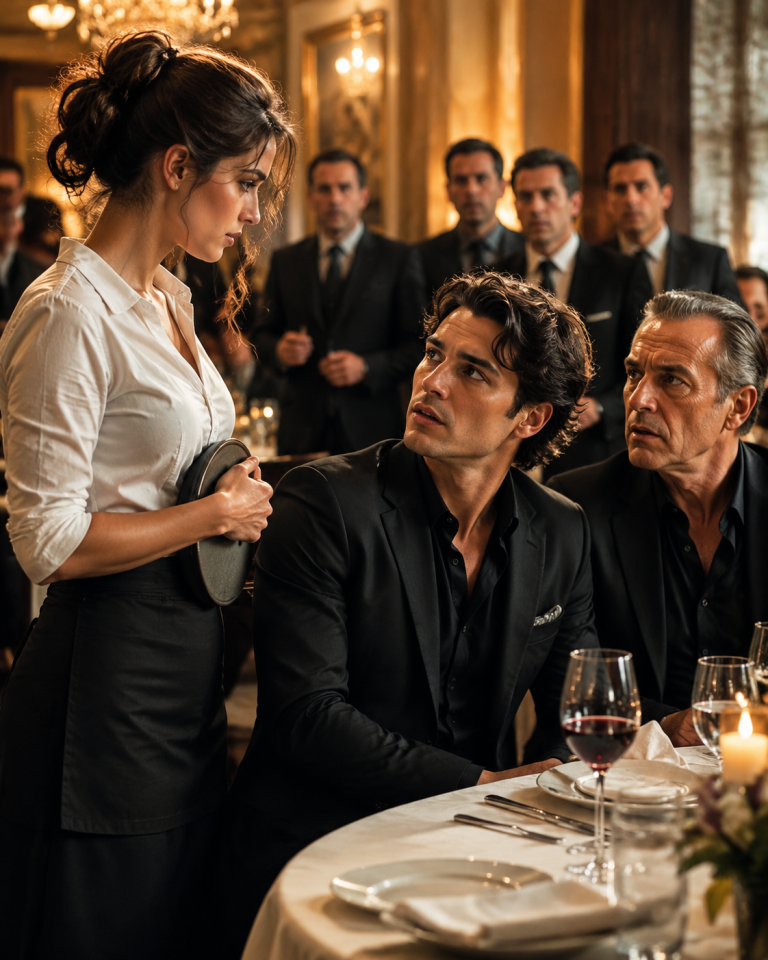
The Mafia Boss slammed his spoon onto the table, his face turning deadly cold. “This soup…” he said, voice shaking for the first time in years, “Who cooked it?” The room fell silent as every eye turned toward the waitress no one had noticed. She went pale—because only his dead mother knew that recipe.

PART 1
The spoon striking the bowl was the sound of something breaking inside Edward Hale.
Nora saw it from across the dining room — not the spoon, which was trivial, but the pause that followed. The way his hand stilled. The way his pale gray eyes tracked something no one else in The Black Lantern could see.
She had been working there for five years. Five years of learning which guests did not want to be seen, which ones wanted to be seen constantly, which ones left money to buy the privilege of not being remembered. Five years of understanding that invisibility was a transaction: you provided it, you got paid, you survived.
What she had not learned until that moment was how much one bowl could change the price of it.
“Who made this?” Edward Hale asked the room.
The dining room was all clean lines and expensive inattention. White tablecloths. Candles at a height that flattered the aging. Guests who understood that the real meal was not the food — it was the proof that they belonged to the kind of world where reservations were hard to get. She recognized two city councilmen. A federal judge’s wife. A woman from a real estate dynasty.
All of them had gone perfectly still.
Nora had learned that silence like this usually meant money was about to move somewhere it shouldn’t.
Brian Mills, the dining room manager, stepped forward too fast. “The chef personally—”
Edward did not look at him.
“I asked who made it,” Edward said. “Not your assessment of excellence, Mr. Mills. The cook.”
Nora felt the moment the answer became complicated.
Chef Victor Bellamy appeared in a white coat with his name embroidered in black thread. He smiled. He always smiled. It was his most expensive asset — the smile that made guests believe they were tasting genius instead of craft stolen from people who could not afford lawyers.
“A traditional Marseille preparation,” Victor said. “A dish my mentor taught me decades ago.”
Edward’s eyes moved.
They passed over Victor. Passed over the manager. Passed over the room of powerful people determined not to watch.
They landed on Nora.
She was standing beside the service station with flour still on her apron because she had not been supposed to be in the kitchen tonight. She had not been supposed to be anywhere near that pot.
But Marcus Reed, the sous-chef, had stepped out during prep to take a call. Victor had gone to the bar. And Nora, who had been learning the recipe in pieces, fragments, whispered corrections — *don’t rush the fennel, let the saffron sit for breath, the pastis is for ghosts not flavor* — had moved without thinking.
She had finished what someone else had started and prepared to take credit where it belonged to no one.
Edward Hale pointed at her.
“Her,” he said. “Bring the woman who is afraid to be seen.”
Every guest in the room finally looked where Edward was looking.
Nora felt the calculation shift.
She had spent three decades learning how to become background. After her mother disappeared into bad men and worse choices, after her grandmother Elise had raised her on a waitress’s salary and a cook’s determination, Nora had understood early that safety meant being transparent. People hurt things they could see.
So she became a mirror. She refilled water without interrupting conversation. She replaced silverware before anyone noticed it was gone. She smiled at insults as though they were weather.
For five years, that had kept her employed and her daughter fed.
Now a man who controlled half of Manhattan’s restaurants had looked directly at her invisibility and asked her name.
Brian’s fingers dug into her elbow. “Whatever he asks, say yes.”
Nora pulled free.
She had spent five years watching Chef Victor take credit for dishes he learned from cooks he treated like mistakes. She had watched him repackage stolen ideas as innovation. She had watched him smile for cameras while the people who had actually built his reputation stood hidden in kitchens.
She understood, very clearly, what Victor had done tonight.
He had sent someone to deliver a bowl of food he had not cooked, whispered credit to a powerful man, and prepared to absorb the result.
What he had not calculated was that Nora had stopped playing background.
She walked toward table twelve.
The room watched.
Edward Hale was older than she expected — not soft, but carved. Silver hair. Black suit. Hands that showed their history. The kind of face that had learned early that emotions were weapons other people could use.
“You made that,” he said.
It was not a question.
“Yes,” Nora said.
“Why were you not in the kitchen?”
“Because the chef does not believe waitresses can cook.”
Edward’s mouth moved. Not quite a smile. Something colder.
“And yet.”
Victor stepped forward. “Mr. Hale, if I may—”
Edward raised one hand, and the dining room froze.
“Tell me,” he said to Nora, “where you learned.”
Nora had decided before she walked over that she would tell the truth. Not the whole truth. Never the whole truth. But enough.
“My grandmother was from Marseille,” she said. “She cooked bouillabaisse before it became a restaurant dish. Before it became something men could steal.”
Edward’s expression shifted.
For one second, something old and painful moved through his face.
Then he recovered. “Outside. Five minutes.”
Brian grabbed her arm. “You do not leave. You smile and you apologize and you offer a discount.”
Nora looked at him.
“You mean lie better than Victor.”
“I mean survive better than him.”
But Nora was tired of surviving the way that meant disappearing.
She walked toward the exit.
—
PART 2
The rain had turned the street into a mirror of neon and regret.
Edward waited beside a black Mercedes with his hands in his pockets.
“Your grandmother’s name,” he said before she could speak.
“Elise Moreau Quinn.”
Something dangerous crossed his face. “Marseille?”
“Yes.”
“1969. La Perle Noire?”
Nora stopped breathing.
Edward looked away. “She made that dish the night my mother died. The first time I tasted it again, I was forty-eight years old. I thought I never would.” He turned back to Nora. “Now I have, and I need to know if that means your grandmother taught you or if you simply guessed correctly.”
“My grandmother taught me that food knows when you’re lying.”
“That isn’t an answer.”
“It’s the only one I have.”
Edward studied her. “What’s your name?”
“Nora Quinn.”
“You have a daughter.”
It was not a question. He said it the way people said things they had already confirmed.
“Lily,” Nora said. “Eight years old.”
“She’s watching Mrs. Alvarez tonight.”
Nora went cold. “You investigated me?”
“I investigated the woman who cooked my dead mother’s soup.”
The rain continued. Somewhere, a siren. Somewhere, Victor Bellamy was explaining to the room why that bowl had nothing to do with her, why credit had been miscommunicated, why people like Nora should be grateful for crumbs.
“I want you to build a restaurant,” Edward said. “Your name. Your terms. No stealing. No excuses. Complete autonomy.”
“Why?”
“Because your grandmother chose not to let me save her life, and now her granddaughter will have the choice to save her own.”
Nora understood then that this was not rescue.
This was transaction.
Edward Hale did not give things to people. He made investments. He bought futures. He calculated how people would become useful to him after they believed they owed him something.
But he was also right.
Victor would destroy her for what happened tonight. Brian would fire her for insubordination. The other restaurants in Manhattan would not hire her because respectable places did not hire waitresses who corrected chefs, no matter how right she was.
She could disappear into a different job, a different city, a different kind of life.
Or she could accept that a dangerous man had seen her cook and wanted that to matter.
“I’ll need my team,” Nora said.
Edward smiled. “Bring whoever you want.”
—
PART 3
The lawsuit arrived three days before Hearth was scheduled to open.
Victor Bellamy claimed Nora had stolen his proprietary bouillabaisse recipe and used it to deceive Edward Hale. He provided notebooks. He provided witnesses. He provided a story so clean and polished that online mobs believed it before they knew her name.
Nora’s lawyer, Patricia Keane, was sharp enough to be dangerous.
“His witnesses are lying,” Patricia said during their first meeting.
“Can we prove that?”
“No. But we can prove he copied a bad translation of a French magazine article from 1968. The article mentions pastis. Victor’s recipe says anise paste. The dishes are different because his is based on a mistranslation.”
Nora listened and understood: the law protected people who could afford the best lies.
The judge ordered a culinary comparison.
Victor and Nora would cook side by side. Two independent experts and the judge would taste both versions. The winner would move forward. The loser would learn what public humiliation felt like.
The night before, Nora tried to cook in her new kitchen and failed three times.
Then Lily climbed onto a prep stool.
“Make it for me,” her daughter said.
“I am making it.”
“No. You’re making it for judges. Make it for me.”
Nora started again.
This time she did not imagine courts or critics. She imagined her grandmother standing beside her, one hand on the small of her back, her voice patient and unforgiving: *Never lie to the pot, Nora. It always tells on you.*
The broth came alive.
When it was done, Lily tasted it and whispered, “That’s Grandma.”
Nora’s throat closed. “No. That’s all of us.”
The test kitchen was sterile, bright, designed to eliminate any advantage.
Victor arrived in a new chef’s coat with his name embroidered in black thread. He moved with theatrical precision. He explained every choice. He performed for the experts like they were cameras.
Nora said nothing.
She built the dish.
Onion, fennel, garlic. Tomatoes. Bones. Heat. Wine. The slow extraction of flavor from things that had survived pain and still had sweetness to give. Saffron. Orange peel. Pastis — barely enough to name itself, but there. Fish in order of need.
Ninety minutes later, two bowls sat before the judges.
Victor’s looked perfect.
Nora’s looked honest.
The first expert tasted Victor’s and nodded. Competent. Polished. Forgettable.
Then he tasted Nora’s.
His eyes closed.
The second expert did the same. The judge tasted twice.
“These are not the same dish,” the first expert said quietly.
Victor’s face went white.
Patricia stood. “We also submit employment records from Marseille identifying Elise Moreau as chef of La Perle Noire. And we note that Chef Bellamy’s cookbook cites a 1968 magazine article with a mistranslation. The article refers to pastis as une trace — a trace. Chef Bellamy’s English translation says paste. His recipe is based on a linguistic error, not on knowledge.”
Victor’s lawyer objected weakly.
The judge dismissed the case before lunch.
Outside the courthouse, reporters shouted questions.
Nora looked at Lily, then at the cameras.
“My grandmother was a chef named Elise Moreau Quinn,” she said. “She cooked in Marseille. She survived things that could have destroyed her. And for fifty years, her knowledge lived in the hands of the people who loved her while men like Victor Bellamy took credit for her work. This ends with me.”
That clip ran all night.
Hearth opened four weeks later.
The reservation book filled in nine minutes.
On opening night, Nora’s team moved like one organism. David Park on sous. Maria Torres on stations. James Whitaker managing heat. Sophie Bell in pastry. Lily doing homework at a prep counter, existing in the space between daughter and apprentice.
At 10:47, the last ticket cleared.
David tapped a spoon against a pot. Maria joined. James. Sophie.
The sound spread through the kitchen — not applause, but recognition of something real.
Nora leaned against the counter and let herself cry where no one needed to see it.
When she walked into the dining room, Edward Hale sat alone at table twelve.
A half-eaten plate of roast chicken in front of him.
“You should be asleep,” Nora said.
“I am old, not dead.”
He pushed an envelope across the table.
“The deed,” he said. “Building, business, everything. Yours.”
Nora did not touch it. “Why?”
“My father bought this building in 1971 intending to give it to Elise. She refused. She said a gift from a man like him would always have a shadow.”
“So you’re giving it to me.”
“I’m settling a debt she would not let me settle.”
Edward stood. He was wearing the expression he wore at restaurant tables — calm, controlled, satisfied.
“You will never owe me,” he said. “Make sure you remember that.”
Then he walked into the night.
—
The New York Times gave Hearth three stars.
The review called Nora’s cooking “a rebuke to vanity disguised as dinner,” and said the bouillabaisse tasted like “someone’s grandmother whispering recipes to someone who listened.”
Victor Bellamy closed The Black Lantern six months later. He blamed labor costs, changing tastes, disloyal staff, online campaigns. He never blamed himself.
Nora did not celebrate.
She was too busy building something that could not be stolen because it lived in her hands, her decisions, her refusal to disappear.
Edward came every Thursday and sat at table twelve.
He never ordered. Nora sent whatever she was testing. He ate silently, sometimes praised, sometimes criticized with an honesty that felt like respect.
A year after the night he threw down his spoon, Nora arrived before dawn to prep alone.
Lily appeared in her school uniform.
“Mom, you promised to walk me.”
Nora looked at the stove. At the knife. At the pot waiting to be filled.
“Okay,” she said.
She turned off the burner and walked out from behind the line.
Because legacy was not only what you built. It was also what you refused to sacrifice to keep building.
Outside, New York was waking hard and fast. Delivery trucks. Steam from grates. A man cursing at a taxi.
Nora and Lily walked hand in hand.
Just a mother and daughter.
Visible.
Alive.
Exactly where they had always belonged, waiting for someone to stop looking away.
And in the language of saffron and survival, Elise Moreau Quinn’s story finally had a place to live — not as a man’s memory, not as a stolen recipe, but as proof that talent was not something men could give you.
It was something you refused to let them take.
THE END