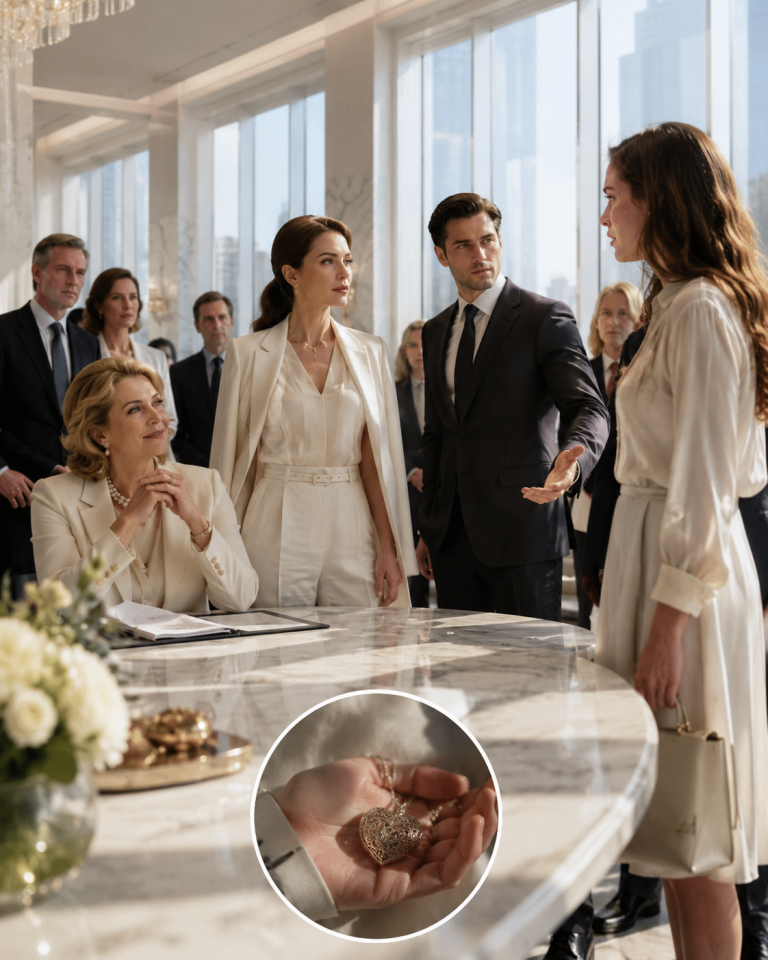
“My Ex Whispered He Was Marrying My Sister—Then the Mafia Boss of Seattle Took My Hand”

## PART 1
The lie started the way most disasters do: with wine, wounded pride, and the specific recklessness of a woman who has finally run out of graceful exits.
My name is Serena Voss. I am thirty-one years old, I coordinate events for a living, and on a Thursday night in October, I sat down at my family’s dinner table and destroyed eight months of carefully managed survival in approximately four seconds.
My ex-fiancé Connor Ashby leaned across the table and whispered it.
Two words.
*She’s pregnant.*
He did not say *Nadia is pregnant.* He did not say *your sister is pregnant.* He simply said *she’s pregnant*, and let the pronoun do the work, because men like Connor understood that cruelty was most efficient when it left the interpretation to you.
My sister Nadia sat across from me, her hands folded on the tablecloth, the engagement ring I had seen only in photographs catching the restaurant candlelight. She was not looking at me. She was looking at the ring. She had always been better at looking at things than at people.
My mother was watching me with the held-breath attention of a woman braced for a scene.
My father was studying his menu.
Connor smiled.
That smile.
I had spent two years learning the taxonomy of his smiles. The charming one for strangers. The private one I had mistaken for intimacy. The patient one he used when I said something he disagreed with but hadn’t decided how to punish yet. And this one: the watching smile, the one that appeared when he had just handed someone a situation they could not survive elegantly and was waiting for the evidence.
He expected me to fall apart.
I lifted my wine glass instead.
“Congratulations,” I said, with a brightness that surprised even me. “How far along?”
My mother exhaled.
Nadia looked up.
Connor’s smile slipped by a fraction.
“Fourteen weeks,” Nadia said.
“That’s wonderful.” I took a long sip. And then, because the wine was bad and the company was worse and something inside me had finally, completely run out of the fuel required to perform dignity for people who had stolen it — I said:
“I’m seeing someone too, actually. Alexei Vasin.”
The table went quiet in the specific way tables go quiet when a name arrives in a room that recognizes it.
My mother’s wineglass stopped halfway to her mouth.
My father looked up from the menu for the first time all evening.
Nadia blinked.
Connor went very still.
Alexei Vasin.
I had worked at the Vasin Continental for two years — the most beautiful and most quietly dangerous hotel in Chicago. I had seen him exactly five times. I had spoken to him twice. He was the kind of man people in our city described with the particular careful vagueness of someone who did not want to name what they were actually describing.
And now his name was sitting in the middle of this restaurant like a grenade I’d thrown without thinking through the blast radius.
“Serena,” my mother said, with the tone of a woman trying to decide whether to be impressed or horrified.
“We’ve been seeing each other a few months,” I said. “It’s new.”
It was also entirely fictional.
Connor set down his fork.
“Alexei Vasin,” he said.
“Yes.”
“The hotelier.”
“Among other things.”
“You’re dating Alexei Vasin.”
“I’m not sure dating is quite the right—”
The restaurant door opened.
The particular ambient hum of a full Friday night service — silverware, conversation, a child’s laugh from the corner — compressed into something quieter. Not dramatic. Just attentive. The way rooms became attentive when certain people entered them.
I turned.
Alexei Vasin walked through the door of Carmine’s like he had been there ten minutes ago and had stepped out briefly for air.
Dark suit, open collar, the kind of unhurried movement that made a room feel smaller without making itself loud. His eyes found mine before his eyes found anything else, which was either coincidence or the most unsettling thing I had experienced in recent memory.
He crossed the room.
He stopped beside my chair.
He placed his hand on the back of it — not on my shoulder, not on me — and looked at the table with the calm patience of a man who had arrived at a place he had always intended to be.
“I’m sorry I’m late,” he said.
His voice was low and accented faintly with something Eastern European, and the words landed with the absolute ease of a man who had never been late for anything in his life and was choosing to say he had been as a courtesy.
Connor’s face drained of color so completely and so quickly that it was almost medical.
My mother’s composure failed her for two full seconds before she recovered it.
I slipped my hand into Alexei’s.
His fingers closed around mine — warm, steadying, saying nothing — and the entire balance of power in the room shifted like furniture being rearranged.
“Alexei,” I said. “You remember my family.”
“Of course,” he said, without a flicker of hesitation, though he had never met them in his life.
He pulled out the empty chair beside me and sat.
And I thought, with a kind of dizzy, terrified wonder: *he heard me from across the restaurant. He was already here. He knew.*
But I did not understand yet what any of it meant.
I did not understand what I had walked into by saying his name.
I did not understand that his hand around mine was not kindness but recognition.
I did not understand that the oldest and most dangerous man in my family had been watching me for years, and that the name I had chosen in desperation had just sent a signal I had not known I was authorized to send.
All I understood, in that moment, was that Connor Ashby had stopped smiling.
And for the first time in eight months, neither had I.
—
## PART 2
My mother recovered first, because Renata Voss had survived worse than the unexpected arrival of a dangerous man at her family dinner and she intended to come out of this one looking composed.
“Mr. Vasin,” she said. “What a pleasure.”
“Mrs. Voss.” He looked at her with exactly the level of attention the situation required and not a gram more.
Nadia was staring at him with an expression I recognized as the one she used when she encountered something she hadn’t anticipated and was deciding how to feel about it. Connor had gone rigid in a way that I recognized as not anger but something more useful: calculation.
The dinner continued in the manner of dinners where everyone is performing normalcy over the ruins of something more honest. My mother made conversation. My father ate without contributing. Nadia asked Alexei two questions that I could tell she had selected specifically to determine whether the relationship was real, and his answers were exactly precise enough to suggest he had spent significant time learning who I was without having recently seen me.
That should have frightened me.
I was too busy watching Connor’s face.
He was afraid.
Not of Alexei specifically — or rather, not only of Alexei. He was afraid of something older. Something the name Vasin had reached back and touched. His eyes moved between Alexei and the table and occasionally toward the restaurant door, with the micro-calculations of a man who understood that the room had changed in a way he had not prepared for.
When the check arrived, Alexei placed a card on the folder before my father could reach for his wallet, and the efficiency of it — the single, silent gesture that closed that conversation before it opened — told me more about who he was than the previous two years of working in his hotel had.
Outside, on the pavement, in the cold Chicago drizzle, Connor appeared behind me before the valet had moved.
“Serena.”
I turned.
He looked between me and Alexei with the urgent precision of a man who had decided that what he was about to say was important enough to say in front of a witness.
“You don’t know what you’re doing,” he said.
“You’ve said that before.”
“This is different.” His voice dropped. “Ask him who he knew before he knew you.”
Alexei said nothing.
That was worse than a response.
“Connor,” I said. “Go back inside.”
His jaw tightened.
“Your father should have told you years ago,” he said.
I stared.
Those words.
*Should have told you years ago.*
I had not given Connor any information about my family that could have led to that sentence. He did not know anything about my family that was not already visible on a surface inspection.
So how did he know there was something to tell?
I looked at Alexei.
His expression had not changed.
But his hand had found the small of my back — not forcefully, not possessively — steadily, the way a person placed a hand when they were deciding whether a situation was about to require intervention.
My phone buzzed.
Nadia.
*Serena please come back in. Mom is crying. Connor is saying things and Dad looks sick. He said Dad should have talked to you years ago. What is going on?*
The rain fell between us.
Alexei read the text over my shoulder.
“We should go,” he said. Quietly. To me, not the situation.
“Go where?”
“Somewhere I can explain.”
“Can you explain?”
The pause that followed lasted exactly long enough.
“Yes,” he said. “I should have, before tonight.”
I looked at him.
*Before tonight.*
Not *I don’t know what he meant.* Not *ignore him.*
*Before tonight.*
As if there was a conversation that had been owed to me, that he had been holding, that he had decided—for some reason I was not yet allowed to know—to withhold until I forced his hand by saying his name across a dinner table.
Behind us, the restaurant door opened.
Connor came out with two men I had never seen before, and the particular way they moved — flanking, scanning — told me they had not come from inside Carmine’s.
They had been waiting.
Alexei turned.
His expression changed.
Not visibly, to anyone else. But I was standing close enough that I felt the shift in the quality of his attention — away from me, toward the door, calculating something at speed.
“Serena,” he said, very evenly. “Get in the car.”
—
## PART 3
I got in the car.
Not because I was obedient. Because the two men behind Connor were standing in the rain with the stillness of people who had been deployed rather than arrived, and Alexei’s driver had already opened the rear door before he’d finished the sentence, which meant this had been anticipated.
The sedan pulled away. Alexei got in the other side. His bodyguard — a man named Ivor who had the dimensions of a wardrobe and the emotional expressiveness of one — sat in the front with the driver.
I watched Chicago smear past in orange and black.
“Who were they?” I asked.
“Men from a family called Rezenkov.”
“What do they want?”
“Me.” A pause. “Now possibly you.”
I turned.
“Why would they want me?”
He looked at his hands in his lap, which was the first time I had seen him look at anything other than the room or me.
“Because of your grandfather,” he said.
I laughed once, reflexively.
“My grandfather died before I was born.”
The car was quiet for a long time.
“No,” he said. “He didn’t.”
—
The suite at the Vasin Continental looked like the kind of room where important decisions were made in the dark.
Alexei stood at the window with his back to me for a moment — not dramatically, not performing thoughtfulness, just a man who was choosing his first sentence from a short list of bad options.
“Your mother’s father,” he said, “is a man named Konstantin Orloff.”
I sat on the arm of the nearest chair, because the nearest chair was the nearest thing.
“My grandfather was Frank Voss. He died in 1990.”
“Frank Voss was a name your grandmother chose when she emigrated. She had reasons for the choice.”
“What reasons.”
“Because Konstantin Orloff was not a safe man to be connected to.”
I looked at him.
“Who is he.”
Alexei turned from the window.
“He runs a private investment and logistics network that stretches from Chicago to Warsaw. Some of it is legitimate. Some of it is not. He is seventy-three years old and was recently diagnosed with a condition that is likely to kill him within eighteen months.”
“And he’s my grandfather.”
“Yes.”
“And he knows I exist.”
Alexei’s face answered before he did.
“He’s known since you were born,” he said. “He made an arrangement with your father.”
“What arrangement.”
“Protection and silence in exchange for distance. Your parents were to keep you out of his world. No powerful connections. No attention. A quiet life.”
I looked at the ceiling.
“And Nadia.”
“Was not part of the arrangement. Nadia was born later. Konstantin didn’t know about her until recently.”
“So she was free.”
“Yes.”
“And I was managed.”
Silence.
“Yes.”
The room was very quiet.
I thought about my father’s careful avoidance of anything ambitious for me. His gentle, persistent suggestions of modest careers, local positions, lives that didn’t require names. The way he had always seemed faintly relieved when my relationships faded rather than deepened.
“My job,” I said.
Alexei looked at the window.
“The Vasin Continental had an opening when your previous firm let you go.”
“Did it open naturally.”
“I was informed you needed work.”
“Informed by whom.”
“Your grandfather.”
I stood.
“You’ve known who I was since I was hired.”
He turned toward me.
“I’ve known your family name since before you were hired. I didn’t know you until you walked into my ballroom and turned a wedding cake disaster into a standing ovation without raising your voice.”
“That is a very elegant way of saying you were watching me.”
“Yes.”
“For years.”
“Yes.”
I crossed to the window and stood beside him, because I needed to look at something that wasn’t his face while I processed this.
The city below was indifferent and beautiful. People moved through it without knowing what conversations were being conducted above their heads.
“Connor knew,” I said.
“Ethan Prescott.”
I turned.
“What?”
“His name is Ethan Prescott. Connor Ashby is a name he has used for professional reasons for several years.”
I stared.
“The man I was engaged to.”
“Yes.”
“Has a different name.”
“And connections to the Rezenkov family,” Alexei said, “that predate his relationship with you by several years.”
I thought about the past two years. About what I had told Connor. About the job, the hotel, the access I had given him to my life without knowing what my life actually was.
“He was placed,” I said.
“I believe so.”
“To watch me.”
“To get close to you. Possibly to find out whether your grandfather had given you anything.”
“Like what?”
Alexei looked at me carefully.
“Like information. Documentation. Evidence of agreements that certain men would prefer remained private.”
I thought about my father’s locked desk drawer, which I had never been permitted to open and had not been curious enough about to force.
“I need to call my father,” I said.
“I know.”
“Tonight.”
“I’ll drive you.”
I looked at him.
“You don’t have to.”
“Yes,” he said. “I do.”
—
My father opened his apartment door in a bathrobe at midnight and looked at me for a long moment before stepping back to let me in.
Alexei waited in the car.
The apartment was small and orderly in the way of a man who lived alone and had learned to fill space with tidiness. My mother had left him three years after I graduated college, for reasons she had described as incompatibility and that I was now understanding differently.
My father put on tea.
I sat at the kitchen table.
“Tell me,” I said.
He sat across from me.
He cried first.
I waited.
“Your mother’s name was Elena Orloff,” he said. “She was Konstantin’s daughter. She met me when she was running from him. I was nobody — an accountant for one of his front companies. She asked me to help her disappear.”
“You gave her a new name.”
“We gave each other a new life.”
“And me.”
“You were born into it. You were ours. But Konstantin found us when you were three.”
“What happened.”
My father’s hands wrapped around the mug.
“He offered a deal. Not a threat, exactly. He said he understood why Elena had left. He said he would leave us alone if we left you alone — if we didn’t make you someone he would eventually have to manage.”
“And my mother.”
My father’s face changed.
“She died six months after that conversation.”
“The car accident.”
“They said it was an accident.”
The kitchen was very quiet.
I looked at my father.
“Did Konstantin—”
“No,” he said quickly. “He was devastated. I believe that. Whatever he was, she was his daughter.” He paused. “The men who ran Elena off the road were Rezenkov. Enemies of Konstantin who wanted to reach him through her.”
I closed my eyes.
“And you kept the deal.”
“I kept you safe.”
“You kept me small.”
He flinched.
“Yes,” he said. “I chose your safety over your life. Every day. I told myself they were the same thing.”
I opened my eyes.
“Connor’s real name is Ethan Prescott.”
My father went very still.
“What?”
“He has ties to the Rezenkov family. He was near me for two years.”
My father’s face did something complicated and terrible.
“Robert,” he said.
“What?”
“I did something.” His voice cracked. “Three months ago, when Konstantin’s health news reached me — I was afraid. I thought if he died with the files, the Rezenkovs would come looking. I called a man I used to know. He said he could create a buffer.”
“A buffer.”
“A reason for you to be connected to Konstantin’s side before the Rezenkovs could make their move. I didn’t know what it would look like.”
I stared at him.
“You arranged for Alexei Vasin to watch me.”
“I told Konstantin’s people that you existed and were unprotected. Yes.”
“Without telling me.”
“Without telling you.”
I stood up.
I walked to the window.
Below, the street was quiet. A dog walker. A cab passing. Ordinary, unmanipulated life.
“There’s a drawer,” I said, without turning around.
My father was silent.
“Your locked desk. You have had it since I was a child. What’s in it.”
A long pause.
Then the sound of him leaving the table.
A cabinet. A drawer. A key.
He returned and placed a folder on the table in front of me.
Inside were documents.
Bank records. Names. A ledger of payments that went back twenty years. Two signed affidavits and a photograph of my mother — her real name at the bottom, Elena Orloff-Voss, dated three years before I was born — standing with a man I did not recognize.
On the back of the photograph, in her handwriting:
*For Serena, if this finds you. You were not created to be hidden. — E.*
I sat down.
I put my hand over my mouth.
“She left it for me,” I said.
“Yes.”
“She knew.”
“She was always more clear-eyed than either of us.”
I folded the photograph carefully and placed it in my pocket.
“I’m going to meet him,” I said.
“Konstantin?”
“Yes.”
“Serena—”
“Not because he wants me to,” I said. “Because I deserve the truth from the person who has been holding it.”
My father looked at me with the exhaustion of a man who has been afraid for thirty years and is finally too tired to maintain it.
“Take Vasin,” he said.
“I intend to.”
—
Konstantin Orloff lived forty minutes outside Chicago in a house that had been built to look like a country estate and felt like a decision.
Stone. Old trees. A driveway that curved so you couldn’t see the gate from the road. Men who materialized out of the landscape when the car stopped and then dematerialized when Alexei said one word in Russian.
Alexei had driven himself.
We had spoken almost not at all during the ride, which was its own kind of conversation.
Inside, Konstantin was not what I had expected.
He was slight. Silver-haired. He used a cane with an ivory handle and his hands had the fine tremor of a man whose body was beginning to disagree with his will. He sat in a library full of books in three languages and looked at me across the room with eyes that were my mother’s.
My eyes.
“Serena,” he said. “You have her posture.”
“I don’t know what her posture was,” I said.
“Exactly like that,” he said. “Upright. Refusing.”
I sat across from him.
Alexei stood near the door.
“You’ve been managing my life,” I said.
“Protecting it.”
“Those aren’t the same thing.”
His mouth curved slightly.
“Elena used to say that.”
“She was right.”
“Yes.” He looked at his hands. “She was right about most things. I was better at deciding than listening.”
I thought about my mother’s letter. *You were not created to be hidden.*
“What do you want from me?” I asked.
He looked up.
“Nothing I am not given.”
I waited.
“I am dying,” he said. “Not dramatically. Practically. My doctors have been specific. I have time enough to close certain things or leave them open and ugly.” He paused. “There are men who will use my death as an opportunity. The Rezenkovs. Others. If you exist in the world as you are now — unknown, unconnected, easy to reach — they will use you to send messages to people who owe me.”
“So you want me connected to you.”
“I want you protected by knowing who you are.”
“Those are also not the same thing.”
He smiled.
And despite everything, it was a warm smile. A human one. The smile of a man who had spent decades being obeyed and was encountering resistance he found, unexpectedly, pleasant.
“No,” he said. “They are not.”
“I don’t want your network,” I said. “I don’t want to be your heir or your symbol or your legacy.”
“I know.”
“Then what are we doing here?”
He reached into the desk beside him and removed a small box.
“Your mother asked me to hold this until you were ready.”
He held it out.
Alexei moved slightly at the door.
I crossed the room and took the box.
Inside was a bracelet. Gold. Old. A small charm at the clasp — a bird in flight, wings open.
On the inner face, engraved in her handwriting: *For when you fly.*
I stood there for a long time.
“She trusted you with this,” I said.
“She trusted me with very little,” he said. “But with this, yes.”
“Because she thought you would find me.”
“Because she thought I would need to.”
I put the bracelet on.
It fit.
—
What came after was not the story of a woman who chose power because she had been born near it.
It was the story of a woman who decided what to do with information she should have had thirty years ago.
I met with a federal prosecutor two weeks after the visit to Konstantin’s house. Her name was Agent Kwan. She had been building a case against the Rezenkov network for four years and was very carefully not saying what she needed from me.
I said it for her.
“You want the documents my father kept.”
She looked at her coffee.
“Those documents would significantly accelerate—”
“Yes,” I said. “I know. And I’ll give them to you. With one condition.”
“Which is?”
“My father is protected. Full immunity. He was a frightened man who made bad choices out of love. He doesn’t go to prison for that.”
Agent Kwan studied me.
“That’s not a small ask.”
“No,” I said. “It isn’t.”
She looked at the table.
“What about Vasin?”
I thought about Alexei standing in his own library, handing me documents in his mother’s box, telling me the truth about who he was with the specific honesty of a man who understood that the truth was the only thing that could possibly serve him at this point.
“He cooperates,” I said. “Fully. He’s been trying to separate himself from this world for years. This is the mechanism.”
Agent Kwan was quiet for a moment.
“You’ve thought this through.”
“I had a week.”
She almost smiled.
“Alright, Ms. Voss. Let’s talk terms.”
—
Ethan Prescott — who had been Connor Ashby to me for two years — was arrested on a Tuesday.
Nadia called me when it happened.
She had moved back in with our parents for the last few weeks. She was six months pregnant, tired, and had been doing the specific work of dismantling a story she had believed about herself and replacing it with something more accurate.
“Are you okay?” I asked.
“I’m angry,” she said. “Which I think means I’m okay.”
“Anger is very okay.”
“He lied about everything.”
“Yes.”
“Even his name.”
“Yes.”
She was quiet for a moment.
“Did you know? Before me?”
“No,” I said. “But I should have asked different questions.”
“We both should have.”
That was the most honest conversation I had ever had with my sister.
It was the first of many.
—
Konstantin died in February.
I had visited him five times.
We had talked about my mother. About her laugh, which he described as embarrassingly loud and completely unself-conscious. About her stubbornness, which I apparently shared. About the afternoon she had left his house and turned in the doorway and looked at him with an expression he had never been able to fully describe.
“What did it mean?” I asked him once.
He was quiet.
“She was not saying goodbye to me,” he said. “She was saying goodbye to the version of me she had hoped I would become.”
“Did you ever become it?”
He looked at the window.
“I am trying now,” he said. “Very late.”
On the morning he died, his attorney called me.
There was no inheritance. No empire. No network to receive.
There was a letter.
*Serena,*
*Your mother tried to outrun her blood. I think she was right to try. I think she was wrong to believe it was necessary.*
*Blood is not destiny. It is only the beginning of a question.*
*I hope you ask better ones than I did.*
*— K.O.*
I read it twice.
Then I put it with the photograph.
—
The Vasin Continental Foundation opened in April.
The hotel itself remained open — still one of Chicago’s finest, still beautiful, still the kind of place that felt like a decision when you walked into it. But the private floor became transition housing. The ballroom became a community legal clinic two evenings a week. The event coordination department became the department that ran both.
I ran both.
Alexei was on the board.
Not as chairman. As a board member. With voting power equal to everyone else’s, which he had insisted on and I had not argued with, because equality was the only structure I trusted.
We were not simple.
We were honest, which was different.
He had watched me for two years with knowledge he should have shared. He had opened a door for me that I should have been allowed to open myself. We had several conversations about these things that were not comfortable.
What made them survivable was that he did not try to make them comfortable.
He sat in them.
He answered what I asked.
He did not try to reframe cruelty as protection, which was the one thing I would not have forgiven.
On the night the foundation opened its doors, I found him on the roof terrace.
Chicago spread below in all directions — the lake, the Loop, the neighborhoods I had grown up in without knowing what was underneath them.
“You look satisfied,” he said.
“I look terrified,” I said.
“Yes. You always look terrified when something works.”
I looked at him.
“That’s a surprisingly accurate observation for a man who spent two years not introducing himself.”
“I was introducing myself,” he said. “You just didn’t know the context.”
“That’s a convenient reframe.”
“It is.” He paused. “I’m sorry.”
I looked at the city.
“I know,” I said.
“Is that sufficient?”
“Not yet,” I said. “Ask me in a year.”
He nodded once.
Ivor appeared at the terrace door and said something in Russian.
“The first residents arrived,” Alexei translated.
I looked at the door.
“Good,” I said.
I went inside.
Alexei followed.
The first woman was standing in the lobby with a child on her hip and a single bag over her shoulder, looking at the space with the specific, overwhelming attention of someone trying to determine whether a thing was real.
I crossed the marble floor and held out my hand.
“Welcome,” I said. “My name is Serena. Let me show you around.”
She took my hand.
Her grip was strong.
And I thought about my mother, who had run from the life she had been born into and built something quieter and more honest, and who had known — even from the beginning, even from the bracelet with the bird charm and the message she had left like a letter in a bottle — that her daughter would eventually find her way here.
Not to power.
Not to an empire.
To a room with an open door.
To the beginning of something that could not be owned.
To herself.
*For when you fly.*
The charm on my wrist caught the lobby light.
I smiled.
—
Six months after the foundation opened, Nadia found an envelope tucked inside the lining of an old coat that had belonged to our mother.
She called me from our parents’ house.
“It’s addressed to both of us,” she said. “Serena. It’s in her handwriting.”
I stopped walking.
“Open it.”
Paper rustled.
Inside was a photograph of Elena Orloff in a garden somewhere warm, laughing, with a baby in her arms. On the back, in her careful script:
*Nadia is not mine by blood. She is the daughter of my dearest friend, Aleksandra, who died two weeks after I did. Your father knew. He brought her into our family because she had nowhere to go.*
*She was meant to be beside you.*
*I am sorry I could not tell you. I am glad you found each other.*
The phone was silent for a long moment.
Then Nadia said, in a voice that had stopped performing composure entirely:
“I knew. I always knew I was different, and nobody would explain it.”
“I know,” I said.
“She knew about me.”
“She knew about you.”
Nadia cried.
I let her.
Then I said, “You were always mine. You were always ours. It just took us too long to stop competing over a story neither of us wrote.”
She laughed through the tears.
“You sound like a fortune cookie.”
“A correct fortune cookie.”
“Those are the worst kind.”
I smiled.
“Nadia.”
“What.”
“Bring the baby when she arrives. I want her to meet the building.”
A pause.
“The building?”
“The foundation. The clinic. The people inside it.”
Another pause.
“You want my baby to meet a nonprofit.”
“I want your baby to know what her family built.”
Silence.
Then, quietly: “Okay.”
—
Some nights, when the city was quiet and the foundation building had settled into its evening sounds — doors, voices, the particular hum of a place that was being used for something real — I stood in the lobby and thought about the architecture of the life I had.
My mother had run from a world that tried to keep her inside it.
My father had built walls around me out of love and called them safety.
My grandfather had watched from a distance and mistaken watching for caring.
And I had sat at a dinner table and said a name I had no right to say, and the name had opened a door I had not known was waiting.
None of it had been clean.
None of it would become clean.
But there was a woman on the third floor who had left a dangerous house and needed a new name, and a child in the daycare room learning the word *door*, and a legal clinic where people who had been told they had no options were discovering that options existed outside the rooms they had been locked in.
I had not built this from nothing.
I had built it from everything that had been buried and everything that had survived the burying.
My mother’s bracelet was on my wrist.
The bird charm faced upward.
*For when you fly.*
The city moved around the building in its ordinary, important way.
And I stood in the light of the thing I had made.
Not the end of a story.
The beginning of one I would tell in my own words.
*THE END*