She Answered a Rancher’s Ad for a Marriage of Convenience — What He Whispered in the Dark Kitchen Changed Everything

**PART 1**
The letter arrived crumpled, as if someone had crushed it in a fist and then thought better of it. Judith Marsh smoothed it flat against her kitchen table anyway, the fifth such rejection she had folded into her memory that year, and told herself she would not cry over a stranger’s handwriting again. She had promised herself that after South Dakota. She had promised herself that after Wyoming, too, and Nebraska before it, and Colorado before that, and Kansas before all of them, a whole map of towns where men had looked at her hands, her voice, her books, and decided she was not the kind of woman worth keeping.
This time the rejection didn’t matter, because a different envelope sat unopened beside it, one she hadn’t dared touch since it arrived that morning.
Willow Bend, Iowa, kept its silence outside her window while children she taught streamed home in twos and threes, swinging lunch pails, calling to each other across the frost-hardened yard. Judith watched them the way a starving woman might watch a table she wasn’t invited to. Thirty-two years old. Eight years at the chalkboard. Three hundred and eighty dollars saved in a coffee tin beneath her bed, and not one man in five states who wanted a wife who thought too much and smiled too little on command.
She finally broke the seal on the second envelope.
*Seeking woman willing to bear an heir and manage a household. No courtship expected, none offered. Comfortable situation guaranteed for the right candidate. Must relocate to Montana Territory permanently. Write A. Kestrel, Copper Hollow.*
No flowers. No promises. Just a transaction laid out plain as a grocery list, and something in Judith’s chest loosened at the honesty of it. She had spent five failed attempts trying to seem softer, quieter, less herself. This man wasn’t asking her to pretend anything.
She wrote back before the ink of her doubt could dry.
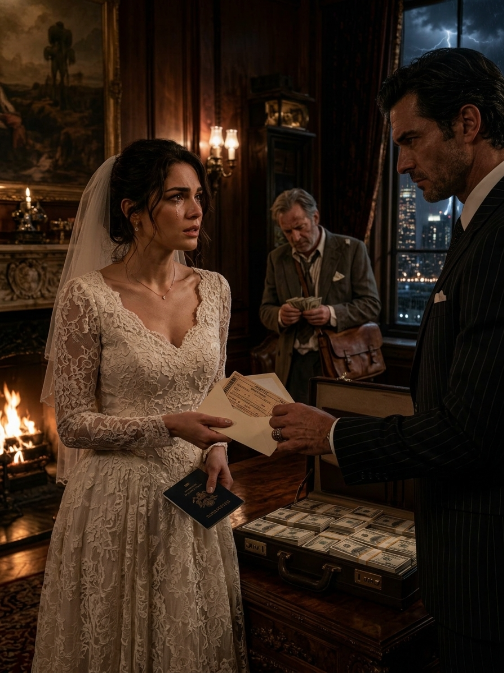
The reply came by telegram two weeks later, four terse lines confirming a train ticket and a date, and Judith gave her notice to a school board that clucked with disappointment, packed one trunk with her teaching certificates, her late mother’s garnet ring, and three volumes of poetry she refused to leave behind, and boarded a westbound train with her heart beating somewhere near her throat.
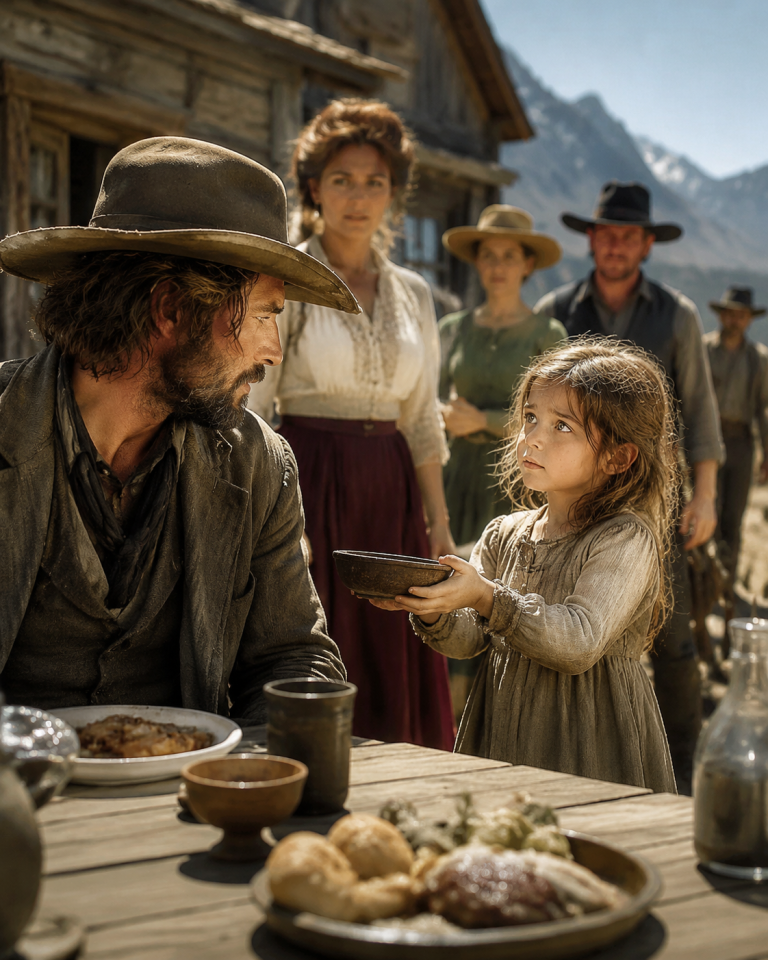
Copper Hollow met her with a gray sky and a man who did not smile.
Ambrose Kestrel stood apart from the platform crowd the way a fence post stands apart from open prairie, solitary, unmoving, entirely certain of its purpose. He was younger than the letter’s coldness had suggested, dark-haired, broad through the shoulders, with eyes the color of a storm that hadn’t decided yet whether to break. He took her hand once, briefly, the way a man might shake on a cattle sale.
“Miss Marsh.”
“Mr. Kestrel.”
The carriage that carried them toward his ranch was finer than anything Judith had ridden in her life, deep burgundy leather, brass fittings polished to a shine. Ambrose recited the particulars of his life the way another man might recite scripture: eight thousand acres, three thousand head of cattle, a household staffed and running like clockwork under a housekeeper named Agnes Holt who had served him a decade.
“Your role,” he said, when Judith finally asked what exactly she’d traveled two thousand miles to become, “is to give me a child. Everything beyond that is arrangement, not marriage.”
She felt the words land somewhere low in her stomach, cold as creek water, and made herself answer steadily. “I understand.”
“I doubt you do.” His gaze cut sideways, assessing, unreadable. “There will be no pretending at feelings neither of us has. I find pretending costs more than it’s worth.”
Something about his bluntness unsettled her less than his silences did, the way his jaw would tighten mid-sentence whenever the conversation edged near anything personal, the way he’d mentioned a marriage once — *I won’t marry again* — before snapping the door shut on the subject entirely.
By the time the carriage crested the last hill and the Kestrel ranch spread below them, white house gleaming amid a valley of gold grass, Judith understood two things with equal certainty. This man had built an empire from nothing but stubbornness and solitude. And somewhere beneath the ledger-book precision of his terms, something in him was still bleeding from a wound he refused to name.
That evening, in a study lined with hunting trophies and a stern portrait of a father he never mentioned, Ambrose poured himself whiskey he didn’t offer to share, opened a leather ledger like he was recording a livestock purchase, and began listing the rules of the life she’d just agreed to live.
She had barely finished absorbing the fourth rule when he set down his pen, looked at her directly for the first time all evening, and said the thing that made her breath catch in her throat.
“There was a wife before you. I won’t speak of why she left. But you should know, Miss Marsh — I intend to make certain history does not repeat itself.”
**PART 2**
The rules came fast after that, each one a small locked door. No involvement in ranch business. Fifty dollars a month, distributed like wages. No correspondence with men she’d known before. Church on Sundays, dignity in public, silence about anything private within these walls.
“And after the child comes?” Judith asked, chin lifted despite the tremor in her hands.
“You raise it. That’s the whole of your purpose here.”
For the briefest instant, something raw flickered behind his composure. “I won’t marry again,” he repeated, like a man reinforcing a fence line he didn’t trust to hold.
She agreed anyway. Thirty-two years of rejection had taught her dignity was a luxury, and a home — even a contractual one — was not.
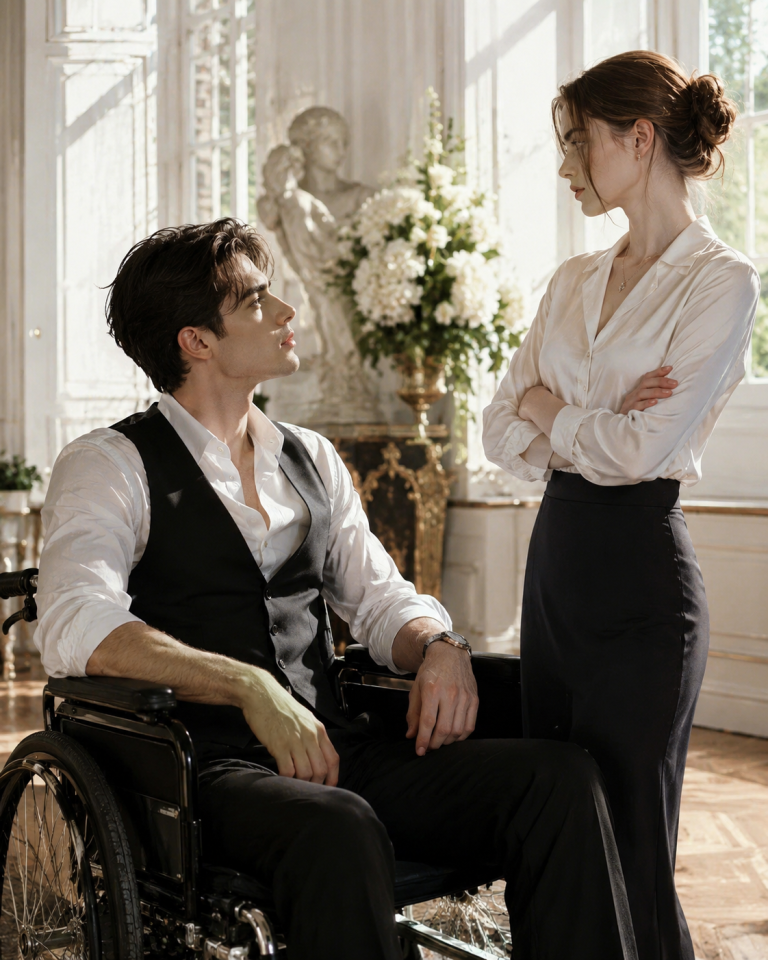
Three weeks folded into a rhythm exact as a railway timetable, breakfast at seven, long silent afternoons, evenings that ended with a study door closing between them like a wall rising brick by brick. Then, past midnight, unable to sleep, Judith came down for warm milk and found him alone in the dark kitchen, moonlight cutting one side of his face to silver.
“You should be asleep,” he said.
“So should you.”
Neither of them moved. The ordinary rules of daylight — the ledger, the terms, the careful distance — seemed to have gone soft in the dark, and something dangerous and unspoken stretched taut in the space between them.
“What keeps you from sleeping, Mr. Kestrel?”
His eyes, gray and unguarded in a way she’d never seen them, dropped briefly to her mouth before he caught himself. “You shouldn’t ask questions like that.”
“Why not? We share a bed, a name soon enough, and a future neither of us fully understands. I think I’ve earned one honest answer.”
He was quiet so long she thought he’d retreat behind the study door again. Instead, in a voice roughened by something that wasn’t whiskey, he said the words that would unravel every careful rule he’d built his life around.
“Because if I answer you honestly, Judith — I’m not sure either of us walks away from this kitchen the same person who walked in.”
**PART 3**
He told her about Eleanor that night, standing in the moon-washed kitchen with his defenses finally down. Married at twenty-five to a banker’s daughter from Denver who’d wanted parties and poetry and a husband who didn’t smell of cattle and long silences. For a year she’d loved the house, the money, the idea of him. Then the isolation had worn her down to nothing, and she’d taken longer and longer trips home to her family, until one visit she simply hadn’t returned, leaving behind a letter that told him precisely how thoroughly he’d failed to be enough.
“I decided after that,” Ambrose said, staring into his glass, “that arrangements were safer than affection. You can’t be abandoned by a business partner. You can only be abandoned by someone you let matter.”
Judith stepped closer, close enough to catch whiskey and leather and the particular warmth of him. “She was a fool,” she said quietly. “Any woman who’d trade this — the man who built all this with his bare hands, who fills his library with Whitman because he actually reads it, who dressed a stranger from Iowa like she mattered before he even knew her — any woman who’d trade that for a banker’s son doesn’t deserve what she left behind.”
“Judith.” Her name came out of him like a warning he didn’t mean.
“Don’t.” She held his gaze. “Don’t tell me to go back upstairs.”
He didn’t. What happened between them after that had nothing left of ledgers or terms or careful arrangement in it. His hands found her face first, then her waist, and when his mouth came down on hers it carried none of the restraint he’d shown in three weeks of clinical politeness. She felt herself lifted against the cool plaster of the pantry wall, felt the whole careful architecture of *no romance required* come apart between them like a levee giving way to floodwater. He said her name like it cost him something to say it. She answered with his.
Afterward, foreheads pressed together, both of them breathing hard in the dark, he said only, “This changes things,” and she said, “Does it?” and he kissed her again, slower this time, like a man discovering he had all the time in the world after all.
Morning brought a version of him she hadn’t met yet — freshly shaved, rising to pull out her chair, calling her Mrs. Kestrel before either of them had said the word aloud, as though some private decision had already been made overnight. Agnes Holt noticed it too, hovering an extra beat in the doorway with the coffee pot, her sharp eyes cataloguing the space between them the way she cataloged every household inventory, missing nothing, saying nothing.
“You look rested,” Ambrose said, and there was something almost shy beneath the words, a crack in the composure Judith had spent three weeks learning to read.
“I slept very little, actually.”
A faint color rose along his jaw. “Neither did I.”
He took her riding that morning, out past the corrals where a dozen cowhands touched their hat brims to her with new deference, out along fence lines he’d strung himself twenty years before with hands that had never known a Chicago banking house or the soft leather chairs of his father’s parlor. He told her, hill by hill, the whole story of the boy who’d fled that inheritance at twenty because he couldn’t breathe inside his father’s plans for him — the eastern college, the apprenticeship, the eventual partnership and the suitable banker’s daughter chosen before he’d finished growing into his own boots. He told her about buying a hundred and sixty half-wild acres from a man who’d already given up, about three winters where he’d nearly frozen alone in a dugout no bigger than her schoolhouse back in Willow Bend, about the particular loneliness of proving an entire family wrong with nobody there to see it happen.
“Why tell me all this now?” Judith asked, reining her mare, Duchess, alongside his restless black stallion. “You’ve spent three weeks giving me nothing but ledger entries.”
“Because ledger entries were safer.” He looked out over the valley, gold grass rippling under a hard blue sky. “A man doesn’t get abandoned by an arrangement, Judith. He only gets abandoned by something he let himself need.”
“You still haven’t told me what happened with Margaret.” She’d learned the name from Agnes, who’d let it slip once and then gone pale, as if she’d committed a small treason.
His hands tightened briefly on the reins. “Her name was Eleanor,” he corrected, quiet enough that the wind nearly took it. “Margaret was my mother’s name. Eleanor left the name Margaret out of every letter she ever sent me, same as she left out most everything else that mattered.”
He told her the rest without prompting after that — the year of parties and Denver trips that were never enough, the letter that arrived instead of a wife, the particular cruelty of finding out from a neighbor’s gossip that Eleanor had remarried a banker’s son within eight months, as though the marriage to Ambrose had been nothing more than an inconvenient delay in a life she’d always intended to live elsewhere.
“You must think me a fool,” he said, “telling a woman I’ve known three weeks the whole shameful accounting of my first failure.”
“I think,” Judith said carefully, “that a man who guards a wound that carefully must have loved harder than he lets himself admit.”
“You love this land,” she added, when he didn’t answer.
“It’s the only thing that never left,” he said, and then, quieter, almost startled by his own honesty, “until now.”
January brought a blizzard that howled around the ranch house for four straight days, burying the corrals to their fence rails and turning the short walk between house and barn into something the cowhands only attempted in pairs, roped together like sailors against a gale. Trapped inside together, Judith and Ambrose fell into a different kind of rhythm entirely, one that had nothing to do with ledgers or terms.
She found his library on the second day of the storm, a room she’d glimpsed before but never properly explored, floor-to-ceiling shelves and a stone hearth he fed constantly with split cottonwood. Among the expected volumes on cattle breeding and territorial law, she discovered Whitman, worn soft at the spine, and beside it Keats, and a slim collection of Emily Dickinson that looked as though it had been read a hundred times by lamplight.
“You disapprove,” Ambrose said, catching her expression from the doorway, already bracing for it.
“I’m trying to decide whether to be impressed or suspicious that a man who claims to distrust sentiment owns three copies of the same Whitman poem, each more worn than the last.”
“A man is allowed contradictions, Miss — ” He stopped himself. “Mrs. Kestrel, nearly.”
“Not yet,” she reminded him, though the correction came out softer than she intended.
They spent the second night of the storm reading aloud to each other by the fire, an activity so far removed from the cold arithmetic of their arrival that Judith found herself laughing — actually laughing, unguarded — at his terrible, deliberately flat recitation of a love sonnet he clearly found ridiculous and clearly loved anyway. Agnes brought them cocoa unasked and lingered in the doorway a beat too long before retreating, smiling to herself in a way she thought no one noticed.
By the third night, the wind had dropped to a low moan against the shutters, and Ambrose set down his account ledger without finishing the column he’d been adding, an unfinished habit Judith had never once seen him permit himself.
“Lydia — ” He caught himself again, and this time laughed at his own slip, low and real. “Judith. I keep losing the thread of what I meant to say.”
“Then say it plainly. You’re better at plain than pretty, by your own admission.”
“Are you happy here?” The question came out rougher than he intended, urgent in a way that surprised them both. “Not comfortable. Not provided for. Happy. Could you be happy in this house, in this life, for the whole of it, not just the part where a child is owed to me?”
Her heart began to race in a way three weeks of careful arrangement had never once managed. “Why do you ask me that tonight?”
“Because before I say the rest of what I came in here to say, I need the truth, and not the answer you think I want.”
“Yes,” she said, without hesitation, rising to close the distance between them. “I am happier in this house than I have been anywhere in thirty-two years, Ambrose. Even snowed in. Even with your terrible poetry voice.”
“Marry me,” he said at last, no ledger, no ceremony, no rehearsed romance, only the plain truth of a man who’d sworn off exactly this and lost the argument with himself. “Not the arrangement. Not the terms. I’m asking you to be my wife because I can’t imagine mornings without your face across the table anymore.”
“I don’t need to think about it,” Judith told him, stepping into his arms. “I already know.”
The storm broke on the fifth morning, leaving the valley scoured white and silent, and within the week Copper Hollow held its first town social since November, a chance for snowbound families to trade news and dance off four days of cabin fever in the church hall. Judith wore the deep green wool Ambrose had chosen for her that first night, and for the first hour of the evening, standing at his side while he was introduced formally as her intended, she let herself believe the hardest part of her story was already behind her.
Then she saw the woman by the punch table, and her stomach dropped clean through the floor.
Beatrice Callahan had traveled up from South Dakota to visit a cousin married into a Copper Hollow ranching family, and she recognized Judith instantly — the same sharp eyes that had once looked Judith over like unwanted livestock and pronounced her unfit to marry a grandson. “Well,” Beatrice said, loud enough to carry across three conversations, “if it isn’t the spinster schoolmarm who couldn’t land a widower with two daughters. Did you finally find a man desperate enough, dear, or did you simply not tell this one about your other failures?”
The hall went quiet in that particular way rooms do when they sense a wound about to be reopened in public. Judith felt every old humiliation rise in her throat at once — Kansas, Colorado, Nebraska, Wyoming, South Dakota, five towns’ worth of men who’d found her wanting — and for one terrible moment she couldn’t find a single word to answer with.
Ambrose stepped forward before she had to.
“Mrs. Callahan, was it?” His voice carried the same flat, ledger-precise authority he’d once used to list the terms of an arrangement, except now it was aimed like a weapon in her defense instead of at her. “I did investigate Miss Marsh thoroughly before I brought her two thousand miles to marry me. Every reference, every particular of her character. I found a woman of uncommon intelligence, uncommon patience, and uncommon courage, who was rejected five times by men too small to recognize what they were losing. I count myself the luckiest fool in Montana Territory that their failure became my good fortune, and I’d thank you not to speak of my future wife in my house — or any house — in that tone again.”
He didn’t raise his voice. He didn’t need to. Beatrice Callahan reddened to the roots of her hair, muttered something no one quite caught, and found urgent business at the far end of the hall. The fiddle player, sensing the room needed rescuing, struck up a reel, and half of Copper Hollow surged gratefully back onto the dance floor as though nothing had happened at all.
Judith found her voice again somewhere in the relief that followed. “You didn’t have to do that.”
“I wanted to.” Ambrose took her hand, formal as any courting suitor now, none of the old cold arithmetic left in his eyes. “I spent three weeks telling you I couldn’t offer romance, poetry, grand gestures. I find I was wrong about at least one of those.” He drew her toward the dance floor, ignoring the eyes still following them. “Dance with me, Judith. Let the whole valley see exactly how wrong that woman was.”
They danced until the fiddle player’s arm gave out, and walking back to the carriage afterward under a sky scrubbed clean and full of stars, Judith understood that whatever this had started as — a telegram, a ledger, a list of terms — it had become, somewhere in the space of a blizzard and a public reckoning, something that looked very much like being chosen.
They married in the small stone chapel at Copper Hollow that February, snow still banked waist-high against the churchyard fence, Agnes Holt weeping openly in the second pew and pretending, unconvincingly, that it was only the cold making her eyes water. Ambrose wore the same black suit he’d worn the night he’d laid out his terms in the study, though nothing about the man wearing it resembled the cold negotiator of that first ledger-bound evening. When the preacher asked if he’d take Judith Marsh as his lawfully wedded wife, his voice broke once, just slightly, on the word *wife*, and Judith understood in that instant that some private wall inside him had finally, permanently come down.
That first night as husband and wife, Ambrose carried her over the threshold of the house she’d arrived at as a stranger four months before, and set her down laughing in the front hall while Agnes pretended not to watch from the kitchen doorway, dabbing her eyes with her apron.
“I have a confession,” Ambrose said later, once the house had gone quiet and they lay tangled together in the lamplight of his room, hers now too, the wedding ring still unfamiliar and bright on her hand. “The night you arrived, I told myself I felt nothing when I watched you step off that train. I lied. I felt terrified.”
“Terrified of what? I was the one who’d traveled two thousand miles to marry a stranger.”
“Terrified that you’d be exactly what my letter asked for. Practical. Unaffectionate. Willing to let me hide behind a ledger for the rest of both our lives.” He traced a slow line along her shoulder, still faintly disbelieving of his own right to touch her so freely now. “And then you stepped off that train looking like you’d already survived worse than anything I could offer you, and I thought — God help me — I thought, there she is. The one who won’t let me get away with hiding.”
“I very nearly didn’t come,” Judith admitted. “Clara begged me to reconsider until the morning I left. She was certain you’d turn out cruel.”
“I very nearly was,” he said quietly. “The man who wrote that advertisement believed cruelty and honesty were the same thing, as long as neither one required him to feel anything at all. It took you three weeks to prove him wrong.”
Spring came early that year, the kind of thaw ranchers spoke of for seasons afterward, and with it came the small, ordinary joys neither of them had dared expect from an arrangement built on a telegram. Judith spent mornings in the garden Agnes had long since given up maintaining alone, teaching herself the particular alchemy of high-plains soil while Ambrose, against every one of his own original terms, began asking her opinion on ranch matters over breakfast, first hesitantly, then as a matter of course, until by midsummer she was reviewing the household accounts alongside the cattle ledgers as naturally as she’d once graded arithmetic in a one-room schoolhouse two thousand miles and a whole lifetime away. The cowhands, who’d watched their employer’s cold arrangement with open skepticism back in November, took to tipping their hats to Mrs. Kestrel with genuine warmth by June, having watched the whole valley’s hardest man learn, in plain daylight, how to be gentle.
Word of the wedding reached Willow Bend by letter a month later. Judith’s sister Clara wrote back four pages of relief and disbelief in equal measure, demanding to know whether the man who’d once advertised for a broodmare in a bonnet had truly become someone capable of writing, in his own hand at the bottom of Judith’s letter, a single line that read: *Your sister has made me remember how to want things I’d long since given up wanting. I am grateful to her, and I hope, in time, to earn your trust as well.*
By autumn Judith was carrying the child the arrangement had once been built around — though by then neither of them thought of it as an arrangement at all, and Ambrose had taken to reading aloud to her swollen belly some evenings, low and half-embarrassed, insisting the child ought to know Whitman before it knew its own name. Their son, Thomas, was born the following June during a thunderstorm that shook the windows, with his father’s storm-gray eyes and his mother’s stubborn chin, and Ambrose held him for the better part of an hour without saying a single word, his face doing something Agnes later described to the kitchen staff as *a man rebuilding himself from the ground up.*
Two daughters followed in the years after, Eleanor’s name never once given to either of them, though a third daughter years later would be named Margaret, after the grandmother Ambrose finally spoke of with warmth instead of grief. The house that had once echoed with silence now filled with exactly the noise Ambrose had once claimed to want only for practical reasons — small feet on the hardwood stairs, a piano badly mangled by tiny hands in the music room, arguments over borrowed poetry books that grew dog-eared and beloved across three children instead of one.
He never did learn to speak in poetry the way the books on his shelves did. He didn’t need to. Every evening for the next forty years, he pulled out her chair at the same long table, still calling her Mrs. Kestrel with the same private reverence as that first changed morning after the blizzard, and every evening she reminded him, without a single word, that he had been enough all along — not the eight thousand acres, not the fortune built from nothing, but the man underneath it who’d finally been brave enough to say so.
Their grandchildren grew up on stories of the mail-order schoolteacher and the rancher who’d sworn he would never love again, retold every winter by the same library fireplace where he’d first asked her whether she could be happy. Thomas Kestrel took over the ranch at thirty with his father’s steady hands and, to everyone’s quiet amusement, his mother’s love of Whitman and her habit of grading the ranch hands’ letters home for spelling, and when he married a schoolteacher of his own from a town two counties over, half of Copper Hollow swore the whole Kestrel line simply had a talent for turning practical arrangements into the realest kind of love there was to find on the frontier. Ambrose lived long enough to bounce four great-grandchildren on his knee, gray now himself, his storm-colored eyes gone soft with age, still fierce only when some stranger dared speak carelessly of his wife. He never stopped correcting people who called their marriage a lucky accident. “It wasn’t luck,” he’d say, settling back in his porch chair while Judith rolled her eyes fondly beside him. “I wrote an advertisement for a stranger who wouldn’t ask anything of me, and instead I got a woman brave enough to ask everything of me. That’s not luck. That’s the best trade I ever made in eight thousand acres of trading.” And on the last evening anyone remembered him clearly, he was found in his old study chair with a worn copy of Whitman open on his lap and Judith’s hand still resting, out of forty years of long habit, over his heart.
Agnes Holt stayed on at the ranch for another eleven years after the wedding, long enough to see Thomas grow tall as his father and long enough to tell young Margaret Kestrel, on quiet afternoons in the kitchen, the whole story of the stern rancher and the frightened schoolteacher who’d both been too proud to admit they wanted the same thing. “Your father built this ranch out of stubbornness,” she’d say, kneading bread dough with the same brisk efficiency she’d once used to catalog a stranger’s wardrobe. “But your mother is the one who taught him what it was for.”
Clara visited from Chicago every summer after that first uncertain year, arriving skeptical and departing, each time, a little more won over by the sight of her sister genuinely, uncomplicatedly happy — happier, Clara admitted once over the garden fence, than any of the safer, softer matches she’d once wished for Judith back in Willow Bend. “I was wrong to worry,” she told Ambrose plainly the last summer before she passed, watching her sister chase two grandchildren across the front lawn while a graying Ambrose looked on from the porch with an expression Clara had never once seen on a stranger’s face at a train platform, four decades gone now, but never forgotten by either of them. “I came out here half-certain I’d be collecting my sister’s body from a shallow grave on some godforsaken cattle ranch. Instead I found the one man in five states who was too stubborn to let her go once he finally understood what he had.”
Ambrose only smiled at that, the same slow, unguarded smile Judith had first coaxed out of him in a dark kitchen at midnight, a lifetime and three children and a whole reordered heart ago. “She wasn’t hard to keep,” he said, reaching for Judith’s hand the way he had every evening for forty years running. “Once I stopped being fool enough to try keeping her at a distance instead.”
The town remembers it still, when the story gets told at all — not as a cautionary tale about desperate spinsters or cold-blooded ranchers, but as proof of something plainer and harder-won: that love built on honesty, even love that begins as a business arrangement scrawled across a telegram, can grow into the truest kind there is, if two stubborn people are brave enough to tell each other the truth, and stay.