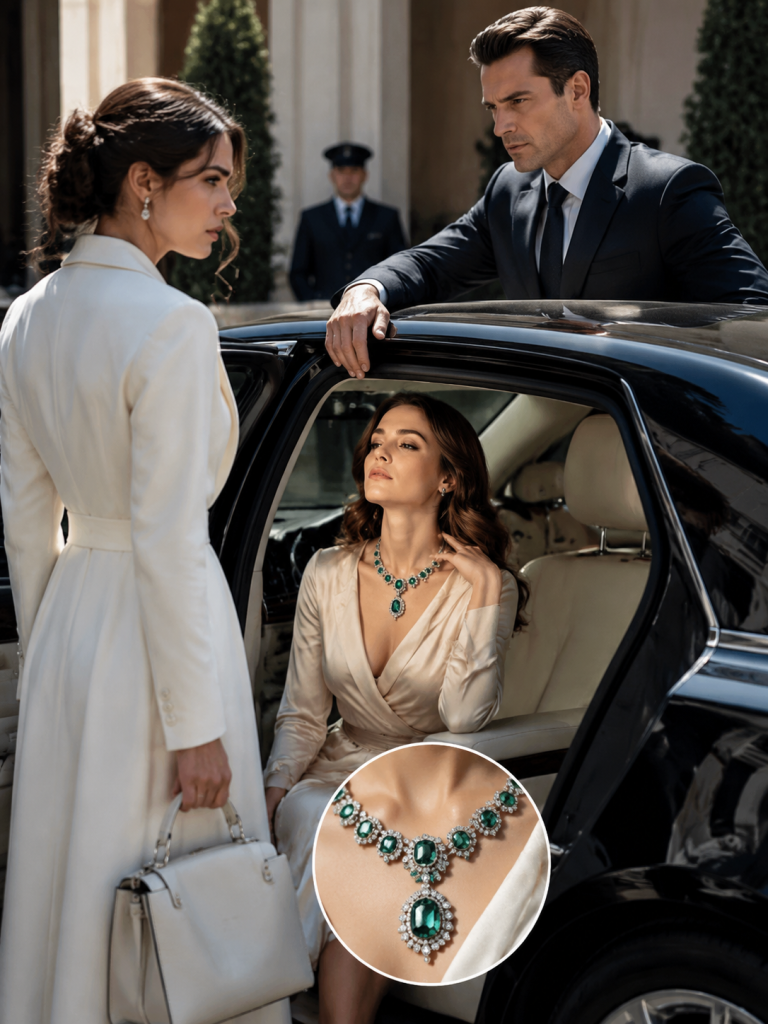
MY CHEATING EX TRIED TO HUMILIATE ME AT MY OWN PARTY — THEN A DANGEROUS STRANGER CLAIMED ME IN FRONT OF EVERYONE

**PART 1**
My ex grabbed my wrist on my birthday and told me we needed to “talk.” Before I could pull away, a stranger stepped out of the shadows, wrapped his hand around my ex’s wrist, and said, “That’s my baby you’re touching.”
The terrifying part wasn’t that he lied for me. The terrifying part was how badly I wanted it to be true.
The bass from Talia’s speakers vibrated through the floorboards of her loft so hard I could feel it in my ribs. The whole place smelled like expensive perfume, spilled rum, warm bodies, and the kind of excitement I had never known how to wear properly. String lights hung across the industrial ceiling beams like a net of tiny stars. People laughed too loudly. Glasses clinked. Someone I barely knew shouted my name from across the room because, apparently, turning twenty-five meant I was now public property for the night.
It was my birthday party, and I was hiding against an exposed brick wall, holding an untouched mojito that had been melting in my hand for almost an hour.
I hated parties. Not in the charming, quirky way people say they hate parties before dancing on tables after two drinks. I hated the pressure of them — the expectation that happiness should look loud, the obligation to smile when people sang at you, the strange loneliness of being surrounded by people who all seemed to know exactly how to be young, beautiful, careless, and alive.
I did not feel careless. I had not felt careless in a year. Not since Marcos Andrade.
Not since I found him in our apartment with another woman wearing my college sweatshirt like it was nothing. Not since he stood in the doorway, shirt half-buttoned, and had the audacity to say, “Camila, don’t make this ugly.” As if I was the one making it ugly. As if betrayal was only real when the person betrayed reacted badly enough.
For one year I had rebuilt my life around not being Marcos’s girlfriend. I went to work. I restored damaged paintings in the museum conservation lab. I learned to sleep alone. I said no to his calls until the calls stopped, then no to the messages, then no to mutual friends who thought closure was a group project.
I had done all the right things. But healing did not make me bold. It made me careful. Too careful, according to Talia.
“You look like you’re about to bolt.”
Talia appeared at my elbow with crimson lipstick still perfect three hours into the party, which felt illegal. “I’m fine,” I lied.
“Terrible lie.” She tapped her glass against mine hard enough to spill liquid over my fingers. “You hate this.”
“It’s a lot.”
“It’s your birthday.”
“That doesn’t make crowds less crowded.”
She rolled her eyes, affection softening it. Talia had been my best friend since college, which meant she’d earned the right to ignore my excuses and love me aggressively in public.
“There is someone I want you to meet,” she said, eyes brightening with a familiar, dangerous kind of mischief.
“No.”
“You don’t even know what I’m going to say.”
“I know your tone. Rafael Teixeira.” The name floated between us, handsome and unfamiliar. Talia had been dropping it into conversations for weeks with fake casualness. *Rafael collects art. Rafael has a gallery background. Rafael is intense, but in a good way.*
“Nina—” I stopped myself. “Talia.”
“He’s here somewhere,” she continued, scanning the crowd. “I invited him specifically for you.”
“Why would you do that?”
“Because you have spent a year being emotionally preserved in glass like one of your museum paintings.”
Before I could argue, someone called her name from the kitchen, and she vanished into the crowd, leaving me alone with my dying mojito and the old, familiar urge to escape.
I made it to the terrace. The moment the glass door closed behind me, the party became muffled, the music a dull heartbeat through the wall. The October air was cool enough to calm my skin. The city spread beneath the loft in glittering layers.
I gripped the railing and inhaled. For ten seconds I felt almost peaceful.
Then a voice behind me said, “Running away from your own party?”
My body knew him before my mind accepted it.
Marcos stood in the doorway, backlit by the party, looking exactly like the memory I’d spent a year trying to starve. Sandy hair falling across his forehead in that calculated casual way. Blue shirt open at the throat. Smile soft enough to fool strangers.
“What are you doing here?”
“Talia invited me.”
My stomach dropped. “She wouldn’t.”
“She thought it would be good for us to reconnect,” he said, stepping onto the terrace.
“No.”
“Camila—”
“Don’t.” He came closer anyway. I could smell his cologne — same brand, same sharp, expensive scent that used to linger on my sheets and later made me nauseous in department stores.
“I miss you,” he said softly. “Baby.”
The word hit harder than it should have. Now it made me feel handled.
“That is not your name to use anymore.” I tried to move past him. He caught my wrist. Not violently. Not dramatically. Just firmly enough to stop me. That was always Marcos’s way — nothing loud enough to become proof. Just pressure. Just possession disguised as emotion.
“Five minutes,” he said. “That’s all I’m asking.”
“Let go.”
“You never let me explain.”
“I saw enough.”
“It was one mistake.”
“It was my sweatshirt.”
His grip tightened just slightly. Not enough to hurt. Enough to remind me I was smaller.
Then another hand appeared. Larger. Darker. Stronger. It wrapped around Marcos’s wrist with casual authority.
A deep voice said, “That’s my baby you’re touching.”
Marcos released me immediately. I looked up.
The man standing beside me was not familiar, but he had the unsettling effect of making the world rearrange itself around him. Close-cropped dark hair threaded with silver at the temples. A jaw sharp enough to look carved. Dark eyes that did not merely look at people — they measured them.
“Who the hell are you?” Marcos snapped, rubbing his wrist.
“Rafael.”
The name landed. Talia’s mysterious guest. The man I was supposed to meet over polite small talk had just claimed me in front of my ex with a lie so bold it stole the breath from my lungs.
“Camila,” Marcos said, face flushing, “do you know this guy?”
I should have said no. Instead, I looked at the stranger who had stepped between me and my humiliation, and something reckless woke up inside me.
“Yes,” I heard myself say. “I know him.”
Marcos stared. “You can’t be serious. Him?”
“I believe she asked you to leave,” Rafael said, voice calm, almost pleasant. That made it more intimidating.
Marcos stormed back through the terrace door, disappearing into the party.
Only then did Rafael step away from me. “I apologize,” he said. “Talia mentioned your ex had trouble understanding boundaries. I saw him corner you, so I improvised.”
“You improvised ‘that’s my baby’?”
“It seemed efficient.”
A laugh escaped me before I could stop it.
“Are you all right?” he asked.
I looked down at my wrist, where Marcos’s fingers had left faint red marks. “I will be.”
Something cold moved through Rafael’s expression, then disappeared. “You did not deserve that.”
“No,” I said, surprised by the certainty in my own voice. “I didn’t.”
Talia burst through the door moments later. “Oh my God. What happened? Why did Marcos just leave looking like someone crushed his ego with a brick?”
“You invited my cheating ex to my birthday party.”
“I thought—”
“No. You didn’t think. You hoped.”
“I’m sorry,” she said, no performance in it this time. “I really am.”
“But you two met,” she added weakly, matchmaking satisfaction flickering despite her guilt.
“We did,” Rafael said.
“Under absolutely insane circumstances,” I added.
She vanished, apologizing and delighted at the same time, which was very Talia.
Rafael turned back to the city, giving me space instead of demanding attention. That mattered. Most men wanted credit for intervention. He simply stood beside me in the quiet, like the rescue was not a debt.
“Talia says you deal in antiques,” I said finally.
“Among other things.”
“That sounds intentionally vague.”
“It is.”
“So, Rafael Teixeira,” I said, recovering the safer rhythm of teasing. “Do you often rescue women from their exes at birthday parties?”
“Only when the ex doesn’t understand that no is a complete sentence.”
The sentence settled somewhere in me. Marcos had never understood no as complete. To him, no was the beginning of negotiation. Rafael had heard one no and acted like it mattered.
“So,” I said, surprising myself with my own boldness. “You called me your baby. Does that mean I’m yours now?”
His eyes darkened — not dramatically, just enough that the air changed. “Not yet. But I could try to earn that title, if you let me.”
“How?”
“Dinner. Tomorrow night. Somewhere quiet. No exes. No bass shaking the floor. No audience.”
I should have said no. I had known this man less than fifteen minutes. But my life had been safe for a year, and safe had started to feel like a locked room.
“Okay,” I said.
**PART 2**
He handed me his phone. I put in my number with trembling fingers. When I gave it back, our hands brushed. My whole body noticed.
“I should let you return to your party,” he said. “Camila? Thank you for saying yes.”
Then he was gone, disappearing into the crowd, leaving me alone on the terrace with my melted mojito and the terrifying realization that, for the first time in a year, I felt awake.
The next morning I woke to sunlight and immediate panic wearing regret’s coat. A message from an unknown number: *Good morning, Camila. Dinner reservation at 8. I’ll send a car at 7:30. Dress comfortably. We’re going somewhere without pretense. R.*
Normal men did not send cars. Normal men asked if sushi was okay. Rafael signed with a single letter and somehow made it feel reasonable.
By 7:00 I had changed clothes six times. At 7:30, a black Mercedes waited at the curb. The driver opened the door. “Good evening, Miss Duarte. Mr. Teixeira asked me to ensure your comfort.”
We drove to the waterfront district, to a building with no sign, just a single door and warm light along the stone. Rafael waited at the top of a narrow staircase, sleeves rolled to his elbows, looking less formal than the night before and somehow more devastating.
The private dining room overlooked the harbor. One table, two chairs, city lights trembling across black water. A chef named Diego appeared, greeted Rafael like an old friend, and served a tasting menu that made me understand why wealthy people sometimes forgot how ridiculous their lives looked from the outside.
But the food became secondary quickly, because Rafael listened — not the way men listen while waiting to talk about themselves, but like he was collecting details, like the things I loved mattered because I loved them.
I told him about art conservation. He told me his father had worked in maritime salvage — shipwrecks, recovered cargo, rare objects lifted from water after centuries of silence. “I grew up learning that value is not always obvious,” he said. “Sometimes it is covered in salt, corrosion, and someone else’s neglect.”
By dessert I had nearly forgotten that twenty-four hours earlier he’d been a stranger. Then his phone buzzed. His expression changed — carefully, not enough for most people to notice. Enough for me.
“Excuse me. Work complication.” He stepped out. When he returned, the charm was back, but something beneath it had locked into place.
“Everything okay?”
“Shipment delay.”
It was the first time I sensed a door inside him closing. Not forever. But deliberately.
**PART 3**
At my building, he walked me to the entrance. I thought he might kiss me. Instead he lifted my hand and pressed his lips to my knuckles. Old-fashioned. Almost absurd. Completely disarming.
“May I see you again?”
“Yes,” I whispered.
That night I fell asleep smiling. That should have been my first warning, because falling for Rafael Teixeira did not feel like falling. It felt like stepping into an elevator without knowing how high the building went.
Three months later, he offered me the gallery. I was in the museum conservation lab, leaning over a minor Tintoretto, when the email arrived. *I’m opening a legitimate gallery downtown. I need someone with your eye, your expertise, your integrity. The position is yours if you want it.*
Dr. Elena Cardoso, who’d mentored me since my first day at the museum, found me frowning at the screen. I handed her the phone.
“Generous?” she asked.
“Double my salary. Curatorial control. Access to private collections I’ve only dreamed of.”
“And he is also the man you’re sleeping with.”
“Yes.”
“Then your question is whether he wants your talent or your proximity.” Her voice softened. “You are brilliant, Camila. Before him. After him. Apart from him. If you accept, make the contract clean. Do not become decoration in a room you were hired to build.”
That night, at Rafael’s penthouse, he’d cooked pasta from scratch. “I’m thinking about your offer,” I told him.
“And?”
“I need to know this is real. Not a way to keep me close.”
He didn’t flinch. “It is real. The gallery has been planned for over a year, before I met you. When I realized I needed someone to run it, you were my first thought. Not because you are in my bed. Because you see what other people miss.” He slid a folder across the table. “Contract. Salary. Profit sharing. Have your lawyer review it. If you take this position, I want you there because you choose it.”
I accepted after a lawyer reviewed the contract. I gave the museum two months’ notice.
The gallery took shape like a dream with invoices. But there were moments — a painting suddenly available after the owner refused to sell for years, permits that should have taken months appearing in days, a collector who’d ignored my emails calling back ten minutes after Rafael “made an introduction.”
“How do you do that?” I asked.
“Relationships. People owe favors. People want favors. It is currency.”
“What kind of favors?”
“Introductions. Access. Information.” He smiled, but it didn’t reach his eyes. “Nothing sinister, if that is what you’re asking.”
But I hadn’t been asking about sinister. Not until he said it.
Three days before the opening, a man named Yuri walked in — expensive suit worn at the edges, Eastern European accent, gold teeth that seemed less decoration and more warning. “I am looking for Rafael Teixeira,” he said. “You are the girlfriend, yes? Camila?”
“I am the gallery director.”
He called Rafael, spoke in a language I didn’t understand, then handed me the phone. “This is Yuri, an old associate. Let him into my office. I’ll be there in ten minutes.”
“You have an office here?”
“I own the building.”
I led Yuri upstairs to an office I hadn’t known existed. Rafael arrived exactly ten minutes later — cold, not angry, cold in a way that made me understand his politeness was a choice, not a temperament.
“Payment by end of month,” Yuri said. “Month ends tomorrow.”
Rafael handed him an envelope thick with cash. Yuri counted it, satisfied, then smiled at me. “Take care of him, gallery lady. Valuable man.”
When he left, the silence felt contaminated. “What was that?”
“A payment for a shipment he facilitated.”
“In cash.”
“Some associates prefer discretion.”
“What aren’t you telling me?”
He looked tired. “My father’s business was not always clean. Maritime salvage became other things. Some cargo had questionable provenance. Some people in that world do not disappear because I prefer them to.”
“And you?”
“I have spent years separating myself from it.”
“But not completely.”
“No. Not completely.”
The opening night came anyway — a triumph with a crack running through it. Critics praised the exhibition. Collectors bought pieces. Then Marcos appeared in the doorway, drunk and furious. “There she is! My ex playing art dealer with her mafia boyfriend’s dirty money!”
Every conversation stopped. Phones came out. “You need to leave,” Rafael said, appearing at my side.
“Or what? You’ll make me disappear? Isn’t that what guys like you do?”
Rafael’s hand settled at my waist — not to hold me still, but to remind me I wasn’t alone. “Security.”
Two men I’d assumed were guests escorted Marcos out while he shouted accusations into a room that would remember them even if it pretended not to. Rafael addressed the guests with flawless control, and mostly it worked — conversation resumed, glasses lifted. But some critics left early. Some collectors whispered.
After the last guest left, I found Rafael upstairs. “Tell me the truth. About your father. About Yuri. About all of it.”
So he did. His father had moved objects for people who couldn’t use normal channels — art, antiquities, items with histories too complicated for polite paperwork. Rafael had worked inside that world from sixteen until his father died when he was twenty-eight. “When I inherited it, maybe thirty percent was legitimate. I have spent six years dismantling the rest.”
“And the gallery?”
“Part of that. Visible proof of what I am building now.”
“Or a beautiful cover.”
The words hurt him. I saw it. “You think that is what you are to me? A cover?”
“I don’t know what to think.”
His voice broke then, not loudly, but enough. “I love you.” I went still — he’d never said it before. Neither had I. “Not because you make me look legitimate. Because you see damaged things and believe they can be restored. Because when you look at me, I remember the man I am trying to become.”
I wanted to say it back. Instead I said, “I need to go home.” To his credit, he let me.
For three years, we built and broke and rebuilt. I stayed at the gallery. I stayed with Rafael. But I stopped accepting fog where clarity was owed — no hidden offices, no cash transactions through gallery property, no acquisition without complete documentation. He agreed, and more importantly, he kept agreeing in action, every day, every file, every difficult conversation. The gallery grew. My name grew with it — as Camila Duarte, director, curator, the woman critics began calling “obsessive in the best possible way” because no painting crossed our walls without provenance clean enough to survive a courtroom.
Then federal agents came. Special Agents Ferreira and Lima arrived on a gray morning with questions about several acquisitions — not the paintings themselves, but the network behind them. Shipping channels. Contacts. Names I’d heard once in phone calls and never asked enough about.
I answered carefully, truthfully, for three hours. When they left, my hands shook so badly I spilled water across my desk. Rafael called before I could call him.
“I don’t know what triggered this,” he said. “But everything in the gallery is clean. I swear that to you.”
“That may not matter if they use the gallery to reach you.”
The investigation lasted eight months — subpoenas, interviews, depositions, collectors pulling back, headlines that loved the word *scandal* more than the truth. Talia asked me the only question that mattered: “What do you believe is true?”
I believed Rafael had inherited a shadow. I believed he’d once survived inside it. I believed he’d hidden too much from me at the beginning. But I also believed the man I’d watched for three years was not building a lie — he’d severed ties that cost him millions, documented acquisitions more thoroughly than required, invited scrutiny into the gallery because he knew clean things survive light.
So when federal lawyers implied my cooperation could protect me from consequences, I told the truth. “Every acquisition I have handled is properly documented and legally obtained. Mr. Teixeira’s past is not mine to testify about before I knew him. But I can testify to his present. His present operations through this gallery are legitimate.” They asked twelve different ways whether romance had compromised me. “My ethics do not disappear because I love someone,” I said. “If anything, they are the reason I am sitting here telling the truth instead of what either side wants to hear.”
Eight months after it began, the investigation ended. No charges. Historical irregularities tied to his father’s operations, disclosed and separated. No evidence of ongoing criminal activity. The gallery fully cleared.
When Rafael called, I was alone in my office. “It’s over,” he said. My knees gave out before I could answer. I sat on the floor crying so hard I could barely breathe. “We survived,” I whispered.
“You did more than survive,” he said. “You stood in the fire and did not become anyone else.”
That evening, in the gallery after closing, he told me, “I am completely out. The investigation forced the final break. Every remaining tie to my father’s world is gone.”
“How does that feel?”
“Free.” The word sounded unfamiliar in his mouth. Like something newly restored.
Six months later, I realized my period was nearly three weeks late. The test confirmed what my body already knew.
I invited Rafael to my apartment three nights later, cooked his favorite meal, lit candles, set the table. “What is the occasion?” he asked, smiling.
I placed the test on the table. “I’m pregnant.”
For a moment he didn’t move. Then he moved around the table and knelt in front of me, no performance, no perfect control, just Rafael with his hands wrapped around mine.
“Marry me, Camila. Not because you’re pregnant — I have been planning to ask for months, and then the investigation, the fallout, rebuilding got in the way. But this?” His gaze dropped to my stomach. “This is not a complication. This is a gift. I want all of it.”
I started crying. “You don’t have to do this.”
“I know. That is why it means something.”
“Yes,” I whispered. “Yes, I’ll marry you.”
Three weeks later, he gave me the ring — designed with an artist using melted-down coins salvaged from one of his father’s shipwrecks. Gold pulled from the complicated inheritance he’d spent his adult life transforming. Reshaped into something clean. Something chosen.
“I cannot promise simplicity,” he said, slipping it onto my finger in the gallery after hours. “But I can promise honesty. Loyalty. Every day of trying. I can promise our child will know a father who chose light deliberately, not because it was easy, but because their mother made truth feel possible.”
I looked at the ring through tears and thought, for once, not of Marcos — not his betrayal, not his hand on my wrist, not the night he tried to humiliate me in front of everyone. I thought of the terrace. The city lights. The stranger who’d lied for me before he ever had the right.
*That’s my baby you’re touching.*
Back then, it had been a reckless sentence. A rescue line. A shield. Now, standing in the gallery we’d defended together, carrying the child we hadn’t planned but already loved, I understood something that made my chest ache.
Rafael had not saved me from Marcos. Not really. He had only interrupted the moment when I was finally ready to stop shrinking. I saved myself when I said yes to dinner. I saved myself when I demanded contracts, boundaries, and truth. I saved myself when I testified honestly, not as a girlfriend protecting a powerful man, but as a woman protecting the work she’d built with her own name.
And Rafael saved himself too — not through me, not because of me, but beside me.
That was the love story people always got wrong. They wanted the dangerous man and the innocent woman, the rescue, the glamour, the scandal. The truth was harder and better: a damaged woman learned she was not fragile. A powerful man learned legitimacy was not something he could buy — it was something he had to practice. A gallery survived because every document was clean. A love survived because neither of us asked the other to lie.
And a baby was coming into a world we had fought, piece by piece, to make worthy of them.
Years later, people would still whisper about the night Marcos shouted accusations at the opening. They would still ask if Rafael’s past scared me. They would still say our story sounded impossible.
I would tell them the same thing every time: love did not make the past disappear. It made us brave enough to face it honestly. And honesty, in the end, was the only thing strong enough to build a future on.