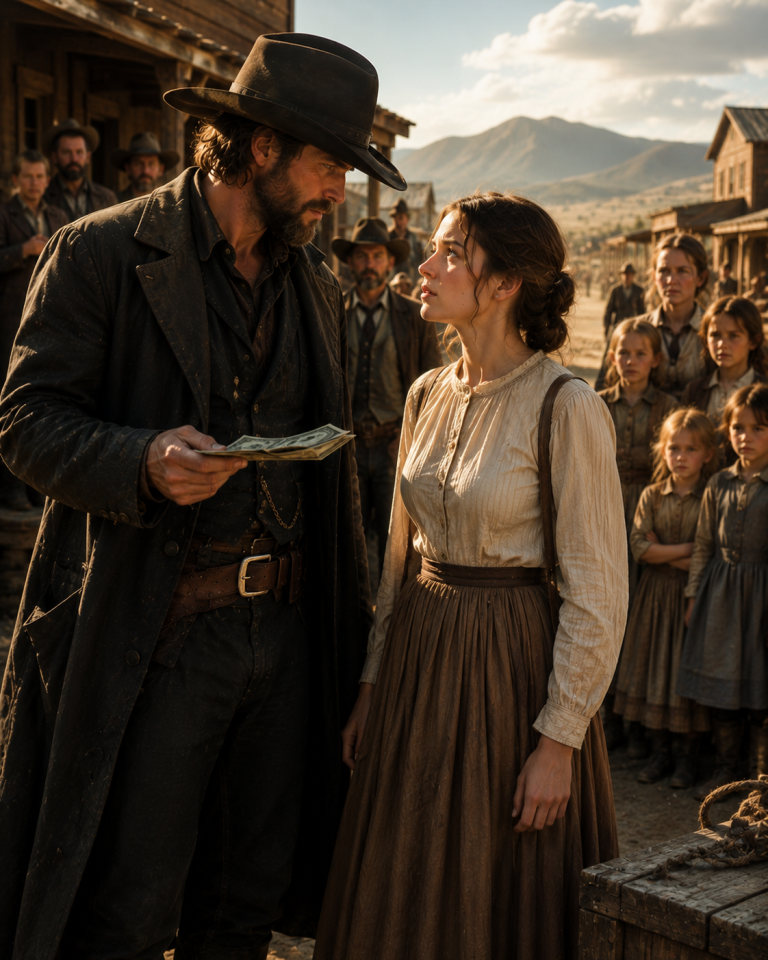
The Cowboy Gave His New Bride One Cold Order—Then Broke Every Rule She Thought He Lived By

She fired. The recoil nearly broke her wrist. The shot went wide, punching the wall behind him. He stopped laughing and started advancing. She fired again, closer this time. “I’ve got six shots,” she said, steadier than she felt. “Eventually I’ll hit something important.” Behind Dalton, Caleb had subdued his opponent and was reaching for his rifle with his good arm. The third gunman looked between the woman holding a gun on him and the sheriff retrieving his weapon, calculated the odds, and came up short — turned and bolted out the door. Dalton looked between Lillian and Caleb, made the same calculation, and found it wanting. “This isn’t over,” he snarled.
“Yeah, it is,” Caleb said, rifle now trained dead center on Dalton’s chest. “Drop it. Now.”
For one long moment Lillian thought he might choose to go out shooting. Then the gun clattered to the floor and his hands went up.
Deputies hauled Dalton and his men to the cells. A doctor confirmed the bullet had gone through Caleb’s shoulder clean, missing anything vital by inches. That night, lying beside him despite his protests that he was fine, Lillian said quietly, “I shot at a man. Actually pulled the trigger, intending to hurt him.”
“You defended us. That’s not wrong.”
“It doesn’t feel right either.”
“Welcome to the West,” he said. “Where survival means doing hard things and living with it after.”
Dalton’s trial came weeks later, the whole town turning out. His lawyer tried to paint the massacre as a misunderstanding, the shooting carried out by men Dalton “couldn’t control.” Then they called Lillian to the stand. She described the attack in steady, unflinching detail, and when the defense tried to suggest she’d misunderstood Dalton’s intentions toward her — “perhaps he meant to help you by killing everyone else first” — the gallery laughed outright and the judge banged his gavel.
“I was there,” Lillian said, voice hard. “I watched people die. I ran for my life. And that man would have sold me like cattle if he’d caught me. Don’t you dare suggest I misunderstood.”
Guilty on all counts. Dalton would hang within the month. Outside the courthouse, her hands shook as the reality hit. “A man’s going to die partly because of my testimony,” she said.
“A man’s going to die because he murdered innocent people,” Caleb corrected. “You just told the truth. Doesn’t make it easier.” “No, it doesn’t.” That night she lay awake seeing Dalton’s face when the verdict was read — no remorse, only cold calculation. “He’ll die hating us,” she whispered. “Probably,” Caleb said. “But he can’t hurt us anymore. The law got him. That’s the best we can hope for out here.”
The school opened officially that September in a real building — fresh wood, large windows, shelves slowly filling with books ordered from back east. Twenty-three students on the first day, nearly double where she’d started. “Welcome,” Lillian told them, “to the first day of the rest of your education.” Among them was Emma, Dutch’s daughter, who raised her hand and asked what Lillian meant by that. “It means this is just the beginning. What you learn here, you’ll carry with you forever. It’ll open doors, create opportunities, let you build whatever life you choose.” “Even if we want to stay here?” Tommy Brennan asked — his father had eventually relented and let him back. “Especially if you want to stay here,” Lillian said. “Education isn’t about leaving. It’s about choosing. Knowing enough to decide what you want, then having the skills to achieve it.” In time, Emma would become the territory’s first female physician, and would tell Lillian she never would have believed it possible without a teacher who’d told her plainly, “If you want it badly enough and work hard enough, you can do anything. That’s what education is for — opening doors people say are closed.”
When the territorial governor toured Iron Ridge considering it for official incorporation, the whole town scrambled to present its best face — fresh paint on buildings, the main street graded smooth, even decorative bunting Caleb thought was excessive. “It’s a governor, not royalty,” he said. “It’s our future,” Lillian countered. “We need to show him what we’re building toward.” The governor, visibly unimpressed by the town’s size, asked exactly that: what were they building toward? Lillian stepped forward before anyone else could answer. “Sustainability,” she said. “Education that creates skilled workers, services that support residents and travelers both, a community strong enough to weather difficulties and smart enough to plan for growth.” He toured the school himself, watched students recite poetry and solve arithmetic and present a history report with a confidence that made Lillian’s chest swell with pride, and asked her hard questions the older students fielded without flinching. “Most men wouldn’t allow their wives such independence,” he observed afterward. “Most men aren’t married to women capable of running successful institutions,” Caleb said, appearing in the doorway. That evening, the governor announced his recommendation: provisional incorporation, full status pending continued development. The room erupted in cheers. Iron Ridge had a future — and Lillian’s investment, her trust, her stubborn refusal to give up on a dusty church schoolroom, had built it.
That night, walking home under a sky full of stars, Caleb asked her, not for the first time, whether she ever regretted how they’d started — the contract, the forced marriage, all of it.
“Sometimes I regret how it happened,” she said. “I never regret where it led us. It made us stronger.”