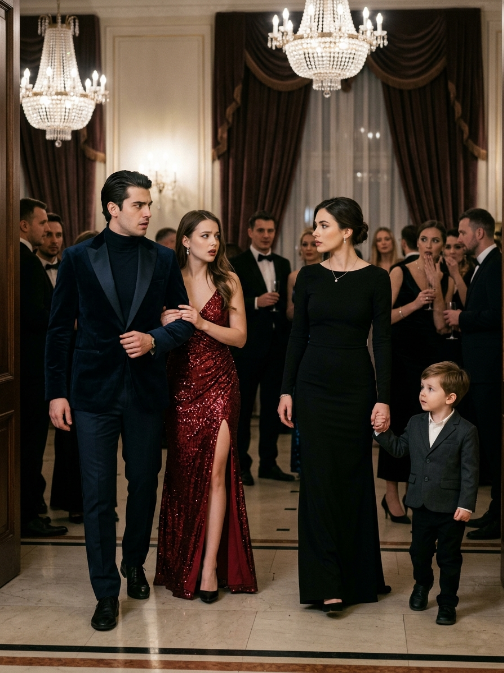
No One Could Tame the Mafia Boss’s Daughter—Until a Waitress Stepped Into the Chaos

## PART 1
The girl had not slept in three days.
That was the fact nobody mentioned when they described Calla Reyes as a monster. They said she bit. They said she locked people in rooms, smashed things, screamed until her throat gave out. They said she was uncontrollable, unreachable, too far gone for normal methods. The file her pediatrician had forwarded to the latest specialist used the phrase *”severe behavioral dysregulation”* with the specific fatigue of someone who had run out of better language.
What the file did not say was that the girl had not slept more than two hours at a stretch since the night her mother died.
Nobody thought to mention that.
I didn’t know any of this when she upended the bread basket onto the floor of Orsino’s and fixed me with a stare that was equal parts fury and something older, something I recognized the way you recognized weather before it arrived.
My name is Rue Calloway. I am twenty-six years old, I work double shifts, and I have been carrying my dead mother’s debt for eleven months now. I notice things about children who are not sleeping because I spent the last year of my mother’s life as the person who stayed awake in hospital rooms watching her breathe, and when you watch someone that carefully you learn what ordinary exhaustion looks like versus the exhaustion that comes from being afraid of closing your eyes.
Calla Reyes was afraid of closing her eyes.
She sat in the corner booth of Orsino’s with the posture of a soldier — upright, braced, scanning — and the face of a child who had been told to behave and did not understand why behaving was supposed to help anything.
The restaurant was the kind of place that required reservations three weeks out and had a host whose only job was to make wealthy people feel acknowledged. The lighting was amber and forgiving. The linen was heavy. On any other Tuesday, it would have been quietly beautiful.
On this Tuesday, a nine-year-old girl was systematically destroying it.
She had arrived attached to a man I recognized before I properly looked at him — the way you recognized certain weather, certain gravity, a quality of attention that made a room adjust its posture. Rafael Reyes. I had heard his name in the specific hushed way people used it when they meant to imply more than they were saying.
He was not a good man, by any organized legal definition.
He was also, apparently, a father who had no idea how to help his child.
The crash that brought every head up was not the bread basket. It was the water carafe — a full one, crystal, expensive, that Calla swept from the table with one straight arm and watched shatter on the floor with something that was not satisfaction but looked like control. Like she had needed something to happen and had made it happen herself.
Her father froze.
His security moved.
Calla grabbed the steak knife from the empty place setting beside her.
Not to threaten anyone.
She pressed it against her own chest with both hands, elbows out, a child building a wall out of the only thing that had made the adults in the room stop.
“Calla,” Rafael said, his voice doing the specific thing voices did when men who were accustomed to commanding silence found it failing them.
She looked at him.
Not with hate.
With the exhausted defiance of someone who had already tried everything and was now at the wall at the end of trying.
I lowered my tray onto the service station.
The other server grabbed my arm. “Don’t. That’s Rafael Reyes.”
“I know.”
“He owns three neighborhoods.”
“He doesn’t own her,” I said.
I stepped forward.
One of the security men blocked me — not aggressively, just a wall of suit and caution.
“She’s going to hurt herself if you crowd her,” I said.
The man looked at Rafael.
Rafael looked at me.
He had the face of someone who had not slept properly in a long time either. Handsome in the way certain structures were handsome — correct, proportionate, entirely functional, and somehow cold for it. His eyes were dark and direct and currently doing the thing eyes did when a person was measuring whether someone was a threat or an idiot.
I sat down on the floor.
Not crouched. Not hovering. Sitting, cross-legged, directly on Orsino’s imported stone floor, far enough from Calla that she would have to choose to reach me.
A sound moved through the restaurant. Not quite a gasp. More like everyone swallowing their own intake of breath at once.
Calla stared at me.
I put my hands palms-up on my knees.
“Hi,” I said.
She said nothing.
“My name’s Rue.”
“I don’t care.”
“That’s fine.”
She watched me with the focused suspicion of someone waiting for the trick.
“I’m not going to tell you to put the knife down,” I said.
Something shifted in her face.
“The other ones always want the knife,” she said.
“I want to know why the glass sounds wrong to you.”
The shift became something else.
She looked at the broken carafe on the floor.
Then back at me.
And I watched the moment — the very specific moment — when the armor cracked just enough to let something honest through.
“How do you know it sounds wrong?” she whispered.
“Because you looked at it after. Not away. At it. Like you were checking if it would keep going.”
Her chin trembled.
“It doesn’t stop,” she said.
“The sound.”
“It keeps happening.” Her voice was barely above breathing. “Every time something breaks.”
I nodded slowly.
I did not say *I understand* because that was a phrase children recognized as a lie.
I said: “Tell me what it sounds like.”
And that was when Rafael Reyes, for the first time in all the months since his wife died, went completely still in a way that had nothing to do with danger.
He went still the way a person went still when they were hearing something true.
Calla looked at me for a long, measuring moment.
Then she set the knife on the floor between us, gently, and said: “Like the window.”
And the sound that left her father’s chest was not a word.
—
## PART 2
I already knew what window.
Not the specifics — not yet — but I knew the shape of it. The sound of breaking glass that lived inside a body and played itself back at intervals, triggered by nothing visible, stopping nothing, explaining itself to no one.
My mother used to flinch at cabinet doors.
After three years of watching that, I could spot the same reflex in someone else without being told what to look for.
I moved very slowly, the way you moved around something that might startle.
“When the glass broke just now,” I said, “where did it take you?”
Calla’s breath caught.
“Back,” she said.
“Where is back?”
She looked at her hands.
Her voice arrived in pieces.
“The car. The light was wrong. Then the sound.”
Rafael was standing so still that the nearest security guard had taken a small step away, as if proximity to that particular stillness might be dangerous.
I kept my eyes on Calla.
“Did you know it was going to happen?”
“No.” She pressed her palms flat on her thighs. “Mommy did.”
Silence.
I did not push.
After a long moment, Calla continued, voice flat with the effort of saying it plainly:
“She undid my belt. She pushed me down. Then the sound came.”
I heard one of the guards release a breath.
“She kept you safe,” I said.
“She’s gone.”
“Yes.”
“Everyone says she would want me to be okay.” Calla’s face twisted. “I don’t want to be okay. I want her to not be gone.”
There was nothing useful to say to that.
So I didn’t try.
I reached into my apron pocket and took out a clean linen napkin, folded it into a square, and held it out across the space between us — an offering, nothing more.
“When the sounds come back,” I said, “sometimes it helps to have something to hold that isn’t the thing you’re afraid of.”
Calla looked at the napkin.
Then she looked at me with the ancient, testing suspicion of a child who had learned that kindness was often just damage with better timing.
“People lie,” she said.
“All the time,” I agreed.
“To me especially.”
“I believe you.”
She took the napkin.
Held it in both hands.
Her breathing slowed by a fraction.
Then she looked past me at her father, and for a moment the mask was entirely gone.
Just a child looking at the one person she most wanted to help her, watching him fail to.
Rafael looked back at her.
And I saw it then — the thing I had not expected to see on the face of a man whose name made grown adults lower their voices.
Not coldness.
Not power.
Grief.
The specific, raw, non-functional grief of someone who had lost the person who knew how to do this, and had been failing alone ever since.
I picked up the knife from the floor and set it quietly on the nearest table.
No one moved toward it.
Good.
“She needs somewhere quiet,” I said.
Rafael nodded once.
We moved to the private dining room.
Calla would not release my sleeve.
—
## PART 3
The private room at Orsino’s was designed for secrecy.
No windows facing the main floor. Thick walls. The kind of door that let the sound of other people’s conversations in but not out. I had always found it slightly airless. Tonight it felt like a pressurized chamber we had brought exactly the wrong amount of intensity into.
Calla sat in the large leather chair at the end of the table with her legs tucked beneath her and the napkin still in both hands. The immediate crisis had drained out of her, which I knew from experience meant approximately twelve minutes before her body caught up to the adrenaline and she crashed into exhaustion.
I went to the kitchen. Made pasta with butter and parmesan, the way my mother made it when I was sick: simple, warm, nothing you had to think about. Added sliced strawberries because there were some on the prep counter and something in me said this child needed color.
Marco, the sous chef, watched me without comment. He was sixty-two and had worked in this kitchen for nineteen years and had opinions about food but almost none about people’s choices.
“Chocolate milk?” I asked.
He pointed to the back fridge.
I poured it into a wine glass because the kitchen had no plastic cups and it seemed like the kind of absurd gesture that might produce a reaction.
It did.
Calla stared at the glass.
“That’s chocolate milk.”
“Yes.”
“In a crystal glass.”
“Orsino’s doesn’t do paper cups.”
She looked at it for another second.
Then: “Does it taste better?”
“I have no idea. Try it.”
She tried it.
“No,” she reported. “But it looks more important.”
I sat across from her and waited while she ate. Not watching, not hovering, not doing the thing adults did when they were anxious and tried to fill space with questions that were really instructions in disguise.
Rafael sat at the far end of the table.
He was doing the same thing I was, I realized — watching without watching, alert without announcing it. He had loosened his tie. It was the first thing that had changed about his appearance since he walked in. Something about it made him look less like architecture and more like a person.
Calla ate without speaking.
Halfway through the bowl she looked up at Rafael and said: “Am I in trouble?”
He opened his mouth.
I saw the effort it cost him to say: “No.”
She studied him.
“Usually I’m in trouble.”
“Not tonight.”
“Why not?”
He looked at his hands.
“Because tonight I finally understood that what I thought was trouble was something else.”
Calla considered this with the seriousness of someone for whom understanding adults was a survival skill.
“Something else like what?”
“Like being in pain.”
She looked at him for a long time.
Then she went back to her pasta.
After a while, she said: “The lady sings.”
Rafael’s hand stilled on the table.
I looked up.
“What lady?” he asked.
Calla shrugged, but it was the careful shrug of someone who had tried saying this before and been told they were wrong.
“At home,” she said. “The voice in the wall. The upstairs part.”
“The east wing,” I said, not quite asking.
Rafael looked at me sharply.
“How did you—”
“She said it earlier. In the car. I paid attention.”
His jaw moved once.
“The east wing is closed.”
“She doesn’t seem to know that.”
Calla was watching this exchange with the focused patience of someone accustomed to adults having conversations over her head that were actually about her.
“She sings the same song every night,” Calla said. “The one Mommy used to sing.”
Rafael went somewhere inside himself.
I could see it — the way his face went from controlled to contained, a different quality of stillness.
“Calla,” he said carefully, “that wing has been locked since before your mother died.”
“I know.”
“There’s no one there.”
“I know what you think,” she said. “But I hear her.”
“Your mother is—”
“It’s not Mommy.” Calla looked at him directly. “The singing is different. The voice is older. I looked up the song. It’s not one Mommy knew.”
I watched Rafael process that.
“You looked it up.”
“I wrote down the words and searched them.”
He stared at his daughter.
The daughter who he had been told was unreachable, unmanageable, beyond help — had been systematically investigating the voice in the wall for months.
“What did you find?” I asked.
Calla reached into the pocket of her dress — the velvet was creased and damp and had clearly been twisted by nervous hands through the evening — and removed a folded piece of paper.
She placed it on the table.
I opened it.
A song title. A composer. A date.
And beneath it, in a child’s careful handwriting:
*This song was played at the funeral of someone named Isobel Reyes (1945–2003). Grandma?*
I looked at Rafael.
His face was blank in a way that was not blankness.
“Your grandmother’s name was Isobel,” I said. It was not a question.
He said nothing.
“Rafael.”
His eyes came back to the room.
“My grandmother died when I was seven,” he said. “She never lived in that house.”
“But she visited?”
He looked at Calla.
Then at the paper.
“Once,” he said. “For a week. When I was first married.”
Calla pulled the paper back and tucked it into her pocket.
“She came back,” Calla said simply. “I think she’s watching the room.”
“What room?” I asked.
Calla looked at her father.
“The one with the blue crib,” she said. “The one you keep locked.”
The blood left Rafael’s face so completely and so quickly that I reached across the table on instinct.
He looked at my hand on his arm.
Then at Calla.
“How do you know about that room?” he said.
His voice was very controlled.
Calla put down her fork.
“Because the door was open once. I was six. I looked in before someone closed it.” She paused. “There was a mobile above the crib. Stars and moons. And a blanket folded in the corner that was yellow with small rabbits.”
Rafael’s eyes closed.
When they opened, they were wet.
“I told myself you were too young to remember,” he said.
“I wasn’t.”
“Calla—”
“There was a baby in the crib,” she said.
The room stopped.
I felt it — the specific quality of a silence that comes when something enormous is about to arrive.
“For one week,” Calla said. “I saw him three times. He had your mouth.” She touched her own chin, demonstrating. “Then the room was locked and no one said anything and I knew I wasn’t supposed to ask.”
Rafael’s breath came out in a single ragged movement.
I sat very still.
“Where is he?” Calla asked.
The question was entirely calm.
A child who had been waiting four years for the right moment to ask it out loud.
Rafael pressed the heel of his hand to his mouth.
Then, from the far end of the private dining room, a sound entered through the ventilation that made every hair on my arms stand upright.
A woman’s voice.
Thin, distant, muffled by stone and plaster and the distance of a dozen rooms.
Singing.
The melody was exactly what Calla had written on that piece of paper.
Calla said nothing.
She simply looked at her father.
He was already reaching for his phone.
—
Josiah — I mean Rafael, though in that moment all his careful control had fallen entirely away and what was left was just a man — moved through his own house like a stranger.
I followed because Calla would not release my hand.
The estate was the kind of building that had been designed to intimidate. High ceilings. Corridors that ran in multiple directions. Staircases that didn’t announce themselves. The east wing had been sealed with the quiet efficiency of a man who was good at making things disappear and had tried to make a grief disappear this way.
The door at the end of the east wing corridor was steel-reinforced, code-locked, and had been sealed for four years.
It was standing open.
Not broken open. Not forced.
Simply open, the way a door was open when someone had unlocked it from the inside.
Rafael stopped six feet from the threshold.
The singing was coming from inside.
I could see light under the door. Not overhead light. Something lower, warmer. A lamp, possibly, or a candle.
One of the guards stepped forward.
Rafael raised his hand.
“No,” he said.
He walked to the door himself.
Pushed it open.
The room beyond was the blue room Calla had described, and it was exactly as she had said: pale blue walls, a white crib with a mobile of stars and moons still suspended above it, a yellow blanket folded across the end with small embroidered rabbits. Dust on every surface. The particular held stillness of a room that had been sealed away while still occupied by the things inside it.
In the old upholstered chair near the window sat a woman.
She was perhaps sixty. Silver-haired, slight, wearing a dress that was not fashionable but was carefully pressed. Around her throat was a faded blue scarf — not red, I noted, not Valentina’s colors at all, though in a child’s frightened memory at a window, colors could transform.
In her arms, asleep, was a small boy.
He was perhaps five years old.
His dark hair was cut close, his face slack with the deep unconsciousness of a sleeping child. One arm was thrown over the side, his fingers lax, his whole body the specific boneless weight of true sleep.
He had Rafael’s face.
Not resembled. Had.
The jaw, the brow, the slight downturn at the corners of the mouth that gave even relaxed features a quality of seriousness.
The woman looked up when the door opened.
She did not look surprised.
She looked like someone who had been waiting for this conversation for a long time and was simply glad it had arrived.
“You took longer than I expected,” she said.
Rafael’s voice came from somewhere he had not used in years.
“Catalina.”
I looked at him.
“You know her.”
“She was my wife’s housekeeper,” he said. “Before.”
Catalina looked at the sleeping boy.
“When they took Valentina,” she said, “I was the only one who knew about him. She had kept him hidden from you. She was afraid.”
“Of me?” Rafael’s voice cracked.
“Of the world you would bring to him.” Catalina’s eyes held no accusation, only the weary honesty of a woman who had been carrying a fact for four years and was ready to put it down. “She believed if he was connected to your name, he would not survive. She asked me to keep him somewhere safe until—”
“Until she could take him herself,” Rafael said.
Catalina nodded.
“She didn’t survive to do that.”
“No.”
“And you kept him.”
“I raised him. In a house outside the city. With my sister.” She looked down at the boy’s face. “But I am old, and I cannot give him what he needs. And I have been watching Calla from a distance for two years, and she has been listening to this room for just as long, and I thought—”
She looked at Calla, who was standing in the doorway.
“I thought perhaps she was ready to know. And perhaps you were ready to be told.”
Calla walked into the room.
I let her go.
She stopped beside the chair and looked at the boy for a long time with the focused intensity she brought to everything that mattered.
Then she looked at Rafael.
“He has your mouth,” she said.
Her voice was exactly what it had been at the dinner table. Calm, certain, patient.
“I told you.”
Rafael crossed the room.
He knelt beside the chair.
He looked at his son for a long time without touching him, the way you looked at something you were afraid to disturb because disturbance might prove it was only a dream.
The boy stirred.
His eyes opened — dark, sharp, his father’s eyes — and found Calla first, which made sense because she was closest and at eye level.
“Who are you?” he said.
“Calla.” She sat down on the floor beside the chair, putting herself at his level. “I’m your sister.”
He regarded her with deep seriousness.
“I don’t have a sister.”
“You do now.”
He thought about this.
“Okay,” he said.
Then he looked past her to Rafael, and his small face rearranged itself into the expression children made when they were meeting someone new and important and trying to understand what they were supposed to do about it.
Rafael touched his son’s cheek with one finger.
His hand was shaking.
“His name?” he said to Catalina, not looking away from the boy.
“Valentina called him Marco,” Catalina said. “I kept it.”
“Marco,” Rafael said.
The boy looked at him.
“Are you my father?” he said.
The directness of a five-year-old who had been wondering about something for long enough that he had decided to simply ask.
“Yes,” Rafael said.
Marco considered this.
“You took a long time,” he said.
Something broke in Rafael’s face and reassembled into something entirely human.
“Yes,” he said. “I did.”
“Why?”
“Because I didn’t know.”
Another silence. The child’s eyes moved over his father’s face with the same measuring quality Calla had.
“Are you going to keep me this time?” Marco asked.
Rafael picked up his son.
The boy went without stiffening, which told me more about Catalina’s care than anything else could have. A child raised in fear did not go easily to a stranger. A child raised with love was simply curious.
Rafael held Marco against his chest and closed his eyes.
One breath.
Two.
The singing had stopped.
The room was warm and still and full of the particular weight of four years of a missing thing suddenly found.
I stood near the doorway and watched the family in the blue room assemble itself out of grief and secrets, and I thought about my mother, who had also kept things to protect me and had also been wrong about whether protection and truth could coexist indefinitely.
Calla found her way to her father’s side and stood very close without quite touching him.
Rafael looked down at her.
His free hand moved and settled, very gently, on top of her head.
She stood completely still.
Then she leaned in.
—
Later — much later, when Marco had been properly fed and had fallen asleep in the blue room’s crib for the first time in his life with his mobile turning above him, and Calla had fallen asleep in the chair beside it, and Rafael had stood at the window for a long time not saying anything — Catalina found me in the hallway.
She was small and very tired and moved like someone whose body had been arguing with her for a while.
“Thank you,” she said.
“You did the work,” I said. “You kept him safe for four years.”
“Yes.” She looked at the closed door. “But he needed someone to open the right door first.”
She looked at me.
“He had been trying to reach Calla for months,” she said. “She had been trying to reach him. But they could not find the right language for it.”
“Children’s grief doesn’t always find language easily.”
“No.” She studied me. “You have been through it.”
“My mother. Last year.”
She nodded once, the brief acknowledgment of someone who knew that more words would not help.
“The girl trusts you,” she said.
I looked at the door.
Through it, sleeping children.
“I didn’t do anything special,” I said. “I just didn’t pretend her feelings were the problem.”
Catalina smiled.
“That is the special thing,” she said. “Most people cannot manage it.”
She left to collect her things. I stayed in the hallway, my back against the wall, and let the exhaustion arrive properly — the kind that came after the adrenaline, the careful measured movement, the sustained attention of a long difficult evening.
Rafael found me there ten minutes later.
He stood at the opposite wall and we looked at each other across the width of the corridor.
He was holding a glass of water that he held out toward me.
I took it.
“You should go home,” he said.
“Probably.”
“I’ll have someone drive you.”
“I can call a car.”
“I know you can.” A pause. “I’d prefer you let me.”
I looked at the glass.
“That’s a very careful way of asking something.”
“I am practicing.”
I looked at him.
The man at Orsino’s and the man in this corridor were not entirely the same person. The weight was the same. The watchfulness was the same. But something had cracked open in the last three hours that was going to require him to make different decisions about who he was going to be, and I could see him beginning to understand that.
“How long has she been like this?” I asked.
“Since the accident.”
“Twenty months?”
“Twenty-three.”
“Did you know about the trauma response? The sound triggers?”
He looked at the ceiling.
“The therapists used different language,” he said.
“Did any of them sit on the floor with her?”
He looked back at me.
“No.”
“Then they were using the wrong language.”
He was quiet for a moment.
“I should have sat on the floor with her.”
It was not a question.
“Yes,” I said. “But you’re going to now.”
He looked at the door.
“I don’t know how.”
“You’re going to learn,” I said. “Both of them need you to learn.”
He turned the glass in his hands. The water caught the hallway light.
“I want to offer you a position,” he said. “With Calla. And now Marco.” He paused. “Before you refuse — which I expect you to do — I want to say that I am not trying to purchase your time as a commodity. I am asking whether you would consider being part of a household that is attempting to become something it has not been.”
I thought about that.
“What has it been?”
“A place that looked like safety and functioned like a prison.” His voice was flat with self-assessment. “I want that to change. I don’t know how to do it on my own.”
“You’ll need to do most of it on your own,” I said. “I can’t replace a parent.”
“I know.”
“Or a therapist.”
“I know that too.”
“Or their mother.”
“Yes.”
I looked at the floor.
Eleven months of my mother’s debt.
Fifty-three dollars and change.
A broken heater and a landlord whose patience had been gone since August.
I thought about Calla’s voice: *People lie.*
I had told her: *All the time.*
But I had also told her I would come back.
“I would need to bring my own things,” I said.
He waited.
“And I would need the children’s schedules to come through me, not around me.”
“Yes.”
“And you would need to come home for dinner when it was possible. They need consistency from you specifically, not just from whoever I am.”
A muscle in his jaw moved.
“That will require changes.”
“Good.”
He looked at me steadily.
“Is that a yes?”
I thought about Calla asleep in the blue room with her napkin still in one hand and her brother’s mobile turning above them both.
I thought about Marco’s voice: *You took a long time.*
I thought about what it cost to have no one sit on the floor beside you, in language or in fact.
“For now,” I said. “We’ll see how honest you can manage to be.”
He accepted that with a nod.
Down the hall, the blue room was quiet.
In the morning, two children would wake in the same room for the first time.
In the morning, there would be a conversation that would be hard and then harder and then, eventually, something else.
In the morning, grief would still be in the house — it did not leave just because you had finally named the rooms that held it.
But the walls had stopped singing.
The door was open.
And sometimes, in the lives of children who had been waiting too long to be seen, that was exactly where everything began to turn.
—
*THE END*