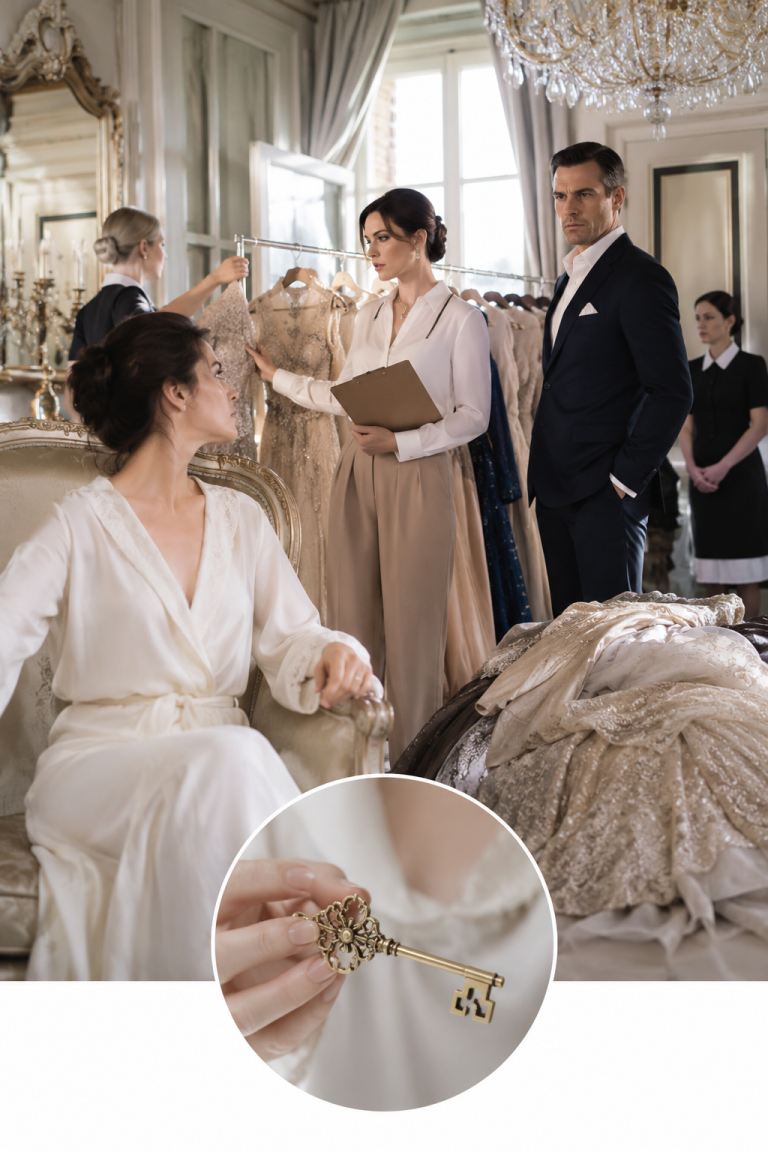
MY HUSBAND THREW HIS MISTRESS’S BRIDAL SHOWER IN MY DEAD MOTHER’S HOUSE — SO I LOCKED EVERY GATE AND LET THEM ALL WATCH

Part 1
The photo landed on my phone while I was still wiping rain off my mother’s headstone.
Pink roses filled my foyer. White gift bags sat under the chandelier she’d shipped home from Paris the year before she got sick. Women who used to air-kiss me at charity luncheons stood in my marble hall, lifting champagne flutes to the woman my husband had been sleeping with for the better part of a year.
Gold script drifted across the video.
*Future Mrs. Sterling.*
I stared at those two words until the rain smeared the screen. Then I called him.
Marcus picked up on the third ring, already annoyed, like I’d interrupted something that mattered more than me. “Camille,” he said, “don’t make this ugly.”
Behind him, women laughed inside my house. Inside my mother’s house.
“Is Delphine having her bridal shower at Windmere?” I asked.
He exhaled like I was the inconvenience. “It was already arranged.”
My hand closed around the stem of the white rose I’d brought for my mother’s grave. “You arranged a bridal shower for your mistress in my home while I was burying myself in grief at a cemetery.”
“She’s not my mistress anymore,” he said, flat, like he was correcting a typo.
That was his first mistake. Grief makes some women scream. It made me go very, very still instead.
“Cancel it,” I said.
“Too late.”
Then, because he’d already decided he’d won, he added, “Try to have some dignity for once.”
I looked down at the wet grass over my mother’s grave. Josephine Ashford had taught me exactly two things before cancer took her voice for good: never beg a man to choose you, and never show anyone what you own until they force your hand.
I hung up. Then I called my head of security.
“Close the gates,” I told him.
Nathaniel Cross didn’t hesitate. “Yes, Mrs. Sterling.”
Thunder rolled over the Connecticut hills like something delivering a verdict. By the time I reached Windmere House, every guest inside was trapped behind black iron, every camera in the building was already recording, and every woman in silk understood, all at once, that something had gone catastrophically wrong.
The shower ended before a single gift was opened.
—
Windmere sat at the end of a private drive behind twelve acres of clipped hedge and stone walls older than most of the money that surrounded it. Locals called it a mansion. My mother called it a warning — *beautiful things attract people who want to own them,* she used to say, back when I still thought love made people gentler instead of hungrier.
I was thirty-four when I walked through those front doors in a wet black coat, my mother’s pearls at my throat, and watched a valet I’d never hired try to decide whether to take my keys. He recognized me a half-second too late.
“Mrs. Sterling,” he stammered.
I handed him the keys. “Park it carefully.”
Inside, the air smelled like peonies and champagne and betrayal. Pink roses climbed the banister. My mother’s portrait had been taken down from the center wall and replaced with a blown-up engagement photo of Marcus and Delphine Reyes — she in ivory, he wearing the exact smile he’d given me in Nantucket the year he swore there would never be anyone else.
Gift bags leaned against the antique console my mother had carried home from Milan, each one stamped *D + M.*
The laughter died in layers — first near the staircase, then around the champagne bar, then Delphine herself, standing under my chandelier with a flute in one hand and my grandmother’s sapphire brooch pinned to her bodice.
That was the thing that nearly cracked me open. Not the roses. Not the photograph. The brooch. My grandmother had worn it to a state dinner in 1962. My mother had worn it the day she saved Ashford Properties from a hostile takeover. I had worn it on my wedding day because Marcus once told me he loved the way blue looked against my skin.
“Camille,” Delphine said, soft enough to carry. “I didn’t know you’d be back so soon.”
She’d known exactly where I was. She’d wanted me to find the house already claimed.
Marcus appeared from the library, tall and blond and immaculate, the kind of man built to stand near fireplaces and lie into microphones. His mother, Margaret Sterling, trailed behind him in cream cashmere and diamonds worn at two in the afternoon, looking at me like I was staff who’d wandered in unannounced.
“We need to talk privately,” Marcus said, crossing toward me.
“No,” I said.
The room went quiet enough that the rain against the windows started to sound intentional.
His jaw tightened. “This isn’t the time.”
“I agree,” I said. “This was never going to be the time.”
Delphine’s engagement ring caught the light — ten carats, oval, platinum, the exact style I’d once told Marcus I hated because it looked like a trophy instead of a promise. He’d bought it for her anyway. Or perhaps not bought. That question would matter later.
He leaned in close enough that only I could hear him. “You’re embarrassing yourself.”
I looked at his face and watched nine years of marriage flicker across it — our first apartment, the night he cried in my lap after his father called him worthless, the three miscarriages he’d stopped mentioning after the second one, the mornings he came home smelling like someone else’s perfume. Then it was gone.
“No, Marcus,” I said. “You are.”
That was when he saw Nathaniel standing at the doors, four members of my private security team behind him. Mine. Not his.
“What is this?” Marcus demanded.
I turned to Nathaniel. “Please escort every guest not on the household access list to the front lawn.”
Gasps scattered through the room. Delphine laughed once, sharp and disbelieving. “You can’t be serious.”
I looked at her. “Remove my grandmother’s brooch.”
Marcus grabbed my wrist. That was his second mistake — the cameras caught it, and Nathaniel was already moving before I had to say a word.
“Mr. Sterling,” he said, calm as winter. “Take your hand off Mrs. Sterling.”
Marcus let go slowly, eyes burning. “You’re making a scene.”
“The scene was already made,” I said. “I’m ending it.”
Outside the window, the last guests were discovering something worse than embarrassment. The gates were closed. The security cameras were blinking red in every corner. And nobody — not Marcus, not his mother, not the woman wearing my family’s jewelry under my chandelier — understood yet that this was only the beginning of what I owned.
Part 2
Within twenty minutes, the pink roses were being cut down from my staircase and the caterers were packing untouched trays into crates. Delphine stood frozen in the foyer with Marcus, his mother, and a photographer pretending to be invisible.
I turned to the photographer. “Memory card.”
He blinked. “Excuse me?”
“This event was held on private property without authorization. I’m requesting preservation of evidence.” He looked at Marcus, then at Nathaniel, then quietly handed it over. Smart man.
“You’re humiliating me,” Delphine said, voice trembling, one hand curved protectively over her stomach — because yes, everyone had noticed, that had been the entire point of the dress.
“I didn’t humiliate you,” I said. “I found you in my foyer, under my chandelier, wearing my jewelry, celebrating my husband. You did that yourself.”
“They told me you were cold,” she whispered.
A few years earlier, that sentence would have gutted me. Now it only bored me. “People call women cold when we refuse to bleed on command.”
She looked away first. That was the first thing I won that day — not the house, not the marriage, just one look. But power comes back in inches before it comes back in deeds and shares and court orders.
Marcus followed me into the library and shut the door hard enough to rattle the glass. My mother’s law books lined one wall. The fireplace sat cold.
“You have no idea what you just did,” he said.
“I ended a party.”
“You made enemies.”
“No,” I said. “I identified them.”
He laughed, ugly and short. “You think this makes you powerful?”
I opened the top drawer of my mother’s desk and lifted out a cream folder sealed with a blue ribbon. His eyes went straight to it, and for the first time all afternoon, he looked uncertain. I let him look. Then I put it back.
“Not yet.”
That was the moment he should have apologized. Instead he lifted his chin, because arrogance had protected him his entire life. “You’re going to lose this house. You’re going to lose the name. You’re going to lose every friend in this town.”
I smiled. It wasn’t warm. “You still think the punishment is social.”
His face froze.
I walked to the door and opened it. “Pack a bag.”
“You cannot throw me out of my own home.”
I looked back at him, thinking of every sentence men say because their lawyers told them to, and every sentence they say because their mothers did, and every sentence they say because no one has ever shown them the deed.
“Watch me,” I said — and closed the door on nine years, not yet knowing that the folder in that drawer was the smallest weapon I had.
Part 3
Marcus Sterling married me in a stone chapel in Newport with four hundred guests and a choir flown in because his mother thought American voices sounded too eager. He cried when I walked down the aisle. That detail matters — not because it proves he loved me, but because it proves he understood performance long before he understood betrayal.
My mother watched from the front pew, already sick but too proud to show it. After the ceremony she kissed my cheek and whispered, “Keep your own lawyer.” I laughed. I thought she was being dramatic. The wealthy don’t survive by being dramatic. They survive by being documented, and my mother had documented everything — the house, the trusts, the shares, the prenup, even the land beneath the office tower Marcus loved so much.
He never understood that, because the Sterlings confused old manners with old money. They had the name, the pew at the cathedral, the country club. They also had debt layered so elegantly beneath their lifestyle that people mistook it for wealth. My mother saw it before anyone — Richard Sterling taking meetings he couldn’t afford to lose, Margaret donating to museum boards while quietly selling bonds, Marcus charming investors with projections built on air. She saw me fall in love with him anyway and never forbade it. She only built the walls higher: the prenup, the Ashford Family Trust, and, tallest of all, Beacon Holdings.
Marcus knew almost none of the shape of it. He assumed my mother’s empire had softened into charity luncheons and framed photographs, because he never once asked who owned the buildings his company leased. He mistook my calm for dependence. Men like him always do. It’s one of their most expensive habits.
By the morning after the bridal shower, the story had already outrun the Greenwich group chats. Someone had filmed Delphine standing on my front lawn, white dress damp at the hem, hand on her stomach, while my security team carried pink roses out behind her. *When the wife comes home early,* the caption read.
Delphine posted her own statement by breakfast — a photo of her hand over her stomach, ring turned perfectly toward the camera, a caption about love arriving in complicated seasons and women who punish other women for choosing happiness.
I read it over black coffee and forwarded it to my attorney.
Diane Corbett replied in four words: *She is very stupid.*
Diane had represented my mother for thirty years, wore her authority like a second skin, and smiled only when someone underestimated her — which was why I trusted her completely. By nine that morning she sat across from me in the library with three folders and no visible sympathy, because sympathy leaks and strategy holds.
“Marcus will try to provoke you,” she said.
“He already has.”
“No. He’s insulted you. Provocation starts now.” She opened the first folder: photographs of Marcus and Delphine leaving a hotel in Midtown, on a boat in Sag Harbor, walking into an obstetric clinic, touring a penthouse in Tribeca. The penthouse made me pause — Ashford Properties owned the land beneath that building.
“How much?” I asked.
“Eight point seven million.”
“With what money?”
The second folder answered that. Marcus had funneled it through a shell consulting contract between Sterling Global and a company called Reyes Creative Group — Delphine’s company — one hundred eighty thousand a month for “brand positioning.” Over fourteen months, more than two million dollars. The down payment on the penthouse had moved through two accounts and landed under her mother’s name. The engagement ring had been billed to a corporate entertainment account. The bridal shower itself had been logged as a “strategic partner cultivation reception,” charged to a Sterling Global event budget.
Under my chandelier.
“Does the board know?” I asked.
“Not yet.”
“Does Marcus know we know?”
“No.”
“Good.”
Diane studied me. “You’re very calm.”
“My mother died a year ago yesterday,” I said. “I spent the morning telling her I was trying to be gracious. Then I came home and found my marriage holding a press event in my foyer.”
She said nothing for a moment. Then, “Your mother would have said the same thing you’re about to say.”
“Not yet,” I said, before she could ask.
I opened the third folder myself — the prenup, eighty-seven pages, signed two days before the wedding after Marcus objected on principle and then asked whether my mother would still cover his business school loans if he refused. He signed with a gold pen I still owned. Clause forty-four was my mother’s masterpiece: documented adultery, combined with unauthorized use of Ashford-owned assets to benefit an affair partner, forfeited all of Marcus’s claims to marital property and all occupancy rights in any Ashford residence.
At the time, he’d called it excessive. My mother had said, “Then you should have no trouble complying.”
“We have the house,” Diane said, tapping the clause. “We have the affair. We have the unauthorized event. We may have financial fraud.”
“More than may,” I said.
“What do you want, Camille?”
The honest answer wasn’t divorce or assets or reputation, though I wanted all three. What I wanted, underneath it, was comprehension — not regret, because regret is cheap and men only regret consequences. I wanted Marcus to understand, fully, that the woman he’d treated like furniture had been the foundation the entire time.
“I want him to walk into his father’s gala Friday believing I’m broken,” I said.
The Sterling Foundation Gala was the family’s annual performance of virtue, held that year at the Ashford Wing of the Whitmore Arts Institute — funded by my mother, naming rights held through the trust. Marcus planned to appear there with Delphine on his arm, pregnant, radiant, rewriting the story before I could file anything at all.
“You want them photographed,” Diane said.
“Yes.”
“You want him to say something defamatory on record.”
“I think he’ll manage that without help.”
She closed the folder. “Then let’s make sure the microphones are excellent.”
—
That afternoon, Marcus came back with his own lawyer, a young man in an expensive watch who clearly hadn’t read the deed before walking into a room with Diane Corbett. He argued that the marriage had “irretrievably broken down” and that Marcus intended to seek equitable distribution of marital property — including Windmere, which he called the marital home.
Diane slid one page across the desk. The deed. Held by the Josephine Ashford Memorial Trust. Sole trustee: me.
“That doesn’t matter,” Marcus snapped. “It was our marital residence.”
“It matters,” Diane said, sliding the prenup beside it. “You had a revocable license to occupy the property during the marriage. That license ended when you used it to host an unauthorized bridal shower for your affair partner.”
“Affair partner?” Delphine whispered from the corner, where she’d been standing with her small crocodile bag, coat still buttoned.
“Did you prefer fiancée?” I asked.
Diane placed the shower invoice on the table. Two hundred thirty-six thousand dollars, billed to Sterling Global as a strategic partner cultivation reception. Delphine’s face went white. “You told me it was handled,” she said to Marcus — the first crack between them, small and beautiful.
Then the photograph: Delphine in my foyer, wearing the brooch. “Registered as a family heirloom under the Ashford Trust inventory,” Diane said. “Unauthorized removal may constitute theft.”
“You’d press charges over a brooch?” Marcus demanded.
“No,” I said. “I’d press charges over the belief that everything I loved was available for your use.”
“This is why I left,” he said coldly. “You weaponize everything.”
“No, Marcus,” I said, stacking the documents neatly. “I inventory everything.”
He laughed. “You always were your mother’s daughter.”
For the first time since the cemetery, something warm moved through my chest. Not pain. Pride.
“Yes,” I said. “I am.”
—
That week, the internet turned my marriage into entertainment. Strangers narrated dramatic voiceovers over footage of pink roses in the rain. They called me a billionaire heiress, which I wasn’t. They called Delphine a waitress, which was unfair to actual waitresses. They called Marcus handsome, which was unfortunately true.
Then Delphine went on a podcast called *Open Hearts*, sat on a cream sofa, and cried exactly once while calling me “his estranged wife” eleven times and describing my house as a place she’d trusted to be “a safe space.” I watched it in Diane’s office with the volume low.
“There,” Diane said, pausing the video. “Defamation rarely arrives as a slap. It usually shows up wearing lip gloss.” *Welcomed* implied consent. *Punished a pregnant woman* implied malice. *Safe space* implied danger.
“Send the preservation letter to the podcast too,” I said.
That night, in Marcus’s closet at Windmere, I found the safe he didn’t know I’d installed the second code for. Our anniversary didn’t open it. Delphine’s birthday did. Inside: passports, cash, a velvet box holding emerald earrings that weren’t mine and weren’t Delphine’s style either, and a manila envelope marked *Personal.*
Inside the envelope was a paternity test from a clinic in New Jersey, dated six weeks before the bridal shower. Probability of paternity: zero percent.
Marcus had known. He’d known before he ever put a ring on her hand, before he let his family use her pregnancy as a weapon against me. Three pages later, I understood why — a contract, informal but damning, in which Delphine agreed to support the public narrative of Marcus’s “separation” in exchange for housing and support, and agreed not to disclose the child’s real paternity.
He wasn’t leaving me for love. He was leaving me for optics. A pregnant, younger fiancée made him look virile and wronged instead of what he actually was.
I photographed everything and called Diane. It was midnight. She answered on the second ring. “I found Marcus’s paternity test,” I said.
There was a pause. Then: “I’m awake.”
—
By the night of the gala, half of Manhattan had shown up purely to see whether I would. I wore black — not mourning, judgment — with my mother’s sapphire brooch at my shoulder, blue and cold as winter water, and walked in alone.
Marcus was already there with Delphine in champagne satin, his father Richard looking older than I remembered, his mother smiling like the family wasn’t held together by debt and delusion. When Marcus spotted me near the sculpture garden, his smile vanished before he recovered it.
“You look well,” he said.
“So do your invoices.”
At dinner, I was seated at Table One. Marcus and Delphine were seated at Table Three — approved by the Ashford Trust, which funded the venue, which I controlled. Margaret Sterling tried to have it changed and was politely told there’d been no mistake.
Richard gave a speech about legacy. He thanked “our newest family member, Delphine Reyes, who reminds us love and renewal are possible at any age.” Then he invited Marcus up to say a few words, and Marcus — who loved microphones almost as much as he loved mirrors — walked onstage and, after several sentences about resilience and privacy and pain, looked dead at me and said into a live microphone, “I have learned that wealth can buy many things, but it cannot buy warmth, forgiveness, or motherhood.”
The room went silent enough to hear silverware clink somewhere near the back. Even Delphine’s face changed — he’d gone too far, and everyone knew it.
I lifted my water glass and took one sip.
Afterward, a tribute video played for my mother — construction sites, ribbon cuttings, her voice from her final foundation speech: *”Legacy is not what we leave to people who share our name. It is what we protect from people who only want to use it.”*
When the lights rose, Diane handed me her phone. Every microphone in the building had caught everything — Marcus’s speech, Delphine’s “safe space” comment near the press wall, Margaret telling a donor I’d “become unstable” since my mother’s death, and Richard telling a banker that Marcus would soon “control Ashford money through settlement leverage.”
Settlement leverage. I read that line twice. The bridal shower hadn’t only been cruelty. It had been strategy — they’d needed me unstable, on record, so Marcus could challenge the prenup before Sterling Global’s financing collapsed. Delphine was bait. The pregnancy was decoration. The shower was a trap, and they’d built it inside my own house without realizing my mother had poured the floor.
—
Diane filed for divorce that Monday, and a civil complaint against Marcus, Delphine, and Reyes Creative Group by Monday afternoon — adultery, prenup violation, unauthorized use of trust property, conversion of heirloom property, misappropriation of corporate funds, defamation, fraudulent transfers. Marcus denied everything, then made the mistake of demanding full financial disclosure.
“Give it to him,” I told Diane. “All of it.”
There’s a particular silence that happens when a man who wants your money receives your balance sheet and realizes it isn’t a pond. It’s an ocean. Marcus had known I was wealthy. He hadn’t known I was structural — that Windmere, the Newport cottage, the Nantucket property, and three Manhattan buildings sat outside the marital estate entirely, or that the Ashford Trust owned the land beneath Delphine’s own penthouse, or that my mother had acquired a controlling interest in Sterling Global seven years earlier through Beacon Holdings, when Richard begged her for emergency capital during a liquidity crisis he’d hidden from his own son.
I found out how deeply that landed on the thirty-seventh floor of Sterling Global’s headquarters, at a board meeting Marcus arrived to at 8:57 wearing no tie and a fading tan.
“What is she doing here?” he asked, when he saw me at the far end of the table beside Diane and two Beacon Holdings representatives.
“Good morning,” I said.
The chairman called the meeting to order. Diane explained that Beacon Holdings, as controlling shareholder, had called for review of executive misconduct. Marcus turned to his father. “Controlling shareholder?”
Richard wouldn’t meet his eyes. “We were overleveraged.”
“You sold us to her?”
“No,” I said gently. “She bought what you were too proud to admit you needed.”
Diane distributed the invoices — consulting fees, penthouse transfers, jewelry receipts, event costs, all funneled to Delphine’s company under line items like “donor relations” and “personal transition planning.” The chief financial officer looked physically ill. The chairman moved to suspend Marcus as CEO, pending investigation. Five hands rose in favor. Mine went up last, so he could see the others first.
“You planned this,” Marcus said.
“No,” I said, standing. “You did. I just read it.”
He was escorted out by corporate security. Not Nathaniel. That mattered — private humiliation is intimate, but professional humiliation is permanent.
Outside the boardroom, Margaret caught my arm. “You have destroyed this family,” she hissed.
“No,” I said. “I audited it.”
“You’ll end up alone.”
I looked at her. “I was alone in my marriage for years. At least now the flowers are gone.”
That afternoon, Delphine called me from an unknown number. No audience this time, no champagne, no hand resting on her stomach for the cameras.
“I didn’t know about the company,” she said. “I didn’t know about the money.”
“That, I doubt.”
Silence. Then: “Marcus told me you were cruel. He said you never wanted children.”
The sentence landed quiet and precise, like a needle instead of a knife. Marcus had been the only person besides my doctors and my mother who knew how badly I’d wanted children — who’d held my hand through the first miscarriage, cried after the second, and stopped showing up for appointments after the third. Later he told his mother I’d chosen to focus on myself. Later still, he told Delphine I was cold. Some men rewrite grief because the truth makes them look ordinary.
“What do you want, Delphine?” I asked.
“I want out. All of it.”
“Then call your lawyer.”
“He won’t let me.”
*Let.* Women like her walk into cages believing they’re carriages. Then the door closes.
“He can’t stop you from calling a lawyer,” I said.
“He has things.”
“So do I.”
“What things?”
“The paternity test.”
Her breath caught. “He told me he destroyed it.”
“Marcus is sentimental with evidence,” I said.
She cried — quietly, not for me, maybe not even entirely for herself, but for a fantasy dying in her hands. “Will you ruin me?” she finally asked.
I thought about the foyer. The white dress. The ring. The podcast.
“I will tell the truth,” I said. “What it ruins after that isn’t entirely up to me.”
Two days later, her attorney contacted Diane. A cooperation agreement followed — emails, texts, wire records, and voice memos, including Marcus telling Delphine to touch her stomach during interviews, telling her the public forgives a man with a baby faster than a man with a mistress, telling her I would settle quietly because “Camille hates mess,” and telling her the paternity test didn’t matter because “narrative is stronger than biology.” Diane played that last one three times. Not because she needed to. Because it was satisfying.
—
The courtroom in Stamford had no chandelier, no marble, no roses — just wood benches and fluorescent light, and the particular honesty wealthy people spend fortunes avoiding. Marcus looked thinner. Richard sat behind him. Margaret had flown to Palm Beach the night before — “family values,” Diane murmured. Delphine sat across the aisle in navy, no ring, visibly pregnant now, no longer able to control the shape of her own story.
Diane walked the judge through everything: the deed, the prenup, the invoice, the brooch, the podcast transcript, the gala speech, the board suspension, the paternity contract, the recording about narrative beating biology. Marcus’s new attorney looked like a man trying to mop up an ocean.
The judge granted my exclusive occupancy of Windmere, restrained Marcus from Ashford Trust properties, ordered preservation of every financial record, barred further public statements, and upheld the prenup pending final ruling.
Then Marcus asked to speak.
He stood and looked only at me. “I know I hurt you,” he said. “I felt invisible in our marriage. I made terrible choices, but I never stopped respecting what we had. Part of you knows we could have handled this privately.”
Privately. After the podcast. After the gala. After pink roses climbed my dead mother’s staircase.
I stood to answer.
“You did not feel invisible in our marriage, Marcus,” I said. “You felt insufficient standing next to my inheritance. You didn’t fall for Delphine because she understood you — you chose her because she admired you without asking what it cost. You didn’t bring her into my home because you believed the marriage was over. You brought her there because you wanted me to break in public.” I paused. “I gave you records instead.”
He looked away first. That was the second time I won.
—
The divorce finalized four months later — not painlessly, but cleanly. Marcus forfeited any claim to Ashford assets, receiving far less than he expected and more than he deserved. The civil claims settled under terms I can’t disclose, though I can say Delphine moved out of the Tribeca penthouse before the baby came, the ring was returned as part of a corporate recovery action, Reyes Creative Group no longer exists, and Marcus resigned from Sterling Global two weeks before the board would have removed him — citing, of course, a desire to pursue “personal healing.” Richard retired within six months. Margaret came back from Palm Beach with softer hair and fewer opinions in rooms where I was present.
Delphine had a son that June. I sent no gift and no curse — the child hadn’t done anything wrong. She wrote me one letter afterward, no return address, saying she was sorry, that she’d confused being chosen with being safe, that my calm had frightened her more than anger ever could have because it forced her to see herself without excuses. She didn’t ask for forgiveness. That’s what made the letter worth keeping.
Marcus tried once more, outside a charity auction at the Plaza, snow falling soft and theatrical over the avenue. He looked older. Not ruined — men like him are rarely ruined, only relocated. “I was cruel,” he said. “I think I hated how much you could survive without me.”
“Then you finally understand the marriage,” I told him.
“Did you ever love me?”
“I loved the man I thought you were,” I said. “Now I love the woman who survived you.”
I got into the car. He didn’t follow. It was the kindest thing he ever did for me.
—
Spring came back to Windmere slowly — crocuses first, then dogwoods, then the roses themselves, stubborn and shameless, climbing toward the sun as though winter had only ever been a rumor. I had the foyer repainted, not because Delphine had touched it, but because I wanted the walls to know something new. My mother’s portrait went back to the center wall. Beneath it, I placed the sapphire brooch in a glass case — not hidden. Protected. There’s a difference.
On the anniversary of the bridal shower, I hosted a dinner at Windmere for twelve women — no gala, no performance, just a long table under the chandelier, drinking champagne from flutes Delphine’s caterers had left behind because nobody remembered to claim them. That amused me more than it should have.
One of the younger women asked how I’d stayed so calm through all of it. I looked toward my mother’s portrait before I answered.
“I wasn’t calm because I was unhurt,” I said. “I was calm because I knew the truth had paperwork.”
They laughed. So did I. It felt strange. Easy. Mine.
Later, alone in the quiet foyer, I remembered the pink roses, the stolen brooch, the women waiting to see if I’d collapse. I remembered my mother’s voice: *legacy is what we protect.* Then I turned off the chandelier and looked at the open gates outside — not open because anyone could still enter, but open because I no longer needed them closed to feel safe.
The storm had passed. The house remained.
So did I.
And if there’s one thing worth carrying out of a marriage that tried to end you in a room you owned, it’s this: never mistake a quiet woman for an unarmed one. Sometimes she isn’t silent because she’s weak. Sometimes she’s listening. Sometimes she’s collecting. Sometimes she’s simply letting everyone talk long enough to sign their own ending.
They brought pink flowers into my foyer. I brought proof. They raised champagne to my replacement. I raised the deed. They tried to write me out of my own life, so I changed the locks, opened the books, and became exactly the woman my mother had spent thirty years preparing me to be.
Not bitter. Not broken. Not begging.
Just free — beautifully, legally, permanently in control.
THE END.