Mafia Boss’s Wife Mocked the Waitress—Then One Sentence Changed Everything

## PART 1
She had rehearsed this night for fourteen years.
Not with guns or lawyers or the long bureaucratic machinery of justice. With patience. With languages. With numbers, wire transfers, shell companies, and the particular education of a woman who had grown up in the wreckage of her father’s honor and decided that the wreckage itself was evidence.
The restaurant smelled of money and roses, which was the same smell at nearly every funeral she had attended.
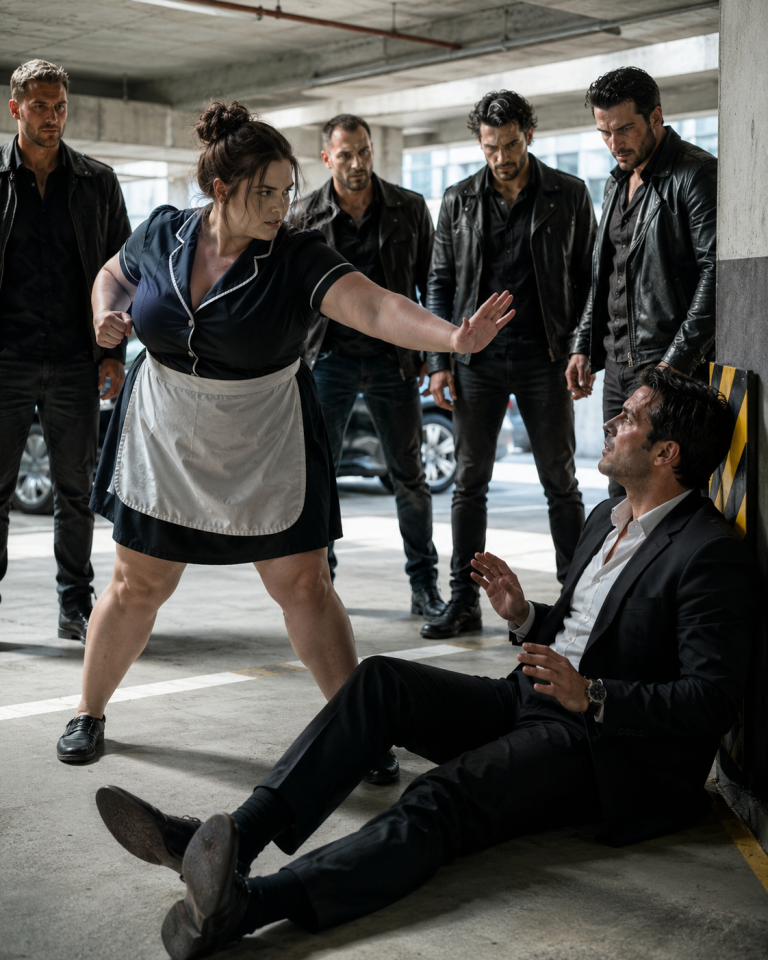
Her name, on the employee paperwork, was Mara Conti. She had chosen it carefully — the surname of the family that had destroyed hers, worn like a blade under a uniform. Six months of carrying plates, polishing crystal, memorizing orders, and being exactly what every powerful person in that room assumed when they looked at a woman in black service clothes.
Invisible.
Useful.
Beneath notice.
The room was a who’s-who of men whose names moved through the city like weather. Judges. Brokers. Members of organizations with no official letterhead. They had come for a birthday. They had come to celebrate Renata Conti, who sat at table four in red silk, wearing the kind of necklace that was as much a claim as a decoration, and whose husband controlled every port, every shipment, every silence that made New York run without catching fire.
Nico Conti.
The woman carrying his champagne had spent six months invisible in his presence, and still she knew exactly how his jaw shifted when he noticed something he hadn’t planned for.
She was about to give him something to notice.
“Another half glass,” Renata said, not looking at her.
Mara poured.
“Not that much.”
Mara didn’t apologize. Didn’t adjust. Just waited with the particular stillness that had kept her alive across three continents and six aliases.
Renata turned to her then, because women like Renata were attuned to resistance the way predators were attuned to stillness.
She looked at Mara.
Her gaze made its inventory.
Then she smiled.
It was the smile of a woman who had decided to perform.
“Tell me,” Renata said, “do you actually understand what I’m saying, or are you just smiling and nodding like a trained animal?”
The table went quiet by half a degree.
Mara looked at her.
Not at her jewelry. Not past her. At her.
“I understand everything,” she said. Her voice came out differently than the service voice she had used all evening. Cleaner. Cooler. The voice of someone who had not come here to serve. “Would you like me to demonstrate?”
Renata laughed.
The laugh turned heads.
Nico Conti, who had been reading an encrypted message on a phone hidden beneath the tablecloth, looked up.
Renata leaned back. “Extraordinary. Someone gave the waitress confidence.”
“Ma’am,” Mara said, “you can call me whatever you want. I have been called worse by people who are now in federal custody.”
The room noticed.
Not loudly. The rooms these people occupied never went loud. But the quality of silence changed — it became attentive, which was its own kind of alarm.
Nico set down his phone.
Mara placed the champagne bottle on the table and lowered the tray.
She spoke in Italian first.
Not service Italian. The Italian of offshore documents, banking correspondence, and transcripts from proceedings she had studied in three countries.
She named a number.
Five hundred thousand euros, a date in May, an account that didn’t officially exist.
Renata’s hand moved.
Then Mara switched to French — the French of shipping manifests and forwarding agents and the specific vocabulary of money moving faster than regulation could follow.
Then back to English.
“Should I continue?” she asked.
Renata’s expression had changed.
Not the silk smile. Something beneath it, exposed.
Nico’s voice arrived like a closed door.
“Who are you?”
Mara looked at him across the table.
Six months she had looked at him from the periphery, carrying his food, refilling his glass, being careful to remain exactly the kind of woman his world produced and immediately forgot. Now she met his eyes directly, and the room seemed to understand that something had shifted.
“The name on my employee file,” she said, “is Mara Conti.”
“Fake,” Nico said.
“Obviously.”
“Your real name?”
She paused.
Not from fear.
From the specific weight of a name she had not spoken aloud to anyone in a very long time.
“Gianna Ferretti,” she said.
And she watched Nico Conti absorb the impact of a name he had not heard in fourteen years.
His enforcer, Aldo, shifted two steps behind the table. His hand moved toward the inside of his jacket.
Nico’s two fingers rose slightly from the tablecloth.
Wait.
The room held its breath.
Mara reached for Renata’s handbag.
Renata slapped her hand.
The crack of it landed in the silence.
Nico’s two fingers twitched upward again.
Mara looked at Renata with the kind of patience that was indistinguishable from contempt.
“You just made a mistake,” she said.
Renata’s chin lifted. “Nico—”
“Vincent.” Nico used the old name without thinking.
Aldo lifted the bag from the chair before Renata could reach it.
Inside, wrapped in a silk scarf, was a second phone.
Renata’s breathing changed.
Mara reached in and removed it.
She held it up.
The chandelier made the black screen glitter.
“Your wife asked me if I could read,” Mara said to Nico. “Let’s see what she’s been writing.”
—
## PART 2
Renata’s composure cracked along a seam Mara had spent months mapping.
Not the diamond necklace. Not the birthday crowd. Not even Nico’s eyes moving between her and the phone with the slow, terrible intelligence of a man rebuilding a story from its bones.
It was the audio file.
Mara opened it, pressed play, and Renata’s own voice filled the dining room.
*”Luca is becoming a problem.”*
A man answered. Her brother Stefano.
*”Solve him.”*
*”We don’t solve men like Luca without Nico noticing.”*
*”Make it clean. He believes in accidents more than people.”*
A pause. Then Renata’s quiet laugh.
*”Make the brakes fail.”*
The recording ended.
A woman at a nearby table pressed her napkin to her mouth.
A judge two tables away looked at the tablecloth.
Nico closed his eyes.
Only once.
When they opened, the husband was gone.
Only the boss remained.
“My father,” Mara said. “Luca Ferretti. Your accountant for eleven years.”
The room contracted.
“He found the thefts. He tried to tell you.” She looked at Renata. “He trusted your wife.”
Renata began to speak.
“Don’t,” Mara said. Not loudly. The word simply had no room for argument.
Nico’s voice came out flat and deliberate.
“How much?”
Mara swiped through the phone.
“Forty-one million over eight years. Laundered through Renata’s three charities, a Marseille shipping subsidiary, and an art foundation Stefano controls.” She paused. “Plus a parallel network of men loyal not to you but to the person who funded them.”
Nico’s gaze moved to his wife.
“A separate network,” he said.
Renata stood. Her chair fell backward. “This is theater. She’s a waitress—”
“Sit down,” Nico said.
She didn’t sit.
Which told the room everything it needed to know about what she had been building.
Stefano Bellini, who had sat in careful silence two seats away, pushed back from the table.
Three men in dark coats moved to block him before he reached standing.
Mara reached into her uniform pocket.
A recorder.
She placed it on the tablecloth beside the silverware.
Nico looked at it.
“How long have you been in here?” he asked.
“Six months.”
“Running.”
“Collecting.”
He almost looked like he admired that. Almost.
Then a young soldier near the wine station drew his weapon and aimed.
Not at Mara.
At Aldo.
The room detonated.
—
## PART 3
**The Night the Empire Cracked**
The first shot shattered a mirror behind the bar.
The second killed the silence permanently.
Mara dropped behind an overturned table before most people had processed what was happening. Crystal rained. Someone screamed. The violinist’s instrument hit the floor with a sound like a small death.
Nico was already moving.
He flipped the nearest table with one arm, sending roses and wine across the marble, and pulled Mara behind it before she had decided whether to resist.
“You planned for this,” he said.
“I planned for exposure.” She checked the gun she had taken from a guard in the first three seconds of chaos. “Not gunfire.”
“Amateur.”
She shot him a look.
Aldo, bleeding from the shoulder, returned fire from the floor with the specific commitment of a man who had survived worse.
The room fractured along its hidden fault lines.
Men who had smiled at Nico’s table turned their weapons against his. Men Mara had watched all evening — quiet ones, patient ones, the kind who arrived early and sat at the edges — rose to positions they had been holding for months.
Renata’s men.
Paid from stolen millions.
Preparing for a succession no one in the public hierarchy knew was coming.
Mara rose from behind the table, fired twice, and dropped back down before the answering shot found her.
“Your wife wasn’t only stealing,” she said to Nico.
“I gathered.”
“She was replacing you.”
He was quiet for two seconds.
“How thorough,” he said.
Chandeliers exploded in a rain of crystal as someone shot out a support chain. Darkness ate half the room.
In the chaos, Mara moved.
She had memorized the floor plan in her second week. Every exit. Every service corridor. Every place a woman in a black uniform could become someone else entirely.
But first — the flash of red silk near the kitchen doors.
Renata.
Mara ran.
She was through the kitchen before Nico could shout her name, past the cooks who had already hit the floor, over spilled oil and broken plates, through the service corridor and out the steel delivery door into the alley.
Rain hit her face.
Renata stood at a black car twenty feet away.
“Stop,” Mara said.
Renata turned.
Without the lights of the dining room, without the diamonds and the crowd, she looked older. More honest in the rain.
She looked afraid.
“You think you won,” Renata said.
“I think I found the door.”
Renata smiled bitterly. “You found one door. There are others. Bigger ones.”
“Who helped you build the network?”
Renata stepped backward toward the car.
“Your father didn’t die because he found us stealing,” she whispered.
Mara’s hand tightened on the gun.
“He died because he found out who else was involved.”
The car door opened.
A driver grabbed Renata and fired twice over her shoulder as they shoved her inside. Mara dove behind a dumpster, bullets sparking off brick.
The car screamed away into the rain.
Mara rose slowly, hand bleeding where glass had caught her palm.
Nico stepped into the alley.
He looked at the empty street.
Then at Mara.
“What did she say?” he asked.
Mara looked at the recorder in her pocket.
It was still running.
She said nothing.
Her second phone buzzed.
An unknown number.
Four words.
*YOUR FATHER IS ALIVE.*
She read it twice.
Then a third time, in case meaning changed.
Nico saw her face change before she showed him the screen.
“Who sent it?” he asked.
Mara stared at the message.
For fourteen years she had stood at a grave and called it truth.
“Someone who knew my father,” she said.
The phone buzzed again.
*ASK NICO ABOUT THE OLD MILL.*
She looked up.
Nico had gone still.
“The Old Mill,” she said.
He looked away.
That was answer enough.
—
**The Cellar Under the Ashes**
The Old Mill had been a factory once, then a private estate, then a fire that the insurance company had paid out without asking too many questions. That was twenty years ago. Since then, the ruins had sat behind iron gates on a private road an hour north of the city, owned by a holding company that dissolved three years after the fire.
Mara knew the address because her father had mentioned it once.
She had been eight. He had called it a place where certain records were kept that certain people did not want found.
She had thought he was being metaphorical.
Diana Marsh, the federal prosecutor who had spent seventeen years building cases against organized crime, met them at the city limit in a tactical SUV with four agents and the expression of a woman who had been waiting for this call longer than patience usually allowed.
“You were not supposed to improvise,” she told Mara.
“The timeline moved.”
“You were supposed to wait for—”
“Renata was going to run.”
Diana’s jaw tightened. Then she gestured to her agents. “Get in.”
Nico looked at the federal SUV with the equanimity of a man accepting the strange logic of an evening that had already defied most of his expectations. “This is unusual company.”
“She contacted me three months ago,” Mara said.
“And you trusted her.”
“I trusted the evidence I was bringing her.” Mara looked at him. “Are you coming or not?”
He got in.
At the Old Mill ruins, moonlight made the scorched stone look like bones.
Diana’s agents took the guards at the gate quickly and quietly. Two more were stationed at the structure’s eastern wall — Nico identified them as men he had not placed there, which confirmed what Mara had suspected.
Someone had been running this site without Nico’s knowledge.
The way underground was beneath the collapsed altar section, exactly where Mara’s father had once said certain things were kept.
She went first.
The cellar was not a cellar.
It was a facility.
Surveillance equipment. Medical stations. Servers. Filing systems. The organized infrastructure of a man who had been operating a second empire from below ground for years while the aboveground version moved under his son’s name.
Eduardo Conti.
Dead for seven years.
His portrait hung in three of Nico’s offices.
His tomb sat in the Conti family plot in Queens.
And his orders still ran through every system in this room.
Nico stood in the doorway.
He did not move for four seconds.
Mara counted them.
“Your father’s work,” she said.
Nico’s voice came out very flat. “He built this.”
“Renata helped him manage it after he disappeared. Stefano handled the finances. Your accountants watched the money.” She paused. “Except for one.”
Nico turned.
“My father,” Mara said, “found this. Not just Renata’s side accounts. This — the whole architecture. He was going to tell you. Eduardo found out first.”
Nico’s expression was stone over something fracturing.
“My father ordered him killed.”
“And your wife helped.” Mara’s voice held steady. “Because Eduardo promised her a larger share of what you’d inherit once the timing was right.”
The agents moved through the facility, securing it, photographing, cataloguing.
Diana found the server bank. “If the archive is intact, this is everything.”
“It is,” said a voice from behind a steel door at the end of the room.
Everyone turned.
The door had not been there a minute ago.
It stood open now.
And in the frame, thinner than fourteen years should have allowed, grayer, slower, but unmistakably present — stood Luca Ferretti.
Mara’s father.
Alive.
She covered her mouth with both hands.
Not a romantic gesture. The gesture of someone whose body had decided its feelings were going to arrive whether she was prepared or not.
Luca looked at his daughter with an expression she had only ever seen once before — the morning she was seven and had gotten lost at the market and he found her in the next block crying over a torn shoe.
Relief so profound it looked like pain.
“Lulu,” he said.
The name broke her open.
She crossed the room in three seconds and held on to him the way you held on to something you had spent fourteen years believing was gone.
He was thin. He was shaking. He smelled of the cellar and of the particular staleness of a man who had not been outside in recent memory.
He was real.
“I thought you were dead,” she said into his shoulder.
“I know.” His voice was wrecked. “I’m sorry.”
“Don’t apologize.”
“I couldn’t—”
“Don’t.” She pulled back to look at him. “Are you hurt?”
“Old. Very old.”
“That’s different from hurt.”
He almost smiled.
Then she looked behind him.
In the room beyond the steel door, on a cot against the wall, was her mother.
Rosa Ferretti.
Who had supposedly jumped from a sixth-floor window fourteen years ago.
Who was thin and silver-haired and alive, watching her daughter from across a room that smelled of antiseptic and kept time.
Mara could not speak.
She went.
—
**What the Dead Keep**
The reunion was not beautiful.
It was ugly the way most true things were ugly — full of fractured sentences and the specific grief of time that could not be returned, and hands held too tightly, and the particular cry that came from people who had survived by suppressing it for too long.
Diana gave them six minutes before her agents needed access to the inner room.
Six minutes was not enough.
It was not nearly enough.
But Mara’s mother pressed something into her hand before the agents moved them to the secure transport.
A small recorder.
Very old.
“Your father hid it here,” Rosa said. “The night Eduardo found out what he knew.”
Mara looked at it.
“What’s on it?”
Her father answered.
“Eduardo’s confession,” Luca said. “In his own voice. Everything. The fake death. The offshore empire. The orders he gave to have me taken. The arrangement with Renata and Stefano.”
Mara looked toward the far end of the facility.
Nico stood by the server bank, watching his father’s ghost made concrete in filing cabinets and surveillance screens.
She walked toward him.
He heard her coming and did not turn.
“He built all of this while you ran what he gave you,” she said.
“Yes.”
“You didn’t know.”
“No.” A pause. “Does that matter?”
She thought about that honestly.
“To the prosecutors,” she said, “yes.”
“And to you?”
She looked at the screens — the archived evidence of a man who had built a kingdom beneath his son’s kingdom and kept it running from a grave he never actually occupied.
“My father said your father was not always what he became,” she said.
Nico turned then.
“When did he say that?”
“After. He told me many things after. He had a long time to think.”
Something moved in Nico’s face.
Not softness.
Something harder than softness and more honest.
“What is on the recording?” he asked.
Mara held it out.
He looked at it.
He did not reach for it.
“Play it,” he said.
Eduardo Conti’s voice filled the cellar.
Smooth. Cultured. The voice of a man who had believed his intelligence made him above consequence.
He named judges. Officers. Politicians. Shell companies in six countries. He described how he had staged his own death. He described the arrangement with Renata in terms that made a federal agent across the room quietly close their notebook and open another one.
And he described Luca Ferretti.
The accountant who had found the architecture.
The man he had ordered kept alive because Luca had hidden a secondary copy of all the records and Eduardo needed to know where.
Luca had never told him.
Not in fourteen years.
Nico listened to his father’s voice admit all of it with the detached efficiency of a man making a will.
When the recording ended, Diana moved forward immediately.
“That is federal evidence.”
Mara handed it over.
Nico said nothing for a long time.
Then: “Where was Renata taking Stefano tonight?”
Diana answered. “We have intercepts. A private airfield in Westchester. Eduardo’s people were waiting.”
“Eduardo,” Nico said.
He said his father’s name the way you said a word after discovering it meant something different than you had used it to mean your whole life.
“He’s alive,” Mara said. “Somewhere.”
“Yes.”
“Are you going to find him?”
Nico looked at the server bank.
At the evidence of a life built parallel to his without his knowledge.
At the cellar where a woman and her father had been kept for fourteen years as insurance.
“No,” he said.
Mara looked at him sharply.
“He’s mine,” Nico said. “Not a federal case. Not a public trial. Mine.”
Diana’s hand moved toward her radio.
Nico looked at her.
“You have the archive,” he said. “You have forty years of evidence. You have Renata. You have Stefano. You have recordings, wire transfers, confessions, and more judges than you can indict in a decade.” His voice was level. “My father is mine.”
Diana looked at Mara.
Mara looked at Nico.
She thought about her parents in the other room.
Fourteen years.
She thought about what they had lost.
She thought about what justice could return and what it couldn’t.
“One condition,” she said.
Nico waited.
“He never comes near my family again.”
Nico was quiet for a moment.
“Agreed.”
Diana exhaled the breath of a woman who had learned when to hold the line and when the line had already moved past her.
“Fine,” she said. “But Renata and Stefano are mine.”
“Yes,” Nico said.
“And you testify.”
The word settled.
Nico looked at the server lights blinking across the archive of everything his father had built.
“Yes,” he said.
—
**The Trial**
New York had seen many trials.
This one ran for nine weeks and was compared, in various publications, to the fall of several historical institutions that people had once assumed were permanent.
Renata Conti testified on day twelve with the specific composure of a woman who had decided cooperation was a better performance than loyalty. She named names. She provided dates. She wept on two occasions that happened to coincide with camera angles.
Stefano Bellini provided more useful testimony with less theater.
Nico Conti took the stand on day thirty-one and spoke for two days.
He described what he had known and what he had chosen not to look at. He described the empire he had inherited and the parts of it he had allowed to continue because disruption was expensive and stability was familiar. He did not minimize. He did not redirect. His attorney had told him to be strategic. He had told his attorney to be quiet.
Diana Marsh questioned him for six hours.
The jury watched a man refuse to perform innocence.
That was, she told Mara afterward, rarer than it should have been.
Eduardo Conti was never found.
Men with resources and patience and the willingness to disappear entirely were rarely found when they chose not to be. He existed, somewhere in the world, under a name that had never been his, in a country that had been selected years in advance.
But his empire was not with him.
The evidence from the cellar archive dismantled it over eighteen months — ports closed, accounts seized, judges removed, politicians resigned, shell companies dissolved across four continents.
A kingdom built on buried people, destroyed by their survival.
Nico Conti served four years.
The sentence reflected his cooperation, the breadth of his testimony, and the judgment of a justice system that was never simple about powerful men who chose, eventually, to help.
Mara’s parents came to every day of the trial.
Luca sat in the gallery with the patience of a man who had spent fourteen years in a cellar learning that justice moved slowly but moved.
Rosa recovered in stages. The physical damage was significant. The other kind was not something doctors named easily. But she grew stronger, and she started sleeping through the night, and one morning Mara came to her parents’ apartment and found her mother in the kitchen making coffee and arguing with a radio program about pasta technique.
That was the first time Mara laughed until she cried.
—
**The Restaurant With No Locked Doors**
Two years after the night at L’Oasis, a small restaurant opened on a street in Carroll Gardens that received no press coverage and needed none.
The sign above the door was hand-lettered.
*FERRETTI’S.*
Inside: brick walls, bare wood tables, mismatched chairs that looked like they had been rescued from different lives. The kitchen smelled permanently of garlic and something sweet. The wine list was one page. The lighting was warm rather than expensive.
Luca handled the books.
Rosa made the food, with the authoritative calm of a woman who had survived worse than a difficult service and was not interested in doing anything at half strength.
Mara served tables when she felt like it and took reservations the rest of the time, which meant the phone rang too often and the wait list was too long and the neighborhood had firmly decided the restaurant was theirs.
Diana Marsh came every other Wednesday and complained that the portions were too large.
She never left anything behind.
On the evening of the restaurant’s first full year, after the last table cleared, Mara was wiping down the bar when the door opened.
She did not look up.
“We’re closed,” she said.
A pause.
“I know,” said Nico Conti.
She looked up.
He was different. Not dramatically — no cinematic transformation. Simply the difference between a man in armor and a man without it, which was less an absence and more like seeing the actual person the armor had been built around.
He stood in the doorway in a plain coat, no bodyguards, holding a bottle of wine.
“A gift,” he said. “For the year.”
Mara looked at the bottle.
Barolo. Very good year.
“You’re out,” she said.
“Two months ago.”
“I know.”
He nodded.
She did not move away from the bar.
“How are they?” he asked.
“My parents?”
“Yes.”
“My father argues with suppliers over two-euro differences. My mother won a neighborhood argument about the proper way to make ribollita and has not mentioned it since, which means she’s still winning.” Mara paused. “They are alive. Some days, that’s still everything.”
Nico set the bottle on the nearest table.
“I’m not asking for anything,” he said.
“I know.”
“I just—” He stopped. This was clearly a sentence he had been building for some time and had not finished to his satisfaction. “I wanted to see it.”
“See what?”
He looked around the restaurant.
At the hand-lettered menus. At Rosa’s sauce recipe framed on the wall. At the photographs — not of famous customers or newspaper coverage, but of the neighborhood. The street. The families who came every week.
“What it looks like,” he said, “when a family comes back.”
Mara looked at him for a long moment.
She thought about the night at L’Oasis. About fourteen years. About the difference between what people became when power had no accountability and what they became when it did.
She thought about her father’s face when she had told him, months ago, that Nico had testified for two days without deflection.
Luca had been quiet for a while.
Then he had said: *”I told you he was not his father.”*
Mara reached under the bar and retrieved two glasses.
“My father is in the kitchen,” she said. “He makes espresso too strong for anyone but himself at this hour. You can tell him that.”
Nico looked at the glasses.
Then at the kitchen door.
He came inside.
Mara locked the front door behind him.
Not to keep him in.
Because the restaurant was closed, and what happened next was not for the street.
Luca was at the counter, reading a newspaper with glasses perched on his nose and the focused displeasure of a man who found the financial section insufficient.
He looked up when Nico appeared.
The two men regarded each other.
The accountant and the boss.
Fourteen years of complicated history standing in a kitchen that smelled of garlic.
“Your espresso is reportedly too strong,” Nico said.
Luca considered this.
“Sit down,” he said.
They sat.
Rosa emerged from the back and looked at the scene without surprise — which meant, Mara realized, that her mother had known this was coming and had said nothing.
Rosa made four cups of espresso.
She placed one in front of Nico with the manner of a woman who had served people in worse circumstances and found the ordinary version to be acceptable.
“Strong,” Nico said, after the first sip.
“Yes,” Rosa said. “Everything worth having is.”
Luca opened the newspaper again, which was his way of making space for a conversation he was also participating in.
Mara sat across from Nico.
Outside, Carroll Gardens moved through its ordinary evening — voices, traffic, a dog, someone’s television. The city that had no idea what had happened in this room’s family or what had been rebuilt in the years since.
“What happens now?” Nico asked.
Mara looked at the wall where her mother’s recipe was framed.
At the kitchen where her father was pretending to read.
At the table where they were all sitting — a circumstance that would have been impossible to predict on any night in the last fourteen years and was now simply the present.
“We open tomorrow at noon,” she said.
Nico looked at her.
“And after that?”
She picked up her espresso.
“Same thing. And then the day after.”
He was quiet.
“That’s it?”
“That’s it.” She looked at him. “Not everything gets to be dramatic.”
He almost smiled.
“No,” he agreed. “Some things just get to be Tuesday.”
Rosa looked at Mara over Nico’s head and made the smallest gesture — barely a lift of the chin — that translated to: *acceptable.*
High praise from Rosa Ferretti.
Luca turned a page of his newspaper.
The espresso was too strong.
Everyone drank it anyway.
—
A year after that evening, a foundation opened on a property north of the city where an old factory had once burned. It was named for two people — Serafina, a name from Nico’s files that turned out to belong to his mother, a woman who had tried to stop the empire from the inside and had been imprisoned for it; and Carlo, which was the name Mara’s grandfather had used before the family immigrated and which Luca had given her as a middle name she had never known.
The foundation served children whose families had been destroyed by organized crime.
Legal aid. Housing support. Education funds. The particular institutional care for lives that had fallen through the specific kind of crack that powerful people made.
The dedication wall had one line.
Mara had written it herself, in the same handwriting she had used to copy wire transfer records in a basement apartment across three countries for fourteen years.
*Some things cannot be returned. Everything else can be built.*
Diana Marsh gave a speech that was legally sound and emotionally stirring.
Luca cried quietly and denied it when asked.
Rosa told him the soup he had made for the catering was underseasoned, which was her version of tenderness.
Nico stood at the back of the crowd in a plain coat and said nothing to the press, who had expected something quotable from the man who had testified against his own inheritance.
Later, at the reception, Mara found him near the window.
“She looked like you,” he said.
She frowned. “Who?”
“My mother. In the photograph they found in the archive.”
Mara looked at him.
“Dark eyes. The specific way of not moving when other people expected you to.”
“You didn’t know her.”
“No.” He looked at the room. “But she knew me. She built the authorization into the server for me to find.” He paused. “I think she always knew the empire would end one way. She just needed someone who could end it from the inside.”
Mara thought about that.
“You didn’t.”
“No. You did.”
“We both did.”
He looked at her.
There was something in his face she had not seen before in the long years of studying him — not the boss, not the son, not the man navigating the aftermath of everything that had fallen.
Something ordinary.
Something that simply needed company.
“Come to dinner,” she said. “Proper dinner. Friday. My parents will argue with you about something. My father will make you espresso that’s too strong. My mother will ask questions she already knows the answers to.”
Nico looked at her.
“Why?”
Mara looked at the foundation wall. At the line she had written. At the room full of people rebuilding things from what was left.
“Because I spent fourteen years making sure the dead were remembered,” she said. “I’d like to spend the next fourteen making sure the living show up.”
He was quiet for a moment.
“Friday,” he said.
“Noon. Not before.”
“I’ll bring wine.”
“Something other than Barolo this time.”
“Demanding.”
“My father will have notes either way.”
Nico almost smiled.
Outside, the Hudson caught the evening light in pieces, carrying it south through a city that forgot things quickly and built over them faster, but that still, occasionally, on the right corner at the right hour, looked like something that had survived itself and was still running.
It was enough.
For a Tuesday, and the one after that, it was more than enough.
**THE END**
—
—