Forced Into a Marriage With a Feared Mountain Man at Nineteen—Then He Handed Her the One Thing She Never Expected

PART 2
She looked at his hands — the size of them, the scarring across the knuckles — and at Croft, standing among the crowd with his smile recalibrating itself. She thought about the widow Hargrove’s daughter. She thought about three to four years.
“If I say yes,” she said, “and I go up to this mountain of yours and decide I want to leave—”
“Then you leave. I won’t stop you.”
“Swear it. On whatever you hold sacred.”
“I swear it.”
She walked to the wagon, where her mother sat with her hands folded, careful not to tip the decision either way. “What do you think?” Eliza asked quietly.
“I think Silas Croft would have eaten you alive,” Margaret said. “I think this man, whatever he is, is not Silas Croft.” She looked at her daughter. “I think you’re braver than you know.”
Eliza walked back to Rhett. “All right,” she said.
The minister married them on the church steps within the hour, with the whole town watching from what it judged an appropriate distance, which was not far at all. Eliza said the words because they needed saying, feeling strangely detached, as if watching herself from a slight distance. When it was done, Croft’s voice cut through the crowd.
“This changes nothing.”
“The original debt is paid,” Rhett said. He reached into his coat again — not the pouch this time, a rough canvas sack. He walked to the steps and tipped it. Raw gold spilled across the boards, dull and rich in the autumn light, more than three times what she’d owed.
“That’s more than three times what she owed you,” Rhett said. “The excess covers any interest, any fees, any interpretation of the note you’re inclined to raise later. We’re done.”
Croft said nothing. His face had gone through several things in quick succession and landed on something colder than any of them.
Eliza held her mother a long moment before she climbed onto the second horse Rhett had brought. “Come visit in the spring,” she said into her mother’s hair.
“Wild horses,” Margaret said, and pressed a hand to her daughter’s cheek. “You are your father’s stubborn heart and my better sense. You’ll be fine.”
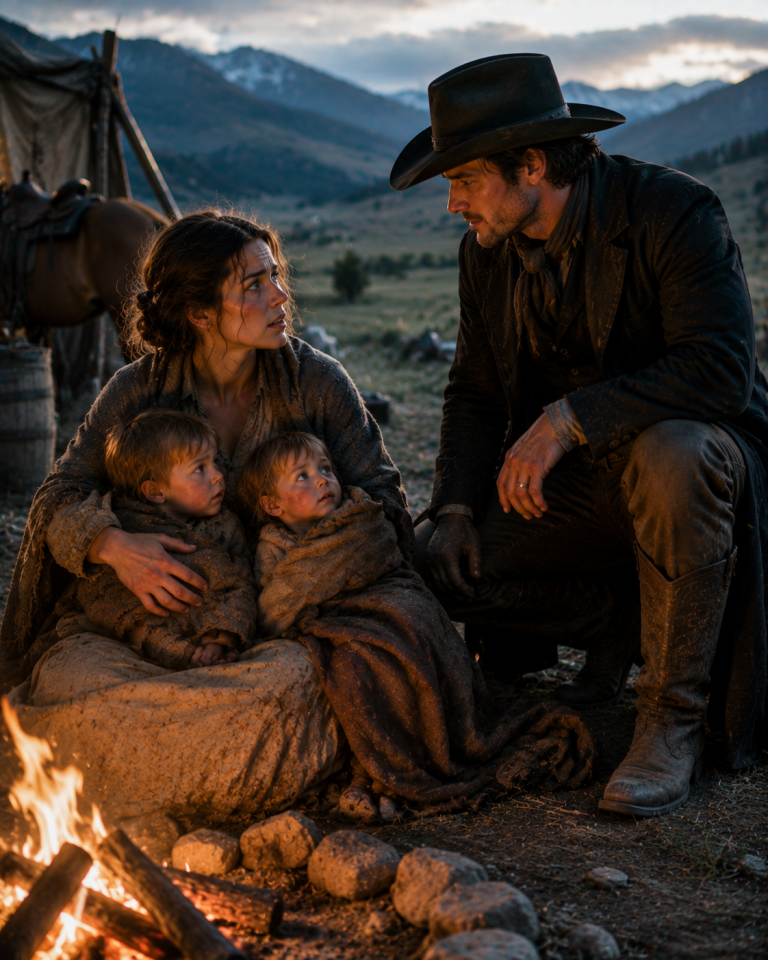
They rode north in a silence that settled around them like weather rather than hostility. An hour in, she asked how far. “Two more days,” he said. “We’ll camp tonight.” She told him it would rain — a cloud bank her father had taught her to read. He glanced back at her, longer than before, and said nothing about it, which she was beginning to understand was its own kind of compliment.
They made camp in a sheltered hollow as the rain came in, exactly as she’d predicted. Over the fire, she said, “You owe me a conversation. I’ve just married a complete stranger.”
He told her about the cabin, the lake, two years of building. When she asked about his family, back in Kentucky, he went quiet long enough that she thought he wouldn’t answer.
“Gone,” he said. “Long time ago.”
She didn’t push. But in the firelight, adjusting the collar of his coat, she caught sight of his left hand gripping his coffee cup — the index finger set at a slight, wrong angle, old scarring at the knuckle that didn’t match the rest of the wear on his hands.
“What happened to your hand?” she asked.
He looked at it like it belonged to someone else for a moment. “Something happened to me up there once,” he said. “I’ll tell you when we’re home.”