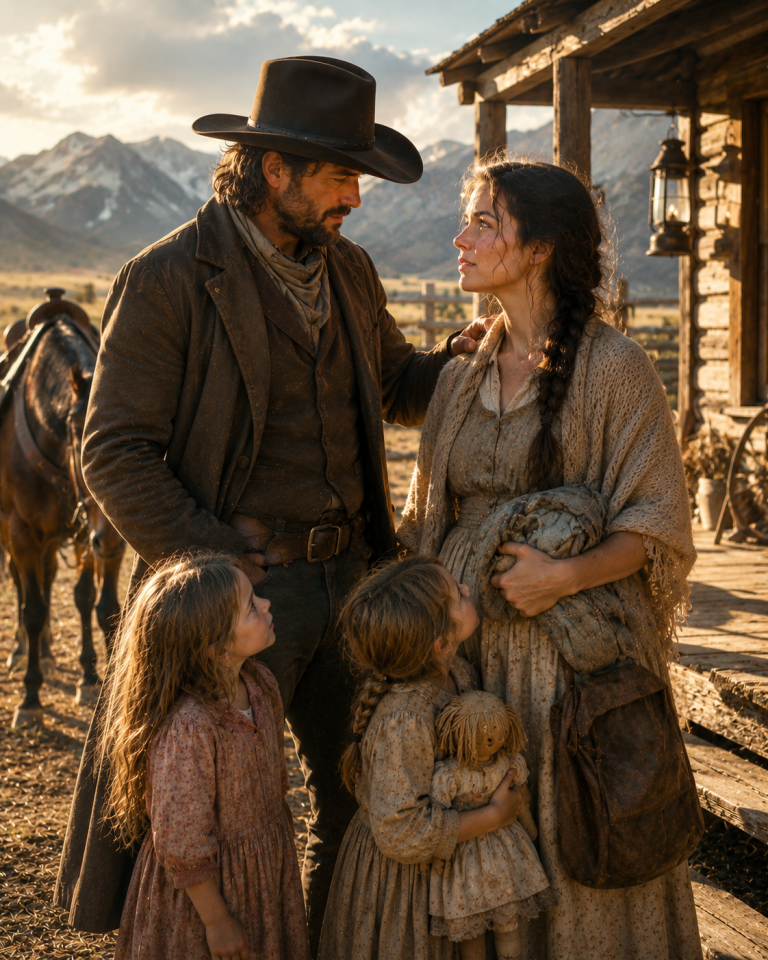
Forced Into a Marriage With a Feared Mountain Man at Nineteen—Then He Handed Her the One Thing She Never Expected

His face, turned on the thin-faced man, was the most purely dangerous expression she’d seen on it. “You’re on private land. Armed. Threatening my wife.” He said it like facts entered for a record. “I know who sent you. Tell him the next men he sends won’t leave the way they came.”
The thin-faced man looked at Rhett, at the man covering the exit trail, at Eliza on the porch with the rifle still raised. “We were just—”
“No,” Rhett said. The single syllable closed the sentence. “Go.”
They went. She stood on the porch, arms shaking with the aftermath of held tension, and Rhett took the rifle from her hands as gently as he’d once taken her cold hands between his.
“You let me handle it,” she said, understanding. “You were watching from the trees.”
“You had it,” he said simply. “So I waited. I wasn’t going to take that from you.”
The broad man was Deputy Marshal Harding, and Rhett had been quietly building a case against Croft’s lending fraud since the morning of the gold on the church steps — testimony from wronged families, a pattern of coercion Croft had run across the valley for years. “I didn’t tell you,” Rhett admitted, “because I didn’t want you waiting on something that might not happen.” She told him that from now on, he told her. He agreed.
“Since October,” he said, when she asked how long he’d been planning it. “Since the morning at the church.” She understood then — he’d paid the debt and gotten her clear of danger, and then, without announcement, begun quietly making sure the danger never followed her here.
The case took Croft’s own hired men’s identification, Eliza’s written statement, and testimony from the widow Keen and the Pattersons to close. Three weeks after Harding rode back down, a letter came up with the supply runner, a nineteen-year-old named Cord Briggs who made the trip twice monthly without excessive curiosity about other people’s business. One letter was from her mother — plain, dry, unsentimental in the way Margaret always was, mentioning she’d moved in with the Abbotts for the winter, that the town was finally saying things about Croft it had been afraid to say. *I have been thinking about you on that mountain,* Margaret wrote. *Not worrying — I want to be clear about that distinction. Thinking there is a version of you I imagined you would become growing up in this valley, and then there is whatever you are becoming up there, which I suspect is considerably more interesting. Come down when you can. Bring the mountain man. I want to look at him properly.*
In August, word came from Harding: Croft convicted on seven of nine charges, a public denunciation from the judge’s own bench, and a note that Eliza’s stand on the porch in April had closed the final gap in the case.
“It’s really over,” she said, reading it at the kitchen table.
“It’s over,” Rhett agreed.