A Lonely Rancher Offered Shelter to a Plus-Size Stranger — Then Asked Her to Become the Mother His Daughters Needed

PART 1
The road burned under the noon sun, and dust rose around Ida Mabel’s ankles with every step she forced herself to take. The air shimmered, bending the horizon into a silver blur. Her throat ached with thirst, her worn sandals had long since cut into her swollen feet, but she kept walking, because stopping meant thinking, and thinking hurt worse than the sun ever could.
She had been walking since dawn, one hand clutched around an old suitcase that held little more than a few clothes and too many memories. Behind her, the village of San Barlo had faded into the heat, along with the voice that sent her away that morning. *A thief and a liar,* Doña Tomasa had shouted, and the words followed Mabel out onto the open road like something with teeth.
Ten years she had worked for that family — sewing, mending, cleaning, her hands cracked and bleeding from a decade of service. She had stitched their dresses, embroidered their tablecloths, sewn the baptism cloth for their youngest child with her own careful hands. And then one piece of lace went missing, and in a single morning she became the villain of a house she’d given a third of her life to. No husband to speak for her. No family to stand behind her name. Just the word *thief*, echoing, with nothing behind it to argue back.
She stopped beside a dry agave plant and sank to her knees, chest heaving, the air thick with salt and dust. Above her a vulture circled, lazy and patient, in no particular hurry.
“God,” she whispered, pressing her hands together. “Please don’t let me die here. Not like this.”
Then came a sound — steady, rhythmic, hooves, a creaking wheel. She looked up to see a cart in the distance, a brown horse pulling it slow and sure, a tall man at the reins with several small figures huddled behind him. Mabel hesitated. Strangers on an empty road could mean any number of things, and none of the ones she was used to were kind. But the cart slowed, and stopped beside her anyway.
The man’s face was shaded under a wide hat, his beard neat and streaked with gray, his shirt clean but worn in the way of someone who worked with his hands and didn’t waste words on much else. “Señorita,” he said, his voice deep and unhurried. “Are you hurt?”
Mabel shook her head. “Just tired. It’s a long walk to the next town.”
He climbed down, boots pressing clean marks into the dust, and five girls peeked out from behind him, faces bright with a curiosity that had nothing guarded in it yet. “Where are you headed?” he asked.
“South,” Mabel said quietly. “Maybe Santa Cruz. Maybe somewhere that doesn’t know my name.”
He nodded slowly, unbothered by the answer. “That’s twenty kilometers at least. On foot, you won’t make it before nightfall.”
She didn’t reply. There wasn’t much to say to that.
A small voice broke the silence instead. “Papa, she looks sad,” one of the girls said, and the man looked at his daughter, then back at Mabel.
“What’s your name?”
“Ida Mabel,” she said. “Just Mabel.”
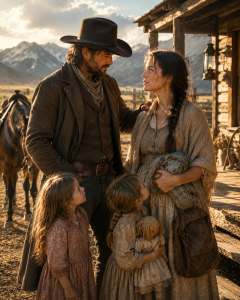
He adjusted his hat. “I’m Teodoro Doro. I have a ranch a few miles west of here. Five daughters.” He motioned toward the cart. “I could use help around the house.”
Mabel frowned. “You don’t even know me.”
“No,” he said, with a shrug that carried no judgment in it. “But I know what it’s like to need a chance.”
The words landed somewhere deep in her chest. No one had ever spoken to her that way before — not with pity, not with suspicion, just with a kind of plain understanding that asked nothing of her yet.
“What kind of work?” she asked.
“Housekeeping. Cooking. Watching the girls when I’m out with the livestock. You’d have food, a room, fair pay.”
She hesitated. “Are you sure? I’m not what people expect.”
Something close to a smile crossed his face. “Neither am I.”
One of the youngest girls giggled and reached out a small hand. “Come, señora,” she said. “We have chickens.”
Something in Mabel’s chest cracked open, not from sadness this time, but from the sudden, unfamiliar memory of what kindness sounded like. She picked up her suitcase. “All right,” she whispered. “I’ll come.”
The cart carried them west as the light went long and gold across the fields. The smallest girl leaned into Mabel’s side without being asked. “Why are the girls so quiet?” Mabel asked eventually.
“They’ve had too many people come and go,” Teodoro said. “They don’t talk much to strangers anymore.”
“Then I’ll try to stop being one.”
He glanced at her, something like approval passing quickly over his face before he turned back to the road.
The ranch came into view as the sky burned red behind it — a wooden house standing alone, fields stretched dry but waiting, the whole place looking like somewhere that wanted to be home again and had simply forgotten how. When the cart finally stopped and Teodoro helped her down, the front door opened before either of them had reached it. A teenage girl stood in the frame, arms crossed, eyes sharp enough to cut.
“She won’t last a week,” the girl said, flat, in Spanish, not bothering to lower her voice.
Mabel met her gaze and gave a small, steady nod.
“Maybe not,” she said. “But I’ll give it my best.”
PART 2
Teodoro’s silence said more than any argument could have. He showed Mabel to a small room with a plain bed and one window facing the hills. “It’s not much,” he said.
“It’s enough,” Mabel replied, and meant it.
That night she cooked stew from whatever she found — beans, onions, a pinch of herbs — and served the girls first, then Teodoro, while they hovered in the hallway half curious, half unsure what to make of her. No one said much until the youngest, Luna, whispered a small *gracias*, and for the first time in days, Mabel smiled without having to build it on purpose.
Morning came with a rooster’s cry and the smell of rain-softened dirt. Mabel rose before anyone else, tied her hair back, and found the garden behind the house — a tangle of weeds and forgotten tools, rough soil that was stubborn but not dead. She knelt and started clearing it with her hands. A quiet girl with dark curls, Nia, brought her a glass of water without a word and left again before Mabel could thank her properly.
By afternoon she found the oldest, Leah, standing near the clothesline holding a small wooden box she clearly hadn’t meant to be caught with.
“What’s that?” Mabel asked.
“Nothing. Just something Mama left.”
“You miss her.”
“You wouldn’t understand,” Leah said, sharp.
“Maybe not your way,” Mabel answered, calm. “But I understand missing people who should have stayed.”
Leah looked at her, thrown, just slightly, by how little heat was in the reply.
That night, once the house had gone quiet, Mabel found the same wooden box left on the porch — packets of old seeds inside, marigolds, beans, squash, one marked *flor de día.* By morning Leah found her still out there, dirt under her nails, kneeling over freshly pressed rows.
“What are you doing?” Leah demanded.
“Starting something new,” Mabel said. “I didn’t take her seeds. I’m giving them a chance.”
Leah went quiet for a long moment. Then she crouched down beside her.
“She never planted them,” she said, barely above a whisper.
“Maybe she was waiting for the right season,” Mabel said.
Leah held out another packet without quite deciding to. “Then let’s see if they still remember how to grow.”
Together they worked until the sun burned through the clouds, six neat rows stretched across what had been dead ground the week before — and for the first time since Mabel had arrived, the house felt less like something testing her and more like something willing to be asked back to life. But the storm that rolled in three nights later would ask a very different kind of question — not whether Mabel could plant something, but whether she’d stay when the ground she’d just started to trust tried to take everything back at once.
PART 3
The garden grew faster than any of them expected, and so, in smaller ways, did the house around it. Sarah, one of the younger girls, brought Mabel a picture she’d drawn one afternoon — water, mostly, poured in careful blue lines over a row of tiny green shoots — and said it was what the garden looked like inside her head when she thought about it. Luna clapped every time a new sprout broke the soil, like she personally deserved credit for the weather. Nia stopped leaving the water glass and started staying to drink half of it herself, sitting quietly beside Mabel while she worked. Even Leah, who had spent her first week promising Mabel wouldn’t last, started showing up at dawn without being asked, packet of seeds already in hand.
It was Sarah who cracked open first, on a night Mabel found her crying by her window, knees pulled to her chest.
“Bad dream?” Mabel asked, sitting beside her.
Sarah wiped her face. “Leah says Mama left because we were too much trouble.”
“Mama left because grown-ups make bad choices,” Mabel said gently. “Not because of you. Not ever because of you.”
“Do you think she’ll come back?”
“No,” Mabel said, careful and honest at once. “But you’ll be okay anyway.”
Sarah leaned into her, small and trembling, and Mabel wrapped an arm around her and hummed an old tune her own mother used to sing — no particular words, just the sound of it, until the girl’s breathing slowed and the room, for a little while, felt almost safe.
Teodoro noticed these moments without commenting much on them, the way he noticed most things — quietly, from a slight distance, filing them away. One evening on the porch he told her, “You’ve done more in a week than anyone has since she passed.”
Mabel didn’t turn to look at him. “I didn’t come here to fix a house, Don Teodoro. I came because I had nowhere else to go.”
“Maybe,” he said, “that’s exactly why you’re the one who can.”
She looked out at the dark field stretching past the fence, coyotes calling somewhere beyond it, and realized, for the first time in longer than she could measure, that she wasn’t afraid of the dark. There was light again, inside, and it had nothing to do with lanterns.
The storm came without warning eleven days after her arrival. Wind tore through the valley, bending trees flat, slamming shutters against the walls, rain hammering the roof like something trying to get in by force. Mabel stood braced in the doorway, holding the frame steady while lightning lit the hills white.
“Stay inside!” she shouted over the noise, and the girls clung together near the hearth, eyes wide.
Teodoro ran past her toward the barn. “The horses! If the doors give, they’ll break their legs trying to get free.”
Mabel didn’t think about it. She grabbed her shawl and ran after him into rain that soaked her through in seconds, mud dragging at her boots the whole way. Teodoro was already fighting to tie the gate shut, rope slipping in his wet hands. She grabbed the other end and they pushed together until the doors slammed and held.
For a moment they just stood there, breathless, faces inches apart, the storm screaming around them like it had opinions about the distance between two people.
“You didn’t have to come out here,” he said.
“You’d do the same for me,” she said, wiping rain from her face.
Lightning cracked again, white and wild, the horses stomping nervous behind the closed doors. Teodoro took her hand. “Come on. We’ll ride it out inside.”
By the time they got back, the girls had built a small fire in the kitchen. Luna was crying softly into her stuffed donkey. Mabel knelt and pulled her close. “It’s only rain, baby,” she whispered. “The house is strong.” The night dragged on in thunder that rolled over the hills like drums, and Mabel sang softly until, one by one, all five girls fell asleep leaning against her.
Dawn broke on a ranch that looked like a battlefield — fences bent, branches scattered everywhere — but it was still standing. So were they. Teodoro came in from checking the damage, hat dripping. “We lost a few posts,” he said. “But the animals are fine. Could’ve been worse.”
Mabel poured him coffee. “We’ll fix it.”
“We will.” His eyes lingered on her a moment longer than the sentence needed. “You kept them safe.”
“They keep me safe,” she said quietly, and meant that too.
The garden hadn’t survived as well. Leah came running from it later that morning, calling for her, and Mabel followed to find the rows they’d planted together drenched and torn, most of the seedlings gone, mud where careful green shoots had been the day before. Leah dropped to her knees, tears mixing with rainwater on her face.
“They’re ruined,” she said.
Mabel knelt beside her, brushing a hand across the mud. “Not ruined. Some roots are still alive.”
“You don’t know that.”
“I do,” Mabel said. “The ground always gives back, if you keep trying.”
They worked through the wreckage together, replanting whatever hadn’t washed away, and soon Sarah and Nia joined, then Luna dragging a bucket of water almost too big for her arms, and eventually even Teodoro, hammering broken posts back into place beside them without being asked. By afternoon the garden looked like itself again — not perfect, but alive, which turned out to be more than enough.
That night, after dinner, Teodoro sat beside her on the porch, the air cool and sweet in the wake of the storm, stars starting to show through the last of the clouds.
“You know,” he said, “you’ve changed this place.”
“No,” Mabel said, with a small smile. “The place changed me.”
He looked at her hands — scarred, steady, gentle in a way that seemed to survive whatever else had happened to them. “When I first saw you on that road, I didn’t know why I stopped. I just knew I couldn’t leave you there. Now I think maybe that was the day everything started over.”
“You don’t owe me anything, Teodoro,” she said, turning her gaze back to the dark fields.
“Maybe not,” he said. “But I’m grateful anyway.”
Silence stretched between them — not heavy, just full, the kind of quiet that only happens once two people have stopped needing to fill it with something.
Weeks passed, and the ranch kept healing in small, ordinary ways. The garden sprouted again, sturdier the second time. Leah taught Luna her letters on the porch steps in the evenings. Sarah started carving small wooden animals out of scrap wood, lining them along her windowsill like a private zoo. Nia began painting the old barn walls in bright, unapologetic colors — flowers, birds, sunlight where there had only ever been gray wood before. The house stopped echoing. It started, in its own quiet way, to sing.
Then one morning, while Mabel hung laundry in the yard, a rider she didn’t recognize appeared down the road. Her stomach tightened before she’d even placed why. When he stopped near the gate, she recognized him — Barollo Cortez, the man who had cheated Teodoro years earlier, smiling like something that had been left out in the sun too long.
“Heard the Espinosa ranch got itself a new woman in charge,” he said. “Thought I’d come congratulate you.”
Teodoro came out of the barn, face hard. “You’re not welcome here.”
Barollo shrugged, unbothered. “Business never dies, old friend. I came to collect what’s owed.”
“You stole from me,” Teodoro said. “You’ve got nothing coming but dust.”
Barollo’s eyes slid over to Mabel instead. “Maybe she could make things right. A woman like that knows the value of peace.”
Mabel’s hands closed into fists at her sides, but her voice stayed level. “I know the value of work. You wouldn’t understand it.”
He smirked. “Careful, big girl. Not everyone likes a woman who talks like a man.”
Before Teodoro could move, Mabel stepped forward instead. “And not everyone survives calling me that twice.”
Something in her tone made him flinch — small, but real. He spat in the dirt and swung back up onto his horse. “This place won’t last,” he said.
“Then you’ll be disappointed,” Mabel answered.
He rode off, the dust behind him settling slow, but their resolve didn’t settle with it. That evening she stood in the garden looking at the small green shoots pushing back through the soil a second time, and Teodoro came to stand beside her.
“He’ll come back,” she said.
“I know,” Teodoro answered. “We’ll be ready. We always are.”
The sun dipped low, burning the sky gold behind the fence line, and Mabel breathed in the smell of turned earth and rain-washed air, thinking about the road that had brought her here, the word *thief* that had once clung to her name like something she’d never be able to wash off, and the sound of five girls laughing now, easily, from the porch behind her.
She wasn’t the woman who had begged God not to let her die alone on that road anymore. She had built something out of dust instead.
Teodoro watched her a moment longer, then said quietly, “You needed a roof. I needed someone who wouldn’t leave. Looks like we both got what we were looking for.”
Mabel smiled, eyes glistening faintly in the fading light. “No,” she said softly. “We got more than that.”
“We got a family.”
As the last light fell over the ranch, the wind carried the faint sound of laughter from the house behind them — small, uncertain the first week, ordinary now, the kind that stays.
THE END