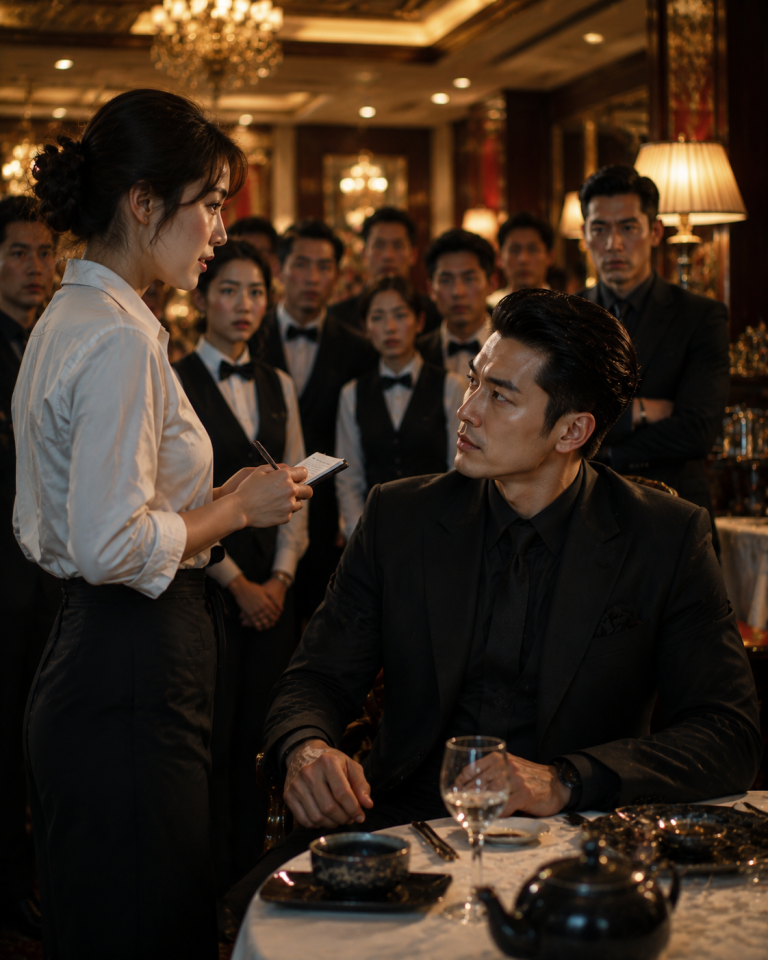
He Called His Wife a “Placeholder” in the Hotel Coatroom—Humiliated and Shaking, She Crushed His Diamonds… Then the Mafia Boss in the Corner Slowly Stood Up

## PART 1
The first diamond hit the marble with a sound too small to stop a ballroom.
But it did.
One small, hard click beneath the chandeliers of the Aldred Hotel, then another, then another — until the necklace Adrian Crane had fastened around his wife’s throat an hour earlier came apart in her hands and scattered across the polished floor like something that had been trying to escape for a long time.
For one full second, two hundred people forgot how to breathe.
The mayor’s wife stopped with her champagne glass halfway to her lips. A city councilman froze beside the ice sculpture, his smile still in place but his eyes moving fast. Investors in dark suits turned from their wives and their phones. Waiters paused between tables with silver trays perfectly balanced.
At the center of it, Sophie Crane stood in a gown Adrian had chosen for her, under lights Adrian had paid for, inside a hotel ballroom Adrian considered part of his territory.
Her husband stared at her from ten feet away.
His face went red first. Then white. Then the particular color of fury being managed.
Sophie knew that look. She had known it for eleven years. It was the look Adrian wore when something he owned failed to behave.
“Sophie,” he said quietly.
The softness was the warning.
She looked down at the broken chain in her hands. She was still not entirely certain she had meant to do it. Her hands had moved and then it was done.
She looked at the necklace.
She thought about the coatroom.
—
An hour earlier, Adrian had pulled her away from the table on the pretense of showing her something — his voice pleasant, his hand at her back, every inch of him performing consideration for the guests they passed. The coatroom was off the kitchen corridor, damp wool and cleaning chemical and one yellow light.
He had locked the door.
He had not been angry, exactly. Adrian rarely got angry. He got cold.
“You asked why Carla was seated at our table.”
“She always used to sit across the room.”
“You asked with your face.”
“I asked with my voice, actually. Very quietly.”
“Everyone heard the subtext.”
Sophie had looked at the rows of coats. “You put your hand on her back during the toast.”
Adrian had straightened his cuff.
“Do you want to know what you are to me?” His voice was calm. That was what made it what it was. “You’re a placeholder. A beautiful, well-maintained placeholder. You’ve had a good life. You’ve been displayed appropriately. When I find someone who can actually contribute to the trajectory I’m building, you’ll be released gracefully.”
The words entered slowly, the way cold did.
He had leaned forward and adjusted the necklace on her throat with cool fingers.
“Don’t look so shocked. You’ve been comfortable. Protected. You should be grateful.”
Then he had unlocked the door and returned to the ballroom.
To Carla.
To the toast.
*To the people who make life worth living.*
And looked straight at Sophie as he said it.
—
The necklace came off before she had fully decided.
She let the chain fall.
The diamonds hit the marble.
The silence became a living thing.
Adrian took one step toward her.
“Sophie.”
She dropped the broken chain at his feet.
Eleven years of performed contentment died on the marble between them.
Then she turned and walked out.
She did not wait for her coat. Did not retrieve her phone from the small clutch Adrian had taken earlier, explaining that checking messages at a formal event looked vulgar. Did not stop for shoes after champagne spilled on the hem of her gown and made the soles of her feet slide on the lobby tile.
She walked past the string quartet.
Past the reporters.
Past the woman from the Tribune who had once written that Sophie Crane embodied effortless grace.
Nothing about her was effortless now.
The revolving door released her into the rain.
Chicago at midnight smelled of wet pavement and lake wind and money being spent behind glass. The Aldred Hotel blazed behind her, all brass and warm light, as if it could not possibly be the place where she had just learned she had been disappearing for eleven years.
“Sophie!”
Jessica’s voice — Adrian’s sister, always polished, always careful.
“Sophie, stop!”
She caught up on the steps and grabbed her arm.
“What were you thinking?”
Sophie turned.
“He called me a placeholder.”
Jessica’s grip loosened.
“In the coatroom. Before the toast.” Sophie’s laugh broke in the middle. “He told me I’d be released gracefully when he found someone better. Then he toasted Carla in front of the mayor and two hundred people.”
Jessica’s face did something complicated.
Not sympathy — something like sympathy that family training wouldn’t quite allow.
“He was angry. He probably—”
“He meant it.”
“Sophie—”
“He meant every word. And you know it.”
Jessica’s hand fell.
“Where will you go?”
The question was worse than the rain.
Sophie had no phone. No wallet. No credit card Adrian couldn’t cancel with a text. No job — he had explained that her energy was better spent on their home and their social obligations, and she had believed him long enough that the explanation had become her life. No friends close enough to call, because the close ones had been gradually, gently crowded out over years. Her mother was in Phoenix and would tell her to be patient. Her sister would help, but her sister’s number was in the phone Adrian had taken.
Sophie had left a thirty-five-million-dollar marriage with nothing but wet silk and the memory of diamonds falling.
Nothing was still more than she’d owned an hour ago.
“Tell him,” she said, stepping back into the rain, “I’m not coming back.”
She walked.
The city moved around her — cars hissing through puddles, storefronts blurring yellow through the rain, her bare feet going numb on cold pavement. She walked without direction because direction required a plan and she had only a refusal. A clean, frightened, furious refusal.
No.
No more.
Her legs stopped working near a bus shelter.
She sat on the bench. Rain ran down her face. Across the street a couple moved under one umbrella, the woman leaning into the man’s side with the ease of a habit.
Sophie could not remember the last time Adrian had touched her without purpose.
“Miss?”
She looked up.
A young woman stood in front of her holding a denim jacket open between both hands.
“You’re going to freeze,” she said. She had tired eyes and the specific kindness of someone who had learned to help before asking questions. “There’s a café around the corner. I work there. Come inside.”
“I don’t have any money.”
“I didn’t ask about money. I asked if you wanted to not freeze on a bench.”
“What’s your name?”
“Nina.”
“Sophie.”
“Come on, Sophie.”
—
The café was small and warm. Old wood, coffee smell, a jazz record playing softly. Nina brought tea and towels and disappeared without making Sophie explain anything.
For several minutes she sat with her face in a towel and let the warmth come back to her hands.
She was thirty-three years old. A rich man’s wife. A woman people envied for the wrong reasons.
She had nothing.
She was still so angry it felt like a pilot light burning.
A shadow fell across the table.
“Bad night?”
Sophie lowered the towel.
A man stood beside the booth. Tall, dark-haired, mid-to-late thirties. Expensive suit damp at the shoulders. Black eyes that didn’t look curious so much as calibrating. Not hungry — he wasn’t assessing her body. He was assessing the situation.
“That’s an understatement,” she said.
“I can leave. Your call.”
No pressure. That was why she said yes.
He sat down across from her.
“I’m Callum.”
“Sophie.”
“What happened?”
“Why do you care?”
“Maybe I don’t like seeing people break alone.”
Her throat tightened.
“Bad marriage.”
“How bad?”
She looked at the tea.
“The kind where you leave in the middle of his anniversary party because if you stay one more second, you’ll stop existing entirely.”
He said nothing.
So she continued.
“The kind where he tells you you’re a placeholder. Where he introduces you as his wife while making sure you never have access to anything. Where you realize you’ve spent eleven years getting smaller and smaller and you’re almost out of room.”
“Adrian Crane,” he said.
Her stomach dropped.
“How do you know that name?”
“I was at the Aldred tonight. Different event, same hotel.” He held her gaze. “I saw you walk out. I saw the necklace.”
“And then what?”
“And then he made a joke about hormones. His table laughed. He went back to Carla.”
The rage came back, cleaner than before.
“You followed me.”
“I had Sophie followed to make sure she got somewhere safe,” he said. “Nina called me when you arrived.”
Sophie looked at Nina, who was wiping the counter with her back turned.
“You planned this?”
“I prepared for a possibility. There’s a difference.” He set a card on the table. “I can help. Real help. The kind Adrian won’t be able to outmaneuver.”
“You don’t know me.”
“I know that by morning he’ll have filed a missing-person report. He’ll tell the story that makes you look unstable. By tomorrow afternoon, half the city will believe you had a breakdown.”
“How do you know that?”
Something moved across his face.
“Because I’ve watched men like Adrian operate for a long time. And because I’ve been building a case against him for months.” He was direct about it, without apology. “I wasn’t ready to move yet. Then I watched what he did to you.”
“Who are you?”
“Someone who can help you fight this,” he said, “if you want to fight it.”
He stood, left several bills on the table, and touched the business card.
“That’s for a room tonight. Nina knows a place.” He paused. “Men like Adrian count on you being alone, frightened, and convinced that powerless is the only thing you’ve ever been. Don’t prove him right.”
Then he left.
Nina appeared with a fresh towel.
“He’s intense,” Sophie said.
“Yeah.” Nina folded the towel. “But he’s good people. The people he knows? You’d rather have them on your side.”
Sophie looked at the card.
She sat in the café for another hour. Not crying. Not yet. She drank tea and let the anger organize itself into something that looked, cautiously, like resolution.
Later, Nina walked her to a hotel three blocks away. The clerk barely looked up. The room was small and clean. Sophie locked the door and wedged a chair under the handle and sat on the bed in Nina’s borrowed jacket over the ruined gown.
Only then did she let reality sit beside her.
She had left.
She had actually left.
But Adrian would not let her go quietly.
She fell asleep with Callum Doran’s business card pressed flat in her palm.
At dawn, the knocking started.
“Sophie Crane? Chicago Police Department. We need to verify your well-being.”
Her eyes opened.
Callum had been right.
By morning, Adrian had turned concern into a leash.
She looked at the door. Then at the phone beside the bed that Nina had left with her.
She dialed.
Callum answered immediately.
“Sophie.”
“The police are outside.”
“Don’t open the door yet.” Completely calm. “Tell them you’re contacting your attorney and you’ll come to the station with legal representation within the hour.”
“I don’t have an attorney.”
“You have one now. Renata Osei. She’s twelve minutes away.”
“How do you know where I am?”
“I made calls the moment I left the café. Give me some credit.”
Sophie walked to the door.
“I’m contacting my attorney,” she said through it. “I’ll come to the station with legal representation within the hour.”
“Ma’am, your husband is very concerned—”
“I’m safer right now than I’ve been in years. Tell him that.”
Twelve minutes later, a different knock. Precise.
“Mrs. Crane? Renata Osei. Callum sent me.”
She opened the door.
The woman outside had silver-streaked hair pulled back, a sharp coat over a sharper suit, and eyes that understood the situation in about two seconds without needing it explained.
“The police are downstairs,” Renata said. “So is your husband.”
Sophie’s body went cold.
“We’re going down together,” Renata said. “You verify you’re safe. You confirm you left voluntarily. You don’t explain, apologize, defend, or elaborate. Clear?”
“Clear.”
“Good.” She handed Sophie a folded stack of clothes. “I brought real clothes. You cannot face them in someone else’s jacket. It feeds his narrative.”
Twenty minutes later, Sophie walked downstairs in jeans and a sweater and shoes that didn’t fit perfectly but allowed her to stand.
Adrian waited in the lobby.
Perfectly groomed. Perfectly concerned. His face had been arranged for witnesses.
He moved toward her.
Renata stepped between them.
“Mr. Crane. My client is here to confirm she is safe. Any further contact goes through me.”
Adrian’s mask cracked for one second.
Then smoothed.
“Her attorney,” he said, lightly. “Interesting. We didn’t have attorneys yesterday.”
“A lot changed yesterday,” Renata said.
The police interview was brief. Sophie was Sophie Crane. She was not harmed. She left voluntarily. She did not wish to return home.
As she turned to leave, Adrian caught her arm.
Light enough not to look aggressive. Hard enough to be a reminder.
“This is a mistake,” he said softly. “You’re throwing away everything over a bad evening.”
Sophie looked at him.
“You called me a placeholder.”
“I was out of line. I was tired and I said something I shouldn’t have—”
“You were clear,” she said. “You were the clearest you’ve ever been.”
She looked at his hand on her arm and then at him.
“I was a placeholder,” she said. “But I’m done holding a place in someone else’s story.”
His fingers tightened.
Renata’s voice cut through.
“Remove your hand from my client.”
He released her.
His smile went cold.
“See you in court.”
In the car outside, Sophie’s hands started shaking.
“He’s going to destroy me.”
Renata opened her tablet.
“He’s going to try.”
She began typing.
“Tell me everything from the beginning.”
—
## PART 2
Renata’s office was glass, steel, and controlled precision.
Sophie sat across from her and told the truth about eleven years.
She had never said it all in sequence before. She had said pieces of it, carefully, to women at galas who nodded sympathetically and changed the subject. She had said parts of it to a therapist Adrian had chosen and paid for, which she now understood was not a coincidence.
Renata did not let her skip anything.
The allowance. The credit cards in his name. The job she had given up in the first year because he had explained, so reasonably, that her energy was better spent on their life. The friends who had gradually stopped calling because getting through Adrian’s layer of helpfulness to reach Sophie had stopped being worth the effort. The affairs — Carla now, someone before, someone before that, each one a message Sophie was not supposed to acknowledge receiving.
“Was there physical violence?” Renata asked.
Sophie looked at the desk.
“Once. Two years ago. I tried to leave. He stopped me in the driveway. The bruise lasted a week.”
“Doctor?”
“He took me. He told the doctor I fell.”
Renata’s expression did not change, but her voice hardened.
“That doctor will be asked to explain his notes.”
At noon, Callum arrived.
In daylight he looked sharper. More legible. The kind of man who understood exactly which rooms he was allowed in and had long since stopped pretending otherwise. He greeted Renata first, then Sophie.
“I need to be direct,” he said. “Adrian has already moved.”
He set his phone on the table.
The article was live.
*Real Estate Executive Pleads for Return of Wife After Public Incident*
The photograph showed Adrian outside the hotel, one hand over his heart, wedding ring visible.
*Sophie has been struggling privately for some time*, the quote read. *I only want her home and safe.*
“He’s lying,” Sophie said.
“Yes.”
“He’s making me look unstable.”
“He’s making himself look devoted,” Callum said. “Which is more useful to him.”
Renata slid a document across. “We go public first. Your statement today. Press conference tomorrow.”
Sophie looked at it.
“Everyone will know.”
“He’s already made it public,” Renata said. “The only question is whether people hear his version or yours.”
Sophie looked at Callum.
“Who are you, actually?”
He didn’t look away.
“I own businesses. Construction, development, import. Some of it is conventional. Some of it is not. I have connections Adrian cannot buy because they operate in places money doesn’t reach.” He said it without making it a performance. “I’ve been building a case against Adrian Crane for eight months. Not because of you — you were not part of this until last night.”
“Why?”
“Because he destroyed my former business partner and three other people I know personally, and because he has been bribing his way through city infrastructure for years, and because I am in a position to do something about it.”
“Are you a criminal?”
“I operate in gray areas.”
Sophie absorbed this.
“Does that change things?” he asked.
She thought of Adrian’s hand on her arm in the hotel lobby. His cool fingers on the necklace clasp. The warmth in his voice during the toast, aimed everywhere except at her.
“No,” she said. “It doesn’t.”
The photographs came out of a folder next.
Adrian with Carla at a private hotel. Receipts. Time-stamped security stills. A pattern of dinners and weekends and presents charged to accounts Sophie had never known about.
Then one photograph that made her go still.
Carla’s right hand, resting on a restaurant table.
On her finger: Sophie’s grandmother’s ring.
“He told me it was stolen,” Sophie said quietly.
Callum tapped the photograph. “He had it resized.”
Renata’s smile went predatory. “That’s marital property.”
Sophie’s grandmother had worn that ring for forty years. Adrian had held Sophie while she cried about losing it. He had promised to replace it.
Then he had given it to someone else.
Something in Sophie that had still been soft went hard.
“Release the statement,” she said.
“You’re sure?” Callum asked.
“I’ve spent eleven years being perfect for him. Whatever he digs up, he’s going to find the person he tried to bury. There is nothing else to find.”
That evening she moved into a building in the West Loop — one of Callum’s properties, clean and modern, with a guard named Marcus at the door and a note on the kitchen counter.
*Make yourself at home. Renata picks you up at 8:00. Don’t open the door for anyone but her. — C.*
Sophie stood in the kitchen with the note in her hand.
*Make yourself at home.*
Home had been a place where Adrian’s moods set the weather. Where silence was safer than truth. Where she could not choose the temperature of her own apartment without his input.
She poured a glass of wine, stood at the window, and looked at the city.
Then she raised the glass.
“To being difficult,” she said.
—
## PART 3
The press conference was brutal in the way that necessary things were brutal.
Sophie stood at a podium with Renata at her right and Callum at the back of the room.
She read the statement.
The allowance. The isolation. The affairs. The doctor’s notes. The missing-person report used as a containment mechanism. The stolen ring.
When the first reporter asked about mental illness, Sophie looked into the nearest camera.
“Gaslighting works by making the victim doubt herself,” she said. “So that no one believes her when she speaks. I am not unstable. I am free. That is what frightens him.”
By evening the clip had spread beyond the city.
By morning, three former employees had posted accounts of Adrian’s patterns. A woman who had dated him before Sophie described the same sequence: isolation, financial control, affairs made visible enough to communicate powerlessness. An assistant described workplace behavior that had never been reported because reporting required believing it would be received.
Adrian’s attorneys filed a motion claiming emotional instability. Citing the necklace incident. Citing her decision to involve Callum Doran, whose name they presented with the specific emphasis of people who expected it to be enough.
It wasn’t.
The forensic accountants Renata brought in spent two weeks in Adrian’s financial records.
What they found was not dirt. It was infrastructure.
Offshore accounts. Shell companies. Permits moving through city offices faster than the approval process allowed. Zoning decisions that benefited his projects at prices that did not reflect market reality. Money that moved between accounts in patterns that had been designed to look like nothing because someone had paid to make them look like nothing.
“This is systematic,” Renata said.
“For how long?” Sophie asked.
“Minimum eight years.”
Callum, who had built his own case over eight months, added the pieces that connected Adrian to specific officials. A judge. Two aldermen. An inspector whose approvals had been unusually consistent for one particular developer.
The FBI, which had been at the edge of this picture for some time, moved closer.
Adrian’s attorney filed for an emergency hearing to block Sophie’s testimony. He came to the courthouse with four lawyers and a folder of documentation concerning her mental state.
The judge was a woman in her sixties with white hair and the expression of someone who had long since stopped having patience for theater.
Renata placed the evidence of the blackmail attempt — Adrian’s contact, the threat involving Sophie’s father, the forensic analysis of fabricated documents — on the table in a packet.
“Your Honor, the motion to exclude Ms. Crane’s testimony is itself evidence of the pattern of behavior we’re here to address.”
The motion was denied.
Sophie testified.
The cross-examination was constructed from the same materials Adrian had used for eleven years — suggestions about mental instability, about financial motivation, about her relationship with Callum Doran. The attorney was skilled. The questions were precise. She had prepared for each one.
“Isn’t it true,” the attorney said, “that you left your husband because you were involved with a more powerful man?”
“No.”
“Isn’t it true you fabricated claims of abuse to justify leaving a marriage that had become inconvenient?”
“No.”
“You expect this jury to believe you endured eleven years of abuse without once telling anyone? Without seeking help? Until another man became interested?”
Sophie looked at the jury.
“Abused women do not leave on schedule,” she said. “We leave when we can. When fear and shame and financial dependency and isolation stop being stronger than the need to exist. I left when I could not survive one more evening. Callum Doran did not make that choice for me. He made sure I did not have to make it alone.”
The jury deliberated for five hours.
Guilty on all counts.
Bribery. Fraud. Corruption. Money laundering. Obstruction. Witness intimidation.
Adrian’s face did not move when the verdict was read. He was still calculating. Sophie watched him and understood that he would be calculating until there was nothing left to calculate about.
The judge sentenced him to sixteen years.
Outside, reporters.
Sophie stopped.
She thought of a woman in a silver gown with diamonds at her feet and rain on her face and no plan beyond the fact of having left.
“It is never too late,” she said, into the cameras, into the phones pointed at her face, into all the versions of the screen where someone might be watching in a dark bedroom waiting for something to change. “Never too late to tell the truth. Never too late to choose yourself. And to the people who keep others small by controlling them — the people you hurt eventually find their voices. When we do, we don’t stop.”
—
The foundation began six months later.
Three rooms, two attorneys, a security consultant, and a waiting list that grew faster than Sophie could bear.
Renata handled legal. Callum funded the first operating year and made the accounting transparent at Sophie’s insistence, so that she could not later suspect she was living inside another cage made of generosity.
Nina from the café ran the crisis line.
Sophie’s father drove her to the office on the first day and told her he was sorry he hadn’t seen it sooner. She looked at him for a long moment.
“You’re seeing it now,” she said. “That can count for something.”
She meant it. Not because the years of not-seeing hadn’t cost her, but because forgiveness, she was learning, was less about the other person than about not letting their failures follow her forever.
Callum stayed.
Not smoothly — he was protective in ways that sometimes felt like the architecture of something she had just escaped, and she had learned to name the difference quickly.
“You assigned a security detail without telling me,” she said, the third time it happened.
“There was a credible threat.”
“There is always a credible threat in your world.”
“Our world.”
“My life,” she said. “You can stand beside me in it. You cannot surround it without asking.”
He was quiet for a moment.
Then: “You’re right.”
He didn’t argue. He didn’t explain. He didn’t find a way to make her concern the problem.
That was one reason.
Two years after Adrian went to prison, Callum asked her to marry him. No cameras. The kitchen. Rain on the windows. A simple ring and his voice with nothing performed in it.
“I love you,” he said. “I want to build something with you. Only if you want it because it makes you happy. Not because I helped you survive.”
Sophie looked at the ring.
“Ask me again in a year.”
He blinked.
“Why?”
“Because I need to know I can be happy alone before I decide I prefer being happy with you.”
He put the ring away.
“I’ll be here.”
The year passed.
Sophie traveled. Took a painting class and was bad at it for several months before she became not bad. Made friends who knew nothing about Adrian except what she chose to tell them. Learned that she liked mornings and silence and the specific pleasure of deciding what to eat without consulting anyone. Bought a yellow chair simply because she wanted it.
She discovered she could be alone.
She found that she liked it.
She also found that most evenings she was glad Callum was on the other end of the couch, reading, occasionally watching her paint with the expression of someone trying not to let it show that he was watching.
When he asked again, she said yes.
They married quietly. Renata. Nina. Sophie’s father. A few people she had come to know as herself rather than as Adrian’s wife. No press. No grand hotel. No flowers chosen by someone else.
Sophie wore her grandmother’s ring, recovered from evidence and resized to her hand.
She thought, briefly, of the diamond necklace on the marble.
Then let it go.
—
Three years later, she stood in a hospital room with her daughter in her arms.
Eight pounds. Outraged at the indignity of being born.
Callum cried without trying to hide it.
“She has your stubbornness,” he said.
Sophie kissed her daughter’s forehead.
“She’ll need it.”
—
At a foundation fundraiser five years after the Aldred Hotel, Sophie stood at the back of a warm ballroom and watched a woman named Dara tell her story onstage.
Callum came up behind her.
“What are you thinking?”
Sophie looked at the room. At Renata near the stage, laughing. At Nina, running the emergency housing program now. At her father, helping an older woman find her coat.
“The night I left,” she said. “I keep thinking about it.”
“What about it?”
“I thought I lost everything.”
She watched Dara onstage — her voice steady, her hands still, the particular dignity of a woman who had survived something and decided to say so.
“I had nothing. No shoes, no phone, no plan. I sat in the rain on a bus bench and a stranger gave me a jacket.” Sophie looked at Callum. “I used to think that was the night someone saved me.”
He turned her toward him.
“And now?”
“Now I think it was the night I saved myself.”
He smiled.
“I just followed.”
“You did more than follow.”
“I know.” He tucked a piece of hair behind her ear. “But you like accuracy.”
“I do.”
They drove home late through the city, rain on the windshield, soft this time.
Sophie watched the lights move across the glass and thought about the sound the diamonds had made when they fell.
Click.
Click.
Click.
The sound of a cage opening.
She had walked out with nothing and from nothing had built a life so full it still sometimes startled her. Not because Callum had made it possible. Not because Renata had made it legal. Not because the world had finally believed her.
Those things mattered. They mattered deeply.
But underneath them was something quieter.
Sophie had survived because on the worst night of her life, she had believed the voice in herself that said *no*.
No more.
No farther.
The rain kept falling.
The city moved below.
And Sophie, who had once been called a placeholder, stood at the window of her own life and understood that she had never been holding someone else’s place.
She had been waiting to step into her own.
—
*THE END*