A Desperate Woman Trespassed on a Ruthless Cowboy’s Ranch — Then He Gave Her the One Thing She Never Expected

—
## PART 1
The wire snapped clean under the cutters, and Ruth Calder rode her four hundred head straight through the gap and onto Straoud land like she had every right in the world to be there.
She didn’t. That was the point.
La Plata County, Colorado, 1887. The drought had been eating the grass on the Calder side of the fence for six weeks straight, and the only water within ten miles that hadn’t already gone to dust was the spring on Eli Straoud’s property — the same spring her father and his father had dragged each other through a courtroom over fifteen years earlier, back when both men were still alive to hate each other properly.
Ruth was thirty-one. She’d taken over the Calder ranch two years back, against the advice of every man in the county who’d assumed she’d sell within the season, and she’d kept it running on nothing but her own stubbornness and a complete unwillingness to fail in front of people who wanted her to. She had a rifle across her saddle when she crossed that fence, not because she planned to use it, but because she’d learned a long time ago that a woman alone on contested land needed people to believe she might.
The feud itself was older than either of them. It had started in 1872, when Angus Calder and Thomas Straoud filed competing claims on the same creek and a judge split the water down the middle in a ruling neither man ever accepted. What followed was fifteen years of cut fences, poisoned wells, and two families raised from the cradle to understand that the people on the other side of that line were the enemy. Angus Calder died in 1885. Thomas Straoud followed him a year later. The fathers were gone. The feud wasn’t — it had simply changed hands, the way some families pass down silver and others pass down debt.
Eli Straoud was thirty-four, and he had never much wanted the debt he’d inherited. He was a quiet man who’d spent a decade and a half being told to despise a family he’d personally never had a single reason to despise, and he’d gone along with it because going along had always been easier than standing up to his father while the man was alive to hear him refuse. Now Thomas Straoud was in the ground, and Eli was left holding fifteen years of a hatred he had never actually felt.
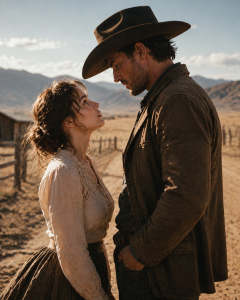
He rode out to the spring that July morning expecting nothing in particular and found four hundred Calder cattle drinking from it, a length of his own fence lying cut in the dirt behind them, and Ruth Calder sitting her horse a short distance off, rifle laid across the saddle, watching him come.
He stopped twenty yards out. Looked at the cattle. Looked at the cut wire. Looked, last, at the rifle.
“You cut my fence,” he said.
“My cattle are dying,” Ruth said. “Your spring’s the only water for ten miles. I’ll pay for the wire. I’ll pay for the water. But my cattle drink today, and if you try to stop me, we’re going to have a conversation neither of us walks away from clean.”
For a long moment, Eli Straoud said nothing at all.
Fifteen years of feud told him exactly what he was supposed to do — drive the herd off his land, mend the fence, ride into Durango and report the trespass to the sheriff before the sun set. Fifteen years of his father’s voice, still loud in his skull even in the ground, told him that a Calder standing on Straoud soil was nothing less than an act of war.
He looked at the cattle again. Ribs showing under dust-caked hide, heads down at the water like they’d forgotten what drinking without fear felt like.
Then he looked back at Ruth, and something in his face changed — not soft, exactly, but tired in a way that went a great deal deeper than one hot July morning.
“Keep your money,” he said.
Ruth’s hand tightened, just slightly, on the rifle stock.
“Water’s water,” Eli said. “No creature ought to die of thirst forty feet from a full spring because our fathers were too stubborn to share a creek.”
Ruth stared at him. She had ridden onto this land fully prepared for a fight. She had prepared for the sheriff, for gunfire, for the sight of Eli Straoud’s face twisted up the way she’d always been told it would twist at the sight of a Calder. In fifteen years, no Straoud had ever offered a Calder anything but the back of a hand.
She had not, in any way, prepared for kindness.
“Why?” she said.
Eli didn’t answer right away. He stood there in the dry grass with the spring running quiet behind him, looking at her the way a man looks at a debt he’s finally decided to stop paying, and for a moment neither of them said anything at all.
—
## PART 2
“Because I’m tired,” Eli said finally. “My father hated your father for fifteen years, and it killed him angry and poor. I buried him last year. I don’t want to be buried angry too.” He nodded toward the herd. “Your cattle can drink. Mine too, for that matter. Spring’s big enough for everybody who ever hated it.”
Ruth lowered her rifle. It was such a small motion — the barrel dropping a few inches, the weight coming off her forearm — but it was the first time in her entire life she had looked at a Straoud and not seen an enemy standing in front of her. She saw, instead, a tired man beside a spring, offering water to cattle that belonged to a family he’d spent his whole childhood being told to despise.
“I’ll fix your fence,” she said.
“Leave a gate in it,” Eli said. “Your side’s going to stay dry till the rains come. Might as well make it easy on both of us.”
He turned his horse and rode off without another word, and Ruth sat alone by the water and watched him go, feeling something shift loose in her chest that she had no name for — a boundary she hadn’t known she was still defending, suddenly not there to defend anymore.
That was the first trespass. The land. It turned out to be the easiest one.
For the rest of that drought summer, Calder and Straoud cattle drank from the same spring, which meant Calder and Straoud people had to talk to each other — about rotation schedules, about which herd watered which morning, about the daily management of the one resource that had started a fifteen-year war and was now, against every prediction either family would have made, the thing quietly ending it.
They met at the spring most mornings. At first the talk stayed where it belonged — cattle, weather, water levels. But the same two intelligent people, talking every single day about something that mattered to both of them, do not stay at cattle and weather forever. The conversation drifted. It went places neither of them had planned for it to go.
Ruth learned that Eli read poetry, and kept it hidden from everyone in the county, because a cattleman caught with a book of verse in his saddlebag became a joke that followed him for years. Eli learned that Ruth could recite the territorial water code from memory, chapter and clause, and had a plan already half-drafted to challenge it in court. They discovered, morning by morning, that they disagreed with each other about almost everything, and that neither of them minded losing an argument nearly as much as they’d expected to.
Then, one morning in August, Eli rode onto Calder land without a single head of cattle, without any reason at all that either of them could put a name to.
—
## PART 3
He rode straight up to the Calder ranch house, a burlap sack tied behind his saddle, and swung down before Ruth had even finished crossing the porch to see who it was.
“Trees are overproducing,” he said, holding out the sack. Peaches, warm from the ride, a few of them already starting to bruise. “Figured you might want some before they rot on the branch. My mother planted that orchard. Never did learn to prune it right.”
It was the first time in fifteen years that a Straoud had set foot on Calder land for any reason that wasn’t sabotage, and both of them knew it, and neither of them said so out loud.
“Come in,” Ruth said instead.
He stayed two hours. They sat at her father’s old kitchen table and ate peaches over the sink and argued — genuinely, happily argued — about whether the railroad coming through the territory would save it or ruin it. When he finally left, Ruth stood on the porch and watched him ride back toward his own land, and understood, with a kind of quiet shock, that the fence between their two properties had stopped meaning anything weeks before either of them had gotten around to admitting it.
By September the drought broke. The rains came down hard and steady for four days, and the grass on the Calder side of the fence came back green within the week. Ruth no longer needed the Straoud spring.
And that, she realized almost immediately, was the problem.
The spring had been the reason. The excuse. Without dying cattle to justify it, there was no longer any functional cause for Ruth Calder and Eli Straoud to see each other every single morning of their lives. The first day after the rains stopped, Ruth rode out to the spring anyway, out of habit more than anything she could have explained.
Eli was already there. No cattle with him. None with her, either.
They looked at each other across water that no longer connected anything at all.
“Your grass came back,” Eli said.
“It did,” Ruth said.
“So you don’t need the water anymore.”
“No.”
A silence settled over the spring, the particular kind where both people understand exactly what’s being decided and neither one wants to be the one who says it out loud first.
“I came anyway,” Eli said finally.
“So did I,” Ruth said.
That was the second trespass — not land this time, but distance, the kind neither family had ever left room for. And it led, the way these things do, straight to the third: the one fifteen years of feud had been built, brick by furious brick, specifically to prevent.
Durango found out before either of them had quite found the nerve to admit it to themselves. A Calder and a Straoud, meeting at the boundary spring every single morning long after any drought could explain it — there was only one story that fit, and the town told it loudly. The feud that had defined the county for fifteen years was ending in the most scandalous way its old partisans could imagine: the two heirs were falling in love.
The reaction did not go gently. Old friends of Angus Calder told Ruth she was spitting on her father’s grave. Old friends of Thomas Straoud told Eli he was a disgrace to the family name he carried. The hatred the fathers had planted did not want to die quietly. It had put down roots in too many other people to let go without a fight.
They met at the spring on a cold morning in October to decide, finally, what they were going to do about any of it.
“The whole county thinks we’ve lost our minds,” Ruth said.
“The whole county spent fifteen years watching our fathers destroy themselves over a creek,” Eli said. “I don’t much care what they think anymore.”
“My father would turn in his grave.”
“Maybe.” Eli held her eyes. “Or maybe he’d be relieved that one of us finally had the sense to stop. I don’t know what the dead want, Ruth. I only know what I want. I crossed your fence in August with a sack of peaches because I wanted to see you. There wasn’t a tree in the world that needed picking that badly.”
Ruth looked at him for a long moment. She had spent her entire life being told that the man standing in front of her was the enemy — had inherited that hatred the same way she’d inherited the ranch, without ever once being asked if she wanted either.
“My father drew a line around this whole family,” she said. “No Calder would ever trust a Straoud. He made me promise.”
“And?”
“And I’m about to break the only promise I ever made him.”
She crossed the spring. Crossed the boundary. Crossed the line her father had drawn around her before she was old enough to understand what a line was, and fifteen years of a war that had never once been hers to begin with — and she kissed Eli Straoud beside the water that had started it and, in the same quiet motion, ended it for good.
Ruth Calder and Eli Straoud were married on December 20, 1887, at the courthouse in Durango. The wedding was sparsely attended. A good portion of La Plata County considered the marriage a scandal, a betrayal, or both at once, and said so freely. Ruth and Eli did not particularly care.
They combined the two ranches into one — the Calder-Straoud spread — and tore down the fence between the properties with their own hands. Not all of it. They left a single post standing, and Eli fitted it with a small brass plaque he made himself, the words hammered out letter by careful letter:
*Here stood a fence that two foolish men defended for fifteen years. Their children took it down in a single afternoon.*
They shared the spring. They shared the water. They shared, in the end, everything their fathers had spent a decade and a half fighting to keep apart.
Within five years, the combined ranch was the most successful operation in the county, because two ranches sharing water and labor turned out to be considerably stronger than two ranches burning themselves out at war. The people who’d opposed the marriage came around slowly, the way people always do when they’re forced to watch something succeed that they’d confidently predicted would fail. By the time Ruth and Eli’s first child was born, the feud had already become the kind of story old men told at the saloon and young people didn’t quite believe had ever been true.
Ruth and Eli ran the Calder-Straoud ranch together for thirty-six years. They had four children, all of them raised on land that had once needed a fence to keep two families from each other and never needed one again. The fence post with Eli’s brass plaque stood in that same spot until 1955, when a Calder-Straoud grandchild had it moved to the local historical museum, where it remains to this day.
Eli died in 1923, on the ranch he and Ruth had built out of a fifteen-year war neither of them had started. Ruth outlived him by eleven years, dying in 1934 at the age of seventy-eight. In her last years, she liked to tell visitors the story of the morning she’d cut a Straoud fence at gunpoint and driven her dying cattle onto enemy land, bracing herself for a war.
“I crossed onto his land to save my cattle,” she’d say, settled into her chair by the window with the old brass-plated fence post visible somewhere in the memory of it. “I did not know I was crossing into the rest of my life.”
She had crossed his fence without permission. He had crossed into her heart without warning. And somewhere between those two trespasses, two people who had never chosen their fathers’ war managed to end it in the one way fifteen years of lawyers, sheriffs, and cut wire never could.
**THE END**