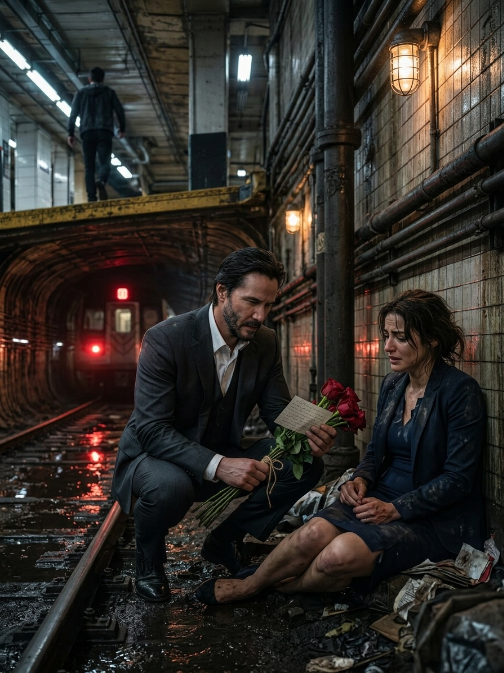
Chicago’s most brutal Mafia Boss kidnapped the wrong woman… but when she asked for black coffee instead of begging, every armed killer froze—and the Boss finally understood why.

PART 1
She had been awake for nineteen minutes when the door came in.
Not the deep, dead sleep that belonged to people with uncomplicated lives — the thin, alert half-sleep of a woman who had spent twelve years building mathematical models for catastrophe and therefore had a professional relationship with the way things could go wrong. Vivian Calloway was lying in the dark at eleven-sixteen on a Tuesday in November, listening to rain drag itself across the windows of her second-floor apartment in Lincoln Park, when she heard the particular sound of a lock being compromised and understood immediately that what was about to happen was not random.
The door gave.
Three men came through it.
She was sitting up by the time they cleared the frame.
The first thing she did was not scream. Not run. Not reach for the phone on the nightstand. The first thing she did was the same thing she did with every unfamiliar dataset — she organized it.
Three men. Moving with a discipline that ruled out desperation. Coats too heavy for the room, fitted at the shoulders in the way that indicated tailoring rather than department store. Two of them moved with the practiced geometry of people who had cleared spaces before. The third was younger and trying to look like the other two and mostly managing it.
Guns low, not raised. Controlled, not excited.
This was a collection, not an assassination.
Which meant she had leverage she didn’t have thirty seconds ago.
The largest of them — a man with a scar bisecting his left eyebrow and the kind of face that had spent years winning arguments by existing — stopped three feet from her bed.
Vivian pulled the sheets off her legs and stood up.
“I need you to listen to me,” she said.
Her voice came out steady, which surprised even her.
The scarred man’s expression shifted slightly — not softening, but recalibrating. She had not done what he expected.
“You’ve made at least four identifiable errors already,” she said. “And I think before this goes any further, it’s worth discussing whether you’ve come for the right person.”
The scarred man looked at the youngest of the three.
“Hood.”
—
She counted the turns.
First left hard, coming out of the alley behind her building. Northbound for six minutes. Then west — she felt it in the van’s banking. Cobblestones around minute eighteen that shook the metal floor under her. Fog horn somewhere distant, muffled by the hood and the rain drumming on the vehicle’s roof. Freight sound. The particular smell of river proximity mixing with diesel and cold.
West Loop warehouse district. The bones of it, the unrevived part, where the square footage cost less because the buildings kept their industrial purpose and asked no aesthetic questions.
She was also counting the names.
They had called her *Vivian* once, just after the hood went on, when the youngest one grabbed her arm and told her to stop moving. That was wrong. That was the name on her building’s buzzer panel and the mail slot and the management agreement. But the name the scarred man had used when he relayed something into his phone — the name that clearly indicated a known target, a reason for this — was *Nina.*
Nina Calloway.
Vivian’s twin sister.
Identical face. Identical dark hair. Identical gray eyes that people said were cool even when they weren’t. The resemblance had been complete enough throughout their shared childhood to generate elaborate confusion and was complete enough now, in adulthood, to have apparently generated an elaborate and dangerous one.
The van stopped. Hands on her arms. Concrete underfoot when they pulled her out — damp, old, uneven. A large interior space, which she could sense by the way sound behaved differently, opening up. Rust in the air. Expensive cologne somewhere closer.
Chair. Wood. Heavy. Back-left leg slightly short.
She measured the room by the ambient noise.
“Boss wants this one personally,” the scarred man said.
A second voice: “She’s lucky we didn’t do it on Clybourne.”
Then a name.
Romano.
Vivian kept her breathing even.
She knew that name in the way anyone who processed risk for a living knew it — not from personal encounter, but from the particular absence in newspapers, the way coverage danced carefully around the specific language of organized crime while still managing to convey the weight of what was happening. Enzo Romano didn’t run a family enterprise. He ran the most controlled, legally insulated criminal operation in Chicago’s recent history. Patient. Precise. Difficult to prosecute. Not impossible to anger.
And whatever Nina had done had apparently managed it.
The metal door.
The change in the room — men straightening without instruction, the quality of attention shifting.
Power, entering.
“Hood off,” a voice said.
—
The light was harsh and single-sourced, which was deliberate. It took a moment for her vision to settle. When it did, she found herself looking at a man who was not what the newspapers implied.
Enzo Romano was somewhere in his early thirties. Dark-suited, precise in the way that suggested the precision was a practiced discipline rather than a natural temperament. His face would have been striking in a neutral context — strong structure, hazel eyes, a quality of attention that felt physical. The eyes were what the newspapers couldn’t capture: tired in a specific way, the tiredness of someone who had stopped being surprised by human behavior and had yet to decide whether that was loss or efficiency.
He sat backward on a metal folding chair.
A silver lighter in one hand.
Click. Click. Click.
He studied her.
She recognized what he was waiting for. Fear, begging, the collapse of composure that would tell him what he was working with. The briefing he’d received on Nina Calloway presumably described a woman who ran on instinct and adrenaline and spectacular poor judgment about men. He was ready for performance. For chaos.
Vivian rolled her shoulders, tested the tension in the zip ties, and said: “These are applied incorrectly.”
The lighter stopped.
The scarred man — Vivian was beginning to think of him as a structural element in the room, load-bearing, always slightly north of Romano — frowned.
“The locking mechanism is facing outward,” Vivian said. “That gives me the ability to use the chair arm for leverage. Given twelve to fifteen minutes and sufficient motivation, the plastic would fracture.”
Nobody said anything.
“I’m mentioning it,” she added, “not because I plan to do it right now, but because it tells you something about the level of attention I’m applying to this situation. And I think you should factor that in before this conversation goes any further.”
Enzo Romano looked at her for a long moment.
Then he said: “You don’t appear frightened.”
“I am,” Vivian said. “I’m managing it.”
“How?”
“It’s my job. Professionally, I mean. I quantify risk for a living. Fear is just unprocessed risk data. If I let it run, I stop being useful.”
“Useful to whom?”
“Right now? To you.” She held his gaze. “Because I think you have me here for the wrong reasons. And I think if you give me five minutes before this becomes something irreversible, I can demonstrate that.”
The scarred man said: “Boss.”
Enzo raised one finger.
The scarred man stopped.
The lighter resumed its rhythm.
Click. Click. Click.
“Talk,” Enzo said.
—
PART 2
Vivian organized what she knew.
“You believe Nina Calloway stole from you,” she said. “Something specific. High value. Bearer bonds, based on what your associate said in the van.”
Enzo’s expression didn’t change. “Approximately.”
“How much?”
A pause. “Two million.”
“When did they disappear?”
“Seventy-two hours ago.”
“And Nina disappeared at the same time.”
“Yes.”
Vivian nodded slowly. “I need to ask you something, and I need you to answer it honestly, because the answer will determine whether I can actually help you or whether we’re both wasting time.”
Enzo tilted his head by a fraction.
“Who was the last person with access to the bonds before they disappeared?”
Silence.
The scarred man shifted his weight.
Vivian watched that shift. “Not you,” she said, to the scarred man. “Someone with financial authority. Transfer capability.” She looked at Enzo. “Someone you trusted enough to give operational access to the accounts.”
Enzo said: “Why does it matter?”
“Because Nina Calloway does not steal without an exit strategy.” Vivian kept her voice level. “She’s reckless about men and reckless about money and genuinely dangerous when she decides something is worth the risk. But she has a specific behavioral profile. She takes calculated risks, not stupid ones. Stealing two million in bearer bonds from the most powerful organized crime operation in Chicago with no exit and no plan is not calculated. It’s suicide. And Nina doesn’t have a death wish.”
The younger of the three men said: “She’s just covering for her sister.”
Vivian looked at him. “I’m covering for her by arguing that she probably didn’t commit the crime you’re accusing her of? That’s an unusual defense strategy.”
Enzo’s lighter stopped mid-rotation.
“Go on,” he said.
“Someone with financial access, existing debt, and a need for a scapegoat framed her. The bonds disappearing at the same time Nina disappeared is a correlation. You’re reading it as causation because it’s the convenient read, and because whoever constructed it wanted it to look that way.” She paused. “Who handles your bond transfers? Who has the authority to move assets at that level?”
Nobody answered.
“The person who told you Nina took them,” Vivian said. “That’s who you should be looking at.”
The scarred man said a name before he appeared to intend to. “Caruso.”
The room got careful.
Enzo’s eyes moved to the scarred man.
The scarred man looked like a man who had just walked into a doorframe in a house he knew well.
Vivian pressed carefully. “Caruso has access to the transfer mechanism?”
“Yes,” Enzo said. His voice had changed. Something had moved behind the hazel eyes — not agreement, not yet, but the particular quality of a man who is beginning to see a shape he hadn’t previously been looking for.
“And Caruso is the one who reported the theft to you.”
Enzo said nothing.
“Does Caruso have debt?”
The scarred man, who appeared to have given up trying to filter what he said: “About nine hundred thousand.”
Enzo closed his eyes briefly.
Vivian said: “Then I’d suggest that the probability that Nina Calloway stole two million dollars in bearer bonds is significantly lower than the probability that Caruso did, manufactured evidence, and gave you a target who is conveniently unreachable and difficult to verify.” She paused. “Which is also why they grabbed me instead of Nina, because—”
Enzo’s phone rang.
He looked at the screen.
He answered.
Listened.
The quality of his stillness changed. The scarred man saw it and moved half a step closer to his employer without seeming to intend it — a reflex, physical loyalty.
Enzo ended the call.
He said, very quietly: “Caruso is dead.”
The room took a breath and held it.
Vivian felt the calculation shift instantly, the new variables landing and reordering everything.
If Caruso was dead, the records he held were either destroyed or moving. Someone was closing the loop. Cleaning the evidence trail. Which meant they were operating on a timeline.
Which meant whoever had staged this had either panicked or been planning this specific acceleration all along.
Which meant Nina—
“She’s running,” Vivian said.
Enzo looked at her.
“Not from you,” Vivian said. “From whoever killed Caruso. She knew something was coming. That’s why she disappeared when she did — not guilt, evasion. She saw it before it happened.” Her voice tightened. “But if whoever killed Caruso knows your men grabbed the wrong twin—”
She stopped.
The math completed itself.
“We’re a loose end,” she said.
Enzo said: “What?”
“You kidnapped the wrong woman. Whoever is cleaning this up knows that. Which means they know you have someone who can identify the actual sequence of events.” Her pulse was moving fast now, faster than she was comfortable with. “They’re not going to let that stand.”
The warehouse doors came off their hinges.
—
PART 3
The first shots shattered the overhead lights.
Darkness and noise and the crash of the doors swinging inward. Vivian went sideways off the chair by reflex, landing hard on her bound wrists, the concrete cold and gritty against her cheek. Boots everywhere. Muzzle flash making the dark strobe.
Professional. Multiple entry points. Coordinated.
Not thieves.
Cleaners.
She rolled toward the debris field her chair had made when it went over. Need leverage. Need leverage. The jagged edge of something — a broken pallet board, she thought, though she couldn’t see it in the dark — and she dragged the zip tie against it, the plastic biting and holding and then, when she shifted the angle, beginning to give.
Gunfire. Return fire. Someone shouting in Italian.
The scarred man — she had learned his name was Aldo from the phone call Enzo had taken — had positioned himself behind an overturned steel shelf unit and was firing with the controlled rhythm of someone who had done this before.
Enzo was moving.
She kept her eyes on him even in the strobe-dark because he was the variable she had the least certainty about, and uncertainty was the thing she tracked. He moved through the space with an economy that was startling — not performing composure, not operating on adrenaline, but genuinely fluent in this environment the way she was fluent in risk tables. It was his native register.
The tie broke.
She pushed herself up to her knees. Her wrists ached. She ignored it.
Something caught the light three feet to her left — a fallen gun, dropped by one of the entry team when Aldo had put him down in the first exchange. She moved for it.
A figure separated from the shadows near the eastern wall.
She raised the gun.
He raised his.
“You’re not going to fire that,” he said.
She had run the math on this question, in the abstract, probably a hundred times. Risk assessment was ultimately an actuarial argument about harm and probability. She had never applied it to herself. She had never had to.
She ran it now in about two seconds.
She fired.
He dropped.
The sound of it went through her differently than she had expected — not louder than the other shots, but more particular. More hers. She had three seconds to process that before the warehouse door on the north side opened and a figure came through it fast and low and familiar in a way that didn’t process immediately in the chaos.
“VIVIAN!”
The voice.
She knew that voice. She would know it at any frequency, in any register, at any volume — she had been hearing it since before either of them could form sentences.
“Nina!”
Her twin came through the north door in wet clothing with a gun in her right hand and an expression that managed to contain about fourteen different emotions simultaneously, which was extremely on-brand for Nina. She fired twice to her left without looking at what she was shooting at, and both shots found their targets, which was less on-brand.
“You know how to use that,” Vivian said.
“LONG STORY,” Nina said. “ARE YOU HURT?”
“No. Where have you—”
“Later.” Nina reached her, and for a half-second they stood in the dark with gunfire still moving at the far end of the warehouse and looked at each other the way twins look at each other after one of them has nearly been killed in the other’s place — with relief and fury and the particular guilt of surviving something that wasn’t supposed to happen to you.
Nina pressed something into Vivian’s hand.
A flash drive.
“Hold onto this.”
Vivian looked at it. “What—”
“Not yet. Don’t ask yet.”
Movement at the center of the warehouse. A figure stepping through the smoke, unhurried, into the space the firefight had just vacated.
Slow applause.
Aldo’s voice, very quiet: “No.”
Enzo went absolutely still.
The man walking toward them was mid-sixties. Silver at the temples. A suit that cost as much as Vivian’s monthly rent. Moving through the aftermath of a professional firefight with the ease of a man arriving at a function he had organized and therefore was not concerned about.
He was also not dead.
He smiled.
“Hello, Enzo.”
“Caruso,” Enzo said.
Vivian processed this at full speed.
Caruso had staged his own death. Created the emotional conditions — grief, shock, the destabilizing effect of apparent loss — to disable clear thinking. He had used Nina as a diversion and the bonds as cover and the twins’ resemblance as a practical tool, manufacturing just enough confusion to move his actual plan forward while everyone looked in the wrong direction.
“The bonds were never the asset,” Vivian said.
It came out before she decided to say it.
Caruso looked at her with the particular expression of someone encountering unexpected competence and finding it inconvenient.
“The bonds were bait,” Vivian continued. Her eyes moved to the flash drive in her hand. “The real asset is this. Routes. Accounts. Political infrastructure. Everything that makes the Romano operation function — that’s what’s on here.” She looked at Enzo. “He spent years with access to your finances. He didn’t steal from you. He documented you. And then he packaged what he had and he was going to use it to leverage his way into a new structure, or burn yours down, or both.”
Caruso said, “Clever girl.”
“The bonds were worth two million,” Vivian said. “What’s on this drive is worth considerably more, depending on what you can do with it and who you sell it to.”
Caruso lifted his gun.
“Put the drive down.”
Nina’s hand closed on Vivian’s arm.
Enzo was very still.
“I built this,” Caruso said. “I built every route, every account, every political relationship you have. I sat in rooms and made promises and took risks you never knew about. And when it became clear that you were never going to acknowledge that—” His voice held something that might have been genuine grievance, beneath the calculation. “I decided to take what I’d built.”
Enzo said: “You decided to betray it.”
“I decided to own it.”
“You decided to sell me to whoever paid for what’s on that drive.”
Caruso said: “Someone was going to. Better me than a prosecutor.”
Enzo crossed the distance between them in less time than Vivian could track it.
The gun went off once — she felt the air displacement of it, close, too close — and then Enzo had Caruso’s wrist bent at an angle that produced a sharp crack, and Caruso dropped.
He didn’t get back up.
Silence settled into the warehouse by degrees.
Rain through the broken doors. Smoke diffusing. The particular stillness of a space where something has just finished happening.
Vivian looked at the flash drive.
Then at Nina, who was watching her with an expression that was mostly relief and a smaller percentage of the expectation that questions were coming.
“You stole the bonds,” Vivian said.
Nina winced. “Technically—”
“Nina.”
“I stole the bonds.”
“Why?”
“Because I found out what Caruso was building on that drive and I needed a reason to be close enough to take it, and the bonds were the most convenient leverage I had access to, and I knew he’d blame me for them anyway so—”
“You framed yourself.”
“I prefer ‘controlled the narrative.'”
“You were nineteen minutes from being executed.”
“I had a plan.”
“The plan put me in a chair with my hands zip-tied in a warehouse in the West Loop.”
Nina looked at the floor. “That part wasn’t in the plan.”
Vivian stared at her twin for a long moment.
Then: “We’re going to have an extremely long conversation about this.”
“I know.”
“Not now.”
“I know.”
Aldo appeared from somewhere in the smoke. He was bleeding from a cut above the ear and holding his left arm at an angle that suggested the shoulder wasn’t right, but he was upright, which seemed to be his preference.
He looked at Enzo.
Enzo looked at the flash drive in Vivian’s hand.
“You should know,” Vivian said, “that holding onto that creates significant risk for both of you. Whatever it contains has already been accessed by at least one other party, or Caruso couldn’t have used it as leverage. Which means copies may exist. Which means—”
“I know what it means,” Enzo said.
“I’m saying it because the right move is probably a structured disclosure rather than a cover-up. Depending on what’s actually on here and how exposed the political relationships are, there may be a version of this that—”
“Are you negotiating with me right now?”
Vivian paused. “I’m analyzing options.”
“She does that,” Nina offered helpfully. “She can’t stop.”
Enzo looked at Vivian for a moment — the same quality of attention she had noted earlier, direct and not quite classifiable, the look of a man updating his assessment of something in real time.
“Your sister stole from me,” he said.
“Technically she stole a debt instrument from a man who was in the process of stealing considerably more from you,” Vivian said. “Net liability seems reducible.”
“The bonds need to be returned.”
Nina said: “Absolutely.”
Enzo’s eyes moved back to Vivian. “And you.”
“I’m going to go home,” Vivian said. “I’m going to change my locks. I am going to strongly reconsider my mail delivery setup since apparently my name on a buzzer panel was enough for your people to identify my apartment as my sister’s. And then I am going to sleep for approximately eleven hours and file an insurance claim for the damage to my front door, which I am going to have to think carefully about how to describe.”
Something happened at the corner of Enzo Romano’s mouth.
Not quite a smile. The shape of one, brief, controlled.
“That’s it?” he said.
“That is approximately it.”
“Nothing else?”
Vivian considered. “I would like it if this never happened again.”
“That,” Enzo said, “is something I might be able to arrange.”
He crossed to her.
He was close enough now that she could see, more clearly than in the harsh single light of earlier, that the quality of tiredness she had noted in his face was not world-weariness or cynicism — it was the specific tiredness of someone who had been operating without a particular kind of support for a long time and had stopped expecting to find it.
She recognized it because she had seen it in her own bathroom mirror at five in the morning before actuarial deadlines.
“The drive,” he said.
She looked at it. Looked at him.
“What’s going to happen to what’s on here?”
“I’m going to handle it.”
“That’s not specific enough.”
His expression shifted. “What would be specific enough?”
“A general sense of whether the political infrastructure is being dismantled or just transferred to a different controlling party.”
A pause.
“Dismantled,” he said. “Carefully. It’s the only version that doesn’t generate follow-on problems.”
“And the men Caruso had working for him? The ones who aren’t dead?”
“They’ll be managed.”
“Meaning?”
“Meaning it won’t generate additional complications for witnesses.”
She studied his face.
Then she put the drive in his hand.
He did not immediately close his fingers around it. He looked at her hand, then at her.
“You have no reason to trust me,” he said.
“No,” she agreed. “But I have Nina’s assessment, and Nina has historically terrible judgment about most things and occasionally brilliant judgment about men, and she seems to believe you’re workable.” She glanced at her sister, who was making a face that suggested she found this characterization only partially accurate. “I’m treating that as a weak data point in your favor.”
“A weak one.”
“Trust is a function of iteration. This is the baseline observation.”
Enzo turned the drive over in his hand once. Then he put it in his pocket.
“The door,” he said, to Aldo.
Aldo, who had been listening with the expression of a man witnessing something he intended to think about later, straightened. “I’ll handle the cleanup.”
“And a car,” Enzo said. “For Miss Calloway.”
“Which one?” Aldo asked.
Enzo glanced at Nina.
“The one who belongs in Lincoln Park,” he said.
—
The car was a black sedan with heated seats and a driver who did not speak or look at her in the rearview mirror, which was exactly the kind of service she would have described as unnecessary under normal circumstances and found, at one-thirty in the morning in wet clothing with zip tie marks on her wrists, deeply appropriate.
Chicago moved past the windows in its night configuration — the lake somewhere east, invisible but exerting its particular gravity; the grid of streets lit orange and white; the occasional pedestrian moving through rain with the focused urgency of someone who had somewhere to be. A city that was always conducting several things at once, most of them just below the visible surface.
She put her head back against the seat.
She thought about the gun she had fired.
She thought about what it meant that her hands were completely steady.
She thought about Nina, who had stayed behind for reasons that would require the long conversation Vivian had promised, and who had — in her spectacular, catastrophically indirect way — been trying to protect something worth protecting.
She thought about Enzo Romano, who ran a criminal organization with the organizational discipline of a consulting firm, who had taken her assessment seriously enough to stop and listen in the middle of a situation where most men would have simply proceeded, who had looked at her when she handed him the drive with an expression she was still processing.
Baseline observation.
That was what she’d called it.
It was also, she was aware, not nothing.
The car stopped in front of her building. The driver got out and opened the door before she reached for the handle. She stepped out onto wet pavement.
Her front door, when she reached the second-floor landing, was in worse shape than she had hoped. The frame was cracked. The lock was destroyed. She was going to need a carpenter and a locksmith in the morning, in that order, and a very creative story for the building management.
She went inside.
She stood in her living room, which was exactly as she had left it — laptop on the table, half a cup of cold tea on the counter, the particular organized quiet of a person who lived alone and liked it — and let the ordinary familiarity of it settle over her.
Three hours ago she had been in a warehouse.
She had been zip-tied to a chair.
She had fired a gun.
She had, in the middle of all of that, conducted an actuarial analysis of the most powerful criminal organization in Chicago and identified an internal fraud that the man who ran it had missed.
She filled a glass of water and drank it standing at the kitchen sink.
Then she opened her laptop, pulled up the actuarial modeling software she had been working in before sleep, and looked at the numbers for a moment.
Then she closed it.
She thought: *I need to recalibrate what I consider a high-probability event.*
Her phone lit up on the table.
Unknown number.
She answered.
“Miss Calloway.” Enzo Romano’s voice, controlled, the particular quality of a man who called people when he said he would because his word was one of the few currencies that remained constant. “You’re home.”
“Yes.”
“No complications with the door?”
“The frame will need replacing. I’ll handle it.”
“I can send—”
“I’ll handle it.”
A pause.
“As you prefer.”
Silence, but not the silence of a call that had ended its purpose. She recognized it as the same quality of silence that filled the moments in risk assessment when the data was complete and the question was what you decided to do with it.
“You said trust is a function of iteration,” he said.
“It is.”
“Then this is a second data point.”
She considered that. “It’s a phone call to confirm I reached my apartment.”
“It’s a phone call I didn’t have to make.”
She looked at her destroyed front door, propped back into its frame, rain audible through the crack at the hinge.
“You’re arguing for the generosity of your own interpretation,” she said.
“I’m making an observation.”
She almost smiled.
“Baseline,” she said.
“Yes,” Enzo said. “Baseline.”
The rain came down steady over Lincoln Park.
Outside her window, the city was still doing its several things at once.
She stayed on the phone a little longer than she had planned to.
And found, when the call finally ended, that she was already thinking about what came next — not with dread, the way she had spent most of her adult life thinking about risk, but with something more like the attention you give to a problem that is genuinely interesting.
She was an actuary.
She understood probability.
The probability that this was simple was low.
The probability that it was worth the complexity was — she ran it, quickly, instinctively, using all available data points — higher than she expected.
She closed the window against the rain.
She went to bed.
For the first time in several years, she fell asleep immediately.