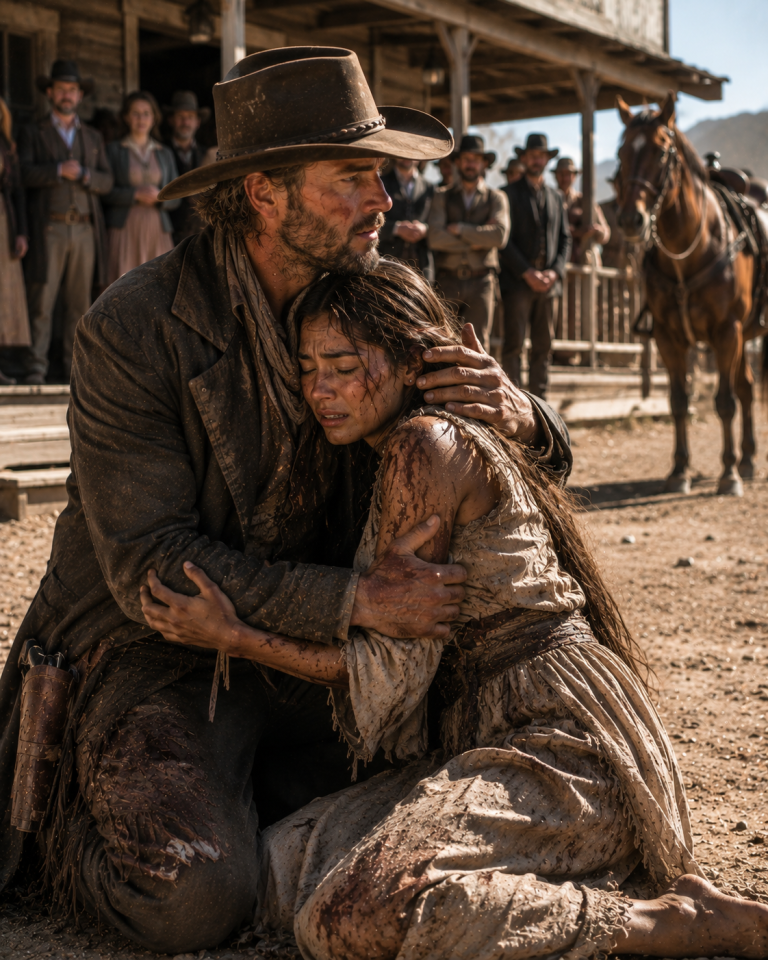
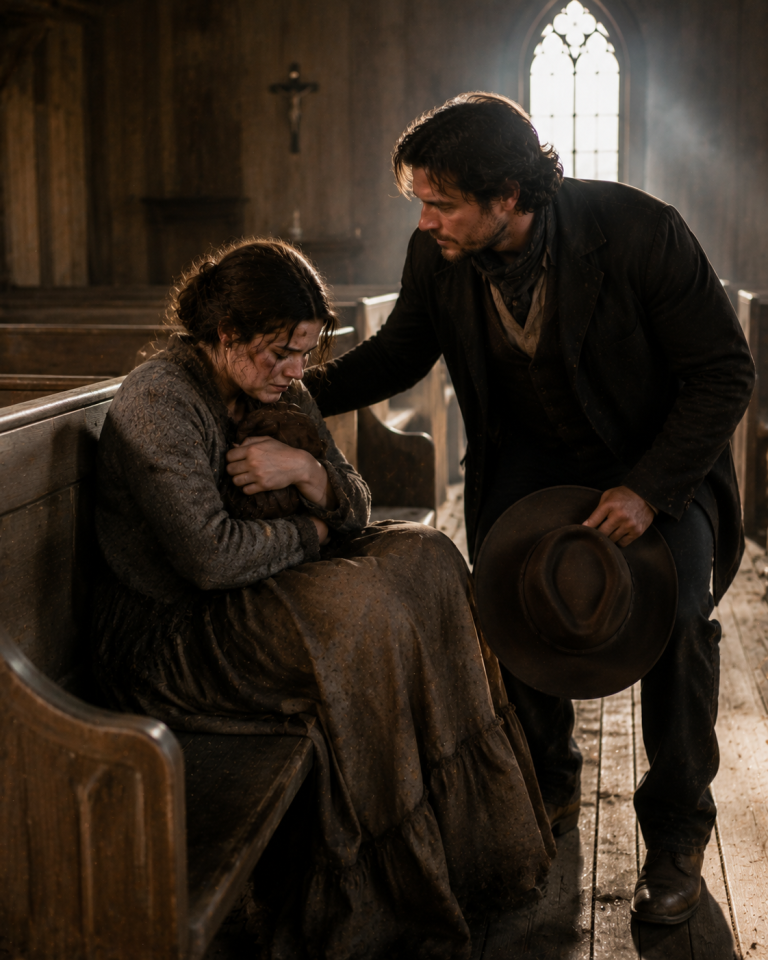
She Fought Alone to Raise Her Four Younger Siblings—Then a Lonely Cowboy Made an Offer That Changed Everything

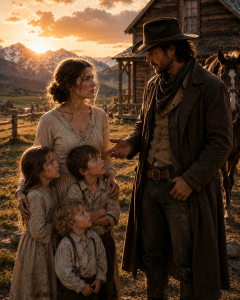
—
PART 1
The ground was still half frozen when they buried Margaret Hart, laid beside her husband Thomas, whose grave had barely settled from the month before. Evelyn stood at the edge of the two crosses and did not cry — she’d already done that in the dark with her face pressed into a flour sack so the younger ones wouldn’t hear through the cabin’s thin walls. Then she’d gotten up before dawn and started the oatmeal, because someone had to, and that someone was always her.
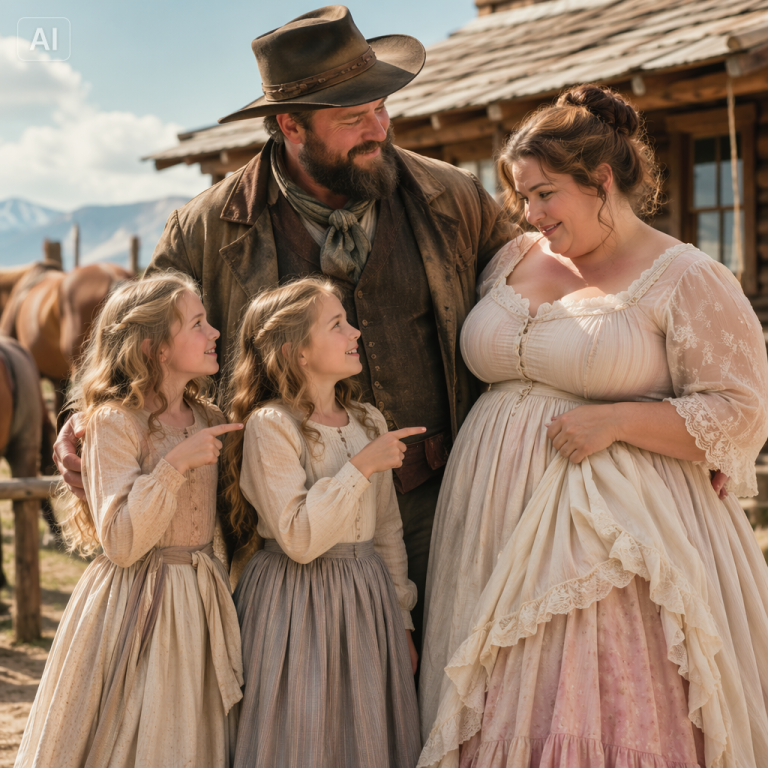
Behind her stood the four of them: Clara, nine, standing straight-backed and trying hard to be brave; James, eight, crying quietly into his sleeve; the twins, Norah and Samuel, six, too young to fully understand what a grave meant, looking at anything but the crosses. “We should go inside,” Clara said carefully. “Samuel’s getting cold.” Evelyn turned around and found four children watching her with the particular look she’d come to know well in the months ahead — hopeful and frightened in equal measure, waiting to see what she’d do.
She found the rot in the ranch’s finances board by board, the way you discover a compromised fence post — not all at once. A note on the ranch, $340 owed to the county bank. Smaller debts scattered through town. Almost no cash, because Thomas had spent the winter buying hay, and what savings remained had gone to medicine when the fever came. Against this: thirty-one head of cattle in uneven condition, four horses, a small flock of chickens, forty-three acres worth something on paper and nothing unless worked, a house needing a new roof, a south fence with three sections down, a water pump that sounded like a dying cat.
She did it all herself. Up before light to break ice off the water trough. Splitting wood in the dark. Riding fence lines on a horse still learning to trust her. Cooking, laundry, mending. Clara helped, taking over the kitchen on the mornings Evelyn was too tired to stand. James went inward, retreating into a watchful silence Evelyn didn’t have the energy to break through as often as she should have. She did not ask for help — partly pride, partly a bone-deep suspicion that if she let herself lean on anything, it might give way and she’d fall with it.
By July she was standing at the counter of Callaway’s Mercantile with a list totaling $855 and $620 in her pocket, doing the arithmetic a fourth time hoping it would change. It didn’t. “I’m short,” she told Dan Callaway, and it cost her something to say it. She was halfway to the door, bag loaded, when her head swam — not dramatic, just the dizziness that comes from not eating enough and standing too long in a hot room after months that had worn her past what she could spare.
“Ma’am.” She turned. A man she didn’t recognize stood a few feet away — tall, broad-shouldered, the build of someone who’d done actual physical work rather than pretended at it. He’d been buying coffee and jerky, introducing himself to Dan as Colt Brennan, newly signed on with the Double H. “I’m fine,” she said. “Sure,” he said, not moving. “But if you’re not, there’s a bench right over there.” She straightened, looked him dead in the face so he’d know she meant it, and walked out into the July heat.
He showed up at her lane at dawn six days later. She watched him from the window — a single rider, sitting very still, looking at her fence. “I got tools,” he said when she opened the door. “Fencing wire, post driver. I could fix those two sections in a couple hours.” “Why would you do that?” she asked. He considered the question seriously, which she hadn’t expected. “Because it needs doing,” he said, “and I’m not busy until noon.” “I can’t pay you.” “I’m not asking to be paid.” “I don’t take charity.” Something shifted in his expression — not irritation, more the small adjustment of a man realizing he’d approached something the wrong way. “It’s not charity. Your south line borders the Double H eventually. Loose cattle don’t respect county lines.” It was a practical argument. It was one she could accept.
He fixed the fence in three hours while she did her chores, brought his own wire without her asking where it came from, and by the time he rode out that afternoon, the twins had already decided they loved him and James — pale, watchful, careful James — had asked him a real question about how the water pump worked and gotten a real answer. He came back the following week to fix that same pump, having heard it was cracked “from the road,” he said, which she didn’t entirely believe but didn’t argue with either. Then he fixed the barn hinge. Then, on a Thursday when she’d stopped pretending to be surprised by the sound of his horse, she finally asked him the question she’d been carrying around for a week.
“Why do you keep coming here?”
—