She endured three years of beatings inside the general store — then a cowboy heard her cry

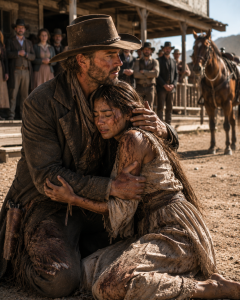
—
PART 1
The desert sun was sinking low over Dust Creek when Cole McKenzie heard the sound that made his blood turn cold. Not a gunshot. Not a shout. The sharp crack of leather against skin, carrying clean across the empty street like something the whole town had agreed not to hear.
He stood across from Blackwood’s general store, his shadow stretched long against the dirt road. Through the dusty window he watched a man’s hand strike a young woman across the face, as though she were nothing more than a stray dog underfoot. She didn’t cry. She straightened her shoulders and lifted her chin, dark eyes proud and unbroken even as blood touched her lip.
Cole’s hand moved to the Colt at his hip before he’d decided anything at all.
Five years of bounty hunting had taught him one rule above every other: other men’s troubles weren’t his business. Step in, and you earned new enemies. But something about that girl stopped him cold — the refusal to fall apart, the look of someone who had already suffered more than most and still would not kneel.
Her gaze met his through the glass. In her eyes he saw pride, fire buried under ash, and — though he hated the thought the instant it came to him — the same strength he’d once seen in his wife, Sarah, before the world burned her away.
He had told himself for five years that some things couldn’t be fixed. This time, he didn’t look away.
Inside, Silas Blackwood loomed over the girl like a storm about to break. Thick through the shoulders, cruel in the mouth. “Clumsy half-breed,” he growled. “That bottle cost me two dollars. You’ll work it off. Fifty cents a week.”
The girl said nothing. She knelt and gathered the broken glass with steady hands, a small turquoise necklace swinging loose at her throat. No older than nineteen, Cole guessed — though three years of this had carved thin, tired lines around her eyes that hadn’t managed to break her.
The bell above the door rang as Cole stepped inside. Six feet of lean muscle and quiet danger filled the doorway, spurs ringing like a warning nobody could afford to ignore.
Blackwood turned. “You got a problem, mister?”
“Looks like you do.”
Blackwood laughed, short and ugly. “Just teaching my worker some manners.”
“Worker?”
“She owes me money. A hundred and twenty dollars for medicine, three years back, for her sick grandmother. With interest, she’s close to three hundred now.”
The math of cruelty. Cole had seen it plenty before — a debt that never shrank, chains that didn’t look like chains.
“Ka,” Blackwood barked. “Get back to work.”
She froze mid-motion, a shard of glass between two fingers, eyes lifting to Cole’s — dark, proud, defiant, waiting to see what kind of man he’d turn out to be.
That night, Cole sat in the Dusty Rose Saloon with a glass of whiskey he never once tasted. The town went on pretending nothing was wrong — men at the card tables, women laughing too loud.
Martha Williams, the widow who ran the boarding house, lowered herself into the chair across from him. “You’re thinking about her.”
Cole didn’t deny it.
“She’s been there three years,” Martha said quietly. “We’ve all seen it. We’ve all done nothing.”
“Why?”
“Because she’s Apache. Because Blackwood’s got the sheriff in his pocket. Because in Dust Creek, if you don’t have money or power, you don’t matter.”
Cole stared into his glass. Five years ago he’d ridden out after a rustler and come home to ash and blood — his wife Sarah and his little girl Emma gone. He’d chosen duty over family once, and it had cost him everything. Fast-draw McKenzie — a name that ended arguments, and had never once fixed a single thing that was actually broken in him.
The next morning, tracking the bounty that had brought him to Dust Creek, Cole learned that Silas Blackwood wasn’t only a cruel storekeeper. He was running stolen cattle through his land, harboring rustlers, doing business with outlaws who paid him to look away. The rot went deeper than one beating inside one store.
In the small room above the store, Ka washed blood from her lip in a cracked basin, fingers touching the turquoise at her throat. Her mother had once told her it protected against evil. She almost laughed at the lie of it. Three years of silence and bruises.
But that stranger had stepped inside the store. And when their eyes met, something had shifted in her that she hadn’t let herself feel in a very long time.
Hope.
By noon the next day, the desert heat pressed down hard on Dust Creek, and Cole rode back into town with his bounty tied over his saddle — two hundred dollars’ worth of justice he no longer much cared about. He dismounted in front of Blackwood’s store and didn’t hesitate at the door.
The bell rang. Blackwood looked up. Ka stood near the shelves, hands trembling.
“I hear you’ve got a worker with a debt,” Cole said.
Blackwood’s mouth curled. “What’s it to you?”
“I’m buying her contract.”
The room went utterly still.
“She ain’t for sale,” Blackwood snapped.
Cole’s expression didn’t change. “Everything’s for sale,” he said softly. “Question’s just whether you’d prefer cash or lead.”
Outside, faces had already begun gathering at the windows. Dust Creek could smell blood in the air, and for the first time in three years, Silas Blackwood understood, standing in his own store, that he might not be the most dangerous man in the room anymore.
—
PART 2
Blackwood’s sneer began to crack, but his pride wouldn’t let him step back in front of a store full of watching faces. “Three hundred dollars,” he barked. “That’s what she owes, plus damages for disrupting my business.”
Cole didn’t blink. “Funny thing,” he said, drawing a folded paper from his vest. “Sheriff Dawkins mentioned something to me last night. Debt bondage was outlawed years back. That contract of yours isn’t worth the ink it’s written in.”
A ripple passed through the crowd pressed against the window glass.
Blackwood’s face went red. “You don’t know who you’re crossing.”
“Cole McKenzie,” he said, and the name hit the room like distant thunder. A few of the men at the window stepped back without seeming to decide to. They’d heard of fast-draw McKenzie. They’d heard how fast his hand really moved, and how few men who’d tested it were still around to argue the point.
Blackwood’s fingers twitched toward the pistol at his hip. He never cleared leather. Cole’s Colt was already resting cold against his forehead.
“I wouldn’t,” Cole said, calm as still water. “I’ve already sent word about your cattle operation. Rustlers hiding on your land. Federal men are on their way.”
The room held its breath — but it was Ka who moved first. She stepped out from behind the counter, slow and steady, no fear left on her face now, only fire.
“I was never his property,” she said, her voice carrying clean through the silence. “And I do not need to be bought.”
In her hand was a thin blade, sharp and perfectly steady.
Blackwood’s eyes jumped between the gun at his forehead and the knife in her grip. “Ka,” he muttered. “Don’t be foolish.”
“Foolish was trusting you.”
Cole lowered his gun a fraction, though his eyes never left Blackwood’s face. “She walks out of here free,” he said, “with wages for three years — or I let her finish this herself. Your choice.”
The silence stretched longer than anyone in that room seemed able to bear.
Then the door swung open. Sheriff Dawkins stepped inside, sweat shining on his brow, two deputies behind him — and behind them, unmistakable in his long coat and badge, a United States marshal.
Blackwood’s courage drained out of him all at once, like water through a cracked basin.
Two hours later the matter was settled. A hundred and eighty dollars in back wages placed directly in Ka’s hands. Federal papers signed on Blackwood’s own counter. The rustlers taken away in chains through a street that had, for three years, pretended not to notice anything happening behind that store’s front window.
Blackwood himself left pale and shaking between two deputies, and Dust Creek folded itself back into its usual silence almost before the dust from the wagon wheels had settled.
But something had changed. For the first time in three years, Ka stepped into the sunlight without anyone watching her like a prisoner counting the hours until she slipped.
Cole had already arranged a gentle mare for her at the livery, supplies, clean clothes — and he said nothing at all about what was supposed to come after. They rode west together as the town shrank behind them, neither one speaking for a long while, the desert wind carrying the mingled scent of freedom and everything neither of them yet knew how to say out loud.
“You didn’t have to do that,” Ka finally said.
“Yes,” Cole answered. “I did.”
She studied him for a long moment — older than the men she’d known, forty-two, silver threading through dark hair, sorrow carved deep around gray eyes that had clearly lived through loss of their own.
“Why?” she asked quietly.
He was quiet himself for several strides of the horses before he answered, and when he finally did, it was the beginning of a story neither of them yet knew would decide everything that came after.
—
PART 3
“Five years ago,” he began, “I had a wife. A little girl. I was off chasing a bounty — thought I was doing the right thing, providing for them the only way I knew how. When I came home, they were gone.”
He didn’t need to say more. The desert held plenty of graves with no names on them, and Ka understood without asking that this was one story he’d never told easily, if he’d told it at all.
“I’ve spent five years telling myself I can’t fix anything,” he said. “Today I decided that was a lie.”
Something in Ka softened, hearing that — not pity, exactly, but recognition. She knew the particular weight of deciding, after years of believing otherwise, that a person could still choose to act. She had spent three years learning the opposite lesson, learning that choice was a thing that could be taken from a person a little at a time until there seemed to be none left worth fighting for. Hearing a man twice her age arrive at the opposite conclusion, out loud, unembarrassed by it, felt like something she hadn’t realized she needed to hear.
“My mother used to say the same thing differently,” she said after a while. “That grief makes a person small if you let it. That the trick isn’t refusing to grieve — it’s refusing to stay small because of it.”
“Smart woman.”
“She was.” Ka looked down at the turquoise resting against her collarbone. “She died before Blackwood. I think that’s the only mercy in any of it — that she never saw what came after.”
“How did it start?” Cole asked, careful, giving her room to say nothing if she chose to. “The debt.”
“My grandmother took fever the same winter my mother died. Blackwood had the only medicine within two days’ ride, and he knew it. He named a price that was three times what it should have been, and I paid it because I didn’t have a choice that felt like a choice. Everything after that was just him deciding the debt would never actually end.” She said it evenly, the way a person speaks about something they’ve had a long time to make peace with, though Cole understood there was a difference between making peace with a thing and having it stop hurting.
“You could have run,” he said. “Plenty would have.”
“Where?” she asked, not bitterly, just honestly. “My grandmother was too sick to travel. And after she passed, I told myself one more season, one more debt payment, and it would be over. It never was. That’s how it works. That’s how he kept a whole town from noticing — everyone could tell themselves it would end soon, so no one had to be the one who stopped it.”
They camped that night beside a clear stream near the foothills, where pine finally began to replace cactus and the air cooled enough to feel like something other than punishment. Ka knelt at the water’s edge and washed the dust from her arms, and it felt, she would tell him much later, like three years of fear were washing off with it — not gone, not entirely, but loosened, the way a knot loosens before it finally comes free.
Cole built a fire. When she came back to sit across from it, the flames caught in her dark eyes.
“What happens now?” she asked.
“That’s your choice,” he said. “I’ll take you to San Carlos. To your people. After that, the road is yours.”
“And you?”
He stared into the fire a long moment. “Maybe I’ll find a place to build something. Something that lasts.”
The fire burned low. The stars overhead felt close enough to touch. Ka moved nearer to him — not out of obligation, not out of gratitude, but because she recognized in him a loneliness that matched her own too closely to ignore. When their hands finally found each other, it was gentle, careful, the way two people touch something they both understand could still break.
Under that wide desert sky, they held onto one another like survivors of two separate storms who weren’t yet certain another one wasn’t already gathering somewhere out past the horizon.
—
The next morning, the San Carlos reservation spread out across the valley below them — rows of small houses, dust rising thin over dirt paths, people quietly holding on to who they’d always been despite everything working against it. Jose Crow Feather met them at the edge of the settlement, his eyes going straight to Cole with a wariness that needed no translation.
“You are alive,” he said to Ka, in Apache.
“I survived,” she answered.
“And this white man?” Jose asked, sharp, protective.
“He freed me.”
Jose’s jaw tightened. “White men always want something.”
Cole understood enough of the tone, if not every word, to know exactly what was being asked of him without anyone asking it directly.
That evening, in the council house, the tribal elders gathered. Thomas Greywolf spoke first, his voice carrying the weight of a man who had buried too many of his own people to speak carelessly. “You have killed Apache before,” he said to Cole.
“I was a lawman,” Cole replied evenly. “I killed criminals. I never harmed women or children.” He paused, choosing the next words with care. “I want her free to choose her own path. With me, or without me.”
The room stayed silent a long moment, considering him.
“You may stay three days,” Greywolf finally said. “After that, you leave. If she goes with you, it will be her choice, and hers alone.”
Three days. Not long, measured against three years of silence — but longer, in some ways, than either of them expected it to feel.
The first day passed under watchful eyes, every glance in Cole’s direction weighed and measured. He kept mostly to the edge of the settlement, helping mend a section of corral fence without being asked, the kind of quiet, useful labor that spoke louder than anything he could have said to Greywolf or Jose directly. A few of the older women watched him work and said nothing, but by evening one of them had left a plate of food near where he sat, which he understood, correctly, as the smallest possible beginning of something.
The second day passed with fewer whispers trailing him across the settlement. Jose found him that afternoon, standing near the horses, and for a while neither man spoke.
“She talks about you,” Jose finally said, in careful, accented English. “Not the way she’d talk about a man who saved her because he wanted something from it.”
“I don’t want anything from her,” Cole said.
“I know.” Jose’s jaw worked a moment. “That’s the part I don’t understand yet.”
“Neither do I, most days,” Cole admitted. “I just know I’m not walking away from this the way I walked away from things before.”
Jose studied him a long moment, and something in his expression eased, just slightly — not trust, not yet, but the beginning of a willingness to consider it.
On the third day, Cole found Ka sitting alone by the stream, turquoise beads braided now into her dark hair.
“You’ve decided,” he said.
“I’ve decided I need time,” she answered softly. “Three years of pain doesn’t disappear in three days. I need to remember who I am first. I won’t be someone you rescue just to ease your own guilt.”
The words landed harder than she probably intended, and he let himself feel the weight of them before answering. “Is that what you think this is?”
“I think you are a good man carrying heavy sorrow,” she said. “And I need to stand on my own before I stand beside anyone — including you.” She laced her fingers through his, just once, just briefly. “Give me a year. If what we have is real, it will still be there.”
“A year,” he repeated, testing the shape of the word.
“A year,” she said. “Not a door closing. A door I’m asking you to leave open without checking on it every week to see if I’ve walked through it yet.”
He almost laughed at that, despite everything. “That’s a harder thing to promise than it sounds.”
“I know,” she said. “That’s why I’m asking it of you and not someone easier.”
The next morning, Cole rode away from San Carlos alone. Ka stood on the hill above the settlement and watched him disappear into the wide, waiting desert, hope stretched thin between them but not broken — the way a rope stays whole even when it’s pulled taut across a long distance.
The desert felt larger with him riding through it by himself. Sunrise painted the hills gold and pale red at his back, and he could feel her eyes on him the whole way down the trail. He didn’t turn around. He knew that if he looked back one more time, he might not find the strength in himself to keep going.
He had freed her from one prison. He was not going to build her another one, not even out of longing.
—
The road south toward Tucson stretched long and empty, carrying the smell of sage and dust for miles at a stretch. For the first time in years, Cole wasn’t chasing a bounty. He wasn’t running from ghosts, either. For once, he understood, plainly, that he was riding toward something instead of away from it.
Six months later, a small ranch stood on a stretch of land outside Tucson. The house had needed work — a leaking roof, fences down in three places — and Cole had fixed it board by board, patient in a way bounty hunting had never once required of him. He built strong corrals. He repaired the barn until it could hold twice what it used to. He planted a garden beside the house despite knowing almost nothing about growing things, because it felt, somehow, like a promise he intended to keep whether or not anyone ever came to see it kept.
He raised horses now — good ones, strong and calm, the kind the army had already started asking after. The work suited him in a way hunting men never had; there was something in watching a fence go up straight, a foal learn to stand on its own legs, that felt like the opposite of everything he’d spent five years doing. He slept easier than he had in longer than he could remember, though not every night — some nights he still woke reaching for a rifle that wasn’t there, chasing the echo of a house burning that had never quite stopped burning somewhere at the back of his mind.
At night, when the work was finally done and the stars came out hard and close the way they only do in that part of the country, he sometimes let himself wonder whether she would ever actually see the place, or whether the year would simply pass and take the promise with it. He did not let himself dwell on it long. He had learned, slowly, that dwelling on things he couldn’t control was its own kind of prison, no better than the one she’d walked out of.
He never wrote her a letter full of promises. He didn’t beg. Instead, one evening after feeding the horses, he sat at his rough wooden table and wrote carefully — *Miss Whispering Wind, San Carlos Reservation, Arizona Territory* — and told her about the ranch. About the mountain view from the porch. About the stream running near the property line and the wildflowers that had started coming up along its banks that spring. He wrote that if she ever wished to visit, she would be welcome. No pressure. No claims on her. Just an open door, the same kind he’d learned, somewhere along the way, that a person could offer without demanding anything be walked through it.
He folded the letter and sent it north with a rider, and then he went back to work, because he had learned that too — that waiting was easier when a man kept his hands busy.
At San Carlos, spring had come early that year. Ka was standing near the council house when the letter arrived, and her hands trembled slightly as she opened it. She read it once, then again, more slowly the second time.
There were no grand speeches inside it. No demands. No talk of love that couldn’t survive a little silence and distance. Only respect. Only space. She folded it carefully and placed it in the small leather pouch she wore close against her heart, alongside her mother’s turquoise necklace and a faded photograph of her parents — the two things she had carried with her through every part of the last four years, good and unbearable alike.
For months she had worked simply to remember who she’d been before Dust Creek. She helped the elders gather herbs, learning again the plants her mother had once shown her as a child, names and uses she’d thought she’d lost somewhere in three years of counting coins toward a debt that never shrank. She mended clothes for families who had little enough to spare, sat with the old women in the evenings while they told stories she’d once been too young to fully follow, and found, slowly, that she was following them now. She walked alone in the hills at sunrise, breathing air that wasn’t heavy with fear for the first time she could clearly remember, and some mornings she simply sat on the high rock above the settlement and let herself cry — not from grief exactly, though there was grief in it, but from the strange, disorienting relief of finally having the space to feel anything at all without bracing for what it might cost her.
There were harder days too, days when a raised voice from across the settlement made her flinch before she could stop herself, when the smell of leather or the particular angle of a man’s shoulders turning toward her sent her back three years without warning. She learned to sit with those moments instead of running from them, the way Thomas Greywolf’s wife taught her to breathe through them, hand pressed flat against her own chest until the present caught back up with her.
Jose Crow Feather had stayed close to her at first. He had loved her before she was taken, and some part of that had never entirely gone quiet in him. He was patient in the way of a man who believed patience would eventually be rewarded, bringing her water from the stream without being asked, sitting near her at gatherings without crowding her, waiting for some sign that the years hadn’t changed what had once been between them.
“You could stay,” he told her one evening by the fire, careful, hopeful despite himself. “You belong here.”
“I do belong here,” she said gently. “But I also belong to myself.”
“That white man,” Jose said, not unkindly, “he didn’t ask you to belong to him.”
“No,” she agreed. “That’s part of why I’m still thinking about him.”
Jose was quiet a long while after that, turning the thought over. “I loved the girl who left,” he finally said. “I don’t know yet if I love the woman who came back. I don’t think that’s an insult. I think it might just be true.”
“It’s true,” she said. “And it’s all right.”
He understood then, watching her say it without a single trace of doubt, that the girl who had left three years earlier was not the same woman who had come back. Her strength had been tested in ways his own never had. It had not broken. If anything, it had simply learned its own shape, and that shape no longer fit neatly into the future he’d once imagined for the two of them.
A year passed. The desert turned through its seasons of punishing heat and brief, hard rain. On a quiet morning, Ka braided turquoise beads into her hair and saddled a horse without announcing anything to anyone. She simply rode south.
The journey took days. Dust rose behind her horse in a long pale ribbon, and hope rode alongside her the whole way, patient as it had learned to be. She passed through country she didn’t know, stopped at a trading post once for water and heard a stranger mention, unprompted, a rancher outside Tucson who bred good horses and kept mostly to himself — and something in her chest had eased at that, small confirmation that the place in his letter was real and not simply a kindness he’d written to ease her leaving.
When she finally reached the ranch outside Tucson, she paused at the edge of the property and simply looked at it for a while before riding any closer. The house stood solid against the hillside. Smoke curled thin from the chimney. Horses grazed easy in the pasture beyond the corral, exactly as he’d described them in a letter she’d read so many times by now that the folds had gone soft. It wasn’t grand. It was honest, built by hand out of exactly what it claimed to be, nothing more and nothing less.
Cole was repairing a fence post when he saw her, and for one long moment he was certain the desert heat had finally gotten the better of his eyes. Then she swung down from the saddle, and he understood it wasn’t a trick of the light at all. He set down his hammer slowly, the way a man moves when he doesn’t trust himself not to break something if he rushes.
They stood facing each other across a few short steps of dirt, neither one closing the distance right away.
“You found it,” he said quietly.
“You left the door open,” she answered.
He noticed how steady she looked, standing there — no fear left in her at all, no hesitation, only a kind of certainty that hadn’t been available to her the last time they’d said goodbye. “I didn’t come because I needed saving,” she said. “I came because I chose to.”
He took a step closer, though he still didn’t reach for her yet. “And if you ever choose different?”
“Then I’ll leave the same way I arrived,” she said. “Free.”
That was all he needed to hear. He reached for her hands, and the wind moved gentle across the fields around them. The horses lifted their heads at the movement but didn’t startle, as though even they understood there was nothing here left to be afraid of.
The desert hadn’t given either of them an easy life. It had given them scars enough to last. But it had also, somewhere in all of it, given them space — space to heal apart, and now, finally, space to choose to stand together.
They walked toward the house side by side.
The ranch grew stronger in the months that followed. Ka planted medicinal herbs in the garden alongside Cole’s stubborn desert flowers, taught him words in her language that he practiced clumsily at first and then with real care, and some evenings they rode the fence line together talking about nothing in particular and everything that mattered at once. She taught him, too, which plants along the stream bank could ease a fever and which were only good for dye, knowledge she’d carried out of San Carlos the way she’d once carried her mother’s necklace out of Dust Creek — as something worth protecting no matter how little space she’d had to keep it safe in.
There were still hard days — memories didn’t disappear simply because love had finally arrived to stand beside them. Some nights Ka woke with her hand already at her throat, checking for a necklace that had never once left her, reassuring herself before she was even fully awake that no one was standing over her demanding payment for a debt that had died with Blackwood. Cole learned not to reach for her in those moments until she reached first; he understood, without either of them needing to explain it, that comfort offered too quickly could feel like another kind of taking. He would simply sit up beside her in the dark and wait, and eventually her breathing would even out, and she would find his hand herself.
He had his own bad nights too — the smell of smoke on the wind some evenings still sent him straight back to a burned house and two graves he’d dug with his own hands, and on those nights it was Ka who sat with him, saying nothing, letting the silence do what words couldn’t. They had each learned, the hard way, that grief didn’t keep a schedule and healing wasn’t a straight road. But they faced those days together now, not as rescuer and rescued, not as guilt on one side and gratitude on the other, but as equals who had each chosen the other freely, with nothing left to prove.
By the second spring, the army had begun buying horses from the ranch in earnest, and word of Cole McKenzie’s stock had started to travel as far as Prescott. He hired on two hands to help with the growing herd, and Ka took over the accounts, keeping the ledger with the same careful, unforgiving precision Blackwood had once used to keep her in his debt — except now every number in the book belonged to something that was actually theirs.
On the first anniversary of her return, Cole built a small wooden sign and hung it near the gate. *Whispering Wind Ranch.*
When Ka saw it, her eyes filled, but she didn’t cry. She had done enough surviving to last a lifetime. Now, finally, she was simply living.
Under a wide Arizona sky, two people who had each once been broken by circumstances entirely outside their choosing found, at last, not rescue but partnership — not chains, but choice.
THE END