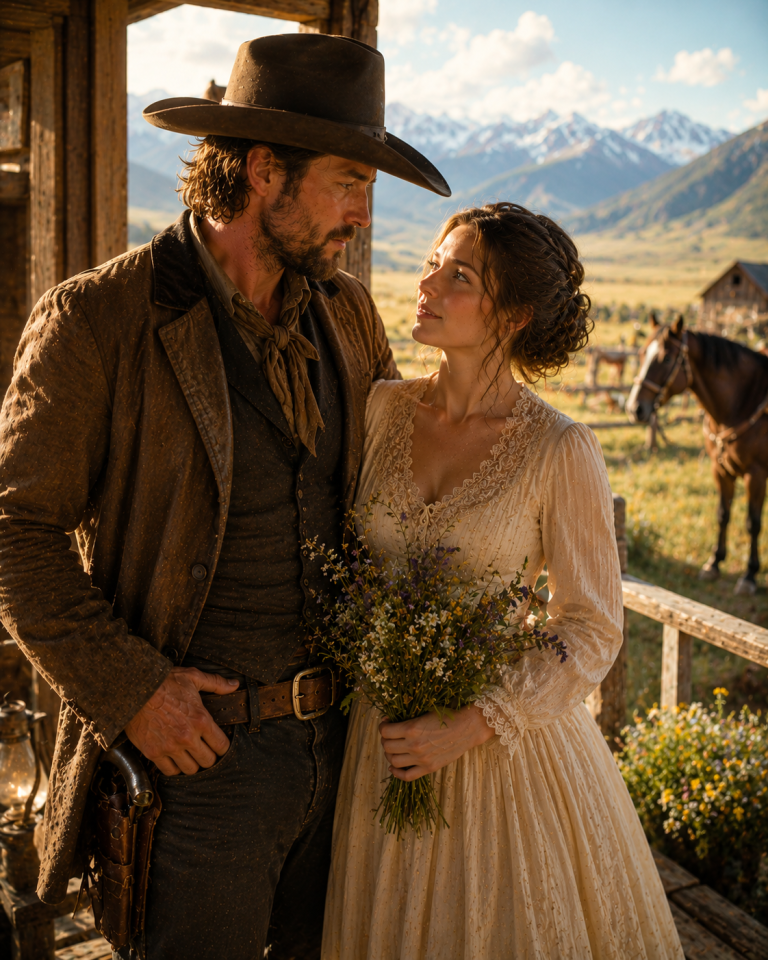
She Fought Alone to Raise Her Four Younger Siblings—Then a Lonely Cowboy Made an Offer That Changed Everything

PART 3
Before the bank crisis, there had been the afternoon in August when they found the spring — a thing Thomas Hart had known about and used once, years before Evelyn was old enough to remember, and had never gotten the chance to show his son. Colt had noticed the creek running lower than it should, even for a dry year, and mentioned an old survey map that might show a water source on the east edge of the property. They found it the next afternoon, tucked into a fold of ground marked by a stand of cottonwoods, clear cold water coming up reliably from somewhere the summer hadn’t reached. James was with them, trailing on the old mare, and he crouched at the edge of the spring and put his hand in the water. “Papa never showed me this,” he said, quiet. “He told Evelyn about it,” Colt said. “That’s how we knew to look.” James looked at his sister for a long moment. “I want to know things,” he said finally. “About the ranch. How things work. So if—” He stopped. “So if what?” she asked. “So if something happens to you,” he said, very carefully, “I want to know how to do it.” She looked at her ten-year-old brother throwing stones into a spring, trying to prepare himself for a world that had already shown him it could take everything without warning. “Yeah,” she said. “We’ll work on that.”
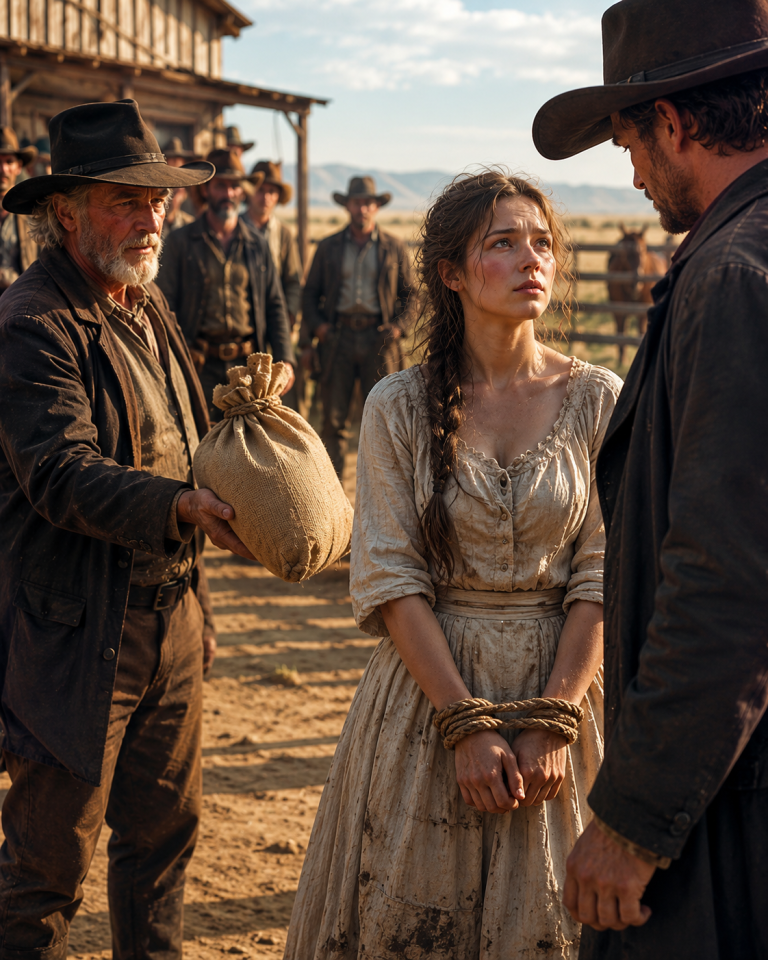
She read the letter twice on the main street of Harland, standing in the January cold, and did math she already knew the answer to. Six weeks. Twenty-three dollars in the tin on the shelf. She could sell what remained of her mother’s good things — the silver candlesticks, the china, the embroidered tablecloth, the small oval portrait that had come across from Massachusetts — and still fall roughly two hundred dollars short with no clear way to close the gap.
She told Colt that Saturday, sliding the letter across the table without dressing up the situation. He read it once, turned it over as if the back might hold an answer, and set it down. “New bank ownership,” he said. “That’s what they’re saying.” “You believe that?” “There are men in this territory who buy up paper on struggling properties and call the notes in when the weather’s hard, because they know people can’t pay and they want the land.” He was quiet a moment, his hands flat on the table. “You know who bought the bank?” “I hadn’t thought to ask.” “Might be worth knowing.” He filed it away without pressing further. “It doesn’t change the number, though.” “No,” he said. “It doesn’t.” Then: “I’ve got two hundred and twelve dollars saved.”
“Colt—”
“Let me finish. I’ve been saving since Wyoming. No debts, no dependents, nowhere I need to spend it. It’s sitting in a Billings bank doing nothing.”
“I can’t take your savings. It’s not about pride this time. If I take everything you have and this doesn’t work—”
“Then we figure that out when it happens.” He held her gaze steadily. “What am I going to do with two hundred dollars in a bank account? Buy a horse I don’t need.”
She wrote it up as a loan anyway — the amount, the date, four percent interest, repayment to begin when the ranch returned to solvency — and they both signed it, because she needed it to be business even if it wasn’t only business. “Thank you,” she said, sliding his copy across. “Don’t thank me yet,” he said. “We’re still forty-five short.” Between his savings, a twenty-dollar extension of credit from Ed Briggs at the feed store, who’d carried the Hart family account for fifteen years and told her bluntly he’d add it to the running tab if she didn’t pay it back in thirty days, and the sale of her mother’s silver candlesticks and, finally, the small oval portrait she’d sworn she’d never part with — she wrapped it in a cloth, drove it to town, and sold it to the dry goods owner’s wife for thirty dollars without haggling — she assembled two hundred and eighty-five dollars, five more than she needed.
She sat across from the bank’s new manager, Aldis Cray, freshly arrived from somewhere east with a banker’s suit and a banker’s practiced pleasantness, and put the envelope on his desk. “Full payment of the outstanding note,” she said, “plus the January installment.” He counted the bills twice, wrote something in his ledger, and seemed to recalibrate something in real time. “Miss Hart, this is — satisfactory,” he said. “I’d like a receipt,” she said. While he wrote it, she looked at the new furniture in the office, the too-shiny nameplate on his desk, and thought about the timing of the call letter arriving in the hardest part of winter, when ranchers had the least cash to spare. “Mr. Cray,” she said before she left. “Is there any reason to expect the terms of the remaining note to change?” His eyes gave her nothing. “The remaining note will be honored per its original terms,” he said, “provided payments continue as scheduled.” She walked out into the cold, the ranch hers again, provisionally, contingent on a world that had not, in her recent experience, shown much interest in things going right.
She told Colt at the woodpile that Saturday. “It’s done. Paid in full.” Something moved through his face — not quite relief, more the release of a tension he’d been holding so quietly she hadn’t fully seen it until it left him. “Good,” he said.
“I want to tell you something,” she said, “and I need you to let me finish.” He nodded. “I’ve been managing this ranch alone for almost a year, and I got very good at doing things alone because I believed needing help was the first step toward losing everything. I know that’s not entirely true. I’ve known it since probably August. You didn’t treat me like a problem to be solved. You just showed up and kept showing up, and I kept waiting for you to want something back for it, and you never did. That scared me more than if you had.” She exhaled. “I’m tired of being afraid of the things that might actually be good.”
He crossed the distance between them in three steps, took her face in both rough, cold hands, and kissed her — not long, not particularly graceful, her nose cold enough that she made an embarrassed sound against his mouth that was almost a laugh. When he pulled back he was smiling, a real, full smile, the first she’d seen, and it changed his whole face.
She told the children that evening — not formally, just gathering them at the table the way she gathered them for anything important. Clara looked unsurprised, which meant approval. Norah asked if he’d be there for Christmas and, informed it had already passed, decided the next one would do. James was quiet longest. “Is this because of the bank? Because of the money?” “No,” Evelyn said. “I could have found the money another way. I would have.” James thought about it with the particular ten-year-old cost-benefit weighing he’d been doing, she suspected, for months. “I want to talk to him myself,” he finally said. “Before you decide anything final.” “Yes,” she agreed.
The conversation between Colt and James lasted forty minutes in the barn, and she never asked either of them what was said, because some things belonged only to the people who’d said them. Afterward, James told her only: “He said he’s not trying to be Papa. He said he knows he can’t be, and he’s not going to try. He said he just wants to be someone I can count on, if I want.” “What did you say?” “I said I’d think about it.” A pause. “I think he means it. He doesn’t say things he doesn’t mean.” “No,” Evelyn agreed. “He doesn’t.” “Okay,” James said — in his particular economy of words, the equivalent of a speech.