She Fought Alone to Raise Her Four Younger Siblings—Then a Lonely Cowboy Made an Offer That Changed Everything

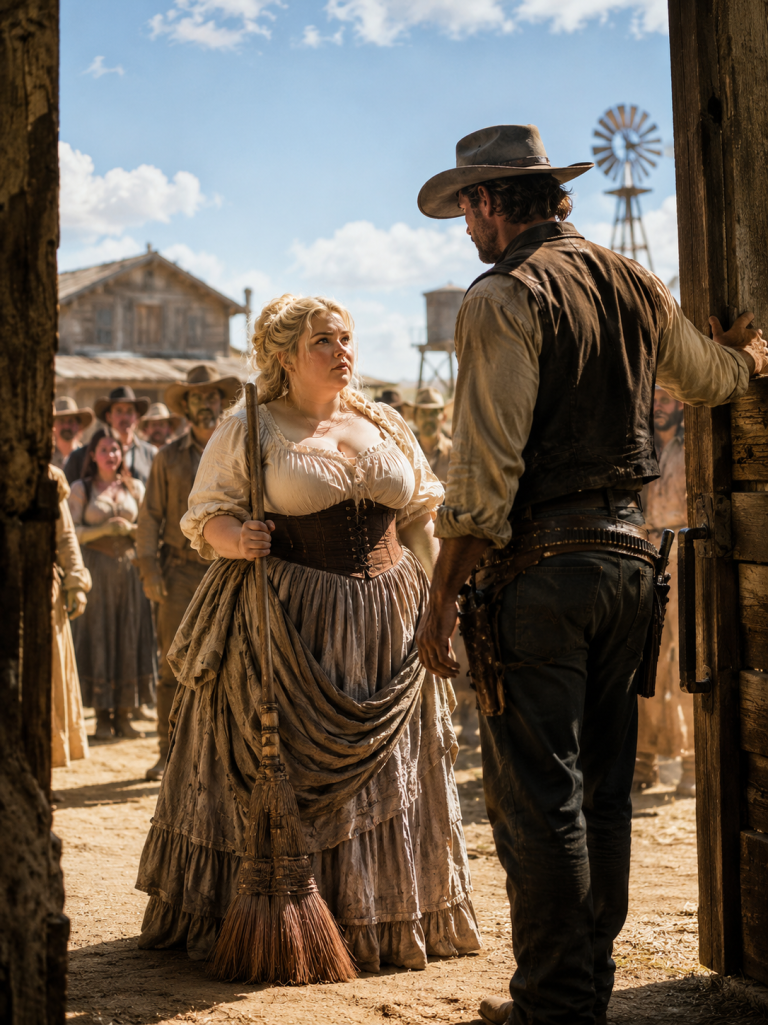
The proposal itself had come a few weeks earlier, on a punishing February evening with the children settling toward bed and the fire burning low. She could tell he’d been carrying something around by the way he sat — not his usual loose, settled posture, but something tauter. “I want to ask you something,” he said, “and I want you to know before I ask it that the answer doesn’t change anything about where I stand.” She put down her mending. “All right.” “Marry me.” “That’s not a question,” she said. “No,” he agreed. “It’s not. Marry me, Evelyn.” She looked at the man who had ridden past her fence and stopped because he couldn’t not stop, who had put two hundred and twelve dollars on her table without hesitating, who talked to her brother like he was worth talking to. “You know what you’re asking,” she said finally. “There are four of them. They’ve already lost two parents. If you’re going to be in this, you’re in it. You don’t get to decide later it was more than you thought.” “I know what I’m asking,” he said. “I’ve been thinking about it since October. Around the cattle drive, when James rode with us and you handled the buyer without blinking. I rode home that night and thought — I want to be part of this. Not as the man who fixed the fence. As someone who stays.” “Yes,” she said, and then, more certainly, “Yes. But I want to talk to the children first, all of them together. And the ranch stays in my name.” “I wasn’t going to argue that.” “I’m saying it anyway.”
They married on a Saturday in March, when the snow was just beginning to pull back from the south-facing slopes and the first tentative suggestion of spring showed in the angle of the afternoon light. It was small — the justice of the peace out from Harland because Evelyn didn’t want it done in town under everyone’s eyes, the Callaways because they’d been there through the worst of it, old Pete Larkin freshly returned from Billings with his sister recovered, standing at the back of the small gathering with his hat in his hands and his eyes bright. Evelyn wore her mother’s green dress, let out at the waist and taken in at the shoulders to fit a body reshaped by a year of hard work — there was a place at the seam that pulled when she breathed deep, and she’d decided that morning she didn’t care. It was her mother’s dress, and she was wearing it. Colt wore his good shirt, clean and pressed, not so different from his other shirts but clearly given attention. The children stood in a row beside her — Clara composed, James still and serious, the twins holding hands the way they always did. When it was done, Samuel asked loudly if there was cake, and there was, because Clara had made one the day before, and the small wedding dissolved into the more manageable business of eating it with people who’d come to wish them well. Pete Larkin pulled her aside near the end and said her folks would be glad, and she thanked him and looked away quickly, because she was not going to cry at her own wedding with cake still to be distributed.
Spring came to a different ranch than the one that had faced the year before. Colt moved in his few possessions — a bedroll, a toolbox, three books she added to the shelf beside the almanac and the Bible, faintly surprised by how small the evidence of a person’s interior life could be when they’d been living lean. They were not easy to share a house with, either of them — his boots left in the wrong place for two weeks before she said something, her tendency to go three days barely speaking to anyone when she got inside her own head and forgot other people were useful. They argued, once loudly enough in April that the twins came downstairs to check what was happening, over whether to buy four additional head of breeding stock now or wait for fall certainty about the spring income. She said wait. He said the opportunity was now or not at all. They didn’t resolve it that night; she went to bed still certain she was right and woke at three in the morning, lying in the dark, privately acknowledging where no one could see her acknowledge it that he had a point. She told him so in the morning, which cost her something real, because she was not constitutionally inclined toward changing her position and even less inclined toward admitting it. He didn’t make anything of it — just said they could look at the numbers together, which was exactly the right thing to say. They bought two of the four animals, a compromise neither of them had proposed but that emerged from the space between their positions, which she was learning was where most workable answers actually lived. That spring’s calves came in better than she’d projected — partly because the hard winter had thinned the weaker animals and left the herd stronger overall, and partly because Colt had a particular skill with cattle that was different from her own; she knew the land and the operation and the numbers, and he knew the animals themselves, their patterns and ailments, the language of a healthy herd versus one sliding toward trouble. Together they could see things neither of them could see alone, which was, she told him one evening that June, watching the children run in the long summer light, probably the most practical argument for marriage she’d ever encountered. “That’s the least sentimental thing anyone’s ever said to me about being married,” he said. “Do you want sentimental?” He thought about it. “No,” he said. “I’ll take real.” “Good,” she said. “Because that’s what I’ve got.”
The debt was repaid in two installments, the first that October, the second the following spring. When she put the cleared, signed record of the loan in his hand, he looked at it and fed it to the stove. “You don’t need that anymore,” he said. “I wrote it down so you’d be protected,” she said. “I don’t need protecting from you.” She watched the paper burn and felt something lift from her shoulders she hadn’t fully identified as weight until it was gone.
The years that followed were not a straight line upward. There was the summer of 1884, when a late frost killed half the season’s calf crop and they had to borrow against spring to make it through. There was the winter James got pneumonia and she sat with him nine days without real sleep, bargaining with everything she could think to bargain with, and got him back thin and pale on the tenth day, then went out to the barn and stood in the dark for twenty minutes doing the thing she never let anyone see. There was a three-day fight in the spring of 1886 that left the house in a chilly politeness the children clearly found alarming, resolved not because either of them won but because they were both too stubborn to walk away from something they’d chosen and too honest to pretend the other didn’t have a point. But the line moved generally in the right direction.
By 1887 the Hart Ranch ran sixty head. By 1889 they’d bought the adjacent twelve acres when the Pearsons moved to Oregon, and Colt hired two hands for the summer seasons while Evelyn managed the books and a household of children growing into people faster than she could quite account for. Clara, seventeen, had the particular self-possession of someone who’d known exactly who she was since the age of nine; she left for teacher’s training in Helena in the fall of 1888 and wrote thorough, unsentimental letters home every two weeks, exactly like her. James, at fifteen, was rangy and capable and utterly unintimidated by land or cattle, talking about running the operation someday with the easy certainty of someone who’d already decided and was only waiting for time to catch up; he and Colt worked side by side now as something closer to equals, both of them seeming to understand the shift had happened without needing to name it. The twins grew into people distinct from each other in ways that surprised everyone who’d known them small — Norah sociable and sharp-tongued, marrying a cattleman from the next valley at twenty; Samuel simply staying, the way some people stay, not because they couldn’t leave but because the place had gotten into him and leaving would mean removing something essential he saw no reason to remove.
In the spring of 1892, ten years after Margaret Hart died and left Evelyn standing at two graves in frozen ground, a man rode up to the ranch and she recognized him immediately: Aldis Cray, the banker who’d sent the letter calling in the note. He was older now, his banker’s suit no longer new, no longer with the bank — with a land development company out of Billings, he explained, consolidating ranches in the county for a larger cattle operation. He held out a document. “I’m not with the bank anymore,” he said. “Left in ’86. We’re buying up ranches in this county. I’ve been authorized to make you an offer.”