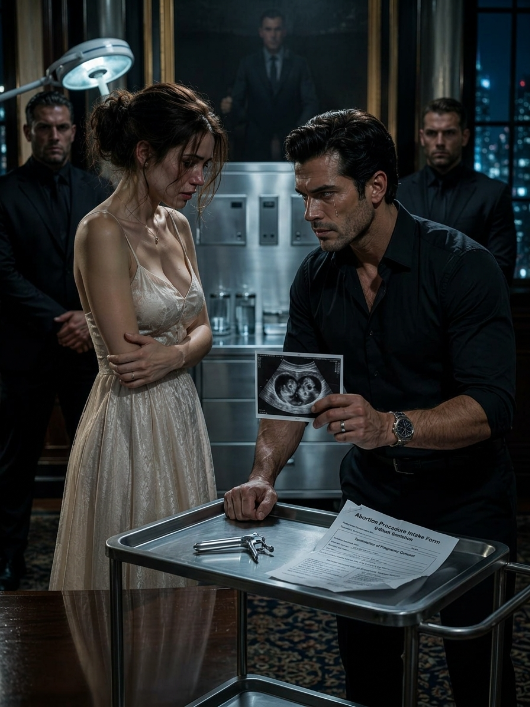
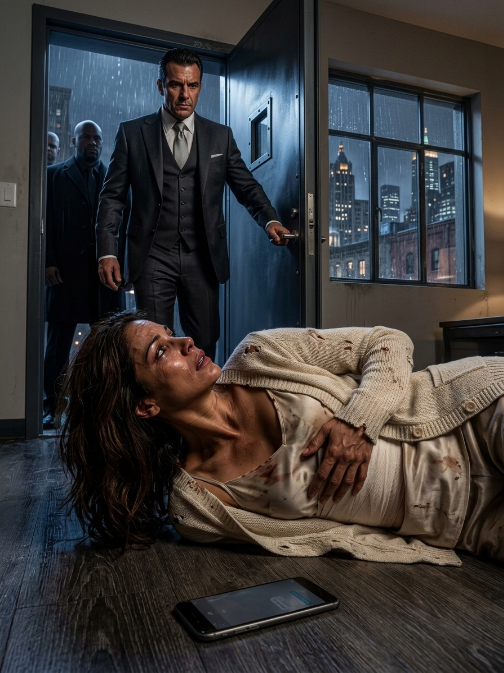
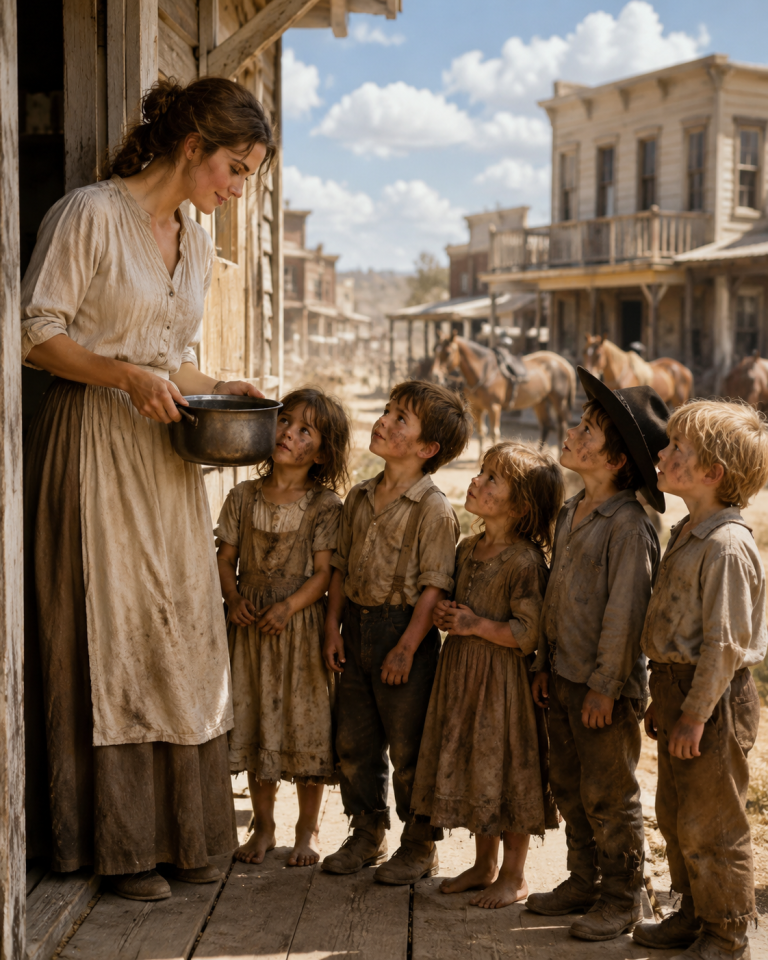
The Richest Man in the Territory Found a Dying Woman Branded Like Cattle — Then Learned His Own Wagons Were Carrying the Monsters Who Did It

PART 1
The morning Rowan Mercer found the body, the sun hadn’t yet burned the frost off the sage.
He’d ridden out before dawn from Silver Ridge — though calling it a ranch was like calling the ocean a pond. Thirty thousand acres. Freight contracts to the territorial capital. Money in railways and timber. At forty-two, Rowan was the kind of wealthy that didn’t need to announce itself. People just knew.
He was heading to Frell’s trading post to collect a custom rifle and winter supplies — the sort of errand he could have sent his foreman to handle. He liked the ride. Liked the silence.
The outpost came into view as the light turned gold. No smoke from the chimney. Frell always had a fire going this time of year.
The door was unlocked. That was the first wrong thing.
The smell hit him before his eyes did — copper and rot. The store had been torn apart, shelves overturned, flour dusting the wreckage like snow. And in the center of it, face down in a pool of black blood, was Frell himself, throat opened ear to ear, hands frozen into broken claws.
Whoever did this had made him suffer first.
Then Rowan heard breathing. Faint. Wet. Coming from the storeroom, its door splintered like it had been forced shut *from the outside*.
“Anyone in there?”
“Stay away,” a woman’s voice whispered.
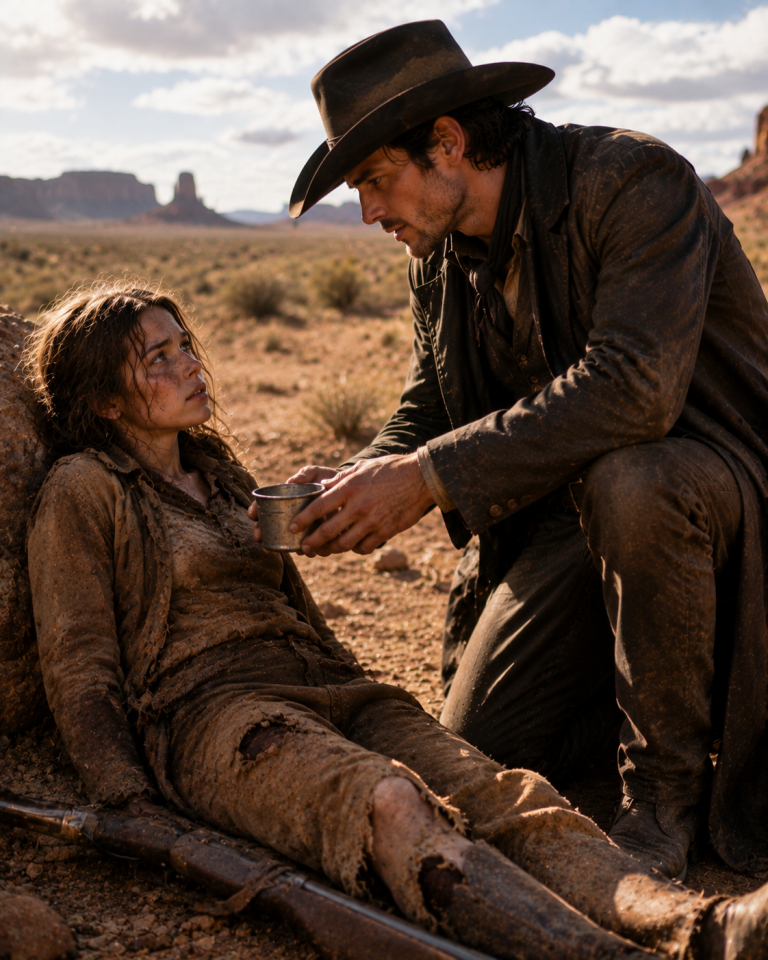
Three kicks and the door gave. In the dark, half-hidden behind ammunition crates, was a woman — mid-twenties, face swollen, one eye sealed shut, wrists rubbed raw with rope burn. And on her shoulder, a brand still raw and weeping — a circle with two crossed lines through it.
Rowan recognized it immediately. Everyone in the territory did.
The Black Hollow mark.
“They’re gone,” Rowan said, keeping his voice low. “It’s just me. Rowan Mercer. I’m going to get you out of here.”
Something in her broken face crumpled, and she nodded once.
“Seline,” she whispered. “Seline Voss.”
Getting her onto his horse took every ounce of care he had. He didn’t take her to Brier’s End — the nearest town, and Black Hollow territory, where the marshal was on the syndicate’s payroll same as half the officials in three counties. Instead he rode three hours north to Silver Ridge, to Clara Hayes, a wartime nurse who wouldn’t ask questions she didn’t need answered.
Seline woke two days later to clean sheets and carbolic soap, and the sick understanding that none of it had been a nightmare. Clara explained where she was. Rowan came to see her that evening — tall, broad-shouldered, hands scarred from work he’d done before he could afford to pay others to do it for him.
“Tell me what happened,” he said.
So she told him. Traveling with her brother toward the mining camps. A saloon in Brier’s End. A man named Boon Rainer getting handsy, and her brother defending her. *I’ll remember that,* Boon had smiled. Three nights later, riders in black dusters dragged her brother from his horse and took them both.
“They kept me two weeks,” Seline said, voice flat. “Grady Pike, their enforcer. Wanted to make me *compliant*. This—” she touched the brand — “was supposed to remind me who I belonged to.”
“Your brother?”
“They killed him slowly. Silas Rainer made me watch. Said it was a lesson.”
Rowan stood at the window a long moment, looking out at his empire — all that land, all that money, none of it worth anything against what he was hearing.
“The Black Hollow Syndicate has been operating in this territory eight years,” he said finally. “They started with protection rackets. Now they move women and children like cattle, and half the territory is in their pocket.” He turned to face her. “I’ve been trying to bring them down for three years. Ever since they killed my wife.”
Seline stared at him. “Your wife?”
“Emily was running a charity helping trafficked women. She found their smuggling route — hidden compartments in freight cars, disguised as livestock shipments.” His hands clenched. “She brought it to the marshal, thinking he’d help. He went straight to Silas. They found her body in a ravine three days later. Made it look like a riding accident.”
He sat across from her, elbows on his knees.
“Miss Voss, I didn’t bring you here only out of charity. You’ve seen the inside of their operation. Their faces, their routines, where they keep their prisoners. That’s worth more than all my money combined.” He paused. “I want to burn them down. All of them. And I need your help to do it.”
Seline looked at this man — his fine house, his empty bed where a good woman used to sleep — and understood exactly what he was offering. Revenge, wrapped in the language of mutual benefit.
“I want Silus Rainer dead,” she said. “And Boon. And Grady Pike. I want them to suffer the way my brother suffered. The way I suffered.”
“Then we’re agreed.”
“Not yet.” She pushed herself upright, ignoring the pain screaming through her ribs. “Why do you really care? You could take your money and leave. Go somewhere civilized. Why fight a war you can’t win?”
Rowan’s voice went raw. “Because Emily asked me to. The night before she died, she said, *don’t let them win.* I promised her I wouldn’t.” He met her eyes. “I’ve broken a lot of promises in my life. Not that one.”
Seline nodded slowly.
“All right, then,” she said. “Here’s the deal. Guns. Supplies. A place to plan. And when the time comes, you don’t get in my way. I’m not your weapon. I’m your partner. Equal stakes.”
Rowan extended his hand. “Equal stakes.”
She took it — and neither of them knew yet just how much blood that handshake would cost, or how close the war they’d just declared would come to swallowing them whole.
—
PART 2
“One more thing,” Seline said, before their hands had even fully parted. “I’m going to kill them. Not capture. Not turn them over to some bought-off marshal. *Kill.* If that’s a problem for you—”
“It’s not,” Rowan said simply.
And just like that, the war began.
Over the next six weeks, Silver Ridge became something Clara only half-jokingly called an army. A one-eyed blacksmith who’d lost his daughter to the syndicate. An explosives expert who’d watched her husband crucified on his own barn door for stealing syndicate opium. A drifter whose farm had been burned for sitting on land they wanted. A woman sold to Silas Rainer at fifteen who’d escaped at nineteen with knife scars and a hatred that could melt iron. A Paiute tracker who never explained why he wanted the syndicate dead, but whose rifle spoke for itself.
They weren’t soldiers. They were survivors — the discarded and the forgotten, chewed up by the syndicate machine and spat out to die. Except they hadn’t died. And now they wanted blood.
“You’re building an army,” Clara told Rowan one morning, watching them drill in the south pasture.
“I’m building a reckoning,” he said.
Seline healed fast — faster than anyone expected. By the sixth week she could shoot better than half the men on the ranch. Revenge, it turned out, was excellent physical therapy. In the evenings, in Rowan’s study — one wall of real books, one wall of maps, one wall bare except for a photograph of a dark-haired woman with kind eyes — they planned.
“Tell me about the ranch,” Rowan said on the third night, notebook open.
Seline described it. Cattle operation on the surface. A second level dug into the hillside underneath, where they kept the prisoners — where they’d taken her brother. Twenty men, some just hands who didn’t know what happened below, others true believers who *enjoyed* the work. Guards rotating heaviest on transport days, when prisoners were loaded into freight wagons disguised as supply runs and shipped east from a depot called Cold Water Junction.
“Cold Water Junction,” Rowan repeated slowly. “That’s part of *my* freight network.”
“I know,” Seline said. “I heard them talking. They use your wagons. Your contracts. You’re the cover, and you didn’t even know it.”
Rowan’s face went white, then red. He set his glass down very carefully and stood, staring out at the stars over land he’d spent twenty years building — land that had been laundering human misery under his own name the entire time.
“I’ve been funding them,” he said quietly. “Every wagon that rolls out with my name on it.” He turned. “Did Emily know?”
“I don’t know,” Seline said honestly. “If she was investigating them, she might have figured it out.”
His hands were shaking. Seline had never seen a man look so furious and so broken in the same breath.
“We end this,” he said. “Whatever it takes. I don’t care if I lose every contract, every dollar. We end this.”
“Good,” Seline said. “Because I’m not stopping until they’re all dead.”
Three days later, the first stranger arrived at Silver Ridge asking when they’d start. He would not be the last — and the plan they built over the following weeks would lead all of them, in less than two months, into a canyon, a burning tunnel, and a room where the man who had murdered Rowan’s wife and Seline’s brother would finally run out of places to hide.
—
PART 3
By the sixth week, Seline barely recognized herself in the mirror. The swelling was gone. The brand had healed into a raised, permanent scar — a mark she’d carry for the rest of her life, whatever that life turned out to be. She’d decided to let it be fuel instead of shame.
Rowan brought her brother’s coat one evening — recovered from Frell’s storeroom, still smelling of tobacco and cheap soap. She pressed it to her face and, for one unbearable second, was back in their old camp watching Daniel laugh at some stupid joke, gesturing wildly about the life they were going to build.
“Thank you,” she whispered.
“We’re meeting tonight,” Rowan said. “Final planning session. If you’re ready.”
“I’m ready.” She put on the coat. It fit like armor. “Let’s end this.”
Eleven of them crowded into the bunkhouse that night — not an army, barely a militia, but it would have to be enough. The next transport was four days out. Iris, the explosives expert, wanted to hit the train. Marcus, the blacksmith, wanted to hit the ranch and kill the head so the body would die. It was Seline who ended the argument.
“We do both,” she said, tracing the map. “Half of us hit the train at Broken Mesa Canyon — the only bottleneck between the junction and Milbrook. The other half hits the ranch. Someone needs to get inside first. Sabotage the guards. Unlock the tunnels.”
“I’ll do it,” she said, before anyone else could.
“No,” Rowan said immediately.
“Exactly. They’ll recognize me — which means they won’t shoot on sight. They’ll want to recapture me. That buys time to get inside.” She met his eyes. “This is war, Rowan. I didn’t survive what I survived to hide while someone else pulls the trigger.”
He argued with his face, not his mouth, and in the end, he nodded. “You don’t go alone. I’ll be in the hills with Tall Grass. The second things go sideways, we cover your retreat.”
That night, after the others had gone to sleep, Seline stayed at the table memorizing the map. Rowan found her there.
“If I don’t make it out,” she said, “find my brother. He’s buried somewhere on that ranch. Bury him properly. Promise me.”
“I promise.”
“Why are you really doing this?” she asked. “Emily’s gone. You could take the money and disappear.”
“Because I failed her,” Rowan said, voice rough. “I had all this power and I couldn’t protect her. The only thing left is making sure her death meant something.”
“It’s not all,” Seline said. “You saved me.”
“You saved yourself. I just gave you a place to stand.”
“Then stand with me,” she said. “And let’s finish this together.”
He held out his hand. She took it. And the deal was sealed — not with contracts, but with something older. Blood for blood. Fire for fire.
—
The final days moved fast. Rowan rode alone into Brier’s End and bullied a nervous land clerk named Wendell into pulling freight manifests — and found it: *Silver Pine Livestock Company*, a shell that didn’t exist, four wagons filed for departure in four days, cattle and feed listed as cargo, bound for Milbrook Station through Broken Mesa Canyon.
He nearly walked straight into Marshal Cole Draven on his way out.
“Rowan Mercer,” Draven said, false warmth thick as syrup. “It would be a shame if something happened to disrupt all your success. Accidents happen out here, even to rich men.”
“Is that a threat, Marshal?”
“That’s advice,” Draven said. “Stick to your ranch. Leave the law to me.”
Rowan rode home with murder in his blood and information that would matter far more than the satisfaction of putting a bullet through a corrupt lawman right there in the street.
The plan was set. Iris would rig a slow-burning fire in the syndicate barn as a diversion. Seline would crawl into the tunnel network the night before the transport, free the prisoners, and vanish before dawn. The rest of the team would hit the wagons at Broken Mesa.
Rowan couldn’t sleep the night before. He stood in his study with Emily’s photograph.
“I’m keeping my promise,” he told her. “I know you’d want it done the right way — through the law. But the law is poisoned here, Emily. So I’m doing it your way — the way you actually did it. I’m not looking away.”
Seline found him there, rifle in hand, her brother’s coat over her shoulders.
“Tell me about her,” she said. “Not the saint everyone talks about. The real person.”
He told her — stubborn, wealthy, could have spent her life at parties in Philadelphia and chose the frontier instead. A school for miners’ children. A shelter for trafficked women. A woman who never scared, right up until the day it killed her.
“You remind me of her,” Rowan said. “Not in looks. In the way you look at monsters and decide to fight them anyway.”
“I’m not noble like she was,” Seline said. “I’m just angry.”
“So was she. People think anger’s a sin. Sometimes it’s the only sane response to an insane world.”
—
Dawn broke cold and clear. Seline descended the ridge alone at dusk, killed the tunnel guard silently, and slipped into the dark. The tunnel opened into a chamber of six cells — a woman clutching a child, teenage boys, an old man with a bandaged leg, others too broken to move.
“I’m here to get you out,” she whispered. “Stay quiet.”
She freed them cell by cell, the rusted locks fighting her every time, until a second guard came looking for the man she’d already killed. She took him too — fast, brutal, necessary — but his dropped lantern shattered and started a fire in the old dry timber. She freed the last prisoners as smoke filled the tunnel and ran them out into gunfire and chaos, Rowan’s rifle cracking from the ridge above, covering her retreat.
They regrouped at a hidden canyon two miles north with twenty-three freed prisoners around a small fire, and Seline sat shaking with a flask of whiskey burning the smoke out of her throat, thinking about the two men she’d killed and the way they’d looked at her, surprised that death had come from someone so small.
“You did it,” Rowan said.
“Barely.” She looked at him. “They’ll know it was us.”
“By tomorrow we’ll have hit the canyon,” he said. “Even if they come after us, it’ll be too late.”
It wasn’t. The transport had been moved up — leaving that same morning instead of the next day, spooked by the fire at the ranch. There was no time to rest. They rode hard for four hours to reach Broken Mesa before the wagons did, Tall Grass peeling off to guide the freed prisoners safely north to Clara at Silver Ridge.
—
Iris had positioned the ambush perfectly — charges at both ends of the narrow canyon, shooters along both rims. When the four wagons rolled fully inside the stone walls, she brought her hand down, and the world exploded. Rockfall sealed both exits. The syndicate guards, trapped at the bottom of a natural killbox, never stood a chance. It was over in three minutes.
Inside the wagons: twenty-three more prisoners. Women. Teenage boys. And in the last wagon, three children barely ten years old crammed into a cage built for one adult. Marcus stared at them with an expression of pure rage.
“We take the documents,” Seline said, gathering manifests and ledgers scattered across the canyon floor. “Everything. This is proof. Real proof — the kind even a bought-off judge can’t ignore.”
They split the group. Marcus and Beatrice would take the forty-six freed prisoners north to safety. The rest — Rowan, Seline, Iris, Cole, and three others — would ride for the syndicate ranch itself, to finish what they’d started, because half measures didn’t work with men like the Rainers.
“We’re going to die, aren’t we?” one of the younger men asked.
“Maybe,” Rowan said honestly. “But we’re taking them with us if we do.”
—
They reached the ranch at dusk to find it fortified, men building barricades, the syndicate clearly expecting retaliation. The tunnel entrance was sealed. Instead, Rowan led them through a narrow drainage culvert running beneath the hillside — a miserable, crawling passage that spat Seline and Rowan out, soaked and filthy, into an underground storage room.
They moved deeper, gathering ledgers documenting six years of trafficking — names, payments, routes, judges, marshals, a senator’s chief of staff. In a final chamber, Seline’s breath caught. A trophy room. Belongings taken from victims. And on the wall, burned into wood like a brand, a list of names. A memorial kept by killers like hunting trophies.
Halfway down: *Daniel Voss.*
“They kept a record,” she whispered, hand rising to touch the letters. “Like he was nothing. Like he was just another rage.”
“I’m going to kill them,” she said, voice gone flat and calm. “All of them, slowly.”
“Good,” Rowan said, and meant it.
—
They climbed to the main lodge and found Silas Rainer holding court over a celebratory dinner with his brother Boon, four lieutenants, and Grady Pike cleaning his knife by the fireplace — the man who had branded her.
Rowan signaled Iris with a mirror flash. The explosion that answered shook the entire building.
“Nobody move,” Seline said, stepping into the doorway, gun raised.
Silas’s shock gave way almost instantly to cold calculation. “The little branded bird came back to the nest.” His eyes flicked to Rowan. “Mr. Mercer. I’m disappointed. I thought you understood how the world works.”
“I understand exactly how it works,” Rowan said. “Men like you buy men like Marshal Draven and call human trafficking business.”
“That’s right,” Silas said. “And it’s worked beautifully for years. So why throw it all away for some nobody girl with a grudge?”
“Because my wife asked me to,” Rowan said. “Before you murdered her.”
The room went very still.
Boon sneered that they were outnumbered, that his men outside were dealing with whoever was foolish enough to attack. Seline shot him in the shoulder without a word. The room erupted. A lieutenant went down under Rowan’s gun. Grady charged Seline with his knife, opened a gash along her ribs before she drove her knee into him and finished it with a fireplace poker — every nightmare, every scream she’d swallowed for weeks, going into those blows until he didn’t move again.
Rowan fought a second lieutenant hand to hand for control of his own gun, won, and turned to find Silas standing by the window with his weapon leveled at Seline.
“Even if you kill me,” Silas said, calm as a man discussing weather, “the syndicate doesn’t end. Four territories. Judges. Marshals. Freight companies. You cut off one head, three more grow back.”
“We found your ledgers,” Rowan said. “Every transaction. By tomorrow, copies go to the governor, the federal marshal, and three newspapers. You’re finished.”
Silas’s composure cracked for exactly one second — long enough for Seline to throw the poker as a distraction. Rowan’s shot caught him left of center. He slid down the wall and died on his own stolen rug, staring up at the woman he’d branded like livestock.
“You should have run,” he whispered.
“So should you,” Seline said.
—
The lodge was already burning by the time they reached the door, fire tearing through a century of stolen timber. They ran through smoke thick enough to cut, burst into a yard full of gunfire and collapsing barns, and made it to the tree line where Iris waited with the horses. A young man named Thomas, who’d lost his sister to the syndicate years before, took a bullet in the back covering their retreat and didn’t survive it.
They rode through the night without stopping until the glow of the burning ranch faded behind the hills. Five of them left, around a small fire in a sheltered canyon, saying nothing much, because what was there to say. Silas Rainer was dead. Boon probably was too. Grady wouldn’t be hurting anyone else. The trafficking network was exposed in damning, documented detail.
“We didn’t get all of them,” Seline said quietly.
“No,” Rowan agreed. “But we got some. That’s not nothing.”
“It’s not enough either,” Iris said, cleaning her gun with methodical exhaustion. “It never is. That’s the thing about fighting evil. You can’t ever really win. You just fight your piece of it, and hope someone else fights theirs.”
—
They reached Silver Ridge three days later, exhausted, wounded, alive. Forty-six survivors filled the ranch’s buildings — fed, clean, but still carrying that hollow, haunted look of people who’d seen what no one should see. Marcus had taken a bullet in the leg but would live. Tall Grass had gotten his group through without incident, using trails Seline suspected weren’t on any map.
Rowan gathered everyone in the dining room that night.
“What we did was illegal,” he told the crowded room. “Violent. Outside the bounds of law. If any of you want to leave, distance yourselves, I’ll help you relocate.” He paused. “But I hope you’ll stay, because this is just the beginning. The ledgers document operations in six states. Hundreds of victims. Dozens of officials. Taking down one ranch isn’t enough.”
“They’ll come after you,” Iris said. “After all of us.”
“I’m counting on it,” Rowan said. “Because when they come after us, they’ll be making themselves visible. Right now they operate in shadows. We’re going to drag them into the light.”
That night, on the porch, Clara found Seline with coffee she didn’t ask for and a question she didn’t need to voice aloud.
“You’re thinking about leaving,” Clara said.
“I don’t belong here. The shooting part’s over. What comes next — the legal fights, the rebuilding — that’s not something I’m good at.”
“What are you good at?”
“Killing people, apparently.”
“That’s not all you are,” Clara said gently. “Anger is a tool, not a home, Emily used to say. You use it to tear down what’s wrong. But eventually you have to build something new. Stay a while longer. You’ve earned that much.”
Seline didn’t answer. But she didn’t argue, either.
—
Three weeks after the ranch burned, a freed prisoner named William — forced once to help bury bodies before his own failed escape — drew Seline a map from memory. Marcus and Cole dug in an unmarked field two miles from the ashes, and found fabric Seline recognized instantly. A shirt with real buttons her brother had been proud of.
“It’s him,” she said, voice steady in a way that surprised her. “That’s Daniel.”
They buried him properly on a hill on the north side of Silver Ridge, one that caught the sunrise, under a granite marker that read simply: *He stood up when it mattered.* Every survivor came. Seline didn’t speak. She just stood in her brother’s coat with one hand on the stone, trying to figure out how to say goodbye to someone she was only now, months later, finally letting go of.
“I got them, Dany,” she told him. “Every single one.”
—
The territorial governor arrived a week later with federal marshals and a journalist demanding answers, documents, testimony. Six judges would eventually be indicted. Fourteen territorial marshals. Two dozen sheriffs and deputies. The syndicate’s reach ran deeper than anyone had suspected.
“Your story isn’t entertainment,” Seline told the journalist flatly, when pressed for lurid details of her captivity. “You want corruption, write about corruption. My story is mine.”
The trials lasted the better part of a year. Seline testified twice, sitting through defense attorneys who called her a liar, implied she’d fabricated evidence, forced her to relive every hour of her captivity in humiliating detail. She answered every question in the same flat, factual tone until even the attorneys looked uncomfortable. Marshal Draven was convicted — fifteen years. Judge Hammond got twenty. Across the territory, verdict after verdict came down, piece by piece, dismantling an empire that had believed itself untouchable.
Rowan’s fortune took a beating — contracts cancelled, business associates fleeing the scandal — and he didn’t seem to care at all. He funded safe houses. Paid for lawyers. Provided security when threats came, and they did come. He’d found a purpose that suited him better than being a cattle baron ever had.
“She’d be proud,” Seline told him one evening, finding him in his study talking to Emily’s photograph again.
“Maybe,” Rowan said. “Or maybe frustrated it took me this long to figure it out.” He looked at her. “What about you? Are you proud?”
Seline thought about it honestly — the killing, the burning, the broken laws, weighed against forty-six freed prisoners and a network of corruption finally exposed to daylight.
“I’m not sure proud is what I feel,” she said finally. “But I’m not ashamed, either. And that’s something.”
“It’s everything,” Rowan said.
—
Spring came, indifferent to human drama. The survivors scattered outward — Margaret opened a small school fifty miles east; Beatrice went west to fight trafficking in California; Iris vanished one morning with nothing but a note on her pillow — *gone to blow up something else, don’t wait up* — so perfectly her that Seline actually laughed.
And Seline herself stayed. Not because she had nowhere else to go, but because she’d finally found something worth staying for. Helping survivors, giving them resources and a path forward, didn’t erase the anger. But it gave the anger somewhere to go that wasn’t destructive. It turned rage into purpose, and purpose, eventually, into something that looked almost like peace.
One April morning, she planted a wild plum sapling beside her brother’s grave — the kind of tree that took root in impossible, hard ground and bloomed anyway.
“I’m staying, Dany,” she told the stone. “Helping people who went through what we did. It’s not the life we planned. But it’s the life I’ve got.”
—
Fifteen years later, Seline brought her niece — daughter of a woman freed from that canyon ambush — to see the plum tree in full bloom. The girl ran ahead, laughing, reaching for the low flowers.
“Can I pick one?”
“Just one.” Seline watched her cradle it carefully in small hands. “It’s a wild plum. It grows in places where nothing else will. Your mama lived somewhere hard like that once. But she survived, and she made sure you’d have a better life.”
The girl looked up, serious. “Are you a survivor too?”
Seline considered the question the way she’d considered it a hundred times over fifteen years. She’d survived the syndicate. Survived her brother’s death, her own rage and grief. But more than that, she’d built something after — never alone, always with people who understood that surviving wasn’t enough. You had to turn survival into living.
“Yes,” she said finally. “I’m a survivor. And so are you, even though you’re too young to remember what we survived.”
Rowan climbed the hill to join them — hair fully gray now, walking with an old man’s careful limp, eyes clearer than they’d been fifteen years before, finally unburdened by the wealth he’d once hoarded when hoarding was all he knew how to do.
“Emily would have liked this,” he said quietly, looking at the tree.
“Yes,” Seline agreed. “She would have.”
The wind picked up, shaking blossoms loose around them like something close to a blessing — proof that even in the hardest ground, watered with more grief than anyone should have to carry, something could still take root. Still bloom. Still persist.
Down in the valley, the bell rang for the midday meal. New arrivals would be waiting — frightened, hurt, needing the kind of help that money alone could never provide. The work would continue. It always did.
But for one quiet moment under her brother’s tree, Seline let herself simply stand there — not because everything was fixed, because it never fully would be, but because she had finally learned that peace was not the absence of pain. It was the presence of purpose. And she had found hers in the hardest place imaginable, among people who had suffered as she had, and had refused, together, to let that suffering be the end of the story.
THE END