A cowboy rejected the widow sent to marry him — then her hidden strength rebuilt his shattered life

—
## PART 1
The wind in Montana didn’t blow. It hunted. It clawed at the logs of Caleb Mercer’s cabin and screamed through the grass like something alive, and out here near the Badlands the land didn’t care whether a man survived it — only whether he was strong enough to stay.
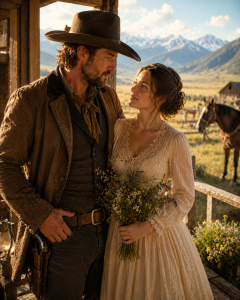
Caleb stood on the wooden platform of the Red Rock depot, coat collar turned up against the cold, a tall man in his early thirties built solid from years of hard labor, his hands rough, his face weathered, a pale scar running from ear to jaw like a warning nobody had ever asked him to explain. He wasn’t here for cattle or supplies. He was waiting for a wife, and the thought sat heavy in his chest the whole time he waited.
Caleb wasn’t a romantic man. He believed in fences, numbers, and work that started before sunrise. His cabin was sturdy, his herd was growing, his claim was clear — but the nights had gotten too quiet for a man to keep pretending that didn’t matter. So he’d written the letter, honest and plain: a practical woman, steady, someone who wouldn’t mind long winters and longer days. He hadn’t expected beauty. He hadn’t expected mystery either.
The stagecoach appeared on the horizon as a cloud of dust against a purple sky. Caleb straightened, his heart beating once, slow and heavy. When the coach finally rolled in, horses steaming and worn, the door swung open — a salesman stepped down first, and then she did.
Caleb blinked. The woman who landed on the dirt street wasn’t soft. Wasn’t shy. Didn’t look like someone hoping to be rescued. She hit the ground hard in worn boots, tall and lean under a dark dress faded thin by sun and travel, dark hair slipped loose from its pins around a face burned by wind. Her eyes were green, sharp, and watchful, moving over the town the way a hunted animal studies fences for the gap it can slip through.
Caleb stepped forward and removed his hat. “Miss Quinn.”
“You’re Mercer,” she said. Her voice was low, rough with dust and miles.
“Yes, ma’am.”
She didn’t smile. She studied him boots to shoulders, then settled on the scar along his jaw, and her eyes didn’t flinch from it. “How far’s your claim?”
“Twelve miles. Creek runs year-round. Well by the house.”
She nodded once, then asked without any warm-up at all, “Do you drink?”
Caleb frowned slightly. “Whiskey now and then. Not heavy.”
“And your temper.” The air between them tightened. “Do you hit women when the whiskey’s in you? Or when you’re sober.”
Caleb felt heat climb his neck, aware of eyes watching from the saloon porch behind her. “I do not hit women,” he said quietly. “Drunk or sober.”
She held his gaze a long moment, searching his face like truth was something she had to dig for with her bare hands. Finally she gave a small nod. “Good. Then let’s go.” She lifted her own battered trunk before he could reach it.
“I can carry that,” he said.
“I can manage.”
“I know,” he said. “But you don’t have to.”
They walked through town together, and Caleb heard the whispers trailing them plain enough — *Mercer got himself a wild one* — and kept walking without answering any of it. At the wagon, one of his horses tossed its head nervous, and before Caleb could reach it, Mara stepped up and spoke low to the animal, one steady hand on its neck. The horse calmed at once.
“This latch is cracked,” she said, pointing. “It’ll snap on an uphill pull.”
Caleb looked. She was right. He fixed it with wire in silence.
“Storm coming,” she added, glancing north. “Less than four hours.”
He studied the sky. She was right again.
They rode out of Red Rock together, the town shrinking behind them, the wind pulling at her shawl though she never once tightened it, sitting straight in the seat and watching the land like it might come at her without warning. After a while Caleb said there was food behind the seat.
“I’m not hungry,” she said. Her stomach betrayed her a moment later.
“Eat,” he said, gentle. She did, guarding the biscuit in her hand like someone might still take it from her even out here.
The cabin came into view near a stand of cottonwoods as the sky turned red beneath dark clouds. “Home,” Caleb said.
Mara studied it carefully. “Solid door?”
“Oak. Crossbar inside.”
She nodded. When she climbed down from the wagon her legs nearly buckled with exhaustion, and she caught herself before he could reach her. Inside, she lit the stove without being told, then stood at the window watching the dark settle over the yard.
“Bed’s yours,” Caleb said. “I’ll take the floor.”
She turned sharp. “We’re married.”
“On paper,” he said, calm. “We haven’t stood before the preacher yet. I won’t touch you until you’re ready.”
Confusion crossed her face. “Why?”
“Because I’m not the man you’ve known before.”
They ate in silence. That night, Caleb lay on his bedroll listening to her breathing, uneven even in sleep, like someone running in a dream she couldn’t wake herself out of. Outside, coyotes howled. Inside, something fragile had already begun taking root. Caleb had asked the agency for a plain wife. Instead, the wind had delivered a woman forged in fire, and something in his chest told him plainly that the real storm hadn’t arrived yet at all.
—
## PART 2
Morning came cold and iron gray, the storm passed but the land left scraped clean and unforgiving, frost crusting the ground under a sky hung low over the hills. Caleb was already outside feeding the horses when Mara stepped onto the porch wearing the heavy canvas jacket he’d given her, swallowed by its size but moving inside it like she’d worn worse.
They rode north after black coffee to check the fence line near the box canyon. She sat a saddle like she’d been born in one — back straight, hands easy on the reins, balanced through every shift of the horse beneath her. Most mail-order brides he’d heard of were city women with soft palms and softer voices. Mara Quinn rode like a woman who’d crossed deserts alone and come out the other side of it harder, not broken.
They’d nearly reached the canyon when old Titus rode up on his mule, his eyes moving slow between Caleb and Mara. “Heard Roar’s boys been sniffing around,” he muttered. “Buying debts. Squeezing small holds. Found a fella out past the Cauley place nailed a notice to his own gate two weeks back, warning off anybody thinking of hiding runners. You be careful.”
Caleb stiffened. “My claim’s clear.”
“Don’t matter,” Titus said. “Roar likes owning more than land.” His gaze lingered a beat too long on Mara. “Wild woman draws wild trouble.”
“She’s my wife,” Caleb said, jaw tight. Titus shrugged and rode on, though he glanced back once before he crested the ridge, like a man filing something away for later.
They worked the fence for hours, mending wire, hammering frozen posts, Mara never once complaining even when barbs cut through her gloves. Near midday Caleb found a scrap of paper nailed crooked to a corner post that hadn’t been there the week before — no words on it, just a crude brand burned into the corner, the same mark Titus had mentioned seeing on Roar’s riders. He pulled it down and said nothing, but folded it into his coat.
By afternoon the sky had turned a sick green.
“Storm,” Mara said quietly, and the wind hit before Caleb could answer, hail slamming down like thrown stone, the trail turning slick underfoot. Mara’s mare slipped, one back leg sliding toward a washed-out drop, and she lost her seat, hanging sideways off the saddle horn.
Caleb drove his horse forward and grabbed her arm — and the moment he touched her, she froze. Not startled. Frozen, eyes gone wide and empty, muscles locked like his grip was a chain closing around her.
“I have you!” he shouted through the storm. “Let go of the saddle. I have you.”
She blinked like someone waking from a nightmare and slowly, painfully, loosened her grip. He hauled her clear as the mare scrambled upright, and she slammed against his chest shaking violently. He didn’t release her.
“I have you,” he said again, softer. This time she didn’t pull away.
They rode home soaked and silent. That night she screamed in her sleep — not a whimper, a broken sound torn up from somewhere deep — and bolted for the door half-awake, hands raised to shield her face.
“Let me out,” she sobbed.
Caleb stood between her and the door but didn’t grab her. “The door isn’t locked,” he said gently. “You’re awake. You’re safe.”
She stared at his empty hands, then collapsed forward into him. He caught her and slid down the wall with her, and she buried her face in his chest and cried like a woman who’d been holding her breath for years.
“I paid,” she whispered. “I paid.”
Caleb didn’t ask what that meant. He just held her, the folded scrap of branded paper sitting cold in his coat pocket, a question he wasn’t ready to put to her yet.
—
## PART 3
He didn’t ask that night, or the next morning, or the two days after that — not because he wasn’t burning to know, but because he’d learned enough already about the shape of her fear to understand that pulling it out of her too soon would only teach her one more time that her secrets weren’t safe with anyone. So he waited, worked the fence line, and let her set the pace of what got said and when.
Two days later they rode into Red Rock to make the marriage official. The small white church doubled as the courthouse, and Reverend Caldwell looked at the two of them like a problem he hadn’t asked to have delivered to his doorstep.
“Do you, Caleb Mercer, take this woman?”
“I do.”
“And do you, Mara Quinn, take this man?”
She looked at Caleb a long moment before she answered. “I do.”
Outside the church, whispers followed them into the mercantile, growing louder the longer they stayed. A drifter leaning near the whiskey barrel smirked. “Mercer buying used goods,” he sneered.
Caleb’s hands curled to fists, the old darkness rising fast and hot in a way that scared him more than it scared the drifter. Before he could step forward, Mara spoke first, calm and level.
“I have survived men with far more power than you,” she said. “Your words are dirt.”
The man faltered. Caleb, breathing hard but not moving, added quietly to the shopkeeper, “Add a ribbon. Blue. For my wife.”
That evening, before the wind picked up for the night, Mara sat mending a tear in his work glove by lamplight while he oiled the hinge on the door that had been sticking since the first storm. When she finished, she reached over without a word and retied the scarf at his collar, which had come loose sometime during the day’s work, her fingers steady and unhurried against his throat in a way that would have made her flinch a week earlier if their positions had been reversed.
“You don’t have to do that,” he said, echoing, without meaning to, the same words she’d once used on him.
“I know,” she said. “But it matters to me.”
He caught her hand before she pulled it back and pressed his mouth briefly to her knuckles, and for a moment the cabin held nothing but the fire and the two of them, no ledger, no Roar, no warrant waiting somewhere down the trail to find them.
It didn’t last. Later that week, Deputy Tom Hail rode into the yard, smiling too easy. “Just checking papers,” he said. “Strangers drifting in. Women running from debts.”
Mara went pale. “He’s fishing,” she said after Hail rode off. “Roar’s counting exits.” She watched the dust settle behind his horse a long moment. “Hail owes Roar money. Cards, mostly, going back years. Man’s not cruel by nature, far as I ever saw. He’s cornered, same as half this county is, one way or another. Doesn’t make him safe. Makes him predictable, is all.”
That night she finally told Caleb the whole of it. She’d signed a contract at sixteen, believing it meant honest kitchen work in a wealthy household. It had meant ownership instead — locked doors at night, wages that never quite covered the debt they were meant to pay down, a ledger kept by a man named Silas Roar that grew heavier every month no matter how many hours she worked against it. Part of her duties, she admitted, had been clerical — copying entries, filing papers at the county recorder’s office where Roar’s “labor placement agency” kept its records registered legitimate on the surface, a front thin enough to fool any judge who didn’t want to look past it too hard. She’d run the first night a window latch failed to catch.
“If they find that paper,” she said, “corrupt judges out here have been treating a debt contract like it’s the same as owning a person outright. Roar’s had Judge Tagert in his pocket two counties over long enough that nobody local will touch a warrant with his name attached.”
Something in Caleb went cold. “You belong to no one,” he said. But even saying it, he understood the danger plain: men like Silas Roar didn’t only own land and debts. Out here, far enough from any territorial capital to matter, they’d bought enough of the law to make an old contract look legitimate in front of the wrong bench.
Winter came down on the valley like a fist. Snow swallowed the grassland, the sky turned to iron, wolves tested the corral wire at night. Every morning became survival measured out in logs, grain, and breath, and Caleb and Mara stopped speaking of fear because there wasn’t room left for anything but the work of staying alive together.
Then the warrant came.
Deputy Hail rode into the yard with two men and a paper signed by Judge Tagert — contract fraud, theft, breach of a labor agreement, the language dressed up formal enough to look legitimate to anyone who hadn’t heard the whole truth the way Caleb had. They weren’t asking questions. They’d come to take her.
Caleb stepped between them on the porch. “She’s my wife.”
“She’s collateral under a debt contract this county’s already recognized once,” Hail replied, not quite meeting Caleb’s eyes when he said it.
Mara didn’t cry. She stood straight, though her hands trembled at her sides. “Let me go,” she whispered to Caleb. “If you fight, they’ll kill you and call it justice for interfering with a lawful arrest.”
Caleb saw the trap laid out plain the moment she said it — draw first, and Roar’s men in badges would shoot him down with a story already written to explain it clean. So he lowered the rifle. Hail’s men hauled Caleb off instead, on a charge of interference that wouldn’t have held up in front of an honest judge for five minutes, and left Mara standing in the yard under orders to be collected the following morning once Roar’s own wagon could make the ride out from town.
They marched Caleb before Judge Tagert the next day for what was supposed to be a formality. Tagert didn’t so much as look up from his ledger the whole hearing, denying bail in a flat voice that made it clear the outcome had been decided before Caleb ever walked through the door. “Interference is interference,” Tagert said, already reaching for his next paper. “Man wants to keep his temper, he should learn to keep it before it lands him in my courtroom.”
That night in the Red Rock jail, Titus showed up at the bars under the excuse of delivering a supper tray, and passed Caleb a folded note along with the bread — a warning, in Titus’s rough hand, that one of Roar’s men had been seen paying off the night guard, and that Caleb ought not to trust whoever came to walk him to the privy after dark. Caleb didn’t sleep that night. When a stranger did come near midnight, key already in hand, Caleb was braced flat against the wall by the door instead of on his cot, and the man got exactly one step inside the cell before Caleb drove a shoulder into him and pinned his arm hard enough against the bars to make him drop the blade he’d been carrying. The scuffle brought the day guard running, more out of noise than principle, and the would-be killer disappeared into the dark before anyone could get a clear look at his face — but the message was plain enough. Roar wanted Caleb gone quiet before any federal marshal ever had a reason to ask questions.
Mara, meanwhile, hadn’t waited for Roar’s wagon to come collect her the next morning. She knew, from two years spent filing Roar’s paper trail herself, exactly where the ledger was kept — not hidden in some locked safe on Roar’s own ranch, where a jealous man might have guarded it close, but sitting in a records drawer at the Red Rock land office itself, filed under the harmless name of his “labor agency,” because Roar had never once imagined a woman he considered property might remember the combination to a lock she’d watched the night clerk turn a hundred times over two winters. She slipped into town before dawn, while Hail’s men were still sleeping off their confidence, and let herself into the recorder’s office with a hairpin and a steadiness that surprised even her. The ledger was there. So were transport manifests bearing an actual railway company’s stamp — records of women moved by rail across the territorial line into Dakota, which was the one detail, she knew, that could pull this whole business out from under any county judge’s protection and into a federal court’s jurisdiction instead.
She rode north through wind and ice toward Helena with the ledger wrapped tight against her chest, three days of hard travel on almost no sleep.
Marshal Davis did not simply take her word for it. He’d had an open file on Silas Roar for the better part of two years already — a woman named Josephine Carr had come to his office once with a similar story and vanished before she could testify, leaving him with nothing solid enough to act on and a case he’d never quite been able to close out of his own conscience. Mara’s ledger, when he finally laid it open on his desk, gave him names that matched half of Josephine Carr’s old testimony word for word, along with the railway stamps he needed to justify federal involvement in the first place. Even so, he spent two full days cross-referencing entries by telegraph with the recorder’s office in Miles City and a rail agent in Bismarck before he’d commit deputies to riding out — because a marshal who moved on bad evidence against a man with Roar’s money didn’t stay a marshal long, and Davis intended to make certain nothing in this case could be picked apart in a courtroom later.
Those two days cost Caleb dearly. By the time Marshal Davis finally rode into Red Rock with federal deputies and a warrant of his own, Caleb had a second attempt on his life to survive — this one in broad daylight, a supposed accident with a dropped rifle during a work detail that put a bullet through the wall a foot from his head — and had grown gaunt and hollow-eyed enough that Mara, standing behind the marshal when they finally unlocked his cell, had to steady herself against the door frame at the sight of him.
“You came back,” Caleb breathed.
“I never ran from you,” she answered.
They rode out together toward the Roar ranch, where word had already reached Silas Roar that a marshal was in town asking questions with federal weight behind them. By the time Davis’s men reached the property, Roar had a wagon half-loaded with cash boxes and a fresh horse saddled behind the barn, clearly meaning to run rather than stand and argue jurisdiction with a federal warrant. Two of Davis’s deputies peeled off and cut him off before he’d cleared the tree line, hauling him back to the yard on foot while his hired men, still up on the porch and in the barn loft, watched their employer get dragged in like any other fugitive and started doing their own arithmetic about which side of this fight was worth dying for.
Marshal Davis called out the federal warrant from the yard. Roar, disheveled now, tried bluster anyway. “This is county business,” he snapped. “You’ve no standing here.”
“Railway manifests crossing into Dakota make it federal business,” Davis said, unmoved, “and I’ve got two years of evidence in a satchel that says so, Mr. Roar, whether your local judge wants to admit it or not.”
That was when Hail, still holding out some hope of proving useful enough to Roar to save his own skin, lost whatever composure he had left. He grabbed Mara from behind, dragging her back against him, a revolver pressed hard to her temple.
“Nobody’s taking anybody till I say,” he shouted, voice cracking on the words in a way that told everyone in the yard he hadn’t planned this so much as panicked into it.
The world narrowed down to wind, gun-smoke, and the black hole of that revolver. Caleb didn’t reach for the Winchester on his saddle. Instead he fired once into the porch post a hand’s width from Hail’s head — close enough to startle, not aimed to kill — and in the half-second Hail flinched from the splinters, Mara drove her elbow back hard into his gun arm and stamped her heel down on his instep the way she’d learned to years ago in a house where nobody was coming to save her but herself. The revolver fired wide into the snow. Mara wrenched free and dropped flat as two federal deputies tackled Hail from the porch steps, and Roar’s remaining men broke and scattered — none of them willing to die for wages that had never once included dying in the terms.
Within minutes, iron closed around wrists all across that yard. Roar stood pinned between two deputies at the end of it, pale but still working his jaw like he had one more argument left in him. “You think this ends me?” he sneered. “I’ve got lawyers in three territories.”
Mara walked forward until she stood level with him. “You called me Asset Twelve,” she said, steady. “You called me debt. You called me property.” She looked him dead in the eye, unflinching. “My name is Mara Mercer. And you do not own me. Neither did any judge you ever paid to say otherwise.”
Marshal Davis stepped up and placed the cuffs on Silas Roar himself. It wasn’t loud. It wasn’t dramatic. It was simply final.
The ride back to the homestead was quiet. The barn stood half burned — a parting message from one of Roar’s men before the arrests finished, they’d learn later — the cabin roof scorched, snow lying heavy and blackened in drifts across what was left of the yard. But the walls still stood. They rebuilt. Titus arrived first with timber, staying on longer this time than any of his usual passing visits, teaching Caleb to reset a foundation post properly while he was at it and telling Mara, more than once, that he’d known the day he first saw her stare down a mule in the Red Rock street that she wasn’t a woman who’d stay broken for long. Others came after him — men who’d once whispered outside the mercantile now showing up with nails and rope and a quiet respect they hadn’t offered before. A new barn rose out of the frozen ground by the time the worst of winter finally let go.
Spring came slow, but it came. Green pushed up through black soil. The ledger Mara had carried through three days of ice ended up doing more than free her — over the following months it opened cases against Roar’s operation in two other counties, and Marshal Davis’s long-stalled file on Josephine Carr finally closed with a conviction instead of a question mark. Not every woman named in that ledger came forward. But enough did, and the network Roar had spent a decade building came apart faster than he’d ever imagined it could, piece by piece, county by county.
One morning a letter arrived from Helena. Roar had made bail, his three-territory lawyers apparently worth exactly what he’d claimed.
Caleb read it twice. “He’ll try again,” he said.
Mara stood beside him on the porch, wind lifting loose strands of her hair. “Let him,” she said. “He doesn’t scare me.”
“Are you afraid?” Caleb asked.
She thought about it a long moment, honest with herself before she was honest with him. “Yes,” she said finally. “But I’m not running.”
Caleb slipped his arm around her shoulders, and for the first time since the night he’d pulled her off that stagecoach, she didn’t go still at the touch first before she leaned into it. It came easy now, unremarked, the way it should have from the start and never quite had until this exact spring morning.
That night, for the first time since Red Rock, Mara slept the whole way through until dawn without once bolting upright, without the broken sound tearing loose from somewhere deep in her chest, without Caleb needing to sit against the wall beside her reminding her the door wasn’t locked. She woke slow instead, disoriented by how ordinary it felt, and found Caleb already awake beside her, watching her the way a man watches something he still can’t quite believe he’s been trusted to keep.
“You slept,” he said, quiet, like it was the finest thing he’d seen all winter.
“I slept,” she agreed, and reached for his hand without flinching, without bracing, without any part of her left waiting for the touch to turn into something to survive.
They stood together that evening watching a hawk circle above the valley, the land still harsh, the wind still hunting the way it always had and always would. The world hadn’t softened. But neither had they, and there was a difference, Caleb had come to understand, between hardness that shut a person off from everything and the kind that simply meant you’d stopped being easy to break.
He had asked the agency for a plain bride. Instead, the wind had delivered a woman forged in fire — and in choosing each other, over and over, through jail cells and ledgers and a winter that had tried its level best to take everything from both of them, they’d built something Silas Roar’s whole fortune had never once managed to buy for himself.
A home no one could own. Not ever again.
**THE END**