The Mafia Boss Watched His Mother Humiliated—Until a Poor Maid Turned the Tables on Manhattan’s Elites

**PART 1**
She had told herself she wouldn’t do anything.
She had told herself this specific thing on the subway uptown, on the service elevator, in the kitchen while tying her apron, and approximately twelve more times across six hours of carrying trays through rooms where people spoke about generosity with their mouths full of canapés.
The Monroe Foundation Gala occupied the Meridian Club’s grand ballroom every December, raising money for pediatric oncology research, and Sofia Navarro had worked three of them. She knew the layout, the flow, the art of becoming invisible in a room where invisibility was the cost of service. She knew the trick of keeping her eyes down and her mouth shut and her cart moving, because jobs like this, at $24 an hour plus tips that sometimes materialized and sometimes didn’t, were what kept her brother Mateo’s dialysis running and the lights in their apartment on.
She had told herself she would not do anything.
Then the wine went down the front of the old woman’s dress.
Not an accident. Sofia had been watching the exchange for ninety seconds — long enough to see the woman with the diamond earrings deliberately lift her glass and tilt it at just the angle that made the spill look like crowding rather than intention. Long enough to see the senator beside her begin to smile before the wine landed.
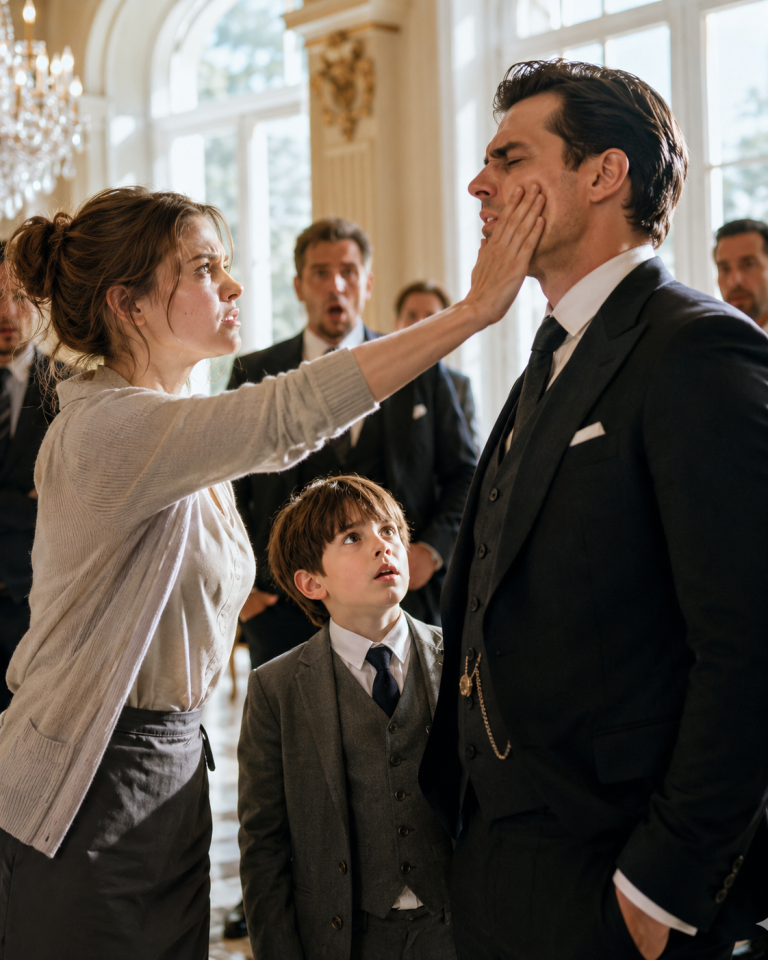
The old woman looked down at herself. Her hands trembled. Her silver hair had come loose. She was wearing an ivory dress that someone had dressed her in with care, and now it was stained down the front, and the room — the room of three-hundred-dollar desserts and handshake deals and people who wrote checks to sick children as public performance — the room laughed.
Not all of it. Not loudly. But enough.
The woman with the diamonds spoke to the senator in the carrying voice of someone who had learned that cruelty was most effective when it sounded bored.
“Leonard, I thought tonight’s cause was children’s medicine, not assisted living.”
Senator Leonard Graff chuckled with the practiced restraint of someone who understood optics without actually possessing principles.
The old woman pressed both hands against her dress.
“I’m sorry,” she whispered. “I’m so sorry about the party. I’m looking for my son. He was right here — has anyone seen my boy?”
More laughter. The contained kind, expensive and precise, designed to communicate status rather than joy.
Near the service entrance, Sofia felt the tray in her hands go heavy.
She had three texts from St. Benedict’s Hospital in her pocket. Mateo’s potassium had spiked. His Thursday dialysis was on hold because the billing department needed updated payment information. Call at your earliest convenience, which in hospital billing language meant *call immediately or watch things deteriorate.*
She had $117 in her checking account and a paycheck from this shift coming in nine days.
She had told herself she would not do anything.
The floor manager, Mr. Alves, was already moving toward the old woman with two security people, his expression wearing the polite irritation of a man whose rich clients had been inconvenienced by someone outside the category of rich clients. The woman with the diamonds watched with the satisfied patience of someone whose point had been made.
Sofia set her tray down.
She crossed the ballroom before her common sense could catch up.
Mr. Alves had the old woman’s elbow. The security guard’s grip was starting to close.
“Let go of her,” Sofia said.
The guard turned. “Excuse me?”
“Let go of her arm.”
Her voice carried further than she expected. The string quartet in the corner went quiet. Conversations stalled at the three nearest tables.
Mr. Alves went red. “Navarro. Station. Now.”
Sofia stepped between the guard and the old woman. She took the woman’s arm with the specific care of someone who had spent a year learning how sick people needed to be held — firmly enough to feel safe, gently enough not to frighten. She pulled a linen napkin from the cart beside her and pressed it carefully to the front of the ivory dress.
“It’s okay,” she said softly. “Nobody’s touching you now.”
The old woman looked at her with the searching, heartbreaking attention of someone trying to place a face in a room full of strangers.
“Do I know you?”
“No,” Sofia said. “You don’t have to know me.”
From the second floor, behind a panel of tinted glass that Sofia could not see through and would not have thought to look at, a man stood with both hands flat on the rail.
He had been there for forty minutes.
He had been watching the room since his mother had slipped past two security details and a driver and arrived at a gala she had been invited to twenty-three years ago, before everything that had followed that invitation. She had kept the card. She must have found it. He still didn’t fully understand how she had gotten downtown.
What he understood was that the senator and the woman with the diamonds had noticed her, and the senator had not moved away, and now his mother was crying softly into a borrowed napkin while someone who earned less in a month than the woman with the diamonds paid for a haircut stood between them like the only honest person in the room.
Dante Ferrara closed his hand around the rail.
The woman with the diamonds turned her gaze toward Sofia.
“How charming,” she said. “The staff believes it has feelings.”
Sofia looked at her.
“You did that on purpose,” Sofia said.
The woman’s eyebrows lifted. “I beg your pardon?”
“I watched you. You tilted your glass on purpose. She was confused and frightened and you spilled wine on her because this room would think it was funny.”
The woman’s expression shifted through amused to offended to the particular look of someone who had never once been publicly corrected and was deciding what to do about it.
“Young woman,” she said, “I’d be careful about how you address people in this room.”
“I’d be careful about how I treated people in front of witnesses,” Sofia replied.
The senator coughed into his fist.
Mr. Alves grabbed Sofia’s arm. “This is over. You’re done.”
Sofia pulled free.
“Money,” she said to the woman with the diamonds, “can put someone’s name on a building and put them in a senator’s ear and buy tickets to events where everyone pretends to care about sick children. It can do all of that.” Her voice was shaking, but it held. “It cannot make you someone other people want to become.”
Nobody laughed this time.
Not one person.
Mr. Alves pointed toward the service exit. “Get your things.”
Sofia looked at the old woman.
“You’re safe,” she said. “Don’t listen to them. Your son will come.”
She turned and walked out.
In the corridor, hands shaking, she leaned against the kitchen door and thought about Mateo’s texts and her $117 and nine days until a paycheck she would no longer receive.
The thought arrived like water finding its level: she had done it anyway.
She had done it anyway.
On the second floor, Dante Ferrara straightened up, and his face had changed.
He was not looking at the woman with the diamonds.
He was looking at the door Sofia had just walked through.
—
**PART 2**
The rain started before she reached the Lexington Avenue station.
Sofia walked because the ride share would cost nine dollars and nine dollars was sixty milligrams of Mateo’s phosphate binder, and there was a math she had gotten very good at in the past eighteen months that converted everything into its medical equivalent. Coffee: three pills. New shoes: a day’s worth of dialysis supplies. Cab: a week of bandages.
She walked.
By the time she turned onto 84th Street, her uniform was wet through and the texts from St. Benedict’s had multiplied to four, the last one marked *urgent* in the subject line, and she was so tired that the headlights of a slowing black SUV registered only as annoyance.
The car stopped at the curb.
She kept walking.
“Ms. Navarro.”
She stopped.
The voice came from the rear window, which had descended silently. It was a voice that had a quality she could only describe as calibrated — not loud, not threatening, but measured in a way that communicated that its owner was used to being heard the first time.
She turned.
A man stepped out.
She had grown up in a neighborhood where she learned early to read the specific grammar of dangerous men — the way they stood, the direction their hands rested, the specific quality of their attention. This man read fluent in it. But he was holding an umbrella, and he was holding it over her, and his suit was getting wet.
“You’re her son,” Sofia said.
“Yes.”
She should have left.
She knew she should have left.
“You were there,” she said. “On the second floor.”
“Yes.”
“You watched.”
“Yes.”
She looked at him. “Then you owe her more than me.”
He absorbed that without argument, which surprised her.
“She asked for you,” he said. “When we brought her home. She called you the girl who wasn’t afraid.”
“I was afraid,” Sofia said. “I just ran out of reasons not to say anything.”
He opened his coat and took out an envelope.
Not flashy. Not performative. Just present.
“My mother has dementia,” he said. “She needs someone patient. Someone who doesn’t treat confusion as an emergency to be managed. I’m offering a live-in position — private room, full medical coverage, three times what the Meridian Club pays.”
Sofia looked at the envelope.
Full medical coverage.
She thought about Mateo. She thought about $117. She thought about the four texts in her pocket and the dialysis machine and the phosphate binders and the nine days until a paycheck she would never see.
She thought about asking who he was.
Then she looked at the umbrella he was still holding over her head in the rain, his own shoulder getting wet.
“What’s your name?” she said.
“Dante Ferrara.”
She knew the name. Half of New York knew pieces of it — the construction contracts, the waterfront properties, the nightclubs that never got shut down, the union negotiations where everyone left the table looking like they had agreed to something they hadn’t planned to agree to.
She stepped back.
“No.”
“No?”
“I don’t work for organized crime.”
“I own shipping companies.”
“You own a reputation.”
He looked at her.
“And yet,” he said, “you are standing in the rain with a phone full of hospital messages and a face that says you’ve already run the numbers.”
She hated him for that.
Not because he was wrong.
Because he was right in the specific way that money was always right — not because it was moral, but because it was present when other options weren’t.
She looked at the envelope.
“My brother,” she said. “He has kidney failure. He needs consistent treatment. If I take this job—”
“Tell me what he needs.”
Sofia looked at the rain.
Then she took the envelope.
“I am not loyal to you,” she said. “I want that on record.”
The corner of his mouth moved.
“Honesty given without cost,” he said, “is the only kind I trust.”
She got in the car.
In the vehicle’s heated quiet, as Manhattan moved past in rain and light, Sofia noticed something she hadn’t from the pavement: his hands, where they rested on his knee, were not still. One thumb moved against his knuckle in a rhythmic, unconscious motion.
He had been frightened tonight.
Not the way men like him were usually frightened — not of rivals or consequences or the legal architecture of their lives. He had been frightened the way people were frightened when the person they most loved was in a room full of people who found them disposable.
She filed this.
It did not make him good.
But it made him human, which was a different calculation altogether.
She arrived at the Ferrara estate in Connecticut to find, on the bedside table of the guest room that was larger than her apartment, a mug.
Ceramic, cream-colored, with a faded blue morning glory painted on the side.
Beside it: a note.
*My mother loses things she doesn’t recognize. Familiar objects help. She used to have one like this. — D.F.*
Sofia read the note twice.
Then she set the mug upright, sat on the edge of the bed, and allowed herself to feel, for exactly four minutes, the terrifying possibility that she had made the right decision.
—
**PART 3**
Rosaria Ferrara had been, in the world she inhabited before the illness, the kind of woman other women described as formidable — not because she was unkind, but because she moved through the world with the composed certainty of someone who had survived a great deal and declined to be softened by it. She had raised Dante after his father died. She had navigated the transition of the family’s business through the years when it was openly violent to the years when it was expensively opaque. She had attended church every Sunday and made pasta from memory and kept the addresses of every person who had ever helped her family in a small red book Sofia found on the conservatory shelf.
What the illness had taken was access, not essence.
Some days Rosaria could not find her son’s name. But she still laughed when Sofia described the Meridian Club with the same flat disapproval she applied to places that charged too much for food that tasted like nothing. She still knew that gardenias required different care than roses. She still ran her thumb across the frame of old photographs with the specific attention of someone for whom the past was not history but weather — present, variable, unreliable in its timing.
Sofia learned her rhythms the way she’d learned Mateo’s: not through clinical notation but through attention. Morning was the clearest window. The sunroom after breakfast, with the garden visible and the light coming in at a low angle, was where Rosaria was most herself. Afternoons required patience. By evening the present became porous and she moved through the house calling for her husband in the voice of a woman who had not yet received the news.
Dante watched from doorways.
Sofia noticed this but said nothing about it.
What she did notice was the quality of his watching — not surveillance, not management, but the specific way people watched those they loved when they believed the watching itself might do something, might hold something together that would otherwise come apart. She had watched Mateo that way in his first weeks after the diagnosis. She recognized it as the particular grief of someone who had understood, precisely, what could not be controlled and had not yet reconciled themselves to it.
One evening she found Dante kneeling in front of Rosaria because Rosaria had become convinced, with calm certainty, that he was eleven years old and needed to eat his dinner.
He did not argue.
He let her smooth his hair with hands that shook with tremor.
“You’re a good boy,” Rosaria said. “You always ate everything I made, even when you didn’t like it.”
Dante’s eyes closed for a moment.
When they opened, he said: “I didn’t like the eggplant.”
“I know,” Rosaria said. “You ate it anyway.”
Sofia looked away.
She spent the next three weeks learning the estate. The layout. The security rotations. The way the kitchen staff spoke freely at 7 a.m. before the day’s formality set in. The way Dante moved through his own house — not at rest, never at rest, always scanning for whatever needed to be managed.
He came to the conservatory on nights when Rosaria had cried herself to sleep, and stood near the windows looking at the garden, and sometimes they spoke and sometimes they didn’t and both were more comfortable than Sofia had expected.
“Does she have good days?” he asked once.
“Today she remembered your father’s first car,” Sofia said. “She described the color of it for five minutes. She was happy.”
He didn’t respond for a long time.
Then: “That car was powder blue. He was so proud of it. He drove it for eleven years until the doors rusted through.”
Sofia said nothing.
He looked at her. “What does your brother need?”
“What he has. Consistency. The treatment running on schedule makes all the difference.”
“How long has he been sick?”
“Since he was fourteen. He’s seventeen now.”
“Does he know where you are?”
“He thinks I’m working for a retired diplomat with a large library.”
Dante looked at the garden.
“That is a very generous interpretation,” he said.
“He’s sick. He doesn’t need stress.”
“He needs his sister.”
“He has her. On video call, twice a day, which I am contractually permitted under the terms of my employment.”
Dante looked at her.
Then, quietly, he almost smiled.
Sofia felt something shift in her chest and immediately told herself to stop.
She had been in rooms with dangerous things before — her neighborhood had offered extensive education on the subject — and she had learned that the quality of a thing’s beauty was not an argument for its safety. Dante Ferrara was, in the most literal sense, a man who had built his life on decisions that had cost other people something they hadn’t agreed to give. The fact that he warmed his mother’s mug correctly and remembered the color of his father’s first car did not change the architecture of what he was.
She told herself this several times.
The problem was that she kept noticing new evidence on the wrong side of the argument.
He was reading Rosaria the newspaper one afternoon when Rosaria fell asleep, and instead of closing the paper and leaving, he kept reading aloud to the empty chair — not every word, but the stories about the botanical garden, the neighborhood school that had received a new grant, the bridge that was finally getting repaired.
He talked to her even when she couldn’t hear him.
Sofia watched from the doorway and said nothing.
Then her phone rang from a number she didn’t recognize.
She stepped into the hall.
The voice that answered was flat and specific.
“Ms. Navarro. Your brother borrowed money. The amount, with fees, is now forty-one thousand dollars. You will leave the rear service gate of the Ferrara property unlocked tomorrow night between two and two-fifteen. If you tell Ferrara, your brother will not survive the week.”
The call ended.
Sofia stood in the hallway with her phone in her hand.
The hallway was exactly as it had been — the runner carpet, the wall sconces, the framed photograph of Rosaria in her forties standing in a kitchen with flour on her hands and an expression of absolute satisfaction. Nothing had changed about the hallway.
Everything had changed about the problem she was in.
She walked back to the conservatory.
She put the newspaper on the table.
She sat in the chair across from Dante.
“There’s a problem,” she said.
He looked at her.
“Men called me from a hospital. They have Mateo’s photo from inside his room. They want the rear service gate left unlocked tomorrow night.”
Dante set down his coffee very carefully.
“Which gate?”
“South. Two to two-fifteen a.m.”
“Who called?”
She told him the name she had been given — a name that meant nothing to her but she saw arrive in him with the specific weight of something expected and dreaded simultaneously.
“You’re telling me,” he said.
“Obviously.”
“They told you not to.”
“They said I’d lose my brother if I did.”
He looked at her.
“I know,” she said. “I understand what I’ve done. I’ve made you the same problem with higher stakes. But I’m not going to let men into a house where your mother sleeps in the hallway sometimes because she thinks she hears your father coming home. I’m not going to do that.”
Dante held her gaze.
“Mateo will not be in that hospital in an hour,” he said.
“You can’t move a patient—”
“Watch me.”
He stood, and she saw the version of him that she had been taking careful notes on for three weeks — the version that existed beneath the evenings in the conservatory and the mornings with the newspaper, the version that had survived enough to build the kind of life that produced enemies willing to threaten sick teenagers.
Both versions were real. That was the thing she had been working out. Neither cancelled the other.
He made one call. One call, sixty seconds.
Then he turned back.
“He’ll be moved before midnight. Private facility. My medical team. You can talk to him tonight.”
Sofia pressed the back of her hand against her mouth.
“He’ll know something’s wrong,” she said.
“He’ll know his sister arranged better care.”
She looked at the ceiling for a moment.
“What happens tomorrow night?”
Dante’s expression shifted into something she recognized now as his working face — not cold exactly, but assembled.
“We leave the gate unlocked,” he said.
She stared at him.
“Not for them to succeed,” he said quietly. “For us to finish it.”
The night moved through the estate like weather.
Rosaria was settled early, in the room with the quilts and the morning glory mug and the old records from her neighborhood. She thought there was a party somewhere outside and wasn’t it nice that young people still danced. Sofia tucked the blankets the way Rosaria liked them and sat for a moment while the music played.
Rosaria put one hand on Sofia’s wrist.
“You’re frightened,” she said.
“A little.”
“My son will fix it.”
“Your son is part of why it needs fixing.”
Rosaria looked at her with the sudden clarity that arrived sometimes in the evenings, a window opening in the fog.
“That’s true,” she said. “He carries heavy things. He always did.” She was quiet for a moment. “His father was the same. Felt responsible for everything. Then one day he tried to put something down and people didn’t like it.”
Sofia looked at her.
“The charity,” Rosaria said softly. “He found out the money was wrong. Children’s money. He said he was going to give it back to someone who could clean it.” Her eyes drifted. “He didn’t get the chance.”
“What charity?”
But the window had closed.
Rosaria patted her hand.
“He’d have liked you,” she said. “He liked people who said what they meant.”
Sofia stayed with her until she fell asleep.
Then she went to find Dante.
—
She found him in the study, and she told him what Rosaria had said.
He listened the way he listened — completely, not filing or calculating until she finished.
Then he opened the desk.
He removed a folder. Inside were photographs, documents, pages from what looked like a private ledger.
“My father was killed seventeen years ago,” he said. “The official account said it was a dispute over territory. That was the story that made sense. Territory disputes were comprehensible.”
“But?”
“But my father was not in a dispute over territory. He had recently attended a fundraiser for the Monroe Children’s Foundation. He had been given access to certain account structures as part of a proposed investment. And what he found in those structures convinced him to withdraw.”
Sofia looked at the photographs.
Senator Leonard Graff. The woman with the diamonds. A younger version, but unmistakable.
“He was going to expose them,” she said.
“He was going to take what he found to a federal prosecutor he trusted. He didn’t believe the evidence was sufficient yet.” Dante’s voice was level. “He died before he decided it was.”
“The gala,” Sofia said. “Rosaria didn’t wander in. She remembered them.”
“She kept the old invitation,” Dante said. “Seventeen years. She must have found it.”
“She knew she was going somewhere important. She just couldn’t hold the reason long enough to explain it.”
Dante looked at his father’s photograph.
“She’s been carrying this longer than I have,” he said.
Sofia sat down.
The pieces arranged themselves with the cold clarity of things that were always true but had been waiting for the right light.
The Monroe Foundation Gala. The senator who had found the wrong woman’s humiliation amusing. The woman with the diamonds who had tilted her glass on purpose. The attackers being paid to move against the estate. All of it connecting.
“They wanted your mother gone from that room,” she said. “Not just embarrassed. Gone. Because they recognized her and they knew what she might remember.”
Dante’s jaw set.
“And when she survived the gala, they sent someone to finish it differently.”
“Using my brother.”
“Using your brother.”
Sofia sat with that.
The attack on the estate was not about Dante’s criminal operations or territorial disputes. It was about a seventeen-year-old murder and the woman who remembered the people who ordered it.
“What do you have?” she asked.
Dante opened a second drawer.
Inside were financial records, a partial account ledger with two names running parallel through seventeen years of charity disbursements, and a series of transfers connecting the Monroe Foundation’s administrative accounts to shell entities held by Graff’s family trust and the woman with the diamonds’ real estate holding company.
“This is what my father found,” Dante said. “He kept copies. My mother kept them after he died, in the hem of the dress she wore the night before he was killed. We found them six months ago when the fabric started failing.”
Sofia thought of Rosaria’s hands on the ivory dress at the gala. Pressed flat, not covering the wine. Pressed flat as if protecting something.
“The dress,” she said.
“Yes.”
“She went there to show them she still had it.”
Dante was quiet.
“She couldn’t tell me,” he said. “She can’t hold the sequence long enough. But she could go to the place where she knew they would be. She could wear the dress. She could—” He stopped.
Sofia reached across the desk and covered his hand with hers.
He looked down at it.
Then, quietly, he turned his hand over and held it.
Neither spoke.
The estate waited around them.
—
At 2:01 a.m., the south service gate swung open.
Five men came through.
They were not quiet about it — they had been told the estate was soft, that the occupant had been compromised, that they would encounter minimal resistance.
At 2:04, the floodlights on the south lawn activated.
Twenty seconds of confusion.
Then the voices: federal agents, positioned on three sides of the property, with warrants that had been issued six hours earlier by a federal judge who had been, for nine months, in receipt of financial documentation that made his continued inaction personally inadvisable.
The five men surrendered.
The man who had called Sofia from the hospital was among them.
Dante stood on the terrace in a dark coat, rain moving past him, and watched the arrests with the expression of a man who had chosen a specific mechanism over a simpler one and was accounting for the cost.
He had called the federal contact himself.
He had given them the financial records, the account structures, the ledger pages, and the documented thread connecting the Monroe Foundation to seventeen years of fraudulent disbursements, two deaths attributed to other causes, and one ongoing conspiracy that had become expensive enough to generate an assassination attempt.
In exchange, he had given his own cooperation — not full immunity, which he had not asked for, but a formal agreement to testify, to provide documentation, and to begin the process of separating the legal portions of his family’s enterprise from the ones that were not.
He had told the federal agent: “I am not asking to be made clean. I am asking to stop adding to the damage.”
The federal agent had accepted this with the pragmatic silence of someone who understood that some evidence only arrived through imperfect vehicles.
Sofia stood in the doorway and watched him on the terrace.
She thought about her $117 and the phosphate binders and the late trains and the years of doing the math that converted everything into what Mateo needed. She thought about what it cost to stand in a room full of expensive people and say the true thing. She thought about a woman who had kept a dress for seventeen years because she could not carry the reason in words but could carry it in fabric.
She went to stand beside him.
He didn’t turn. But his shoulder shifted, half an inch, to close the distance.
“Senator Graff,” she said.
“His office was raided at midnight. His name will be in the morning edition.”
“The woman with the diamonds.”
“Cornelia Ashworth.” He paused. “Her accounts were frozen this afternoon. Her attorneys are already restructuring.”
“And the foundation money?”
“Recovered assets,” he said. “Managed through the court.”
Sofia was quiet for a moment.
“Your father would be glad,” she said.
Dante looked at the rain.
“I hope so.”
“He tried to put something down,” she said, echoing Rosaria’s words. “You picked it up seventeen years later and put it somewhere it could do what it was supposed to do.”
He looked at her.
The rain was cold and the floodlights were still bright over the lawn and somewhere inside the house Rosaria was sleeping with her quilts and her morning glory mug, her memory moving through years like water finding cracks in stone.
Sofia met his gaze without flinching.
“I am not telling you you’ve been redeemed,” she said. “I am not that kind of naive.”
“No,” he said. “You’re not.”
“I am telling you I watched you choose differently. Tonight and before tonight.” She looked at the garden. “That’s not nothing.”
He turned toward her. Not fully. Just enough.
“My mother called you the girl who wasn’t afraid,” he said.
“I was afraid.”
“So was she,” he said. “When she wore that dress to that room and stood in front of the people who killed my father. She was terrified. She went anyway because she had been carrying the evidence for seventeen years and she was running out of time to give it to someone.”
Sofia felt something inside her release, very slowly, like a knot loosening.
“She gave it to me,” she said. “Indirectly.”
“Yes.”
“I gave it to you.”
“Yes.”
“And you gave it where it needed to go.”
“Yes,” he said. “That is the whole chain.”
She looked at him.
“That’s not nothing either,” she said.
He reached out very slowly and touched her face with one hand.
She let him.
—
Six months later, the Monroe Foundation’s former headquarters became a family resource center for parents of children receiving long-term medical care at three affiliated hospitals.
The chandeliers were removed and replaced with warm ambient lighting. The marble floors were softened with rugs in colors that children had helped choose. The bar became a coffee station. The private dining room became a quiet room where families could sleep when overnight stays became days.
On the opening day, Sofia stood beside Rosaria at the entrance.
Rosaria was wearing a rose-colored coat and carrying a small bag she had packed with the careful focus of someone who knew they were going somewhere important. She didn’t fully remember why the building was familiar. But when she stepped inside and saw children sitting at low tables with their parents, she turned to Sofia with a sudden smile.
“This is a good party,” she said.
Sofia took her hand.
“Much better than the last one.”
Rosaria laughed.
It was clear and real and full.
Dante stood a few feet back, watching his mother laugh.
He had testified three weeks earlier — two days of deposition, during which he had given federal prosecutors an organized account of his family’s operations, the financial records his father had left, and the chain of evidence that had eventually resulted in Senator Graff’s indictment on six counts and Cornelia Ashworth’s plea agreement on four.
He was not cleared. He would not be cleared. He would spend years under oversight, in cooperation agreements, managing the consequences of what he had built and what he had chosen to help dismantle.
He had accepted this.
More than accepted — he had, in some private way Sofia had watched unfold over months, chosen it deliberately, as if choosing its weight was the only form of agency he had left over his history.
Mateo, transplanted and recovering, sat near the coffee station arguing gently with the volunteer coordinator about the playlist.
“It’s fine,” Mateo said. “It just needs more energy.”
The coordinator, a woman in her sixties, said: “Energy is not a music genre.”
“It is in my experience.”
Mateo looked up when Sofia came to sit beside him.
“He’s looking at you,” Mateo said, tilting his head toward Dante without being subtle about it.
“You should drink your water.”
“He’s definitely looking at you.”
“Mateo.”
“I’m just saying it’s medically advisable for you to have someone in your life.”
“That is not medical advice.”
“I’m in recovery. I’m developing authority.”
Sofia pointed at his water glass.
He drank it, still grinning.
Dante came to stand beside her a few minutes later.
Rosaria was seated near the window with a child who had brought her paper flowers, and Rosaria was accepting them with the solemnity of someone receiving appropriate tribute.
“She’s happy,” Sofia said.
“She’s somewhere she doesn’t remember being in pain.” He looked at his mother. “That’s the best I can do.”
“It’s enough.”
He looked at Sofia.
“I used to think enough was a failure of ambition,” he said.
“And now?”
“Now I think it might be the most honest target available.”
She looked at the room — at the families finding coffee and quiet, at the children drawing at the tables, at Mateo debating playlist aesthetics with someone who clearly found him charming, at Rosaria receiving paper flowers with the dignity of a woman who had spent seventeen years carrying something heavy and had finally, finally been allowed to put it down.
She thought about a catering uniform and a borrowed napkin and a ballroom that had laughed at an old woman looking for her son.
She thought about what it cost to say the true thing in a room where the true thing was inconvenient.
She thought about chains — the ones that bound people to old damage, and the ones that connected one person’s courage to another’s, link by link, until something larger than any individual act became possible.
“You know what I think?” Sofia said.
“No,” Dante said. “Tell me.”
“I think your father would have liked this room.”
He was quiet for a moment.
Then he took her hand.
Not urgently. Not with the weight of anything being claimed.
Just: present. Chosen. Real.
“I think so too,” he said.
Outside, December moved across the city without mercy or sentiment, as December always did.
Inside, a woman who had once stood in a ballroom with nothing to protect her but the unwillingness to look the other way found herself standing in a room that had been rebuilt from the evidence of that moment.
Justice, she had learned, was not always swift. It was not always clean.
But it arrived.
It arrived in the form of testimony and financial records and federal indictments. It arrived in the form of a girl who stepped between a frightened woman and the people who found her disposable. It arrived in the form of a son who chose consequence over the easier path of violence, because his mother had spent seventeen years protecting a piece of cloth that contained the proof.
It arrived because someone stayed, and someone acted, and someone chose to believe that the truth, carried long enough, would find its way to the light.
Sofia believed that now.
She had the evidence.