My Husband’s Mistress Humiliated Me at Dinner — Then Her Own Husband Dropped to One Knee Before Me

—
## PART 1
Tessa Vain lifted Marin Calder’s anniversary necklace from its velvet box and fastened it around her own throat before the first course arrived. The private dining room at Bellweather House went quiet. Grant Holloway watched his mistress admire the emeralds in the dark window, then reached across the table to adjust the lowest stone against her skin — practiced, intimate, done in front of his wife, his mother, two company directors, and the attorney he believed had come to witness Marin’s surrender.
“It suits her better,” he said.
Tessa smiled at Marin. “Some pieces need a woman with enough confidence to carry them.”
Marin set her napkin beside her untouched plate. The necklace had been Grant’s tenth-anniversary gift — at least that was the story he’d told. In reality, the purchase had been charged to Calder Systems as a client development expense, then listed in Grant’s sworn divorce disclosure as property bought with separate funds. Marin had confirmed both facts six weeks earlier. She’d also confirmed that Tessa had worn the necklace to a hotel in Lisbon seven months before Grant claimed their affair began.
“Keep it on,” Marin said.
Tessa’s smile widened. Grant relaxed, certain the first humiliation had landed. At the far end of the table, Tessa’s husband, Theo Ardan, caught Marin’s eye and gave a small nod — a man who’d spent ten months learning that anger only became useful once it was organized. Inside his jacket was a certified divorce decree entered at 4:12 that afternoon. Inside Marin’s briefcase was another, bearing the same judge’s signature.
Grant and Tessa knew settlement documents had been filed. They didn’t know both marriages had legally ended hours ago. They’d been too busy planning this dinner — where they intended to announce their relationship, take control of Calder Systems, and reduce their discarded spouses to witnesses. They’d also failed to learn who actually owned the software their restaurant empire depended on.
Grant raised his wine glass. “Since everyone important is here, Tessa and I would like to address the future.”
Marin glanced toward the empty chair by the door — reserved for an investigator from the state attorney general’s financial crimes bureau, who would arrive once Grant finished explaining exactly what he planned to do with assets he did not own.
“Please,” she said. “Tell us everything.”
—
Ten months earlier, Marin had believed her marriage was strained by expansion. Grant ran Holloway Dining Group, thirty-two upscale restaurants built on intimate service and ruthless operational consistency. Marin had built the system behind that consistency — forecasting software tracking bookings, staffing, waste, vendor pricing, customer preference across every location. The public knew it as Lattis. Most investors assumed Holloway Dining Group owned it. It didn’t.
Marin had written the first version at her mother’s kitchen table, incorporated Calder Systems two years before the wedding, and licensed Lattis to Grant at a steep discount when he opened his second restaurant, customizing it for free, for years. They’d called it a partnership. Then Grant started calling it his company.
Marin noticed the shift during a television interview. *I built a predictive system before the industry understood data,* Grant told the host, and didn’t mention her name, or Calder, once. When she asked why, later, he said, “You expect me to explain our marriage and a licensing structure between questions about truffles?”
“You said you built Lattis.”
“We built it.”
“That’s not what you said.” He kissed the top of her head and told her not to turn publicity language into a marital problem.
Three months later, Tessa joined Holloway Dining Group as vice president of brand strategy — polished, quick, unusually good at locating the person in a room who needed to feel important. Marin liked her at first. Tessa remembered her birthday, recommended a surgeon for Marin’s father’s knee, sent handwritten thank-you notes. She talked often about her husband, Theo, a restructuring attorney. *Reliable,* she called him once, over lunch. *Sometimes reliable starts feeling like furniture.* Marin disliked the sentence and couldn’t say why.
The first real warning arrived in a software access log. Someone using Grant’s executive credentials had entered the Calder intellectual property archive at 2:14 in the morning, downloading license schedules, source code escrow terms, Marin’s original incorporation documents. Grant had been in Chicago that night, opening a restaurant. Tessa had been there too.
“Did you access the Calder archive?” Marin asked him the next morning.
“I reviewed contract material. The board is refinancing. Lenders need to understand the technology.”
“Then the request goes through Calder Systems.”
His sigh came down the phone. “This separation is artificial, Marin. We’re married. Stop behaving like I’m stealing family property.”
“A license isn’t ownership.”
“You always retreat into legal language when you want control.”
She ended the call without resolving anything, then changed the archive permissions and preserved the access record. She didn’t yet believe he was having an affair. She believed he was planning a financing transaction and meant to pressure her into transferring Lattis. Both suspicions were true. Neither was complete.
Two weeks later, at the opening of a new flagship, Grant spent the evening beside Tessa, introducing her as “the mind behind our next era.” When a reporter asked Marin to join them for a photo, Tessa stepped half an inch closer to Grant, leaving no natural space. The photograph ran in a trade magazine — Grant’s hand at Tessa’s waist, Marin standing straight, unreadable. Comments called her cold. Tessa sent the article with a smiling emoji: *The camera caught us all so honestly.*
Marin stared at the words for several seconds. Then she saved the message.
That night Grant came home after one, showered before the bedroom, laid his phone face-down on the dresser. “Are you sleeping with Tessa?” Marin asked.
His pause was less than two seconds. It contained the end of their marriage.
“You’re tired,” he said.
“That was a question.”
“Theo is one of my closest advisers. Tessa works twelve-hour days for this company. Your jealousy is insulting to all three of us.”
“Did you access my archive with her?”
“This is exactly what I mean. You’ve isolated yourself in code so long that normal human relationships look suspicious.” He took a pillow from the bed. “I’m sleeping in the guest room until you can speak rationally.”
Marin waited until the door closed, sat on the edge of the mattress, and let herself shake. She loved him — that was the humiliating fact beneath every other fact. She remembered the young restaurateur who’d washed dishes beside his staff, spent a week repairing her father’s porch, listened to her explain a database problem for forty minutes because he liked watching her face when she found the answer. She didn’t know when that man had become someone who used concern as a weapon.
She cried until her breathing hurt. Then she opened her laptop and wrote down the conversation as precisely as she could remember it.
At eight the next morning, she called Nisha Bell, a divorce attorney a former colleague had recommended.
“Do you want to save the marriage,” Nisha asked, “or do you want to discover whether it’s already over?”
“I want facts.”
“Good. Facts can support either decision. Separate the company issue from the affair. Don’t confront him again until we understand both.”
Marin retained her before noon.
—
## PART 2
She moved her salary into an individual account, copied tax returns, inventoried household property, and changed Calder’s signing authority so every intellectual property action required outside counsel’s approval. Then she reviewed eighteen months of executive access logs. Grant’s credentials had entered the archive eleven times, clustered around trips he’d taken with Tessa. One file had been opened using Theo Ardan’s professional login.
Marin didn’t know Theo well — courteous, reserved, called humorless by Grant, joked about by Tessa for turning a birthday invitation into a due diligence exercise. She sent a formal notice through Calder’s counsel asking whether he’d requested the file.
His reply came in twenty-three minutes.
*I did not access Calder Systems’ archive or authorize anyone to use my credentials. Please preserve the complete log. I believe this may be connected to unauthorized documents submitted in my name.*
Below it, a direct number. Marin forwarded it to Nisha, then called. Theo answered on the first ring, his voice controlled but tight.
“When did the access occur?”
“Three weeks ago. 2:38 in the morning.”
“I was in Denver. Tessa had my old tablet — she said hers was being repaired.” A pause. “What documents were submitted in my name?”
“A solvency opinion. A personal guarantee, connected to Grant’s refinancing proposal.”
Marin stood from her desk. “Grant told me the board was refinancing.”
“The board hasn’t approved anything. I advise one of the independent directors. Grant asked me to support a management buyout. I refused after reviewing the numbers.”
The shape of the problem changed all at once.
“Did you tell Tessa?” Marin asked.
“Yes.”
“Then she knew you refused. She knew exactly why.”
A pause stretched between them. “Marin,” Theo said, quieter now, “I need to ask something personal. Has Grant given you reason to believe his relationship with my wife isn’t professional?”
She closed her eyes. “Yes.”
“Evidence, or instinct?”
“Both. Not enough evidence yet.”
“I may have enough for both of us.”
—
## PART 3
They met that afternoon in Nisha’s office. Theo brought his own attorney and a forensic copy of the tablet Tessa had returned, its deleted files incompletely erased. Recovered location data placed the device at hotels where Grant and Tessa stayed under separate reservations. Draft emails discussed folding Lattis into a new holding company after the refinancing. And one recovered photograph, timestamped seven months old: Tessa in Lisbon, wearing Marin’s anniversary necklace, seated on Grant’s lap.
Marin looked away from the screen. Theo asked the analyst to pause. “Do you want to stop?”
She nodded. Everyone else left the room. Nisha stayed by the door.
“He let me thank her for arranging that trip,” Marin said. “I sent flowers to her room because she claimed she’d worked through a fever.”
“Kindness offered under false information is still kindness,” Nisha said, setting a glass of water beside her. “The shame belongs to the people who exploited it.”
Marin drank the water. Five minutes later, she asked them to continue.
The full picture was worse than an affair. Grant and Tessa planned to create a holding company, Northline Hospitality Technologies, represent that Holloway Dining Group already owned Lattis, transfer the platform, and use it as collateral for a seventy-five-million-dollar buyout. Theo’s forged solvency opinion made the debt look supportable. His forged guarantee covered an eight-million-dollar bridge facility. And a draft assignment bore Marin’s electronic signature — copied from a routine vendor amendment.
“They’ll need an original board consent and final assignment,” Calder’s outside counsel said. “The draft won’t survive diligence.”
Theo checked the transaction calendar. “Grant expects lenders to fund in eleven weeks. He may believe marital pressure will make Marin sign before closing.”
She remembered Grant accusing her of hiding behind legal language. He hadn’t been offended by her caution. He’d needed her to doubt the boundary between marriage and ownership.
“Then we have less than eleven weeks,” she said. That day became the legal date of separation for both marriages.
Marin told Grant she was moving into the guest suite until they decided whether the marriage could continue — nothing about what she knew, only that trust had been damaged and company matters would go through counsel now.
“You hired a lawyer?”
“Calder always has counsel.”
“Don’t play games with me.”
“Then don’t ask questions you already answered.” She closed the guest suite door. On the other side, he stood silent for almost a minute. Then he called Tessa. The call appeared in preserved carrier records later that week. Their first mistake had been believing Marin would never inspect the archive. Their second was believing that once she did, she’d be too frightened of losing him to protect what was hers.
She filed for divorce three days later, moving into a Calder-owned townhouse and taking her clothes, her mother’s silver, and the battered ceramic bowl Grant had made in a pottery class on their second anniversary. She almost left it behind, then realized discarding everything connected to him would let the betrayal decide what she was allowed to keep.
Grant called twenty-one times after service. She sent one message: *Please communicate through Nisha regarding the divorce and through Calder counsel regarding business matters.* His reply: *You are destroying twelve years over a paranoid fantasy.* She saved it beside the Lisbon photograph.
Tessa tried a softer approach — a long email about Grant’s unbearable pressure, Theo’s “legal severity,” an offer to meet privately, woman to woman. Marin forwarded it to counsel. The metadata showed Grant had drafted it on his own laptop.
—
The board learned about the divorce before it learned about the forged documents. Grant called an emergency meeting and described Marin as emotionally volatile, claiming she’d threatened to terminate the license unless the company funded her settlement.
“Have you threatened termination?” the lead director asked her, by video.
“No. Calder issued a notice requiring compliance with the existing license. The license remains active.”
Calder’s attorney shared the access log — eleven unauthorized entries through Grant’s credentials. Until they were investigated, Calder wouldn’t discuss assignment, expansion, or collateral. Independent director Evelyn Cho asked the question Grant had hoped to avoid.
“Is there a management buyout under discussion?”
“We consider strategic options continuously.”
“Has any lender received a representation that Holloway Dining Group owns Lattis?”
“Not to my knowledge.” Recorded in the minutes. Within an hour, a preservation request secured lender correspondence proving the opposite.
The board suspended both from transaction authority. They obeyed for four days. On the fifth, Northline submitted a revised collateral schedule through a private lender outside the approved process — Marin’s forged assignment, Theo’s forged guarantee attached. The lender’s compliance officer called Theo directly, mid-review, in the same conference room where Marin and both legal teams sat.
He set the phone down carefully. “They filed the final versions.”
“Can the bridge facility fund?” Marin asked.
“Not now. I denied the guarantee and reported the forgery. But submitting it establishes intent.”
They filed a criminal referral that afternoon. The attorney general’s office opened a confidential investigation into identity theft, attempted bank fraud, forgery, corporate diversion. Calder sought a temporary injunction against any transfer of Lattis.
Grant, expecting negotiation, received subpoenas instead. He moved Tessa into the marital apartment two weeks after Marin left. The doorman, who’d known Marin nine years, called before letting movers touch the piano that had been her mother’s, or the walnut cabinet holding Calder’s earliest prototypes. Tessa appeared in the lobby in Marin’s cream coat, demanding the cabinet as part of a “home office redesign.”
“You can’t keep controlling a home you abandoned,” she told Marin by phone, recorded with counsel’s approval.
“The prototypes predate the marriage.”
“You always need to be technically right.” A pause, softer, sharper. “This is why he stopped loving you. You make every room feel like a contract.”
“Is there anything else you want to say about the cabinet?”
“Grant needs the hardware for a lender demonstration. If you interfere, employees lose their jobs, and everyone will know it’s because you couldn’t accept the marriage was over.”
“Thank you for clarifying.” The recording later proved Tessa knew the lender demonstration required Calder hardware after she’d already been removed from transaction communications.
—
That evening, Theo came to the townhouse with an encrypted drive for the investigators. When the lawyers left, he lingered by the door. “Do you want me to go?”
Marin, who’d been eating crackers for dinner because cooking for one still felt like an accusation, said, “Would you stay for tea?”
“Yes.”
He told her Tessa had entered his apartment while he was at work and taken photographs, his father’s watch, a file of client Christmas cards — hoping one of his clients would finance Northline once Grant’s lender pulled out. “I keep thinking I should have known sooner,” Marin said.
“So do I. She told me you were dull.”
“Grant told me you were incapable of warmth.” Marin gave a quiet, humorless laugh. “They wrote matching excuses. They needed us to be defective. Otherwise they’d have to call what they wanted by its real name.”
Neither spoke for a moment. “Were you happy with her?” Marin asked.
“I was loyal to the life we built. For a long time I assumed loyalty and happiness were the same thing.”
“I understand.”
He carried his mug to the sink but didn’t step closer than necessary. “You don’t have to make this place feel like home immediately,” he said. “It’s temporary.”
“Temporary can be honest. It doesn’t ask you to pretend you know the next address.”
He left without touching her. That night Marin slept six uninterrupted hours for the first time since Lisbon had appeared on the tablet.
—
Grant and Tessa took their case public three weeks later — a friendly hospitality magazine, both marriages framed as “emotionally over for years,” Marin recast as a controlling programmer, Northline’s financing recast as a rescue for thousands of jobs threatened by her instability. The accompanying photo showed Tessa in Marin’s coat beside the piano, the empty velvet necklace box visible on a side table.
Calder’s response ran two paragraphs — service uninterrupted, no jobs threatened, all disputed ownership questions subject to active legal proceedings. No emotional spectacle for reporters to run with, but enough to tell lenders the dispute was real. Two banks withdrew from Northline talks. A third demanded certified IP records.
Grant called an emergency board meeting, demanding Calder assign Lattis at a tenth of its appraised value. “You owe this company a solution,” he said.
“Calder provides the solution every day, under license.”
Tessa leaned forward. “This is bigger than a divorce settlement. Mature leaders separate emotion from business.”
“You used your husband’s credentials to access my archive,” Marin said.
“That’s defamatory,” Grant snapped.
“Then answer the special committee’s device request.”
“We will not surrender private communications to satisfy a jealous spouse.”
“The request came from independent counsel,” Evelyn Cho said. “Not Marin.”
Grant stood. “Without me, there is no company.” Marin remembered when he’d said *we built it.* Now even the board had disappeared from his version of success.
“Sit down,” the director said. He didn’t. He walked out with Tessa behind him. The special committee suspended both from transaction authority that afternoon — Grant remaining CEO in title only, unable to borrow, sell, hire, or touch the Calder license without approval. Tessa went on paid leave pending device review.
Grant’s mother, Deardra, called Marin next, twelve years of holidays and country club dues behind her, none of it ever quite affection. “You need to stop trying to ruin my son because another woman made him feel alive.”
“The board suspended his authority because of false financing documents.”
“Tessa understands his world. You never tried.”
“I wrote the system that runs his world.”
“There, that need for credit. A wife shouldn’t keep score.”
“A company owner must.” Marin ended the call — the first time, clearly, for the first time. The next morning Calder’s auditors found that Deardra’s club membership hadn’t come from Grant’s personal account as claimed; Tessa had coded it as restaurant market research, partly allocated to Lattis implementation. Calder had unknowingly reimbursed it for four years. The company issued a repayment demand. Deardra called it cruelty. Marin called it an invoice.
Theo faced the same pressure from Tessa’s family — her brother threatening the bar association, her mother insisting a decent husband wouldn’t expose private mistakes when Tessa’s career was at risk. He forwarded every message to his attorney, cut off her luxury car lease and stylist, kept paying only what temporary orders required. Tessa responded by posting a photo of an empty refrigerator, claiming he’d left her without food. It belonged to a vacant staging apartment; her friend later admitted taking the picture. The lie weakened her own support claim and strengthened Theo’s countersuit.
“Our opponents keep mistaking documentation for coldness,” Theo told Marin one evening. They were beginning, slowly, to understand that documentation was the only language that let them stop paying for other people’s stories.
—
The criminal investigation ran on its own clock — seven months of subpoenas, imaged servers, reconstructed messages, vendor invoices checked against real deliveries. Marin learned how much of her marriage had been financed by invisible theft: Calder implementation budgets covering Grant’s private dinners, gifts, a six-month apartment lease; the necklace itself, $180,000, charged to a corporate card and reclassified by Tessa as hospitality for an investor who’d never visited the country. The emeralds weren’t a symbol of Grant’s love. They were evidence of fraud, left in place on Marin’s instruction until investigators decided whether to seize them.
Northline’s operating agreement turned out to give Grant fifty-five percent and Tessa twenty-five — the remaining twenty controlled by Grant’s college friend, holding half of it, unknowingly to Tessa, for Deardra. Private messages showed Grant planned to dilute Tessa’s stake once financing closed, calling her “excellent at desire and terrible at documents” — even while relying on her to falsify them. Theo found the message during a supervised review and didn’t show it to her. Her attorney received it in discovery two days later.
Tessa wrote Theo an apology — Grant had manipulated her, she’d always known Theo was the steadier man, could they meet without attorneys. He forwarded it to his lawyer and declined.
“She knows about the dilution plan,” he told Marin that night, walking beside the river after a joint meeting — the first time they’d chosen to spend time together without lawyers present.
“Do you think she wants you back?”
“I think she wants another exit.”
“Does that hurt?”
He was quiet a moment. “Less than the fact that I had to ask myself whether I wanted to believe her.”
Marin understood. Betrayal didn’t erase memory. A person could know a relationship was unsafe and still miss the version that once felt like home. “Wanting the apology to be real isn’t the same as trusting it,” she said.
“That sounds like something Nisha would charge for.”
“I’ve become very expensive.” He laughed. Their calls grew more frequent, careful — evidence, mostly, then increasingly the strange practical work of separation: which holiday traditions to keep, which friends were truly mutual, learning to sleep on only one side of a large bed. Theo started cooking again. Marin taught herself soup without Lattis calculating waste. He sent a photo of bread burned nearly black; she replied that the carbon forecast was concerning. The humor didn’t erase what happened. It made room around it.
Four months after separation, Marin’s father had a second knee procedure. Grant knew the date and didn’t call. Theo arrived at the hospital with a phone charger and a paper bag — soup, bread, fruit, tea. “You remembered what I drink.”
“I remember most things people tell me. Tessa called that dull.”
“Tessa once called a fire inspection dull.” Marin smiled despite the fear tightening her chest. He waited in the cafeteria until the surgeon confirmed the procedure went well, then asked whether she wanted him to stay.
“Go home. You have court in the morning.”
He didn’t perform disappointment. At the elevator he stopped. “I’m glad he’s safe.”
“So am I.” Their eyes held a second too long. He stepped into the elevator without closing the distance.
She didn’t name what had changed. Naming created obligations, and both of them were still legally married to people who’d made private desire an excuse for public dishonesty. She wouldn’t build something new in the shadow of the old.
“Nothing happened,” she told Nisha the next morning.
“I didn’t ask whether something happened. Your face did.” Nisha closed a file. “There’s no rule against discovering a decent man exists. There are rules about acting while legal relationships remain tangled. Keep the distinction clear.”
“I intend to.”
“Good. Also — the fact that your husband will weaponize any friendship doesn’t mean he controls whether you have one.”
He tried two weeks later. A private investigator photographed Theo leaving Marin’s townhouse after a meeting with four lawyers present; the published crop excluded everyone but him. An anonymous account claimed an affair predating either filing. Nisha answered with entry logs, invitations, billing records, security footage of the full room, and Theo’s own location data placing him at his apartment throughout. The account traced to Tessa’s former assistant, created on Tessa’s home network. The judge struck Grant’s motion, sanctioned his attorney, and entered a protective order — and the smear itself opened discovery into who’d paid the investigator: a Northline account funded by the unauthorized bridge fee. One more lie became one more financial count.
Reporters caught them on the courthouse steps. “Mrs. Holloway, are you in a relationship with Mr. Ardan?”
Marin stopped. “Mr. Ardan and I are witnesses in related legal matters. The court reviewed the evidence today and found the allegation unsupported. I will not help my husband replace financial records with gossip.” She kept walking.
“That was precise,” Theo said, once they’d reached the parking lot.
“I wanted to say more.”
“I know. Do you?”
He looked at her. “Yes.” The feeling between them was no longer unnamed. It remained, deliberately, unacted upon.
—
Separately, the board’s special committee moved faster. At six months, its own report landed: Grant had breached fiduciary duty, concealed a buyout, misrepresented IP ownership, submitted false lender documents, diverted $3.7 million. Tessa had approved false expenses, copied credentials, transmitted forged signatures, retaliated against an employee, joined the smear campaign. Both were terminated for cause — Grant losing salary, severance, equity, three years of clawed-back bonuses; Tessa losing salary, bonus, and her hospitality association’s Executive Marketer of the Year, quietly withdrawn.
Grant held a press conference outside the flagship anyway, calling Marin a manipulator of frightened directors, Theo a man manufacturing a solvency dispute out of jealousy. Every claim was fact-checked within hours. It didn’t restore his authority — it showed investors he still rejected his own board’s findings. Three landlords invoked reputation clauses. Two lenders declared covenant defaults. The board appointed an interim CEO and Marin extended the Lattis license five years at fair market rate, with protections for employees through the restructuring. Grant called it theft. The board called it the agreement that kept the company open. Once he no longer controlled it, the myth that he alone had built it began to collapse — regional managers kept restaurants running, chefs kept menus stable, Calder’s engineers kept the system alive. Investors discovered a company made of hundreds of people Grant had always treated as scenery.
The divorces turned vicious after his termination. Grant demanded half of Calder, arguing the prenup — which classified the company and all IP as Marin’s separate property — was unconscionable now that Lattis had outgrown anyone’s prediction. Nisha produced a twelve-year-old letter from Grant’s own independent counsel, warning him explicitly that Calder might appreciate dramatically and urging him to negotiate a limited share. His written reply survived in the file: *I am going to build something ten times bigger than her software company. I do not need her code.* Marin sought only her contractual share of marital appreciation, dissipation reimbursement, and damages tied to the forged assignment. Grant refused every settlement requiring him to admit the signature was false — confession, it turned out, was the one loss he couldn’t refinance.
Tessa’s divorce moved differently. She’d hidden her Northline stake, an offshore account, jewelry bought through false expenses. When the receiver found them, the court added their value against her and imposed fees. Theo offered a settlement letting her keep legitimate savings and a smaller apartment if she waived his premarital partnership interest and accepted responsibility for the forged guarantee. She refused. “She thinks Grant will still close Northline,” Theo told Marin, walking by the river. “He doesn’t have a company left to buy.”
“Does she believe that?”
“She believes the version that preserves her choices.”
They stopped near a railing, lights moving on the water. Theo took a small box from his coat pocket. Marin’s breath caught. He didn’t open it.
“This belonged to my grandmother,” he said. “I’m not asking tonight. I’m showing you because Grant intends to turn the closing dinner into a display. If he humiliates you, if Tessa tries to use me the same way, I need you to know that anything I do won’t be improvised revenge.”
“What are you planning?”
“I want to ask you a question after the decrees are entered. I’d rather ask privately. Part of me also wants them to witness the future they insisted we were too cold to deserve.”
Marin sat on the piano bench in her new living room. “A proposal shouldn’t belong to them.”
“I agree. It also shouldn’t be a surprise used to force an answer.”
“Ask after their documents are exposed,” she said. “Not as the answer to an insult. Ask when the room knows we’re legally free, and when I’ve already finished defending myself. If I don’t like the moment, I’ll shake my head.”
“I’ll wait.”
“If you ask, my answer won’t be revenge.”
“Neither will the question.” He closed the box, put it away. They still didn’t kiss. Three days remained before the decrees. They’d waited ten months to make the truth clear. They could wait three more to begin without theft.
—
Friday brought hard rain and a courthouse delay. At 3:40, Nisha’s message arrived: *Both decrees entered. Certified copies available.* Marin sat alone with it — the end of twelve years reduced to a docket stamp and one dissolving sentence. She expected clean relief. Instead grief moved through her hard enough to lower her forehead to the desk. Grant had betrayed her, tried to steal her company, used her name as collateral and her temperament as a defense — and she still mourned the man she’d married. She cried, then washed her face and called her father.
“Do you want me to say I’m sorry, or congratulations?” he asked.
“Both.”
“Then both.”
At 4:15, Theo’s message arrived: *I received the decree. I will follow your signal tonight.*
*Ask only if the moment still belongs to us,* she replied.
*Always.*
—
Marin arrived at Bellweather House at 7:20 in deep green, carrying a briefcase that held the certified decree, Calder’s ownership records, and the Northline injunction. Nisha waited in a separate room with investigators and company counsel; every guest had been informed, through the booking terms, that security recording covered the private dining space.
Theo arrived two minutes later, walking beside her, not touching her. “How do you feel?”
“Like I signed a death certificate for something that tried to kill me first.”
“Do you want to leave?”
“Not yet.”
Grant stood near the windows with champagne. Tessa wore red, Marin’s cream coat over her chair, the anniversary emeralds at her collarbone. Deardra sat at Grant’s right, Tessa’s mother beside her, Evelyn Cho and another former director across the table, and Peter Lang, the restaurant group’s general counsel, holding two sealed folders and the look of a man who regretted the invitation.
“I hope this isn’t awkward,” Tessa said, touching the necklace.
“It’s evidence,” Marin said.
“We haven’t even sat down,” Grant laughed, “and you’re already threatening litigation.”
“It’s listed in the asset preservation order. It was purchased with company funds.”
Peter looked at Grant. “You told me it had been cleared as personal property.”
“It has. Marin disputes everything I touch.” Marin took her seat. “Keep it on,” she told Tessa, who mistook the permission for defeat.
“Some pieces need a woman with enough confidence to carry them.”
“Then carry the invoice, too.”
The first course arrived. Grant spent it describing Northline’s future — six restaurants acquired, a next-generation license from Calder. “Marin has finally agreed to stop obstructing the future.”
“I have agreed to nothing.”
“The settlement transfers the necessary marital rights,” Peter said. “It expressly waives your equity claims.”
“It doesn’t eliminate the derivative license he’s inventing,” Marin said.
“There is no derivative license,” Peter said, opening a folder. Grant’s expression tightened.
“We discussed this. You represented Calder would sign tonight.”
“She will,” Grant said, then turned to Marin. “This is the last reasonable offer you’ll receive. Northline will pay twenty million for perpetual Lattis rights.”
“Lattis was appraised at two hundred forty million. By your own consultants.”
“You see why living with her became impossible?” he asked the table. “Every conversation is a valuation exercise.”
“Grant received twelve years of below-market licensing,” Marin said. “He responded by forging an assignment.”
“You keep saying forged because it makes you sound victimized,” Tessa said. “The first version was registered two years before I met him,” Marin answered. “Code evolves.” “So do ownership records — through written assignments. You know that, because you created a false one.” Tessa’s smile vanished.
Theo, silent until then, met Tessa’s demand that he defend her. “You’re not asking for protection. You’re asking me to interrupt a fact. You were always impressed by paperwork. Tonight may improve your opinion of it.”
Grant clicked to a presentation slide showing restaurant graphics and a photo of himself and Tessa beneath the word *renewal.* Marin recognized one image instantly — a confidential Calder engineering render, watermarked.
“Where did you obtain that?”
“It’s company material.”
“It’s watermarked to the prototype archive you paid a contractor to enter.” The room went still. Tessa’s hand rose to the emeralds. Marin opened her briefcase and set down a photograph of the recovered prototypes, the storage unit lease, the contractor’s payment receipt.
“You gave her my account records,” Tessa said to Theo.
“The receiver obtained them under court order.”
“You helped her destroy me.”
“You paid someone to steal property.”
“Because Grant said it belonged to the marriage.” The words landed clean on the recording. Grant’s own attorney wasn’t present; Peter represented the company, not him.
“Stop talking,” Grant said. Tessa stared at him. “You told me this dinner would clear everything.”
“It will, if Marin signs.”
“She’s not going to sign.”
“Then she’s responsible for what happens to the restaurants.”
“The restaurants have a five-year Lattis extension,” Evelyn Cho said. “The board approved it yesterday.”
“You can’t do that without founder consent.”
“Your founder consent was suspended after termination for cause. The court denied your injunction this morning.” He hadn’t checked the docket.
“Then what is Northline buying?” Tessa asked. Nobody answered. Without Lattis, the entity held proposals, liabilities, and claims against two indicted founders. Marin removed a final document: the foreign investor had withdrawn at 6:40, after certified ownership records and the injunction reached his counsel.
“You contacted them,” Grant said.
“Their counsel contacted Calder to verify your representations. We answered truthfully.”
Tessa reached for her phone; Grant closed his hand over it. “Put that away.”
“You said funding was secured.”
“It would be if everyone stopped panicking.”
“You said Marin had no legal claim after today.”
“She does,” Nisha said, entering with two certified decrees. “The divorce judgment confirms Lattis and all associated intellectual property as Marin Calder’s separate property. Mr. Holloway waived any marital claim.”
Grant stood so fast his chair struck the wall. “This is a private dinner.”
“I was invited as Miss Calder’s counsel.”
Tessa stared at the papers. “The decrees were entered at 4:12,” Theo said. “You knew?” “Yes.” “And you let me sit here calling you my husband?” “You called me that when it was useful. The court ended it this afternoon.”
Grant tore a page grabbing the settlement schedule from Nisha’s hand. “This doesn’t say what you claim.”
“Page fourteen,” Nisha said. His waiver. His dissipation judgment. The apartment proceeds satisfying company and marital claims before he saw a cent.
“You took everything,” he told Marin.
“I kept my company. The rest followed the accounting.”
“You’d have nothing without me.”
“The restaurants would have expanded far more slowly without Lattis,” Peter said, quietly, to the table.
“You work for me,” Grant snapped.
“I work for the company. You were terminated seven weeks ago.”
Deardra began crying. “Marin, please. Whatever Grant did, you were family.”
“When did that stop? When he began the affair? When he forged my signature? Or when you accepted a hidden Northline interest?”
“I didn’t understand the documents.”
“You signed a declaration that the interest belonged to you.”
“Grant said it protected the family.”
“It protected assets from the divorce court. You invoiced my company for your club membership while telling me wives shouldn’t keep score.” Deardra looked around the table for support. Nobody offered it.
Tessa unclasped the emeralds, hands trembling, and dropped them in the box — Peter photographing the item for the receiver before she could close it. “You humiliated me over jewelry.”
“You wore evidence to a recorded dinner.”
“You promised she would break,” Tessa said to Grant.
“I never said that.”
“You said once she saw the necklace and the investor papers, she’d sign to avoid looking abandoned. I have the message.” She opened her phone. Grant moved around the table; Theo stood, positioning himself between them without touching either. “Sit down.”
“This is between me and Marin.”
“You were reaching for Tessa’s phone.”
“She’s unstable.”
Tessa laughed, sharp and wounded. “That’s what you called Marin. You used my login. You approved every expense.” Their confessions arrived disguised as accusations, right up until the door opened and two financial crimes investigators entered with the restaurant’s security director.
“She staged this,” Grant said.
“You organized the dinner,” Marin said. “You brought a false investor presentation.”
The laptop was taken under warrant. Tessa’s phone was collected — her attorney’s consent secured minutes earlier as part of the cooperation talks already underway behind Grant’s back. On the device: Grant’s message about making Marin sign to avoid public abandonment, and one sent that same afternoon, instructing Tessa to wear the necklace *because Marin only understands loss when she sees another woman enjoying it.*
“We’ll need that item preserved,” the investigator said, looking at the box. Peter sealed it.
“This has gone too far,” Deardra whispered.
“It went too far when they copied my signature,” Marin said, standing. “Tonight only made it visible.”
No handcuffs — both were already under indictment, and custody required a separate bond hearing. New preservation orders were served instead. Grant, watching them leave without cuffs, mistook it for a win.
“You wanted a spectacle,” he told Marin. “You still leave alone.”
The sentence revealed the whole purpose beneath every document and every insult. He needed her independence to look like loneliness.
Marin closed her briefcase. The ownership record was clear. The investor had withdrawn. The necklace was secured. Grant and Tessa had contradicted each other in front of investigators. The moment no longer belonged to them.
She looked at Theo. He held her gaze and waited. She gave the smallest nod.
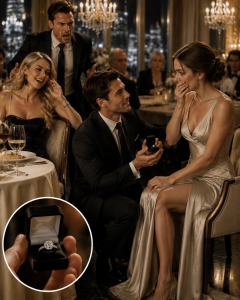
He stepped from the table. Tessa saw his hand enter his jacket and went still. “What are you doing?” He didn’t answer her. He crossed to Marin and lowered himself onto one knee.
The room went silent for a different reason.
The ring was a slender, worn sapphire flanked by two small diamonds — nothing like the emerald spectacle Tessa had used as a weapon.
“For ten months,” Theo said, “you’ve shown me that strength can be exact without becoming cruel. You never asked me to save you, and you never used my pain to make your own smaller. I love the life you’re building, and I love who I am when honesty is ordinary between us.” He didn’t say *now.* He didn’t name a date. “Marin Calder. When you are ready — will you marry me?”
Grant stared at her like the possibility of her future was a second fraud committed against him.
Marin looked past him, back to Theo. “Yes,” she said. “When we’re ready.”
He rose, and placed the ring on her finger only after she offered her hand.
“You planned this together,” Tessa said, somewhere between a laugh and a sob.
“We discussed it,” Marin said. “Consent isn’t conspiracy.”
“You’ve been sleeping with him,” Grant said.
“No.”
“We waited until both divorces were final,” Theo said. “Some people can love without stealing first.”
Grant looked as if he might lunge; the security director moved between them. Deardra stared at the ring. “You cannot marry so quickly.”
“We haven’t set a date,” Marin said, picking up her coat.
“After everything she’s done to my daughter,” Tessa’s mother said.
“Marin didn’t make Tessa submit false documents,” Theo said. “She took advantage of your grief.” “She gave it boundaries.” The room went quieter than anger could have made it.
Grant called after her as she reached the door. “You’ll come back when his patience runs out.”
She stopped without turning. “I didn’t leave because another man was waiting. I left because you made staying a betrayal of myself.” Then she walked through it.
In the corridor, away from the table and the cameras and the evidence bags, Theo paused. “Are you all right?”
Marin looked at the ring. “Ask me again.”
He took both her hands, still standing. “Will you marry me — when we’ve had enough time to build something that belongs only to us?”
Tears reached her eyes. “Yes.” He kissed her for the first time, quiet, careful, without witnesses who mattered. The proposal at the table would become the story everyone repeated. The question in the corridor was the one Marin kept.
—
The dinner recording changed the criminal case entirely — Grant caught presenting a stolen prototype image as company material, Tessa admitting she’d paid for the theft because Grant told her the hardware belonged to the marriage. His bond was revoked to home confinement with monitoring; he was barred from contacting lenders, employees, or advisers. Tessa’s cooperation kept her free but stripped of every device and her passport.
The trial began fourteen months after the dinner. Marin testified for two days about Lattis’s history and the forged assignment. “Fame is not an assignment of ownership,” she told the defense, when pressed on whether Grant’s success had entitled him to her code. Asked about Theo: “We became friends after both spouses filed for divorce. We did not begin a romantic relationship until the final decrees. It was an intentional timeline. We did not use betrayal as permission to imitate it.”
Theo testified to the forged guarantee. “A signature does not change based on whom I love,” he said, when the defense tried to suggest bias.
Tessa testified last, admitting the copied signatures, the false invoices, the contractor payment, the necklace worn to make Marin feel replaceable — without asking the jury to excuse any of it. “I understand him now,” she said, when asked if she hated Grant. “He was above me in the company. He designed the financing. I still chose to help him.”
Grant took the stand with his charm intact, calling the forgeries “preliminary transaction conventions.” The prosecutor walked him through five separate lender packages, each concealing the dispute differently, until he couldn’t name a single one that had disclosed it. The jury deliberated nine hours and convicted him on conspiracy, attempted bank fraud, securities fraud, aggravated identity theft, wire fraud, corporate theft, obstruction, and forgery.
At sentencing he apologized, called Marin “the most brilliant person I’ve ever known,” and asked the judge to consider that no lender had actually lost the seventy-five million, since the deal never closed.
“Failure does not convert planned fraud into honesty,” the judge said. “You do not receive moral credit for your victims’ competence.” Eleven years, restitution to investors, the restaurants, Calder, the employee fund; every remaining asset consumed between civil judgments and legal fees. His name stayed on old menus in an archive. It disappeared from every ownership record that mattered.
Tessa received fifty-four months and three years of supervised release, barred from executive authority over client funds. Before sentencing, she turned to Marin. “I thought taking your place would prove I was more valuable. I didn’t understand that Grant only valued what he could use. That doesn’t excuse what I did to you.” Marin listened without expression. Neither she nor Theo offered forgiveness in the room. An apology could be true and still arrive too late to restore anything.
Deardra lost the hidden Northline interest, the club dues, most of a small portfolio, and every friend who’d only admired her proximity to the empire. She wrote Marin asking to rebuild the relationship. Marin answered through Nisha: acknowledged, declined. Boundaries didn’t require a closing argument.
—
Theo’s proposal stayed open eighteen months before they married — neither willing to rush simply because the public already knew the answer. They went to therapy, separately and together, not because the relationship was failing but because both understood how easily loyalty could hide unspoken needs. They learned each other slowly, outside legal offices: that Marin sang badly while cooking and left every cupboard open, that Theo owned seven nearly identical blue shirts and turned unreasonably competitive over crossword puzzles. They argued once, about whether he was helping too much with her father’s appointments, and the argument ended in an apology and a real question — *what would feel respectful* — instead of a wound. That ordinary repair meant more to Marin than any dramatic promise could have.
They married in the garden behind her new house, twenty-four guests, her father walking beside her without giving her away — he kissed her cheek and took his seat. She wore the sapphire and no necklace at all. Their vows didn’t mention Grant or Tessa. The marriage they were building didn’t need betrayal as its foundation story.
Calder Systems kept growing. Marin turned down acquisition offers, built an employee ownership pool so the engineers’ work wouldn’t vanish behind a founder’s myth, and funded a legal clinic for small technology companies facing coercive IP transfers from larger partners — Hearthine Restaurants, formerly Holloway Dining Group, one of its first sponsors.
Three years after the dinner, Marin attended a new Hearthine opening as Calder’s chief executive, not as anyone’s former wife. The manager showed her the updated kitchen dashboard — Lattis flagging vendor irregularities now, logging every executive override. “Nothing disappears quietly anymore,” he said.
“That was the idea.”
Theo waited near the entrance with her father. When she joined them, he didn’t ask if she was ready to leave. He asked if she wanted dessert.
They sat at a small table near the kitchen, servers moving in the rhythm her software helped coordinate, guests laughing over a room that carried on without knowing the history built into its systems. Grant had believed love could be converted into ownership. Tessa had believed being desired made her powerful. Both had mistaken Marin’s patience for dependence, and Theo’s restraint for weakness. Their real mistake had been simpler: believing loyalty removed a person’s right to leave.
Marin hadn’t reclaimed her life the night Theo knelt. She’d reclaimed it months earlier, the morning she protected the archive and called a lawyer instead of waiting to be forgiven for noticing. The proposal only mattered because it came after that — he hadn’t rescued her from an empty table. He’d asked to join a future she’d already made possible.
She reached across the table. Theo took her hand. This time, nobody at dinner was waiting for her to break. They were only choosing dessert.
**THE END.**