The Quiet Rancher Attended Every Hearing in Silence — Then the Judge Read the Letter He’d Hidden for Years

—
## PART 1
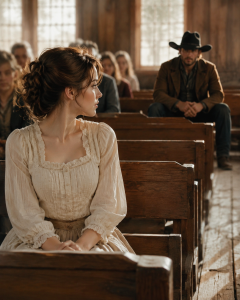
The desk was built for a ten-year-old, and Wade Coulter folded himself into it anyway, knees jammed against the underside of the wood, hat balanced on one thigh like something he might need to grab and run with. He picked the back row on purpose. Farthest from the lamp. Farthest from the chalkboard. Far enough that if his face did something he didn’t want seen, nobody would see it.
He was thirty-five years old. He owned eleven hundred acres of grazing land north of Prineville, Oregon, a herd that had never once gone hungry under his care, and not one letter of the alphabet he could put a name to.
He hadn’t come in person to sign up. He’d sent word through the feed store, the way a man sends word about something he can’t say out loud in his own voice. Old Mrs. Tilden had passed the message along to Hattie Brennan with a shrug, as if it were nothing. Hattie had not treated it as nothing.
She was forty-one, unmarried, and she noticed things. Not in the parlor-gossip way the town meant when they said it — *Hattie Brennan, she notices everything, watch what you say around her* — but in a way that went all the way down. She’d come from Illinois in ’74 to teach children their letters, and stayed because the work fit the shape of her, and because somewhere in thirteen years of quiet Oregon evenings she had made her peace with something most people never had to make peace with: that a woman who saw straight through a person did not, as a rule, get chosen by one.
Men liked to be admired. Hattie couldn’t help understanding them instead, and understanding, she had learned, was not the same gift as being wanted.
That autumn, the town had asked her to open an evening class for the adults who had never learned their letters — the ones who’d spent whole lives locked outside the written word and had finally scraped together the nerve to walk in and admit it. A surprising number came. Hattie taught them because she knew, better than the town did, exactly what it cost a proud adult to sit in a child’s chair and confess, in front of neighbors, *I cannot do the thing every eight-year-old in this room can do.*
Wade came in a week after the term had already started, and he came in silent, and on the first night, when he lowered himself into that back-row desk and set his hat on his knee and fixed his eyes on the slate like it might get up and leave if he looked away, Hattie made a decision that would end up shaping the rest of both their lives.
She would not call on him. Would not praise him where the others could hear. Would not do one single thing that might make a man like that bolt for the door and never come back.
She would only notice.
And notice she did. Evening after evening, small and unhurried, the way she noticed everything.
The first thing was his hands. Rancher’s hands — scarred, thick-knuckled, built for rope and iron, comically large around the thin slate pencil. But careful. When Wade shaped a letter, he did it slow, with a kind of concentration that looked almost like reverence, as though the letter were a live thing that might break if he pressed too hard. A careless man holds a pencil loose. Wade held his like it mattered. She filed that away without deciding to.
On the fair-weather evenings, he was out the door before the lamp wick had finished smoking. But on the bad nights — sleet coming sideways, the first hard snow of the season turning the road home into misery — he lingered. Not to talk. He’d stack chairs. Wipe slates clean that didn’t need wiping. Feed the stove a log it didn’t strictly require. Small, useful excuses to stay a few more minutes in the one warm, lit room he had access to before riding back out to an empty house that would still be dark and empty when he got there.
Hattie understood exactly what that meant, and said nothing about it, and kept it.
By December he could read whole sentences, faster than the lesson plan alone should have produced. And one evening, gathering her things at the front of the room, she caught him at the little bookshelf she kept for the class — caught him without letting him know he was caught — and watched to see what a hard, quiet cattleman would reach for.
She’d guessed a farming almanac. Something with a practical spine.
Wade Coulter picked up a thin, soft volume of poetry. Opened it. Moved his lips over the lines, slow, his enormous scarred hands cradling that small book the exact same careful way he cradled the slate pencil. Then, like he’d been caught doing something shameful, he shut it, set it back, and left without looking at her once.
Hattie said nothing that night either.
She just made sure, the following evening, that the same book of poems was already sitting on the back-row desk before anyone arrived — no note, no explanation, as if it had simply been left behind and forgotten.
—
## PART 2
Wade found it before class started. He looked around the empty room once, saw no one, and slid the book into his coat like a man committing a small crime against himself.
He brought it back the following week and returned it to the shelf without a word, and Hattie checked it the way she checked everything — quietly, thoroughly, without being asked. Pressed between the pages of the poem he’d clearly read the most was a single dried wildflower.
She didn’t touch it. She closed the book and put it back exactly as he’d left it.
His reading kept improving after that, faster than any evening class alone could explain. Hattie understood what that meant too. It meant that somewhere north of town, in a ranch house with no one in it, a grown man was sitting up by lamplight after dark, practicing letters nobody had assigned him, because he wanted this — wanted it badly, wanted it the complete, quiet, all-consuming way he seemed to want everything — and there was no one there to see him do it. He did it anyway.
Something in Hattie’s chest, a part she had long since decided would stay closed for good, started, very slowly, to ache.
Then, one February evening, Wade left his slate behind.
She should have set it aside for him to collect the following week, the way she’d have done for anyone. Instead — because of who she was, because noticing was the one thing she could never turn off even when it would have been kinder to — she looked at it.
It wasn’t lesson words. It wasn’t letters from the board.
Wade Coulter had been practicing one thing, over and over, in a hand that was careful almost past bearing.
Her name.
Nine times. Each attempt a little steadier than the last.
Hattie sat down alone in the empty schoolroom, holding that slate, and understood, all at once, that the noticing had never been going in only one direction.
—
## PART 3
She did not wipe it clean.
Her hand hovered over the slate for a long moment — long enough for the lamp to gutter and steady again — and then she set the rag down without using it. Wade’s nine careful attempts stayed exactly as he’d left them, each one a little truer than the one before. Underneath them, in her own hand, small and certain, she wrote a single line:
*The man in the back row has been seen, and is glad of it, and so is his teacher.*
She set the slate back on the desk exactly where she’d found it. Then she banked the stove, took her coat from the peg, and walked the half mile home in the cold without feeling much of it, and lay awake most of that night unable to say whether it was fear or hope keeping her eyes open, because by then the two had started to feel like the same thing wearing different coats.
Wade came early the next evening, before the others, to collect what he’d left behind.
Hattie was at the front of the room when he came in, sorting papers that did not need sorting, her heart going like a fist on a door. She did not look up. She had spent her whole life understanding, better than most people ever bother to, that a person reading something that mattered to them needs to be left alone to read it. So she gave him that. She heard the slate scrape against the desk as he lifted it. She heard him go still.
And then she heard something she had never once heard in six months of Tuesday and Thursday evenings — Wade Coulter’s boots, crossing the floor toward the front of the room. He had spent every evening in that schoolhouse in the back row, as far from her desk as the walls allowed. Now the sound of him was getting closer, and closer, and she made herself look up before he arrived, because a woman who noticed everything did not intend to be caught not noticing this.
He stood in front of her desk. This enormous, careful man who had spent half a year refusing to be seen, holding a child’s slate in two hands like it weighed something.
He set it down. Gently, the way he did everything.
“Nobody ever noticed me before,” he said. His voice came out rough, the way a voice does when it isn’t used to carrying this much weight. “Not once, my whole life. You noticed me the first night. I felt it. Like being warm again after you’ve been cold so long you forgot the word for warm.”
Hattie didn’t trust her own voice yet, so she let his fill the room instead, and Wade — a man who had never once, in all the months she’d known him, strung together more than a sentence at a time — found, standing there, that he had a great deal to say.
“I didn’t come to this class to learn to read,” he said. “Not really. I mean — I did. I can’t read, that part’s true. But I could’ve beat that out of a book alone on the ranch, given enough winters.” He stopped, looked down at his hands like they belonged to someone else. “I came because I heard the teacher was a woman who sees people. Mrs. Tilden said it, down at the feed store. She said, *Hattie Brennan, she looks at a person and sees the whole of them.* And I thought — I’ve never once in my whole life been seen the whole of. My folks are dead. I got no wife. I work that ranch alone from dark to dark, and the only living things that know I’m alive are the cattle.”
He lifted his eyes to hers.
“I thought — just once, before I get old and die out there by myself — I’d like to be seen by somebody who can actually see.”
Hattie said nothing. Her hands had gone still on the papers in front of her.
“So I signed up,” Wade went on. “And I sat in the back, because I figured a woman like you would see right through me, and that scared me half to death. And I wanted it anyway. Both at once.” A breath. “And you did see through me. And you didn’t look away. That’s the part I can’t get past, Hattie. You saw all of it — the not-reading, the being alone out there, all of it — and you didn’t look away. You left me a book of poems and didn’t say a word about it. You let me come to the front when I was ready instead of dragging me here before I was.” He set his hat down beside the slate, both hands empty now. “In thirty-five years, you’re the only person who ever made me feel like there was something in me worth seeing.”
Hattie Brennan, who had built an entire quiet life around the conviction that her own attention was a thing that frightened people off — who had made her peace, years back, with being the woman who understood everyone and was chosen by no one — looked at this man who had just crossed an entire schoolroom to tell her that being seen by her was the warmest thing that had ever happened to him.
“Wade,” she said. “I noticed everything about you. Your hands. The poetry. The way you stayed late on the bad nights, because this room was better than that cold house waiting on you. I noticed you teaching yourself faster than I was teaching you.” She had to stop and steady her own breath before she could go on. “I have spent my whole life noticing people, and watching them flinch when they realized how much I’d seen. You never flinched. You noticed me right back.” She shook her head slowly, like she still didn’t quite believe it. “Do you have any idea how rare that is — being seen all the way down, by the one person you’re seeing back?”
“No,” Wade said. “Tell me.”
“It’s the only thing I ever truly wanted,” Hattie said, “and the only thing I’d stopped believing I’d ever get. And it’s been sitting in the back row of my schoolhouse every Tuesday and Thursday since October.”
Neither of them moved for a moment. Outside, the wind was doing what February wind did in that part of Oregon — pushing at the windows, rattling the stovepipe — and inside, none of it mattered at all.
They were married the following June, in the schoolhouse itself, because it was the one place either of them had ever been truly seen by the other, and it seemed wrong to be married anywhere else. The town found the match a strange one — the spinster schoolteacher and the silent rancher, two people nobody in Prineville had ever quite known what to do with — but the town had never really understood either of them, and by then Hattie and Wade had long since stopped needing it to.
Wade kept reading. He never stopped, not once, for the rest of his life. He built shelves into the wall of the ranch house himself, plain pine, and filled them slowly, book by book, until the room that had once been empty and cold when he rode home to it held more words than most rooms in the county. On winter evenings he read poetry aloud to Hattie by the fire, slow, in that same rough careful voice he’d once used to tell her nobody had ever noticed him — and Hattie listened to every line like it was the only sound in the world, which, to her, it very nearly was.
They were not a loud couple. They didn’t need to be. They had spent the first six months of knowing each other almost entirely in silence — a book left on a desk, a slate borrowed and returned, a wildflower pressed into a page neither of them ever mentioned out loud — and that same quiet, careful attention stayed the language they spoke to each other for the rest of their lives. Hattie still noticed things. Wade still noticed her noticing, and never once flinched from it, not in all their years together.
In time the ranch house filled with more than books. Two children came, a few years apart, both of them taught their letters at their mother’s knee long before they ever saw the inside of a schoolhouse — and both of them, without either parent quite planning it, grew up watching their father read.
She kept the slate. The real one — Wade’s nine careful, climbing attempts at her name, and her own sentence written underneath in reply. It sat on the mantle of the ranch house for the rest of her life, through every winter after, and when the children asked about the strange, worn old slate their mother wouldn’t let anyone clean, she told them it was the first letter their father ever wrote her — even though it was only her own name, nine times over, written by a man who hadn’t yet found the courage to say it out loud.
Wade Coulter died in 1924, on the ranch he’d worked his whole life, in the house he’d filled with books because a woman had once noticed his hands and left something on a desk for him to find. Hattie followed him two years later. They’re buried side by side outside Prineville, under a single stone that carries both their names and nothing else — because between the two of them, words had never been the thing that mattered most, and at the end, they didn’t need many.
A rancher sat in the back row of a schoolhouse every evening, trying his hardest to be invisible. A teacher who could not stop noticing things simply refused to let him be.
That is, really, the whole of it. She noticed his hands, and the poetry he was ashamed to love, and the loneliness he never once put into words, and the way he stayed late on the cruelest nights because the warm, lit room was better than the cold, dark one waiting for him. She gathered up the small true facts of a silent man until they added up, without either of them quite deciding it, to someone worth loving. And then, in the smallest, gentlest way she knew how, she let him find out he’d been seen.
**THE END**