She Agreed to Marry a Stranger by Letter — Then the Man Waiting at the Train Changed Everything

—
## PART 1
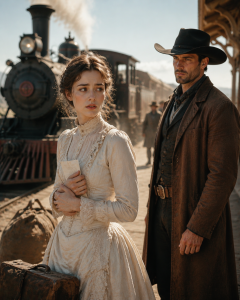
The photograph had shown a clean-shaven man in a pressed collar, intelligent eyes, the kind of face that photographed well because it had learned how. The man standing on the platform of the Union Pacific Depot in Cheyenne had a beard like a thorn bush, a coat with a hole worn clean through the elbow, mud dried up past his boot tops, and was eating something out of a paper sack with his bare hands when he spotted her.
He wiped that hand on his trousers, extended it anyway, and said, “You’d be Cordelia. I’m Amos. Hope the train wasn’t too hard on you.”
Cordelia Vance shook the offered hand and thought, with a clarity that frightened her, *I have made the worst mistake of my life.*
She was wrong about that. It would take an entire Wyoming winter to find out how wrong.
She was twenty-nine, the daughter of a Boston attorney, in possession of a vocabulary that intimidated most men and an independence that outright frightened the rest of them. She had been engaged twice, and both engagements had ended the same quiet way — the man in question discovering, sooner or later, that Cordelia had opinions, read the newspapers cover to cover, and had no intention of pretending she understood less than she did. By twenty-nine, her social circle in Boston had settled on a word for her. *Difficult.*
She had answered the matrimonial advertisement out of curiosity more than desperation, and a certain defiant hope she wasn’t in the habit of admitting to. Most such advertisements read like grocery lists — *cook, clean, breed.* This one had been different. *Wyoming rancher seeks a wife who can think. Beauty optional. Conversation required.*
She wrote back. The man who answered — Amos Bricker — wrote letters that surprised her at every turn. Grammatically rough, intellectually sharp. He asked her opinion and meant the question. He disagreed with her, at length, and explained exactly why. He never once quoted poetry at her or offered a single line of flattery, but he argued the price of cattle, the future of the territory, whether a republic could survive its own appetite for more — and his arguments, letter after letter, were better than anything either of the two Boston men she’d nearly married had ever managed to say to her face.
Over eleven letters, Cordelia fell in love with a mind. The photograph he’d sent along — clean-shaven, well-dressed — had been taken four years earlier at somebody’s wedding, though she didn’t know that yet. From eleven letters and one out-of-date photograph, she had assembled, without meaning to, a complete picture of the man she was about to marry.
Every piece of that picture was now standing in front of her on a train platform, holding a paper sack of food, wearing a coat that had clearly given up on being presentable some time ago.
The forty miles from Cheyenne to the ranch went by wagon, and Cordelia spent the first hour of it sitting beside Amos in silence, cataloging his failures one by one. The beard. The coat. The way he ate with his fingers like manners were an expense he’d decided he couldn’t afford. The mud. She had married a brute. She had been fooled by handsome penmanship into imagining a man who didn’t exist. She began composing, in her head, the letter she would send her father explaining that she’d be arranging passage back to Boston as soon as it could be managed.
Then Amos pointed at a hawk circling low over the prairie grass.
“Ferruginous hawk,” he said. “Rare this far north. They mate for life, which is more than most creatures manage.”
Cordelia looked at him. He kept talking — not, she realized after a while, to fill the silence, because Amos was plainly a man entirely comfortable with silence. He talked because he’d noticed she was upset, and this, in his rough and unpracticed way, was his attempt to ease it. He named every plant they passed and what it was good for. He described the ridgeline they were following, and how the whole territory had been the floor of an inland sea sixty million years before either of them existed. He explained, without being asked, why the grass grew where it grew and why the cattle knew, better than any fence line, exactly where to find it.
Somewhere in the second hour, Cordelia understood that the man beside her — the brute, the disappointment, the mistake she’d already half-written a letter about — was one of the most genuinely knowledgeable people she had ever spent an afternoon with. He had read everything he could get his hands on. He had watched this land close enough to know its history in his bones. And none of it was performance. Nobody out here was around to perform for.
The hole in his elbow wasn’t neglect. It was a coat he didn’t think about because he had better things to think about. The beard was fifteen minutes a morning he’d rather spend on the herd. He ate with his hands because he’d been awake since four and hadn’t paused long enough to consider whether his manners were adequate.
None of it, she was slowly starting to understand, had anything to do with who the man actually was. It only had to do with what he valued — and what Amos Bricker valued, she was beginning to suspect, was very close to everything she’d married him hoping to find.
She did not write the letter to her father. Not yet.
But she was nowhere close to convinced. Because the question that actually mattered to her — the one that had ended two engagements before this one had even properly begun — was still sitting unanswered in the wagon between them: how, exactly, was this man going to treat her once the letters stopped and the marriage started?
—
## PART 2
Cordelia’s deepest fear — the one that had cost her two Boston engagements before either man got as far as the altar — was that marriage meant the slow surrender of everything that made her herself. She arrived at the ranch already braced for it.
The cabin was small, clean, and unexpectedly full of books — two shelves’ worth, well-worn, ranging from agricultural manuals to a battered volume of Marcus Aurelius. There was a second room, and Amos showed her to it himself.
“This is yours,” he said. “Door’s got a latch. We’re married on paper, but I figure the rest of it happens at whatever pace it happens. No rush from me.”
She had not expected that. She had expected a man who treated a marriage license as a receipt, proof of purchase, nothing left to negotiate. Over the weeks that followed, she waited for the other Amos to show up — the controlling one, the one who’d start telling her what to do and expect it done without argument.
He never appeared.
When she said she wanted to learn to ride properly, he taught her without a trace of condescension. When she disagreed with him about the cattle market, he listened, and changed his position when her argument beat his. When she quietly reorganized his account books — which were, by any reasonable standard, a disaster — he looked over the results and said, “You’re smarter than me about this. From now on, you keep the books.” And he meant it.
Cordelia took over the ranch’s finances outright. Within two months she’d found three separate ways Amos had been bleeding money without knowing it, and corrected every one. He wasn’t threatened. He was delighted. He told a neighbor, without a hint of irony, that his wife was the best business decision he’d ever made, and he’d made it entirely by mail.
Slowly, against everything Boston had ever taught her to expect, Cordelia began to understand something. Amos Bricker had never wanted to own her. He’d wanted her near him. He’d advertised for a wife who could think because he was lonely for conversation, not for a servant. The beard, the coat, the mud — every single thing she’d judged him for on that platform — was just the surface of a man who was, underneath it, exactly what his letters had promised.
She had trusted the letters completely, and then thrown that trust away the moment she’d seen a hole in his elbow. She never told him so. But the shame of it quietly changed how she looked at him from then on.
And then January came, and it took the rest of her judgment with it.
—
## PART 3
In January of 1885, Cordelia rode out alone to check a fence line — a task she had insisted on taking over herself, because she had already decided, somewhere in her first months on the ranch, that she was not going to be the kind of wife who stayed indoors while the work got done without her.
She crossed a creek that looked frozen solid. It wasn’t.
Her horse went through first. She went in after it. Wyoming creek water in January will kill a person in a matter of minutes, not hours, and Cordelia knew that with the same clear, practical certainty Amos had taught her to apply to everything — the grass, the weather, the land. She got herself out, barely. But she was four miles from the cabin, soaked to the skin in temperatures well below zero, and her horse had already bolted for home without her.
She started walking anyway, because walking was better than not walking, and did the arithmetic in her head as she went. Four miles. Wet clothes. Below zero. The math, she understood with a strange, distant calm, did not work in her favor.
Amos found her at the two-mile point.
Her horse had come back to the cabin alone, and he’d known immediately what that meant. He’d ridden the fence line at a dead gallop in the dark, calling her name into a wind that swallowed most of the sound before it reached anywhere. When he finally found her, she had stopped walking and was sitting in the snow — which, as Amos knew and Cordelia did not, is precisely what a body does in the last stretch before the cold takes it for good.
He pulled her up onto his horse. Wrapped her in his coat — the same coat, hole in the elbow and all, that she’d judged him for the moment she’d stepped off the train — and rode hard for the cabin.
Inside, he got her out of the wet clothes. Wrapped her in every blanket the cabin owned. Then held her against his own body, skin to skin under the blankets, because that was the only real treatment for cold that deep, and Amos Bricker knew it the same way he knew everything practical about staying alive on this land.
She shook for the better part of an hour. He didn’t say a word the entire time, just held on.
When the shaking finally slowed enough for her to speak, she looked up at him.
“You came,” she said.
“Of course I came.”
“When I saw you on that platform,” Cordelia said, “I thought I’d made a mistake. I judged you in one minute. The beard. The coat. I thought I’d married the wrong man.”
“I know,” Amos said. “I saw your face. You’re not hard to read, for a woman that smart.”
“You knew. And you said nothing. You let me—”
“I figured you’d come around when you saw who I actually was,” Amos said. “Same as I came around when I saw who you actually were. Letters only show you so much of a person. The rest takes a winter.”
Cordelia Vance, who had judged this man completely inside sixty seconds on a train platform, who had spent the ride home privately composing her retreat back to Boston, who had spent two whole months waiting for the brute she’d decided he was to finally show his face — looked at Amos Bricker, wrapped around her in a freezing cabin, having ridden through the dark on the strength of nothing but a riderless horse, and understood, all at once, that she had fallen in love with him weeks ago and had simply been too proud to admit she’d been wrong about him from the start.
“I regret every word I thought that day,” she said.
“Good,” Amos said. “Now stop talking and get warm.”
The marriage that had begun on eleven pieces of paper became real that winter — not purely because of the rescue, though the rescue mattered more than either of them ever said out loud again, but because Cordelia finally let herself see Amos the way his letters had been asking her to all along. As a mind. As a partner. As a man whose worth had never had anything to do with the condition of his coat.
They ran the ranch together for thirty-five years. Cordelia kept the books and grew the operation from four hundred head to two thousand. Amos managed the land and the herd and never once, in all that time, made her feel smaller for knowing more than he did about something. They argued constantly — politics, economics, philosophy, and, with real and lasting passion, the correct way to brew coffee — and both of them considered the arguing among the best parts of being married to each other.
They had three children. Cordelia taught all three to read before they were old enough to remember not knowing how. Amos taught all three to watch the land the way he did — to name a hawk on sight, to know which grass meant water underneath and which meant none. All three left eventually for university, the way children of ambitious parents do, and all three came back, because the ranch had become the kind of place people came back to.
Cordelia never entirely forgave herself for the platform. She kept it, privately, as a lesson — a reminder that a woman who prided herself on her intelligence had very nearly thrown away the best thing that would ever happen to her over a beard and a hole in a coat. She told her daughters, years later, “Never trust your first impression of a person. Trust the eleventh. By then, you might actually be looking at them.”
Amos Bricker died in 1919, at sixty-eight. Cordelia lived twelve years past him, dying in 1931 at seventy-six.
After he died, she kept his coat — the one with the hole in the elbow, the one he’d wrapped her in on the night she nearly froze to death checking a fence line she’d insisted on riding alone. She never repaired the tear. When her granddaughter asked why, years later, she said, “Because that hole taught me the most important lesson of my life. I judged a man by it once, and the man wearing it saved my life, and never once held my foolishness against me.”
She had married him by letter. She had regretted every word of it the moment she saw his face on that platform. And then she had spent the next thirty-five years profoundly grateful that the man standing there in the mud and the torn coat had been patient enough to let her be wrong about him for exactly as long as it took her to see straight.
**THE END**