She Called Him Trash After He Soaked Her—Then the Mafia Boss Walked Into Her Restaurant

## PART 1
Nobody warned me that the worst night of my life would begin with a ruined grocery bag and a man who didn’t know how to apologize.
I know the exact moment I stopped being afraid of him. It wasn’t at the diner, or the restaurant, or the night someone pointed a gun at his chest and he looked calm enough to be asleep. It was later than all of that — quieter, smaller, barely a moment at all. But I’m getting ahead of myself.
The rain started around six on a Wednesday, which was also when I finished my second-to-last shift before rent was due, my umbrella chose to break in the most theatrical way possible — snapping clean in half while I was still holding it — and I was walking home with thirty-nine dollars to my name and a grocery bag full of things that could be described, generously, as “ingredients” only if you had a very forgiving definition of the word.
I was wet. I was tired. And I was running on the specific kind of hollow energy that only comes from skipping lunch to afford dinner.
The black car came around the corner too fast.
It hit the puddle with what felt like personal intention.
The wave came up over the curb and hit me full on the left side — shoes, jacket, the grocery bag’s paper bottom, everything. An apple rolled into the gutter. My jacket went translucent. Water found the inside of my collar and made its way, slowly and deliberately, down my back.
I stood there for one long second.
Just breathing.
Then the car stopped.
Something about that — the stopping — cracked whatever patience I had left. Not an apology. Not someone running out. Just the car, stopped at the curb, window sliding down, and a man who looked at me the way you look at a broken traffic light: briefly, with mild inconvenience.
I walked toward him.
Later, people would ask if I was scared. Honestly, I had nothing left to be scared *with*. Forty-hour weeks and exam week and a pharmacy bill I’d been hiding from my mother had used it all up.
“Do you see what just happened?” I said. “Do you see me?”
He looked at me.
Not embarrassed. Not sorry. Not even bothered.
Just — watching.
That was the part that got me. Not the silence. The *watching*, like I was something mildly puzzling he hadn’t decided what to do with yet.
“My shoes,” I said. “These are my only work shoes. And I have work tomorrow. And the apples are — look, that apple is literally in the street right now—”
He still said nothing.
Something snapped.
“You know what the problem with people like you is? You move through this city like the rest of us are scenery. You think if you drive something expensive enough, you don’t have to pay attention.” I stepped back, looked at him one last time. “You’re a waste. A very expensive, very polished waste.”
I walked away.
I didn’t look back.
The window rolled up.
For a few seconds, the car didn’t move.
Then it drove on.
And that, I thought, was that.
—
It wasn’t.
I worked at Strada, an Italian restaurant six blocks from my apartment that had real linen tablecloths and a wine list longer than some novels. I worked the evening shift, five nights a week, alongside enough DePaul undergrads that we’d started an informal support group for people doing homework in the break room between tables.
The following Friday, I was running section three when the host sat a man at table nine.
I was across the room. I noticed him the way you notice a thing that doesn’t belong — too still in a room where everyone moved, a quality of attention that seemed to include every corner without appearing to look at anything.
Then he turned his head slightly and I recognized him.
My stomach dropped through the floor.
His name, I found out thirty seconds later when I fled to the service station and grabbed my coworker Sofia by the elbow, was Dominic Vane.
Sofia stared at me. “You don’t know who that is?”
“Should I?”
She looked at me like I had announced I’d never heard of weather.
“Nadia,” she said carefully, “he owns the building.”
I turned slowly back toward table nine.
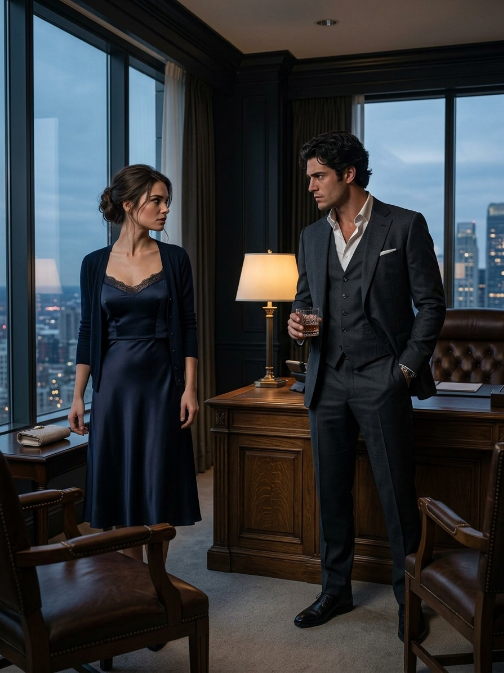
Dominic Vane sat with one arm resting along the back of the booth, reading the menu with the same energy a person brings to reviewing documents they’ve already decided about.
“He owns the restaurant?” I said.
“He owns the building the restaurant is in. He owns the parking structure across the street. He owns the club on Wacker and two others and about half of everything that runs late in this city.” She paused. “He is, to put it gently, not someone you want to have made a bad impression with.”
I thought about the rain.
The apple in the gutter.
*You’re a waste. A very expensive, very polished waste.*
“Okay,” I said.
“Okay?”
“I’m going over there.”
“Nadia—”
“Because either I still have a job after this or I don’t, and standing here isn’t going to change which one.”
I straightened my apron. I crossed the restaurant. I picked up my notepad.
And I stopped at table nine.
“Good evening,” I said. “Can I start you with something to drink?”
Dominic Vane looked up from the menu.
His eyes were dark, almost black, and they registered recognition in the way a camera registers an image: precise, immediate, giving nothing back.
“The rain,” he said.
“Yes.”
“You called me a waste.”
“You were blocking traffic.”
Something shifted in his face. Not a smile — too controlled for that. Something adjacent to one, happening underneath.
“The Chianti,” he said. “2018.”
I wrote it down.
“Will that be all to start?”
“For now.” He looked back at the menu. “I’ll need a few minutes.”
I left.
I made it four steps before my manager, a man named Gerald who had worked in restaurants long enough to develop a sixth sense for catastrophe, materialized at my elbow.
“He asked for you specifically,” Gerald said.
I stopped. “What?”
“When the host tried to give him a different section. He said he wanted the section with you in it.” Gerald looked at me with an expression I had never seen on his face before: genuine fear wearing a professional smile. “Do you know him?”
“Not really,” I said.
“Nadia.” Gerald lowered his voice. “That man does not come to restaurants to eat. He comes to restaurants he owns to remind people that he owns them.” He looked toward table nine. “Why is he here?”
Dominic Vane turned a menu page with one hand, unhurried, every line of him expressing perfect indifference to the room.
“I honestly have no idea,” I said.
But I was starting to suspect.
—
## PART 2
I got through the first course without incident.
He ordered simply — soup, the branzino, bread — and ate with the quiet focus of someone who took food seriously without making a performance of it. He didn’t demand conversation. He didn’t watch me with unsettling intensity. He tipped his water glass once and said *thank you* when I refilled it, which was more than half my section managed.
It was almost normal.
Then, over the second course, he said: “Why six nights?”
I was setting down bread.
“Sorry?”
“You work six evenings a week. Plus full course load.” He looked at me steadily. “Why?”
Something went still and careful in my chest.
“You looked me up.”
“I looked at the schedule.”
“That’s the same thing.”
He didn’t deny it. “Is there a reason you’re angry about it?”
“Is there a reason you’re curious?”
A pause. Then — unexpectedly — he said: “Honestly? Not one I can fully explain.”
It was the most human sentence he’d said all evening.
I stood with the bread basket in my hand and looked at him, and for one unguarded second, the distance I kept between myself and the tables I served collapsed slightly.
“My mother’s medical bills,” I said. “And tuition. And the fact that generic cereal is only fifty cents cheaper than the real thing and I still buy generic.” I shrugged. “Pick one.”
Something moved through his expression. Not pity. Something older.
“Go back to your other tables,” he said quietly. “I’ll still be here when you’re done.”
I went.
I came back twenty minutes later to find him on his phone, speaking in a low voice that stopped the moment I approached. He set the phone face-down on the table.
“The check,” I said.
“Not yet.” He turned the phone over once. Turned it back. “I want to tell you something.”
“Mr. Vane—”
“Dominic.”
I looked at him.
“The car,” he said. “I did see you. Before the puddle.”
“Then—”
“I was distracted.” He said it like a confession he hadn’t planned to make. “I saw you walking, and I was — for a moment I wasn’t paying attention to the road.” He held my gaze. “I’m sorry.”
I hadn’t expected that.
I didn’t say anything.
He picked up his phone and placed it on the linen beside the bread plate. A new one — matte, simple, unlike the expensive thing he’d had before.
“In case you need to reach me,” he said.
I stared at the phone.
Then at him.
“What exactly,” I said slowly, “do you think is happening here?”
Before he could answer, Gerald appeared at the restaurant entrance, face draining of color, eyes fixed on something behind me.
I turned.
Three men had come through the door.
They weren’t dressed for dinner.
—
## PART 3
Dominic was already standing.
Not dramatically — he didn’t tip his chair or reach for anything. He simply rose, the way water rises, quietly and with absolute intention, and positioned himself between me and the door in a single unhurried motion that I only understood the meaning of afterward.
The three men scanned the room. The largest one’s gaze landed on Dominic and something passed between them — wordless, ancient, the kind of communication that happens between people who have been enemies long enough to skip the introduction.
“Vane,” the man said.
“Garrett.” Dominic’s voice was the same temperature it had been discussing the menu. “You’re early.”
“Benetti sends his regards.”
“Benetti is welcome to send them in writing.”
“He prefers in person.” The man smiled without warmth. “Via us.”
The restaurant had gone quiet the way restaurants do when everyone understands that something is wrong but no one wants to be the person who acknowledges it. Forks held mid-air. Conversations halted. Gerald stood near the host stand with his hand hovering over the phone.
Dominic’s second — a quiet man named Soren who had been sitting at the bar for the last hour, I now realized — moved from his stool.
“Three against two,” the man called Garrett said pleasantly.
“Three against one,” Dominic replied. “Soren is staying with her.”
He said it without looking at me. Without dropping his voice.
Just settled it.
I wanted to argue. Instead I stood very still and watched the mathematics of the room rearrange itself.
Garrett looked at me for the first time.
It was a different kind of looking than Dominic’s. Where Dominic’s attention had felt like being taken seriously, Garrett’s felt like being evaluated for usefulness.
“The waitress,” he said.
“Not relevant,” Dominic said.
“Maybe not tonight.” Garrett smiled again. “But Benetti heard you’ve been coming here every week.”
“I own the building.”
“You own a lot of buildings. You eat at one.” A pause. “He’s curious about that.”
The room felt very small.
Dominic moved first — one step toward the hallway near the kitchen, drawing Garrett’s gaze, and then everything happened quickly. Soren was beside me. The other two men moved toward Dominic. Gerald hit the emergency line. Someone in the kitchen shouted.
Four minutes later the police sirens started.
Garrett and his men were gone by then, in the way people with practice disappear: no running, no urgency, just the door swinging and the street outside empty when I looked.
Dominic stood near the entrance with a cut on his left hand and an expression of complete composure, speaking quietly to a police officer who looked like he would rather be doing literally anything else.
Soren appeared beside me with a glass of water I hadn’t asked for.
“Drink it anyway,” he said.
I drank it.
—
He came back the next night.
I almost didn’t go to his table. Gerald made a sound when he saw me head that direction — something between a prayer and a sigh — and then let me go because he was, underneath all the professional anxiety, a decent man who understood that some conversations needed finishing.
“You should find a different restaurant,” I said.
Dominic looked up. “Probably.”
“I’m serious.”
“I know.”
“You brought danger into this building last night.”
“Yes.”
I sat down across from him, which was not something waitresses did during service and which Gerald would absolutely be agonizing over from across the room. I didn’t care.
“Who is Benetti?” I said.
Dominic was quiet for a moment. Then: “My father’s oldest rival. They ran competing operations for twenty years. When my father died, Benetti expected to absorb what was left.”
“And?”
“And I was twenty-four and angry and not particularly interested in being absorbed.”
“So you built your own.”
“I inherited the bones. I built the rest.”
I looked at my hands on the table.
“What exactly does ‘competing operations’ mean?”
He looked at me steadily.
“It means exactly what you think it means.”
“So you’re—”
“Retired, functionally. The clubs are legitimate. The security company is legitimate. The real estate is entirely legitimate.” A pause. “But the history isn’t.”
“And Benetti.”
“Benetti is the history that won’t stay in the past.”
I thought about Garrett’s eyes landing on me.
*Benetti heard you’ve been coming here every week.*
“He’s going to use me,” I said.
It wasn’t a question.
Dominic’s jaw tightened slightly.
“He’ll try.”
“And that doesn’t—” I stopped. “Why are you still coming here if you know that? Why would you give him the opening?”
A long silence.
Then Dominic said: “Because the alternative was not coming here. And I found, after the first week, that I didn’t want that.”
I stared at him.
He looked back.
Not performing. Not managing. Just honest, in the careful, slightly rusty way of someone who hadn’t been honest in a long time and was remembering how.
“You’re going to get me killed,” I said.
“No.” His voice went flat. “I’m not.”
“You can’t promise that.”
“Watch me.”
—
He was wrong, of course. Not about the promise — about the timeline.
Benetti moved three weeks later.
I was walking home after a closing shift, taking the long way because it was cold enough that every extra block felt like an accomplishment, when the car pulled alongside me. Not a nice car. Not a Dominic Vane kind of car. The kind of car that made you understand immediately that whatever was happening had not been planned with your comfort in mind.
The window came down.
“Miss Vasquez,” the man inside said pleasantly. “We were hoping you’d take a ride.”
“No,” I said.
“That wasn’t really a request.”
The door opened.
I ran.
I was fast — I’d been fast since high school, cross-country, two years — and I made it half a block before an arm caught mine from the left. Not hard. Not violent. Just immovable.
“Nadia.” Soren’s voice, low and urgent. “With me. Now.”
I turned. His car was already running at the curb, hazard lights blinking, looking exactly like an Uber and nothing like a rescue.
I got in.
The black car accelerated toward us.
Soren accelerated faster.
“Are you hurt?” he said.
“No. Where’s Dominic?”
“On his way.”
“To where?”
“To you.”
I looked out the back window. The black car had stopped — not chased, stopped — which meant either Soren had lost them or they’d gotten what they wanted, which was for me to know they could find me.
I understood, in a cold and clarifying way, that this was the point.
I wasn’t in danger because Benetti wanted me.
I was in danger because Dominic did.
—
They brought me to a building in the West Loop that I would later learn Dominic used as an office and occasionally a fortress, which I supposed was efficient.
He was already there when Soren walked me in.
He looked at me the way I’d seen him look at very few things: with relief that cost him something to show.
“Are you—”
“Fine.” I sat down on the nearest chair without being asked. “This has to stop.”
“I know.”
“No.” I looked at him. “You keep saying things like that, like knowing is enough. It isn’t.” I pressed my hands together. “He knows about me because you kept coming to the restaurant. So either you stop — actually stop, not just say you’ll stop — or this gets worse.”
Dominic sat across from me.
“Or,” he said carefully, “we end it.”
“How?”
“I give Benetti what he’s wanted for eight years.”
I waited.
“Proof,” Dominic said. “That he ordered my father’s death. I have most of it. There are two things I’ve been missing.” His eyes met mine. “I found them six months ago.”
“Then why hasn’t anything happened?”
“Because delivering them to law enforcement means the whole history comes out. Not just Benetti’s.” He held my gaze. “Mine too.”
The room was very quiet.
“You’d expose yourself,” I said.
“Cooperating witness arrangement. Soren’s been in contact with a federal prosecutor for three months.” He paused. “I’ve been trying to decide if I was willing.”
“And now?”
He looked at me for a long moment.
“I’m willing,” he said.
Something in his voice made it clear this was not an easy sentence. It was the kind of sentence people spent years not saying.
“What happens to you?” I asked.
“Probably some things I deserve.” He said it without self-pity and without performance. “Some things I don’t. That’s usually how it goes.”
I looked at my hands.
I thought about the rain. The apple in the gutter. The way he’d looked at me from the car like I was a puzzle he hadn’t decided whether to solve.
“You came back to the restaurant,” I said, “because I didn’t treat you like you were dangerous.”
He was quiet.
“Yes,” he said finally.
“And I didn’t, because I didn’t know who you were.”
“Yes.”
“And by the time I did—” I stopped.
“By the time you did,” he said quietly, “I was hoping it wouldn’t change anything.”
It hadn’t.
I didn’t know what to do with that. I didn’t know what to do with any of it — the man across from me who had built a world out of controlled damage and was now, apparently, trying to burn it down because a waitress had called him a waste in the rain and then kept talking to him anyway.
“Okay,” I said.
Dominic looked at me.
“Okay?”
“Do whatever you have to do.” I met his eyes. “Just do it fast. I have exams in three weeks and I cannot spend them hiding in your fortress.”
Something broke open in his expression.
Not dramatically.
Just — warmth, sudden and real, moving through the control he wore everywhere like a second jacket.
“Exams,” he said.
“Financial modeling. It’s brutal.”
“I could—”
“You cannot help me with my exams, Dominic.”
“I have an MBA.”
I stared at him.
He looked nearly apologetic about it.
I laughed.
It surprised both of us — the sound of it, genuine and slightly helpless, filling the room.
Dominic looked at it like he was memorizing it.
—
The case broke over a Tuesday in February.
I was in the library when the news alert came through — federal indictment, organized crime, Chicago-area, multiple defendants, cooperating witness identified only as “an industry insider.” My phone buzzed four times in quick succession with texts from Sofia, Gerald, and two classmates who had apparently just made the connection between my restaurant and the names in the article.
I closed the laptop.
I sat for a moment in the library’s particular silence — the shuffle of pages, the distant ventilation hum, the mundane and reassuring texture of people doing ordinary work.
Then I texted Dominic: *Saw the news.*
Three minutes later: *How are you?*
Which was the most Dominic Vane way to respond to a federal indictment I could have imagined.
*Fine,* I sent back. *You?*
A pause.
*Better than expected.*
I looked at the message for a moment. Then: *Good.*
Another pause.
*I still owe you for the groceries.*
I smiled at my phone in the middle of a university library, which was not something I had anticipated doing that semester.
*The apple was the real loss,* I sent back.
*I’ll replace it.*
*It was one apple, Dominic.*
*I know. I’m buying a whole tree.*
I put the phone face-down on the table so my expression would stop confusing the person across from me.
—
What happened after was slower and less cinematic than the before.
The legal process was long and had a lot of paperwork. Dominic’s cooperation arrangement was complicated and resulted in some penalties and not others, and was covered in news that I mostly avoided because reading your own name in articles about organized crime families was not something I had put on my personal development list for junior year.
He sold the clubs. Kept the restaurants. Spent a lot of time in meetings with lawyers and a federal prosecutor named Chen who called him every Wednesday and whom I eventually met at a dinner where Dominic introduced her as “the reason I sleep better than I did” and she said “he’s an unusually cooperative witness, which is the strangest compliment I’ve ever given anyone” and they both laughed in the tired way of people who have been through something difficult together and come out the other side still standing.
I finished my degree.
Gerald gave me a reference that was so enthusiastic I called him to make sure he hadn’t confused me with someone else.
My mother’s treatment plan was updated, and she was doing better, and she met Dominic over dinner at her apartment where she made three kinds of pasta because she had been informed he was Italian-American and she was not going to let that go unaddressed. He ate all three, complimented the cooking twice, and helped clear the table without being asked.
My mother pulled me aside afterward and said, in Spanish, that he looked like a man who had been very lost for a very long time and was only recently learning to be found.
I thought she was right.
—
One evening in March, we were walking back from a restaurant that was not Strada — we’d been expanding, in the careful and slightly complicated way of two people who had come to each other sideways through rain and bad timing — when he reached into his coat pocket.
He placed something in my hand.
A receipt.
Old. Water-warped. Barely legible.
My grocery receipt.
From the night with the rain and the puddle and the apple.
I looked at it.
“You kept this,” I said.
“I found it in the backseat afterward.”
“Dominic.”
“I know.”
“This is either very romantic or extremely strange.”
“Can it be both?”
I looked at the receipt in my hand. The impossible list — apple, bread, pasta, eggs, the generic cereal — preserved in water-damaged paper because a man had apparently picked it up from the street and held onto it for seven months.
“You could have just apologized,” I said.
“I did apologize.”
“Eventually.”
“I wasn’t good at it immediately.”
“You’re better at it now.”
He looked at me. Something warm and steady in it, the particular look I’d come to recognize as the one he used when he wasn’t performing anything.
“I’m better at a lot of things now,” he said.
I folded the receipt carefully and put it in my jacket pocket.
Above us, Chicago moved in its usual way — lit and loud and indifferent and beautiful, carrying on its own enormous life around the smaller ones nested inside it.
“Come on,” I said. “You can tell me what else you’ve been practicing on the way home.”
He fell into step beside me.
The street was cold and bright, and somewhere behind us a siren wailed and someone laughed and a bus sighed at a corner, and none of it was a love story and all of it was.
The man who had moved through this city like he owned it had learned, one slow evening at a time, that ownership was the wrong word.
The right word was belonging.
And that, unlike property or power or perfectly controlled silence, couldn’t be purchased.
It had to be earned.
Rain by rain, honest word by honest word, grocery receipt by grocery receipt.
Until one day you look up and realize you’re home.
—