Shy Confession, Mafia Boss Reaction—Chicago’s Most Feared Man Did the Unexpected

## PART 1
The blood was on his collar.
Not a lot. Not the kind that required explanation. Just a small, dark stain at the edge of the white fabric, barely visible against the shadow of his jaw, the kind of mark that could have been anything if you were not the sort of person who paid attention to small things in order to survive.
Lena Calloway was exactly that sort of person.
She had been paying attention to small things her whole life — the way her landlord’s mood showed in whether he bothered to restack the mail, the way the gas gauge read differently depending on the temperature, the way a catering client’s silence during a delivery meant they were calculating whether to tip. Small things were the margin between okay and not okay, and at twenty-five with eleven dollars in her checking account and her mother’s electric bill three weeks past due, Lena could not afford to miss them.
So she noticed the blood.
And she noticed the empty security desk on the lobby level of the Vantage Tower at eleven-forty on a Tuesday night.
And she noticed the elevator’s panel illuminating the thirty-first floor without her pressing it.
She should have left then.
She should have told her manager, Deb, that the building was locked and she would redeliver the invoice in the morning. Deb would have docked her pay. Deb docked people’s pay the way other people breathed — reflexively, regularly, without particular malice. It was simply how Deb operated.
But Lena’s car needed a part she couldn’t afford. And her mother’s voice on the phone that morning had the quality it got when she was trying not to worry out loud, which always worried Lena more than if she’d simply said the thing. And the invoice from Blue Plum Catering needed a signature and a check tonight because accounts payable did not process on weekends and this particular client had somehow not paid in thirty-one days and Deb had made very clear that if it didn’t get resolved tonight, someone was losing their job.
So Lena rode to the thirty-first floor.
She had catered a fundraiser here six days ago. She had spent seven hours in the kitchen of the building’s event space making pastry cream and strawberry compote and a cheese course that she had arranged with more care than the job technically required, because she was made that way. She knew this building. It was fine.
The elevator opened.
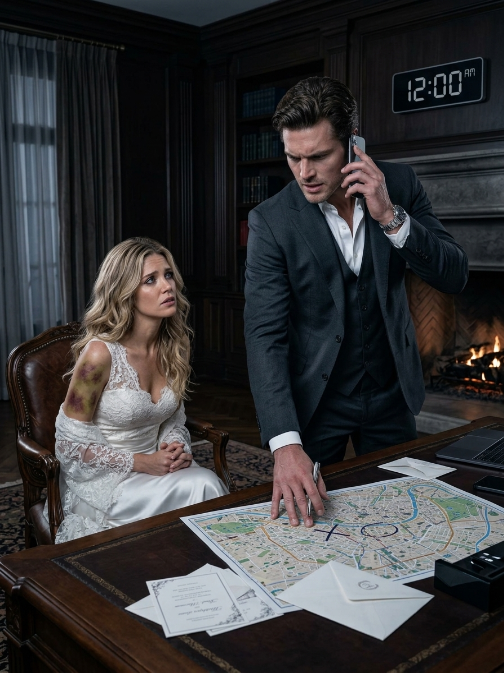
The hallway was dim, lit by floor-level lighting. The main overhead lights were off. At the far end, through frosted glass walls, a single lamp was on.
She knocked.
No answer.
She pushed the door.
—
He was standing at the windows with his back to her, a glass in one hand, Chicago spread below him like a circuit board lit from within. He did not turn when she came in. He did not need to. The quality of his stillness told her he had known she was there since the elevator doors opened.
Lena had seen photographs of Marco Vantale in the news, in the business section of the Tribune, on the wall of a restaurant her mother liked. In photographs he looked like a man who had been assembled from expensive materials. In person he was something else — the photographs had missed the specific quality of the room around him, the way sound seemed to reduce in his presence, the way the air felt slightly denser.
She understood, standing in his office doorway at midnight, why his name made people pause before saying it.
“I’m from Blue Plum Catering,” she said. “I have your invoice.”
He turned.
His eyes were dark, the kind of dark that read as almost black in low light, and they moved over her with the unhurried attention of a man who had learned a long time ago that looking carefully at things saved problems later.
The stain on his collar was visible from here.
She held the invoice slightly higher.
“The fundraiser,” she said. “Last Tuesday. Your accounts payable team missed the payment window.”
He said nothing for a moment.
Then: “You came here alone.”
“Your security desk was empty.”
“And you came up anyway.”
“My boss was specific about tonight.”
He crossed the room, not toward her but toward the desk, and Lena noticed the way he moved — economical, controlled, the exact opposite of men who needed space or volume to communicate authority. He sat in the chair behind the desk.
“Put it down,” he said.
She set the invoice on the desk.
He did not pick it up. He looked at her instead.
“You made the fruit tarts,” he said.
Lena blinked. “I made most of the dessert course.”
“The ones with the lavender cream.”
“Those were mine.”
He pulled the invoice toward him, read it, opened a drawer, and removed a checkbook. He wrote without apparent deliberation, tore the check free, and set it on the edge of the desk.
When Lena picked it up, she read the number twice.
Then she set it back down.
“This is more than what’s invoiced.”
“The lavender cream is extra.”
“By four hundred percent?”
“Approximately.”
“I can’t take this.”
“You can.”
“My manager will have questions.”
“Tell her the client was generous.” He leaned back. “Or tell her nothing. Tip is yours, not hers.”
Lena looked at the check.
She thought about the car part. The electric bill. The specific sound of her mother’s voice that morning.
She picked it up.
“Thank you,” she said.
He was quiet for a moment.
Then: “What’s your name?”
“Lena.”
“Lena what?”
“Calloway.”
He said it once, quietly, not quite to her. The way you placed something in a mental file.
“You should go,” he said.
She was already moving toward the door.
“Miss Calloway.”
She turned.
“Don’t tell anyone you were here tonight.”
It was not a threat. It was the specific, flat quality of a warning given honestly, without embellishment.
Lena looked at the blood on his collar.
She looked at his face.
“Okay,” she said.
She took the elevator down.
The lobby security desk was still empty.
Outside, rain was beginning, light and cold. Lena walked two blocks to where she had parked, turned the engine over, and sat for a moment while the heater struggled to respond.
She had made more money tonight than she earned in two shifts.
She should feel relieved.
Instead, she felt the specific, slightly sick unease of someone who has noticed a small thing and understands, at the back of their mind, that small things sometimes mean large ones.
She drove home.
She did not sleep well.
—
## PART 2
The check cleared in the morning.
Lena sat at the kitchen table in her robe and looked at her bank balance until the number became abstract, the way large numbers in small accounts became abstract — not quite real, not quite hers, requiring repeated verification.
Her mother shuffled in, found her staring at her phone, and leaned over to look.
“You win something?”
“Tip,” Lena said.
Her mother looked at the number again.
“From who?”
“A fundraiser client.”
“What did you serve them?”
“Lavender cream tarts.”
Her mother was quiet for a moment.
“Those must have been extraordinary tarts.”
“They were good.”
“Lena.”
“I know.”
Her mother sat down across from her.
“You look like someone who knows something they wish they didn’t.”
Lena put her phone face-down on the table.
“I’m fine.”
“Uh-huh.”
“I’m paying the electric bill today.”
“Okay.”
“And the car.”
“Okay.”
“And I think we can cover March rent without the side shifts.”
Her mother reached across the table and covered Lena’s hand with hers.
“Whatever you did,” she said quietly, “I hope it was worth it.”
“I delivered an invoice,” Lena said.
Her mother looked at her.
“Okay,” she said again.
—
By noon, Lena had paid the electric bill, called the mechanic, and gone back to work at the catering kitchen for a three-hour prep shift. She was slicing citrus when her coworker Brie appeared at her elbow with the expression she wore when she had information she had been containing with effort.
“So,” Brie said.
“So nothing.”
“So you look different today.”
“I look exactly the same.”
“You look like someone who had a thing happen.”
Lena kept slicing. “I delivered an invoice.”
“At midnight.”
“Deb said—”
“Lena.” Brie lowered her voice. “I looked at the delivery log. That invoice was for the Vantage Tower. Thirty-first floor. The whole floor is leased to a company called VT Holdings.”
“Okay.”
“VT Holdings. Vantale Holdings.” Brie’s eyes were very wide. “You delivered a catering invoice to Marco Vantale.”
Lena placed a lemon segment in the tray with perfect precision.
“At midnight,” Brie said.
“Deb said tonight—”
“Lena.”
“What?”
“Marco Vantale,” Brie repeated, in a tone that suggested she thought Lena might not have fully absorbed the name. “The man whose construction company also somehow manages half the city’s distribution infrastructure. The man who showed up to testify in front of a federal committee four years ago and walked out with zero charges. The man who—”
“I know who he is.”
Brie went quiet.
“He tipped well,” Lena said.
“He tipped insanely.”
“The lavender cream was good.”
“Lena.”
“Brie.”
They looked at each other across the citrus tray.
“Was everything okay?” Brie asked, softer now.
Lena thought about the empty security desk. The blood on his collar. The flat, honest quality of his voice when he said *don’t tell anyone you were here tonight*.
“Yes,” she said.
“You sure?”
“Yes.”
Brie looked at her for a long moment.
“Okay,” she said.
They went back to prepping.
At three forty-five, Lena’s phone rang. Unknown number. She answered it in the walk-in cooler, away from Brie and the prep noise.
The voice was one she recognized immediately — low, contained, the particular quality of a person who had stopped performing restraint because restraint had become their actual baseline.
“Miss Calloway.”
Lena leaned against a shelf of butter.
“Mr. Vantale.”
“You’re careful with names.”
“When it seems warranted.”
A brief pause. Not awkward — assessing.
“I want to apologize for last night,” he said. “The building’s security failure put you in an uncomfortable position.”
“I’m fine.”
“You handled it well.”
“I delivered an invoice.”
“You came up alone,” he said, “into a building with no security, to an occupied office, late at night, for a woman you barely know. That was either very confident or very desperate.”
“Little of both,” Lena said.
Something shifted in his voice. Not quite amusement. More like acknowledgment.
“I want to compensate you further.”
“You already tipped me more than I earned.”
“This is different.”
“Different how?”
He was quiet for a moment.
“Dinner,” he said. “Tomorrow night.”
Lena stared at a block of butter.
“Mr. Vantale—”
“Marco.”
“Marco.” She said his name carefully. “You don’t know me.”
“I know you make lavender cream tarts and you went up alone and you didn’t ask about the blood.”
“Asking seemed impolite.”
“Most people would have run.”
“Running also seemed impolite.”
Another pause. This one longer.
“Tomorrow,” he said. “Eight o’clock.”
She should say no.
She had a list of reasons why she should say no that was both obvious and extensive, beginning with who he was and ending with the blood she had not asked about.
“I’ll think about it,” she said.
“That’s not yes.”
“No.”
“It’s also not no.”
She pressed her free hand against the cold shelf.
“Tomorrow,” he said quietly. “I’ll send a car.”
He ended the call before she could revise the answer she hadn’t actually given.
Lena stood in the walk-in cooler for another thirty seconds.
Then she went back to slicing citrus.
At exactly four-fifteen, her manager Deb appeared in the prep kitchen doorway.
“Lena,” she said. “The Vantage Tower account settled. With a significant overage.” She looked at Lena with an expression that contained curiosity and suppressed questions in approximately equal measure. “You deliver something special last night?”
“Lavender cream tarts,” Lena said. “From Tuesday.”
Deb looked at her.
“Right,” Deb said.
She left.
Brie sidled back to Lena’s station.
“Something’s happening,” Brie said.
“Nothing is happening,” Lena said.
But she drove home that evening already thinking about what she owned that was appropriate for a dinner she was probably not going to attend with a man she absolutely should not see again.
—
## PART 3
She went.
She told herself she was going because refusing felt wrong — not frightening, not unsafe, but specifically wrong in the way of turning down something rare because you had convinced yourself you didn’t deserve it. She told herself she was going because curiosity was a reasonable motivation. She told herself she was going because one dinner did not mean anything.
All of that was partially true.
The car that arrived at eight was black and unmarked and driven by a man who did not speak except to confirm her name, which he knew without asking. The restaurant was on the river — small, warm, the kind of place that did not have prices on the menu and existed primarily for people who had never needed to consider them.
Marco was already there when she arrived.
He stood when she entered. Not dramatically — simply, as if standing when someone arrived was a thing he did and always had. He was wearing a dark suit without a tie, and the collar of his shirt was clean.
She noticed that immediately.
He noticed that she noticed.
“Miss Calloway,” he said.
“Lena,” she said. “I told you.”
“You did.”
They sat.
The evening had a quality that surprised her — not the charged, high-stakes atmosphere she had braced for, but something more like a conversation between two people who had decided, without announcing it, to be honest with each other rather than performing.
He asked about her work, and she told him the truth: that she had gone to culinary school for one semester before the money ran out, that she had been catering because it paid steadily and allowed her to be in kitchens, that she had a specific idea about a small bakery she had been planning in theoretical form for three years.
He listened with the same quality of attention she had seen in his office — not performing interest, but actually receiving the information.
She asked about him.
He answered carefully, which was different from deflecting. He told her he had grown up in the Southwest Side, that his father had worked in city maintenance until he died when Marco was seventeen, that he had built the company himself over fifteen years starting with one construction contract.
“And everything else?” she said.
He looked at her.
“The things the Tribune writes about,” she said. “The things people lower their voices to say.”
“Some of it is true,” he said. “Some of it is what people invent when they can’t explain how someone succeeded without connection.”
“Which parts are true?”
“I operate in spaces the city needs operated in,” he said. “Some of those spaces have complicated histories. I am not always the first person to have worked in them, and the people before me were not always people whose methods I would endorse.”
“That’s a careful answer.”
“Yes.”
“Is the blood part of the complicated history?”
He held her gaze.
“That particular instance was someone else’s blood,” he said. “From a meeting that did not resolve the way I intended.”
“Is the person okay?”
“Yes.”
“You sound certain.”
“I am.”
She looked at the river through the window. Light moved on the surface in broken shapes.
“What I’m trying to understand,” she said, “is what this dinner is.”
He was quiet for a moment.
“I am not entirely certain,” he said.
She looked back at him.
“You’re usually certain about things.”
“Yes.”
“So what changed?”
He considered the question without apparent deflection.
“You didn’t ask me to explain myself,” he said. “Most people either avoid me or manage me. You talked to me like I was a person.” He paused. “That’s rarer than it should be.”
Lena looked at him across the table.
She understood, in a way she had not quite put into words before, that what was dangerous about him was not what the newspapers described and not the blood she had seen and not even the rooms with complicated histories. What was dangerous was the specific, absolute quality of his attention. He gave it without division. It had weight.
She was not accustomed to being on the receiving end of undivided attention from anyone.
“I should tell you something,” she said.
He waited.
“I looked you up,” she said. “After the invoice. Before the call.”
“I assumed.”
“The federal inquiry. The three companies in 2019. The journalist who stopped writing about you.”
“Yes.”
“Those are not small things.”
“No.”
“And you’re telling me some of those histories are complicated.”
“Yes.”
“Can you tell me specifically what happened with the journalist? She stopped writing about business entirely and moved to documentary work. That’s not a normal career change.”
His expression did not change, but something in it settled — the expression of a man accepting a question as fair rather than deflecting it.
“Rachel Osei,” he said.
“Yes.”
“She had the right story. She had incomplete documentation. She published what she could prove, which was accurate, and left out what she couldn’t, which also happened to be accurate.” He held her gaze. “She made a decision that the accurate story she could tell was going to cause damage she wasn’t prepared to be responsible for.”
“She chose to stop herself.”
“Yes.”
“And you had nothing to do with that.”
“I told her what I believed she was missing. I told her that publishing the incomplete version would implicate people I could not allow to be implicated.” He paused. “Then I left her alone and she made her own decision.”
“Did you threaten her?”
“No.”
“Did anyone working for you?”
“No.”
Lena sat with this.
The distinction he was drawing was real and it was also imperfect, because information applied at the right moment was its own form of pressure whether violence accompanied it or not. She understood that. She also understood that she was sitting across from a man who was answering her questions without managing her away from difficult ones.
“I don’t know what to do with this,” she said.
“You don’t have to do anything with it tonight.”
“But eventually.”
“Eventually,” he agreed.
The evening continued.
The food was very good. Lena ate with attention and said so, which made the server visibly pleased, which made Marco watch her with an expression she was beginning to recognize as something he kept contained in most contexts and was not entirely containing in this one.
On the way out, she said: “What scared you the most. In your life.”
He stopped walking.
She stopped beside him.
“You don’t have to answer,” she said.
“I’m deciding how to answer.”
She waited.
They were standing near the exit, coats on, the river visible through the glass doors.
“Getting used to loss,” he said finally. “The point at which you stop expecting to have things and start operating from that as the baseline.” He looked at the river. “Once you’re calibrated that way, wanting something specific is — it’s inconvenient.”
“Because then you have something to lose.”
“Yes.”
She looked at him.
“Then why dinner?”
“Because I decided inconvenient was acceptable.”
She put her hand on the door.
Then the glass reflected something behind them.
She saw it before he did: two men at the bar, standing too casually, in identical dark jackets, and both of them looking not at the river or the menu or each other but at Marco.
She said, quietly: “Don’t turn around.”
He went still.
“Two men at the bar. Dark jackets. They’ve been watching you since we stood up.”
He exhaled once. Very controlled.
“How long have you been watching the bar?”
“Since we sat down. I watch rooms.”
“Why?”
“Because I’m usually the least powerful person in them.”
He reached for his phone. One text. Short. He received a reply in four seconds.
“Side exit,” he said. “Through the kitchen.”
“You have a side exit.”
“I have arrangements.”
She followed him through the kitchen — the staff barely looked up, which meant they had been briefed — and out a service door into an alley. A car was already there, engine running. Not the same car from earlier.
They got in.
“Who are they?” she asked.
“People who have a reason to be inconvenient to me right now.”
“Connected to last night?”
He looked at her.
“Yes,” he said.
“The meeting that didn’t resolve.”
“Yes.”
“So it’s not actually resolved.”
“No.”
She looked out the window as the car moved.
“Will it be?”
“Yes.”
“That sounded certain.”
“It is.”
She turned to look at him in the passing light.
“Lena.” He said her name carefully, the way he said everything. “I want to explain something.”
“Okay.”
“Whatever this is” — he gestured briefly between them, which was the most unguarded physical thing she had seen him do — “I did not plan it. I do not operate by putting people in danger and calling it acceptable.”
“I know.”
“You don’t know that.”
“I know you gave me an honest answer about Rachel Osei,” she said. “And I know you texted someone in under a second when you understood the room was wrong, and that the kitchen staff was already briefed. You’re careful.”
“Being careful does not eliminate risk.”
“No,” she agreed. “Nothing does.”
He looked at her.
“You are not afraid of me,” he said. It was an observation, not a complaint.
“I’m a little afraid of you,” she said. “But not in a bad way.”
He was quiet.
“That is a confusing statement.”
“I know. I’m working on articulating it.”
The car moved through Chicago’s late-night traffic. Rain had started again, thin and cold, collecting in the window corners.
“There are things I can’t tell you,” he said.
“I know.”
“Some of them will be frustrating.”
“I know.”
“And some of what you find out on your own will be uncomfortable.”
“I found out enough on my own already to make this decision.”
He looked at her directly.
“What decision?”
She pressed her hands flat on her knees.
“The decision to be here,” she said. “I made it. You didn’t make it for me. Deb didn’t make it. The check didn’t make it.” She met his gaze. “I came to that building because I had to. I came to dinner because I wanted to. Those are different.”
He was very still.
“You’re telling me you chose this.”
“I’m telling you I chose it knowing what I know and not knowing what I don’t. And that as more of the second category becomes the first category, I’ll make decisions accordingly.” She paused. “But I’m not operating from fear. I’m operating from information I’m still collecting.”
Marco looked at her for a long moment.
“That is,” he said, “the most levelheaded thing anyone has said to me in years.”
“That’s slightly depressing.”
“Yes.”
She laughed once, genuine.
He looked at that laugh with an expression that was not quite contained and not quite released.
The car stopped.
They were outside her building.
“This is me,” she said.
“I know.”
“I figured.”
She put her hand on the door.
“Lena.”
She turned.
“The people from the restaurant,” he said. “I need two or three days to resolve that. During that time I need you to be careful.”
“I’m always careful.”
“More careful than usual.”
She looked at him.
“Are they a risk to me specifically?”
“Not yet. But being careful is a cheaper price than the alternative.”
She nodded.
“Marco.”
He waited.
“You said what scared you most was wanting something specific after you’d stopped expecting to have things.”
“Yes.”
“I’m telling you in advance,” she said, “that I will be inconvenient.”
Something happened in his expression. Too fast and too controlled to name, but real.
“I assumed,” he said.
She got out.
She walked to her door without looking back.
She was most of the way up the stairs when her phone buzzed.
*Two days. I’ll call.*
She replied: *Okay.*
Not: *looking forward to it.* Not: *be safe.* Not any of the things that would have been too much too quickly.
Just: okay.
—
He called in three days, not two.
Lena had spent those days working her shifts and paying her bills and thinking, at odd intervals, about the specific quality of attention that made Marco Vantale dangerous.
She had come to a conclusion.
It was not that he was powerful, or that his history was complicated, or that the people from the restaurant had turned out to be — according to Brie, who had found an article — two men charged in connection with a federal fraud case tangentially related to one of VT Holdings’ former subsidiary companies, a story that Marco had not mentioned and she had found on her own, and which she filed in the category of *things I know that I didn’t before*.
The dangerous part was the attention.
Because she was beginning to understand it was not a performance. He had not turned it on for her specifically. It was how he operated. Everything received it. Everyone near him would eventually feel the full weight of a mind that processed things without remainder.
That was, she had decided, something she could work with.
On the third evening, he came to the catering kitchen.
Not to the front. To the alley entrance, where deliveries came in. He knocked.
Brie opened it, looked at him, looked at Lena, and said nothing, which was either remarkable self-control or shock, Lena was not sure which.
“You found me,” Lena said.
“Address was on the invoice.”
She had not thought about that.
“Come in,” she said.
He came in. The kitchen was mid-cleanup from an afternoon event — stainless steel surfaces, the smell of dish soap and leftover garlic, fluorescent lights. He looked slightly incongruous and entirely unbothered by it.
“Resolved?” she asked.
“Resolved.”
“Two of those men are facing charges.”
“I know.”
“Were you involved in that?”
“I provided documentation to a federal contact,” he said. “The rest was the appropriate machinery doing what it does.”
“So you cooperated with federal investigators.”
“When it served the outcome I wanted.”
“Which was?”
“Those men out of circulation,” he said, “without involving anything that couldn’t withstand daylight.”
She dried her hands on a towel.
“That’s still strategic.”
“Yes.”
“Not altruistic.”
“No.”
“But the outcome is the same.”
He looked at her.
“The outcome is the same.”
She tossed the towel into the bin.
“I want to show you something,” she said.
She led him to the kitchen’s back counter, where she had been working that afternoon on a project that was technically not assigned to Blue Plum but that she had been doing on off-hours because the kitchen manager allowed it.
Three tiers. White cake with a citrus crumb, elderflower cream, and a thin layer of preserved lemon curd. She had been testing the ratio for a month.
She cut a small slice and handed it to him on a fork.
He tasted it.
She watched his face.
There was a quality in the stillness that followed that she had learned, over the last three days, to read as genuine reaction rather than performed evaluation.
“This is for the bakery,” he said.
“Wedding tier option. If the bakery ever exists.”
“When,” he said. “Not if.”
She looked at him.
“You don’t know that.”
“I know it’s the right instinct when someone’s been planning something for three years.” He set the fork down. “Do you have a business plan?”
“In my head.”
“What would it take to make it real?”
She looked at the cake.
She had the numbers. She had always had the numbers, because she was someone who paid attention to small things, and business plans were made of small things arranged precisely. She knew the startup cost, the lease requirements, the equipment list, the twelve-month projection she had built on a spreadsheet she updated whenever the numbers changed.
“I have it written down,” she said. “More or less.”
“Send it to me.”
She looked at him.
“That’s not—”
“Send it to me,” he said again. “I’m not offering charity. I’m offering to look at it and tell you what I see.”
“And if you see problems.”
“Then I tell you the problems.”
“And if you see opportunity.”
“Then I tell you that too.”
She studied him.
“You make a lot of decisions quickly,” she said.
“I’ve been making decisions for twenty years. The quick ones are usually clearer than the slow ones.”
“This one seems fast.”
“No,” he said. “This one has been developing since Tuesday night at midnight when a woman walked into my office carrying an invoice and didn’t ask me about the blood.”
She was quiet for a moment.
“I noticed the blood,” she said.
“I know. You noticed and you stayed.”
“The job required—”
“Not the staying. That was you.”
She looked at him across the counter with its cake tiers and citrus crumbs and the ongoing smell of garlic that was just a permanent feature of this kitchen.
“I’m going to be inconvenient,” she said. “I said that.”
“You did.”
“I ask questions.”
“I’ve noticed.”
“And I don’t assume answers.”
“I know.”
“And I’m going to keep doing the work,” she said. “The catering, the prep shifts, all of it. I’m not going to become dependent on—”
“I know.”
“I’m telling you in advance.”
“I heard you the first time.”
She pressed her hands flat on the counter.
“Okay,” she said.
He looked at the cake.
“The lemon curd ratio,” he said. “Is that the version you want, or are you still working on it?”
She blinked.
“Still working on it,” she said.
“What needs adjusting?”
“The balance between the bitterness and the sweetness. I want them to be equal but the bitterness is about ten percent dominant right now.”
He looked at the slice.
“That might be intentional,” he said.
She looked at it too.
“What do you mean?”
“Something that’s ten percent more bitter than sweet doesn’t read as a mistake,” he said. “It reads as a choice. The sweetness arrives second, which means it lands.”
She stared at the cake.
She had been thinking about it as a problem to solve rather than a decision to make.
“That might be right,” she said.
“Or not,” he said. “You’d know better than me.”
She tasted it again, slowly, with this reframing.
He was right.
The bitterness came first and the sweetness followed, and together they made something that felt complete rather than compromised.
“Thank you,” she said.
“For what?”
“For seeing it differently.”
He looked at her with the quality of attention she was beginning to understand was not going to become familiar in the way of things that diminished — it was going to remain what it was, which was both the difficult thing and the good thing about it.
“Send me the business plan,” he said.
“I will.”
“And Lena.”
She looked up.
“The lavender cream,” he said. “On Tuesday. I had three tarts.”
She laughed — real, unguarded, the kind she had learned over two days of cautious vigilance to finally stop suppressing.
He looked at it the same way he had on the first night.
Like it was something that hadn’t existed in his office before she brought it there and he had not yet decided what to do with the fact that he wanted more of it.
She figured that was honest enough for now.
For now was plenty.
—
She sent the business plan that night from her kitchen table while her mother watched television in the other room and the city made its ordinary nighttime sounds outside the window.
His reply came in twelve minutes.
*Three notes. Call tomorrow.*
Not: *this is great.* Not: *you should reconsider.* Three notes. Call tomorrow.
She put her phone down and looked at the business plan still open on her laptop.
Three notes from a man who had been reading documents for twenty years.
She could work with that.
She saved the file, closed the laptop, and went to bed.
She slept better than she had in three days.
—
**THE END**