She Was Freezing Outside His Cabin With Nowhere Left to Run — Then the Mountain Man Opened the Door and Whispered, “You Shouldn’t Be Here… Not With Me.”

Part 1
The wind howled through the Montana peaks like a wounded animal, rattling the thick log walls of the cabin that had been Caleb Reeve’s only companion for fifteen winters.
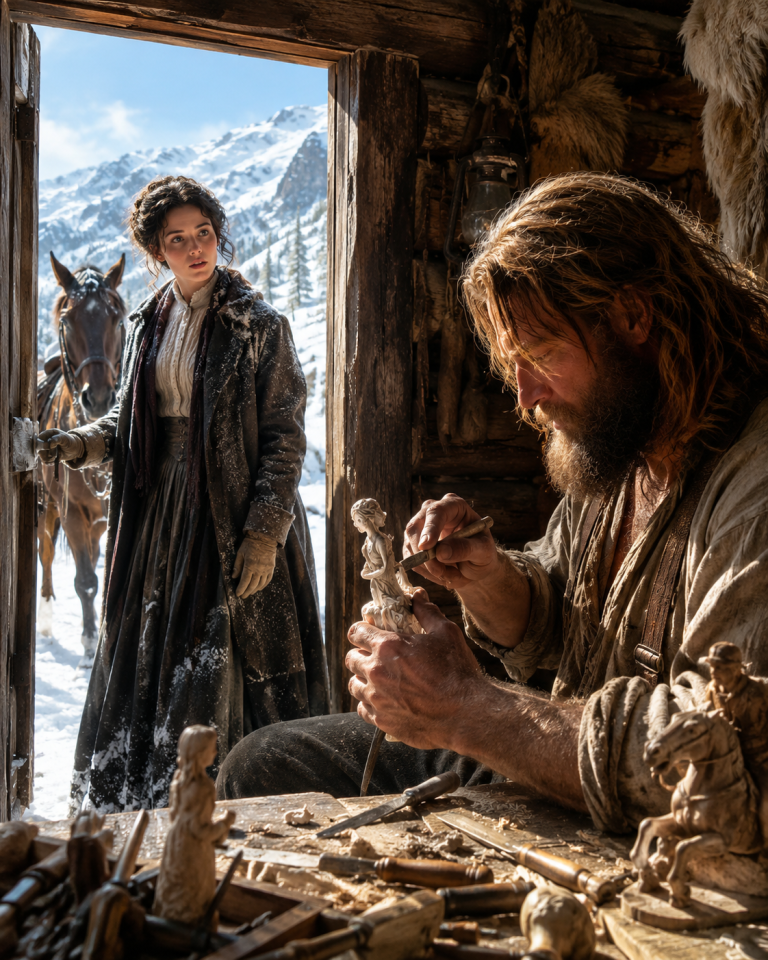
Inside, Caleb sat by the stone fireplace with a carving knife in hand, coaxing another wolf out of a block of pine. He’d carved so many over the years that a silent pack now guarded the mantel — wolves crouched low, wolves mid-run, wolves with heads lifted toward a moon they’d never reach. His hands knew the work without thought: cut along the grain, hollow the eyes, shape the muzzle, let the creature reveal itself because there were precious few other things left in the world still willing to be honest with him.
Firelight threw restless shadows across his weathered face. At thirty-nine, Caleb looked older. Dark hair, gone gray too early, hung past his shoulders, and his beard had grown wild enough that men in Larkspur Crossing crossed themselves when he rode in twice a year for supplies. He’d stopped caring how he looked the day he buried Eliza and their unborn child in the Kansas prairie.
That had been another lifetime. Another man.
That man had believed in God’s mercy, spring wheat, young marriage, and the promise of tomorrow. He’d held his wife’s hand in a small farmhouse and spoken with certainty about the baby who’d be born come winter, the horses they’d raise someday, the good years waiting just past the next harvest.
Then the baby came early. The doctor came late. By the time the drunken frontier physician sobered enough to ride out, Eliza had already labored ten hours, his hands shaking from whiskey. The child died first. Eliza bled after. She lasted one more hour — long enough to make Caleb promise he’d live, make something of himself, be happy.
He buried them in the same coffin. Eliza holding their son.
That night he burned the homestead to ash — house, barn, fifteen acres of wheat ready for harvest, every place hope had once touched the earth. Then he rode west until the mountains swallowed him whole.
Now his cabin measured no more than twenty feet square, built with his own hands from pine dragged down the mountainside. Every notch, every mud-and-moss seam, every peg and hinge spoke of desperate determination. It wasn’t only shelter. It was a fortress against memory.
Through the single glass-paned window, hauled from Billings at considerable expense, he watched December snow fall thick and relentless. The year was 1879, though Caleb rarely bothered with calendars anymore. Time had little meaning when one day bled into the next with the same hollow rhythm: wake, work, eat, sleep, try not to dream.
Outside, his black stallion Sable shifted restlessly in the lean-to. The horse was the only living creature Caleb trusted — he asked for hay, shelter, water, fair handling, and nothing more. He understood silence, respected boundaries, never demanded explanations for the nightmares that sometimes drove Caleb from bed to pace the floor until dawn.
The nearest town, Larkspur Crossing, lay two days’ ride through treacherous passes that claimed at least one traveler every winter. Caleb made the journey twice a year for salt, coffee, tobacco, ammunition, and whiskey. The townspeople had learned not to speak to him beyond necessary transaction. They called him the Hermit of Granite Hollow.
He didn’t care. Words were for people who still believed in human connection — people who hadn’t learned the truth Caleb carried like a stone in his chest. Caring for someone meant watching them die. Love was only another word for inevitable loss.
The mountains asked nothing from him except strength and caution. They didn’t lie. Didn’t pretend. Didn’t promise what they couldn’t deliver. Live alone. Die alone. Hurt no one. Be hurt by no one.
That afternoon, securing the stable door against the rising wind, Caleb paused. Something in the storm’s voice had changed — a note of urgency that raised the hair on his neck. This blizzard carried menace, a promise of tragedy for anyone caught exposed on the ridges. He thought briefly of the stage road in the valley below, the weekly coach run, and decided no sane driver would attempt the pass in this weather.
Still, unease followed him back inside.
By dawn, the blizzard had exhausted itself into a low moan. Caleb pushed the door open against a three-foot drift and squinted into brilliant morning light. Sable’s anxious whinny drew him to the stable, ears pricked toward the valley. Caleb had learned to trust that instinct. He saddled up despite the snow, strapped on snowshoes, and took his rifle from the pegs.
An hour into the descent, Sable stopped abruptly, nostrils flaring. Caleb dismounted, rifle ready, and pushed through a stand of pine.
What he found on the other side ran his blood cold despite the rising sun.
A stagecoach lay on its side like a broken toy, one wheel still spinning lazily in the wind. The four horses lay frozen in their traces. The driver hung from his seat at an unnatural angle, face blue-white with death. The strongbox had burst open — mail, packages, ladies’ clothing, books, a child’s wooden horse, scattered across the snow like the debris of interrupted lives.
He’d seen death before. But something about the wreck gnawed at him — the position suggested the coach had been driven off the road at speed, as if fleeing something.
Then he heard a sound. Barely audible. Almost human.
He circled the wreckage, past a man in city clothes thrown clear of the crash, past a hired guard half-buried near a snowbank. The sound came again, weaker, leading him to a drift piled against a boulder. Fabric showed through the snow — expensive fabric. He dug with his bare hands and found a woman’s traveling cloak, fine wool lined with fur, then a gloved hand small enough to belong to a child.
She lay curled like a question mark, chestnut hair hiding her face, a torn and soaked blue wool dress with ivory buttons speaking of money — city clothing as impractical in a Montana blizzard as a paper parasol in a thunderstorm.
Caleb pressed two fingers to her throat, expecting nothing. Her skin felt like marble.
Then, impossible but undeniable, a flutter against his fingertips. A pulse. Barely there. Fighting.
He should have left her. Nothing good came from involving himself in other people’s catastrophes — he’d learned that in Kansas and paid for it with everything he’d ever loved. But his hands were already lifting her, weighing almost nothing, a bundle of frozen flesh and soaked fabric, her head lolling against his shoulder. Young, mid-twenties, fine features suggesting breeding and comfort — the kind of woman who’d never chopped wood or skinned a deer or dug a grave in frozen ground.
Sable stood patient as Caleb mounted awkwardly with her across the saddle, one arm wrapped around her, pressing her against his chest to share whatever warmth his body still held.
The ride back became a race against time. Her breathing grew shallower with every minute. By the time they reached the cabin, the sun had climbed high, offering cold brightness that did nothing to ease the burden in his arms.
He laid her on the rug before the hearth and forced himself to think practically. Wet clothes would kill her faster than any injury. His hands shook as he worked — when had they started shaking? — stripping away soaked garments until she lay in only her shift, then wrapped her in his thickest buffalo robe as carefully as he’d wrap a child. He built the fire roaring and hung her clothes on every peg and chair back, turning the cabin into a strange ladies’ dressing room, the wet fabric steaming with lavender and rose — ghost scents from another world.
Her marble pallor softened to faint pink in the firelight, but her eyes stayed closed.
Caleb sat back on his heels and understood what he’d done. He’d brought a living woman into his sanctuary. He’d broken the rule that held his world together. If she died, he’d have another ghost in the cabin. If she lived, she’d want town, help, conversation, comfort, all the human niceties he’d forgotten how to provide.
He should have left her in the snow.
But he hadn’t.
Near sunset, she stirred. A soft moan escaped her lips. Her eyes opened suddenly — green, spring-leaf green — and for a moment she stared at the ceiling before her gaze found him and confusion sharpened into terror.
She screamed, scrambling backward until her back hit the wall, clutching the buffalo hide to her throat.
“You’re safe,” Caleb said, raising both hands empty. His voice came out rusty from disuse. “There was an accident. Your coach—”
“Don’t touch me.”
“You were freezing,” he said carefully, like calming a spooked horse. “Wet clothes would have killed you. I didn’t — I only did what was necessary.”
Her eyes found her clothing hanging by the fire, fresh horror blooming.
“Your coach crashed in the storm,” he said. “Everyone else is dead. You’d have been too, if I hadn’t found you.”
The words reached through her panic. “Everyone? Mr. Halloway? Mrs. Endicott? Little James?”
Caleb remembered the wooden horse in the snow and shook his head.
Her face crumpled, and she began to sob — not delicate tears, but raw, ugly sobs that shook her whole body. Caleb stood helplessly and watched her world break, remembering that part too well: disbelief, bargaining, the crushing weight when reality refused to bend. At least this woman had someone to witness her grief. He’d howled alone in an empty house, holding Eliza’s cold hand until neighbors forced him to let go.
When the storm of tears passed, she wiped her face with trembling hands. “I apologize for my outburst. You saved my life.”
“You needed saving.”
“I’m Caroline,” she said. “Caroline Ashford. Of Boston.” She pulled the robe tighter, gathering what dignity she could. “And you are?”
“Caleb Reeve.”
He offered no more.
“How long until we can reach town?” she asked, forcing a businesslike tone despite the trembling.
He glanced at the window, where snow had begun falling again. “Storm’s not done. Could be days. Could be a week.”
“A week? Surely you exaggerate.”
“This is Montana,” he said. “Storms here don’t care what year it is.”
Part 2
The first night tested every boundary Caleb had spent fifteen years building.
Caroline sat rigid by the fire, the robe clutched around her like armor, while Caleb busied himself with tasks that didn’t need doing. “I need my clothes,” she finally announced, her Boston accent sharp as broken glass.
“Still wet. Tomorrow, maybe.”
“This is intolerable. Surely you have something more appropriate.”
He did. From the trunk beneath the bed he pulled a flannel shirt and wool trousers, both patched but clean. “These will be too big.”
“I’ll manage.”
“I’ll tend the horse,” he muttered, grabbing his coat.
When he returned, she’d dressed herself, his clothes hanging from her frame like a child playing lumberjack, but she sat straighter now, dignity restored. “Thank you,” she said stiffly. “Though I fail to understand why a simple rescue requires such primitive arrangements.”
“You fail to understand a lot of things,” Caleb shot back, patience fraying. “Starting with the fact that you’re lucky to be breathing.”
Her green eyes flashed. “How fortunate that a mountain hermit happened along. Tell me, Mr. Reeve, do you often rescue half-dead women, or am I a special occasion?”
“First in fifteen years,” he said flatly. “Beginning to remember why I stopped.”
They glared at each other across the fire. Then, unexpectedly, Caroline laughed — short and bitter, but real. “Forgive me. My mother would be appalled. Here you’ve saved my life, and I’m acting like—”
“Like a scared woman alone with a stranger. It’s natural.”
“Nothing about this is natural.” She gestured at the cabin, at herself. “Three days ago I was dining at the Palmer House in Chicago. Now I’m dressed like a lumberjack, trapped in a cabin that would fit inside my bedroom back home.”
“Why were you on that coach?”
The question slipped out before he could stop it. Conversation. Another rule broken.
Her face closed. “I was going to San Francisco. I have an aunt there.”
He recognized the evasion but didn’t press. Everyone came west running from something.
“You need food,” he said instead, ladling stew. She accepted it warily, took a tentative bite, and surprise flickered across her face. “This is actually quite good.”
“Venison. Wild onions. Cattail roots.”
“Won’t kill you,” he added. “Already saved you from freezing. Seems foolish to poison you now.”
Another laugh, warmer this time. They ate in silence that had lost its hostility, and when the meal was done she asked the question both had been avoiding.
“Where do I sleep?”
He nodded toward the loft. “Up there. I’ll take the floor.”
“That hardly seems fair.”
“Life’s not fair. You need proper rest to heal. Floor’s fine for me.”
She climbed the ladder awkwardly in oversized trousers, and from above her voice drifted down. “Mr. Reeve. Thank you. Despite my behavior, I am grateful.”
Sleep didn’t come for Caleb. Every sound from above — the creak of straw, a soft sigh — reminded him of the intruder in his sanctuary. When had another person’s breathing last filled this cabin? Eliza, pregnant and restless, shifting beside him while he promised everything would be fine.
By dawn, Caroline descended more gracefully, hair in a long braid, color returned to her cheeks. “Good morning,” she said formally, as though standing in a Boston parlor.
Caleb handed her coffee, black and bitter. She sipped without complaint.
“I need to check the storm,” he said. “See how long we’re stuck.”
“May I come?” The request startled him. “Because I’m tired of being managed like a child,” she said, steel entering her voice. “I spent three months traveling west alone, Mr. Reeve. I am not as fragile as you assume.”
“You nearly died yesterday.”
“But I did not. I would like to understand my situation. Surely that’s reasonable.”
Against his better judgment, he nodded, finding an old coat of Eliza’s in the trunk — when had he meant to burn it? — and watched her wrap herself in it. Outside, the storm had dropped another two feet. The world lay buried in white.
“Dear God,” Caroline whispered. “It’s like the moon.”
“Welcome to Montana.” Caleb pointed toward invisible valleys. “Larkspur Crossing’s that way. Two days in good weather. Billings is five days east. Nothing else for a hundred miles.”
She turned slowly, seeing the wilderness properly for the first time. “You live here alone?”
“Fifteen years.”
“Why?”
When he didn’t answer, she pressed. “What makes a man choose this?”
“Emptiness. What makes a woman run from Boston to San Francisco?”
Her jaw tightened. “That’s different.”
“Is it?”
At last, barely above a whisper: “My fiancé. Hollis Vane. A business arrangement between our fathers, sealed when I was sixteen. The wedding was scheduled for next month.”
“You ran.”
“Like a thief in the night. I took what money I could and bought passage west. I thought I could disappear. Become someone else.”
Caleb understood that impulse too well. “The West is good for that.”
“And you?” she asked. “Who were you before?”
He turned back toward the cabin. “Someone who learned better.”
That night the rhythm between them shifted. Caroline helped with dinner, proving surprisingly adept with a knife, and ran her fingers admiringly over the carved wolves on the mantel. “You made these?”
“Passes the time.”
“Could you teach me?”
“Carving’s not for ladies.”
“Neither is fleeing marriage contracts or surviving coach crashes. Yet here I am.” She picked up a knife and tested its weight. “I need something to occupy my hands. Idleness makes me think too much.”
He understood that too well — empty hours were dangerous territory.
“Maybe,” he conceded, and they spent the evening by the fire, her first attempts producing only splinters and mild profanity that would have scandalized Boston society, until she’d made something vaguely resembling a cat.
“It’s terrible,” she said.
“It’s a start.” Caleb found himself almost smiling. When had he last smiled?
The storm stretched into its fifth day. Caroline abandoned any pretense of propriety, moving through the cabin with increasing confidence, hair in a practical plait, palms developing new calluses. “Show me how to split wood,” she announced one morning.
“You’ll hurt yourself.”
“Then teach me properly so I won’t.”
He studied her determined face — the city lady who’d screamed waking in his cabin had evolved into someone far harder to dismiss. “Fine. Kindling first.” Her first swings bounced harmlessly off the wood, but on the fourth try she split a piece clean through.
“I did it!”
Triumph lit her face, and Caleb’s chest tightened. He had to fight a smile.
That afternoon he made a disturbing discovery — the flour barrel nearly empty, winter stores lower than they should be. He’d planned for one mouth, not two.
“Because of me,” Caroline said.
“Can’t be helped.”
“Can we hunt?” she asked. “I know nothing about it. But I can learn. My presence caused this. I should help solve it.”
Something shifted in Caleb’s perception of her then — steel beneath the silk, a practical courage he hadn’t expected.
That evening, over a meager supper, she asked about the coat. “Who was she?”
His hand stilled on the wolf he was carving. “My wife.”
“How long ago?”
“Fifteen years, two months, eleven days.” The precision escaped before he could stop it.
“Is that why you came here? To escape the memories?”
“Came here to stop making new ones.”
“Memories follow you regardless.” He stood abruptly and went to check on Sable, leaning against the horse’s warm flank, breathing hay and trying to steady himself. Her question had opened a door he’d barred shut, letting in drafts of old pain. Beneath the pain, though, was something else. The world hadn’t ended because he’d spoken Eliza’s name.
When he returned, Caroline sat carving by the banked fire. “I’m learning the wings are hardest,” she said without looking up.
Grateful for neutral ground, he sat closer than usual. “Forget individual feathers. Think about the shape, the way it catches air.” He reached to guide her hand. Their fingers touched. She inhaled sharply, the knife slipped, nicking her thumb.
Without thinking, he caught her hand. “Not deep. Stay still.” He cleaned the wound with whiskey and bandaged it, and didn’t release her hand when he finished. She didn’t withdraw it. They sat frozen that way, fire crackling between heartbeats, her green eyes meeting his.
Recognition, perhaps. Two damaged souls finding unexpected shelter.
Caleb dropped her hand as if burned. “Keep it clean.”
The next morning brought the first break in weather. Checking trap lines together, they found a rabbit, and when she asked to try the second snare herself, her hand shook but she did it cleanly, then stood staring at the small body with profound sadness.
“I know it’s necessary,” she said, “but I don’t think I’ll ever find it easy.”
“The moment it becomes easy is the moment you lose something human.”
“Is that why you live alone? To avoid losing more of your humanity?”
The question cut too close. “We should head back.”
Walking through snow-muffled forest, she slipped on ice and he caught her instinctively, arms around her waist, pulling her back against his chest. Neither moved.
“I’m all right,” she whispered. But she didn’t step away.
Caleb became aware of every point of contact — her warmth through layers, the way she fit against him. This was a danger greater than any blizzard. She turned in his arms and looked up with eyes holding both warning and wanting.
“Caleb,” she breathed, his name for the first time.
He stepped back almost roughly. “Storm’s coming back. We need to move.”
That night the cabin felt too small, every movement bringing them too close. “I should check the stage road tomorrow,” Caleb said abruptly. “See if it’s passable.”
Caroline’s hands stilled in the dishwater. “Of course. You must be eager to reclaim your solitude.”
“It’s not about — you need San Francisco. Your aunt expects you.”
“Yes. My aunt.” She scrubbed a plate with unnecessary force. “Heaven forbid I disrupt your hermit existence longer than necessary.”
“Caroline.”
“Miss Ashford,” she corrected sharply. “We should maintain appropriate boundaries, don’t you think? After all, I’ll be leaving soon.”
They finished chores in brittle silence. When she climbed to the loft, she didn’t say goodnight. Caleb sat by the fire, carving with strokes vicious enough to ruin the wolf’s delicate face. He should have felt relieved she’d leave soon. But as the fire died, he faced an uncomfortable truth: the thought of returning to emptiness, of never hearing her laugh again, felt like contemplating a second death.
Then came a sound from the loft. Muffled crying.
Every instinct told him to stay where he was. His feet carried him to the ladder anyway. “Caroline.”
The crying stopped. “Go away.”
“Are you hurt?”
“No.”
He should have left it there. “What’s wrong?”
“Everything.” The word came raw. “I am trapped in a cabin with a man who saved my life but can barely stand to look at me. I am wearing a dead woman’s coat. Everyone I traveled with is dead. I’m supposed to start a new life, and I don’t even know who I am anymore.”
The anguish pulled at him. He climbed the ladder. She sat on the straw mattress, face wet, looking lost and young and utterly alone.
“You’re not trapped,” he said softly. “And I can look at you just fine.”
“That is the problem.”
Understanding dawned in her eyes. “Caleb.”
“I know.” He sat near the mattress, keeping careful distance. “I know all the reasons this is foolish. But you are not alone, Caroline. Not while you’re here.” She reached out. He let her take his hand, and they sat that way while the storm raged outside and something just as powerful moved through the cabin.
The next morning, she’d rekindled the fire before he woke. “About last night,” she began.
“Nothing happened last night,” he said carefully.
“No. Nothing happened. And nothing will happen. We agree?”
He should have felt relief. Instead, disappointment settled like stone. “Agreed.”
By midday the tension was unbearable. “Stop staring,” she said without looking up from her carving.
“Wasn’t staring.”
“You were. Do you think I’m blind?”
Heat rose in his face. “Don’t flatter yourself.”
“Flatter myself? Do you think I want this? Do you think I planned to develop feelings for a man who’d rather live with ghosts than the living?”
Feelings. The word hung between them like a loaded gun.
“You don’t know what you’re saying,” he growled.
“Then tell me. Tell me why you’re so determined to bury yourself alive. Tell me about Eliza.”
The name on her lips broke something open. “You want to know? Fine.”
The story came out of him like blood from an old wound. Eliza at nineteen. Their marriage. The farm. The pregnancy. The baby coming early. The drunken doctor. The blood. The promise. The shared coffin. The fire he set afterward. The ride west.
When he finished, the cabin was silent.
“But the memories followed,” Caroline said softly.
“Every damn day.”
He expected pity. Instead, he found understanding. She moved closer, close enough he could see gold flecks in her green eyes. “I understand fear, Caleb. I’ve been running from mine for months. But at some point, we have to stop.”
“It’s not that simple.”
“Isn’t it?” She touched his face. “You saved my life. Not just from snow. From a different kind of death. A slow suffocation in silk and propriety, married to a man who saw me as a business acquisition.”
He caught her wrist, meaning to pull it away. Instead, he leaned into her touch. “Caroline, I can’t control myself around you. I swore I’d never—”
“Never what? Never feel? Never want?” Her other hand framed his face. “You are already half in love with me, Caleb Reeve, just as I am half in love with you. The only question is whether we’re brave enough to admit it.”
With a sound somewhere between a groan and a prayer, he pulled her against him. Their kiss held fifteen years of loneliness seeking solace, two broken souls recognizing their match.
“This changes everything,” he said roughly when they broke apart.
“Everything already changed,” she whispered. “From the moment you carried me through that door.”
Part 3
The peace lasted three days. Three days of tentative happiness, of building something fragile and precious in a cabin that hadn’t known tenderness in fifteen years.
Then Sable’s warning whinny shattered the morning quiet.
Caleb was instantly alert, reaching for his rifle. Three riders picked their way up the treacherous path. “Get up to the loft,” he ordered.
“No,” Caroline said, moving instead to the second rifle and checking it with the competency he’d taught her. “Three men approaching our home with unclear intentions. I am not hiding like a child.”
*Our home.* The words struck him even as he recognized the steel in her voice.
“Do you recognize them?” he asked. Through the window, the lead rider sat his horse with military bearing, his coat marking him no ordinary traveler.
Caroline gasped. “Oh God. That’s Hollis.”
“You’re certain?”
“I was engaged to him three years. Yes.”
“What kind of man is he?”
“Dangerous. His family owns half the shipping contracts on the Eastern Seaboard. He has judges, lawmen, politicians in his pocket.”
“Well,” Caleb said, moving to the door, “he doesn’t own Montana.”
The riders reached the flat ground before the cabin. Hollis Vane dismounted with studied elegance, handsome in a soft Eastern fashion, pale skin that had never known hard labor.
“Gentlemen,” Caleb said evenly. “Long way from anywhere to be riding in this weather.”
“Indeed. But I would ride through hell itself to recover stolen property.”
“Don’t see property here. Just my cabin and my mountain.”
“We both know Caroline is inside. Her trunk was found in the wreckage. Miraculous she alone survived.” Vane smiled. “I made inquiries in Larkspur Crossing. The Hermit of Granite Hollow. Caleb Reeve, formerly of Kansas. Wanted for questioning in connection with a fire that killed two people fifteen years ago.”
Caleb’s blood turned to ice. “Those two people were my wife and child.”
“So you say. But a clever prosecutor might argue differently.” Vane pulled out a folded paper. “I took the liberty of having new warrants drawn up. Amazing what money can accomplish.”
“Forged papers don’t mean much here.”
“Perhaps not. But they’ll mean something when I bring you back to face trial — unless we reach an understanding. Caroline is my fiancée. A legal contract, signed and witnessed. She is confused, possibly influenced by trauma. I am here to take her home.”
“Even if I knew this woman, she’d be free to choose.”
“Free? Mr. Reeve, you clearly do not understand how the world works. Caroline’s father owes me a considerable sum. Our marriage was part of the arrangement. Without it, her family faces ruin.”
The cabin door opened. Caroline stepped out, chin high despite the fear Caleb saw in her eyes. “My sisters are better off in the streets than sold to men like you, Hollis.”
Vane’s mask slipped. “Caroline, darling. You’ve had your adventure. Time to come home.”
“I am home.”
“With this mountain savage?” His gaze raked her men’s clothing, work-roughened hands. “Look what he’s done to you.”
“Yes,” she said quietly. “I am finally myself.”
“You will come with me now, or I will have Mr. Reeve arrested for kidnapping, assault, and whatever else I choose to file.”
“Try it,” Caleb said.
“Hollis, I’ll make you a bargain,” Caroline said. “Leave now. Tell my father the wedding is off, and I’ll sign papers releasing any claim to my inheritance.”
“I don’t want money. I want what is mine.”
“I am not property.”
“Aren’t you?” He nodded to his men. “Take her.”
Everything happened at once. The hired guns reached for their weapons. Caleb shoved Caroline behind him and brought his rifle up. The crack of gunfire shattered the mountain silence — one gunman spun and fell, clutching his shoulder, clean shot. The other dove behind the horses.
Vane drew a concealed pistol and aimed at Caleb. Another shot rang out. The pistol flew from his hand.
Caroline stood steady, rifle smoking, face white but determined. “The next one goes in your chest, Hollis.”
“This ain’t worth dying for,” the remaining gunman said, hands raised.
Vane cradled his bleeding hand, staring at Caroline in genuine shock. “You shot me.”
“You threatened the man I love. What did you expect?”
“Love? You’ve known him what, two weeks?”
“I would throw away everything to avoid becoming what you would make me. A pretty ornament. A possession. Yes, Hollis. I choose love over that every time.”
“You cannot hide here forever. I have resources. Connections. Witnesses.”
“And I have witnesses too,” Caroline replied. “Two hired guns who can testify you came here with forged warrants and violent intent. How do you think your business partners will react?” She stepped closer, rifle never wavering. “Here is what will happen. You will leave. You will tell my father the engagement is over. You will forget I exist. If you don’t, I’ll write to every newspaper in Boston detailing exactly what kind of man you are. My diary from our courtship makes fascinating reading. The times you struck me when you were drunk. The mistresses you flaunted. The bribes you paid. I wonder how your Senate campaign would fare after that.”
Vane went gray. “You wouldn’t dare.”
“Try me.”
For a long moment, no one moved. Then Vane struggled to his feet. “This isn’t over.”
“Yes,” Caleb said quietly, “it is. If you come back, if you send anyone else, I won’t aim for shoulders and hands. Mountain justice is simple. You threaten what’s mine, you don’t leave the mountain.”
He had lost, and he knew it. Before riding off, he gave Caroline one last look. “You’ll regret this. When you are old and broken from hard living, remember you could have had everything.”
“I already have everything,” Caroline said. “Everything that matters.”
They watched the riders disappear down the trail. Then Caroline’s rifle slipped from her fingers, and she began to shake. Caleb caught her as her knees buckled.
“You did good,” he murmured into her hair. “You did so good.”
“I shot him.”
“You protected us. Our home.”
The wounded gunman, Marsh, talked once they’d tended his shoulder. Vane had hired them in Billings with papers that made the matter sound legal, but the warrants tied to the Kansas fire had been arranged by Vane’s family using an old closed tragedy as leverage. They knew Caleb was innocent. They simply hadn’t cared.
“Rich folk don’t care about truth,” Marsh said through gritted teeth. “Just what they can use.”
“Will you testify?” Caroline asked. “Tell the real law what Hollis tried to do?”
Marsh studied her with something like respect. “You patched me up when you could’ve let me bleed. Yeah. I’ll testify.”
The next morning Caleb rode partway to Larkspur Crossing with them, giving them a choice at the crossroads: ride to Sheriff Tate and tell the truth, or keep riding and never return. They chose the sheriff.
That night, by the fire, they planned — not only supplies and repairs, but dreams. Caroline spoke of starting a school. Caleb admitted he’d always wanted to raise horses, breed Sable with good mares. “Eliza wanted horses,” he said quietly. “She said they were freedom given form.”
“Tell me about her,” Caroline said. “Not the pain. Tell me who she was.”
So he did, and for the first time the memories came without agony.
Part 4
Sheriff Tate rode up days later to take statements, a grizzled veteran who listened with growing disgust to the tale of forged warrants. “I’ll wire Boston. Let them know what kind of man Hollis Vane really is.”
“Mrs. Reeve,” Caroline corrected him at one point, then blushed. “I mean—”
“Not yet,” Caleb said, surprising himself, “but soon. If she’ll have me.”
“About time,” Tate chuckled. “Fifteen years is too long for any man to be alone.”
After he left, Caroline confronted Caleb. “Did you mean it? About marriage?”
“I meant it. Question is whether you want it. A real marriage. Building a life together, good times and bad. Children, maybe.”
“Yes,” she interrupted. “Yes to all of it.”
They married two weeks later in Larkspur Crossing’s small church. Caroline wore a simple dress with flowers pinned in her hair. Caleb trimmed his beard and looked almost civilized in his only good shirt. When the reverend asked if she took him as her husband, her “I do” rang clear as mountain air. When Caleb’s turn came, his voice caught — but he said it, and meant it with every scarred piece of his heart.
They returned to the cabin transformed — new curtains, a handmade quilt, preserves on the shelves, wedding gifts from people who understood what it meant to take chances on love.
One year later, spring 1880 came early to the mountains. Caroline stood in the doorway of their new, larger cabin, hand resting on her rounded belly, watching Caleb work a young mare in the corral. Three mares and their foals grazed in the meadow below — the beginning of their dream. The old cabin had become a workshop where Caleb carved furniture to sell in town and Caroline taught local children twice a week, a new sign above its door reading *Reeve Homestead, established 1879.*
A letter arrived from Caroline’s sister Margaret with unexpected news: Hollis Vane had been exposed for fraud, fled to Europe to avoid prosecution, his engagement to a senator’s daughter broken, reputation in ruins. Better still, her father’s debts had been mysteriously paid by an anonymous benefactor.
“Mysterious benefactor?” Caroline turned in Caleb’s arms. “Did you sell those horses to Stern to pay my father’s debts without telling me?”
“Might have. A man doesn’t let his wife’s family suffer if he can help it.”
“You impossible, wonderful man.”
Doc Hartley rode up later that day — mother and baby healthy — and mentioned, almost in passing, a letter from a Boston colleague: Caleb’s old Kansas case had been officially closed. All charges dropped. The last shadow lifted.
That evening, walking to their favorite rise overlooking the valley, Caleb said, “Never thought I’d be here. Forty years old. Married again. Baby coming. Building something real instead of just surviving.”
“Regrets?” Caroline teased.
“Only that I wasted so many years.” He drew her back against him, arms around her and their unborn child. “But maybe I needed those years to be ready. For this. For you.”
“I wasn’t ready either,” she admitted. “If I’d met you in Boston, young and sheltered, I’d have seen only the surface. Instead, I saw home.”
That evening, over dinner in the home they’d built — books on shelves Caleb had crafted, Caroline’s writing desk by the window, baby clothes sewn through long winter evenings, the original wooden wolf still standing guard on the mantel — Caroline said, “I’ve been thinking about names. If it’s a boy, Samuel, after your father.”
“And if it’s a girl,” Caleb said softly, “Eliza Caroline. For both the women who made me whole.”
Her eyes misted. “Eliza Caroline Reeve. I love it.”
Later, as they settled for the night, a wolf’s howl echoed across the mountains, lonely and wild. Moments later, another answered.
*Not alone anymore*, Caroline thought. None of them were.
“Remember what you told me?” she asked. “That you couldn’t control yourself around me?”
“Best warning I ever failed to heed,” Caleb murmured against her hair.
“The city woman didn’t listen.”
“And the mountain man took her in.”
“And they lived happily,” Caroline whispered.
“Against all odds and good sense,” Caleb said. “Happily.”
Outside, the Montana night wrapped around the cabin like a blessing. Inside, two people who’d found each other in loss and storm held tight, building tomorrow on the ashes of yesterday — the wooden wolves keeping their silent vigil, witnesses to a love story written in courage and choice, in bullets and blizzards, and in the simple daily decision to stay rather than run.
In the end, love was that simple.
And that complicated.
And that perfect.