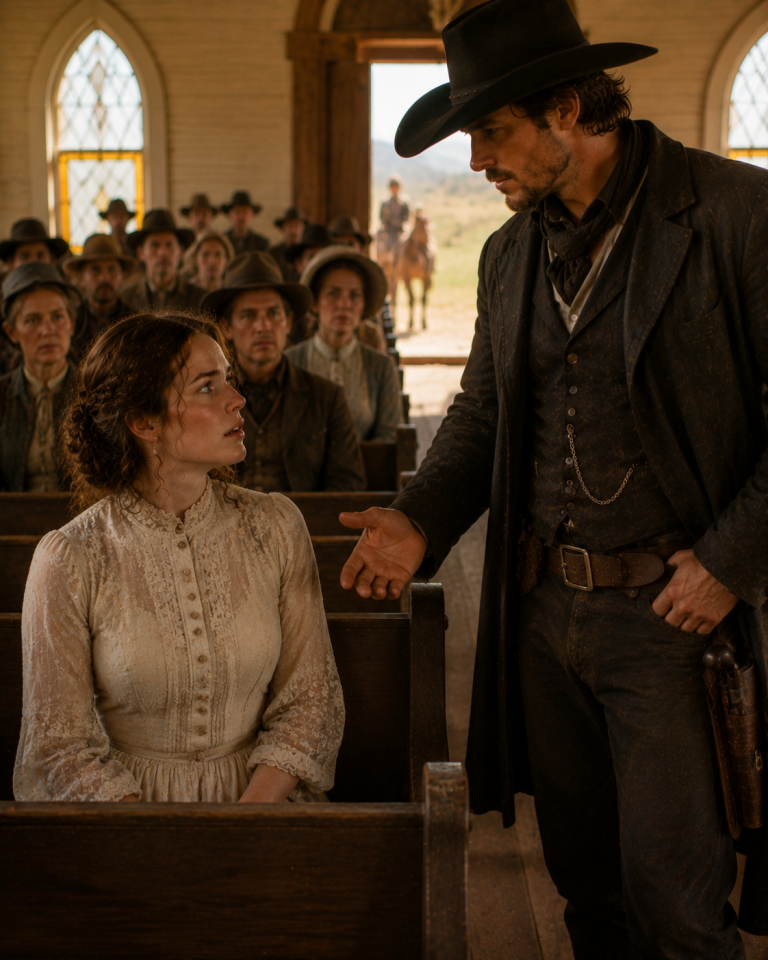
The Whole Town Called Him Too Soft to Keep a Wife — She Came Home and Saw Something Different

PART 1
Everyone in Cedar Hollow had an opinion about Asa Colt, and none of them had ever bothered asking him for his side of it.
They said he was too quiet. Too gentle for a man his size. Better with a green colt than with a woman, and not the kind of husband who could ever really run a household the way a husband was supposed to. The talk had followed him since high school, back when he’d rather sit with the horses at recess than trade insults with the other boys, and it had only calcified over the fifteen years since — the way small towns do, deciding who you are once and refusing, out of sheer stubbornness, to ever reconsider.
Delilah Monroe hadn’t planned on coming home at all.
She’d spent six years in the city convincing herself she’d outgrown Cedar Hollow — its slow mornings, its two-block downtown, the particular exhaustion of living somewhere everyone remembered your worst year in embarrassing detail. She’d chased something bigger. Instead she’d found long hours at a job that used her up and gave nothing back, an engagement that quietly dissolved over a shared calendar neither of them had ever actually opened together, and an apartment so silent at night she’d started leaving the television on just to hear another voice in the room.
One gray Tuesday, tired in a way sleep didn’t touch, she packed her car and drove the four hours back to the only place that had ever, however imperfectly, felt like hers.
Cedar Hollow greeted her the way it always had — the diner still smelling of burnt coffee and bacon grease, the feed store’s sign still hanging crooked on one hinge, a tractor holding up traffic on Main Street like time itself had simply declined to move forward without her. Delilah found herself smiling before she meant to. The town hadn’t changed. She had.
She moved back into her grandmother’s old house at the edge of town, dust thick on every surface, memory thicker still in every corner. Neighbors dropped by with casseroles and careful questions about how long she planned to stay. She smiled and said she wasn’t sure, though somewhere underneath the uncertainty, she already suspected she was home for good.
She saw him again a week later, at the feed store, and didn’t recognize him at first — not because he’d changed so much as because she’d forgotten how much room he took up in a doorway. Asa Colt had gone from lanky teenager to broad-shouldered man somewhere in the years she’d been gone, though the quiet was exactly the same, unhurried and unbothered, like a man who had made peace with taking up space slowly instead of loudly.
“Delilah.” He said her name careful, like he was checking it against memory before trusting it out loud.
“Hi, Asa. It’s been a long time.”
He took his hat off without seeming to notice he’d done it, and something about the small, automatic courtesy made her chest do something unexpected.
They talked about nothing much — her return, the town, the horses he trained out at Timber Creek Ranch. He listened more than he spoke, but when he did speak, his words were careful and complete, the kind of sentences a person builds because they’ve actually thought about them first. There was nothing weak in it. Nothing small.
After he left, the woman behind the counter leaned in, lowering her voice the way people do when they think they’re being kind.
“He’s a good worker,” she said. “Loyal as they come. But you know how folks talk.”
“Talk about what?” Delilah asked, though she already suspected the shape of the answer.
“That he’s too quiet to really keep a wife happy. That he’s better suited to horses than people. That there’s not much *there*, if you take my meaning.”
Delilah walked home with those words looping uncomfortably in her mind, because none of it had matched the man she’d just spoken to. Asa hadn’t seemed unsure, or small, or lacking in anything at all. He’d seemed like a man entirely settled in who he was, whether or not Cedar Hollow had bothered to notice.
She saw him again three days later at the Saturday market, helping an elderly rancher haul feed sacks into the bed of a truck without being asked, refusing her offer to help lift because he didn’t want her hurt, warmth in his voice instead of the awkwardness the rumors had led her to expect.
The gap between what people said about Asa Colt and what she actually saw when she looked at him kept widening, day by day, until Delilah found herself doing something she hadn’t planned on at all.
She started looking for reasons to run into him.
And she had absolutely no idea yet that the town’s careful, decade-old story about Asa Colt was about to be quietly, thoroughly, and permanently proven wrong — starting with the two of them, alone, on a Tuesday evening at Timber Creek Ranch, fixing a fence that had never actually needed fixing at all.
—
PART 2
The fence, as it turned out, had needed fixing after last week’s storm, but Delilah stayed far longer than the repair required, handing Asa nails and listening to him talk about horses in a voice that carried none of the flatness the town’s gossip had led her to expect.
Over the following weeks, their closeness grew the way things do when neither person is in any particular hurry — no declarations, no rushed conclusions, just Delilah showing up at Timber Creek more often than strictly necessary, and Asa slowly, visibly surprised by how easily she listened without already having decided what he was.
One evening, sitting beneath the old cottonwood at the edge of the north pasture, Asa admitted what she’d already half suspected.
“I know what people say,” he said, watching the horses move in the fading light. “That you’ll get tired of the quiet eventually. That a woman like you won’t be satisfied staying with a man like me.”
Delilah turned to face him fully. “You’re steady,” she said. “You’re thoughtful. You care more than you let yourself show. None of that is a shortage, Asa. People just don’t know how to recognize strength that isn’t loud.”
Something shifted in his face — not relief exactly, but the loosening of a thing held tight for a very long time.
Cedar Hollow noticed, of course. It always did. Curious glances at the market. Conversations that paused a beat too long when the two of them walked by together. Delilah heard the whispers sharpen as the weeks went on — that she’d regret it, that Asa didn’t know how to lead a household, that she was settling for a man the town had decided, years ago, wasn’t quite enough.
She answered none of it directly. She simply kept choosing him, publicly and without apology, until the choosing became its own kind of answer.
One evening, Asa showed up at her grandmother’s house quieter than usual, helping her fix a loose porch step without much conversation, his movements careful in a way that told her something was sitting heavy on him before he ever said a word.
“Delilah,” he said finally, not meeting her eyes. “You don’t have to do this. People are already talking. I don’t want to be the reason folks look at you sideways for the rest of your life here.”
She set down her coffee and stood directly in front of him until he looked up.
“I’m not doing this because I have to,” she said. “I’m doing it because I want to. There’s a difference, Asa, and I need you to actually believe it.”
Something in his face broke open then — not weakness, but the particular relief of a man who’d been holding his breath around this exact fear for the better part of fifteen years and had finally, quietly, been allowed to let it go.
He asked her to marry him three weeks later, no crowd, no rehearsed speech, just the two of them walking the fence line at sunset, the same stretch of ground where they’d first talked without the town listening in.
“I don’t have fancy words,” he said, hat in his hands. “And I don’t have much beyond this ranch and steady hours. But if you want a life with me, I’ll spend every one of my days making sure it’s a good one.”
Delilah didn’t hesitate.
“I already have that life,” she said. “With you.”
The news moved through Cedar Hollow within a day, the old rumors returning louder and crueler than before — questions about whether Asa could really be a husband in every sense of the word, whether Delilah understood exactly what she was settling for, cruel speculation dressed up carefully as concern for her future happiness.
Delilah refused every last bit of it a hearing.
But she noticed, on their small, quiet wedding day at the old chapel outside town, that Asa’s hands trembled slightly as he spoke his vows — and she understood, watching him, that whatever waited for them that night, in their own home, away from every voice Cedar Hollow had ever raised against him, was about to answer every single rumor at once, in a way none of those voices would ever actually get to witness.
PART 3
The wedding itself was small and unhurried, exactly the way Asa moved through most things in his life. Held at the little whitewashed chapel just outside town, it drew perhaps thirty guests — Delilah’s mother, a scattering of aunts, Asa’s older sister down from the next county, and a handful of ranch hands who’d worked alongside him long enough to know the man underneath the town’s careless story.
Asa wore his one good suit, the collar slightly too tight, nerves showing plainly in the set of his shoulders. When Delilah walked the short aisle in a simple ivory dress that suited her far better than anything she’d worn in six years of city life, she watched every ounce of his nervousness dissolve into something that looked, unmistakably, like wonder.
“I promise to stand by you,” he said, voice steady despite the visible tremor in his hands. “To listen. To care. To love you in every way I know how, even on the days I don’t have the words for it.”
“You already do,” Delilah answered, and meant it entirely. “And I’m proud to be your wife, in front of every single person in this town who ever doubted you.”
A few guests smiled warmly. A few others exchanged the same uncertain glances that had followed Asa his whole life. But when he kissed her for the first time as her husband, something in the room shifted anyway — a small, stubborn crack in fifteen years of settled opinion.
That evening, after the last guests had driven off from Timber Creek and the lanterns strung along the porch had burned down to a low, warm glow, Asa stood just inside the door of the small ranch house they now shared, and Delilah watched the old tension climb back into his shoulders.
He’d heard what people expected. He knew, better than anyone, the shape of the story Cedar Hollow had told about him for fifteen years, and some old, worn-down part of him still braced for the night to somehow prove it true.
“This isn’t about them,” Delilah said softly, stepping close enough to take his hand. “Whatever they’ve said, whatever they think they know. Tonight is only about us.”
Asa nodded, working visibly to let the words settle somewhere useful.
The house was quiet in the way that follows a long day — not empty, but gentle, filled with the low chorus of crickets outside and the warm, uneven light of a single lantern on the kitchen table. This was the night Cedar Hollow had whispered about for weeks, certain in its collective, careless way that it already understood exactly how the story would go.
It had no idea at all.
Instead of rushing anything, Asa lit a second lantern, poured warm tea into two mismatched cups that had belonged to his mother, and cut the small cake one of the ranch hands’ wives had left on their counter, offering Delilah the first careful slice.
“You don’t have to do all this,” she said, smiling despite herself.
“I want tonight to be good for you,” he said simply. “I want you to feel chosen. Not just married. Chosen.”
“I already do,” Delilah said. “You’ve made sure of that since the day I ran into you at the feed store.”
They sat together at the small table, talking — not about expectations, not about anything the town had ever whispered about them, but about ordinary things. Childhood summers. The horses he’d trained from skittish colts into steady, trustworthy animals. Dreams neither of them had said aloud to another living person before that night.
Asa listened the way he always did — fully, without distraction, the kind of attention that made Delilah feel, for the first time in longer than she wanted to admit, genuinely heard.
“People think strength has to be loud,” she said at one point, turning her teacup slowly between her hands.
“Quiet things can hold plenty of strength,” Asa said. “Fence posts don’t shout. They just hold.”
She laughed, surprised and delighted by the small, dry humor she was only now discovering he had. He reached for her hand across the table, unhurried, certain, his touch carrying an intention that had nothing uncertain about it at all.
This was not a man unsure of himself, whatever fifteen years of Cedar Hollow gossip had insisted. This was a man who understood, deeply and without needing an audience to confirm it, exactly how to care for someone.
Later, when they moved to the small sitting room by the fire, Asa spoke again, voice low.
“I know what they say about me,” he said. “That I don’t know how to love a woman properly. That there’s not enough in me for it.”
Delilah looked at him steadily. “Then show me how you love. Not them. Me.”
And he did — not with bravado, not with anything performed for an audience that would never even witness it, but through patience, through attention, through the small, deliberate way he checked in with her comfort at every turn, through pausing simply to ask rather than assume. Every gesture was considered. Every moment, chosen rather than rushed.
Delilah understood something clearly, somewhere in the quiet hours that followed. Asa Colt was not inexperienced in love, whatever the town believed. He was careful with it. He treated it like something valuable, worth handling slowly, rather than something to be hurried through and mentioned casually at the diner the next morning.
When the night settled into stillness again, they lay together, Delilah’s head resting against his chest, listening to the steady, unhurried rhythm of his heartbeat.
“You surprised me,” she said quietly.
“Good surprise?” A faint smile in his voice.
“The best kind,” she said. “You made me feel safe. Seen. Like every part of me mattered to you, not just the parts that were easy.”
He was quiet a moment, and when he spoke, his voice had thickened slightly.
“Nobody’s ever said that to me before.”
—
Morning came slow and pale through the curtains, and Asa woke first, the way he always did, lying still for a long moment just watching Delilah sleep, peaceful and unguarded beside him. Something settled deep in his chest that had nothing to do with anyone else’s approval at all — a quiet, earned kind of confidence, built entirely from the truth of the night before rather than borrowed from anyone else’s permission.
They stepped outside together later that morning, the ranch hushed and dew-heavy, horses moving unhurried in the distance. Delilah slipped her arm through his, and for the first time in fifteen years of practiced smallness, Asa didn’t pull away or shrink his shoulders in anticipation of being watched.
He stood taller.
Word moved through Cedar Hollow quickly, as it always did — not about anything that had happened behind closed doors, which remained entirely their own, but about what people noticed afterward. Asa walking through town with a new, settled steadiness. Delilah laughing without restraint at the market, unbothered by who might be listening. The particular, unhurried way Asa spoke now in public, no longer folding himself smaller to fit the story the town had assigned him.
“He’s changed,” someone murmured at the diner counter one morning.
“Maybe,” his sister replied, passing through town for a visit, “he was always like this, and you all just never bothered looking closely enough to notice.”
The old rumors didn’t vanish overnight, because towns rarely let go of a comfortable story quickly, however wrong it turns out to be. But they lost their grip, slowly, the way frost loses its hold once the sun actually commits to rising. Asa remained exactly as attentive with Delilah in public as he’d been in private — listening when she spoke, supporting the small business she eventually opened restoring old furniture out of her grandmother’s barn, standing beside her without ever needing to dominate the room or retreat from it entirely.
One afternoon, a rancher who’d been among the loudest doubters for over a decade clapped Asa on the shoulder at the feed store, a little sheepish.
“Looks like you proved us all wrong, son.”
Asa shook his head, unbothered. “Didn’t prove anything. Just kept living the way I already was. Y’all just weren’t looking.”
That evening, he and Delilah walked the same fence line where he’d proposed, the sky bleeding gold over the western ridge, horses settling into the cooling evening air.
“They were wrong about you,” Delilah said, squeezing his hand. “For fifteen years, and nobody ever bothered checking.”
Asa’s smile was calm, entirely certain of itself now in a way it had never quite managed to be before that quiet wedding night.
“They were,” he agreed. “But it never mattered much once I had someone who actually looked.”
As the sky deepened toward evening, Cedar Hollow finally caught up to something Delilah had understood almost from the very first afternoon she’d watched him hand feed sacks to an old man who hadn’t asked for help — that the quiet cowboy the whole town had spent fifteen years underestimating had never once been lacking anything at all.
He had simply been waiting, patiently and without complaint, for someone willing to recognize that gentleness and strength had never actually been opposites to begin with.
And on the one night that mattered most, without a single word ever reaching the rest of the town, Asa Colt had answered every rumor Cedar Hollow ever whispered about him — not by arguing, but simply by being, entirely and unhurriedly, exactly the man he had always quietly been.
THE END