A BROKE ER NURSE COUNTED HER LAST TWENTY DOLLARS AT HER OWN BIRTHDAY TABLE — THEN A CRIME LORD BOUGHT HER SILENCE WITH HER DAUGHTER’S SAFETY

## PART 1
Maya Bennett’s thumb kept sliding back to the same corner of the menu, the one with the price printed small enough to pretend it wasn’t there. Forty-four dollars for a piece of salmon. She had eleven dollars in tips folded into her wallet and a debit card she’d already watched decline twice this month.
She ordered it anyway.
Some birthdays, a woman had to be reckless just to remember she was still a person underneath the mother.
The restaurant was called The Ledger, and it did not so much serve food as perform wealth — black stone floors buffed to a mirror shine, chandeliers dripping crystal like frozen rain, servers gliding between tables with the practiced silence of men who’d been trained never to make a rich man wait. Maya’s dress had come from a clearance rack two winters ago. Her purse still had a small scuff mark near the clasp where her daughter had dragged it across the linoleum that morning, narrating a very important business trip.
*Happy birthday, Mommy,* four-year-old Nora had said, pressing a plastic unicorn charm into her palm like it was a medal. *So you remember me at your fancy dinner.*
As if Maya had ever once forgotten her. Nora was folded into every hour of Maya’s day — into the grocery list creased in her wallet, into the ache behind her shoulder blades after double shifts at Grace Memorial, into the tiny sock she kept finding wedged behind the radiator. For four years Maya had been the only parent Nora had. Breakfast-maker. Rent-negotiator. Monster-hunter. Tonight was the first night in longer than she could count that no one needed anything from her at all, and it felt almost illegal to sit still and let someone else pour the water.
Then the room changed temperature.
It wasn’t loud. It was the kind of shift that animals feel before a storm breaks — a man near the bar straightening his tie without thinking, a woman’s laugh dying mid-breath, two hostesses near the entrance stepping back as if a line had been drawn on the floor that only they could see.
Maya looked up because everyone else had.
He came in flanked by two men, and he did not hurry, because men like him never had to. Dark hair. A charcoal suit that made every other jacket in the room look like it had been bought off a rack instead of built around him. His face wasn’t handsome so much as engineered — sharp bones, a mouth set into a line that suggested it rarely bothered with expression, eyes the color of good bourbon held up to a low light. Warm in color. Not in promise.
One of his men leaned in and murmured something.
The man’s gaze slid across the room and landed, without hesitation, directly on Maya.
She looked down at her napkin so fast her neck ached, heart slamming against her ribs in a way that had nothing to do with attraction and everything to do with instinct. Some old, animal part of her brain understood, before her mind caught up: *do not let him see you noticing him back.*
“Who is she?” His voice was low. It still carried the length of the room.
She didn’t hear the answer. By the time she risked another glance, he had already disappeared behind a carved wood screen at the back, into whatever alcove was reserved for men whose names nobody said carelessly.
“You’ve caught his attention,” her server said when he returned, his professional composure slipping just enough at the edges to show something underneath it that looked almost like fear.
“Whose?”
“Mr. Cross.”
The name meant nothing to Maya. The way the server said it meant everything — not admiration, not respect. Fear, wearing very good manners.
Her salmon arrived beautifully plated and tasted like ash, because every few minutes she felt eyes on her from behind that screen, patient as a held breath. When she asked for the check, the server set down a glass of dark red wine she hadn’t ordered.
“Compliments of Mr. Cross.”
“I didn’t order this. I can’t accept it.”
“It would be impolite to refuse.” His eyes flicked toward the private room, and the words underneath his words were unmistakable. This was not a gift. It was an instruction dressed in velvet.
“I’d still like the check.”
“Your meal has been taken care of, Ms. Bennett.”
Maya’s breath caught somewhere behind her sternum. “How do you know my name?”
“Mr. Cross is a thorough man.”
A cold thread moved down her spine, slow as melting ice. She gathered her worn purse and her cardigan and made the mistake, on her way out, of glancing once toward the private alcove.
Through the gap in the screen, a man she had never spoken to raised his glass to her.
His expression gave away nothing.
His eyes gave away everything.
—
## PART 2
Outside, the parking lot air felt like rescue — until a sleek black car pulled alongside her ancient Honda and the rear window slid down.
“Ms. Bennett.” One of Cross’s men, patient as a held door. “Mr. Cross would like you to arrive home safely. Allow us to escort you.”
“That’s not necessary. I live fifteen minutes from here.”
“He insists.”
The back door opened before she could argue further, and the man himself stepped out into the parking lot lights — up close, more unsettling than at a distance, not because he was handsome, though he was, devastatingly, but because he carried stillness the way other men carried weapons.
“Please,” he said. “Join me.”
She should have screamed. She should have found a valet, a stranger, anyone. Instead she thought of her empty apartment and her tired feet and the fact that no one in that restaurant had looked at this man like refusal was a real option.
She got in the car.
The door shut with a soft click that sounded, absurdly, like a cage learning her name.
“Maya Bennett,” he said beside her, and her name in his mouth felt too intimate for a stranger. “What brings a woman like you to my restaurant alone on a Tuesday?”
“It’s my birthday.” The truth slipped out before she could stop it.
Something flickered behind his eyes — interest, calculation, something almost softer underneath both. “A birthday should never be spent alone.”
“I manage.”
“Yes,” he said, studying the tiredness under her makeup like he could read it in a language only he spoke. “I can see that.”
He asked about her daughter. He asked, more bluntly, about her daughter’s father, and something in her face must have answered before her mouth caught up, because he only nodded, as if confirming something he already suspected. When the car reached her building — modest brick, a stairwell light that flickered when the weather turned humid — he caught her hand before she could reach the door handle. Not roughly. Firmly enough that her breath stopped.
He pressed a card into her palm. Heavy black stock. A phone number embossed in silver. No name.
“When you need something, call this number.”
“Why would I ever need something from you?”
His eyes held hers, unblinking. “Because, Maya Bennett, everyone eventually needs something from someone like me.”
She fled the car with the card clutched against her chest like it might burn through her cardigan.
She told herself it meant nothing.
Three days later, a stranger buzzed her apartment door holding two dozen white roses wrapped in cream paper — no signature on the card tucked inside, just three words. *Happy belated birthday.* No name was needed.
The flowers no longer looked romantic.
They looked like a message: *I know your door. I can reach you whenever I decide to.*
That night, after Nora fell asleep clutching her stuffed rabbit, Maya searched the name online and found a man built out of contradictions — restaurants, real estate, private investment, philanthropy, all laid over a substructure of federal inquiries that never quite produced charges, competitors who vanished from markets without vanishing from life, sentences that used the word *alleged* like a shield. Organized crime. Never printed as fact. Never printed as fiction, either.
She closed the laptop with cold hands.
The next afternoon, changing out of her scrubs in the hospital locker room, she looked up into the small mirror over the sink and saw one of Roman Cross’s men standing behind her, patient as a held breath, already speaking before she’d finished flinching.
“Mr. Cross would like to see you. Arrangements have already been made for your daughter.”
—
## PART 3
Ice moved through Maya’s whole body. “You spoke to my sitter? Without asking me?”
“Mr. Cross is thorough.”
“This is insane. I’m not going anywhere with you.”
“The car is waiting.”
She thought about screaming for hospital security. She thought about the roses, her own address in a stranger’s hand, the way an entire restaurant had watched him like refusal carried consequences. “What does he want?”
“That’s between you and him.”
She rode alone to a waterfront estate that rose out of the coastline like a fortress dressed up as modern architecture — glass, stone, clean lines built to warn rather than welcome. Roman Cross stood from a glass table on the terrace when she was brought to him, papers spread in front of him like a man interrupted mid-war.
“Maya. Thank you for coming.”
“Did I have a choice?”
“There are always choices,” he said. “Some are simply harder than others.”
“That’s what powerful men say when they don’t want to admit they pressured someone.”
Something like approval warmed his eyes. “Sit.”
“I’d rather stand.”
“Then stand.”
The small concession disarmed her more than any command could have.
“What do you want from me?” she asked.
“Your company.”
“You could have anyone. Models. Women who actually belong in restaurants like yours.”
“When I saw you sitting alone, uncomfortable, exhausted, and still carrying yourself with dignity, I saw something rare.” His voice didn’t waver. “Authenticity.”
“I’m a novelty.”
“You’re a mystery I want to understand.”
She laughed, sharp and disbelieving. “There’s nothing to understand. I work at Grace Memorial. I raise my daughter. I pay bills late and sleep when I can. That’s the whole story.”
“And her father?”
Her jaw tightened. “Gone. Derek Holt. Disappeared two years ago with our savings and Nora’s college fund, and left debts behind him like breadcrumbs.”
Something dark passed over Roman’s face. “Men who steal from children are a particular kind of worthless.”
“And you’re what — useful?”
“I try to be.”
“Are you in the mafia?”
He didn’t blink. “That’s an outdated word.”
“That’s not an answer.”
“I operate in the places conventional systems can’t reach. Protection. Arbitration. Certain specialized services. The world manufactures problems the law is too slow to solve, and men like me profit from solving them instead.”
“Is that supposed to comfort me?”
“No. It’s supposed to answer you honestly.”
The honesty frightened her more than a lie would have.
Dinner had already been prepared, of course. One meal, he said, and then she could leave. She agreed, mostly because refusing inside his own house felt like a performance she no longer had the energy to sustain — but somewhere between the appetizer and the last course, he did something she hadn’t expected.
He listened. Not politely. Seriously. He asked about the hospital and understood, without needing it explained twice, why elderly patients apologizing for needing help made her furious. He asked about Nora and let her talk uninterrupted about rabbits, swimming pools, and pancakes cut into shapes. He asked what she’d wanted for herself before her life narrowed down to survival.
No one had asked her that question in years.
“Pediatric nursing,” she admitted. “Maybe oncology, eventually. Then Derek left, and dreams got expensive.”
“Dreams aren’t less real,” he said quietly, “because someone made them difficult.”
She looked away first.
His phone rang before dessert. When he came back from the terrace, the charming dinner companion had vanished, replaced by the man the restaurant had feared.
“There’s been a development,” he said. “It concerns Derek Holt.”
The floor tilted under her. “What about him?”
“He’s back in the city. Looking for you. He’s accumulated new debts. Dangerous ones — to the Kessler brothers, who don’t forgive easily.”
“How would he even find us? I moved. Changed my number.”
“Desperate men are resourceful.” Roman’s eyes didn’t leave hers. “He’s told his creditors you’re holding something valuable. Your grandmother’s jewelry.”
The small wooden box in her closet held a gold locket, two old rings, a strand of pearls — the last things her mother had placed in her hands before dying. “They’re sentimental. Not valuable.”
“He’s told the Kesslers otherwise. Seventy thousand, plus interest.”
Maya thought of Nora asleep at her sitter’s apartment in pink pajamas, small enough to still believe her mother could stop the world from being cruel. “Will he come after us?”
“He watched your building yesterday.”
Her water glass nearly slipped from her hand. “Yesterday. And you didn’t tell me.”
“You were never in immediate danger. My people were watching.”
“You’ve had people watching us?”
“Protecting you.”
“That is not the same thing.”
For the first time, something shifted behind his composure — not apology exactly, but recognition. “Then I’ll say it plainly. I crossed a line you didn’t give me permission to cross, because I judged the danger was moving faster than trust could be built. I won’t pretend that makes it right.”
She wanted to reject the whole explanation outright. But fear for Nora had already walked into the room and taken up more space than pride could argue with.
“I need my daughter.”
Within the hour, Nora arrived sleepy-eyed in pink pajamas, clutching her rabbit, staring up at the marble foyer with wide eyes. “Mama, this house is like a castle.”
Roman descended the staircase slowly, his severity softening — not fully, not for show, but enough that Maya glimpsed, for just a second, the outline of a lonely boy who had existed before power trained the softness out of him.
“You must be Nora,” he said, crouching to her height. “This is my home.”
Nora considered him with total seriousness. “Do you have a pool? Castles are supposed to have pools.”
A real smile broke across his face. “I do, actually.”
That night, after Nora was asleep, a soft knock came at Maya’s door near midnight. Roman stood there, still dressed, keeping a careful distance when she let him in.
“I have a proposal,” he said. “A position in my household. Live-in manager. Staff scheduling, property oversight. A generous salary, private accommodations for you and Nora, excellent schooling for her, and safety while Derek is handled.”
“You want me as your employee.”
“Initially.”
“And eventually?”
His eyes darkened. “Eventually depends entirely on what you want.”
“You’ve invaded my privacy. Arranged my childcare without asking. Had my apartment watched.”
He didn’t deny a single charge.
“That isn’t romance, Roman. That’s control.”
Silence. Then, quietly: “You’re right.”
She blinked. “I am?”
“Yes. If you stay, there will be written terms. Your own money, your own room, your own phone — unmonitored unless you ask otherwise. Your daughter’s care decided by you. Not me.” He set down the glass he hadn’t touched. “I’m not good. But I can be precise. If rules make you feel safe, we’ll build rules.”
“And if I say no?”
“Then I fund a safe location for you and Nora somewhere far from Derek, and I stay out of your life.”
She asked for paper. He brought it, and in his office, with a hospital pen from the bottom of her purse, she wrote out terms like a woman drawing a border around the only country she had left to defend. *Her room stays private. Nora’s room stays private. No monitoring calls without cause and disclosure. Salary paid directly to her account. Job duties defined in writing. No romantic expectation tied to safety or employment. Anything beyond that requires separate, freely given consent.*
Roman read it without interrupting. Then he signed it.
“You just signed a contract written on notebook paper.”
“Yes.”
“Is it even legal?”
“Not yet. My lawyers will fix that by morning.”
“And you’ll honor it?”
“Yes.”
She swallowed hard. “Then we stay. Until Derek is resolved. After that, we reassess.”
He kissed her knuckles once, gently, and did not smile like a man who had won anything.
—
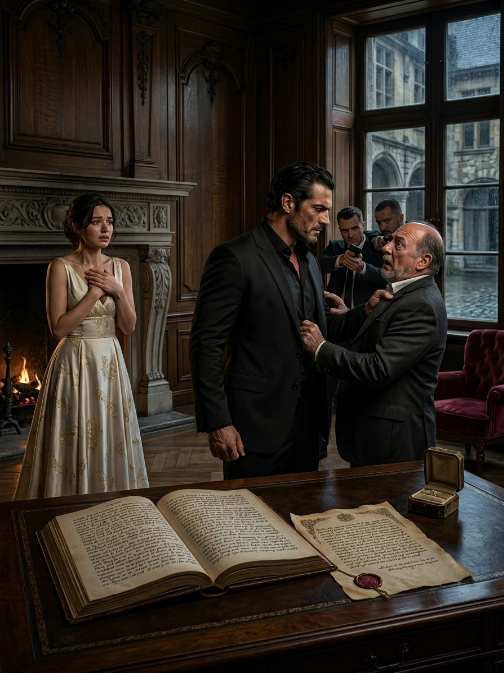
Two days later, security spotted Derek near the estate’s east perimeter. Roman’s entire demeanor changed in the space of a heartbeat — the man beside the pool disappeared, replaced instantly by the man an entire restaurant had learned to fear.
“Lock the house down. Nora stays in the blue suite with Mrs. Alvarez and two guards outside. Bring Derek to me. Alive.”
“Alive?” Maya asked, cold moving through her.
“I made you a promise about boundaries.” His eyes met hers. “I keep the ones that matter.”
She sat in his office for thirty unbearable minutes, calling the suite twice, hearing Nora’s small voice tell her they were playing “quiet castle” with Mrs. Alvarez. When the office door opened again, two guards brought Derek in — thinner than she remembered, haggard, feverish-eyed, hands bound, jaw already bruised. Two years of running from every consequence had worn him down to something hollow.
“Emma,” he spat — then caught himself. “Maya. Still hiding behind other people.”
Roman moved so fast she gasped, gripping Derek’s throat just short of choking him. “You’ll speak to her with respect,” he said softly, “or you won’t speak at all.”
He released him. Derek coughed, red-faced.
“No,” Maya said. “Let him talk. I want to hear him lie.”
Roman stepped back — not far, but back.
“You came to my building while Nora could have been there,” she said.
“I need the jewelry.”
“You mean my grandmother’s jewelry.”
“It was supposed to be mine, too.”
“You stole from your daughter and vanished.”
“I was desperate.”
“You were selfish.”
He flinched. Good.
“The Kesslers are going to kill me,” Derek said, voice cracking. “I told them it was worth fifty thousand. Your mother —”
“My mother said those pieces were all she had left. She never once said they were worth money.”
Roman had the box brought in and opened it himself, lifting one ring to the light. “Glass stone. Gold plated. Sentimental value only.” He picked up the locket next. “Perhaps a few hundred dollars from a vintage dealer. I had them appraised yesterday. Total market value, around two thousand. Not nearly enough to cover your debt.”
Derek’s face went the color of ash. “No. They have to be worth something.”
Maya looked at the man she had once believed she’d marry and, for the first time, saw exactly what he was — not Nora’s absent father, not a broken heart, just a weak man standing in the wreckage of every choice he’d made.
“Seventy thousand, plus interest,” Derek whispered, when Roman asked the number again.
“Borrowed from the Kesslers on collateral that didn’t exist.” Roman’s voice went flat. “They operate under my territory. Indirectly.”
Hope flared, pathetic and immediate, in Derek’s eyes. “You could pay them off.”
“No.” A short, humorless laugh. “But I can offer a choice. One — I tell the Kesslers exactly how you tried to defraud them, and let them handle it their way. Two — you disappear. New identity, new city, monitored funds to survive on if you behave, and you never contact Maya or Nora again. In exchange, I settle the debt as a business matter.”
Derek looked between them. “You’re buying me out of their lives.”
“I’m removing a threat.”
He turned to Maya, something almost like an accusation in his face. “Is this what you want? Do you even know what he is?”
“I know what you are,” she said.
The words landed harder than anything Roman had done to him all evening.
“I’m sorry,” Derek said finally.
“For which part? For leaving? For stealing from a two-year-old?”
“For everything.”
She felt nothing that resembled forgiveness. Only an old grief, finally allowed to unclench. “Nora thinks her father is dead. That will stay simpler than the truth until she’s old enough to survive it. Take the deal. It’s better than you deserve.”
He nodded, and within minutes he was gone, escorted out — a broken man walking not toward justice, exactly, but toward consequence.
When the door closed, Maya carried the jewelry box to the window and held it with both hands. “My mother kept these through eviction notices. Through winters with no heat. I used to wonder why she never sold them.”
“Because not everything valuable can be priced,” Roman said.
She looked at him — for once not a man calculating ownership, but a man visibly trying to learn the language of people who survived without power. “What happens now?”
“Derek leaves tonight. The debt is settled. Your building gets new security, funded quietly. Your neighbors are compensated through channels that won’t expose you.”
“You’d already planned all of it.”
“Yes.”
“And us?”
“That’s yours to define.”
“You want more.”
“Yes.”
“You say that without any shame.”
“Wanting you isn’t shameful. Pressuring you would be.”
The distinction mattered more than she wanted it to.
—
Months folded into each other. Maya learned the rhythms of the Cross household — less romance novel, more logistics war: staff schedules, supply chains, a calendar coded in language she slowly learned to translate. She was good at it, better than the six-figure managers Roman had hired before her, because raising a daughter alone and running a hospital floor had trained her in exactly the kind of triage this house needed.
Nora thrived first, the way children always do, because they carry fewer theories about safety than adults. She loved the pool, the library, Mrs. Alvarez’s animal-shaped pancakes, the guard who let her push the garage door button. She loved Roman most of all, who never rushed toward her affection, never demanded it, and once sat through an entire pretend tea party wearing a paper crown because castles, apparently, required proper manners.
Maya found them like that one Saturday — the most feared man in the city folded into a child-sized chair, holding a plastic teacup between two fingers while Nora explained that Mr. Rabbit had committed a serious crime by stealing cookies.
“What’s the sentence?” Roman asked, solemn as a judge.
“An apology and one nap.”
“Merciful.”
Maya laughed from the doorway, and the look on Roman’s face when he heard it wasn’t triumph. It was wonder — like he hadn’t expected to be allowed anywhere near a sound like that.
He kept his word about boundaries. Mostly. When he replaced her old Honda with a new SUV without asking, she left the keys on his desk without a word.
“It’s safer,” he said.
“It’s also only mine if I choose it.”
“It’s practical.”
“It’s control in a nicer paint job.”
He stared at her, then exhaled. “You’re infuriating.”
“Yes.”
Three days later she picked her own car and paid a symbolic amount from her own salary, letting him cover the rest as an employment benefit written cleanly into her contract. Ridiculous, maybe. But dignity often survives in the technicalities.
She started nursing school online. He rearranged her schedule around it, but only after asking first. At night, once Nora slept, they met in the library — no staff, no guards, no business calls unless the world was on fire — and talked about her mother, his childhood, power, fear, the difference between being protected and being managed.
“You scared me, in the beginning,” she told him one night.
“I know.”
“Not because of what you are. Because you made my choices start disappearing.”
His jaw tightened. “That was never the intention.”
“Intentions don’t undo impact.”
“You’re right.” He said that more easily now — not effortlessly, but sincerely. “I learned power from men who only understood control. By the time I met you, I’d forgotten there was another language.”
“And now?”
“Now I’m trying to become fluent.”
She shouldn’t have found that as attractive as she did.
The first kiss came six months after that first birthday dinner — not in a hallway, not under threat, but in the kitchen at midnight after Nora’s fifth birthday party, balloons sagging from the ceiling, frosting dried on Maya’s sleeve. Roman stood by the counter holding a plate of cake Nora had insisted he save for later.
“She had a good day,” he said.
“The best.”
“You gave her that.”
“We did.” The word slipped out before she noticed it. *We.*
He set the plate down. “Maya.”
“I know,” she said.
“You can tell me no.”
“I know.”
“You can walk away.”
She stepped closer instead. “I know.”
Then she kissed him — softly, carefully, a woman testing whether wanting something could exist without owing anyone for it. He didn’t grab. He stood still until her hands found his chest on their own, and only then did his arms close around her, gentle, reverent enough to ache.
“I’ve wanted that since the restaurant,” he whispered against her forehead.
“I know. You waited.”
“Yes.”
Nothing became simple after that — there were still guards, still shadows, still calls at strange hours that he didn’t explain and she didn’t ask him to. But he began changing what he could. He folded more of his business into legitimate structures, walked away from contracts he’d once have signed without a second thought, quietly funded a program for hospital families buried under medical debt after Maya told him about a patient who’d delayed treatment because rent came first.
“Don’t put my name on it,” he said.
“Afraid of good publicity?”
“Afraid of turning charity into a reputation strategy.”
“You’re learning,” she said, smiling.
“I have a strict teacher.”
“She sounds impossible.”
“She is.”
—
One year after the night he’d first sent wine to her table, Roman took Maya back to The Ledger. She wore deep green this time, chosen entirely by herself, the little scratched unicorn charm still hanging from her purse. When they walked in, the room shifted exactly as it had before — whispers, recognition, the low hum of fear — but this time Maya didn’t look down.
The same server appeared at their table. “Good evening, Ms. Bennett.”
“Good evening.”
She ordered the salmon. Roman ordered wine, and this time he looked at her first. “May I?”
“You may.”
He poured it himself. She lifted her glass. “To birthdays alone that never should have been lonely.”
“To women who deserved better long before anyone noticed,” he said.
“You know what I thought, that first night?”
“What?”
“That you looked like trouble with excellent tailoring.”
“You weren’t wrong.”
“No,” she said. “I wasn’t.”
Nora was asleep by the time they got home, one hand curled around her rabbit, a new drawing taped over her bed — three stick figures holding hands under a yellow sun. *Mommy. Nora. Roman.*
Roman came up behind Maya in the doorway. “Does it bother you? That she drew me in?”
Maya thought of Derek. Of roses that had once felt like surveillance. Of a contract written on notebook paper and honored anyway. Of how love, if this was love, hadn’t arrived through grand declarations but through boundaries kept, over and over, even when keeping them cost him something.
“No,” she said. “It doesn’t bother me at all.”
His hand found hers. He didn’t squeeze until she squeezed first.
That was how she knew.
People who heard the story later liked to tell it simply — a broke single mother went to dinner alone and got swept off her feet by a dangerous, beautiful man. That was never the truth. The truth was that Maya Bennett was cornered by danger, watched by a powerful stranger, and offered protection wrapped tightly in control — and she did not become safe because Roman Cross decided to notice her. She became safe because she refused to let noticing become owning. Because she said no when no needed saying. Because she made the most feared man in the city understand that protection without consent is only another name for a threat.
Roman never became a good man overnight. Men built the way he’d been built rarely become clean all at once. But in the places that mattered most, he became better — he learned to ask before he acted, to wait instead of assume, to correct himself out loud instead of pretending the correction wasn’t needed. He learned that Nora wasn’t something to be won, only a child to be gentle around. He learned that Maya wasn’t a lonely woman waiting to be rescued, but a tired one who had carried far too much alone, and who still deserved the final say over how help walked into her life.
Derek had left her with debt.
Roman had offered security.
But Maya had given herself something stronger than either — a voice, a set of terms, a line nobody crossed twice, and a life where love was never allowed through the door unless her freedom walked in ahead of it.
Years later, when Nora finally asked how her mother had met Roman, Maya gave her the softer version first. “I went to dinner alone on my birthday. And someone noticed.”
“Was it romantic?” Nora asked, older now, sharper, still secretly fond of rabbits though she’d deny it in public.
“Not at first.”
“What was it, then?”
Maya thought about it carefully. “It was a warning.”
“That sounds bad.”
“Warnings can be useful. They tell you to pay attention.”
“Did you?”
“Eventually,” Maya said. “Yes.”
She didn’t tell her every dark detail — not the Kesslers, not the debt, not the particular flavor of fear that came from realizing your own child could become leverage in someone else’s bad decisions. She told her what actually mattered: that danger sometimes wears beautiful clothes. That gifts aren’t always kindness. That real protection never asks you to go quiet. That love worth keeping never needs you to become smaller so someone else can feel large.
On Maya’s thirty-second birthday, Roman booked The Ledger again — not privately this time, not as a display, just one table by the window, Nora seated between them in a sparkly dress informing the server that birthdays should always come with cake, even when grown-ups pretended to be too full for it.
The server laughed. Roman ordered the cake.
Later, driving home through streets gone soft with reflected light, Nora asleep against her side, Roman glanced across the quiet back seat.
“Happy birthday, Maya.”
“Thank you for asking before you ordered the cake.”
“I’m very advanced now.”
“Moderately,” she said, and he laughed, low and unguarded, in a way that the man from that first terrifying dinner would never have allowed himself.
Maya looked down at her sleeping daughter. Then at the man beside her — the one who had once looked across a crowded restaurant and decided her loneliness was somehow his business to solve. The one who had learned, slowly, imperfectly, one written rule at a time, that a woman’s life could never be acquired like property.
Not her rescuer.
Not her owner.
Just the man who had finally learned how not to turn love into a cage.
The first night, his card had felt like a threat folded into heavy black paper.
Now it sat framed on her office shelf, beside her nursing certificate and a photograph of Nora missing both front teeth — not proof that he had ever claimed her, but proof of the night everything, slowly, had begun to change.
THE END