THE WHOLE TOWN LEFT HER PEW EMPTY FOR 3 YEARS — THEN A STRANGER SAT DOWN AND SAID “SAVE ME A SEAT”

*Part 1*
Nobody had sat beside Clara Whitmore in three years.
It wasn’t written anywhere. There was no rule posted on the church door of Willow Creek, Montana Territory. It didn’t need to be. Small towns build walls the way rivers carve canyons — slowly, through the patient accumulation of whispers, until the whispers become the truth, and the truth becomes something nobody even remembers building.
The wall around Clara went up in the spring of 1881, the night her fiancé, a cattle broker named Thomas Aldridge, vanished from town three weeks before their wedding — leaving behind an empty bank safe, two witnesses who swore they’d seen Clara speaking privately with him hours before the robbery, and a town that found it very convenient to have someone left to blame.
The marshal found no evidence against her. But in Willow Creek, the law’s opinion and the town’s opinion were two very different animals, and the town’s had longer teeth.
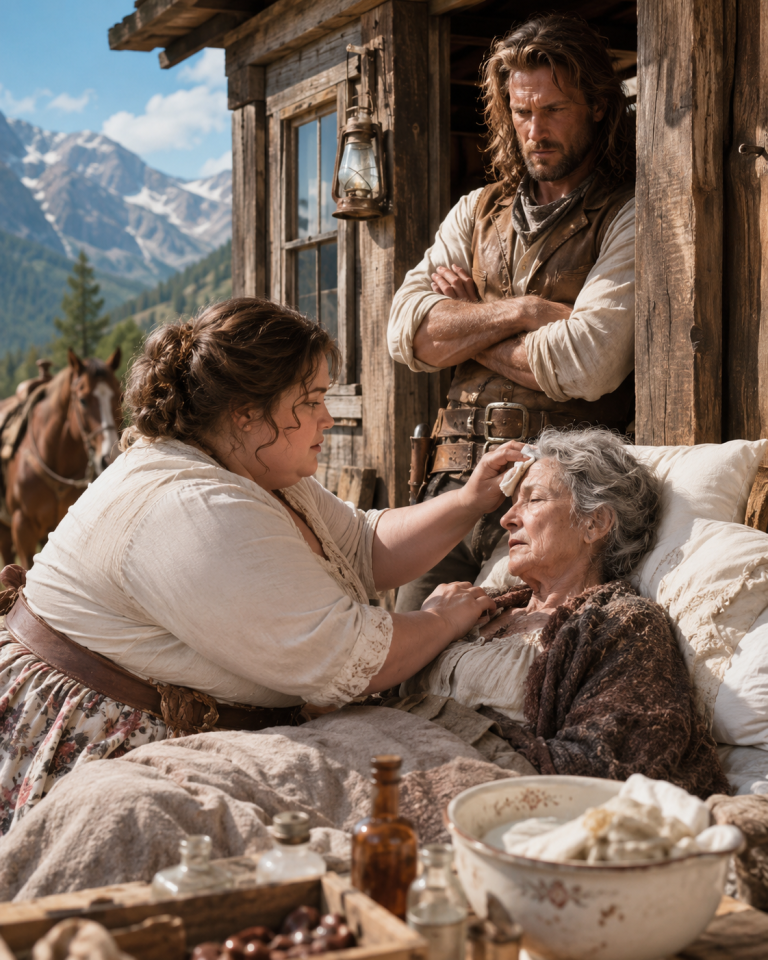
So Clara rebuilt what she could. She cared for her ailing mother, Edna. She took in sewing. She sold eggs from her small flock. And every Sunday, she walked the half mile to church early enough that the pews were still empty, and sat in the third pew from the back, left side — far enough from the whispers, close enough to the door to leave quickly.
This Sunday started the same way. Until the door opened differently.
Heavier boots. Deliberate, unhurried. The low rustle of a coat pushed back. And then the voices around her dropped in a way they didn’t usually drop this early in the morning — the curious kind of silence, the kind a whole room makes when something unexpected walks through the door.
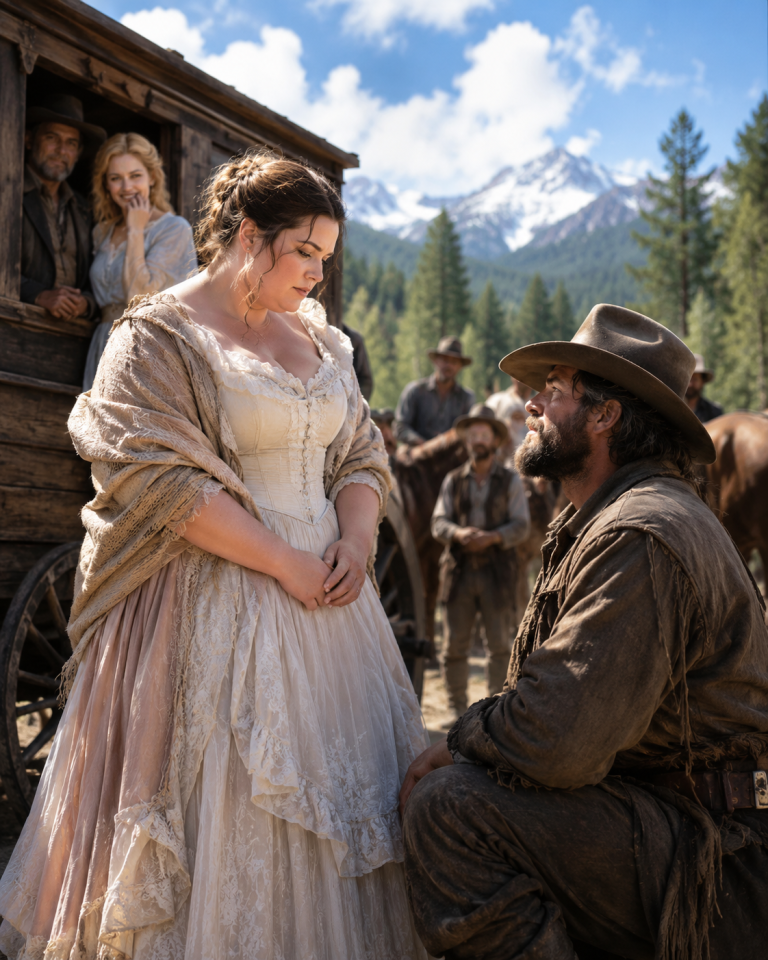
Clara looked up. He was standing in the aisle, four feet away, looking straight at her. Tall, broad through the shoulders, weathered from years outdoors, not quite thirty. His hat was in his hands, held the way a man holds something when he means to show respect but hasn’t been asked to.
He was looking at her like she was simply a woman sitting in a pew on a Sunday morning. Not a scandal. Not a warning. Just a woman.
“Save me a seat.”
Three words, low and easy, like he asked it every Sunday and expected a reasonable answer.
Clara stared at him. She was peripherally aware of the entire congregation doing the same — Mrs. Hartwell stopped mid-sentence two pews ahead; the Danforth brothers, who never missed a chance to whisper something cutting in her direction, had gone silent for the first time in living memory.
“I’m new to Willow Creek,” he said, still unhurried. “Rode in last night. Don’t know anyone, and it seems like you’ve got room.”
There was a beat. Clara moved six inches on the pew.
He sat, settled his hat on his knee, and opened the hymnal that had sat untouched on that pew for three years.
“I’m Luke,” he murmured, low enough that only she could hear it.
“Clara.”
“Nice to meet you, Clara.”
She didn’t say anything else. She wasn’t sure she could have.
Reverend Samuel Grayson took the pulpit the way he always did — silver-haired, certain, the kind of man who collected gratitude the way other men collected land, half the town owing him a favor of one shade or another. Three sentences into his opening scripture, his eyes found the third pew from the back. Something flickered across his face — brief, quickly controlled, something older than surprise — and then it was gone, replaced by his usual Sunday warmth.
Clara told herself she’d imagined it.
By the time the closing prayers were said, she had the peculiar, disorienting sensation of having been treated for ninety minutes like a person who had done nothing wrong. It was more unsettling than the stares had ever been.
She was reaching for her coat when she saw it — the watch chain, caught in the light as his coat fell open at the vest. Silver. Distinctive. A small engraved link at the second clasp.
She had given Thomas that chain. A birthday gift. She’d saved four months to buy it.
“Mr. Callahan,” she said, her voice coming out flat and careful. “Where did you get that watch chain?”
Something behind his eyes went still — not the easy calm he’d worn all morning, but the stillness of a man who had been waiting for exactly this question and had finally arrived at the moment of it.
“That’s a complicated answer,” he said. “I’d like to hear it anyway. Not here.” He glanced briefly at the cluster of congregation members already watching them. “Not in front of people who’ll make it into something it isn’t.”
Clara had spent three years learning to read the faces of people who wanted something from her. This man did not want any of those things. She wasn’t sure what he wanted. But it wasn’t those.
“The road behind the livery,” she said. “There’s a break in the fence. Noon.”
She picked up her Bible and walked out of the church without looking back — not at Mrs. Hartwell, not at the Danforths, not at Reverend Grayson shaking hands at the door with his particular Sunday warmth. She kept walking until she was around the corner and out of sight, then stopped, put one hand flat against the wall, and stood there a full minute with her eyes closed, her heart slamming against her ribs.
—
*Part 2*
At noon, at the break in the fence behind the livery, he was already waiting.
“Start talking,” Clara said.
“I found the watch chain in a trading post in Wyoming,” he said. “Six months ago. The man who sold it to me said he’d gotten it from a traveler moving east — described him well enough that I knew who he’d been.” He paused. “Clara, the man said the traveler was in bad shape. Said he talked about going back for someone. A woman. Said the woman had nothing to do with what happened in Willow Creek.”
“That’s very convenient,” Clara said, her voice still flat, still careful.
“I know how it sounds.”
“Do you? Because what it sounds like is a story someone who wanted my trust would tell me. So I’d like you to tell me why you’re really here. Because a cowboy looking for ranch work doesn’t carry a stolen watch chain into a church and sit down next to the woman everyone blames for the robbery it came from. That’s not a coincidence. That’s a choice.”
The silence stretched.
“You’re right,” he said. “It was a choice.” He held her gaze. “Because I’ve been looking into what happened at the Willow Creek bank in 1881, and everything I’ve found points to the same conclusion — that you had nothing to do with it, and someone in this town has been very careful to make sure you stayed blamed for it.”
Clara felt something happen to her breathing. She controlled it. “Who are you?”
“Luke Callahan. That part’s true. But I’m not here for ranch work. I’m here for the truth about Thomas Aldridge, because I don’t think he ran away. I think he was killed. And I think the man who killed him is still living very comfortably in this town.”
The wind came up cold between them.
“That’s a serious accusation,” Clara said.
“It’s not an accusation yet. It’s a conclusion I’ve been building toward for eight months. To prove it, I need someone who knew this town when it happened. Who knows where the bodies are buried — figuratively speaking.”
Three years of sitting alone in a pew while people whispered past her rose up in Clara’s chest. Three years of carrying a blame she never earned, watching it calcify into something permanent, watching the people who called themselves Christian allow a lie to define her because it was easier than the truth.
“You’re asking me to help you,” she said.
“I’m telling you what I found. What you do with it is up to you.”
That evening, she sat her mother down at the kitchen table. “Mama, tell me everything you remember about the week before the robbery.”
Edna Whitmore looked at her daughter with the particular expression of a woman who’d been waiting three years for someone to finally ask. Thomas had come to the house twice that week, scared in a way that wasn’t ordinary nervousness. He’d asked whether the church kept its financial records separate from the bank, whether Reverend Grayson handled the church money personally. And Edna had seen a man watching from across the road while Thomas was inside — a man she’d recognized in church every Sunday for thirty years.
One of Grayson’s deacons. Roy Sutton.
The same Roy Sutton who had been one of the two witnesses who told the marshal they’d seen Clara with Thomas the night of the robbery.
Clara went straight to Luke that night. She told him everything — Sutton watching, the questions about church accounts. And Luke told her something he’d been holding back, something he was still deciding how to say: his real reason for being in Willow Creek, and a note he’d found folded inside the same trading post transaction as the watch chain. A note in Thomas Aldridge’s own handwriting, its last lines reading: *Tell Clara it wasn’t her fault. Tell her she needs to look at Grayson’s land records from 1880. She’ll know what to do with it.*
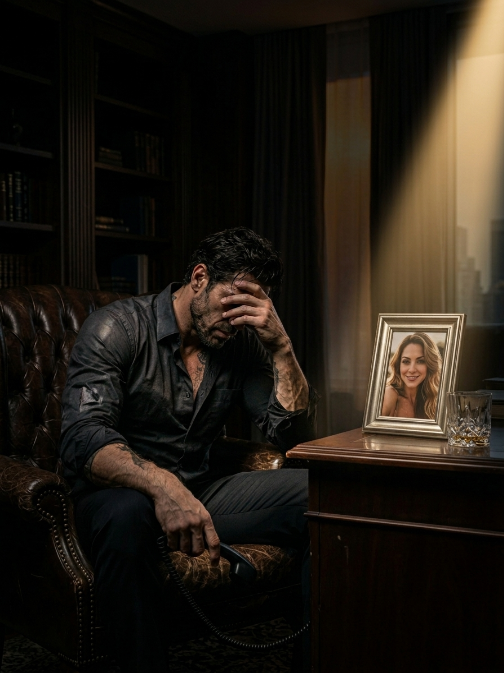
Thomas hadn’t run. He’d been silenced. And the man Luke Callahan really was — the truth about who he’d been in the spring of 1881, and what he’d seen and hadn’t done in a dark alley the night Thomas died — was still sitting face-down on the desk in his rented room, waiting for a moment he wasn’t sure he’d ever find the courage to choose.
—
*Part 3*
The county recorder’s office opened at eight, and Clara Whitmore was there before Harold Briggs had finished his first cup of coffee.
Harold was a small, precise man whose life’s work was the organized preservation of other people’s transactions — and one of the few people in Willow Creek who had never once treated Clara with anything other than professional indifference, which in the economy of the past three years counted as extraordinary kindness.
“Land records,” Clara said carefully, once Mrs. Briggs had gone to the back. “From 1879 through 1882. Specifically any transfers or liens recorded under the name Grayson, Samuel, or any Grayson-affiliated church properties.”
Harold looked at her over the rim of his spectacles a beat longer than the question strictly required. “That’s a specific range.”
“I have specific questions.”
“Give me twenty minutes.”
He came back eighteen minutes later, carrying a record book that looked recently opened. But he carried it not to her — to the shelf directly behind her, where he stood with his back to the room and said, in a very quiet, very even voice, without turning around:
“There are three land parcels in this record that changed hands in 1881. All three were originally held under liens that came due at the same time. All three prior owners lost them within ninety days of the Willow Creek bank robbery. All three were transferred to a holding company. The holding company’s registered agent is listed as one Roy S. Sutton.”
Clara’s hands went very still on the counter. “The church got those parcels.”
“The holding company got those parcels,” Harold said, precisely, still with his back turned. “Whether the holding company and the church share anything in common is not a question a county recorder is in a position to answer.” He put the book back, turned around. “Was there anything else I could help you with today, Miss Whitmore?”
“No,” Clara said. “Thank you, Harold.”
She stood on the wooden sidewalk outside for a full thirty seconds without moving. Three families. Three land parcels. Three foreclosures timed perfectly with a bank robbery that had left the bank’s regular borrowers suddenly in default. And Roy Sutton’s name on the receiving end of all of it — clean as a ledger entry, quiet as a funeral.
The robbery hadn’t been about stealing money. It had been about triggering defaults. The money was cover. The land was the point. And Thomas had figured it out.
—
She was halfway home when footsteps caught up behind her — Margaret Teller, a woman Clara hadn’t spoken to in two years, not since the last attempt had ended with Margaret turning away without a word.
“I need to talk to you,” Margaret said, low and urgent.
“Then talk.”
“Roy Sutton came to my husband last year,” Margaret said, the words pressed flat by nerves. “Told James that if we ever changed our story about what we saw that night, he had evidence James had mishandled funds before we were married. Evidence he’d take to the marshal.” Her voice cracked once, precisely, and she stopped it. “There was no such evidence. James had done nothing wrong. But Roy had people who could manufacture it as well as destroy it. We have two children, Clara. I am so sorry. I have been sorry every day.”
Clara looked at this woman — her closest childhood friend, who had stood up at a town meeting and confirmed a lie, and had carried the guilt of it in silence for three years under threat, and was standing here now shaking because something had shifted.
“What changed?” Clara asked.
“The stranger. Roy Sutton was at our house last night asking if we knew who he was. I have never seen Roy Sutton scared before. I thought — if someone is scaring Roy Sutton, maybe it’s not too late.”
“It might not be,” Clara said carefully. “But I need you to be prepared for what speaking the truth might cost you.”
“I know.”
“Are you prepared for that?”
A pause, shorter than Clara expected. “Yes.”
—
At the horse ranch east of town, Clara told Luke everything — Harold’s records, Roy Sutton’s name, Margaret shaking on a public street with three years of guilt finally overflowing.
“Thomas found it,” Luke said quietly, once she’d finished. “He was going to take it to the marshal.”
“He never got the chance,” Clara said, her voice flat and clear.
She looked at him then — this man who’d ridden into Willow Creek with a dead man’s watch chain and a notebook full of months of careful investigation, at the face-down note on his desk she still hadn’t asked about, at the careful way he measured every word he gave her.
“Tell me what’s on that paper,” she said.
He looked at her a long time. She watched him make the decision — watched it happen in his face, the way a man puts down something heavy he’s been carrying too long because his arms have finally given out.
“It’s a note,” he said. “From Thomas. I found it with the watch chain. I should have told you Sunday. I told myself I was waiting for the right time, but the truth is I was afraid of what it would do to you, and I was wrong to make that choice for you.” He held her gaze. “He wrote it near the end. He thought he was going to die. He asked whoever found it to tell you it wasn’t your fault. He said you’d know what to do with it.”
The world went very quiet. Clara stood still for a long time. When she turned back, her eyes were dry.
“He was right,” she said. “We’re going to need that note. We’re going to need Harold’s records. We’re going to need Margaret. And we’re going to need to move before Roy Sutton figures out how close we are.”
“What haven’t you told me yet?” she asked, seeing something still held behind his eyes.
“My real name,” he said, “is Nathan Hail. Deputy Marshal, federal circuit, based out of Cheyenne. I’ve been working a land fraud case tied to this territory for two years.” He told her about Grayson’s pattern in two other towns, the watch chain, Thomas’s note, eight months of circumstantial evidence not yet strong enough for a court.
“There’s something else,” Clara said, reading the rest of what he wasn’t saying. “About the spring of 1881.”
He held her gaze. “I was in Willow Creek. Not as a marshal — I was twenty-four, riding with a small outfit passing through. I was in the saloon the night Thomas Aldridge was killed.” He said the word plainly. Killed. “I saw two men drag a third out the back door. One was Roy Sutton. The other — I recognize him now. It was Grayson’s son, Daniel.” His jaw tightened. “There were four of them waiting in the alley. I was twenty-four and armed with a knife and an old pistol, and I told myself I needed more information before I did anything. It was exactly what it looked like. I heard enough. And I walked away.”
“You walked away,” Clara said.
“Yes.”
“And Thomas died.”
“Yes.”
She turned her face from him, looked at nothing for a moment. He let her, without filling the silence — which told her something about him.
“You were twenty-four and badly outnumbered,” she said finally, turning back. “You didn’t create the situation, and you didn’t pull any trigger. I’m not going to tell you what you should have done. But I need to understand — is this about justice, or is this about penance?”
“Both,” he said, without dodging it. “I know that’s not a clean answer.”
“No,” she said. “But it’s honest. The reason I can work with you is because I believe you’re telling me the truth. All of it. If I find another piece held back, we’re done. Are we clear?”
“We’re clear.”
“Good,” she said. “Then let’s talk about what we do next.”
—
The plan had three moving parts: documentation tying Grayson directly to the holding company, since Sutton was only the instrument; the financial thread showing where the stolen bank funds had actually gone; and someone inside the church’s records, which Grayson kept locked in his own office, trusting no deacon or treasurer to touch them.
“He hosts a ladies’ fellowship the third Thursday of every month,” Clara said. “His office window faces the back alley. The latch has been broken since 1879 — he’s too careful with church funds to spend money on a carpenter. I know because I fixed it myself with my father, twice, and Grayson never got it properly repaired.”
“Clara, don’t—”
“Don’t give me the speech about danger,” she said. “I’ve been in danger since the spring of 1881. Most of it slow and suffocating, which is worse than the kind that moves quickly.”
Nathan needed backup on the exterior — someone not connected to Grayson. He found Pete Garland, a ranch hand who’d known Thomas, who had, Clara realized with a cold recognition, lost his own land to the same holding company in 1881 and had been working someone else’s ranch beside the man who’d taken everything from him ever since, without knowing it.
Thursday night, while thirty women drank tea in the church hall under Reverend Grayson’s watchful warmth, Nathan worked inside Grayson’s office by low lantern light — church accounts, monthly ledgers, property fund disbursements going back to 1879. He found a thread: a “property maintenance fund” that had received and dispersed, in the eighteen months after the robbery, an amount of money that had no business in a church account. And a name he didn’t recognize — Eliza R. Callaway — listed as receiving party for three transfers, each matching almost exactly the assessed value of the three foreclosed parcels.
Two taps on the window frame — the signal for someone approaching, not the three-tap all-clear. Nathan was out the window in six seconds, pressed flat against the wall beside Pete, holding his breath as footsteps moved down the alley and faded.
“That was Daniel Grayson,” Pete said quietly. “He walks that alley every Thursday. Checks the church is locked. Has for two years.” He paused. “I lost my land to that holding company in 1881. I’ve been trying to figure out who it answered to ever since.”
“Roy Sutton registered it,” Nathan said. “Grayson is the back. And there’s a name inside those records I haven’t placed — Eliza Callaway.”
“Grayson had a sister,” Pete said slowly. “Married name Callaway. Moved east about fifteen years back. Reverend always said they were estranged.”
Grayson had never been estranged from his sister. He’d been laundering money to her through property transfers for years — far enough away to be untouchable, close enough in blood to trust completely.
—
Clara was waiting at the top of the stairs when Nathan got back, having been told to stay home and having declined the suggestion. He told her all of it. She took it in with that particular stillness he’d come to understand wasn’t distance but its opposite.
“His sister,” she said. “Living in St. Louis, untouched.” She was quiet a moment. “What do you need to reach her?”
“A federal warrant. Which requires enough evidence to convince a judge what I have isn’t circumstantial. The land records. Thomas’s note. Margaret’s testimony about witness intimidation. And ideally, one of Grayson’s own people willing to talk.”
“Roy Sutton is scared,” Clara said. “You said it yourself. A scared man who knows he’s the front of an operation under investigation has to decide quickly whether he’d rather be charged alongside Grayson, or alongside the marshal who’s been quietly building a case for eight months.”
“You want me to approach Sutton?”
“I want you to give him a clearer picture than Grayson ever will. See what he does.”
—
Sutton hitched his horse outside the feed store at seven the next morning when Nathan fell into step beside him. “Don’t look around. Don’t change what you’re doing. Just listen.”
He laid it out — the holding company, the timeline, Eliza Callaway, Daniel in the alley in 1881, a buried federal complaint three weeks before Thomas died that pointed to reach inside the marshal’s own circuit.
“Here’s what’s going to happen,” Nathan said. “Evidence goes to a federal judge within the week. When it does, Grayson’s first move is to separate himself from the instrument. You’re the registered name on every paper trail. You’ll stand in front of a court while Grayson sits in his church and mourns a trusted deacon who deceived him.”
Sutton stopped walking. “What do you want?”
“I want Grayson. I want the name inside the circuit. And I want a signed statement of everything you witnessed the night Thomas Aldridge was killed.”
“What happens to me?”
“That depends on the judge. But a cooperative witness is a substantially different position than the man whose name is on every document when the case breaks without him.” Nathan held his gaze. “I’m giving you one opportunity today. You have until noon.”
—
Sutton came out the other side of it by noon, standing at the edge of the creek path with the flat determination of a man who’d burned one bridge and was standing on the remaining ground.
“Grayson gave the order,” he said without preamble. “I was there when he told Daniel and two hired men that Thomas Aldridge had found the account irregularities. He said it needed to be handled before morning. Those are his words. Handled.”
“You were present,” Nathan said. “Did you participate?”
“I arranged for the two hired men. I didn’t go to the alley.” A pause. “That’s the truth.”
“The federal complaint. How did it get buried?”
“Grayson has a brother-in-law. William Marsh. Circuit clerk in Cheyenne. Twelve years.”
Nathan felt something settle into place with the certainty of a key turning in a lock. Eliza Callaway’s husband. The whole operation run through family — Grayson at the center, his sister holding the money in St. Louis, her husband providing federal cover in Cheyenne, Sutton and Daniel as instruments on the ground. Every piece connected by blood or debt or both.
Sutton also warned him: Grayson had a plan for Sunday service. He would take the pulpit first and tell his version — Nathan as an outside agitator, Clara as a woman who’d brought trouble deliberately. By the time service ended, the town would be behind him, and anything Nathan tried to bring forward would look like an attack on the community itself.
“Then we don’t give him Sunday,” Nathan said.
—
He was riding back toward town, running the logistics of reaching a federal judge in Helena within forty-eight hours, when he saw smoke rising behind Clara’s house. The wood pile was burning — soaked, deliberate, too uniform for accident. Clara was already fighting it with a bucket, working with the focused efficiency of a woman who had no time for panic. They fought it side by side for four solid minutes until it was down to smoldering.
“Third time,” Clara said, her face flushed, expression hard rather than afraid. “First the note telling me to leave town. Then Mama’s medicine went missing from the shelf Tuesday — I replaced it the same day, she doesn’t know. Now this.” She turned to face him. “This is Grayson sending a message. It means he’s rattled. It means he’s willing to escalate.”
Nathan told her about Sutton’s statement, about William Marsh in Cheyenne — the sequence now painfully clear. Thomas had found the fraud, tried to report it, and the report had disappeared before it could ever reach anyone who might have protected him. He’d been alone from the start.
They needed a judge who had no ties to the compromised Cheyenne circuit. Judge Abernathy in Helena. Nathan would have to ride through the night to file personally — which left Clara alone for three days.
“I need you to do something while I’m gone,” he said. “Talk to Reverend Grayson. If he’s planning to use Sunday to tell his version first, he needs to believe he still has time. Give him the impression you’re frightened, considering leaving town. Buy us the time we need.”
“You want me to act scared,” Clara said.
“I want you to act like the woman he spent three years believing you are. Not because that woman is who you are — because it’s the most useful performance you could give right now.”
“I know what I’m asking,” he said. “I know what it costs.”
“Do you?” she asked — not with heat, a genuine question, turning it over. Then she exhaled. “Yes. I’ll go to him. I’ll be exactly what he expects.” She looked away, toward the smoldering wood pile. “I hate this. Not the plan. The fact that it works. The fact that I know exactly how to do it, because I’ve been doing a version of it for three years just to survive.” She looked back at him. “Being what people expect so they don’t hurt you worse. I’m very good at it. I hate that I’m very good at it.”
“When this is over,” Nathan said quietly, “you will never have to do it again.”
“Make sure it gets over, then,” she said.
—
That evening he rode to Sutton’s house and took the formal statement, then learned one more name — Cal Britain, the last living witness from the alley, working a mine operation near the state line, a man Sutton believed was ready to talk if approached right.
Nathan left for Helena that night. At Clara’s gate, cold enough that their breath showed between them, there was something he wanted to say that he’d been careful not to say, because the timing had never felt right and there was too much between them still unresolved.
“Clara—”
“Go,” she said, not unkindly. “Come back with the warrant. Everything else can wait.”
He went.
—
Friday morning, Clara dressed carefully — not her dark wool, something softer, easier to read as anxious. She walked to the church. Grayson answered her knock with the smooth, instant warmth of a man who’d been told something was coming and had prepared for it accordingly.
She told him she was frightened. That the stranger’s questions had brought everything back. That she was thinking of taking her mother to Billings for the winter, maybe longer. That she was tired of being associated with trouble and just wanted peace.
She watched the particular satisfaction settle over his face as she spoke — the satisfaction of a man who believed the last obstacle had just announced its own removal. He took her hands, told her a fresh start was exactly what God intended, promised his prayers for her safe travels.
She thanked him. She shook his hand. She walked out into the cold Friday morning with her face composed and her pace steady, all the way around the corner and out of sight — and then her hands began to shake, not from fear, but from the effort of touching that man’s hand while Thomas’s note sat folded inside her coat.
Three houses from home, a voice called her name — Alice Doyle, the banker’s wife, who’d never spoken directly to Clara in three years.
“My husband did not want to foreclose on the Garland property in 1881,” Alice said, low and precise. “He was pressured by the church. He’s been uncomfortable ever since. If someone were looking for a bank officer willing to speak to certain irregularities from that period, my husband would not be opposed to a private conversation.”
The walls of Grayson’s world were cracking from every direction now — Sutton, Margaret, Pete Garland, and now the bank itself.
“Tell your husband,” Clara said, “to be available Saturday afternoon.”
—
Nathan rode back into Willow Creek Saturday morning, mud on his coat, exhaustion in every line of his face, a federal warrant signed by Judge Abernathy folded flat inside his vest alongside Sutton’s statement and a second sworn affidavit from Cal Britain — who had taken exactly forty minutes to decide that five years of Grayson’s quiet threat was a lighter burden than what Nathan laid in front of him.
There was one more piece, delivered by wire from a federal investigator in St. Louis: Eliza Callaway’s accounts had been frozen, and she had given a voluntary statement — she’d believed the money came from legitimate church fundraising, and had cooperated fully once shown its true source. William Marsh, the circuit clerk in Cheyenne, was suspended pending investigation as of Friday afternoon.
“It’s done, Clara,” Nathan said. “The architecture of it is down. Tomorrow it becomes public.”
She read Thomas’s note at last, for the first time since he’d told her about it, and he watched her face while she did — the controlled steadiness of her, and then the brief, precise moment when something moved underneath it. Grief and release and a terrible tenderness for a man who’d spent two of his six final lines making sure she knew it wasn’t her fault.
“Thank you for bringing it back to me,” she said, folding it carefully.
“It always belonged to you,” Nathan said.
“Whatever happens in that church tomorrow,” he told her, “I will be standing right beside you. Not because you need me to be — you’ve made it very clear you can stand on your own. But because I should have been standing beside you five years ago in that alley, when there was still time to make a different choice. I can’t give that back. But I can give you tomorrow.”
“You’ve been giving me more than tomorrow,” Clara said quietly. “Since Sunday morning.”
—
Sunday came cold and clear. Two deputy marshals arrived from Helena at nine and positioned themselves without needing explanation. At 9:45, Pete Garland took a seat in the middle of the congregation. At 9:50, Roy Sutton walked in and took his usual front-row seat, the face of a man who had made his decision and was living inside it.
Reverend Grayson took the pulpit at ten, silver-haired and certain, and after his opening scripture cleared his throat.
“There is a man in our midst,” he began, “who has been spreading falsehoods about the history of this community, using a troubled woman’s grief and isolation to—”
The church doors opened. Nathan walked in, two deputy marshals a step behind him, down the center aisle in the sudden, total silence of a congregation that had no category for what was walking through their door.
“Reverend Grayson,” Nathan said, his voice carrying without effort to every corner of the room. “I am Deputy Marshal Nathan Hail, federal circuit, operating under warrant issued by Judge Abernathy of the Helena Court. I am here to place you under arrest on charges of fraud, conspiracy, land theft, coercion of federal witnesses, and complicity in the murder of Thomas Aldridge in May of 1881.”
The room erupted. Grayson raised one hand, and the room went quiet for him — the particular power he’d built over thirty years — and Nathan had counted on exactly that, because what came next needed to be heard clearly.
“This man is an outsider,” Grayson began, his voice shaking with controlled outrage. “He came to this town with an agenda, using a troubled woman who has always—”
“The agenda is this,” Nathan said, and placed Thomas’s note on the front pew railing where the congregation could see it. “A note written by Thomas Aldridge before he died, identifying Samuel Grayson’s land fraud scheme. Corroborated by the signed statement of Roy Sutton, who was present when Reverend Grayson ordered Thomas’s death.” He set the statement beside it. “And by the sworn affidavit of Calvin Britain, who was in that alley the night it happened, and has identified Daniel Grayson as one of the men present.”
Daniel Grayson made a sound. Nathan kept going — the land records on file with Harold Briggs, three fraudulent seizures, the holding company registered in Sutton’s name, the account held by Eliza Callaway in St. Louis, now frozen under federal order.
The congregation was no longer making noise. They were sitting in the particular silence of people being handed something they cannot return.
“This is fabricated,” Grayson said, still confident, still certain of his room.
“The records are real, Reverend,” Harold Briggs said, rising from a middle pew. “I have them. I’ve had them since 1881. I can account for every transaction on record.”
“And I have something else,” said Lawrence Doyle, standing at the back, his voice unsteady but loud. “The bank was pressured to accelerate the Garland foreclosure. I have the correspondence. It came from your desk, Reverend. I kept copies. I have been sitting on them for five years, and I am done sitting.”
“He framed her,” Margaret Teller said, standing in the fifth pew, voice shaking, eyes dry. “He arranged the witnesses. I was one of them. I was coerced by Roy Sutton on Samuel Grayson’s instruction. I am saying so now, in front of everyone, because I should have said so three years ago and I did not.” She turned and looked directly at Clara. “I am sorry, Clara. I am so sorry.”
Clara looked back at her and said nothing — the truth in her own face offering neither forgiveness nor condemnation, only the hard-edged acknowledgment of one woman to another: *I know what it cost you to stay silent, and I know what it cost you to speak, and I see you.*
Daniel Grayson made a break for the side door and was caught in four seconds by the waiting deputy. Samuel Grayson did not run. He stood at his pulpit and looked at his congregation, and understood, in whatever passed for understanding in a man like him, that the room he’d built over thirty years was standing inside its own ruins. He bowed his head. Said nothing. Nathan walked him out.
—
The silence that followed was not the silence of a room looking away — it was the silence of a room that no longer knew where to look, because looking at Clara Whitmore now required looking at itself, and what it saw was a community that had chosen comfort over truth for three years and called it righteousness.
Pete Garland walked from the middle of the congregation to the third pew from the back and sat down on Clara’s left. Lawrence Doyle sat on her right. Harold Briggs turned in his seat to look at her once, briefly, with the relief of a man who had waited a long time for the room to catch up with the truth. One by one, in the uncertain, halting way of people doing something they should have done years ago, the congregation rearranged itself around the woman who had sat alone in that pew for three years.
Nathan sat down beside her. He didn’t say anything at first. He simply sat, hat on his knee, the way he had that first Sunday.
“The warrant went through,” she said. “Completely.”
“It’s done,” he said. “Thomas’s name will be cleared. On record. It won’t bring him back.”
“No,” she said. “But it gives him back his truth. He tried to do the right thing, and it killed him. He deserves to be remembered correctly.”
“He does.”
“What happens to you?” she asked. “When this closes?”
“I’ll have to file the final reports. Testify. It’ll take months to work through the court.” He paused. “I’d be based somewhere in the territory.”
“Somewhere in the territory,” Clara said. “Ideally somewhere with a decent livery and a county recorder who keeps good files.”
Something moved in her face — not quite a smile, the thing that lives one layer beneath a smile, in the place where a woman keeps what she’s not ready to say aloud but has stopped pretending she doesn’t feel.
“That description applies to Willow Creek,” she said.
“It does.”
—
The church bells rang at eleven, the way they rang every Sunday, carrying out over the valley and the frost-covered hills of Montana Territory the same as they always had. Only now the woman who had sat alone beneath those bells for three years was sitting with her hand in Nathan Hail’s, her chin level, her name clean — and the pew that had been left empty by every coward and every small cruelty and every comfortable lie Willow Creek had ever told itself was full.
Nobody whispered. Not one person.
Thomas Aldridge had written six lines in fear and darkness, and spent two of them making sure Clara Whitmore knew she was not to blame. Three years later, in the church where his killer had preached righteousness every Sunday morning, the truth he had died trying to tell finally stood in the light where it had always belonged.
Where it could finally do what truth is supposed to do, once you stop being afraid of it.
It set her free.
THE END