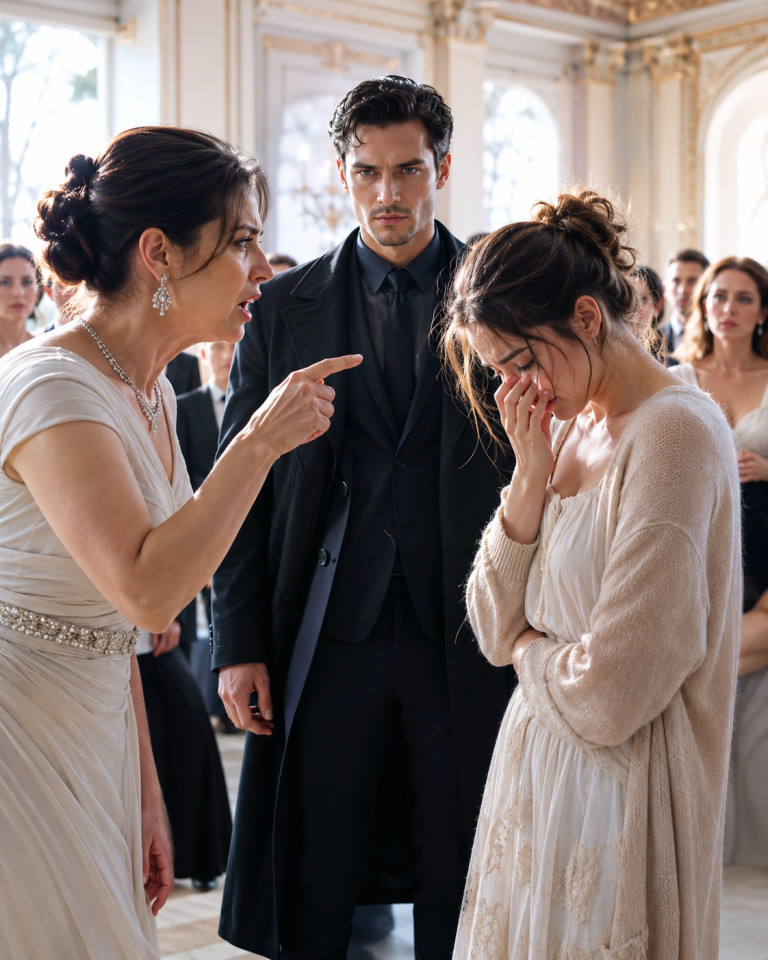
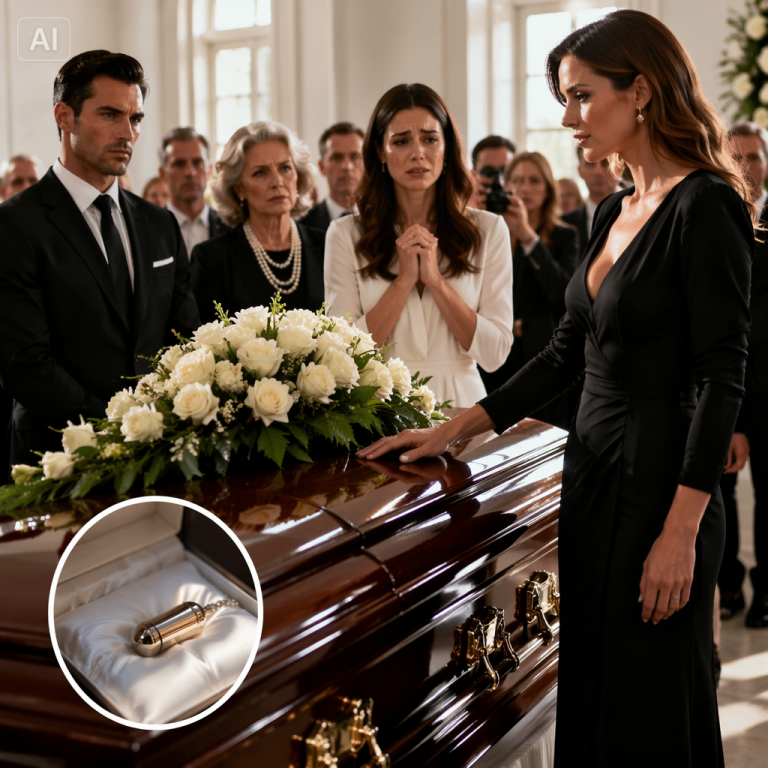
He Ignored His Wife’s ER Call—By Sunrise, the Mafia Boss Had Lost Everything That Mattered

## PART 1
The first time Raffaele Sarto understood that his wife had been dying inside his house, he was reading her letter.
Not when she fainted in a pharmacy on Lexington and was taken to Memorial Hospital by a stranger who called the number in her wallet. Not when the attending physician tried three times to reach him and each time went to voicemail. Not when the nurse sent a message through the hospital’s patient portal that sat unread on his phone for six hours because he had been at dinner with Celestine Blanc, explaining quarterly projections over steak tartare while the woman he had married was alone under a thin hospital blanket counting the rings she could not get him to answer.
He was in none of those places when he understood.
He was in the bedroom.
Standing in front of an open closet.
Looking at the empty space where her life had been twelve hours before.
The blue coat was gone. The small cedar box from her mother. The particular perfume she wore only in winter that he had stopped noticing three years ago and now suddenly, with the violence of complete absence, could smell everywhere. Her side of the bathroom, visible through the open door, had been cleared with the thoroughness of someone who had not made this decision tonight but had been making it, quietly, for a very long time.
On the bed was an envelope.
Her wedding ring sat beside it.
Raffaele stood with the ring in his palm for a full minute before he touched the letter.
It was not long.
It was not angry.
That was the worst part.
—
*Raffaele,*
*You are very good at making rooms quiet.*
*For three years I have eaten meals beside you without being spoken to. I have attended events where I existed only in photographs. I have learned to stop asking questions about your schedule, your work, your intentions, and eventually about anything at all, because the lesson arrived so consistently that it finally took.*
*I called you tonight from a hospital bed. You let me reach voicemail twice. The third time you answered and told me you were unavailable.*
*I understand. You were always unavailable. That was the arrangement, I think, though no one explained it to me when I agreed to it.*
*I am leaving. Not in anger. In clarity.*
*This is not a conversation. It is a conclusion.*
*Do not look for me through your men. Do not send flowers or lawyers. The only thing I want from the Sarto name is the distance from it.*
*—Isabeau*
—
Raffaele set the letter down.
He did not move for almost thirty seconds.
Around him the penthouse was exactly as it had been every other night: polished stone, clean lines, the abstract art Celestine had suggested because it photographed better, the white sofa Isabeau had asked to replace twice and which remained because he had not gotten around to responding.
He had not gotten around to responding.
He called his security chief. “Where is my wife?”
The pause that followed told him everything he needed to know about how the evening was about to proceed.
“Mr. Sarto. We didn’t — we weren’t aware Mrs. Sarto had—”
“Hospital. Memorial. Seventy-Third Street. Pull the cameras from the discharge exit. What car did she take? Who was with her?”
“Give me four minutes.”
Raffaele walked to the kitchen and placed both hands flat on the island.
On the marble, face-up, was his phone.
Six missed calls. Four from the hospital. Two from a number he did not recognize.
And two from Isabeau.
He had been at the table with Celestine when the first one arrived.
She had looked at the screen, at Isabeau’s name, and said: “She always calls at the worst times.”
He had turned it over.
He looked at the phone now with the specific feeling of a man understanding that the thing he has been walking toward has already arrived.
His security chief called back.
“She left on foot. Refused a cab from the hospital. We have her on cameras at the Sixty-Sixth Street subway entrance.”
“Subway.”
“Yes, sir.”
Raffaele’s jaw tightened.
His wife. Who had not taken the subway alone in three years because he had told her it wasn’t suitable. Who had spent three years being driven everywhere in cars that answered to him. Who had, apparently, remembered how to use public transit in the forty minutes between leaving her hospital room and boarding a train he could not intercept.
“Card activity?”
“She paid cash for the fare.”
Cash. She had no cash. She had an allowance disbursed weekly to a joint account he monitored.
Which meant she had been preparing this.
Not tonight.
For some time.
“Who taught her to disappear like this?” Raffaele said, though he was not really asking his security chief.
The answer came from his phone.
Not a call. A message. Unknown number.
A photograph: Isabeau in a corner booth of somewhere warm, wrapped in a coat he had never seen, holding a mug with both hands. Across from her sat an older woman with silver hair and the kind of face that had seen a great deal and judged very little of it.
Below the photograph: *She is somewhere safe. Whether she stays that way depends on you.*
A second message arrived four seconds later.
*Check your offshore accounts. All of them. Start with Geneva.*
Raffaele stared at the screen.
His security chief was still speaking.
He ended the call.
Opened the banking application.
The Geneva account had been flagged for compliance review at 11:14 p.m.
The Cayman holding was frozen.
Three additional lines of credit had been suspended pending investigation.
Raffaele set the phone on the island beside the letter.
He stood very still.
Outside, Manhattan went on doing what Manhattan always did — indifferent, luminous, vast. Below the windows, yellow taxis moved like slow comets through wet streets. A siren rose and faded somewhere north.
He had built thirty floors of this city’s skyline.
He had thirty-two men on his direct payroll, fourteen properties, nine shell entities, six bank relationships, and one wife who had apparently spent an unknown amount of time constructing the precise mechanism for dismantling all of it.
Celestine arrived at midnight.
He let her in because he wanted to watch her face.
“I came as soon as I heard,” she said, stepping into the foyer with her coat still on, her expression arranged into the particular configuration of someone offering both comfort and competence.
“She’ll come back,” Celestine continued, walking toward him. “You know how she is. She gets overwhelmed.”
“Isabeau?”
“Yes.”
“Tell me something.” He kept his voice flat. “When she called from the hospital tonight. The first time.”
Celestine paused.
“You said she always calls at the worst times.”
“I only meant—”
“You meant something specific. What?”
Celestine’s expression recalibrated. Not into distress. Into something more careful.
And for the first time since she had appeared in his professional life three years ago — smart, tireless, present in ways his wife had stopped being or perhaps had never been allowed to be — Raffaele noticed what his wife must have noticed long ago.
Celestine never looked surprised.
She looked *prepared.*
“How long,” he said, “have you been managing the story about Isabeau?”
The room went quiet.
Outside, rain began.
Celestine’s mouth opened, and then his phone lit up on the island between them, and they both looked at it.
On the screen was a name: *ELENA SARTO.*
His mother.
Calling at 12:04 in the morning.
Raffaele picked up.
His mother did not say hello.
She said: “Raffaele. I need to tell you something about the girl you married. Something I should have told you the day your father arranged the match.”
—
## PART 2
He put her on speaker.
Not to include Celestine. To watch her.
His mother’s voice filled the kitchen.
“Your father did not choose Isabeau because she was suitable,” Elena said. Her voice had the quality of someone reading from a document long committed to memory. “He chose her because of who her mother is.”
“Her mother died when she was an infant,” Raffaele said. “That was in the file.”
“Her mother is not dead.”
Celestine’s chest rose in a short breath.
Raffaele watched it.
“Her mother,” Elena continued, “is Miriam Conte.”
The name arrived the way certain names did — not unknown, but displaced, belonging to a category he had not expected to find in this conversation. Miriam Conte had been his father’s financial architect for fifteen years. A precise, solitary woman who had managed more of the Sarto organization’s actual structure than anyone except his father knew. She had disappeared twelve years ago, the same week federal investigators had begun circling three Sarto business addresses.
His father had told him she defected. That she had run to protect herself, taking documents that, if released, would have been damaging.
He had told Raffaele never to speak her name.
“Your father found her eight years later,” Elena said. “He found her and her daughter. He could not kill them — Miriam had arranged for the documents to be released automatically upon her death. So he made an arrangement.”
Raffaele said nothing.
“He offered Miriam’s daughter protection. Safety. The name Sarto as a shield that no federal investigation or rival family could penetrate.” A pause. “In exchange for the documents being sealed. And for her daughter becoming your wife.”
The kitchen was completely silent.
“Isabeau doesn’t know,” Elena said. “She never knew. She thought she was marrying a man. She didn’t know she was being used as collateral.”
Raffaele turned to look at Celestine.
Celestine’s face had done something interesting. The careful arrangement had slipped, just slightly, and beneath it was something that was not grief and was not fear.
It was the expression of someone whose timing had been disrupted.
“You knew,” Raffaele said to her. “My father told you.”
Celestine straightened. “Raffaele—”
“He brought you in to manage it. To manage her. To keep the arrangement running after he died.” He moved toward her. “What did she start to figure out?”
“She asked about the foundation accounts,” Celestine said, and her voice had dropped the softness entirely. “She noticed the routing. She asked me directly, and I deflected, and then she stopped asking. I thought she’d given up.”
“But she hadn’t.”
“No.”
On the phone, his mother said quietly: “She went to Miriam.”
Raffaele stopped.
“Her mother is alive,” Elena said. “And Isabeau has been in contact with her for the last four months.”
On the island, Raffaele’s secondary phone lit up.
The message was from the unknown number again.
One line:
*Come to the Ardmore building on Riverside. Come alone. Bring nothing except whatever remains of your father’s son.*
Raffaele looked at Celestine.
“I’m going to need you to stay here,” he said.
She reached for her coat. “You can’t go alone—”
“I am not asking.”
He put two fingers on the edge of her coat sleeve and applied the particular kind of pressure that in his world was not a physical action but a complete sentence.
She stopped.
He walked out.
Behind him, he heard Celestine make a call.
He did not stop to listen, because he did not need to.
His mother’s voice was still coming through the kitchen speaker, saying something he could no longer hear.
And somewhere ahead of him, his wife was waiting in a building on Riverside Drive with the woman who had spent twelve years protecting her from a truth that had been arranging itself around her since before she was old enough to refuse it.
—
## PART 3
The Ardmore was a residential building that had stopped being residential sometime in the 1990s and had since occupied the particular urban category of *not yet anything else* — intact but empty, its lobby accessible through a service door on the ground level that someone had ensured was unlocked.
Raffaele entered at 1:17 a.m.
The interior smelled of dust and old plaster and something he could not name that might have been age or might have been the way abandoned spaces smelled when they had been witnesses to a great deal and had no way of releasing it.
A light was on in the third-floor room at the end of the corridor.
He took the stairs.
The door was open.
The room held a folding table, four chairs, and two people: one he had spent three years living beside without knowing, and one he had been told was gone.
Miriam Conte was smaller than her file had suggested. Compact. Still. She had silver hair and eyes that catalogued him with the practiced efficiency of someone who had spent years reading financial documents and understood that everything left a pattern.
Isabeau stood near the window.
She was wearing the unfamiliar coat from the photograph — dark wool, too large, something borrowed. Her face was pale, but the quality of her stillness was different from the stillness he had been watching across dinner tables for three years. That stillness had been held. This one was chosen.
She did not move toward him.
Neither did he, immediately.
He thought about everything he had understood in the kitchen in the thirty seconds between his mother’s revelation and Celestine’s careful expression.
Then he said, “You knew.”
Isabeau looked at him. “That I was collateral for your father’s peace of mind? No. Not for most of it.”
“When did you find out?”
“Four months ago. I found a file in your father’s study during the estate inventory. A correspondence file. Between him and a woman I didn’t recognize.” She paused. “I recognized the name from a photograph in your mother’s study. A photograph that had been turned face-down for as long as I had been in the house.”
“My mother’s study,” Raffaele said. “You went in there.”
“Your mother left the door open one afternoon. I think on purpose.” Isabeau’s gaze was steady. “I think she has been trying to tell you something for years without being able to say it directly.”
Raffaele thought about his mother’s call. The way she had said *I need to tell you something I should have told you the day your father arranged the match.*
Not: I need to tell you something I didn’t know.
He sat down in one of the folding chairs.
Miriam Conte had not moved.
“You are the architect of the documents,” he said to her.
“Yes.”
“My father believed they would be released automatically upon your death.”
“Yes.”
“And?”
Miriam’s expression did not change. “They will be. That arrangement stands. But they can also be released voluntarily, at any time, by me.”
Raffaele was quiet.
“And you haven’t done that,” he said. “In twelve years.”
“No.”
“Why?”
Miriam glanced at Isabeau.
Isabeau looked at her mother with an expression Raffaele could not read except to understand it contained both a great deal of history and a great deal of restraint.
“Because the documents would have destroyed everyone around her,” Miriam said. “Not just your father. Not just the Sarto organization. Judges. Prosecutors. Three families connected through your father’s financial routing. Releasing them would have been — large.”
“But you went to Isabeau.”
“Isabeau came to me.”
“Four months ago.”
“Yes.”
Raffaele processed this.
“She told you about the accounts,” he said. “The foundation routing.”
“She brought me documentation,” Miriam said. “More than I had. More than I collected in fifteen years of working for your father, because she had been in the house for three years with full access to the archive room.”
“She had access because I didn’t consider her a threat.”
“No,” Miriam said. “She had access because your father’s arrangement assumed she would become comfortable. That she would be absorbed. That the name and the security and the resources would be enough to make her stop noticing.” A pause. “He miscalculated.”
“He always did,” Raffaele said.
It was the first honest thing he had said about his father in years.
Isabeau was still standing near the window. The rain outside had grown heavier, and the light from the streetlamp below caught it in running lines against the glass behind her.
“What do you want?” Raffaele asked her.
She considered the question carefully, which told him she had been waiting for him to ask it and had prepared a real answer instead of a strategic one.
“I want the foundation accounts disclosed,” she said. “Not selectively, not through your lawyers. Through the financial authorities. The people whose money was moved through charitable structures deserve to know what happened to it.”
“That will expose the organization.”
“Yes.”
“It will expose me.”
“Some of it. The parts you were responsible for. Not the parts that belonged to your father.”
He looked at her.
“You’ve separated them out.”
“Four months is a long time.”
He looked at the table. There was a folder on it, closed, which he had not noticed until now. He reached for it.
Isabeau said, “That’s your name, and your father’s name, and documentation for both.”
He opened it.
Inside were two sections, clearly divided. His father’s history, which was substantial and damning and predated his own involvement by a decade. And his own portion, which was smaller — the years since his father’s death when he had continued certain practices without examining their origins or their costs because he had inherited them along with everything else and treating them as simply the way things worked was easier than asking why they worked that way.
Raffaele read through his section.
He had expected more.
He had also expected less.
Neither was entirely comfortable.
“The foundation donors,” he said. “The routing.”
“Celestine moved money through the foundation structure for three years,” Isabeau said. “I think she came in specifically to do that. I think your father brought her in before he died, as an asset who would manage the transition.”
“And manage me.”
“And ensure I didn’t look too closely.”
“The medication,” Raffaele said.
Isabeau was quiet for a moment.
“What medication?” Miriam asked.
Raffaele looked at Isabeau.
Something crossed her face.
“Dr. Harmon,” she said slowly. “He has been my physician for two years. He was recommended by Celestine.”
“He prescribed you something,” Raffaele said. “Celestine’s messages mention it. Something to keep you—” He stopped. “Something to make the exhaustion worse. The confusion. To make it look like a pattern of fragility.”
Isabeau’s face had gone very still.
“She told you I was fragile,” she said.
“Many times.”
“And you believed her.”
He looked at his hands.
“Yes,” he said. “Because I wasn’t looking at you. I was looking at what was in front of me and assuming what was behind me was staying.”
The room was quiet.
Miriam sat down in the remaining chair.
“The question,” she said practically, “is what happens now.”
Raffaele thought about the accounts bleeding through the night. The foundation portal going dark. The compliance flags spreading through the Geneva structure. The architecture of his father’s empire revealing itself in the way structures always revealed themselves when examined honestly — not collapsing, exactly, but becoming transparent.
He had choices.
He could fight it. Call lawyers, pull every contact, contain the disclosures, reframe the narrative. He had enough resources to delay it by years.
He looked at his wife, who had fainted in a pharmacy because she had been tired for so long her body had made the decision her dignity was still considering.
Who had been quietly drugged by a doctor selected by the woman managing the arrangement.
Who had found the file, found her mother, spent four months building a case, and had done all of it without once coming to him, because he had trained her over three years to understand that coming to him was not an option.
He thought about the letter on his kitchen counter.
*You are very good at making rooms quiet.*
He opened his phone.
Called his attorney.
“Begin the voluntary disclosure process,” he said. “Foundation accounts first. All routing. Geneva and Cayman secondary. I want the structure visible by morning.”
His attorney said: “Raffaele. Do you understand what—”
“I understand.” He looked at Isabeau. “Do it.”
He ended the call.
Miriam studied him.
“That will not undo the past,” she said.
“No.”
“It will cost you significantly.”
“Yes.”
“Why?” She was asking sincerely.
He said: “Because my wife fainted in a pharmacy while I was at dinner. Because I turned her calls to voicemail for three years and called it professionalism. Because every person who worked for my father and told me she was fragile knew she was the most observant person in my household, and they spent three years trying to make her doubt that, and I let them.”
He stood.
“And because Celestine called me eighteen minutes after I left the penthouse. Someone told her I was on my way here. Which means she has a backup plan. And whatever that plan is, it involves moving funds before morning.”
He looked at Miriam.
“Your documents,” he said. “If Celestine disappears before disclosure—”
“She won’t,” Miriam said. “I’ve had a contact at the FBI watching her financial structure for six weeks.”
Raffaele blinked.
Miriam’s expression was serene.
“Your wife is not the only person who has been preparing,” she said.
—
By 4 a.m., the disclosures were filed.
By 4:47, federal agents were at Celestine’s apartment in the West Sixties.
She was not there, which meant her backup plan had been triggered. But the financial contact at the FBI that Miriam had cultivated had flagged her primary accounts twenty minutes before she attempted to move them, which meant the movement failed.
By 6 a.m., she was at LaGuardia.
By 6:18, the FBI’s financial crimes unit made the arrest.
Raffaele was not there for any of it. He sat in the Ardmore building on Riverside Drive in a folding chair while the city around him began its morning in complete ignorance of what had shifted during the night.
Miriam had made tea at some point from a thermos she had apparently brought, which struck Raffaele as either extremely practical or characteristic of a woman who had been operating under pressure for twelve years and had learned that small comforts were not luxuries but necessities.
Isabeau sat across from him.
They had been talking for almost two hours.
Not about the accounts, or the disclosures, or what the morning press would look like, or which of his relationships would survive. They had been talking about the things that did not appear in folders: the dinner where he had been reading messages while she pushed food around a plate for the seventh consecutive evening. The gala where she had stood against a wall for forty minutes because Celestine had been at his side and redirecting introductions. The morning she had said *I don’t feel well* and he had said *You never do lately* and continued getting dressed.
He did not make excuses for any of it.
She did not require him to.
What she required, it turned out, was for him to stay in the room and keep listening after it became uncomfortable. Every time his instinct was to reframe or qualify or move the conversation toward what could be done now, she noticed it, and he noticed her noticing, and he stopped and went back to the thing he had been about to redirect away from.
It was the most he had spoken with her in three years.
Possibly more.
“What do you want from here?” Raffaele asked.
Isabeau held her mug.
“I want to find out who I am outside the arrangement,” she said. “I want to figure out what I was doing before I became a wife who didn’t notice she’d stopped doing anything else.” A pause. “I want to spend some time with my mother.”
He looked at Miriam, who was sitting with her back to them and who had the particular quality of presence that suggested she was giving them privacy without moving.
“She should have had you with her,” he said.
“She kept me safe the only way she could.”
“It wasn’t enough.”
“No,” Isabeau said. “It wasn’t. But she was the one who gave me the information to leave. She was the one who helped me build the documentation. She was the one who drove to the hospital last night when no one else came.” She looked at him. “She was enough when it mattered.”
Raffaele looked out the window.
Morning was arriving over the Hudson. The particular pale light of early November that was not warm but was present, that said *I know it’s cold, here is what I have.*
“Can I ask you something?” Isabeau said.
“Yes.”
“When you read the letter. Not when you found out about the accounts, or the scheme, or your father. When you read the letter.”
He waited.
“Did you feel anything?”
He thought about standing in the bedroom with his hands braced on the empty closet rail. About the smell of the perfume that was no longer there.
“The apartment felt like a building,” he said. “Not a place where someone lived. Just a building.”
Isabeau was quiet.
“I should have told you that much earlier,” he said. “That it felt like something when you were in it. I should have—” He stopped. “There are a great many things I should have said.”
“Yes.”
“I don’t know if I have the right to ask for time.”
“You don’t,” she said. “You have the opportunity. Whether you have the right is something different.”
He nodded.
“Then I would like the opportunity,” he said. “Not to get it back. Just to become someone different enough that the distance between who I was and who I could be is legible.”
Isabeau set her mug down.
She looked at him with the kind of assessment that had nothing to do with deciding whether to believe him and everything to do with deciding whether it mattered.
“That’s a long road,” she said.
“I know.”
“You’ll make mistakes.”
“I will.”
“And some things won’t be repairable.”
“I know that too.”
She stood.
He stood.
They were the same distance apart as they had been for most of the last three years — the distance that existed in a room when two people are not closed to each other but are also not close. The distance of possibility, or the distance of ending. It looked the same from the outside.
“I’m going to stay with my mother for a while,” she said.
“Okay.”
“I’m not saying what comes after that.”
“Okay.”
“But I’m saying what comes after that is something I will decide.”
“Yes,” he said. “It is.”
She picked up the coat and moved toward the door.
At the threshold she stopped, not turning back, just pausing.
“The letter,” she said. “Did you keep it?”
He reached into his coat.
He had folded it in the kitchen at the moment before he called his security chief, some instinct operating beneath the procedural part of his mind.
“Yes.”
She did not reach for it.
“Good,” she said. “You should read it again when you’re further from tonight.”
Then she walked out.
Miriam followed, pausing at the door.
She looked at Raffaele for a moment with the particular expression of a woman who had spent twelve years watching the Sarto empire from a safe distance and who had, at some point in those twelve years, stopped being afraid of it and started being contemptuous of it, and who was now in the process of deciding whether contempt was still what she felt.
“She is extraordinary,” Miriam said.
“I know,” Raffaele said.
“You did not make her that way.”
“No.”
“She made herself that way because she had nothing else to work with.”
He absorbed that.
“If she gives you the opportunity,” Miriam said, “do not waste it the way you wasted her patience.”
She left.
Raffaele stood alone in the empty room.
The light through the window had grown. Manhattan was fully awake now — the particular organized chaos of a city that did not wait for anyone’s crisis to resolve before moving on to the next appointment. He could see a barge on the Hudson and, farther, the Jersey shore in the gray November light, and beyond that only distance.
He took the letter out.
He read it again.
*You are very good at making rooms quiet.*
The second reading was different from the first.
The first time he had read it as an accusation.
The second time he read it as a description — precise, accurate, and offered without cruelty — of something that he had indeed been very good at and that had cost both of them more than he had allowed himself to calculate.
He folded it back.
Put it in his coat.
He did not know what the day held. Federal proceedings. Financial disclosures. Press. Men who had been loyal to his father deciding whether loyalty to the Sarto name was still a viable arrangement. The long, difficult, unspectacular work of becoming answerable for the years of looking away.
He did not know what came after that.
But he had been in this city long enough to understand that the buildings that lasted were not the ones that looked the most imposing from the outside. They were the ones that had been built with attention to what they were actually for. What load they needed to bear. What they were meant to hold.
He had built thirty floors of this city’s skyline.
None of it had been built with that kind of attention.
He walked down the stairs.
Outside, a bus went past with the particular mild indifference of transit that keeps moving regardless of what is resolved or unresolved on the sidewalk beside it.
Raffaele turned his collar up against the November morning and walked.
—
*Six months later, in a building on the Lower East Side that had been purchased through a legitimate holding company and converted into transitional housing for families displaced by predatory acquisition schemes, there was a small office on the second floor with a window that faced east.*
*The woman who worked there most mornings arrived early. She made coffee in a French press, arranged things at the desk with the deliberate satisfaction of someone organizing their own space, and sometimes sat by the window for a few minutes before the day began.*
*Her name, on the office door, was Isabeau Conte.*
*The Sarto name had been formally returned, in the legal sense, by mutual agreement, at a proceeding attended by both parties and no press.*
*Some mornings, a man arrived at 8 a.m. with two coffees. He did not come inside unless she left the door open, which was not every morning.*
*On the mornings she did, they talked. Not about the past, mostly. About the building, and the families, and the work that was being done, and sometimes about what it was like to be in the process of becoming something other than what you had inherited.*
*He was not yet worthy of her.*
*He knew it.*
*She had told him that the knowing was where it started.*
*She was right, because she was usually right, and he had spent six months getting better at noticing.*
*Across the street, a child balanced on the edge of a planter while her father held both hands and she looked down at the distance with that particular expression children had — the expression of someone who has not yet learned that falling is the part you are supposed to be afraid of.*
*She jumped.*
*He caught her.*
*They did it again.*
—