She Admitted She’d Never Been Kissed—Then the Mafia Boss of Chicago Shocked Her


## PART 1
The security desk was empty.
Clara Holt noticed it the moment she pushed through the revolving door into the lobby of the Ferrante building, and the noticing made her pause with one hand still on the glass and her breath condensing in the cold space between outside and in.
At midnight, in a building like this, the security desk was never empty.
She had been here twice before during daylight hours — once to collect a check, once to drop off a signed contract for Bell & Bloom Catering. Both times there had been at least two men at the desk, and both times they had looked at her the way people looked at delivery workers and grocery staff: through her, around her, past the point where she existed.
Tonight: nothing.
The lobby lights were on. The elevator panel glowed soft gold. Somewhere above her, forty-seven floors of offices and boardrooms and whatever else Nico Ferrante owned hummed with the quiet of after-hours systems.
Clara’s catering manager had not suggested she come at midnight. She had screamed it. “*If that invoice doesn’t reach Ferrante tonight, I’m pulling your Saturday shifts.*” Clara had twelve dollars in her checking account, flour under one fingernail from the four hours she’d spent prepping for tomorrow’s event, and a mother whose electric bill had a shutoff notice attached.
So she had come.
She crossed the lobby and pressed the elevator button.
It opened immediately.
That also felt wrong.
The ride to forty-seven was the longest thirty seconds of her recent life. She watched her reflection in the mirrored elevator doors — tired eyes, cheap coat over her catering uniform, a manila envelope bent slightly at one corner from being clutched too hard — and thought: *you should go back down.*
The doors opened.
The forty-seventh floor was dark except for the light coming from the far end of the corridor, where a set of double doors stood slightly ajar.
Clara walked toward them.
She told herself it was professionalism.
It was not professionalism.
She knocked twice and pushed through into the office.
Nico Ferrante stood at the window with his back to her.
She knew him from photographs — the newspapers ran his face when they wanted to suggest something without proving it, and there had been enough of those headlines that his face had the quality of a repeated image, familiar before you’d actually seen it. Restaurants. Construction. Shipping. And below those words, in smaller print, always the same implication.
In person, the photographs had not captured the specific quality of stillness he had. The way the room seemed to have organized itself around him rather than the other way around.
He turned.
The blood on his collar was not a lot. But it was enough.
Not a cut-yourself-shaving amount. An amount that arrived from outside.
Clara’s hand tightened around the envelope.
Nico’s eyes moved from her face to the envelope to her face.
“The building should be closed to visitors,” he said.
“The desk was empty,” Clara said.
“I know.”
His voice was low and unhurried, with the particular calm of someone who had decided not to perform urgency in situations that required it from other people. His dark eyes were sharp. Not cold exactly. More the way metal was not cold until it was.
“I’m from Bell & Bloom Catering,” Clara said. “The St. Jude fundraiser. Invoice.” She held it out.
He didn’t move to take it.
“You came alone at midnight,” he said.
“My boss—”
“Your boss sent you here at midnight.”
“She didn’t send me. She yelled at me. There’s a difference.”
Something crossed his face. Very briefly.
“Come in,” he said.
She was already in, but she walked farther in anyway, because the alternative was to back toward the elevator like someone who had made a mistake, and Clara Holt had spent twenty-six years refusing to look like she’d made mistakes even when she obviously had.
The office was enormous. Black walnut and leather and glass, with the kind of furniture that announced wealth by being beautiful without trying to be impressive. Beyond the floor-to-ceiling windows, Chicago glittered at midnight — cold and brilliant, Lake Michigan a dark expanse at the edge of vision.
The room smelled of whiskey and rain.
Nico Ferrante smelled of something more expensive than she could identify, underneath which was something she couldn’t.
She stopped at a reasonable distance and held out the envelope again.
He crossed to her and took it. His fingers were long, unhurried. He didn’t open it.
He looked at her instead.
“The cannoli,” he said.
She blinked.
“From the fundraiser. You were in the kitchen arguing with the pastry chef about orange zest.”
Clara stared at him. “You saw that.”
“You told him he was lazy and ruining them.”
“He was.”
“You were right.”
The endorsement landed strangely — not like a compliment, more like an observation being filed somewhere.
He moved to his desk, took out a checkbook, wrote with quick decisive strokes, and slid the result toward her.
Clara looked at the number and felt her heart perform something unscheduled.
“This is too much,” she said.
“It includes your tip.”
“For cannoli.”
“For being right about the orange zest.”
She looked up at him.
He had the faintest trace of something near the corners of his mouth. Not quite a smile. The ghost of one. On a face that probably hadn’t hosted many genuine ones recently.
Clara knew she should leave. She had what she came for. More than what she came for. The check in her hand could pay rent and her mother’s bill and the mechanic who’d been leaving voicemails about her dying Honda.
“Dinner,” Nico said.
“What?”
“Tomorrow. Eight o’clock.” He paused. “I’ll send you the address.”
Clara stared at him.
Men like Nico Ferrante — men whose names appeared in newspapers below words like *alleged* and *sources say* — did not invite catering workers to dinner.
“That’s a joke,” she said.
“I don’t joke often.”
“I noticed. Still. No.”
His eyes stayed on her face. “Why not.”
“You have blood on your collar.”
He didn’t look down. He already knew it was there. “That answers which one of us is more honest,” he said.
Clara opened her mouth.
Closed it.
“I’ll text you the address,” he said. “You don’t have to come.”
She should have said: *I won’t.*
What she said was: “If I come, I’m meeting you there.”
His expression didn’t change, but the air in the room did.
“Fine,” he said.
Clara left before either of them could say another word.
In the elevator, watching her tired face in the mirrored doors, she told herself firmly: *you are not going.*
Her reflection looked unconvinced.
—
She went.
The message came at six-thirty the next evening, from a number she didn’t have saved, giving her an address she already recognized.
She had one decent dress. Black, slightly too tight in the ways that stress changed a body. She stood in front of the mirror and said, with the calm of a woman making a public record: “You are not falling for someone who had blood on his collar.”
Her reflection did not comment.
The car waiting outside her building had been sent with a careful message: *I compromised. I’m not technically picking you up.*
Despite everything, she laughed.
Nico was already inside when she climbed in. All black tonight. No tie. The angles of his face looked different in the car’s interior light — sharper, and something else. Tired, but not in the ordinary way. Something longer than one night.
“You look beautiful,” he said.
No preamble. No performance.
Clara forgot everything she had prepared.
The restaurant was empty when they arrived — every table set and glowing with candles, a pianist near the back, not a single other customer.
“No crowds?” she asked.
“I dislike them.”
“You own half the city and crowds are the problem.”
“Most crowds contain unremarkable people.”
“That’s terrible.”
“It’s accurate.”
They ate handmade pasta and talked about things that had no business being discussed between them — his contempt for champagne (it reminded him of political events), her description of the bakery she used to want.
“Small,” she said. “Real butter. Good coffee. No trendy nonsense.”
“No trendy nonsense,” he repeated, as if filing it.
“Strong feelings about six-dollar air muffins,” she added.
Nico laughed.
It startled her.
It seemed to startle him too — brief, and it made him look younger and less like the person everyone had decided to whisper about, and more like someone who had once known how to be ordinary.
Then his phone vibrated on the table.
He looked at it once.
The warmth was gone.
“You need to leave,” he said.
“What—”
“Now.”
They were back in the car in minutes. Nico spoke in rapid Italian — she caught fragments: *shipment, warehouse, traitor.*
They reached her street.
His hand touched her arm.
“Go inside,” he said.
“What happened?”
“Nothing that involves you.”
“That doesn’t sound true.”
His jaw tightened. “Clara. For once in your life, listen to the warning.”
Headlights appeared behind them.
Three SUVs moving too fast.
Nico’s hand closed on her shoulder.
“Get down.”
She barely had time before gunshots exploded outside.
—
## PART 2
The world became noise.
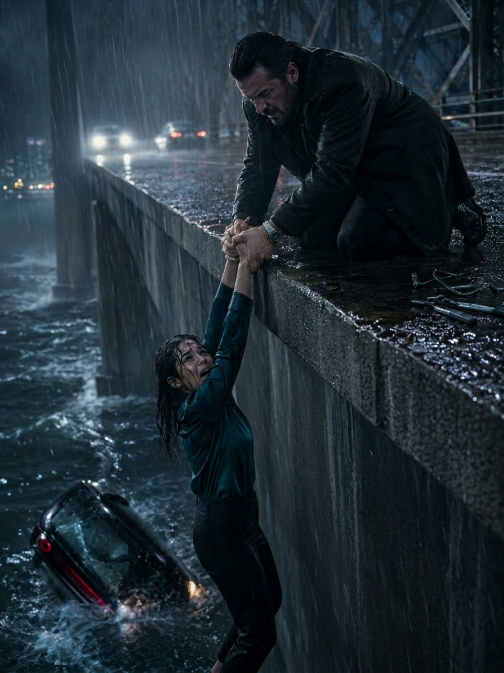
Glass. Metal. Clara’s own scream swallowed by the car’s acceleration and the driver’s voice cutting through in Italian. Nico’s body covering hers — his arm hard around her head, his weight a shield she had not asked for and could not have refused — while bullets shook the car like something trying to crack it open.
“Drive!” he said, and the car lurched forward hard enough to throw her against the door.
She was shaking before she understood she was shaking.
An underground parking structure. Brakes screaming. The door open and Nico pulling her out, keeping her body between his and whatever was behind them, moving through concrete columns and parked cars with the specific ease of someone who had done this in different configurations before.
A man materialized from the shadows.
Clara stopped breathing.
He lowered his weapon when he saw Nico.
“How many?” Nico said.
“Four vehicles. Eight men.”
Nico said a name. The answer was: shoulder wound.
His eyes moved to Clara, then back to Nico, with the assessing quality of someone cataloguing a variable.
“Don’t,” Nico said.
The man nodded and said nothing more.
More shots echoed from somewhere above.
“Get her out,” Nico said.
Clara grabbed his sleeve. “No.”
“He works for me—”
“That is not a comfort.”
Despite everything — the gunfire, the blood, the man with a weapon — Nico’s expression shifted for half a second into something that was almost, impossibly, amusement.
Then a figure came around the corner ahead.
Nico fired.
The sound was enormous in the concrete space.
The man dropped.
Clara stood very still.
The blood spread across the floor with terrible patience.
Nico turned toward her.
Not triumphant. Not cold.
Regretful.
Deeply, visibly, regretful.
She stepped back.
One step.
It was involuntary.
She watched it hit him.
“Take her,” he said to the other man, and his voice had gone completely flat.
—
The safehouse had a view of the river and smelled of old plaster and central heating.
Renzo — the man from the garage — brought tea and gave his name without being asked.
“The stories are mostly true,” he said carefully. “About Nico.”
Clara wrapped her hands around the cup.
“His partner,” she said. “Someone said there was a partner who betrayed him.”
Renzo’s expression shifted. “Those things are never simple.”
“But it happened.”
“In this life, everyone eventually chooses survival over loyalty. The question is what you lose in the exchange.”
“What did Nico lose?”
Renzo looked toward the dark window and said nothing.
Footsteps on the stairs.
Clara’s pulse did something predictable and inconvenient.
Nico stood in the doorway. Fresh blood on one sleeve, not his. Eyes moving to her immediately, and the specific quality of relief that crossed his face was almost unbearable to witness.
“You’re safe,” he said.
Those were his first words.
Renzo left without a sound.
“You killed someone,” Clara said.
“Yes.”
“You could have lied.”
“I don’t lie to you.”
“You barely know me.”
“I know enough.”
She had heard him say that before. At dinner, about knowing she was honest. It meant something different now, on this side of what had just happened.
“How many times?” she asked.
He was quiet.
“How many people.”
The silence was the answer.
Clara looked away.
Nico did not come closer.
“You should hate me,” he said.
The strange thing was that she couldn’t. She had tried it out mentally on the drive here, had located every reasonable reason. But there was the way he had covered her in that car — not strategic, not calculating, just immediate — and the look on his face when she stepped back in the garage, and now this: the man who had terrorized half of Chicago standing in a safehouse doorway looking like she held the particular power to end him.
“Why me?” she asked.
She meant it as a small question. It came out as a larger one.
Nico was quiet for a long time.
“Because when everyone else looked at me, they saw power.” His voice was low. “You looked at me like I was a person who had made choices. Not a legend. Not a target. A person.”
Her throat tightened.
He reached into his jacket and removed a photograph.
She took it.
A younger Nico stood beside another man, both in suits, both with the faint smiles of people who had briefly let their guard down. Between them stood a girl. Eight years old, perhaps. Dark curls. Completely happy.
“Who is she?”
“My daughter.”
Clara looked up.
“She died six years ago.” His voice roughened without breaking. “She was in the car when they came for me. I was late picking her up from school. I had promised ice cream.”
Clara couldn’t speak.
“The bullets were meant for me.”
The weight of those words was not like the weight of a story being told. It was the weight of something someone carried every day in a specific location.
She understood then why Nico Ferrante had such careful hands. Why he had touched her cheek so gently in that office. Why the grief kept surfacing beneath every hard surface — not weakness, but the specific sorrow of a man who had survived what he had not been meant to survive.
“You loved her,” Clara said.
“She was the only good thing I ever made.”
Clara crossed the room.
She watched him watch her come — carefully, like he expected her to change direction, like the step back in the garage was still the most likely outcome of all of this.
She reached up and touched his face.
He went completely still.
“You keep telling me to stay away from you,” she said.
“Because it’s true.”
“But you still asked me to dinner.”
“Yes.”
“And you still covered me in that car.”
His eyes were very dark and very close.
Nico lowered his forehead slowly to hers.
Not a kiss. Something more fragile than a kiss.
Clara closed her eyes.
For one impossible moment, the safehouse and the night and the violence outside it didn’t exist.
Just warmth.
Just the sound of both of them breathing.
His phone rang.
He answered it.
Clara watched his face change.
“What do you mean she’s gone?” he said.
The temperature in the room dropped.
He listened. Then he looked at Clara, and for the first time since she had met him, the person looking back at her was afraid.
Not calculating. Not controlled.
Afraid.
“They took my sister,” he said.
Clara stared at him.
“And they left a message.”
He held the phone toward her.
The screen showed a text: four words and her name.
*We want Clara Holt.*
—
## PART 3
**The Offer**
The message on the phone was clear.
Clara read it twice, not because she had misunderstood it the first time, but because the mind insisted on the courtesy of a second pass when it received information it hadn’t prepared for.
She handed the phone back.
Nico was watching her face.
“Tell me about the sister,” she said.
His expression shifted — not surprised by the question, but by the order of it. That she had not said *oh god* or started crying or asked *why me.* He’d expected something else from her. She could see it.
“Aria,” he said. “Younger than me by eight years. She lives in Lincoln Park. She’s not—” He paused. “She doesn’t know the full shape of what I do.”
“But whoever took her knows your shape.”
“Yes.”
Clara sat down.
Her legs had been planning to give out for some time and it seemed reasonable to get ahead of that.
Nico sat across from her.
“You don’t have to be part of this,” he said. “I’ll find another—”
“Who took her?”
His jaw tightened. “The partner I mentioned.”
Renzo appeared in the doorway. Clara had not heard him approach.
“We confirmed it,” Renzo said. “Savini’s people.”
Clara looked at Nico. “The partner who betrayed you.”
Nico’s face had gone very still.
“Luca Savini was my business partner for six years. Before I controlled anything in this city, it was the two of us building it. He was brilliant. Patient. And when I wouldn’t expand into trafficking — when I drew the line there and said no — he decided the line was the problem.” Nico’s hands were flat on the table. “He tried to move anyway. I stopped him. He disappeared rather than face the consequences.”
“People said you betrayed him.”
“People said what Savini’s men told them to say.” He met her eyes. “I shut down his operation. Three people who worked for him died in the process. None of those deaths were ordered by me, but none of them were prevented either.”
Clara held his gaze.
“And now he has your sister.”
“Yes.”
“And he wants me.”
“He wants leverage against me. You’re—” Nico stopped.
“What?”
He looked away from her. “You’ve been followed since last night.”
Her skin went cold.
“He was watching the dinner,” Nico said. “He saw—” Another pause. “He saw what I couldn’t hide.”
Clara sat with that for a moment.
“So he took Aria to force an exchange,” she said. “Me for her. Because he knows you’d trade anything for Aria.”
“He’s wrong.”
“Is he?”
“I will not hand you to Luca Savini.”
“That’s not what I asked.”
Nico met her eyes.
“Tell me about Aria,” Clara said.
“Why?”
“Because I’m trying to understand what I’m helping with.”
He stared at her.
“You’re not—”
“Tell me about her.”
Renzo, from the doorway, spoke quietly: “She teaches piano. Third grade. She still sends him birthday cards with those sticker seals.”
Nico looked at the window.
Clara looked at Nico.
She thought about the photograph in her pocket. The girl with the dark curls. The ice cream that never happened.
She thought about what it cost a person to carry that kind of loss inside a life made of violence, with no one to carry it to.
“Then we do this without me being handed to anyone,” Clara said.
Nico looked at her sharply.
“Renzo. Sit down. Tell me what you know about where Savini operates.”
Renzo entered and sat.
—
**What Clara Knew About Kitchens**
She was not a strategist.
She was a catering worker who could produce three hundred perfect cannoli in six hours and knew that orange zest ruined by a lazy pastry chef was the same as no orange zest at all, and that the difference between good food and bad food was often only the decision to care.
She was, it turned out, very good at caring.
Renzo talked for forty minutes. Nico clarified and contradicted and occasionally gave information he hadn’t intended to give because Clara asked specific, simple questions that stripped the architecture off the situation and exposed the framework.
*Where does Savini meet people? Where does he feel safe? Does he trust his own men?*
Renzo watched her with an expression that moved slowly from wariness to something adjacent to respect.
Nico watched her with the expression he’d had in the parking garage, right before everything went wrong — specific and undisguised.
“The restaurant,” Clara said finally.
Both men looked at her.
“He was watching your dinner. Which means he knew where you were. Which means someone told him.” She looked at Nico. “The restaurant is yours?”
“Yes.”
“So someone in your organization fed him the location.” She traced the pattern on the table with one finger. “If he trusted that person before tonight, he’ll trust them after. He’ll want to meet somewhere that feels like victory to him.”
“He’ll want to meet wherever he controls,” Renzo said.
“He’ll want to meet somewhere Nico can see him gloat,” Clara said. “Men like Savini need the audience.”
Both of them were quiet.
“I used to cater for men like him,” Clara said. “Not exactly like him. But men who needed to be the most important person in a room, who needed everyone to see them win. They always want the same thing. A stage.”
Nico said quietly: “You catered for people like me.”
“I catered for people like you used to be,” she said. “Before you figured out you didn’t need the audience anymore.”
He looked at her for a long moment.
“The warehouse on Fulton,” Renzo said slowly. “He bought it through a shell company six months ago. It’s the only space he owns that Nico doesn’t control.”
“Then that’s where he’ll want to do the exchange,” Clara said.
“We go in first,” Nico said. “Before he expects it.”
“You go in first,” Clara said. “I go in after.”
“No.”
“He’s expecting you to bring me to him. If you arrive without me, he knows something’s wrong. He’ll move Aria.” She kept her voice even. “If I arrive separately — if I walk in looking like someone who wasn’t supposed to be there — it divides his attention.”
Nico’s jaw was very tight.
“This is not how this works.”
“How does it work?”
“I don’t use civilians.”
“I volunteered.”
“That’s not—”
“Nico.” She looked at him directly. “You covered me in that car without thinking. Let me do the same thing.”
The word *thinking* hit him. She could see it.
He was quiet for a long time.
Then he looked at Renzo.
Renzo spread his hands. “She’s not wrong about the attention.”
“She’s not trained.”
“Neither was I when I started.”
Nico closed his eyes.
Then opened them.
“You go nowhere near the main floor,” he said. “You stay in the service access — there will be a loading dock entrance at the south end of the building. You go in twenty minutes after us. You make noise. Enough to pull eyes to the south side. Then you get back out immediately.”
“And if it doesn’t—”
“Then you run,” he said. “And you do not look back for me.”
Clara held his gaze.
“That’s not a deal I’m going to make,” she said.
Something crossed his face.
“Clara—”
“I’m not leaving you there,” she said. “I already told you that in the parking garage and I meant it then too.”
The room was very quiet.
Renzo suddenly became very interested in the ceiling.
Nico looked at Clara with the expression of a man who had been alone for a very long time and had just encountered something that made that fact ache rather than feel like safety.
“Fine,” he said finally.
It came out rough.
Like it cost him.
—
**The Warehouse**
The Fulton district smelled of cold river and industrial exhaust and the particular quiet of a neighborhood that had been something else once and was in between being something else again.
The warehouse was three stories of brick and old timber, lit from the inside with the amber glow of temporary lighting. Clara could see it from the corner where Renzo had left her fifteen minutes ago.
In her earpiece — borrowed, awkward, functional — Nico’s voice arrived in intervals.
*South access is clear. Two men at the front entrance. Renzo has the east.*
*Three minutes. When you go in, stay against the wall.*
Clara touched the earpiece once.
*Understood*, she said.
A pause.
Then: *You don’t have to do this.*
Clara looked at the building.
She thought about the check he had written for cannoli. About orange zest and the bakery she’d stopped wanting because wanting things was expensive. About the way he had looked at the photograph of his daughter, and the way he had looked at her when she crossed the room toward him in the safehouse.
She thought about Aria, who sent birthday cards with sticker seals and didn’t know the full shape of her brother’s world.
*Yes I do*, Clara said into the earpiece.
She went in.
The loading dock door was unlocked — Renzo’s work. She slipped through into a service corridor that smelled of damp concrete and oil. Ahead, through the building’s bones, she could hear voices. Too many of them, echoing off brick.
She moved along the wall.
She found a metal staircase and went up one level, which gave her a narrow catwalk overlooking the main floor.
Below: eight men, maybe ten. In the center, a woman with dark hair sat in a chair with her hands bound — Aria Ferrante, who taught third-grade piano and still sent birthday cards. She looked frightened but unharmed. Across from her, pacing, was a man whose back was to Clara.
Savini.
Clara had expected something dramatic. What she found was a man who looked like middle management — medium height, gray suit, no particular menace to his appearance. The menace was in the way his men watched him. The space they gave him.
Then Nico walked through the main entrance.
No gun drawn. No guards.
Alone.
Savini turned.
Clara could see his expression from the catwalk — the specific pleasure of a man who had been waiting for this moment for years.
“Finally,” Savini said. “No women with you? I thought you were bringing me something.”
“I brought myself,” Nico said. “Let Aria go.”
“When I have what I came for.”
“You’re not getting her.”
“You don’t have a—”
Clara knocked the metal bucket against the catwalk rail.
The crash was enormous.
Every head turned toward the sound.
Savini’s attention fractured — three of his men moved toward the south end of the building, toward the catwalk, toward her.
Renzo came through the east entrance.
Then the back entrance opened.
Four more men.
Not Savini’s.
Clara watched from the catwalk as what Nico had apparently arranged in the hours she hadn’t seen — other men, other loyalties, the accumulated architecture of six years of controlling something — arrived to make Savini’s odds miscalculate.
Savini understood it before his men did.
He moved toward Aria.
Nico was already moving.
The room collapsed into controlled chaos — shouts, movement, the sounds of struggle, none of it gunfire because nobody could shoot without risk of hitting the wrong person and everyone in the room knew it.
Clara came down the stairs.
She reached Aria before Savini did.
The binding on Aria’s wrists was zip ties. Clara found the seam by feel and yanked with the practiced grip of someone who opened packaging for a living and had specific opinions about poorly designed fastenings.
Aria’s hands came free.
“Go,” Clara said. “There’s a door on the south wall—”
“Who are you?”
“Someone your brother trusts more than he should. *Go.*”
Aria went.
Clara turned.
Savini was three feet away.
He looked at her with the calculating expression of a man reassessing.
“You’re the catering girl,” he said.
“You say that like it’s an insult.”
“He sent a civilian to rescue his sister.”
“She sent herself,” Nico said from behind Savini.
Savini turned.
He had a weapon. He started to raise it.
Renzo was faster.
What happened next was brief and final and Clara looked at the wall.
Then it was quiet.
—
**After**
The official story — the one that ended up in press reports — mentioned an abandoned warehouse, an organized crime standoff, and the voluntary surrender of Luca Savini to federal authorities who had apparently been building a case for years and had been waiting for an opportunity to make the final move. The voluntary surrender was a generous reading of events, but Nico had good relationships with specific journalists, and Savini had made enough enemies in federal buildings that the official story served everyone’s purposes.
Aria sat in the safehouse kitchen wrapped in a blanket, drinking tea, and studying Clara with the frank appraisal of a woman who taught eight-year-olds and had therefore developed excellent instincts about people.
“You’re the one he made dinner for,” Aria said.
“He owned the restaurant. He just—”
“He cleared the whole place. He doesn’t do that.” Aria wrapped her hands around her cup. “He doesn’t do *any* of this.”
Nico had gone to make arrangements. The specific kind of arrangements that required his physical presence and would take several hours and about which Clara had decided not to ask specific questions.
“He showed me a photograph,” Clara said. “Of his daughter.”
Aria’s face changed.
“Sofia,” she said softly. “He carries it everywhere.”
“I know.”
“Did he tell you?”
“Yes.”
Aria looked at her for a long time.
“He hasn’t told anyone in years,” she said. “Not even people he trusted completely. It was—” She stopped. “It was the thing he kept completely private. Like naming it out loud made it more real, or maybe it made the grief more shareable than he could bear.”
Clara looked at her tea.
“He’s going to tell you to leave,” Aria said. “When things settle. He’s going to say it’s for your safety. He’s going to be very convincing and also completely wrong.”
“Why wrong?”
“Because every dangerous thing in his life came from the outside. Savini. The trafficking operation he refused. His father’s debts, before that.” Aria tilted her head. “You’re the first safe thing that walked toward him. He doesn’t know what to do with that.”
—
**Three Weeks Later**
The morning was cold and clear, and Clara was behind a counter she didn’t own yet.
The bakery on Wicker Park’s edge — small, warm, white walls and a wooden counter and an oven that had required exactly three weeks of paperwork, a specific check that she had argued about at length, and a landlord who turned out to be remarkably flexible once certain people made certain phone calls on her behalf — smelled of real butter and coffee and the first batch of morning bread.
She was not supposed to have opened at six-thirty.
The sign said seven.
She had opened at six-thirty anyway because the bread was done and there was no good reason to make it wait.
The door opened at six-forty.
Nico came in wearing a coat she hadn’t seen before, hands in his pockets, hair slightly damp from outside.
He looked at the counter. At the bread. At the hand-lettered chalkboard menu that said *No trendy nonsense. Real butter. Good coffee.*
His expression did something complicated.
“You’re not open yet,” he said.
“I’m open when the bread is done.”
“That’s not how business—”
“I have strong feelings about making bread wait.”
He came to the counter and sat on one of the stools.
Clara poured two coffees without asking and set one in front of him.
He wrapped his hands around the cup.
They sat in silence for a moment.
“Renzo says the Savini case goes to a grand jury next month,” Clara said.
“Yes.”
“And the federal cooperation—”
“Complicated. And ongoing.” He looked at her. “I’ll be involved in several things for the next year that I can’t fully explain.”
“I figured.”
He was quiet.
“The bakery,” he said.
“What about it.”
“I paid for the lease.”
“You gave me a loan,” Clara said. “I have a repayment schedule. I made Renzo write it up properly.”
“He told me.”
“He looked like he’d never done a straight business arrangement in his life.”
“He hasn’t.” A beat. “I had to explain what interest rates were.”
Clara laughed.
Nico looked at her laughing.
His expression was the one he’d had in the safehouse — the one that seemed to cost him something to wear, because it was real rather than performed.
“I told you to run,” he said.
“You told me that multiple times.”
“You didn’t.”
“I know.”
“I had blood on my collar.”
“I noticed.”
“My world is—”
“I know what your world is,” Clara said. “I’ve been in it for three weeks. It’s not what I would have chosen. But I didn’t choose the part where I walked into an empty lobby at midnight either, and that turned out to matter anyway.”
Nico looked at his coffee.
“I never kissed you,” he said.
It came out quiet. Not quite careful — more like something that had been waiting somewhere and had decided this was its moment.
Clara looked at him.
In the office, that first night, she had told him something true that she hadn’t intended to say — *I’ve never been kissed* — and he had covered her cheek with one careful hand and said *then we take it easy.* And then the week had erupted into gunfire and violence and the photograph of Sofia and Savini’s warehouse, and the easy version had been buried under everything else.
“You didn’t,” she said.
He looked up.
“We were a little busy,” she said.
Something crossed his face.
Then he reached across the counter and touched her face the way he had in the office — careful, like something breakable was involved, like the gesture meant more than the space it occupied.
Clara leaned forward.
He kissed her once.
Gentle.
Unhurried.
The way you kissed someone when you had decided it was worth being slow about.
When she pulled back, the bread behind her had started to cool, and the morning light was coming through the window at the angle that turned everything gold.
Nico looked at her.
“The bakery,” he said.
“Yes.”
“No air muffins.”
“Absolutely not.”
He almost smiled — the real one, the one that made him look like someone who had been young once and might be permitted to remember it.
“Then I’ll need coffee every morning,” he said.
Clara turned back to the counter and refilled both cups.
“You’ll need to get here before seven,” she said.
“I can do that.”
“No entourage.”
“Fine.”
“And no making calls in my kitchen.”
He was quiet.
“One call per visit,” he said. “Non-negotiable.”
Clara pretended to consider this.
“Fine,” she said. “But only if it’s not about shipping.”
“It’s usually about shipping.”
“Then it counts as two calls and you owe me an extra coffee.”
Nico looked at her across the counter of a small bakery in Wicker Park at six-forty in the morning, with his hands around a cup of real coffee and the smell of bread filling the room and no one in the world who needed to know he was here.
“Acceptable,” he said.
**THE END**
—
—