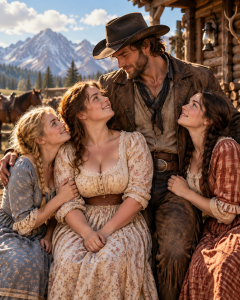
A Mail-Order Bride Arrived With Her Two Sisters — Then the Mountain Man Chose All Three Instead

—
PART 1
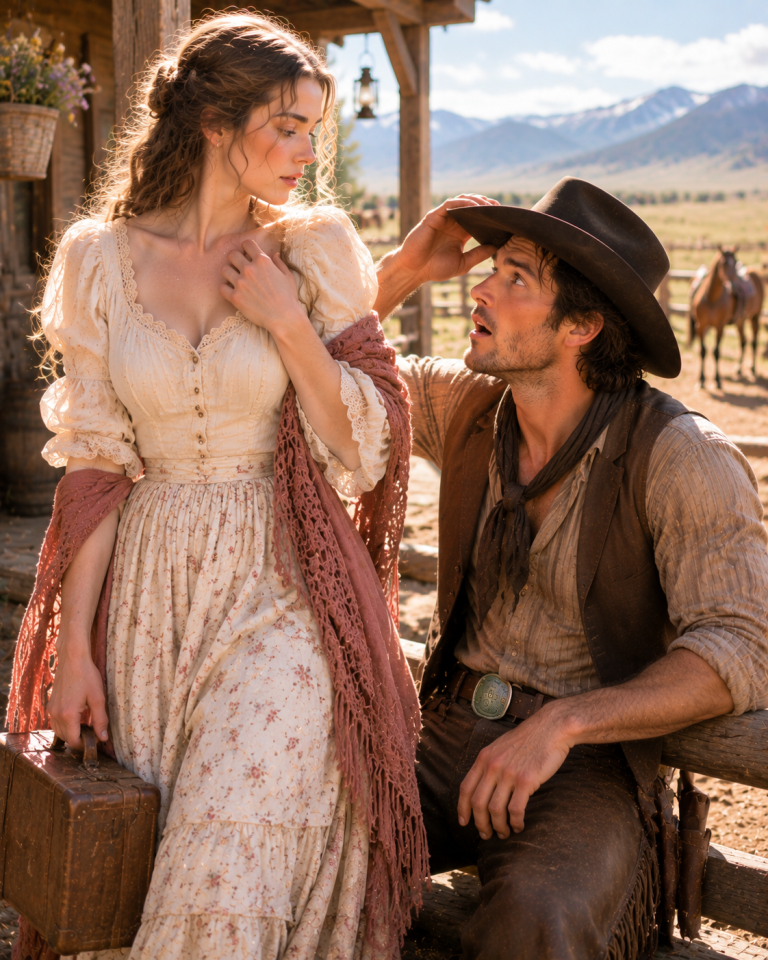
The stagecoach rolled into Banick, Montana Territory, three hours late, caked gray with trail mud and the first bite of an early snow.
It was October, 1874. The air already tasted like the winter that was coming to bury this whole lawless little scar of a town — a huddle of raw-plank saloons and half-finished storefronts that seemed to agree, collectively, that civilization was a suggestion rather than a rule.
Waiting on the boardwalk of the Gold Leaf Hotel was Silas Thorne.
To call him a mountain man undersold it. He stood six-foot-four in a coat cut from a grizzly hide he’d likely killed with his own two hands, forty years old by the calendar, but weathered by wind and altitude into something that looked older than the mountain itself. Folks in Banick said he’d struck a gold vein up on Dead Man’s Ridge thick as a man’s forearm. Nobody had ever gone up to confirm it. The last man who tried was found at the bottom of a ravine, missing his boots.
Silas had paid fifty dollars to a matchmaking service in St. Louis for a specific, practical reason. A homestead claim needed a family name on the paper to hold against the mining corporations creeping up the valley. He needed a wife the way a man needs a deed — not for love, not for softness. For legal weight, and for someone to keep the fire lit while he worked the deep shafts.
The coach door opened. A small, worn boot found the step first.
Ara Vance emerged — twenty-two, dark hair scraped back too severely, eyes that never stopped moving, assessing, calculating. Her dress was faded blue and had seen better roads than this one. She looked up at Silas, took the full measure of him, and didn’t flinch.
“Mr. Thorne,” she said. Her voice was steady. Too steady.
“Parson’s ready,” Silas said. “We marry within the hour. Ride out before sunset.”
She didn’t move toward him. She turned back to the open coach door instead.
A second girl climbed down from the shadows of the carriage — younger, maybe eighteen, same dark hair, a face pulled tight with fear. Sarah.
The men loitering on the saloon porch stopped mid-drink. A murmur rolled down the street.
Then a third girl stepped out. Ruth — no older than sixteen, clutching a doll so ragged it looked like it had survived a war.
Silas went very still. His hand drifted, slow and instinctive, toward the Colt Navy on his hip.
“What is this?” The words came out like two rocks grinding together. “I sent for a wife. One wife.”
Ara stepped in front of her sisters, shielding them with a frame that looked far too small for the job. “We come as a package, Mr. Thorne. Our parents died of fever in Missouri. I couldn’t leave them for the orphanage — they’d have been split up.”
It was a lie, and Silas could smell it the way he could smell weather changing. Fear had a scent, and these three girls were soaked in it. The dust on their traveling clothes wasn’t just road dust. It was the dust of people running.
Sheriff Josiah Black, watching from a rocking chair outside the depot, spat a stream of tobacco into the dirt and grinned with cold eyes. “Looks like you got swindled, Thorne. Want I put the other two on the next coach east? Or maybe Big Molly’s got room behind the saloon for fresh girls.”
Sarah flinched at the word *saloon.* And Ara’s hand slid toward the pocket of her skirt — Silas caught the outline of a small derringer there, and understood in that instant she was fully prepared to shoot the sheriff where he sat rather than let her sisters end up in that house.
He looked at Ara’s steel. At Sarah’s trembling ground she refused to give up. At Ruth’s white-knuckled grip on a doll that was the last soft thing she owned.
Winter was coming to Dead Man’s Ridge. The work up there was brutal, and lonely enough to kill a man’s mind before it ever touched his body. Silas Thorne didn’t just need a wife.
He needed a crew. He needed eyes at his back. And he knew, better than anyone standing on that street, exactly what it felt like to be hunted.
“Get your bags,” he said.
Ara blinked. “Excuse me?”
“I said get your bags. Wagon’s out back. I’ve got supplies to load.” He turned and started for the livery, throwing the rest over his shoulder loud enough for the sheriff and every gossip in Banick to catch every word of it.
“I paid for a bride. I got a workforce. I’ll take all three.”
The sheriff surged up out of his chair. “You can’t marry three women, Thorne. That’s bigamy.”
“I’m marrying one.” Silas didn’t stop walking. “The other two are hired help. Unless you’re offering to pay their fare back to St. Louis yourself, Sheriff.”
Josiah Black’s jaw worked, and nothing came out of it. He wasn’t spending a dime on three strange girls, and everybody on that street knew it.
Ara let out a breath she seemed to have been holding for a thousand miles of bad road. She caught Sarah’s hand.
“Let’s go.”
As they loaded their thin trunks into Silas’s heavy supply wagon, Ara caught him watching them across the wagon bed — not with lust, not even with kindness. He was looking at them the way a general looks at green recruits the night before a battle nobody’s coming back from whole.
“Don’t thank me,” he muttered, tossing a fifty-pound flour sack into the wagon like it weighed nothing at all. “Where we’re going, you might wish you’d stayed at the saloon.”
Behind that iron-shuttered fortress waiting for them on the ridge, behind a locked door Silas would forbid them from ever touching, lay a secret buried five years deep — one that would turn a marriage of convenience into a war that only one of them would walk away from unbroken by spring.
—
PART 2
For the first weeks, life on the ridge fell into a rhythm as brutal as the terrain itself.
Silas was gone before first light, disappearing through a heavy oak door at the back of the cabin — a door bound in iron, padlocked, and forbidden. *You do not touch it. You do not look at it. You do not ask about it.* The sisters would hear, faint and rhythmic, the ring of a pickaxe somewhere far beneath their feet. They chopped wood, hauled water, cooked venison stew, and told themselves the isolation and the endless screaming wind were things a person could get used to.
Silas, meanwhile, was changing. He grew more paranoid by the week — hours spent cleaning rifles that were already clean, staring out through arrow-slit windows at an empty trail, eating his meals sitting against the locked door like a man guarding it even from his own household.
Then came the blizzard in mid-November.
Ara couldn’t sleep through it. She climbed down from the sisters’ loft for water and found the fire burned to embers — and Silas not asleep by the front door where he claimed to keep watch, but standing at the back of the cabin. The padlock hung open in his hand.
She froze in the shadows and watched him drag a heavy wooden crate into the firelight and pry the lid loose.
It wasn’t gold.
The crate held rifles — brand-new military Henry repeaters — and beneath them, stacked in neat rows, stick after stick of dynamite.
Silas Thorne wasn’t mining for gold. He was arming for a war.
“You have light feet, Ara,” he said without turning around, his hand already drifting to the knife at his belt. “But not light enough.”
He turned slowly, firelight catching the blade. “I told you never to look at that door.”
“And I told you I’m not just a wife.” Ara stepped into the light, chin raised. “If we’re going to die up here, Silas, I want to know who’s coming to kill us.”
He held her stare a long moment. Then, quietly, he sheathed the knife and kicked the crate shut.
“Sit down. Pour us some whiskey. It’s time you knew why the mail-order service sent you to a ghost.”
The storm raged against the shutters as he sat across from her at the rough-hewn table.
“I’m not Silas Thorne,” he said. “Silas Thorne died five years ago in a prison camp at Andersonville. I took his name.” He met her eyes across the table, and for the first time since the stagecoach, something in his granite face looked almost afraid. “And the gold I’m supposed to be pulling out of this mountain — it isn’t in the ground. It was stolen. From the Confederate treasury. A wagon train disappeared in ’65, and I was the one who hid it. The men who ordered my whole unit killed to get their hands on it — they just found out I’m still breathing.”
Ara felt a cold that had nothing to do with the blizzard settle into her chest.
“Who are they?”
“Pinkertons,” Silas said. “And a rogue general named Archibald Callaway. They don’t want to arrest me, Ara. They want to skin me alive until I tell them where it’s buried.” He leaned across the table, his voice dropping lower. “I didn’t bring you and your sisters up here to be maids. I brought you because when they come — and they will come — I can’t shoot in three directions at once. Can your sisters shoot?”
Ara thought of Sarah dressing rabbits back in Missouri with a steady, practiced hand. She thought of Ruth’s small, careful fingers.
“Yes,” she said. “We can shoot.”
“Good,” Silas said, looking toward the shuttered window where the storm howled without mercy. “Because when the snow stops falling, the tracks will lead them right to our door — and what’s coming for us doesn’t knock.”
—
PART 3
**I.**
The snow didn’t stop for three days. It buried the goat trail back to Banick, buried the horizon, buried whatever hope any of them had of simply being left alone.
Inside the fortress cabin, the air stayed thick with gun oil and tension. Silas — Ara had stopped trying to think of him by any other name, real or false — turned out to be a hard teacher. He didn’t yell. He didn’t coddle. He simply expected precision, and when he didn’t get it, he made them start over, again and again, until precision stopped being a choice and became the only thing their bodies knew how to do under pressure.
“Again,” he grunted, standing over Ruth as she fumbled the lever of a Henry rifle nearly as long as her forearm. He’d stripped the powder from the cartridges first, drilling the mechanics before he’d trust any of them with a live round. “You’re hesitating. The Henry doesn’t care that you’re scared. Snap it forward. Snap it back. Violent. Do it.”
Ruth bit her lip until it bled. *Clack. Clack.* The action finally cycled smooth.
“Good.” He turned to Sarah, whose hands shook loading dummy cartridges into the gate. “You’re loading too slow. Five men through that door, you’re dead before the third round’s in the tube.”
“I’m a seamstress, Mr. Thorne,” Sarah said tightly. “Not a soldier.”
“You’re neither,” Silas said, voice flat and low. “You’re meat. Unless you learn this.”
He turned last to Ara, standing easy by the fireplace, rifle steady in her hands, watching him with a cold, analytical patience that unsettled him more than he let show.
“You’ve held a gun before.”
“I have. Double-barrel shotgun. Harder to miss.”
He nodded slowly and poured himself coffee. “Snow’s settling. Crust’ll hold a man’s weight by tomorrow. That’s when the scout comes.”
“The scout?” Ruth asked, lowering her rifle.
“Callaway won’t send his whole force up a goat trail blind. He’s a tactician — fought the Shenandoah Valley campaigns. He’ll send one man first. A tracker. To see if I’m here. To see if I’m alone.”
“And when he comes?” Ara asked.
“We kill him,” Silas said, quiet as a closing door.
**II.**
Two days later, the sun broke hard and blinding off the snowpack.
Silas was on the roof with a brass telescope, sweeping the valley below, when Ara climbed up with a mug of hot water she never got the chance to hand him.
“Movement,” he said, voice suddenly tight. She lay beside him on the flat roof, peering over the snow-crusted parapet. A mile below, a single black dot cut across the white.
“Riding a thoroughbred, not a mountain horse,” Silas muttered, passing her the glass. “That’s Callaway’s style. Man likes pretty things that run fast. Look at the saddlebags.”
Through the lens, wrapped in furs but unmistakable, she found the stamp on the saddlebags — a weeping eye. “Pinkerton.”
“Not just a Pinkerton. That’s a scout named Uriah Fenn. He can track a falcon across a cloudy sky. Half a mile out, he’ll see our chimney smoke. He’ll see the fresh-cut wood. He’ll know.”
“So we put the fire out?” Ruth called from the ladder.
“Too late.” Silas reached for a rifle that wasn’t the Henry — a Sharps Buffalo gun, single-shot, a barrel as long as a man’s leg, built to fling a bullet the size of a thumb.
“He’s a mile out,” Ara said. “You can’t hit a moving target at a mile.”
“I’m not aiming for the rider.” He adjusted the vernier sight, calculating wind and drop in a silence that felt like held breath. The air up here was thin enough that sound carried strangely, and Ara found herself holding her own breath along with his, as if that might steady the shot. He lay prone, cheek to the stock, and stopped breathing entirely.
*Boom.*
The shot rolled down the canyon like slow thunder. Through the telescope, Ara watched the horse pitch forward mid-stride, its chest opening in a spray of red against white, throwing its rider deep into a snowdrift.
“You shot the horse?” Sarah gasped from below, horrified.
“A man on foot in four feet of snow is a dead man,” Silas said, reloading with mechanical calm. “Now we wait.”
Below, Uriah Fenn dragged himself upright out of the drift and looked wildly around before his gaze fixed on the ridge itself. He didn’t run — couldn’t, waist-deep as he was. He began waving his arms instead, shouting something the wind tore apart before it ever reached them.
“He’s surrendering,” Ara said.
“There’s no surrender in this war,” Silas said softly, shifting his aim. “I let him live, he crawls back to Callaway. Tells him the layout. Tells him about the fence. Tells him about you.”
Ara set her hand flat against the barrel. “Don’t. If we kill him like a dog in the snow, we’re no better than the men chasing us.”
Silas hesitated, scope still trained on the distant, floundering shape.
“We aren’t trying to be better,” he said. “We’re trying to be alive.”
“Let him freeze, then. Nature’s cruel enough on its own. You don’t have to be.”
He held there a long moment before he lowered the rifle. “Save the bullet.”
They watched until the light failed. The black dot stopped moving somewhere out in the white and didn’t move again. The snow fell fresh over the tracks, over the horse, over whatever was left of Uriah Fenn.
“Go inside,” Silas told them, climbing down at last. “Eat. Sleep. Because tomorrow, Callaway realizes his scout isn’t coming back. And then he brings the army.”
That night, after Sarah and Ruth had finally drifted into an uneasy sleep in the loft, Ara sat alone at the table while Silas worked a whetstone over his Bowie knife, the rasp of it steady and hypnotic in the quiet cabin.
“You asked who we were running from,” Ara said finally. “You never asked twice.”
“Figured you’d tell me when you were ready.”
So she told him. Not the fever story she’d given him on the boardwalk in Banick, but the true one — a father who gambled away everything, including his own life, to a man named Cornelius Reich; a mother’s heart giving out a week later at the funeral Reich had the gall to attend; a debt Reich called *inherited*, and a offer to work it off in a house on the riverfront that made her blood run cold even now, months and a mountain range removed from it.
“I went to his office the night before he meant to collect us,” she said, staring into the fire rather than at him. “Told the clerk I had the money. I didn’t. I had my father’s shotgun instead. I didn’t kill him, Silas. I missed. Took off his ear and half his shoulder, and in the confusion we ran. First train west, then the stage.”
Silas’s hand stilled on the whetstone. Whatever crossed his weathered face in that moment wasn’t pity. It was something closer to respect.
“Rich is a vicious dog,” he said. “But he’s a city rat. He scares easy once he’s out of his own territory. He won’t follow you this far.”
“He put a bounty on us. Five hundred, alive.”
Silas let out a dry huff that might, in a kinder light, have been a laugh. “I’m worth ten thousand dead. Seems you girls married up.” The dark humor cracked the tension in the room just long enough for both of them to breathe — and then the reality of it settled back down around them like snowfall. They were a household of fugitives now, in every direction. A family built entirely out of people the world had already tried, once, to throw away.
**III.**
The attack didn’t come at dawn. It came at dinner, three days later, while the household ate rabbit stew in a silence heavy with the memory of the man frozen in the valley.
The east shutter shattered without warning. A bullet cracked past Ruth’s ear and buried itself in the log wall with a dull, final thack.
“Down!” Silas roared, flipping the heavy table onto its side. A fusillade of lead hammered the cabin, chewing chinking from between the logs, shattering the lantern glass.
“North ridge, three hundred yards,” Silas called from a loophole, grabbing rifles off the rack and shoving them into shaking hands. “They’ve got the high ground. They’re suppressing us — keeping our heads down while the assault team closes on the wall. Ara, south loop. Ruth, west. Sarah, keep the guns loaded. If they breach the door, we fall back to the mineshaft.”
Ara crawled to her position, heart hammering. Through the slit she saw shapes moving — not three hundred yards out anymore. Fifty. Men in white coats gliding through the snow like ghosts.
“They’re at the fence!” she shouted.
“Fire,” Silas ordered.
She sighted a man raising an axe against the perimeter posts and didn’t think about her father, or Reich, or anything but Ruth. She fired. He spun and fell face-first into the snow.
“Don’t celebrate,” Silas snapped over the boom of the Sharps. “Keep firing.”
The cabin dissolved into chaos — bullets punching through the roof, snow and sawdust raining down, Ruth crying and firing blind into the dark until a voice boomed out from the treeline and every gun on both sides went silent at once.
“Thorne.” Cultured. Southern. Carrying clean through the freezing air. “This is General Archibald Callaway. You have nowhere to run, son.”
“I’ve got plenty of ammunition, Archie,” Silas called back. “Come and get it.”
“I don’t want you dead, Silas. I want the gold. Give me the location of the bullion, and I’ll let you walk. You’ve got women in there — I can hear them. Do you want them dying for your greed?”
“He’s lying,” Silas breathed to the sisters. “He leaves no witnesses. Ever.”
“Send the women out,” Callaway shouted. “My word as an officer. We’ll escort them to Salt Lake City safe. This is between you and me.”
Sarah’s eyes found Ara’s, half-hopeful.
“No,” Ara said sharply. “Look at his men.” Through the loop she watched the white coats creeping closer under cover of the negotiation, not retreating an inch. “They’re moving up!”
“Fire!” Silas roared, and the battle reignited twice as fierce. This time they threw dynamite. A stick landed on the porch and detonated, shaking the cabin to its bones, buckling the front door on its hinges.
“They’re blowing the door!” Silas yelled, pumping rounds from the Henry, dropping two men on the porch before a shot from the ridge found him — not clean, punching through the shutter and into his thigh. He went down hard, blood soaking his trousers instantly.
“Silas!” Ruth screamed.
The front door splintered under an axe blade. A boot came through the gap.
Dragging himself backward through his own blood, unable to stand, unable to aim, Silas tossed a set of keys toward Ara. “The mine. Lock yourselves in. Blow the tunnel.”
**IV.**
Ara caught the keys and looked at the iron-banded mine door — a safe room, but a trap too, if Callaway simply chose to smoke them out or bury them alive instead of breaching it.
Through the splintering front door she caught a bearded, grinning face.
Sarah was frozen. Ruth was sobbing. Silas was down. The sheriff back in town had never cared what happened to any of them. Nobody was coming.
Ara didn’t run for the mine. She ran for the crate — the one Silas had shown her the night of the blizzard.
“Sarah, help me!”
She grabbed a bundle of three dynamite sticks taped together, a short fuse trailing from the end.
“What are you doing?” Sarah shrieked.
“Light it.” Ara held the fuse to the embers. Sarah, hands shaking, grabbed a burning twig and touched it home. It hissed and sparked violently just as the axe finally cracked the lock and three men surged through the ruined doorway, pistols raised, howling.
Ara didn’t hesitate. She screamed and hurled the bundle at their feet.
“Fire in the hole!”
She dove behind the overturned table, dragging Silas down with her. One of the men tried, too late, to kick the bundle back out.
*Kaboom.*
The front of the cabin ceased to exist. The blast wave lifted the log roof three inches before slamming it back down; all three men in the doorway vanished in a flash of orange light and splintered wood. Every lantern blew out at once, plunging the room into ringing, smoke-choked darkness.
For a long moment nobody moved.
“Is everyone alive?” Ara choked out.
“Here,” Ruth whispered from under a heap of blankets.
“Here,” Sarah said, steadier than anyone had a right to expect.
Silas groaned. Ara crawled to him — pale, eyes rolling, losing too much blood too fast.
“You crazy woman.” A faint, wrecked smile touched his lips. “You blew my front porch off.”
“I bought us time.” She tore a strip from her petticoat and cinched a tourniquet above the wound, ignoring his cry of pain. Behind her, Ruth had found the tin water pitcher, miraculously unbroken, and pressed a wet cloth to a cut above Sarah’s eyebrow that neither of them had noticed until the adrenaline began to fade and every small hurt started making itself known at once. “Listen,” he gasped, catching her wrist with what little strength remained in his grip. “Callaway won’t hit us again tonight — he’s rattled, thinks I’ve got a cannon. But he’ll burn us out come dawn.”
“Then we leave.”
“I can’t walk. Take the girls out the back, through the mine ventilation shaft. It comes out on the north face.”
“No.” Ara finished the knot and stood, walking to the gaping, smoking hole where the front wall used to be. Cold wind poured through it. She picked up his fallen Henry, jacked the lever, and chambered a fresh round.
“We aren’t leaving. And we aren’t hiding in a hole.” She turned back to her sisters, and whatever fear had lived in her face all night was gone, replaced by something cold and borrowed straight from the mountain itself. “Sarah, get the medical kit. Ruth, reload every gun we have. Silas is the bait. We are the trap.”
**V.**
Sarah, who’d once stitched silk and lace in a St. Louis dress shop, now knelt over Silas with a needle heated in the fire, sewing torn flesh instead. He gritted his teeth and didn’t pull away.
“You have hands like a surgeon,” he rasped.
“I have hands like a dressmaker,” she corrected, tying off the suture. “You’re just another torn coat, Mr. Thorne.”
Ruth stepped out of the shadows a while later, unrecognizable — soot smeared across her face to dull the shine of skin against snow, a white wool blanket draped over her like a poncho. She had cinched it tight at the waist with a strip of leather, and in the firelight, for one unsettling second, she didn’t look sixteen at all.
“I’m ready,” she said.
“You know what to do?” Ara asked, checking the knots on the canvas sack herself even though she knew Ruth’s hands were steadier than her own right now.
“Treeline. Plant the charges. Don’t engage. Don’t shoot unless they see me. Come back.”
“If they see you—” Ara’s voice cracked, just once, and she hated herself for it.
“They won’t.” Ruth hefted the sack, heavy with dynamite, each stick wrapped in nails and scrap metal, tied with twine into something closer to a weapon than an explosive. She’d learned to build them herself two nights before, Silas guiding her hands over the workbench with the same patient brutality he’d used to teach her the rifle. She slipped out through the blown-open wall and dissolved into the blizzard so completely that Ara found herself staring at empty white for a full ten seconds before she could make herself look away.
Twenty minutes crawled by like an hour. The wind filled every silence with its own restless noise, and twice Ara caught herself reaching for the door before remembering there was nothing to do but wait. Then a crunch of snow, and Ruth stumbled back through the debris, breathless, snow crusted white in her lashes.
“They’re circling to the blind side. The cliff face. They’re going to rappel down the chimney.”
“Clever,” Silas groaned. “Smoke us out. You planted the charges?”
“By the big pine. Along the fence line.”
“Good.” Ara turned to Sarah. “Get him to the mine door. Drag him if you have to.”
“Ara, no—” Silas tried to rise.
“You can’t stand, you stubborn old bear. Get to the door. You’re the only one who can open it.”
Sarah hauled him, dead weight, across the ruined floor while Ara and Ruth took cover behind the overturned table. Outside, low and confident, men’s voices drifted through the wind. *Easy now. Watch your footing.*
“Now,” Ara whispered, and fired — not at the men, at the treeline, at the base of the pine Ruth had wired. The bullet found the taped bundle of dynamite. The explosion was blinding, shredding, turning nails and scrap into a swarm of supersonic hornets. The pine sheared at its base and crashed down onto the men sheltering behind it.
“Flank left!” Callaway’s voice, screaming through the smoke. “The fence!”
Ruth fired at the second charge, missed, hands shaking. “Again,” Ara ordered, laying down cover fire of her own. Ruth breathed, aimed at the red-taped bundle nailed to the fence post, and squeezed.
The blast tore a hole clean through the perimeter, throwing climbing attackers backward into the snow. What had been a disciplined Pinkerton assault broke into chaos — men fighting shadows, exploding trees, a fury none of them had planned for.
But there were still too many of them. Through the smoke Ara watched ten men stop advancing and start rushing, bayonets fixed, straight for the breach.
“Retreat! To the mine!”
She fired wildly into the charge, dropping the lead man without waiting to see him fall, hauling Ruth by the collar toward the open iron door where Sarah waited with Silas slumped just inside. Ruth dove through first. Ara followed, spinning to fire one last shot as a Pinkerton agent burst through the ruined doorway, pistol raised —
Ara slammed the heavy door shut. The bullet sparked harmlessly off iron a half-second too late. She threw the deadbolt, dropped the bar across the brackets, and for one suspended moment, they were safe.
**VI.**
The darkness inside the tunnel was absolute.
“Matches,” Silas’s voice came from the floor. “Left pocket.”
Ara struck one. The flare revealed a narrow passage shored up with rotting timber, sloping down into the mountain’s belly. Outside, the pounding on the iron door was already dull and distant, and underneath it, worse — the faint smell of smoke seeping through the door frame.
“They’re going to burn us out,” Sarah whispered.
“No,” Silas said, strangely calm. “Draft pulls out of the mine, not in. Fire won’t reach us down here. But we can’t stay. Help me up. It’s time you saw what you’re dying for.”
The descent was a slow nightmare — Ara and Sarah supporting his weight down loose shale until the passage opened into a vast natural cavern, a stagnant black pool at its center, and against the far wall, dozens of crates stamped with the seal of the Confederate States Army.
The cavern swallowed the lantern light and gave almost nothing back. Water dripped somewhere unseen with a patience that made the silence between drops feel enormous, each one landing like a slow countdown none of them could see the end of. The air tasted of iron and old stone, and every sound they made — Silas’s ragged breathing, the scrape of shale under Sarah’s boots, the soft creak of the crates as Ara pried at their lids — came back to them flattened and strange, as if the mountain itself were listening and had been listening, patiently, for the better part of ten years.
“Is that it?” Ruth whispered, lantern raised. “The gold?”
Ara pried one open and found no gold at all. Paper. Thousands of documents wrapped in oilcloth, dry and untouched by five years of buried silence.
“Ledgers,” she said. “Maps. Receipts.”
“Gold can be spent,” Silas said, voice echoing off wet stone. “That is leverage. Callaway didn’t just steal Confederate bullion — he used it to bribe officials, buy land, sell out his own men for profit. Those papers prove he’s a traitor to both sides. They get out, he hangs.”
Ara understood then, turning one brittle page toward the light and finding column after column in a careful clerk’s hand — names, dates, sums that would have ruined careers and ended lives twice over even before the war had properly finished dying. Callaway wasn’t chasing gold. He was chasing the erasure of his own past, and he had been chasing it, patiently, for ten long years.
“He sent me to hide it ten years ago,” Silas said. “I read the books instead of burying them blind. I’ve been waiting for the right moment to use them.”
“And now?” Ara asked.
“Now we burn them.” He pulled a stick of dynamite from his coat. “Callaway thinks we’re trapped. He’ll come down himself to verify the papers are real. When he does, we blow the tunnel.”
“You want to bury us alive?” Sarah gasped.
“No.” He gestured toward a fissure high on the cavern wall. “Ventilation shaft. Goes straight to the peak. Tight, but the three of you fit.”
“And you?” Ara asked softly.
He looked at his shattered leg. “I can’t climb. I stay. I’m the bait until Callaway gets here. Then I light the fuse.”
“No. We don’t leave you.”
“You have to. I bought you to work. This is the work. You survive.”
A metallic screech rolled down the tunnel — the iron door above, finally breached.
“They’re in. You’ve got ten minutes. Go.”
Sarah and Ruth scrambled for the shaft. Ara didn’t follow. She walked instead to the crates, shoving a fistful of ledgers into her satchel.
“Insurance,” she muttered.
“Ara, go!” Silas pleaded.
“I’m done running, Silas.” She knelt beside him, checking her rifle. “Callaway won’t come alone. Blow the tunnel too early, they dig him out. Wait too long, they shoot you before you strike the match. You need a partner.” Her eyes had gone cold and certain. “I’ll hold them off. You strike the match.”
**VII.**
Torchlight flickered from the tunnel mouth long before the voices reached them — confident, unhurried, the sound of men who had never once considered that the hunted might turn.
“Thorne.” Callaway’s voice, booming down the shaft, distorted and doubled by the stone. “I’m coming for my property.”
Ara racked the lever of her Henry, aiming into the dark. “Welcome to hell, General,” she whispered.
Silas sat against the rock, bleeding heavily, a match in one hand and a stick of dynamite in the other, his breathing gone shallow and wet in a way Ara had learned, over the last day, to recognize as borrowed time running out. Behind a stack of crates, she pressed her cheek to an empty rifle and made herself perfectly still, the way he’d taught her — *the mountain rewards patience and kills everyone who won’t wait.*
Callaway entered the torch-lit chamber flanked by four enforcers, ignoring the false-front gold bars entirely and heading straight for the crates of documents — the physical proof of his own treason, close enough now to touch after ten years of not knowing where it slept.
“I thought you were dead, Silas,” he sneered, seizing a bundle of ledgers and riffling through them with the greedy haste of a man who has waited too long for anything. “But a dog always returns to its own vomit.” He leveled a heavy revolver at Silas’s chest. “Where are the women?”
“Gone,” Silas lied, voice a wet rattle. “Halfway to Banick by now.”
“Pity.” Callaway cocked the hammer, entirely unhurried, savoring it. “Goodbye, Sergeant.”
“Now,” Silas whispered.
Ara broke from cover, her rifle cracking, dropping the agent nearest Callaway before the cavern devoured the gunshot in a deafening roar. She pumped the lever, dropped a second man — and ran dry. Before she could reload, a massive enforcer slammed her against the wall, forearm crushing her throat.
Callaway kicked Silas onto his back, standing over him with something like satisfaction. “A valiant effort. But you were always a second too slow.” He aimed at Silas’s heart. “Any last words?”
Silas’s eyes drifted past him, fixing on the open crate of dynamite at the general’s feet.
“Yeah,” he coughed. “Duck.”
A thunderous boom rolled through the cavern — not from Ara’s rifle, but from thirty feet above. Ruth had climbed back down the ventilation shaft and braced herself on a ledge with the massive Sharps Buffalo gun, and the bullet didn’t take a man.
It took the dynamite.
The world went white. Callaway and his men vanished in the blast, the cavern’s stone support pillars shattering, the whole mountain groaning with a deep, tectonic wrongness.
“The roof!” Ara screamed, thrown clear by the shockwave. “It’s coming down!”
She crawled through the dust to Silas, pinned beneath a fallen slab, his life already draining fast.
“Go,” he gasped, pushing her hand away. “The girl saved us. Don’t let her die.”
“I’m not leaving you.”
“You have to.” A faint, real smile broke through the blood on his face. “My name was James. Tell them James stood his ground.”
With one last look she would carry the rest of her life, Ara scrambled up the rock wall toward Ruth’s outstretched hand. They wedged themselves into the narrow shaft just as the ceiling gave way behind them — thousands of tons of granite crashing down, burying the false gold, the general, and the man who had called himself Silas Thorne, forever.
**VIII.**
The three sisters burst out onto the snow-blind peak of Dead Man’s Ridge just as the ground shuddered one final time beneath them, and then went still, the mountain finally, mercifully finished with all of them for one night.
Sarah, already waiting, shivering, pulled her sisters into a fierce embrace. “Is it over?”
Ara sat up slowly, wiping blood and soot from her face. She opened her satchel and looked at the bundle of ledgers she’d carried out of the cavern — leverage, now, and power, in equal measure.
“Yes,” she said, her eyes gone hard as iron. “It’s over.” A beat, and something new settled into her voice — not relief exactly, but resolve finding a new direction. “Now we go after Reich.”
**IX.**
They didn’t disappear into the wilderness the way people expected fugitive orphan girls to. They conquered instead.
Within two years, using the leverage of Callaway’s own stolen documents to open doors that would otherwise have stayed shut to three penniless sisters from Missouri, they’d relocated to San Francisco and begun building something none of them could have imagined from the back of a mud-caked stagecoach. Ara became a shipping magnate, ruthless and precise in ways that made grown men uneasy across a negotiating table — she had learned, on a mountain that winter, exactly what it cost to hesitate, and she never made that mistake again in business or otherwise. Sarah’s needle, once used to save a dying man’s leg by lantern light, turned toward silk and lace on her own terms; she became one of the city’s most sought-after designers, and it was said she could read the truth in a client’s posture the way she’d once read the give of torn flesh under a needle. Ruth, who had once been too terrified to speak above a whisper on a stagecoach seat, picked up a camera instead of a rifle and became a renowned photographer of the vanishing frontier — her eye for danger, distance, and the exact right moment to act was unmatched, and more than one editor remarked that her photographs of Montana’s high country carried a stillness that felt, somehow, like held breath before a shot.
Cornelius Reich learned, eventually and far too late, exactly what kind of debt three sisters were capable of collecting. The details of that particular reckoning never made the San Francisco papers, though whispers of it followed Ara for the rest of her life, trailing her into boardrooms and dinner parties alike, and she never once bothered to deny a single word of them.
Ara never remarried. For the rest of her life she wore a locket that held, instead of a portrait, a small charred fragment of granite — all that was left to carry of a man who’d told her his real name only once, in the dark, with his last breath, and asked for nothing in return but to be remembered correctly.
Locals near what’s left of Dead Man’s Ridge still say that when the October wind picks up through the ruins of that blown-out cabin, you can hear, faint under the howl, the phantom sound of a Henry rifle racking round after round — the ghost of the man who held the line so three girls could walk away from it whole.
The treasure of Dead Man’s Ridge was never the gold. There wasn’t any. It was the bond forged in a blizzard, in a cavern, in the space of one impossible night — three sisters who arrived in Montana as someone’s mail-order bargain, and left it as their own kind of army. General Callaway had gone to that mountain believing he was hunting one broken soldier and three helpless women.
He forgot the oldest law of the wild country he claimed to understand so well: the female of the pack is always the more dangerous one, and never more so than when she’s protecting what’s hers.
**THE END**