She Was Left Standing Alone At The Altar In Her Dead Grandmother’s Dress — Then The Cathedral Doors Exploded Open

PART 1
Clarina Davies had spent two sleepless nights at her grandmother’s old Singer sewing machine, taking in the waist and hemming the skirt of a dress that had waited fifty years in a cedar chest for exactly this day. It wasn’t couture. It wasn’t even close. But it was hers, and it was the only thing left standing between her and walking down the aisle in her slip.
Three days earlier, her actual wedding gown — three thousand dollars she’d saved for over a year on an ER nurse’s salary — had been ruined when Beatrice Carmichael’s assistant “accidentally” emptied a tray of blackberry mimosas over it. Beatrice’s apology had been thin as tissue paper. There wasn’t time to replace it, she’d said. Clarina would have to make do.
“Mother’s stressed,” Preston had told her, with the particular shrug of a man who’d already decided whose comfort mattered more. “Don’t make a big deal out of it.”
So Clarina made do. She stood now in the bridal suite of St. Mary’s Episcopal Church in Newport, staring at her own reflection in her grandmother’s ivory shantung lace, while four hundred of Boston’s oldest money filled the pews outside, waiting to watch a Carmichael get married.
“It looks exactly like what it is,” said Chloe, adjusting a five-thousand-dollar diamond choker with the casual cruelty of someone who’d never once had to make anything last. “A thrift-store tragedy. Are you seriously walking down our aisle in that?”
“It was my grandmother’s,” Clarina said, lifting her chin. “It means a lot to me.”
“Just don’t stand too close to the orchids,” Chloe said, already turning away. “We paid eighty thousand dollars for those. I’d hate for your polyester to ruin the aesthetic.”
It wasn’t polyester. It was cotton and lace, sewn by hand, by a woman who’d loved someone enough to keep a dress for half a century in the hope her granddaughter might wear it one day. But explaining that to Chloe would have been like explaining color to someone who’d only ever seen in gray.
Clarina had no father to walk her down the aisle, so she walked alone, gripping a simple bouquet of white roses so tightly her knuckles went pale. The whispers started before she’d made it halfway down the nave.
“Is that cotton? Good lord, it looks like a nightgown.”
“I heard Beatrice refused to pay for a replacement. Can you blame her?”
“Preston looks absolutely mortified.”
She looked for him at the altar, waiting for the one face in that entire freezing room that was supposed to see past the dress to her. Instead she found Preston shifting in his tailored tuxedo, jaw clenched, eyes fixed not on her face but on the fraying lace at her collarbone like it was something contagious.
The priest had barely gotten through his opening line when Beatrice Carmichael rose from the front pew, her voice cracking across the cathedral like a whip.
“Stop.”
“Mother, please,” Preston hissed. He didn’t move to stop her.
“I will not sit here and watch my son make the biggest mistake of his life.” Beatrice’s gaze raked over Clarina with open contempt. “Look at what she is wearing to the most important society event of the decade. She didn’t even try. She is making a mockery of our family name. She looks cheap. She *is* cheap.”
Laughter rippled through the pews — low, delighted, entirely without shame. Someone’s phone came out to film it.
“Preston,” Clarina whispered, her voice breaking. “Say something. Defend me.”
Preston looked at his mother. He looked at the sea of watching billionaires. And then he looked at Clarina with eyes that had gone completely, deliberately cold.
“She’s right, Clarina,” he said, stepping back from the altar, putting distance between them like she was something that might rub off on him. “I have investors here. The board is watching. I told you to look presentable, and you show up looking like a peasant. I can’t tie my family’s legacy to this.” He raised his voice for the room. “The wedding is off. I’m sorry to everyone for this embarrassment.”
The laughter got louder. One of Chloe’s friends bumped Clarina hard enough to knock the bouquet from her hands. “Whoops. Time to take the trash out.”
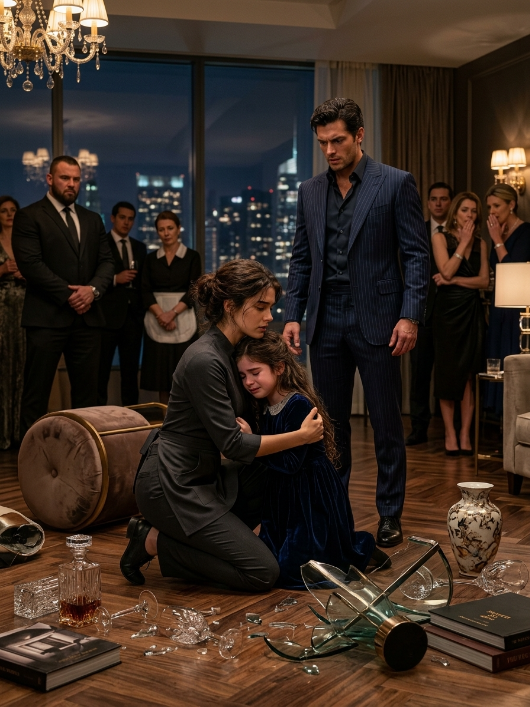
Clarina stood frozen at the altar, abandoned, drowning in a room full of people who considered her humiliation a form of entertainment. She closed her eyes and prayed for the floor to open.
That was when the heavy oak doors at the back of the cathedral exploded inward with a crash loud enough to stop every heart in the building.
The laughter died instantly.
Outside, the roar of high-performance engines swallowed the last notes of the organ. Four matte-black Mercedes and two armored Maybachs had jumped the curb and boxed in the church entrance. A dozen men in immaculate suits moved into the cathedral with terrifying, silent efficiency, sealing every exit before a single guest could think to scream.
“What is the meaning of this?” Richard Carmichael bellowed, rising to his feet. “Do you know who I am?”
One of the men in black looked at him. Just looked. Richard sat back down without another word.
Then the air in the room dropped ten degrees, and footsteps — slow, unhurried, entirely unafraid — echoed across the marble.
A man stepped into the light of the stained glass. Clarina had seen those eyes exactly once before, fourteen months ago, in a hospital with the power out, her hands buried in a stranger’s blood, fighting to keep his heart beating in the dark.
He had told her, that night, that he never left a debt unpaid.
He had just walked through a cathedral wall to prove it.
—
PART 2
His name was Gabriel Costa, and in the boardrooms of Boston and New York, people spoke about him the way sailors used to speak about storms — carefully, and only when necessary.
He wasn’t wealthy the way the Carmichaels were wealthy. He was something underneath that, something that controlled the ports and the unions and the parts of the East Coast that never showed up on a balance sheet. Six-foot-three, a faint silver scar through one eyebrow, a bespoke suit that cost more than most people made in a decade — and eyes that, the moment he crossed that cathedral threshold, found Clarina and didn’t look away from her again.
Richard Carmichael went white as a sheet. “That’s Costa,” he hissed to his wife. “Beatrice, shut up. Don’t say a word.”
Gabriel ignored every billionaire in the room. He walked the length of the aisle while four hundred of Boston’s most powerful people parted like water, and when he reached the altar, he stopped in front of Clarina and reached out to catch a tear from her cheek with a hand calloused enough to belong to someone who’d earned every dollar of that suit the hard way.
“They have no idea what they’re laughing at,” he said.
He took off his jacket and settled it over her shoulders, covering the dress the whole room had just spent five minutes mocking. Then he turned to Preston, and the tenderness in his face vanished entirely.
“You had a queen standing in front of you,” Gabriel said, “and you threw her away because a room full of court jesters laughed.” He didn’t raise his voice. He didn’t need to. “Your family owes my syndicate forty million dollars from last quarter’s failed shipping ventures, Preston. I was going to grant the extension your father’s been begging for.” A faint, dangerous smile. “Not anymore. I’m taking the ships. I’m taking the Newport estate. I’m taking it all.”
Beatrice gasped and clutched her chest. Richard buried his face in his hands. In under thirty seconds, Gabriel Costa had ruined the Carmichael dynasty in front of every witness who mattered to it.
Then he turned back to Clarina, and in front of the entire congregation, the most feared man on the Eastern Seaboard dropped to one knee on the marble floor.
He pulled a black velvet box from his vest and opened it. Inside sat a flawless twelve-carat vivid pink diamond, flanked by white spear-cut stones — a piece worth, by any jeweler’s estimate, well north of ten million dollars.
“You saved my life in the dark,” Gabriel said, looking up at her. “You asked for nothing in return. I have wealth. I have power. I have an army. I don’t have peace. You gave me peace, Clarina. Let me be the shield you deserve. Marry me. Say yes, and no one in this city will ever laugh at you again.”
Preston found his voice first, panic and sudden, desperate greed twisting his face as the scale of his family’s ruin finally landed. “Clarina — don’t. He’s a criminal. The FBI’s been trying to build a case against him for years—”
He didn’t get to finish. Gabriel raised two fingers without even turning his head, and one of his men had Preston pinned against a marble pillar before the sentence was done.
Clarina looked down at the man kneeling in front of her — a man the world called a monster, offering her a diamond worth more than the church itself — and then at the family who’d spent a year teaching her exactly what their kind of love was worth.
“Yes,” she said, her voice steady enough to carry to the back pew. “Yes, Gabriel.”
What happened in the six months after that — the hostile takeover that erased the Carmichael fortune by sundown, the SEC files, the true reason Preston had abandoned her at the altar in the first place, and the wedding she finally got to have, on her own terms, in her grandmother’s dress — is where this story actually begins.
—
PART 3
**Chapter One: The Dress**
Clarina Davies had spent two sleepless nights hunched over her grandmother’s 1980s Singer sewing machine, the same one that had lived under a dust cover in her mother’s attic for as long as she could remember, and she had let herself believe, somewhere around three in the morning on the second night, that this was actually going to be enough.
The dress was simple — shantung lace over a modest cotton lining, cut in a style that hadn’t been fashionable since before Clarina was born. It wasn’t a Vera Wang. It wasn’t even close to whatever Beatrice Carmichael had originally imagined for her son’s wedding. But it had been her grandmother’s, worn once, fifty years earlier, in a small church in a town nobody at St. Mary’s Episcopal had ever heard of, and it was the only thing standing between Clarina and walking down the aisle in her slip.
Three days before the wedding, her actual dress — three thousand dollars of silk she’d saved for over a year on an ER nurse’s salary, working double shifts at Boston Medical Center to afford it — had been ruined. Beatrice’s assistant had “accidentally” spilled an entire tray of blackberry mimosas across the bodice during a final fitting. Beatrice’s apology had been hollow enough to see through from across the room. There wasn’t time to buy a replacement, she’d said. Clarina would simply have to make do.
“Mother’s stressed,” Preston had told her, with the same easy shrug he used for anything that inconvenienced him. “Don’t make a big deal out of it.”
So Clarina hadn’t. She’d altered her grandmother’s dress instead, taken in the waist, hemmed the skirt, and told herself, somewhere in the exhausted small hours of the morning, that love was supposed to see past things like fabric.
She was twenty-seven, a trauma nurse who’d spent five years learning to stay calm while other people’s worst days happened in front of her — codes, gunshot wounds, the particular chaos of an ER on a Saturday night — and none of that experience had prepared her for the particular cruelty of Boston’s high society, dressed up in pearls and pretending it was just honesty.
“It looks exactly like what it is,” Chloe Carmichael said, sweeping into the bridal suite and adjusting a five-thousand-dollar diamond choker in the mirror without so much as a glance at Clarina. “A thrift-store tragedy. Are you seriously walking down our aisle in that?”
“It was my grandmother’s,” Clarina said, lifting her chin. “It means a lot to me, Chloe.”
“Just don’t stand too close to the floral arrangements.” Chloe was already turning for the door. “We paid eighty thousand dollars for the white orchids. I’d hate for your cheap polyester to ruin the aesthetic.”
It wasn’t polyester. It was cotton, and lace, and fifty years of careful storage, and love from a grandmother Clarina had lost when she was nineteen. But there was no explaining that to a Carmichael. There never had been.
**Chapter Two: The Aisle**
When the heavy doors of the sanctuary finally opened and the organ swelled into Wagner’s bridal chorus, Clarina took the deepest breath of her life and stepped into the vaulted nave alone. She had no father to walk her down the aisle — he’d left before she could remember his face — so she gripped her bouquet of simple white roses and walked by herself, past four hundred of the wealthiest people on the Eastern Seaboard, all of them turning to look.
The whispers started before she’d made it a third of the way down.
“Is that cotton? Good lord, it looks like a nightgown.”
“I heard Beatrice refused to pay for a replacement. Can you blame her?”
“Preston looks absolutely mortified.”
Clarina fixed her eyes on the altar, on the man she’d fallen in love with over candlelit dinners and long, sweeping promises about the life they were going to build together, and waited for him to look at her the way he used to. Instead, she found Preston shifting in his bespoke tuxedo, jaw clenched, face flushed with an embarrassment that had nothing to do with love and everything to do with appearances. His eyes weren’t on hers. They were fixed on the fraying lace at her collarbone, like it was something that might be contagious if he looked at it too long.
When she finally reached the altar, the silence in the cathedral was total.
“Dearly beloved,” the priest began, his voice echoing against the stained glass, “we are gathered here today to unite Preston and Clarina—”
“Stop.”
The word cracked across the church like a whip. Clarina turned, already knowing before she saw her exactly who had spoken.
Beatrice Carmichael rose from the front pew, rigid, her eyes dripping with contempt she’d clearly been rationing all morning for exactly this moment.
“Mother, please,” Preston hissed. He made no move to stop her.
“I will not sit here and watch my son make the biggest mistake of his life,” Beatrice announced, her voice carrying with the flawless projection of a woman who’d spent decades practicing exactly this kind of public cruelty. She gestured at Clarina like she was something found on the bottom of a shoe. “Look at her, Preston. Look at what she is wearing to the most important society event of the decade. She didn’t even try. She is making a mockery of our family name. She looks cheap.” A pause, timed for maximum damage. “She *is* cheap.”
Laughter rippled through the crowd — low, delighted, utterly without shame. A few guests actually pulled out their phones to film it.
Clarina’s heart shattered against her ribs. Hot, fast tears pricked at her eyes, and she turned to Preston with the last desperate hope she had left.
“Preston. Say something. Defend me.”
He looked at his mother. He looked at the sea of judging billionaires. And then he looked at Clarina with eyes that had gone completely, deliberately cold.
“She’s right, Clarina.” He stepped back from the altar, physically distancing himself from her like she might stain his tuxedo just by proximity. “I have investors here. The board of directors is watching. I told you to look presentable, and you show up looking like a peasant. I can’t tie my family’s legacy to this.”
“Preston, it’s my grandmother’s dress. Your mother ruined mine.”
“Enough.” His voice snapped through the microphone, ricocheting off the vaulted ceiling. “The wedding is off. I’m so sorry to my family and our guests for this embarrassment.”
The laughter grew louder. One of Chloe’s wealthy friends purposefully bumped into Clarina, knocking the bouquet from her hands. “Whoops. Time to take the trash out,” the girl giggled, and the sound of her own amusement seemed to invite the whole room to join in.
Clarina stood frozen at the altar, abandoned, discarded like garbage over a piece of fabric by the man she had genuinely believed loved her. The elite crowd sneered and pointed and whispered, drowning her in humiliation thick enough to choke on. She closed her eyes and wished, with everything she had left, that the marble floor would simply open and swallow her whole.
That was when the heavy reinforced oak doors at the back of the cathedral exploded inward with a violent, ear-splitting crash.
The laughter died instantly.
**Chapter Three: The Debt**
Outside, the roar of high-performance engines drowned out even the memory of the church organ. Four matte-black Mercedes G-Wagons and two armored Maybachs had jumped the curb and boxed in the entire church entrance, and before anyone in the pews could think to scream, a dozen men in immaculate tailored suits poured through the shattered doors with a silent, terrifying efficiency that had nothing in common with the chaotic panic of an actual robbery. They didn’t look like wedding crashers. They looked like the last thing four hundred rich, comfortable people had ever expected to see inside a cathedral — professional, armed, and completely unbothered by anyone’s title.
“What is the meaning of this?” Richard Carmichael bellowed, rising to his feet, his voice carrying the particular authority of a man who had never once, in his entire life, been told no by anyone who mattered. “I am calling the chief of police. Do you know who I am?”
One of the men in black turned and looked at him. Just looked — a dead, empty stare that made the billionaire’s throat close around whatever he’d been about to say next. Richard sat back down without another word.
Then the air in the room seemed to drop ten degrees all at once, and footsteps — slow, deliberate, entirely unhurried — echoed across the marble floor.
Gabriel Costa stepped into the colored light of the stained glass.
He was a name spoken in careful, lowered voices in the boardrooms of Boston and New York — not wealthy in the way the Carmichaels understood wealth, but something underneath that, something that moved through the ports and the unions and the parts of the East Coast economy that never showed up in an annual report. Six-foot-three, razor-sharp features, dark eyes, a faint silver scar cutting through one eyebrow. He wore a bespoke charcoal three-piece suit that cost more than most people made in a decade, a Patek Philippe flashing at his wrist, and an aura that made four hundred of the most powerful people in New England instinctively shrink back in their pews.
“That’s Costa,” Richard hissed to his wife, his face gone completely white. “Beatrice, shut up. Don’t say a word.”
Preston, moments ago so arrogant and image-conscious, now looked like a frightened child. He backed away from the altar and nearly tripped over the hem of the priest’s robe.
Gabriel ignored all of it — the billionaires, the trembling groom, his own men securing the perimeter. His eyes were locked entirely on one person.
Clarina stared back at him, her breath catching in her throat, because she knew exactly who he was.
Fourteen months earlier, during a citywide blackout at Boston Medical Center, a man had been carried in through the loading dock, bleeding out from a severed femoral artery, the aftermath of some violent business Clarina had never asked about and never would. The hospital’s backup systems had failed. The other doctors on shift had panicked in the sudden dark. Clarina hadn’t. She’d clamped the artery with her bare hands, working by the light of a flashlight held in her own teeth, covered up to her elbows in a stranger’s blood, and she hadn’t asked him a single question the entire time. She’d just fought, the way she fought for every patient who came through those doors, to keep his heart beating.
Before his men quietly moved him out of the hospital ahead of dawn, he’d grabbed her bloody wrist.
*I owe you a life, little bird,* he’d whispered, his voice ragged with pain. *And Gabriel Costa never leaves a debt unpaid.*
She hadn’t seen him again. Until now.
**Chapter Four: The Proposal**
Gabriel walked slowly down the aisle, and the crowd of terrified aristocrats parted for him like water finding the path of least resistance. When he reached the altar, he stopped in front of Clarina, and the most feared man on the Eastern Seaboard looked down at her with a softness that made no logical sense in the middle of everything he’d just done to get there.
He reached out and caught a tear on her cheek with a calloused thumb.
“They have no idea what they’re laughing at, Clarina,” he said, his voice carrying easily through the dead silence of the church. He shrugged off his suit jacket and draped it over her shoulders with a care that felt almost ceremonial, covering the dress the entire room had just spent five minutes tearing apart. It smelled of expensive cologne and something colder underneath, and it made her feel, for the first time all day, like someone was actually protecting her instead of merely standing near her.
Then he turned to Preston, and every trace of softness disappeared from his face.
“You,” Gabriel said, the single syllable dripping with contempt. “You had a queen standing in front of you, and you threw her away because a room full of court jesters laughed.”
“I—” Preston’s knees were visibly shaking. “Mr. Costa, please. This is a private family matter.”
“Nothing regarding Clarina is private to me anymore.” Gabriel stepped closer, the height difference between them staggering, deliberate. “Your family owes my syndicate forty million dollars from last quarter’s failed shipping ventures. Your father has been begging me for an extension. I was going to grant it.” A dark smile crossed his mouth. “Not anymore. I’m taking the ships. I’m taking the Newport properties. I’m taking it all.”
Beatrice let out a strangled gasp, clutching her chest. Richard buried his face in his hands. In under a minute, Gabriel Costa had dismantled the Carmichael dynasty in front of every witness whose opinion it had ever mattered to.
He turned his back on the ruined groom and faced Clarina again. The entire church watched in paralyzed silence as the most dangerous man in America gracefully lowered himself to one knee on the marble floor.
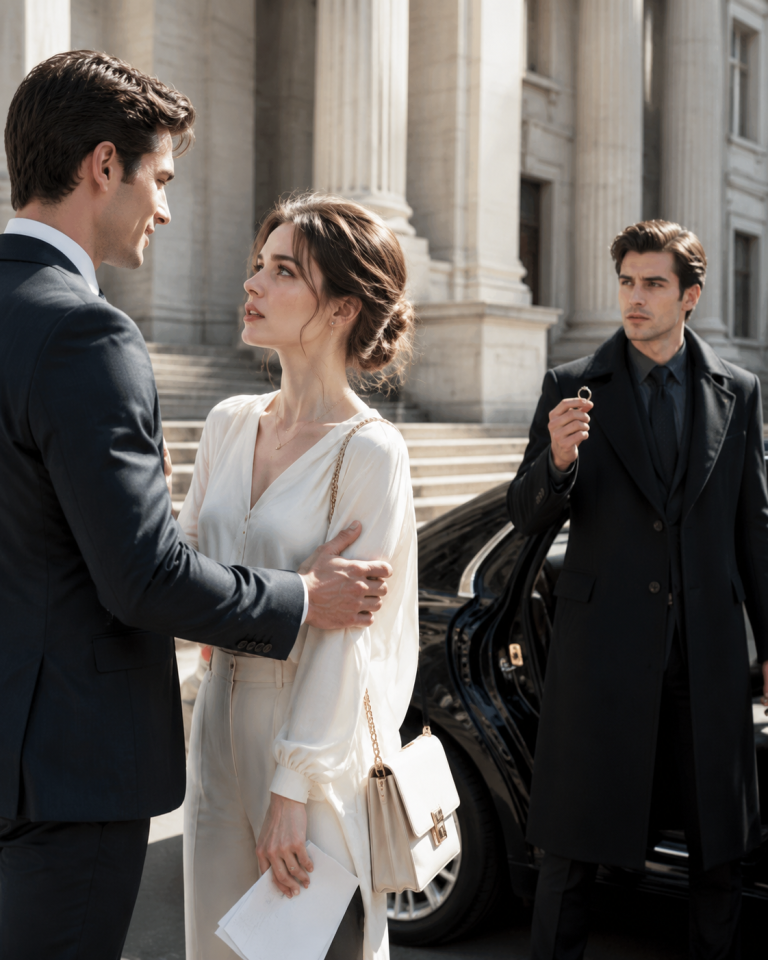
He pulled a black velvet box from his vest pocket and opened it. Sunlight caught the stone inside and nearly blinded the front row — a flawless twelve-carat vivid pink diamond, flanked by two spear-cut white stones, a custom Graff piece worth, by any serious estimate, north of ten million dollars.
“You saved my life in the dark, Clarina,” Gabriel said, looking up into her wide, shocked eyes. “You asked for nothing in return. For over a year, I have watched from the shadows to make sure you were safe. But watching this—” his jaw tightened, gesturing at the altar, at Preston, at the whole ruined ceremony — “I will not stand in the shadows anymore.”
He took her left hand, his thumb brushing across her knuckles.
“Let me be the shield you deserve. Marry me. Let me give you my empire, my protection, and my life. Say yes, and I promise you — no one in this city will ever dare laugh at you again.”
**Chapter Five: The Answer**
Clarina stood frozen, the weight of ten million dollars glittering in front of her, the eyes of every terrified aristocrat in the building watching her decide her own future in real time.
Preston found his voice first, panic and sudden, ugly greed twisting together on his face as the full scale of his family’s collapse finally landed on him.
“Clarina — don’t do this. He’s a criminal. The FBI’s been trying to build a RICO case against him for years. You can’t seriously be considering this. We just had a misunderstanding. We can fix this.”
Gabriel didn’t even turn his head. He raised two fingers, and a mountain of a man in a Brioni suit materialized out of the shadows, grabbed Preston by the collar of his tuxedo, and shoved him back against a marble pillar hard enough to knock the air out of him.
“Keep your mouth shut, Carmichael,” the bodyguard said, forearm pressed against Preston’s throat, hand resting on the grip of a concealed weapon.
Beatrice let out a muffled shriek. The senators and hedge fund managers and real estate tycoons filling the pews shrank back into their seats, people accustomed to wielding power through lawyers and boardrooms, utterly without defense against the raw, unadorned force standing in their aisle.
Clarina looked at Preston, pinned and pathetic against the pillar, and then down at Gabriel, whose dark eyes were fixed entirely on her — patient, remarkably tender, a jarring contrast to the chaos he’d just walked in and created.
“Why?” she whispered. “Why go to all this trouble for me?”
“Because in a world full of people who only look at what they can extract from others,” Gabriel said quietly, meant for her alone, “you are the only person who ever looked at me and saw a life worth saving. I have wealth. I have power. I have an army. I don’t have peace. When you touched me in that emergency room — when you fought for a man you didn’t even know — you gave me peace. You are worth more than every ship the Carmichaels own.”
A tear slid down Clarina’s cheek, washing away the last traces of the humiliation she’d been drowning in ten minutes earlier. In its place came something she hadn’t expected to feel at her own wedding: a fierce, unfamiliar sense of power. She didn’t care anymore what the room thought of her. She didn’t care about the rumors that would follow this moment for years. She looked at the man who had just dismantled her bullies without a second thought, and she made her choice.
“Yes,” Clarina said, and her voice carried clearly through the vaulted ceiling of the nave. “Yes, Gabriel.”
A genuine, breathtaking smile broke across his stoic face. He took her left hand and slid the diamond onto her finger — heavy, cold, and a perfect fit — the stone catching the stained glass light and scattering it in fractured color across the church. He rose, wrapping his arm around her waist, pulling her against his side, and turned back to the terrified crowd with all the warmth gone from his eyes.
“Arthur.” A sharp-dressed lieutenant stepped forward with a tablet already open. “Execute the hostile takeover of Carmichael Shipping. Call Harrison at the SEC — anonymously forward the encrypted files I gave you last night, the ones detailing Richard Carmichael’s offshore tax evasion and the fabricated quarterly earnings. Then call First National Bank of Boston. Call in every one of their margin loans. Today.”
Richard let out a choked gasp, clutching his chest. “Gabriel — Mr. Costa, please. You’ll destroy five generations of wealth in an afternoon. You’ll put us on the street.”
Gabriel’s expression didn’t move. “You put my future wife on display to be mocked. You laughed at her grandmother’s memory. Be grateful, Richard. I’m only taking your money.”
Beatrice broke completely. The arrogance that had defined every year of her life since birth shattered all at once, and she scrambled forward, falling to her knees at Clarina’s feet without a single thought for the fifteen-thousand-dollar Chanel dress dragging across the marble.
“Clarina, please,” she sobbed. “You’re a kind girl. You’re a nurse — you heal people. Tell him to stop. I beg you. The dress is beautiful. It really is. I’m sorry.”
Clarina looked down at the woman who had tormented her for over a year, and felt, briefly, an unwelcome flicker of pity. Then she remembered the ruined silk, the sneering, the cold abandonment at the altar in front of four hundred witnesses.
“You’re right, Beatrice. I do heal people,” Clarina said quietly, her voice ringing with an authority she’d never had reason to use before. “But some infections need to be cut out.”
Gabriel smirked, clearly, unmistakably impressed. He pressed a kiss to the side of her head. “Let’s go home, little bird.”
**Chapter Six: What They Didn’t See Coming**
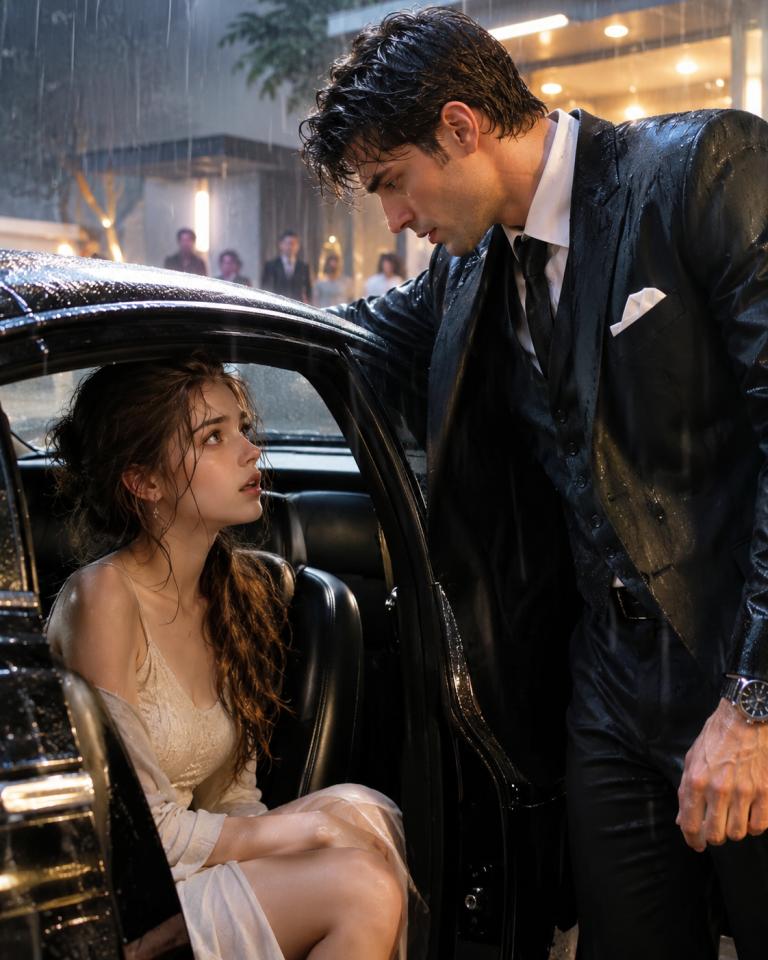
Surrounded by a phalanx of armed men, Gabriel led Clarina back down the aisle. The same aristocrats who’d been laughing at her ten minutes earlier now cast their eyes to the floor, unwilling even to look directly at the woman who had just become, in every way that mattered, the new power in the room. They walked out through the shattered oak doors and into bright Rhode Island sunshine, and Gabriel opened the armored door of the lead Maybach himself.
Clarina climbed into the plush leather interior, the smell of new money and old danger settling around her, and watched through the tinted window as the Carmichael dynasty physically and metaphorically crumbled in the rearview mirror.
Six months later, the Boston Seaport District glittered against a twilight sky, and inside the penthouse office of the newly established Davies Medical Foundation, Clarina stood at the floor-to-ceiling windows reviewing a stack of architectural blueprints.
Her life had transformed entirely, but the center of who she was hadn’t moved an inch. She hadn’t abandoned medicine. With the limitless backing of Gabriel’s legitimate business fronts, she’d founded a state-of-the-art trauma clinic dedicated to uninsured and low-income patients — the kind of care she’d spent years trying to give people on an ER nurse’s budget and an ER nurse’s limited resources. She wore a sharp navy pantsuit now instead of scrubs, and on her left hand, the twelve-carat pink diamond caught the last of the city light.
A soft knock interrupted her. Gabriel walked in, shrugging off his jacket, rolling up his sleeves to reveal forearms mapped in careful ink, the ruthless kingpin of Boston softening, as he always did, the moment he crossed the threshold into her space.
“You’re working late, Dr. Davies,” he said, wrapping his arms around her from behind, pressing a kiss to her neck.
“Just finalizing the pediatric wing.” She leaned back against him. “Did Arthur handle the supply chain issue?”
“Handled.” Dark amusement flickered in his eyes. “Speaking of supply chains — I have a late wedding gift for you. Something my men uncovered auditing what’s left of Carmichael Shipping.”
Clarina turned, raising an eyebrow. “I thought we were done with them. I read in the Globe that Richard’s facing federal indictment. They had to auction the Newport estate.”
“We are done with them,” Gabriel agreed, tracing a finger down her cheek. “But I needed you to know the full truth of why you were standing at that altar in the first place.”
He crossed to her desk and set a manila folder on the glass surface.
“Preston never intended to marry you, Clarina. The Carmichaels have been quietly bankrupt for two years — hemorrhaging money on failed shipping ventures. The only way Preston could save the family was by marrying Victoria Kensington, heir to the Kensington banking fortune. But Victoria wouldn’t commit until Preston ended things with you.”
Clarina stared at the folder, the final pieces sliding into place — the ruined dress, the hostility, the very specific, very deliberate humiliation at the altar. “It wasn’t an accident.”
“No,” Gabriel said, his voice cold. “Beatrice orchestrated the spill on your gown. Preston orchestrated the public humiliation. They wanted you to look so pathetic, so cheap, that ending things with you at the altar would look justified to their friends. They wanted the story to be that you were a fraud — clearing the way for Preston to pivot to Victoria without any of Boston’s old money batting an eye.”
A cold chill moved down Clarina’s spine. It wasn’t just snobbery. It had been a calculated, deliberate assassination of her character, planned weeks in advance.
“But you ruined it,” she said slowly, a smile spreading across her face as the shape of it became clear. “By destroying their company before Preston could marry Victoria — the Kensingtons backed out.”
“Exactly.” Gabriel’s grin turned distinctly wolfish. “No one wants to merge with a bankrupt, federally indicted family. Preston’s currently managing a mid-level logistics warehouse in New Jersey. His mother’s in a two-bedroom apartment in Queens.” A pause. “They got exactly what they deserved.”
Clarina looked at the man in front of her — the one the world called a monster, a criminal, a threat to be whispered about in boardrooms — and understood, with total clarity, that he had done more than rescue her from a single humiliating afternoon. He had systematically dismantled the machine that built her humiliation in the first place.
“Thank you,” she whispered, stepping into his arms.
“I told you, little bird. I don’t leave debts unpaid.” He rested his forehead against hers. “Now — we have a plane to catch. Our actual wedding starts in forty-eight hours.”
**Chapter Seven: Lake Como**
Two days later, on the private, heavily guarded shores of Lake Como, Italy, Clarina finally got the wedding she deserved.
There were no laughing socialites. No sneering aristocrats angling for the best camera position. The guest list consisted entirely of Gabriel’s most trusted inner circle — men and women who respected Clarina not for a bank account she’d never had, but for the unshakable spirit that had, against every reasonable expectation, tamed their boss.
As the sun set over the water, casting a gold light across the villa’s stone terrace, Clarina walked down the aisle again. She wore the same dress. Her grandmother’s vintage cotton and shantung lace, the one that had been mocked in front of four hundred people less than a week earlier.
But Gabriel had quietly flown in a master tailor from Milan. They hadn’t changed the design — not a single line of it. They’d reinforced the delicate lace, and hand-stitched hundreds of tiny, flawless diamonds into the bodice, until the humble, decades-old fabric shimmered like something cut from the night sky itself.
Gabriel waited for her at the altar in a classic black tuxedo, and when she reached him, his eyes were full of a reverence that had nothing to do with the diamonds and everything to do with the woman wearing them. He didn’t see a cheap dress. He never had. He saw the woman who had braved total darkness to save a stranger’s life with her bare hands, standing in front of him now as his equal, his partner, and — in every sense that mattered to either of them — his queen.
They exchanged vows under a canopy of white roses, an ocean away from the toxic glitter of Boston society, and when Gabriel finally pulled her in for a kiss that sealed it, the small crowd erupted into genuine, unguarded applause — the first celebration either of them had experienced all week that didn’t have a price tag attached to it.
They had tried to bury Clarina Davies in humiliation. They had forgotten one crucial detail about her.
She was a survivor. And when she fell into the dark, she didn’t just find her way back out.
She found the king of the underworld waiting on the other side of it — and together, on their own terms, in a dress that had waited fifty years for exactly this moment, they built something that belonged to no one but themselves.
THE END