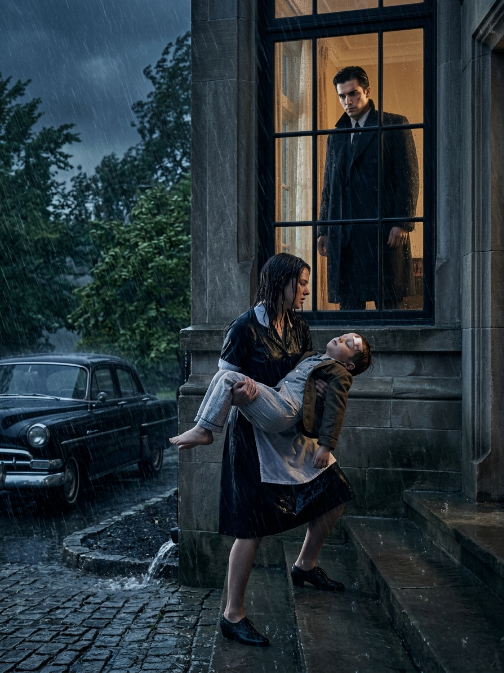
The Mafia Boss Exploded in Rage When He Found His Employee Freezing in the Snow on Christmas

## PART 1
The thing nobody tells you about hypothermia is how reasonable it makes dying feel.
You stop shaking. The pain in your hands and feet fades into something distant and almost polite. Your thoughts slow from panic to something that resembles peace, and that is the most dangerous part — when the cold convinces you that rest is not surrender, that closing your eyes is simply practical, that no one is coming anyway and perhaps that is fine.
I know this because I was nearly there.
Curled against the locked side entrance of a Ferrante family warehouse on the eastern edge of Chicago, snow piling in the gap between my knees and my chest, the last charge on my phone gone for two hours, I was starting to believe the cold.
Christmas Eve.
I had been there since six o’clock. It was approaching ten.
The man assigned to drive me back to the city had received a phone call at the loading dock and told me to wait inside while he sorted something urgent at the docks. He had said it the way people say things they don’t expect to be held to. *Give me twenty minutes.* Then he had driven away in one of the company cars, and the building’s holiday lockdown had engaged behind him, and my keycard had stopped working, and every number I tried from inside the security vestibule had reached voicemail, and the snow had thickened from inconvenient to punishing.
My name is Clara Voss, and I am — was — the head accountant for the Ferrante family’s legitimate holdings.
Not a glamorous title. Nothing like what people imagine. My days were built from spreadsheet formulas, tax filing structures, vendor reconciliation, and the careful, painstaking work of keeping several dozen businesses looking exactly as clean as they were supposed to look. Numbers that behaved, numbers that didn’t, and the narrow corridor between them where I spent most of my working life.
I knew enough about the rest. You don’t last eighteen months in that world without understanding the weight behind certain invoices, certain addresses, certain names that appeared on contracts but never in meetings. You learn which questions are professional and which are suicidal, and you choose your questions accordingly.
Luca Ferrante, who owned all of it, was not a man anyone questioned.
He ran Chicago’s most powerful crime organization with a kind of controlled authority that I had come to understand, from a safe professional distance, was rarer and more frightening than simple violence. Other men scared people with volume. Luca scared them with calm. He was tall, heavy-shouldered, with dark eyes that processed everything and gave back very little. The tattoos on his hands and neck disappeared into the collars and cuffs of suits that looked like they had been cut for someone who was never supposed to be approachable.
Everyone who worked for him was afraid of him.
I was afraid of him too.
But I had made the mistake of being afraid and something else besides, and the something else had been following me quietly for months, sitting in the corner of every late-night accounting session, present every time I sensed him standing in the doorway before he spoke.
Now, with my toes entirely numb and the cold working upward past my knees, I thought about that something else with the specific cruelty of a mind that knows it is running out of time.
I thought: I never said it.
I thought: I never even let myself know what it was until just now.
I thought: *of course.*
Then headlights tore through the snow.
Not a delivery truck. Not security. The beam was too focused, too purposeful. An engine that made no apologies for the weather. The car stopped with the kind of controlled urgency that means someone has been moving fast for a reason.
A door. Footsteps, heavy and direct.
Then a voice I recognized immediately, even through the ringing in my ears.
“*Clara.*”
Luca Ferrante was crouching in front of me in the snow, his coat open, tie loosened, his face stripped of every careful expression I had ever seen him manage, and what was left underneath was something I had no name for except *raw.*
He said my name again like the word itself was a command.
“Look at me. Clara, open your eyes and look at me.”
I tried to speak.
My mouth refused.
Something moved through his jaw — a tightening, a decision — and then his arms were around me, lifting me entirely off the frozen concrete, and the warmth of his body hit me like a physical shock.
I pressed my face into his coat without thinking.
Behind him, the black Mercedes sat running with every vent open and blasting heat. He placed me inside with a care that seemed almost incompatible with his hands, and then he was in beside me, and he pulled off his jacket and wrapped it around my wet shoulders, and his expression was still doing the thing it had no name for.
“How long?” he said.
“Four hours,” I managed. “Maybe more.”
Something dangerous moved behind his eyes.
“*Ricci.*” He said the name of the man assigned to my transport with the particular quiet that meant the matter was no longer a personnel issue but something with a different kind of consequence.
Then he turned back to me, and his hands — careful, efficient, not rough even now — were peeling the soaked coat away from my body.
“I’m all right,” I said, which was not true.
“You are not.”
He pulled his shirt over his head.
I stopped arguing.
The tattoos covered his chest and shoulders and ribs, saints and dates and things I couldn’t read in the low light, and his body was warm in the way of someone whose blood ran at a different temperature than fear, and when he pulled me against him and held the blanket closed around us both I pressed my cheek to his chest and felt his heart.
It was not slow.
It was not steady.
Luca Ferrante, who had never once appeared frightened of anything, was afraid.
“How did you find me?” I asked. My voice came out thin. Grateful and confused in equal measure.
“I was reviewing the security logs.” He said it like it was obvious. “Your keycard accessed the warehouse at seventeen forty-two and never logged an exit. Ricci told me transport had been handled. I pulled the cameras.”
“You checked.”
“I watched you sit down.” His voice tightened. “I watched the snow get worse. I watched the lot empty.”
A pause.
“I drove myself.”
Those three words carried more weight than anything else he could have said, and I was not warm enough yet to know how to receive it.
“The car,” he said. “When I saw you on the screen—”
He stopped.
Started again.
“Do you know how many people work in my organization, Clara?”
I shook my head.
“Several hundred. Across businesses, warehouses, construction sites, restaurants, the docks. Staff I’ve had for fifteen years. Men who would take a bullet for the family name.”
His thumb moved once along my jaw, not intentional, just contact.
“How many do you think I have personally driven through a blizzard to find?”
I already knew the answer.
I felt it in the way he was holding me, the way his heartbeat hadn’t slowed, the way my name had sounded in his mouth like something precious being recovered from ice.
But I was still cold enough that the answer felt dangerous to say.
“Luca—”
“One.”
The heater ran. The storm pressed against the windows. His heart hammered beneath my ear.
And I realized that the something else I had spent eighteen months carefully not naming had apparently been named by him long before tonight.
—
## PART 2
He took me to his house.
I should have argued. I knew I should have — urgent care, my own apartment, a hotel, anywhere that kept the boundaries of our professional relationship from dissolving entirely in the aftermath of a near-death experience.
I didn’t argue.
The house sat north of the city, behind private gates, all glass and stone and deliberate angles. Beautiful the way buildings are beautiful when they haven’t been interrupted by genuine living. Carver, his head of security, met us at the garage. He took one look at me and then at Luca’s expression and apparently decided all questions were a poor idea.
Luca carried me inside again, which I allowed because my legs were still uncertain.
He put me in a chair at the kitchen island and immediately moved to the kettle.
“Tea,” he said.
“Please.”
He moved through his own kitchen with the focused economy of a man who had learned to need very little from domestic spaces. I watched him from across the counter and tried to understand the version of him that existed here, without the suit jacket, with his collar open and his forearms visible, the tattoos that climbed past his wrists.
He set the mug in front of me.
“Thank you,” I said.
“Stop thanking me.” He leaned against the counter across from me. “This never should have happened.”
“Ricci didn’t intend—”
“Intention is not the standard.”
There was no volume to it. That was the thing about Luca — he didn’t need to raise his voice for a sentence to close a room.
“What will happen to him?” I asked.
Something passed through his eyes. “What would you like to happen?”
The question surprised me.
“I don’t want him hurt.”
“All right.”
“Do you mean that?”
“I mean it because you asked.” He met my eyes. “Not because I’m not angry.”
I held the mug and let the warmth travel up through my palms.
“I need to tell you something,” I said. “And I’m only saying it now because I almost didn’t get to say it at all, and that turns out to matter more than I thought it would.”
Luca waited.
“My sister has leukemia,” I said. “She’s been in treatment for fourteen months. The protocol that’s working is experimental. Insurance denied coverage. Every salary payment I’ve received from this organization has gone directly to keeping her alive.”
He said nothing.
“That is why I took this job. Not because I didn’t understand what it was. Not because I had no other options.” I looked at him. “Because I needed money and I was good enough that you hired me, and I have not regretted that calculation.”
Luca’s expression was doing the thing again. The one without a name.
“Why didn’t you tell me?”
“Because you pay me to do work. My personal life is mine.”
He crossed the kitchen in three steps and stopped directly in front of me.
“What hospital,” he said.
“Luca—”
“What hospital, Clara.”
“I’m not telling you so you can purchase a solution.”
“I know why you’re telling me. You’re telling me because you almost died in my parking lot and you needed someone to know the whole shape of your life before it ended.” His voice dropped. “Now I know. Tell me the hospital.”
I looked at him for a long moment.
The pride in me, the carefully maintained professional distance, the eighteen months of not-naming — all of it pressed against the words.
But my sister was running out of time, and Luca was standing close enough that I could still feel the warmth of his chest, and sometimes survival means knowing when to stop fighting the wrong battle.
I told him the hospital.
He took out his phone and made one call. Thirty seconds. Gave the name and the treatment protocol and said *find who I need to talk to* and ended the call.
Then he put his phone away and looked at me.
“Tomorrow,” he said. “Tonight you rest.”
“Luca. What are we doing?”
He was very still.
“What do you want to do?”
“Stop answering questions with questions.”
A breath. Almost a laugh. “You’ve said that to me before. About the payroll structure.”
“I say it whenever you’re avoiding the direct answer.”
“The direct answer,” he said slowly, “is that I have been watching you work in my building for eighteen months. I have read every report you filed even when I didn’t need to. Three weeks ago you were at your desk after midnight and I came in without a reason except that I knew you were there, and I told you to make sure someone drove you home and then I spent the drive back to this house trying to remember the last time I cared where anyone went.”
I didn’t breathe.
“And tonight I saw you on a security screen, alone, in the snow, because a man I trusted with your safety considered you low enough priority to forget.” His jaw tightened. “That is what we are doing, Clara. We are correcting that.”
Something in my chest came loose.
“You terrify me,” I said.
“Good,” he said. “You should have full information.”
“I’m not running.”
“I know.”
Then he kissed me.
Nothing cautious about it. Nothing performed. He kissed me like a man closing a distance he had been calculating for a long time, and I kissed him back with everything that had been sitting in the corner of eighteen months of careful professionalism, and outside the snow kept falling and the city kept turning white and neither of us pulled away until breathing made it necessary.
When he rested his forehead against mine, his eyes were closed.
“Tell me to stop if this is too much,” he said.
“It is too much,” I said. “Don’t stop.”
—
## PART 3
We slept in his bed that night.
Just slept.
He held me against his chest with his arms loose enough that I could move if I wanted to, and every time I shifted in the night he adjusted without waking, and sometime before dawn I realized I felt, for the first time in over a year, completely safe.
Not because danger had disappeared. Not because the world outside had gotten simpler.
Because someone knew I was here.
In the morning I woke to the smell of coffee and something cooking, and for one disoriented moment I forgot where I was. Then the memories arrived in order — snow, cold, headlights, Luca’s voice saying my name like it was important — and I pulled the blankets up to my chin and stared at the ceiling of a room that cost more than my monthly rent and thought: *well.*
I found him in the kitchen.
Jeans. Black T-shirt. Tattoos along both forearms visible past the cuffs. Barefoot on the heated floor, standing over a pan with the focused attention he brought to everything, including apparently Christmas morning eggs.
“You cook,” I said.
He glanced over his shoulder. “My mother insisted.”
“Where is she?”
“She died when I was nineteen.” He turned back to the pan. “Cancer.”
I came to stand near the island.
“My father too,” he continued. “Two years later. His heart. They said it was cardiac.”
“What do you think it was?”
“I think he didn’t want to be here without her.”
He said it without self-pity. Just as a fact he had made his peace with.
“My uncle raised me after that. Gave me the business when he retired. The whole inheritance — territory, alliances, debts, loyalties.” A pause. “The blood that comes with all of it.”
“I know what I know,” I said.
“Numbers aren’t the same as reality.”
“No. But they tell a version of it.” I sat down at the island. “I’ve been doing your books for eighteen months, Luca. I know which companies are shells. I know which vendors don’t exist. I know what the word *logistics* means when it appears on an invoice from a certain district.”
He turned and looked at me.
“And?” he said.
“And I’m still here.”
Something in his face shifted.
He came around the counter and placed a plate in front of me, then coffee. Then he sat across from me on the other stool, close enough that our knees almost touched, and we ate breakfast on Christmas morning in his too-clean kitchen while snow melted outside the windows.
After a while, he said, “Ricci.”
I set down my fork.
“He loses his position,” Luca said. “He loses his access. He does not work in this organization again.” He met my eyes. “He lives, because you asked.”
“Thank you.”
“I’m also changing the protocols.” He poured more coffee with the careful attention of someone who had made a decision overnight and was working through the logistics of it. “Transport assignments. Warehouse lockdown procedures. Emergency contact systems for all staff, not just senior people. Holiday staffing coverage.”
I looked at him.
“You stayed up planning that,” I said.
“I stayed up planning several things.”
“You were angry.”
“I was.” He set down the carafe. “But anger is a feeling. Systems are what prevent the reason for the anger from recurring. I learned that distinction late. I am still learning when to apply it.”
The way he said it — simply, without performance — reached somewhere in me that the warmth and the safety and even the kiss had not quite found.
“My sister,” I said.
“Dr. Anand Shah. Northwestern Memorial. He’s the lead on the experimental protocol. I have a call with him this afternoon.”
My throat tightened so fast I had to look away.
“Clara.”
“Don’t,” I said.
“Don’t what?”
“Don’t let me cry at your kitchen island on Christmas morning.”
“Why not?”
“Because I’ve been holding this together for fourteen months and if I start I’m not sure I’ll stop.”
A pause.
Then his hand covered mine on the counter.
“Then don’t stop,” he said. “I’m not going anywhere.”
I cried.
Not the kind that looks good in movies. The exhausted kind. The kind that had been building in waiting rooms and insurance denial letters and late nights when the bills came in and the treatment calendar went out another three months and I went back to my spreadsheets and told myself *keep going, just keep going.*
Luca held my hand through all of it and did not say that it was all right or that it would be fine or any of the empty scaffolding people use to fill silence. He just stayed present, which was more than most people managed, and eventually the crying wound down into something quieter, and I wiped my face on the kitchen napkin and said, “I’m sorry.”
“Don’t.”
“I’m not usually—”
“You almost died last night,” he said. “In my parking lot. Because my organization failed you. And your sister is fighting for her life and you’ve been carrying that alone.” He looked at me steadily. “You’re allowed to be a person, Clara. Even here.”
I looked at him for a long moment.
“Especially here,” he said.
—
That afternoon became something neither of us had planned.
He made his mother’s hot chocolate — real chocolate, warm milk, cinnamon, a recipe he recited from memory with the precision of someone who had repeated it privately many times. We stood side by side at the stove arguing about the cinnamon quantity, which I felt was insufficient and he felt was correct, and we compromised by adding more and I told him his mother would have agreed with me and he said *probably* in a tone that was not entirely disagreement.
We talked for hours.
About his mother before the illness, and mine — alive, retired, unreachable by choice, a whole other story. About the sister I was trying to keep alive and the little ways I had memorized her face since the diagnosis, the specific shape of her laugh, the gap in her front teeth she had always hated and I had always loved. About the work and what it cost me to be good at it and why I had chosen to be good at it anyway.
He talked more than I expected. Not easily — he chose every sentence deliberately, the way someone speaks who has spent years in rooms where careless words had consequences. But he talked. About his uncle, who had been hard and fair and flawed. About the weight of the inheritance, the parts that looked like power from outside and felt like obligation from inside. About the decade he had spent building legitimate holdings large enough that the family could eventually move toward something that didn’t require blood weight in every ledger.
“Is that what you want?” I asked. “To move toward something different?”
“I want to build something that doesn’t require everyone I care about to live inside a fortress,” he said.
It was the most honest sentence I had heard from him.
I thought about it for the rest of the afternoon.
That evening, he gave me a necklace. A fine gold chain with a small diamond — elegant, understated, the kind of thing chosen with attention rather than price.
“There is a tracker in the setting,” he said immediately.
I looked at him.
“I considered not telling you,” he said. “I decided not telling you was not something I was willing to do.”
“Show me.”
He showed me the application on his phone. The settings. The ability to disable it entirely. The emergency function that broadcast to both him and Carver with one press. The option to share location only with specific people or under specific conditions.
I studied it for a long time.
“This is because of last night,” I said.
“Yes.”
“You’re afraid it will happen again.”
“I changed the protocols so it can’t,” he said. “This is because I will be afraid anyway, and I would rather have something honest about it than pretend I’m not.”
I turned the necklace over in my hands.
There was a version of me — the version that had maintained professional distance for eighteen months, the version that had carried everything alone, the version that had learned not to need — who would have handed it back. Who would have framed it as control, as possession, as the thing she had always been careful to avoid.
But Luca had told me before I decided. He had shown me the settings. He had given me the off switch.
He had, in the middle of a gesture that could have been about ownership, made it about choice.
“I control it,” I said.
“Entirely.”
I held it out to him and lifted my hair.
His hands on the clasp were steady, but when I turned back around, his expression was the one with no name again — the one I was beginning to recognize as the face he made when something mattered more than he was practiced at showing.
“Thank you,” I said.
He shook his head.
“Thank you,” he said.
—
I moved into his house in February.
Not all at once. Not under any pressure. My lease ran out, which was practically convenient, but the real reason was simpler and harder to say: I had spent fourteen months constructing a life that could survive solitude, and somewhere between Christmas Eve snow and Christmas morning cinnamon arguments and the phone call with Dr. Shah that resulted in treatment approval within the week, I had started to find solitude less necessary than I’d thought.
I brought my books. A ridiculous number of them, stacked in the moving boxes alongside my accounting files.
Luca stood in the foyer watching two of his men carry boxes past him with the specific expression of a man recalibrating his spatial assumptions.
“How many books,” he said.
“Enough.”
“There are twelve boxes.”
“And.”
He looked at me.
“They stay,” I said.
They stayed.
So did the ceramic pitcher shaped like a fish that had belonged to my grandmother. Luca placed it on the kitchen counter with the energy of a man respecting a foreign custom he did not fully understand, and I kissed him on the cheek and he stood there for a moment as if the gesture had surprised him somewhere below his usual architecture.
He was not easy to live with, in the ways I had expected.
He left without explanation. He returned silent. He carried things from certain nights in the set of his shoulders and would not put them down until he slept, and sometimes not even then. We had conversations about where the line was between what he shared and what he protected me from, and we marked the line in different places more than once and had to find it again.
But he asked.
That was the part I had not expected, and it became the part that mattered most. He asked where the line was. He asked what I needed. He asked, late at night when the city was quiet and his guard was lowest, if I was all right — not as a formality but as a real question, the kind that waits for the real answer.
I was learning to give real answers instead of reflexively fine.
He was learning that fine was not an answer.
We were, in our different ways, learning.
—
My sister met him in March.
She was in the middle of her fourth treatment cycle, still exhausted but measurably better — Dr. Shah’s word was *responding*, and that word had become the most important word in my vocabulary. She sat in her hospital bed in a Chicago Bears sweatshirt she had worn since college and interrogated Luca Ferrante with the complete fearlessness of a woman who had been keeping score of her remaining energy and had decided to spend some of it on this.
“You look like you were designed to make people nervous,” she said.
“That’s accurate.”
“Are you actually nice to her? Not perform nice. Actually nice.”
“I’m learning.”
“Good answer.” She pointed at him. “She has spent five years taking care of everyone else. If I find out you’re adding yourself to that list in the wrong direction—”
“Mira,” I said.
“—I will become a problem for you regardless of who you are.” She looked at me. “She’s allowed to be someone’s priority for once.”
Luca was quiet for a moment.
“I know,” he said.
And the way he said it — not to manage her, not to end the conversation, but with the weight of someone acknowledging something true — made my sister sit back against her pillow and look at him differently.
“Okay,” she said.
On the drive home, he was quiet.
“What are you thinking?” I asked.
“That she’s right.”
“About what?”
“That you’ve been everyone else’s resource for a very long time.” He kept his eyes on the road. “That I intend to be aware of that every day.”
I looked at his profile in the passing city light.
“You intend to,” I said.
“I will not always succeed.”
“I know.”
“But I intend to.”
I reached over and put my hand on his.
He turned his hand over and held it.
—
He proposed the following Christmas Eve.
Not in a restaurant. Not in front of anyone. He drove me back to the warehouse on the eastern edge of Chicago, and I hated him for the thirty seconds between recognizing where we were and understanding what he had done.
The side entrance had been rebuilt.
Not just repaired. *Rebuilt.* Heated concrete pad. A weatherproof shelter alcove with a door that couldn’t lock from outside. Emergency phone mounted in a glass case on the wall. Backup keycard terminal rated for power outages. Floodlighting that covered the full lot. And beside the entrance, a small plaque — not decorative, functional — listing the new emergency protocols for every staff member in the building.
He had changed the system.
Not as a gesture. Not to perform accountability. He had looked at the thing that failed and he had fixed it structurally, so it could not fail the same way again.
Snow was falling.
“I almost lost you here,” he said.
I looked at the place where I had sat a year earlier with my thoughts slowing and the cold making its argument.
“It’s also where you found me,” I said.
“I know.” He turned to face me. “I wanted to tear this building down. The same way I wanted to tear apart everything that had failed you that night.” He paused. “You told me systems matter more than rage. You told me that the first week we ever had a real conversation, about the payroll structure, and I have thought about it more often than I expected.”
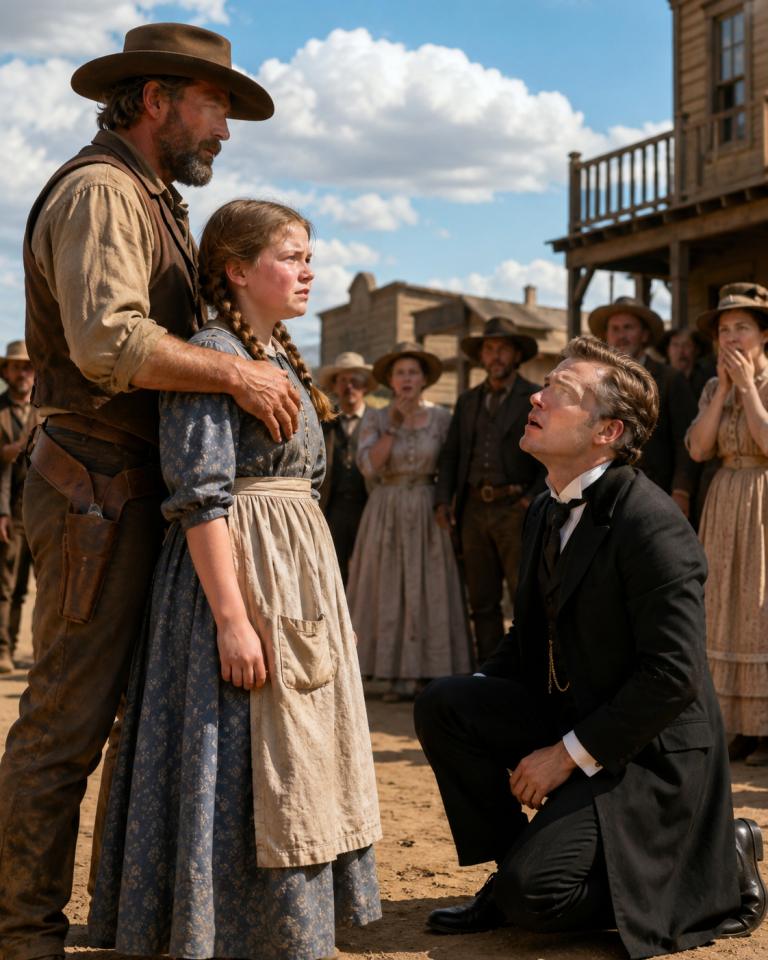
He lowered himself to one knee on the cleared concrete.
Luca Ferrante, who had never needed to kneel for anything, kneeling in the snow outside a warehouse because he had decided this was the place where the story changed.
“I cannot promise you simple,” he said. “My life does not allow it. But I can promise you honest. I can promise you that your safety will be real and not performed. I can promise you that when you tell me where the line is, I will try to remember it and ask again when I’m not sure.” He held up the ring. “I can promise you that you will not carry things alone that I am able to carry with you.”
My eyes were burning.
“I can also promise,” he said, “that I will always put too little cinnamon in the hot chocolate and be wrong about it every time.”
I laughed, which turned into something that was also crying.
“Amelia,” he said, and then caught himself. “Clara.”
“You can call me whatever you want.”
“Clara.” He held my gaze. “Will you marry me?”
I looked at the rebuilt entrance. At the plaque with the protocols that existed because someone had understood that love was not only about the rescue — it was about making sure the rescue was never necessary.
“Yes,” I said.
He slid the ring onto my finger with hands that were not entirely steady, and then he stood, and when he kissed me the snow fell around us both, the same snow, the same city, completely different everything else.
—
People ask, sometimes, how a woman like me ended up with a man like him.
I used to give the short version: he found me in a snowstorm and the rest followed. It was true enough to satisfy most questions.
The longer version took time to understand myself.
I did not fall in love with Luca because he was powerful. Power had never been something I needed from another person — I had always had enough of my own. I did not fall in love with him because he saved me that night, though the saving mattered. Rescue, on its own, is not a foundation. It is a beginning.
I fell in love with him because of what came after.
Because he changed the system instead of only punishing the person. Because he handed me the off switch before I asked for it. Because he asked where the line was and moved it when I needed him to. Because he had blood on his hands and looked me in the eye and told me so, and then asked what I needed anyway.
Because he had spent years building something legitimate alongside everything else, not for appearances, but because he wanted a different future — one where the people he cared about didn’t have to live constantly inside the consequences of his past.
Because he was learning.
And because I was brave enough to learn alongside him.
I was not made brave by his love. I had been brave for years — in hospital billing offices, in late nights over impossible spreadsheets, in silence, in the particular survival of a person who keeps going without anyone watching. He did not give me strength. He saw it. And then he made a home large enough to hold it, and held the door open without demanding I hurry through.
That is a different thing.
That is the rarer thing.
My sister completed treatment in July. Clean scan in October. She came to our wedding in December — our wedding, because the timing was Luca’s idea and I had agreed because he had argued, correctly, that Christmas Eve deserved better associations — wearing a green dress that made her look like someone with her whole life ahead of her, which she had.
She danced with Carver, which neither of them has ever explained.
That night, after the guests were gone and the house was quiet and the snow had started again outside the windows, Luca made his mother’s hot chocolate.
I added too much cinnamon.
He looked at the mug, then at me.
“That is aggressively wrong,” he said.
“It is exactly right.”
“It is not.”
“Drink it.”
He drank it.
Afterward, sitting together in front of the fire with the snow moving beyond the glass, his hand found mine. I let it.
Not because I had nowhere else to go.
Not because being found had made me dependent on being kept.
Because I chose it. Every day, in every small way that choice was available, I chose to be there — warm, seen, carried when I needed it and carrying when he did, and never, ever left alone in the snow again.
That is what we built.
Not perfect. Not without cost.
But honest.
And on the worst nights, when the city was hard and the weight of what he carried made his silence heavy, he would reach for my hand in the dark and I would give it.
And on the best nights, which came more often than either of us had believed to expect, he would make his mother’s hot chocolate and I would add too much cinnamon and we would sit by the window and watch Chicago turn white and he would say, very quietly, *thank you* — and I would know, without asking, what he meant.
Thank you for being here.
Thank you for staying.
Thank you for making this house feel like something other than a fortress.
And every time, I would think: *thank you back.*
For looking at the security screen.
For driving through the storm.
For saying my name like it mattered.
For being, when I needed it most, someone who came.