A Quiet Woman Walked Into His 4,000-Acre Ranch — Then Turned the Stubborn Cowboy’s World Upside Down

—
## PART 1
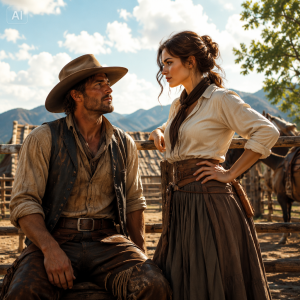
Gideon Marsh thought he had no problems.
He ran four thousand acres in the Texas panhandle, eighteen hundred head of cattle, and a crew of fourteen men, and the whole operation ran the way he liked it — which was the way it had always run. Then his late brother’s widow arrived to stay for a week, looked at his books for one evening, and told him he was losing money on a good stretch of that land, and had been for years.
Gideon laughed at her. He was a cattleman. She was a banker’s daughter from Kansas City who had never branded a calf in her life. What could she possibly know about his land.
By the end of the week, he wasn’t laughing.
Naomi Marsh had come to the ranch to settle her dead husband’s share of the family land. Her husband — Gideon’s younger brother, Caleb — had owned a quarter of the operation before pneumonia took him that winter, and Naomi had inherited his quarter and traveled to Texas to either sell it back to Gideon or understand exactly what she now owned.
She was thirty-three, raised inside the machinery of money. Her father owned a bank in Kansas City, and she had grown up at his elbow, learning to read a ledger before she learned to read a novel, understanding by the age of twelve that every business in the world was just a story told in numbers — and that the numbers never lied, even when the people did.
She’d married Caleb Marsh in 1879. A love match, and a good one, lasting five years before the pneumonia took him. Caleb had been the gentle brother — the one who’d left the family ranch to make his own way, who courted a banker’s daughter, read poetry, and never quite fit the hard world he was born into. He used to tell Naomi that his brother Gideon “loved that land the way some men love a grudge — like letting go of any part of it would mean admitting the first man who worked it was wrong to.” Naomi had laughed at the line the first time she heard it. She understood it a great deal better now.
What Naomi didn’t tell Gideon, that first evening, was that she wasn’t arriving blind. Caleb had written her long letters over the years about the ranch — the water troubles on the east range, the two old hands his father had hired before Gideon was born, the running argument between Gideon and their father about whether the far pastures were worth the fencing. Homesick letters, mostly, the kind a man writes to feel closer to a life he’d left behind. Naomi had read them the way she read everything — carefully, more than once — and by the time her train crossed into Texas she already carried a rough shape of the place in her head, the way you might recognize a house from a description before you ever saw the door.
She could have sold the share by mail and never set foot in Texas. But Naomi was her father’s daughter, and her father had one rule above all others — never sell an asset you have not personally examined. So she packed a trunk, boarded a train, and went to see exactly what her husband had left her.
Gideon met her at the station in Amarillo. He was thirty-nine, weathered, visibly uncomfortable. He’d loved his brother and hadn’t known what to say to his brother’s widow, so he said almost nothing, and the ride to the ranch was forty miles of silence.
Gideon had already decided how this week would go. A city woman would take one look at the dust and the work and the loneliness, sign whatever needed signing, and flee back to Kansas City inside two days. He intended to buy out her share at a low price, assuming she neither understood it nor wanted it.
He was wrong on every count.
On her first evening at the ranch house — while Gideon was out checking the night herd — Naomi did the thing that came to her as naturally as breathing. She found the account books, sat down at the kitchen table with a lamp and a cup of coffee, and read them.
They were better kept than she’d expected, in truth. Gideon logged every head sold, every wage paid, every feed bill, in a steady hand — a lifetime of habit, the discipline of a man who trusted numbers he wrote down and mistrusted numbers anyone tried to explain to him. What he had never done, in ten years of keeping those books, was set one column against another and ask what the difference was telling him.
By the time Gideon came in from the dark, she had found the first hole. By midnight, with Caleb’s old letters spread beside the ledgers for cross-reference, she’d found four more.
Naomi understood, closing the last ledger, that she had not inherited a quarter of a healthy ranch. She had inherited a quarter of a slow disaster, run by a proud man who kept careful records and had never once made them tell him the truth.
On the first morning, Naomi asked Gideon to ride the property with her. He agreed, expecting to humor a city widow for an hour. They rode for most of the day, and Naomi asked questions the whole time — not cattle questions. Money questions.
*What does this section produce? What does it cost to run? When did you last measure the grass against the herd?*
Gideon could answer some of it, more than she’d expected. He knew his tallies. What he couldn’t answer was what any of it added up to, because he’d never once laid the figures side by side.
That evening, Naomi laid it out on the kitchen table.
A large stretch of his land, she told him — the driest sections, farthest from any reliable water — cost more to fence and patrol than the thin cattle it supported were ever worth. He was running the whole spread because his father had run the whole spread, and he had never once stopped to ask whether every acre of it earned its keep.
Some of it hadn’t, for the better part of ten years. It was bleeding him slowly, and the profit from his best grazing land was quietly disappearing into the loss from the worst of it.
Gideon sat across the table from her, jaw tight, and said, “You’ve had my books for one evening.”
“I’ve had your books for one evening,” Naomi said. “And Caleb’s letters for five years before that.”
Gideon looked up sharply at his brother’s name, and said nothing more that night. And Naomi understood, watching his face in the lamplight, that she had just opened the first crack in something a great deal older and more fragile than an account book.
—
## PART 2
On the second day, she audited the crew. Not their character — their cost.
She found two hired men drawing full wages for far less work than the younger hands, kept on out of loyalty because they’d ridden with Gideon’s father. She found a feed supplier who’d been overcharging Gideon by a third for six years, because Gideon never checked the bills line by line, and the supplier knew it.
Gideon didn’t take any of it quietly this time. He rode out the next morning before dawn, without telling her, and came back at midday with the supplier’s own delivery receipts from the general store in town — proof, he was certain, that Naomi had gotten her numbers wrong.
She hadn’t. He laid the receipts on the table expecting to win, and instead found that they confirmed her figures almost to the dollar. He sat with that for a long moment, the fight going out of him slowly, like air out of a punctured bladder.
“I wanted you to be wrong,” he admitted.
“I know,” Naomi said. “That’s why you checked. I’d have thought less of you if you hadn’t.”
He didn’t answer that either. But it was the first time all week he’d gone looking for the truth instead of waiting for her to hand it to him, and Naomi noted the difference the way she noted everything — quietly, and without saying so out loud.
That evening she raised the two old hands directly, and here, for the first time, Gideon didn’t simply defend them with a phrase. He told her about the older one, a man named Hollis, who’d taught Gideon to rope before Gideon’s own father had the patience for it, and who had carried Gideon’s father’s body in from the range the day he died. “You don’t just hand a man his walking papers after that,” Gideon said. “Numbers or no numbers.”
Naomi didn’t argue the point about loyalty. She simply showed him the figures again, and said, “Then don’t call it walking papers. Call it what it should have been years ago — a rest he’s earned, paid honestly, instead of a wage he has to be too proud to admit he can’t fully work for anymore. There is a difference between caring for your people and letting the ranch quietly starve so you don’t have to have the harder conversation. The first is honorable. The second is just pride dressed up as kindness.”
Gideon walked out to the barn after supper and stayed there past dark. And Naomi sat alone at the kitchen table with her papers and her coffee, wondering — not for the first time that week — whether she’d come to Texas to settle an inheritance or to take apart, item by item, the last thing a grieving man had left to believe in.
On the third day, she found the heart of it. And what she found there wasn’t a number at all.
—
## PART 3
The driest, farthest acreage, Naomi came to understand on the third day, was not simply unprofitable. It was a monument.
It was the land Gideon’s father had died defending in a dispute over water rights the winter before Gideon took over the operation, and Gideon had kept every inch of it because selling any of it felt like betraying the dead man. Naomi understood this immediately, because she understood grief. She had buried a husband. She knew what it was to hold on to something because letting it go felt like a second death.
And here the audit became something more than numbers.
Naomi Marsh looked across the kitchen table at this proud, grieving, drowning man, and saw that the ranch was not really the thing she had come to examine. The ranch was a symptom. The real problem was a man who had buried his father, and then his brother, and had decided that the way to honor them was to never change a single thing — even as the changing world quietly cost him more than he could afford.
“You’ve kept it exactly as he left it,” she said, not as an accusation, just as a fact laid on the table beside the ledgers.
“It’s his land. Every fence post.”
“Not all of it needs to go, Gideon,” she said. “I want to be plain about that. There’s a section along the eastern boundary I nearly wrote off with the rest — the grazing figures on it look as thin as anywhere out there. But I rode past the old line shack yesterday and saw green where there shouldn’t have been any, this time of year.”
Gideon looked up. “The spring.”
“You have a spring out there that never runs dry, and it isn’t in a single one of your production records, because you’ve never once grazed cattle close enough to it to count.” Naomi’s mouth tightened, an admission she didn’t enjoy making. “I nearly recommended you sell that section along with the rest. I was wrong about it. It may be the most valuable acre you own, come the next drought year, and no ledger I have shows it, because you never wrote it down.”
It was a small thing to concede, and Gideon didn’t gloat over it — he only nodded slowly, like a man filing away that the woman across the table, however sharp, wasn’t infallible either. It settled something between them that her certainty alone never could have.
“My father used to say the same thing about that spring,” Gideon said quietly. “Word for word, near enough. Never told anyone why he wouldn’t sell that piece, even when Caleb argued for it. I always thought it was just stubbornness.” He looked at the map spread between them. “Maybe he just never wrote it down either.”
“Then we keep that section,” Naomi said. “And you’re right that some of what I’d call a monument, your father built with better sense than either of us gave him credit for. The rest of it, though — the sections with no water at all, that cost you more in fence line and lost time than they ever return — that’s not memory, Gideon. That’s just weight you’ve been carrying because setting it down felt like letting go of him.”
Gideon didn’t answer right away. But something in his face had shifted — not full agreement yet, just the look of a man realizing he’d been asked a question he’d spent ten years avoiding, and that the answer wasn’t quite as simple, in either direction, as he’d assumed it would be.
By the fourth day, Gideon had mostly stopped defending himself, though not entirely — he still pushed back once more that morning, over a section of scrub pasture near the southern line he swore had carried a decent herd in a wet year Naomi hadn’t accounted for. She checked her figures again that evening, found he was right about that one parcel, and adjusted the plan without being asked twice.
“You were right,” she told him plainly, over supper. “I had that section wrong.”
Gideon looked almost more unsettled by her admitting it than he had been by everything she’d previously proven. “You don’t have to say that like it costs you something.”
“It doesn’t,” Naomi said. “It would cost me something to pretend I hadn’t been wrong. That’s a different kind of pride than yours, Gideon, but it’s the same shape.”
It was a small exchange, and neither of them dwelled on it, but it did more to close the distance between them than any of the nights she’d been simply, coolly correct.
That evening, over the same lamp, Gideon finally listened all the way through while Naomi laid out the rest of the truth of his operation, and somewhere in the listening, his resistance turned into something else. Relief, partly. For ten years he had felt the ground shifting under him and hadn’t understood why. Now here was a woman who could name what was wrong, in order, with the figures to back most of it — and who had also, twice now, been willing to admit where the figures didn’t tell the whole story. The naming was a relief even when it stung, and the admitting made the naming easier to trust.
But it was more than relief. Naomi did not audit him with contempt. She audited him with care. Every hard truth she delivered came with the clear underlying message that the operation was worth saving — and so was the man running it. She wasn’t tearing him down. She was, in the most literal sense, taking inventory of everything he had, including the things worth keeping.
And there were things worth keeping. Naomi found those too.
She found a man who knew every animal in his herd by sight. She found a man whose crew — the honest part of it — would have ridden through fire for him. She found a man who had kept his dead brother’s favorite horse for four years and brushed it himself every morning, though he never spoke of it to a soul.
She found that out by accident, on the fourth evening, walking to the barn to fetch a lantern and finding Gideon there ahead of her, a currycomb in his hand and a gray gelding leaning its head into his shoulder like it had done it every morning of its life.
“Caleb’s,” Gideon said, without turning around, as if he’d known she was standing there before she’d made a sound. “Bought him the year before he left for Kansas City. Wouldn’t take him east — said a banker’s daughter’s husband didn’t need a cutting horse.” A faint, unpracticed smile. “He used to say the fastest way to lose an argument with our father was to be right about it in front of other men. I never understood what he meant by that until I watched him do it, gentle as anything, and win every time.”
Naomi stood in the barn doorway for a long moment. “He never told me he kept a horse here,” she said. “He wrote me about the spring. About Hollis. About you and your father arguing over fence lines like it was a family sport. He never once mentioned this.”
“He wouldn’t have wanted you worrying over a horse he wasn’t man enough to bring east with him,” Gideon said, and there was something rough in his voice that hadn’t been there all week.
It was the horse, in the end, more than any single figure in the ledger, that undid something in Naomi she had kept carefully sealed since the funeral. She put a hand against the gelding’s neck and found, without warning, that she was crying — not loudly, not for long, but entirely, the way grief sometimes arrives late and all at once when a person has been too busy being useful to feel it.
Gideon didn’t reach for her, and didn’t look away either. He simply stood there with the currycomb still in his hand and let her cry without trying to fix it, the same patience he might have shown a spooked animal, and after a while Naomi wiped her face with the back of her wrist and said, “I came here to audit a ranch. I didn’t expect to find him again in a barn.”
“He’s all over this place,” Gideon said. “I just never had anyone to point him out to before.”
Neither of them said anything else about it that night. But it was the evening, more than the ledgers or the plan or any hard truth delivered across the kitchen table, that the distance between them finally closed.
On the fifth evening, the work was nearly done. Naomi had a plan drawn up: sell the acreage that was truly marginal — dry, distant, water-starved — while keeping the spring section and a modest reserve of grazing land against drought years, replace the feed supplier, and settle honest terms with the two old hands rather than pretend they earned full wages for work they could no longer fully do. By her more careful figures, allowing for the retained acreage and the cost of the settlements, the ranch would take closer to three years than two to turn a clear profit on its reduced footprint — slower than her first estimate, but steadier, and built on ground that would hold in a bad year as well as a good one.
Gideon looked at the revised plan for a long time. Then he said the thing that changed the whole week.
“My brother used to say you were the smartest person he ever met,” he said. “I thought he was just in love. I owe him an apology, wherever he is. He was right — though it looks like even you needed a week and a few wrong guesses to prove it properly.”
Naomi allowed herself something close to a smile. “Caleb saw things in people,” she said quietly. “It was his gift. He saw the good in this ranch when you couldn’t. He saw the good in you. And he saw something in me that I didn’t fully know was there until he was gone — and I had to be it on my own, without him to tell me when I’d gotten it wrong.”
“You got some of it wrong,” Gideon said. “The spring. That scrub section by the south line.”
“I know,” Naomi said. “I’d rather be the kind of person who gets it wrong twice in five days and says so, than the kind who’s never once wrong because she’s stopped checking.”
They sat in the lamplight, two people who had both loved the same dead man, and who had — over five days of cattle and figures and hard truths and a few honest mistakes — come to see each other clearly. It wasn’t romance yet. It was recognition. But on the frontier, recognition was almost always the thing that came first.
—
On the sixth day, Naomi was supposed to leave.
The audit was finished. The plan was written. Her week was up. She’d come to examine an asset and decide whether to sell, and she’d done both. The sensible thing was to sign her quarter share over to Gideon at a fair price, take the train back to Kansas City, and let the man run the ranch the new way.
Before she packed her trunk, Gideon asked her to come with him to speak to Hollis and the other old hand, a quiet man named Beck. He didn’t do it alone, and Naomi understood, watching him find the words, that it cost him more than anything in the ledgers had.
“You didn’t come here to be pensioned off,” Gideon told Hollis, standing in the yard with his hat in his hands like a much younger man. “You came here to work beside my father, and then beside me, and I let that turn into something closer to charity than either of us wanted, because I couldn’t stand to have the conversation any sooner. I’m sorry it took a stranger with a ledger to make me have it now.”
Hollis, gray and stooped and unhurried, was quiet for a moment. “Your father would’ve taken twice as long to say that, and said it worse,” he said finally. “I’ll take the terms, Gideon. Been waiting on my knees to quit for two years and too stubborn to ask.”
It wasn’t a triumphant scene. Nobody cried, except perhaps Naomi, quietly, a little, standing at the edge of the yard — not from sorrow this time, but from watching a proud man do a hard, decent thing in front of witnesses instead of alone in a barn.
She packed her trunk after that. Gideon drove her to the station in Amarillo — forty miles, and this time not silent, because they’d spent a week learning to talk to each other. But as the station came into view, both of them went quiet, because neither wanted to say the thing they were both thinking.
At the platform, Gideon said, “You fixed in one week what I couldn’t see in ten years. I don’t know how to thank you for that.”
“You can thank me by actually doing the plan,” Naomi said. “Sell the acres that need selling. Keep the ones that don’t. Fire the supplier. Pay Hollis and Beck what you told them you would. Don’t let pride talk you out of any of it the day after I leave.”
“And the quarter share,” Gideon said. “Do you want me to buy it out?”
And here Naomi Marsh — banker’s daughter, a woman who never made a decision without the numbers — made the one decision of her life that no ledger could fully justify.
“No,” she said.
Gideon waited.
“My father has one rule,” Naomi said. “Never sell an asset you have not personally examined. I have examined this one. I have examined the land, and the herd, and the books, and the man. I got some of it wrong, and you caught me at it twice, and I’d rather be wrong beside a man who checks his own numbers than right beside no one at all.” She looked at him steadily. “The most valuable thing on this whole spread is not the cattle, and it isn’t the good grazing land, or even the spring I nearly sold out from under you. It’s a man who kept his dead brother’s horse and brushes it every morning and never told a soul, until a stranger with a ledger asked him why.” Her voice caught, just slightly, on the word *brother*. “I am not selling my share, Gideon. I am moving onto it, if you’ll have me. Not as Caleb’s widow. As your partner — in the ranch, and in everything else.”
The train whistle blew behind her. Naomi did not move toward it.
Gideon Marsh, who hadn’t known what to say to this woman on the first day, found that he didn’t need to say anything at all. He took her trunk back off the platform and set it in the wagon.
That was his answer. And Naomi understood it perfectly, because by then they understood each other completely.
—
They married that autumn. The county thought it was strange — the cattleman and his dead brother’s widow, the banker’s daughter from Kansas City. They didn’t understand it, and Naomi didn’t bother to explain it. She had stopped explaining herself to people who couldn’t read a ledger years before.
She ran the books. Gideon ran the land. They sold the truly marginal acreage within the year — a fair sale, not a windfall, though a modest railroad survey crew did later offer a decent premium for a right-of-way strip Naomi had quietly flagged as valuable before anyone else in the county thought to ask. It helped. It was not, in the end, what saved the ranch. What saved it was three years of cut waste, honest wages, a fired supplier, and a herd concentrated on ground that could actually support it — the slow, unglamorous arithmetic of doing less, better, instead of everything, badly.
By the third year, the Marsh ranch earned more on its reduced acreage than it had ever earned on the whole four thousand, and it became one of the more efficient operations in the panhandle — not the largest, never the largest, but the one other ranchers rode out to study, trying to understand how a smaller spread had outlasted their bigger ones.
The answer, when they asked, was always some version of the same thing. Gideon’s wife could read the numbers. And where the numbers ran out — a spring nobody had measured, a debt owed to a man who’d carried his father in off the range — she’d learned, that first week, to ask instead of assume.
They kept Caleb’s horse. Both of them brushed it mornings for the rest of its long life, and neither of them ever again spoke of it as only Gideon’s habit. Naomi said once that she thought Caleb would have approved of the whole arrangement — the ranch, the marriage, the horse still catching the morning light in the same stall. Gideon said he knew it for a fact, and for once didn’t need a ledger to prove it.
Gideon Marsh died in 1921, at the age of seventy-five. Naomi outlived him by eleven years and ran the ranch herself the entire time — sharper at seventy than most men were at forty. When she died, the operation passed to the two children she and Gideon had raised, both of whom could read a ledger before they could ride, because Naomi had made certain of it — though she’d also made certain, in a way she never fully explained to either child, that they learned to walk the land itself before they trusted any column of figures about it. *Numbers don’t lie,* she used to tell them. *But they don’t tell you everything, either. Go and look.*
On the last evening Naomi ever spent at that kitchen table, decades after the audit that had started it all, her daughter found her with the ranch’s current ledger open in front of her by lamplight — the same table, a different book, the numbers still not lying, the way they never had.
She closed it gently before she went up to bed, the way she’d closed the first one, all those years before, the night she decided a proud, grieving man’s whole four thousand acres held exactly one asset worth more than all the rest combined.
THE END