The Mountain Man Ordered His Plus-Size Bride to Take Off Everything—She Froze in Shame… Until She Saw What He Was Really Holding

Part 1
The winter wind carried more than snow through Pine Hollow that December morning in 1883. It carried the sharp, metallic scent of cruelty, the kind that rose from a crowd gathered not for trade or justice, but for spectacle — the smell of neighbors pretending not to know one another while they watched a young woman’s dignity placed on a platform and priced like livestock.
Iris Calloway stood in the center of town with her wrists bound in rough hemp rope, the fibers already biting through her skin in raw red grooves that burned beneath the cold. Every breath came shallow and white in the frozen air. Every snicker from the crowd struck her before the wind could.
She was twenty-four. Only twenty-four, yet it felt like she’d already lived a lifetime trying to become less visible. Smaller. Quieter. Easier to forgive. She’d spent years learning to lower her eyes when people stared too long, to laugh before others could laugh at her first, to apologize for the space her body occupied. She’d believed, because the world had taught it to her patiently and often, that something was wrong with her. That she was too large, too awkward, too much and somehow not enough.
Now Pine Hollow had gathered to prove it.
The town square still wore its Christmas decorations — pine boughs on storefronts, red ribbons twisted around hitching posts, a wreath above the dry goods store door framing the scene like a mockery of mercy. Goodwill toward men, Iris thought bitterly, seemed to have limits.
Beside her stood Silas Crews, the auctioneer, a narrow, weasel-faced man whose breath carried whiskey though it was only ten in the morning. He smiled at the crowd with yellow teeth and lifted both hands as though presiding over a county fair.
“Ladies and gentlemen,” he announced, voice bright with false cheer, “we come now to the matter of the Calloway estate debts. Miss Iris Calloway, ward of the late Eleanor Calloway, stands here to settle accounts totaling five hundred dollars, accumulated through gambling debts and doctor’s bills.”
A murmur moved through the square. Iris kept her eyes fixed on the distant mountains. Their snow-capped ridges had watched over Pine Hollow her entire life. As a girl she’d imagined walking toward them and disappearing among the pines, vanishing into something too large and wild for the town’s judgments to follow. Dreams of escape had always remained just that.
Behind the platform, someone laughed. “Look at the size of her,” a woman called. “Feed bill alone would bankrupt a man.” Laughter cracked through the crowd like ice splitting. A male voice, thick with drink, added, “Need a wagon just to get her to the altar.” More laughter.
Iris bit the inside of her cheek until she tasted blood. She would not cry for them. Her mother had died six months earlier, and if Eleanor Calloway had taught her anything, it was that dignity could be held even when others tried to tear it away.
The first stone struck her shoulder — small, hardly larger than a pebble, but the shock made her flinch. The second hit her cheek, pain flashing bright before the cold stiffened the blood at the corner of her mouth.
“Now, now,” Crews said, more amused than alarmed. “Let us maintain some order. Miss Calloway is offered as an indentured servant, not a circus animal. She can cook, clean, sew, and perform household duties. The term of service will be seven years, or until the debt is paid in full through labor.”
Seven years. The words landed harder than the stones. Seven years of belonging to someone else. She’d be thirty-one when the term ended, if it ended at all — already old for an unmarried woman in Pine Hollow, and she knew exactly how people spoke of women who’d outlived their usefulness without ever being wanted.
Her uncle, Garrett Calloway, stepped forward then, and the sight of him hollowed out the last of her hope. Late forties, well-dressed, clean-shaven, a face built for respectability — a manager at the mine office, a churchgoer, the relative who’d shown Christian charity by taking in his orphaned niece. Only Iris had seen the coldness behind closed doors, when no one respectable was watching.
“Now let us have some decency,” Garrett said, voice rich with practiced sympathy. “My niece is a good Christian girl. Surely someone here can see her value.”
Value. The word tasted like ash.
The bidding began. Horace Lindt, the dry goods owner, offered fifty dollars in the tone of a man granting charity. “She can scrub floors at my establishment. God knows I need someone who can lift heavy loads.” The crowd tittered.
Widow Marsh raised it to seventy-five. She ran the boarding house with a hard fist and a reputation for cruelty; Iris had worked there after her mother died, three months of sixteen-hour days for pennies that never settled any debt. Marsh wanted her not simply for labor, but because Iris had seen too much — stolen property, watered soup charged at full price, girls struck for mistakes too small to name. Marsh did not forgive witnesses.
Lindt bid eighty. Marsh snapped back with a hundred. Then the bidding stalled.
Crews raised his gavel. Iris understood this was the end. Seven years in Widow Marsh’s cellar room, hearing every day that she was unwanted and fortunate anyone had taken her at all.
Garrett leaned close to Crews and whispered something Iris couldn’t hear. The auctioneer nodded. Garrett’s eyes gleamed with satisfaction — the same look he’d worn while her mother lay dying, while he moved into their cabin under the pretense of care, every time he mentioned debts that seemed always to grow larger no matter how hard Iris worked.
“One hundred going once,” Crews called.
Iris closed her eyes, thinking of her mother’s grave marked only by a wooden cross she’d carved herself, of her father Daniel Calloway dead ten years to consumption when Iris was fourteen, of all the prayers she’d once whispered as a girl asking why God had made her a body the world seemed determined to punish.
“Going twice.”
The mountains blurred. Not with tears. Iris Calloway would not cry.
“Going—”
“Five hundred dollars.”
The voice cut through the cold like thunder over a canyon — deep, rough, utterly without negotiation. It didn’t sound like a bid. It sounded like a verdict.
Iris’s eyes opened. The crowd parted as if pushed by an unseen force, and through the gap came a man unlike any she’d seen — massive, built with the blunt power of the mountains themselves, shoulders broad beneath a heavy bear-fur coat, worn leather beneath it, beard dark and thick, jaw hard as carved stone. Beneath the brim of his hat, his eyes held a silence earned through years of seeing too much and saying too little.
Whispers passed through the crowd. “That’s Garrick.” “The mountain hermit.” “Hasn’t been to town in three years.” “Heard he killed his wife.” “Heard grief drove him mad.”
He walked to the platform with steady, deliberate steps.
“Did you say five hundred?” Crews managed.
The mountain man didn’t answer. He pulled a leather pouch from his coat and tossed it onto the platform edge with a heavy, final sound, then began counting bills. Fifty. A hundred. A hundred fifty. The crowd watched in stunned disbelief. Garrett’s face went from pink to white to an ugly mottled red.
“Now hold on,” Garrett said, stepping forward. “Who are you, stranger? I have a right to know who’s buying my niece.”
The mountain man didn’t look at him. He kept counting — three hundred, four hundred, four seventy-five, five hundred — placed the last bill on the pile, and lifted his eyes to Silas Crews.
“Debt’s paid,” he said, voice like gravel in a tin cup. “Cut her loose.”
Garrett sputtered. “You cannot simply walk in here and take her. She is my niece. I have family rights—”
The mountain man looked at him then. Whatever Garrett saw in that gaze killed the rest of his words.
“You put her on this platform,” the stranger said quietly. “You gave up those rights.”
Crews counted the money with shaking fingers. “The debt is paid in full. Miss Calloway, you are free to go.”
Free. Iris stared at the stranger. The word sounded impossible. Men did not spend five hundred dollars without expecting payment in some other form. Nothing in this world came free.
He climbed the platform steps, drew a wide, sharp knife from his belt that caught the pale winter sun. Iris flinched backward.
“Easy,” he said, gentleness entering his voice for the first time. “Just cutting the ropes.”
Two quick movements and the hemp fell away. Blood rushed back into her hands in a hot, painful surge. She gasped, cradling her wrists, the skin beneath raw and deeply grooved. The mountain man’s jaw tightened at the marks. Then he turned to the crowd.
“Show’s over,” he said. “Go home.”
Slowly, grudgingly, the crowd dispersed. Only Garrett remained.
“You made an enemy today, stranger,” he said, low and poisonous. “That girl carries more than debt. There are family obligations money cannot buy away.”
“The law says the debt is paid. The law says she’s free. If you have a complaint, take it to the territorial court. Otherwise, walk away while you still can.”
Garrett’s hand twitched toward his gun, then stopped — not foolish enough to draw on a man who looked as if violence had been born knowing his name.
“This is not finished,” he spat, then turned and stormed toward the saloon.
The mountain man turned to Iris, eyes moving over her worn dress, wild hair, shaking hands — no disgust, no mockery, only assessment, as if trying to determine whether she was hurt, not whether she was pleasing.
“You got anywhere to go?” he asked.
“No,” Iris managed. “My father’s house was seized against the debt. I’ve been sleeping in the church basement.”
“Any belongings?”
“A bag at the boarding house. Mrs. Marsh let me keep my things there until…” Until she was sold.
“Get it,” he said. “Meet me at the livery in an hour. Can you ride?”
“A little.”
“Good.”
“But I don’t understand,” Iris said. “Why? What do you want from me?”
Something crossed his face — not desire, not pity. Something nearer recognition.
“What I want,” he said slowly, “is for you to get your things and meet me at the livery. The mountain is a hard ride, and we need to leave before the weather turns. Beyond that, we’ll figure it out as we go.”
“The mountain?”
“Twenty miles northeast. Cabin high up where most folks don’t bother going. Rough country, but quiet. And a damn sight better than this town.”
Every warning Iris had ever heard about strange men and isolated cabins rose in her mind. She should refuse. But to what? A church basement. Garrett’s schemes. Widow Marsh’s spite. A town that had watched stones strike her face and called it entertainment.
“I am not going to hurt you,” the man said, as though understanding the calculation taking place inside her. “I’m not going to force you into anything. But you’re standing in winter with nowhere to go and a town that just proved it doesn’t give a damn about you. You can come with me, or take your chances here. Your choice.”
Your choice. Those two words weighed more than five hundred dollars.
“An hour,” Iris said. “I’ll be there.”
At the boarding house, Widow Marsh waited with arms folded and mouth drawn tight. “Come for your things, have you? Running off with that mountain savage. Shameful.”
“I need my bag.”
“You still owe me for two weeks’ room and board. The bag stays until the debt is paid.” Marsh smiled, knowing exactly what was inside — Iris’s mother’s wedding ring, the only photograph of her parents from before sickness hollowed them. For one moment Iris wanted to fight. Then she saw the hunger for it in Marsh’s eyes, the longing for one last chance to hurt her.
“Keep it,” Iris said quietly. “There’s nothing there I cannot replace.” A lie, but she turned before the older woman could see what it cost.
“You’ll be back,” Marsh called after her. “Girls like you always come back.”
Iris didn’t look behind her.
At the livery, the mountain man waited beside two horses — a powerful black stallion and a gentle mare. When he saw her empty-handed, his brow furrowed. “No bag?”
“Mrs. Marsh decided I owed her money.”
His jaw tightened. He pulled a heavy wool coat lined with rabbit fur from a saddlebag, smelling faintly of pine and smoke. “Put this on. That dress won’t keep you warm past sundown.”
He helped her onto the mare with steady, impersonal hands, then mounted his stallion. “Four hours to the cabin. Trail gets steep. The mare knows the way.”
As they rode out of Pine Hollow, Iris looked back once. Then she turned toward the mountains and did not look back again.
The ride was hard, winding through pine forest and up steep switchbacks. At a frozen stream they stopped to rest the horses, and Iris finally found her voice.
“The town said you killed your wife.”
The man’s hands stilled on his stallion’s girth. “Town’s not entirely wrong.”
Her heart lurched. “Did you?”
“No. But I might as well have.” He stared at the frozen water. “Her name was Eve. We married young. She was about your size. Town called her too big to be a bride. I didn’t care. I loved her.” He swallowed. “She died giving birth. The baby too. A boy. I rode through a blizzard for the doctor, but by the time I got back, they were gone.”
“I’m sorry.”
“Don’t be sorry,” he said harshly. “Be alive. That’s all.”
“That’s why you saved me,” Iris said. “Because of her.”
“I saved you because I couldn’t save her. When I saw you on that platform, heard them laughing, I saw Eve. I thought maybe if I saved you, it would mean something.”
They stood in the cold beside the stream, two broken people recognizing the shape of one another’s pain.
“I won’t die on you,” Iris said.
“That’s not a promise you can make,” he replied. “But I appreciate the thought.” He tightened the girth. “We should keep moving. Storm’s coming.”
The cabin appeared near sunset, tucked against the mountainside, smoke rising from a stone chimney. He helped her down; her legs nearly buckled.
“Go inside. Fire’s lit. I’ll settle the horses.”
Inside, warmth greeted her — fireplace, kitchen, table, rifle above the mantel, a bed covered in furs. Sparse, plainly a man’s space, but clean, warm, safer than any room she’d known in months.
When he returned with bundles, he pointed toward a door. “Bedroom. Bathing room beyond. Copper tub, water’s heated. Clean clothes in the trunk by the bed. They were Eve’s. Should fit.”
Iris’s throat tightened. “Thank you.”
“Don’t thank me yet. Winter here is brutal. You’ll earn your keep cooking, cleaning, tending animals. I don’t run charity.”
“I never asked you to.”
Respect flickered across his face. “Good.”
“I don’t even know your name.”
“Garrick. Garrick Holt.”
“Iris Calloway.”
“I know.” He moved toward the door. “I’ll sleep in the barn tonight. Give you privacy.”
“You don’t have to. It’s your cabin.”
“Yes. I do. You’ve been through enough today.”
He left before she could answer.
In the bedroom, Iris found Eve’s trunk — work dresses, warm shawls, all clean and carefully kept. At the bottom lay a letter addressed simply: *To whoever finds this.* She unfolded it with trembling hands. Eve had written that if the reader found the letter, she’d likely passed. Garrick was a good man, the best man. If he’d brought someone there, it was because he saw in her what he’d seen in Eve: worth. The mountain forgave. So did Garrick. So could she.
Iris read it three times, crying silently. Eve had written it knowing another woman might someday wear her clothes — and instead of bitterness, had left kindness.
She bathed in the copper tub, scrubbing away dirt, blood, fear, the lingering touch of the platform, until her skin flushed pink. In the small mirror afterward, the same face looked back. The same body. But something in her eyes had changed. For the first time in years, she looked like someone who had a choice.
In the main room, Garrick had set out two plates of venison stew. “Eat. Then we’ll talk.”
When the plates were empty, he spoke. “I need to tell you something about your mother’s death. You said she died of illness. But I heard the gossip — doctor ruled it arsenic poisoning. Accidental, they said. Who prepared her food when she was sick?”
“Uncle Garrett,” Iris whispered. “He moved in to help.”
“Your uncle didn’t auction you off for five hundred dollars in debt. He wanted control of you.” His eyes sharpened. “Why?”
The answer rose from memory — her mother’s last day, fever and poison and fear blurring her words but not their urgency. *The land is yours, Iris. Don’t let him take it. It’s all I can give you.*
“My mother said something before she died. About land. But we never owned any land. We rented.”
“She did own land,” Garrick said. “Copper mining rights. Fifty acres northeast of town. I checked the county records today.”
“How did you know to check?”
“Because men like Garrett Calloway don’t go to the trouble of a public auction unless they’re trying to gain control of something valuable. And when a woman dies suddenly of poison and her brother takes custody of her daughter, it’s usually not coincidence.”
The room tilted. “You think he killed my mother for land.”
“I think it’s more than possible.”
“I need proof.”
“Then we find it.” Garrick rose and took an old family Bible from a shelf. “Found this in your mare’s saddlebag. Convinced Mrs. Marsh keeping stolen property was a criminal offense.”
Iris recognized it instantly — her father’s Bible. She opened it with shaking hands. Between the pages of Psalms lay a yellowed deed granting mining rights on fifty acres to Eleanor Calloway, née Hartwell. Beside it, a letter in her father’s handwriting addressed to Father Mallory. If the priest was reading it, Daniel Calloway had written, he was likely dead at Garrett’s hand. He’d discovered Garrett embezzling from the mine office. When confronted, Garrett threatened his family. The letter named the deed, named Garrett’s desire for it, and warned that if anything happened to Eleanor or Iris, the truth should be searched for in Eleanor’s Bible.
“He killed them both,” Iris said numbly. “My father. My mother. For land.”
“And he would have killed you eventually,” Garrick said. “Once you signed over the rights.”
The wind howled outside. Something shifted in Iris’s chest. Not breaking. Breaking open.
“What do we do now?”
“Now,” Garrick said, “you rest. Tomorrow we figure out how to make sure he never hurts anyone again.”
Iris went to bed that night in a dead woman’s nightgown, protected by a grieving widower, hunted by a murderous uncle she’d once trusted.
She should have been terrified. Instead, she slept deeply. Because tonight she was warm. Tonight she was safe. Tonight, improbably, she was free.
Part 2
Dawn came pale through the cabin windows. Iris woke to the steady sound of an axe biting wood, clean and practiced, as if the mountain had a heartbeat and Garrick Holt knew how to match it.
In the main room, a note read: *Eat. Work starts when you’re ready. Garrick.* She found him behind the cabin splitting logs, breath clouding the air, each swing carrying controlled violence directed precisely where it needed to go.
“Sleep well?”
“Better than I have in months.”
“Good. You’ll need strength. Winter here does not forgive weakness.”
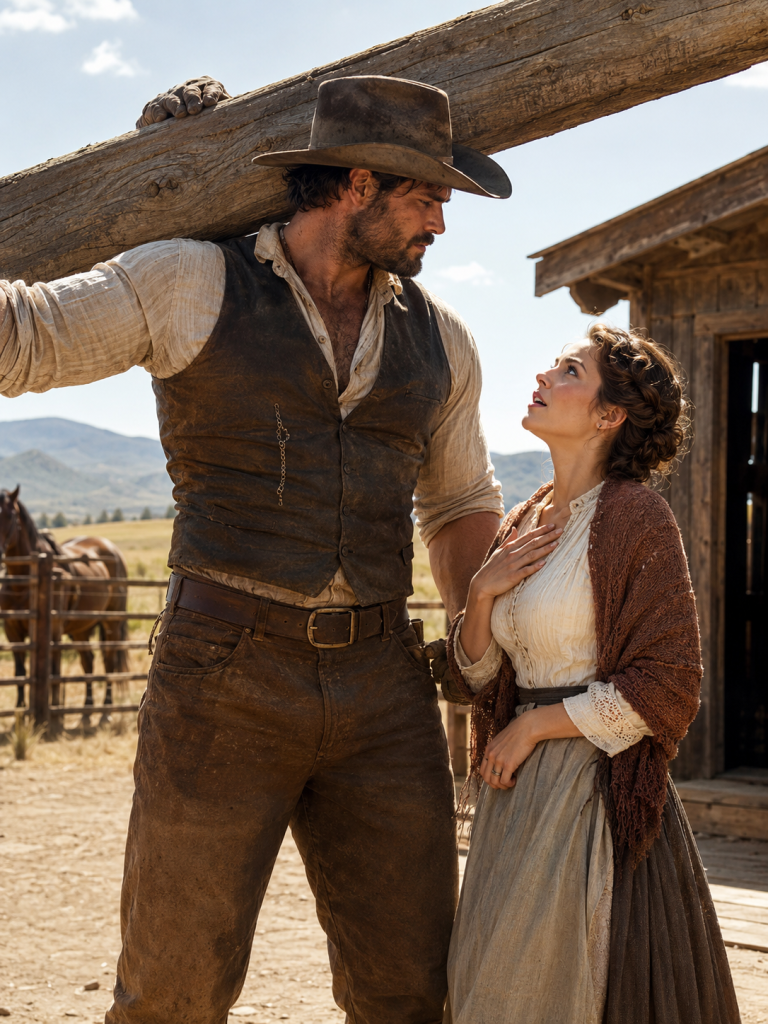
Over the weeks that followed, Iris learned the truth of that. Garrick didn’t coddle her. The mountain required work, and work didn’t care about shame. He taught her to split kindling — blisters rose and tore the first day, hardening into calluses by the week’s end. He showed her how to carry water from the spring with a yoke across her shoulders, helping her up and refilling spilled buckets again and again until she made it to the cabin. He taught her to muck out the barn, dirty and exhausting work that her back screamed against, but the animals needed care whether she hurt or not.
February gave way to March. Maeve — no, Iris — stopped noticing the difficulty first, then began noticing herself. Her breath came easier on hills. Her arms gained strength. Eve’s dresses fit differently. Work did not make her smaller, as Pine Hollow had always wanted. It made her solid.
One evening, after a day clearing deadfall, Garrick looked across the fire. “You’re getting stronger.”
“Am I?”
“Carried both water buckets this morning without stopping. First time.”
She hadn’t noticed. The accomplishment felt small, but the way he said it — plainly, without flattery — made it feel real.
“Eve’s dress doesn’t pull the same way,” she admitted.
“Eve would have liked you,” Garrick said quietly. “She hated waste. She’d have liked seeing someone use her things. And seeing someone fight back to strength.”
“I’m not fighting. I’m surviving.”
“Same thing up here.”
Their silences grew easier after that. Garrick slept in the barn or by the fire, always leaving her the room, knocking before entering, never touching her without cause. Iris began to understand that restraint could be a form of respect.
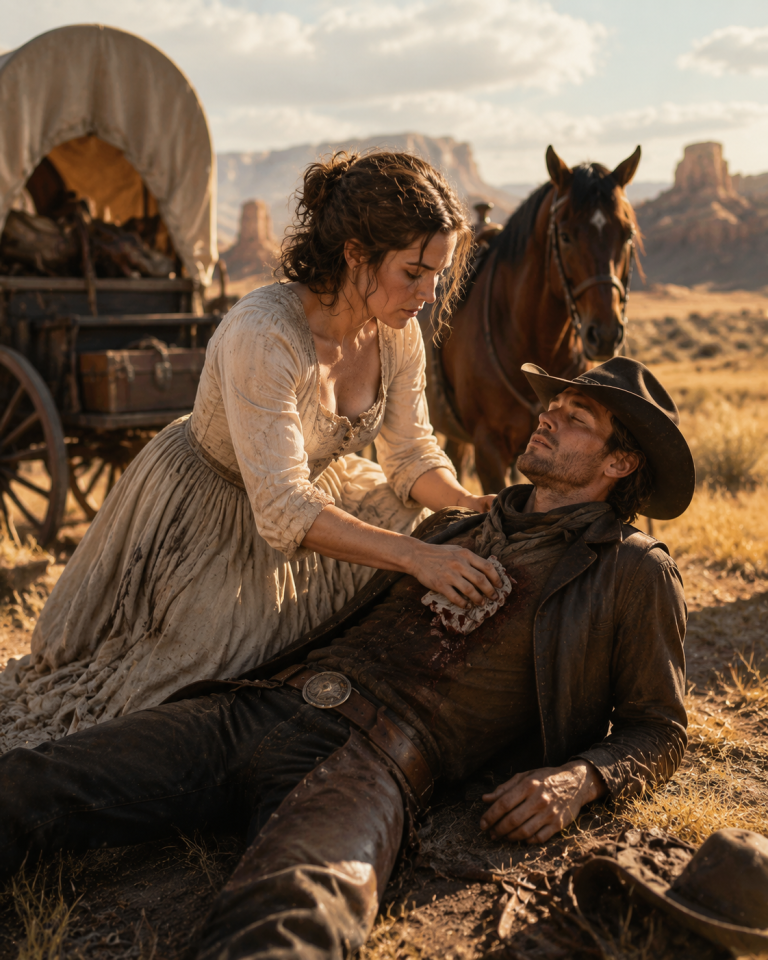
The quiet shattered late in March. She was splitting wood when pain seized her chest, sudden and sharp, stealing the air from her lungs. The axe fell. The world tilted. Snow rushed upward.
When she woke, Garrick carried her against his chest in long, desperate strides toward his horse, face pale beneath his beard. “Stay with me. Iris, stay with me.”
“I’m here. What happened?”
“Your heart. You collapsed. I’m taking you to the doctor.”
Doctor Amos Pruett lived in a valley town ten miles off — old, kind-eyed, steady-handed. After examining her, he spoke to Garrick in the hall, though Iris heard every word.
“Her heart is enlarged. Common in severe obesity combined with malnutrition and stress. If she does not continue improving, if the heart does not strengthen, she will be dead before thirty. I’m sorry to be blunt.”
Iris heard Garrick’s sharp breath, then his fist striking the wall once.
“But she is improving?”
“Yes. Significantly. The physical labor, clean food, mountain air — those are in her favor. But she cannot go back to the life she lived before.”
“She won’t,” Garrick said, steel in his voice.
Back at the cabin, he settled her beneath furs. “I’m going to die,” Iris whispered.
“No.”
“The doctor said—”
“I know what he said. I also know what I see. You’re stronger every day.”
“Why do you care whether I live or die? You don’t owe me anything.”
Garrick sat on the edge of the bed, silent a long moment. “Because somewhere in the last two months, I stopped seeing Eve when I looked at you. I started seeing you, Iris. And the thought of losing you—” He swallowed. “I couldn’t save Eve. But you are not Eve. You’re here. Fighting. I’m not letting you die.”
“Why do you care?” she whispered again.
His calloused hand found hers under the furs. “Because you matter. Because watching you get stronger reminds me life can be more than surviving grief. You make me remember what hope feels like.”
Tears slid into her hair. “I’m scared.”
“So am I. But we’ll face it together. You’re not alone.”
The weeks after her collapse changed their rhythm. Garrick watched her more closely but never stopped her from working, understanding the work itself was medicine. One evening, as spring softened the edges of snow, they sat on the porch while sunset painted the mountains gold.
“I need to tell you something about the copper rights,” Iris said. “A lawyer came while you were hunting. The land is worth more than my father’s letter estimated. There’s a new smelting operation nearby. Current value around fifty thousand dollars.”
Garrick let out a low whistle.
“He wants me to move to Helena, live in proper society.”
“What do you think I should do?” she asked.
“It’s not my decision.”
“I know. I’m asking your opinion.”
“I think you should do what makes you happy.”
“What if I don’t know what makes me happy?”
“Then experiment until you find out.”
Iris took a breath. “What if we used the money to build something here? Not just a cabin. A real place. Somewhere women like me could come. Women the world gave up on.”
She waited for him to laugh. Instead he nodded slowly. “Eve used to talk about something like that. Said every woman deserved a place where she could be more than what the world told her she was.”
“Would you help me? Not charity. A partner. Equal partners building something that matters.”
Garrick looked at her, really looked. “Iris Calloway, are you asking me to build a life with you?”
“I’m asking if there’s something here worth building.”
“I think you’re the bravest person I’ve ever met. I think watching you fight your way back to health has been the most beautiful thing I’ve seen in six years. And I’d be honored to build something with you.”
His hand found hers in the dusk. Not quite a declaration of love. A beginning.
Three days later, horses approached through the trees. Garrick heard them first, took the rifle from above the door. “Get inside. Bar the door.”
Through the window, Iris saw three riders emerge from the pines. Her blood turned cold. Garrett.
Garrick stepped onto the porch, rifle held low. Iris ignored his order, took Eve’s old rifle from the bedroom, and joined him.
“I told you to stay inside.”
“I’m done hiding.” Her hands shook, but she kept the rifle pointed at the ground. “For now.”
Garrett reined in twenty feet off, older than when she’d last seen him, thinner, new lines around his mouth, two hired guns behind him.
“Iris Calloway. I have come to speak with my niece. Family business.”
“She is not yours,” Garrick said.
“The law says—”
“The law says she is twenty-four and free to make her own choices. You have no claim.”
“Is that what she told you?” Garrett’s smile sharpened. “Did she mention the land? The copper rights belonging to the Calloway family?”
“They belonged to my mother,” Iris called. “The deed has her name.”
“You killed her,” she added. “You killed my father too. For that land.”
“I have proof,” she continued, before he could answer. “Father’s letter, written six years before he died. He knew about the embezzling. He knew you threatened us. He wrote it down for Father Mallory. Doctor Pruett — no, Doctor Webb, in town — has records of Mother’s arsenic poisoning. You were the only one preparing her food. And there is one more thing you do not know about.”
Garrett’s eyes narrowed. “What?”
“A witness. Your daughter. Lily was there. She was hiding under the kitchen table the day you put poison in Mother’s soup. She saw everything.”
The words came from instinct, desperation, and some deep understanding Iris didn’t know she possessed. The moment she said them, she knew they were true. Garrett’s face confirmed it.
“You’re bluffing,” he said, voice shaking.
“Then bet your neck on it. Murder carries a hanging sentence, Uncle. When Lily testifies, no money in Montana will save you.”
Garrett’s hand dropped toward his gun. Garrick’s rifle came up. “Don’t. Draw that weapon, and you die here. Your hired men too. Is that land worth your life?”
For a long moment, no one moved. Then hoofbeats sounded from another direction. Sheriff Bryce Wade emerged from the trees with three deputies.
“Mr. Calloway. I need you to come with me. Got a warrant for your arrest.”
“On what charges?”
“Murder. Embezzlement. Fraud. Take your pick.” Wade held up a document. “Judge in Helena issued it this morning based on evidence submitted by Mr. Holt.”
“This is a setup. My daughter would never—”
“Your daughter came to my office two weeks ago,” Wade said carefully. “Said she’d been carrying something heavy for six years. Statement taken before a notary.”
Iris felt the world tilt. Lily had already spoken. The child had carried the truth since she was three years old.
Garrett looked at Iris with pure hatred. “You turned my own daughter against me.”
“No,” Iris said softly. “You did that when you made her watch you kill someone.”
Wade and his deputies surrounded Garrett and the hired men. For a moment Iris thought he might fight. Then the defiance drained from him. But one of the hired guns, young and frightened, saw his chance slipping away, jerked toward his pistol.
“Gun!” a deputy shouted.
The shot cracked across the mountain. The bullet went wild, angled toward the porch, and struck Garrick. The impact spun him sideways, his rifle clattering to the wood as he went down hard, clutching his thigh.
“Garrick!” Iris dropped beside him. The deputies tackled the shooter; the others raised their hands.
Doctor Pruett, who’d ridden with Wade expecting trouble, was already running with his bag. “Move aside.”
“How bad?” Garrick gritted out.
“Clean through the meat. Missed bone. Missed artery. You’re lucky. Damned lucky. But you’ll be off that leg for weeks.”
As Wade’s men led Garrett away, he looked back once. “Tell Lily…” he began, then stopped. “Tell her I’m sorry.”
Iris watched him disappear through the trees. She should have felt triumph. Instead, only a vast weariness and strange, aching pity.
“You took a hell of a risk with that bluff,” Garrick said.
“It wasn’t a bluff. I just knew. Children are always underfoot. Always watching.” She set down the rifle. “Is Lily safe?”
“Wade has her with a kind family in the valley.”
“She’s nine years old and testified against her father.”
“She’s free of him now,” Garrick said. “Like you.” He reached for her face. “It’s over, Iris. He cannot hurt you anymore.”
“What happens now?”
“Now we live. We build that refuge. We help other women the way I helped you.”
“The way we helped each other,” Iris corrected.
“The way we helped each other,” he agreed. Then he leaned down slowly, giving her time to pull away. She did not. The kiss was gentle, careful, and fierce all at once.
“I love you,” Iris said. “I don’t know when it happened, but I do.”
“I know. I love you too. And this time, I’m not letting grief win. This time, I am choosing life.”
Part 3
Three weeks passed before Garrick could walk without wincing. Doctor Pruett came twice, nodding in satisfaction at the clean healing. Iris changed the dressings morning and night.
“She’s taking good care of you,” Pruett told Garrick. “Better than most field nurses I’ve seen.”
After the doctor left, sitting at his side, hands matched now in their calluses, Garrick said, “I’ve been thinking about the refuge. I think it’s what we’re meant to do.”
A knock came at the door. Theodore Vance, a well-dressed attorney from Helena, introduced himself and spread papers across the table. “The deed has been verified and recorded. The copper mining rights are currently valued at fifty-three thousand dollars.”
“What would you like done with the property?” Vance asked. “You could live comfortably in Helena.”
“I want to stay here,” Iris said. “I want to buy the land around this cabin, expand it, build something. A refuge. For women who’ve been told they’re worthless. Abused, abandoned, sold. A place to rebuild, learn skills, find strength.”
Vance studied her, then smiled unexpectedly. “That is the most sensible thing I’ve heard from a client in twenty years. You want to invest in human capital.”
“Mr. Holt, I assume, as partner?” he asked.
“If he’s willing,” Iris said.
“Equal partner,” Garrick said. “Fifty-fifty ownership.”
“It is not generous,” Iris corrected when Vance called it that. “It’s fair. We build it together or not at all.”
After Vance left, Garrick said, “You did not have to offer me half.”
“The money is money. What we’re building is ours.”
“Iris Calloway,” he said, “are you proposing to me?”
“I’m proposing a life. Is that something you want?”
“I loved Eve,” he said after a long quiet. “I will always love her. But she’s gone, and I spent six years living like I died with her. Then you came along and reminded me what it feels like to be alive. I love you, not because you remind me of Eve. I love you because you are brave and stubborn and kind. Because you see the best in people even when they don’t deserve it.”
“Then yes,” he said. “I want to marry you properly, in a church, with witnesses. I want to spend every day making sure you know you are valued.”
“When?”
“As soon as I can walk down an aisle without falling over.”
Two weeks later, Doctor Pruett pronounced him healed enough for ordinary activity. The next day they rode to the valley church where Father Mallory, old now but sharp of mind, had kept her father’s letter all those years.
“Are you entering this marriage freely?” the priest asked. “Without coercion?”
“Yes. Completely freely,” Iris said. “This is my choice.”
“Then we publish the banns,” Father Mallory said. “And hold the ceremony in three weeks.”
But first came Garrett’s trial in Helena, three days’ ride away. Sheriff Wade warned her the defense would come hard. “Stick to facts.”
“Lily already gave her deposition two weeks ago,” Wade added. “Judge ruled she does not have to take the stand again, given her age.”
The next morning, the courtroom was full. The prosecutor entered Lily Calloway’s sworn deposition into evidence — three years old when she’d watched her father pour white powder into a bowl of soup, watched him carry it to her aunt’s room. The courtroom fell silent. Garrett sat stone still, staring at the table.
Then Iris testified, speaking of her mother’s illness, the rapid decline, the letter her father wrote years earlier. The defense attorney, Morrison, cross-examined her brutally, implying she’d forged the letter, was a bitter niece, was emotionally unreliable.
But Iris had survived the stones on the platform. His words could not cut as deep as what she’d already endured.
“I am not lying,” she said calmly. “I am not crazy. I am a woman whose uncle murdered both my parents and who has the evidence to prove it. The jury can decide who to believe.”
The trial lasted three days. The jury deliberated less than two hours. Guilty on two counts of murder. Guilty of embezzlement. Guilty of fraud. The judge sentenced Garrett Calloway to death by hanging, sixty days hence.
As bailiffs led him away, his mouth formed words Iris couldn’t hear but could read. *I’m sorry.* She nodded once. Not forgiveness. Some things were beyond forgiveness. But she could let go of hatred, before it poisoned her the way greed had poisoned him.
Outside the courthouse, Lily waited shyly with her guardian, Mrs. Okafor. “Miss Calloway. Can I talk to you?”
“I’m sorry,” Lily burst out. “I should have told someone years ago.”
“You were three,” Iris said gently, kneeling to her eye level. “None of this was your fault.”
“Mrs. Okafor is nice, but she has five other children. I don’t think she really wants me.”
“How would you feel about coming to live with me and Garrick? We’re building a place on the mountain. A refuge for people who need a fresh start.”
“But I am his daughter. The daughter of the man who killed your parents.”
“You’re a child who deserves a chance at a good life. What your father did does not define you unless you let it.”
Lily threw her arms around Iris’s neck and sobbed.
Mrs. Okafor agreed with obvious relief, and by the time Iris and Garrick left Helena a week later, Lily rode with them, her few possessions bundled behind Garrick’s saddle. Four days on the slow trail, Lily stared at the mountains with wonder and fear.
“Will I have my own room?”
“We’re building a bigger place. Lots of rooms.”
“Can I call you Aunt Iris?”
“You can call me whatever feels right.”
“Mama,” Lily said softly. “Could I maybe call you Mama? Not right away. Someday.”
Iris had to stop her horse, tears blurring the trail.
The wedding took place June first in the valley church. Father Mallory officiated; Doctor Pruett stood as witness; Sheriff Wade attended with his wife. To Iris’s astonishment, nearly thirty people from Pine Hollow came, hesitant and shamefaced, carrying small gifts and apologies. Widow Marsh was among them.
“I was cruel to you,” Marsh said before the ceremony. “I have no excuse except my own bitterness. If you can forgive me, I would like to help with your refuge. I can teach sewing and bread baking.”
“We would welcome your help, Mrs. Marsh.”
Horace Lindt pressed an envelope into her hand. “Collection from the town. Eight hundred dollars for the refuge. Doesn’t make up for what we did, but it’s a start.”
Iris walked down the aisle on Sheriff Wade’s arm. Garrick waited at the altar, clean clothes, hair trimmed, eyes dark and warm and full of promises he would keep.
“I promise to see you,” he said. “Not who the world says you should be, but who you are. I promise to build with you, not for you. To stand beside you, never in front of you.”
“I promise to honor Eve’s memory by living fully,” Iris replied. “I promise to be your partner, your equal, your home. And I promise our love will be a refuge for us and for everyone who needs one.”
When Father Mallory pronounced them husband and wife, Garrick kissed her with such tenderness the church seemed to fade.
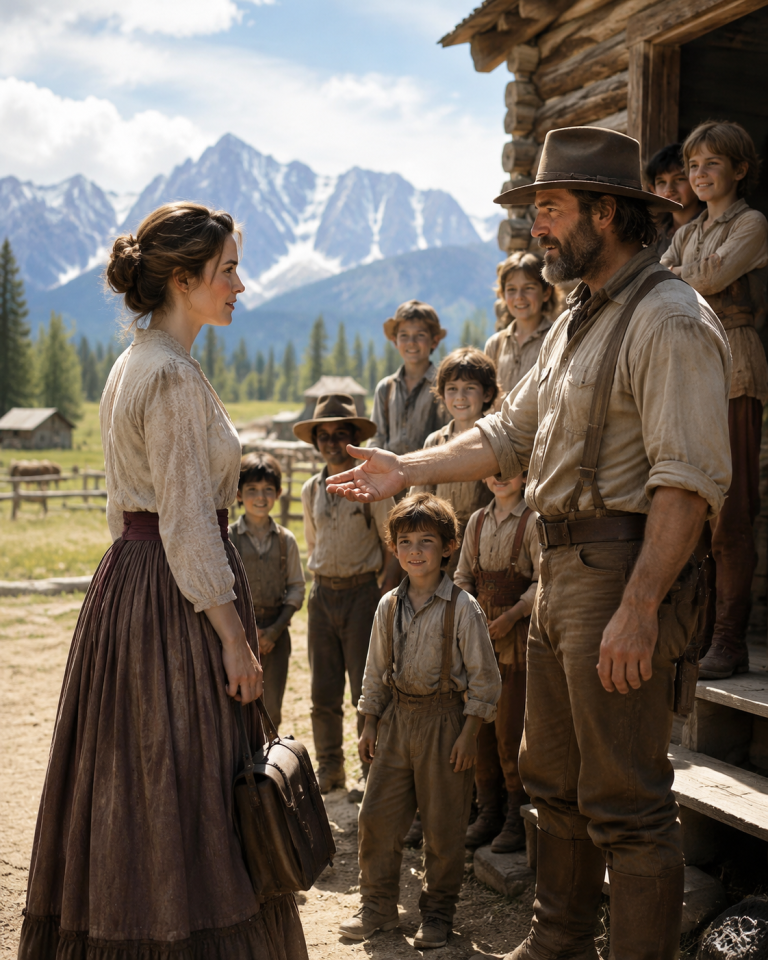
The months that followed were a blur of construction. Using Iris’s inheritance, they expanded the cabin into a proper house with six bedrooms, a bunkhouse that slept twelve, a workshop, a schoolroom where Iris taught reading and Lily continued her education. By autumn, the refuge was ready. Word spread quietly through ministers, doctors, sympathetic lawmen. Women began to come.
The first was a woman named Della, fleeing a husband who’d broken her arm twice, arriving terrified, jumping at sudden sounds. Iris recognized herself in Della’s fear, gave her space, simple tasks, time. Slowly Della relaxed, learned to split wood and milk cows and trust her own strength.
By winter, six women lived at the refuge. By the following spring, fifteen had passed through. Widow Marsh came twice a week to teach sewing. Doctor Pruett visited monthly. Pine Hollow, eager to prove its change of heart, donated supplies and money.
Lily thrived, learned to read fluently, helped in the garden, taught younger children their letters. A year after coming to the mountain, climbing into Iris’s lap by the fire, she asked, “Mama, when I’m grown, can I work here helping women like you help them?”
“If that’s what you want, yes. But you can be anything.”
“This calls to me,” Lily said seriously. “Because you taught me that being broken does not mean being worthless. I want to teach other people that too.”
In the spring of 1886, two years after the wedding, Iris stood on the porch of the main house, twelve women in residence, Lily teaching three small children their letters, Garrick and two women repairing the bunkhouse roof. Her hand rested on her swollen belly — seven months pregnant, Doctor Pruett assuring her the child would be healthy despite her earlier heart concerns. Two years of mountain living had transformed her entirely. Strong. Healthy. Her heart sound. She’d lost nearly eighty pounds, but more importantly, gained everything that mattered.
Garrick came to stand beside her, covering her hand with his. “Kicking again?”
“Like she’s trying to escape early.”
“She,” he agreed. “I know it. And if it’s a girl, we name her Eve. If a boy, Daniel, after my father — your father,” he corrected himself, smiling.
That evening, as Lily read aloud by the fire and the baby kicked steadily, Iris thought of the day she’d stood on the auction platform believing her life was over.
How wrong she had been. How impossibly, beautifully wrong.
Her life had not ended that day. It had begun.
Five months later, in October 1886, Iris gave birth to a healthy baby girl. They named her Eve Eleanor Holt, honoring both the woman whose kindness had guided them and the mother whose sacrifice had made the future possible.
When Lily held her new sister for the first time, tears streamed down her thirteen-year-old face. “I promise to protect you,” she whispered. “To make sure you always know you are loved.”
Iris and Garrick exchanged a glance above their children’s heads. This was their legacy. Not the buildings. Not the money. Not even the women the refuge would go on to help in the years that followed.
Their legacy was teaching broken people they could be whole. That worth was not determined by the world’s judgment. That a person’s life could begin again, even on the day everyone else thought it had ended.