Cruel Family Left a Mail-Order Bride to Die — Then She Saved the Cowboy Everyone Had Given Up On

PART 1
The August heat made the air shimmer like broken glass. Clara Whitmore had been traveling for six days — three trains, two coaches, and one freight wagon that smelled like wet cattle. Her leg ached in that deep, grinding way that meant weather was coming, though the sky showed nothing but pale blue brutality.
She’d memorized the letter during those endless miles. Every word of Samuel Brennan’s careful script, promising her a home, a partnership, a fresh start in Salvation Creek, Arizona Territory.
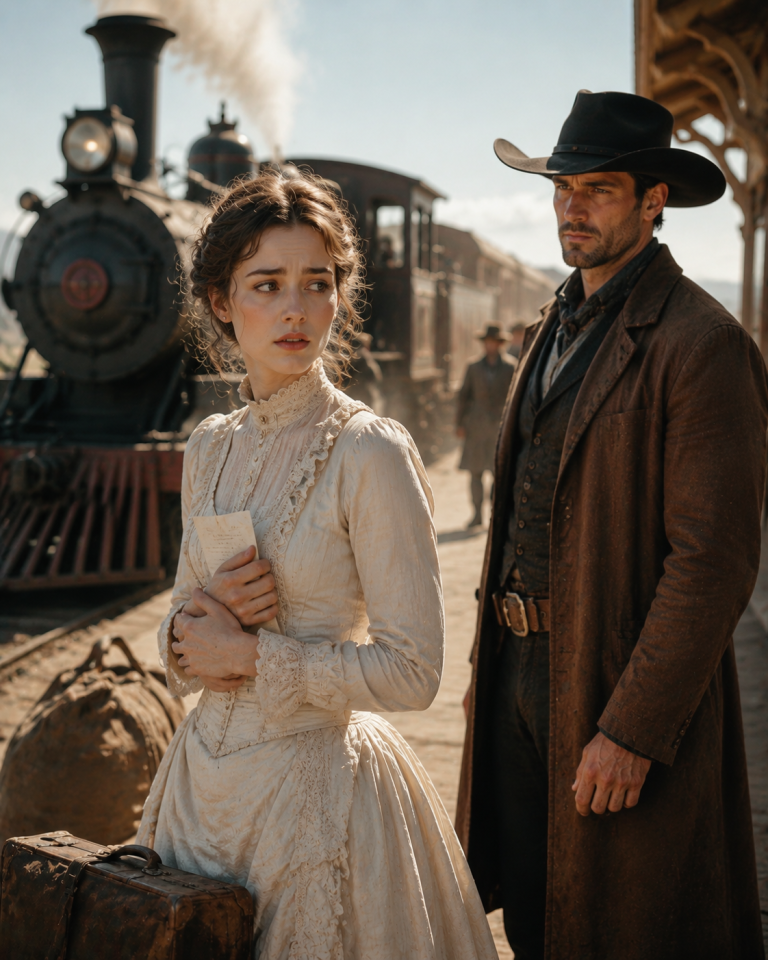
The train lurched to a stop with a shriek of brakes. Through the dusty window she could see the station — if you could call it that. A few sun-bleached buildings clustered nearby. Beyond them, nothing but red dirt and scrub brush stretching toward mountains that looked cut from rust-colored paper.
“Salvation Creek,” the conductor announced, not bothering to hide his doubt that anyone would choose to get off here.
Clara gathered her two cases and made her way down the aisle, feeling the other passengers’ eyes tracking the way her left leg dragged slightly. She’d stopped caring about those looks somewhere around Kansas City. The step down from the train was higher than expected. She took it carefully, leading with her good leg, then bringing the bad one down with a thump that sent a spike of pain up her hip.
A man stood about twenty feet away, apart from the locals collecting freight. He wore a clean shirt and a new hat, and he held a piece of paper — her letter, she assumed. Their eyes met. He took a step forward, then his gaze dropped to her leg.
It wasn’t a quick glance. He stared at the way she stood, weight shifted to her right side, the way her skirt hung different on the left, where the muscle had never fully recovered from the fever that had nearly killed her at fifteen.
His face didn’t change expression exactly. It just closed, like shutters slamming over windows.
“Mr. Brennan.” He didn’t answer. Instead, he folded the letter — her letter, with all her careful honesty about her past and her hopes — and put it in his pocket. Then he turned and walked to a horse tied at the edge of the platform, mounted up smooth and easy, and rode away without a backward glance.
“Wait,” Clara said, taking a limping step forward. “Mr. Brennan, please.”
He touched his hat brim in a gesture that might have been politeness if it hadn’t been so completely empty. Then he was gone, down the dusty street, out of sight.
Clara stood there holding her cases. The station master pretended not to watch. The conductor gave her a look, equal parts pity and impatience. “Miss, you getting back on or not? We’re pulling out.”
She turned to stare at the open train door. She had maybe $8 left to her name. Enough for food for a few days, maybe. Not enough for a ticket back east.
“No,” Clara heard herself say. “I’m staying.”
The conductor shrugged. The train pulled away in a cloud of steam and cinders.
A woman emerged from what looked like a boarding house — two stories, white paint peeling like sunburned skin. She came halfway across the street and stopped, hands on her hips.
“You the mail order bride Samuel Brennan sent for?”
“I suppose I was.”
“He didn’t take you.” Not a question.
“No, ma’am, he did not.”
The woman’s mouth twisted into something that wasn’t quite a smile. “Can’t say I’m surprised. Samuel’s particular. You got money for a room?”
“Some.”
“How much is some?”
“Eight dollars.”
A few of the watching townspeople laughed. “That’ll get you three nights and meals,” the woman said. “After that, you’ll need to work it off or move along. I’m Ruth Carpenter. You got a name?”
“Clara Whitmore.”
“Well, Clara Whitmore, you look like you’re about to fall over. Get inside.”
That night, over supper, retired Judge Morrison asked her directly what she planned to do. “Find work,” Clara said. “Stay if I can.”
“Doing what?” one of the ranch hands laughed into his coffee. “Ain’t exactly a lot of call for—” He trailed off.
“For what?” Clara asked, voice level. The ranch hand’s ears went red.
Judge Morrison studied her. “Can you shoot? Ride? Handle livestock?”
“No, sir. To all three.”
“Then you’re limited to indoor work, and there’s precious little of that.” He considered her. “I’d find someone who needed help bad enough that they’d overlook your limitations. Someone desperate. And I’d make myself so useful they couldn’t afford to send me away.”
By evening the next day, word of Samuel Brennan’s public humiliation of her had already run twice around Salvation Creek — Ruth told her so over the wash basin, not unkindly, just factually. “He’s telling people you must’ve hidden the truth in your letters,” Ruth said. “Making himself the wronged party. That’s Samuel. Always finds a way to be the victim of his own cruelty.”
The next morning, Clara found a notice pinned to a board at the general store, handwriting cramped but clear: *Looking for ranch hands. Must know cattle. Must have horse. Hail Ranch.*
“Hail Ranch is about eight miles northwest, up in the Badlands,” the storekeeper told her. “Ethan Hail runs it, or tries to. Drought’s hitting him hard. Last I heard, he’d let his hands go.”
The notice didn’t say no women. It didn’t say must be able to walk properly. It just said he was looking.
That was something.
Clara packed a smaller case and told Ruth where she was going. “With that leg, in this heat,” Ruth said, staring at her. “Are you stupid or suicidal?”
“Probably both. But I’m going anyway.”
Ruth came back with a canteen and a cloth-wrapped bundle. “Water, bread, dried meat. Go northwest toward the red rocks. Watch for snakes.” She paused. “And Clara — if it doesn’t work out, come back. I’ll figure something out.”
Clara started walking. Eight miles through the Badlands, on a leg that had never once let her forget it was broken, toward a stranger’s ranch and a job notice that didn’t specify what kind of person she needed to be.
She had no way of knowing that the man who’d ridden away from her that morning wasn’t finished with her yet — that Samuel Brennan had already begun, in small and quiet ways, to make sure Salvation Creek never let her forget her humiliation on that platform. It would be the hardest walk of her life. It would also be the one that saved it.
—
PART 2
By the sixth mile, Clara’s legs had stopped aching and started screaming. She fell once, tasted blood from her own bitten tongue, and got back up because those were the only two choices left. By the eighth mile, she saw buildings: a weathered gray ranch house, a leaning barn, a few struggling cottonwood trees.
She collapsed against the front door. Silence — but not the silence of an empty house. The silence of a house holding its breath.
The door was unlocked. Inside, sprawled on the floor near a cold fireplace, was a man. Not moving. She limped over. He was maybe thirty, dark hair plastered to his head with sweat, breathing shallow and rapid.
“Mr. Hail.” She shook his shoulder. His eyes fluttered open, unfocused. “Who?”
“Clara Whitmore. I came about the job. You’re burning up. How long have you been sick?”
“Days, maybe. Don’t know.”
She found the source of it fast — a gash on his forearm, deep, badly infected. This was not a fever she could talk down with cool rags alone, and some old, hard-earned instinct told her so. She’d spent five years nursing her own father through a wasting illness before he died, and two of those years helping the midwife two streets over in Philadelphia, back when her leg still let her walk fast enough to be useful in an emergency. She knew infection. She knew what it looked like when a body started losing the fight.
She sterilized a knife in the stove flame and opened the wound, and Ethan came half-conscious for it, gripping the sheet until the threads popped, but he didn’t scream. It helped — for one night. By morning his fever had climbed instead of breaking, and he was talking to people who weren’t there, calling for his father, insisting the well had run dry.
Two more days passed like that. Clara changed the dressing, forced water down his throat, and watched him get worse instead of better, the wound weeping green now instead of clean. On the fourth night, his breathing turned so shallow she couldn’t find it without pressing her ear to his chest, and she understood, with a cold certainty that scared her more than the desert had, that she was about to watch a stranger die in a house she’d walked eight miles to reach.
She left him at first light and rode his slower horse bareback to the nearest neighboring spread, four miles east, where a rancher’s wife kept a store of carbolic and quinine bark bought off a traveling peddler the year before. The woman didn’t know Clara from anywhere, but she looked at her face and didn’t ask many questions before handing over what she had.
By the time Clara got back, Ethan’s lips had gone gray. She packed the wound properly this time, forced the bitter tea down him a spoonful at a time through the night, and sat with her hand on his chest to feel it still rising, hour after hour, refusing to let herself sleep.
The fever broke two days later, on the sixth day since she’d found him on the floor. He woke with his eyes clear for the first time and found her asleep sitting up beside the bed, and later he told her he’d known, in whatever dim awareness a body has at the edge of dying, that someone had been fighting to keep him on this side of it.
“You almost died,” Clara told him flatly, once he could hold a spoon again. “Twice, probably. Once from the wound and once from stubbornness.”
“You ranch hand?” he managed, voice still hoarse.
“I can learn.”
“You can barely walk.”
“I walked eight miles in desert heat to get here, rode four more for medicine that saved your life, and sat up two nights straight making sure you kept breathing. So yes, I can barely walk, but I’m still here and you’re still alive. Maybe we can skip the part where you tell me what I can’t do.”
He laughed weakly, then winced at the effort of it. “You always this mean?”
“Only when I’m tired.”
Over the two weeks that followed, as Ethan slowly regained his strength, Clara learned ranch work the hard way — pitching hay, feeding chickens who seemed personally offended by her existence, avoiding the bite of a gray mare named Smoke. She learned that Ethan Hail was possibly the most stubborn man alive, forever trying to get up and work before his legs would hold him.
They argued about nearly everything — whether the fence could wait, whether he should be out of bed at all, whether her leg could handle a full day in the saddle. More than once she stormed out of the house mid-argument only to come back an hour later because there was still work to do and neither of them had time for pride.
It was in the middle of one of those arguments, three weeks after she’d arrived, that Ethan finally told her the truth of the ranch’s finances: forty dollars in cash, a loan coming due, cattle scattered across the drought-cracked Badlands.
“You should go back to town,” he said. “This place is sinking.”
“Is that what you want?”
He was quiet a long moment. “No. I don’t want you to go.” Then, quieter still: “I don’t think I want to do any of this without you anymore, and that terrifies me, because we barely know each other and I can’t even pay you.”
Clara thought about her eight dollars, about Ruth’s boarding house, about Samuel Brennan riding away.
“I’m staying,” she said. “We’ll figure out the money. We’ll figure out the cattle. But I’m staying.”
Neither of them knew yet that Samuel wasn’t finished with them — that he’d already begun, quietly, working the bank manager and the town’s opinion against them both — or that the fight to save this ranch would force Clara to answer a question she’d never let herself ask before: not what she could survive, but what she actually wanted to keep.
—
PART 3
By early September, three weeks after the fever broke, Ethan was back on his feet, thinner than before but steady, and the two of them had settled into a wary, exhausting rhythm — searching for the scattered herd by day, arguing by firelight about whose turn it was to be reasonable.
One morning, Clara woke to find him at the corral, watching the horses with the kind of focus that meant he was thinking about something he didn’t want to say.
“What’s wrong?” she asked, limping over.
“Nothing. Just planning the day.”
“You’re a terrible liar.”
“I was thinking about my father. He used to stand right here every morning, checking the land like it might’ve disappeared overnight.” His jaw tightened. “He fought the drought until his heart gave out, three years ago this month. Digging a well that never found water. I always thought I’d do better than him. Turns out I’m just repeating his mistakes with less grace.”
Clara said nothing. Sometimes silence was better than empty comfort.
They rode out together most days after that, Clara clinging to the gentle bay gelding Ethan had put her on, her leg screaming after every mile but holding. When her horse suddenly shied from a rattlesnake, Ethan shot it clean and came to check on her, gray eyes serious.
“This land doesn’t care about effort or good intentions. It’ll kill you for one moment of inattention.”
“I know.”
“Do you? Because watching you almost get thrown—” He stopped himself.
They found cattle in ones and twos over the following week — three head here, five there — but it was slow, grinding work, made harder by the fact that Samuel had not, in fact, been idle in town.
The first sign came in the form of Carter at the general store, suddenly cool and evasive when Ethan tried to buy rope on credit. “Samuel’s been by a few times,” Carter admitted, not meeting his eyes. “Saying you’re not thinking straight since your fever, that you’ve got a stranger running your affairs. I don’t know what to believe anymore, Ethan.”
The second sign was worse. Ten days after that, Ethan and Clara rode out to check the north fence line and found forty feet of it cut clean through with wire snips, the posts pulled and scattered, and the handful of cattle they’d already gathered scattered again across three miles of Badlands.
“This wasn’t wind,” Ethan said, crouching over the severed wire. “Wind doesn’t cut fence with tools.”
“Samuel.”
“Can’t prove it.” His voice was tight with fury he was working hard to control. “But I don’t need proof to know.”
They spent two full days re-gathering cattle they’d already caught once, work that should have been finished, undone by a man too much of a coward to ride out and do it himself. It cost them nearly a week they didn’t have.
That night, exhausted and furious, Clara finally asked the question she’d been circling. “Why does he hate us this much? You rejected him nothing. I’m the one he humiliated.”
“Because you didn’t crawl away and confirm what he needed to believe about you,” Ethan said. “And because watching me succeed with you here proves he made a fool’s choice leaving you on that platform. Men like Samuel can forgive almost anything except being wrong.”
—
**WHAT GREW BETWEEN THEM**
By the second week of the cattle search, the nights had turned cold enough that separate bed rolls stopped making sense, and they’d taken, wordlessly, to sharing the warmth of one fire and one shared blanket — purely practical, both of them told themselves, though neither quite believed it anymore.
“You should have told me your leg was hurting that bad today,” Ethan said one such night.
“Would it have changed anything?”
“I would have let you rest.”
“We don’t have time for me to rest.”
“I don’t want you to have to deal with everything alone.”
“I’m not alone. I have you.” Then, more carefully: “Don’t I?”
“You do.” He was quiet a moment. “I keep telling myself this is still practical. That we’re just two people who need each other to survive a bad year. But three weeks ago I nearly lost you to that rattlesnake and it wasn’t a practical kind of fear I felt.”
“What kind was it?”
“The kind I don’t have a name for yet.” He looked at her steadily in the firelight. “I know you’re stubborn and bossy and you argue with me constantly. I know you saved my life twice — once with a knife and once by riding for medicine when you had every reason to just let me die and take the ranch’s problems off your hands. I know that having you here feels right in a way nothing has in a long time.”
“That’s not love.”
“No. Not yet, maybe. But it’s respect. And out here, that might be the thing love actually grows out of.”
Clara didn’t cry that night, not yet — that came a week later, after a brutal day spent re-fencing what Samuel’s men had cut, when the accumulated weight of fear and exhaustion finally broke loose in her chest and Ethan simply held her without trying to fix it. It was another two weeks after that — well into late September, the cattle count climbing slowly toward thirty — before either of them said the word *love* out loud, and by then it didn’t feel sudden at all. It felt like something that had been quietly built, log by log, the way Ethan’s father had built the barn: unglamorous, load-bearing, meant to last.
—
**THE THREAT MADE GOOD**
It was Samuel himself who found Clara alone in the eastern quadrant in early October, flanked by two men she didn’t recognize.
“Miss Whitmore,” he said, making her name sound like an insult. “Out here all alone? That seems unwise.”
“I’m looking for our cattle.”
“Your cattle? You’ve found what, thirty head? You need at least forty-five. The math doesn’t work. It never did.” His smile was cold. “I’ll pay for your passage back east. You’ll still have your dignity.”
“We don’t need it.”
The older man beside him, a scar across his cheek, leaned forward. “Things might get unpleasant, ma’am. Accidents happen out here.”
“That fence you cut ten days ago,” Clara said. “Was that the start of unpleasant, or a warning?”
Something flickered in Samuel’s face — not quite guilt, but a flinch of recognition that told her everything. “I don’t know what you’re talking about.”
“I think you do.”
Samuel’s jaw tightened. “Leave, or the next thing that goes missing won’t be fence posts. It’ll be your husband’s cattle, permanently, and there won’t be enough of a herd left to argue about.” He wheeled his horse. “Your funeral.”
She told Ethan everything that night. His face went white with fury. “I’m riding to the sheriff.”
“He won’t do anything. You know that.”
“Then I’ll sit up every night with a rifle if I have to.”
They doubled their watches after that. Twice more that week they found cattle deliberately scattered, gates left open that hadn’t been left open by wind or accident. It cost them cattle, time, and sleep, but it also did something Samuel hadn’t counted on: it turned the two ranch hands boarding with Ruth, men who’d been on the fence about getting involved, firmly onto Ethan and Clara’s side. Nobody in Salvation Creek much liked a man who fought women and sick men with wire cutters in the dark.
—
**THE TOWN MEETING AND THE MARRIAGE**
By mid-October, word came that Samuel had finally moved his campaign into the open, calling a town meeting to discuss “the situation at the Hail Ranch,” and pressing the bank manager to call in Ethan’s loan early on the grounds that his judgment was “compromised.”
Ethan rode into town alone to face it and came back hours later, moving stiff, like a man who’d taken a beating that left no marks. “Samuel had it planned,” he said. “Got the bank manager to announce they’re calling in the loan. Said if you stay, I’m finished. If you go, maybe they reconsider.”
He was quiet a long moment before he said the thing Clara hadn’t let herself hope for. “I already told you I don’t want to do this without you. I mean it more now than I did three weeks ago. There’s one thing that would shut all of them up permanently. We get married.”
“That’s not funny.”
“I’m not joking. If we’re married, you’re my wife. You have legal standing. The bank can’t say I’m not capable of managing my affairs if I’m capable of a rational decision about marriage.” He crossed the room to stand a few feet from her. “I’m not going to pretend this is romantic timing. But it’s not just strategy either, not anymore. I don’t want to lose this ranch. I don’t want to lose you. Turns out those are the same fear now.”
Clara looked into his eyes and saw exhaustion, determination, and something steadier than either. “You barely know me.”
“I know you rode four miles for medicine when it would’ve been easier to let me die and inherit the problem instead of the man. I know you stood up to Samuel alone in the desert. I know that having you here feels less like an arrangement every single day.”
“All right,” she said finally. “Let’s get married. But I have conditions. We split everything equally. And we do this in town, in front of everyone, so they can’t say we’re hiding something.”
They married four days later in Judge Morrison’s sitting room, with Ruth as witness. Word spread through Salvation Creek like wildfire, exactly as intended. They walked through town together afterward, heads high, and found Samuel outside the saloon. His face went pale.
“You married her?”
“Best decision I ever made,” Ethan said. “Thanks for the push.”
“This is ridiculous. You barely know each other.”
“We know enough,” Clara said. “We know we work well together. We know we respect each other. And we know exactly what you’ve been doing to our fences, Samuel. Cut them again, and the sheriff will have more than gossip to work with.”
They left him standing there.
—
**THE SEARCH**
The loan payment was due in five weeks. After settling in, they had thirty-seven dollars against a debt of two hundred eighteen, and only thirty head of cattle found so far — fifteen short even of a bare minimum, after Samuel’s sabotage had cost them so dearly.
“We need help,” Clara said. They rode into town and asked. Ruth agreed on the spot. Judge Morrison, seventy-three and admitting he hadn’t rounded up cattle in thirty years, came anyway. Two ranch hands and Doc Hartley rounded out a party of eight.
Samuel found them loading supplies. “This is what you’ve got? An old man, a boarding housekeeper, a drunk doctor?”
“They’re here,” Clara said, “which is more than I can say for you, or for whoever you paid to cut our fence.”
Nobody in the gathering crowd missed that. Carter, who’d been wavering, stepped forward and extended them credit anyway. “My father knew your father,” he told Ethan. “Find your cattle. Save your ranch. Then tell Samuel Brennan to go to hell.”
They rode out into country that had killed better men. By late October, after a week of grinding, dangerous work — including a sudden dust storm that scattered half the party for six terrifying hours and left one of the ranch hands with a badly gashed hand from a spooked horse — they’d brought the count to thirty-nine. One more good push, and they might have enough.
On the worst day of the search, Ethan’s horse went down in a hidden gully while chasing three strays, and for a full minute Clara thought she’d lose him the way she’d almost lost him to the fever — his mount rolled, he didn’t move, and the world went very quiet and very cold before he groaned and sat up, bruised but whole. She didn’t let go of his hand for an hour afterward.
“There’s a valley about ten miles north,” Ethan said that night, still favoring his ribs. “Rough country. If any cattle survived, that’s where they’d be.”
They left before dawn — everyone but Clara and Doc Hartley, who stayed to guard the herd they already had. The day crawled. When riders finally emerged from the scrub at sunset, driving at least fifteen more head ahead of them, Clara’s knees nearly buckled with relief.
“We found them,” Ethan said, his voice rough. Fifty-four head total. More than enough.
—
**WHAT THEY EARNED**
They drove the herd two days to the railhead town. The buyer tried to lowball them. “That’s half what they’re worth,” Clara said, stepping forward. “Pay us fairly or we’ll drive them to the next town.” He raised the offer. They walked away with $243 — enough, after debts, to pay the loan in full with eight dollars to spare.
Eight dollars, the same number Clara had arrived with, two months and a lifetime ago.
“This pays off the loan in full,” the bank manager said, counting slowly like he couldn’t believe it. “Congratulations.”
Ruth hugged Clara hard enough to hurt. “You did it.”
“We did it. All of us.”
Samuel’s unraveling, once it started, didn’t stop with the celebration he watched from a doorway and slunk away from. Within a month, word of the cut fence had made its way, through Ruth and Carter and the two ranch hands who’d seen the wire snips, to the rest of Salvation Creek and, eventually, to the bank itself. Thomas Garrett quietly stopped extending Samuel the easy credit he’d always enjoyed, unwilling to be seen backing a man now widely suspected of sabotage. The saloon crowd that used to laugh along with him stopped laughing. When Samuel tried, once, to make amends with a stiff, unconvincing apology at the general store, Carter simply looked at him and said, “Little late for that,” and went back to his ledger. Two years later, Samuel sold his ranch for less than it was worth and left Salvation Creek entirely, chasing whatever dignity he thought he’d find somewhere he wasn’t known.
That night, back home, Clara sat at the kitchen table with the ledger — eight dollars left, but they’d survived. Ethan came up behind her, hands on her shoulders.
“I love you,” Clara said. “I don’t know exactly when it happened. Somewhere between the fever breaking and the fence being cut and you not letting go of the fight even when Samuel made it as hard as he could.”
Ethan pulled her up and kissed her properly. “I love you too. Been building up to saying it for weeks. Guess I finally caught up to what I already knew.”
—
**FIVE YEARS ON**
The drought didn’t break for three more years. They scraped by, made eight dollars stretch into ten, and made it together. Clara learned to ride properly, though her leg never let her be graceful about it. She learned to rope cattle, doctor sick animals, keep the books better than Ethan ever had.
Five years after stepping off that train, Clara stood on the ridge behind the ranch house and watched the sunset paint the Badlands gold and red. Ethan came up behind her, slipping an arm around her waist.
“You ever regret it? Getting off that train, choosing this?”
Clara thought about the platform, about Samuel riding away, about the fence he’d cut and the fever that had nearly taken Ethan from her before she’d even learned to love him.
“No,” she said finally. “Not even the hard parts. Especially not the hard parts. The hard parts are what made it matter.”
Ethan pulled her closer. “You’re an odd woman, Clara Hail, and you’re stuck with me.”
“Best thing that ever happened to me. Getting stuck with you.”
She’d been left standing on a platform with nothing but determination and eight dollars. Now she stood on a ridge with a home, a husband, and a future that was uncertain but hers.
She was more than her limitations now. More than the woman someone hadn’t wanted. She was Clara Hail — ranch wife, partner, survivor, fighter.
And she wasn’t going anywhere.
THE END