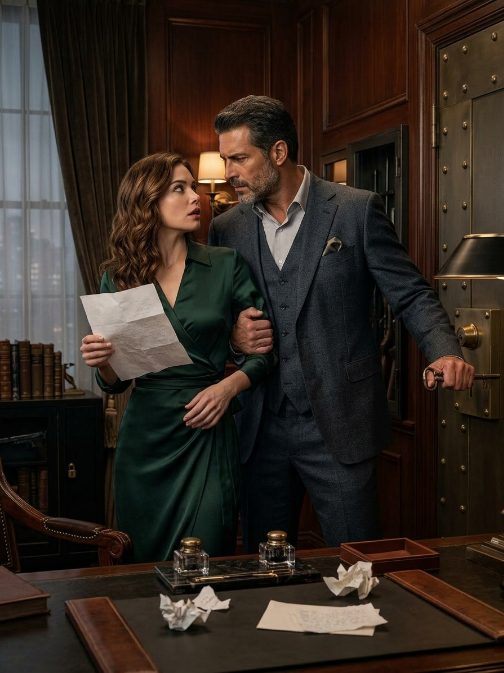
The Paralyzed Mafia Boss Had Accepted He’d Never Walk Again After Ninety-Nine Doctors Failed Him—Then the Maid’s Little Girl Sneaked Into His Forbidden Garden… and his dead legs suddenly moved.

PART 1
Caleb Marino had calculated every room in the mansion, every corner that could hide a threat, every exit that could become a tomb. The winter garden was built to be beautiful because beauty, he understood, was how power disguised itself.
Glass ceiling. Marble fountains. Indoor trees that had cost more than most houses.
And windows on all sides — nothing hiding, nowhere to hide, complete visibility disguised as openness.
He sat in the wheelchair because sitting was the default of a man ninety-nine doctors had failed. Not the sitting that came from habit or choice. The sitting that came from having calculated what came next and understood that nothing did.
Eight years of silence inside a mansion built on the kind of money that did not ask questions.
His wife, Audrey, had died eight years ago. Not the neat way that grief allowed. She had died bleeding in a hospital while Caleb was learning his legs no longer belonged to him. She had died while something was being born that no one would let him see. She had died while men in suits made decisions in rooms Caleb could not reach, and he had accepted those decisions because what choice did a paralyzed man have?
Now he calculated constantly. The angle of rain against the glass. The number of seconds it took security to sweep the perimeter. The exact mathematics of staying alive while feeling like a monument to something that had already ended.
The little girl who entered the garden at 3:47 p.m. on a Tuesday was not in any calculation.
She moved like she had stolen the building, like she knew the rules were suspending themselves. Eight years old, maybe less. Brown hair in a chaos of tangles. Hazel eyes that should have been afraid but were not.
She wore muddy sneakers on marble worth more than her life.
Behind her came a boy, older, carrying the terror she had forgotten to be afraid of.
Caleb’s security team did not move. They waited for him to decide whether these were threats.
The girl stopped in the center of the garden and looked up at the glass ceiling like it had personally betrayed her.
“It has trees inside,” she said to the boy. Then she turned and looked directly at Caleb. “Mister, your face looks like a statue someone forgot to finish.”
One guard’s hand moved toward his radio.
Caleb raised one finger, and the guard died into silence.
“Statues do not have eyebrows,” Caleb said.
The girl tilted her head. “Yeah, they do. Angry ones.”
Something moved in Caleb’s chest that had no medical name.
He should have had her removed.
Instead, he said, “What is your name?”
The girl pulled a small speaker from her hoodie pocket like she had planned this entire invasion.
“Lily,” she said, and pressed play.
The song was loud, American, impossibly alive in a room built for the sound of money.
Lily began to dance — not gracefully, not in any way that involved actual rhythm, but with a ferocity that turned the marble into her stage. She spun. She slid. She pretended to sell hot dogs at a baseball field that existed only in the joy that had no place in Caleb Marino’s life.
The boy watched in horror.
The guards watched in confusion.
And Caleb Marino — the Harbor King, the man who once made city officials swallow their threats, the calculation of violence and restraint living inside a tailored suit — felt something move.
His throat constricted.
Air became difficult.
It took him several seconds to understand what was happening.
He was laughing.
The sound was foreign. Rusty. A door opening onto something he had locked away so completely that he had forgotten it existed.
Three armed guards nearly pulled their weapons because they had never heard it before.
But Caleb was not laughing at the girl.
He was laughing at the impossibility of a child who danced in his frozen garden like death was not in the room with them both.
Then his foot moved.
Just once.
Just enough.
The shoe shifted fractionally on the footrest of the wheelchair.
Caleb’s hands clamped down until the leather creased beneath his fingers.
For eight years, his legs had been information. Medical reports. Scan results. The specific architecture of a life that no longer moved. He could look at them. Touch them. Curse them silently while doctors whispered about spinal damage, nerve death, the particular cruelty of a body that remembered how to hurt but forgot how to function.
But they never, ever responded.
Now one did.
His eyes locked onto Lily.
She froze mid-spin, her expression shifting to something that looked like recognition.
“Did you see that?” she asked.
“Everyone saw it,” the boy whispered.
But they were all looking at the wrong thing.
None of them understood that in the moment Caleb’s foot had moved, a calculation had shifted. A man who had been waiting for death had suddenly been given a reason not to.
A reason that looked like a child who had wandered into his tomb and decided it needed more music.
—
PART 2
Sarah Bennett appeared in the doorway with terror rewriting her face.
She was the new maid, hired through a service that no one at the mansion looked at directly. Early thirties. Thin from too many choices between rent and food. She moved like someone who had learned to be invisible and was now discovering the cost of that invisibility.
“I’m so sorry,” she said, pulling Lily against her chest. “She didn’t know. We’ll leave right now. Please don’t fire me.”
Caleb studied her.
Sarah’s whole body curved around Lily like she could absorb punishment before it reached the child. Her hands shook. Her coat was thin at the cuffs. Her eyes held the specific terror of a person for whom consequences were not abstract.
“What is her name?” Caleb asked.
“Lily.”
“Your daughter?”
Sarah hesitated for less than one second. A calculation. A decision. The moment stretched long enough for Caleb to understand this woman had lies ready for any emergency.
“Yes,” she said finally.
Caleb felt something settle in him — not satisfaction, but recognition. A woman protecting a child the way people protect things that matter more than themselves. He understood that equation. He had once understood it completely.
“Bring her tomorrow,” he said. “After school.”
Sarah’s face went white. “Mr. Marino, I promise she won’t—”
“She disturbed something that needed disturbing.”
Lily leaned around her mother and studied Caleb with the confidence of a child who had no context for fear.
“Does your face want more lessons?” she asked.
Caleb felt that old door open again, just slightly.
“Tomorrow,” he repeated.
That night, while Sarah rode two buses back to Dorchester with Lily asleep against her shoulder, Caleb sat alone in his study staring at his right foot. The sensation had faded. But the ghost of it remained — a promise his body had made and then retracted.
Eight years of nothing.
One moment of possibility.
He hated himself for needing it.
By morning, Caleb told himself it meant nothing. A muscle spasm. A nerve firing randomly. The random electrical impulses of a dead system pretending to function.
Yet when Lily returned at 3:45 p.m., wearing the same oversized hoodie and carrying the same cheap speaker, Caleb was already waiting.
For two weeks, she came.
Sarah cleaned. Lily danced. A boy named Benji followed, pale and frightened, watching like someone who had learned early that adults with power wanted payment.
Each day, Caleb felt something moving inside him that was not his legs.
It was worse. It was need.
Then one afternoon, as Lily spun with her eyes closed, Caleb’s left leg twitched.
Not invisible this time.
Sarah saw it and pressed both hands to her mouth.
Caleb stared at his own body like it belonged to an enemy.
Hope arrived like violence, tearing through the calculation he had built so carefully. Hope that said maybe ninety-nine doctors had been wrong. Hope that said maybe one child’s impossible dance could do what machines had failed to do. Hope that said maybe survival had a meaning beyond breathing.
Then hope said: what if it stops?
That evening, Caleb called Dr. Elaine Porter.
She examined him with a frown that deepened into something that looked like either discovery or pity.
“Your body has been resistant,” she said carefully. “Not injured beyond repair — resistant. Depression, trauma, medication, pain, fear. These become physical. They become walls a nervous system will not cross.”
Caleb looked toward the garden.
“You’re telling me a child fixed what you could not?”
Dr. Porter smiled without humor. “I’m telling you meaning is not separate from healing. If that child gives your brain a reason to reconnect with your body, you should thank her, not question it.”
But Caleb understood something the doctor did not.
Meaning was a trap.
The moment he needed something, it could be taken.
—
PART 3
The first time Sarah arrived late, everything changed.
Lily’s hair was wet. Benji carried plastic bags filled with clothes. Sarah’s hands shook as she explained: eviction notice, landlord impatience, rent that could not be paid because a sibling had needed medical care and Sarah, apparently, had made a choice between keeping a roof and letting a child die.
Caleb understood that calculation.
“What is the child’s name?” he asked.
Sarah’s eyes filled. “Max. He was Lily’s baby brother. He got sick. He died while I was working double shifts, and I still could not save him.”
The room held that grief like it was contagious.
“Where are you sleeping tonight?” Caleb asked.
Sarah’s silence answered.
Within the hour, Caleb ordered the east guest wing opened.
Sarah refused at first, citing pride, citing fear, citing every previous kindness that had come with hooks. But Caleb was not offering kindness. He was offering transaction.
“The house is too quiet,” he said. “Lily is under contract to insult my face until it works. You are under contract to ensure she attends. This is employment.”
Lily brightened. “Can I be paid in pancakes?”
“You negotiate aggressively.”
“Chocolate chip pancakes.”
“Agreed.”
Sarah wept silently, ashamed of her own relief.
From that moment, the mansion changed in ways Caleb had not calculated.
Crayons appeared in the breakfast room. Sneakers materialized by the marble stairs. The smell of grilled cheese drifted through hallways built for silence. Even the guards began leaving offerings: a Red Sox cap for Lily, a chessboard for Benji, warm gloves by the door.
Caleb attended physical therapy again, not because a doctor ordered it, but because Lily had declared that if he didn’t try, she would perform the pigeon lady dance for one full hour.
His legs burned. His back screamed. Some days nothing happened, and he wanted to destroy every machine in the room. On those days, Sarah stood quietly nearby with water and the simple statement: “You don’t have to prove anything today.”
That infuriated him. He was not proving things for permission. He was proving things because he had tasted the possibility of moving and could not unknow it existed.
“You don’t understand what it means to have your body betray you,” he told her once, bitter with pain.
Sarah’s eyes changed.
“I know exactly what it means,” she said softly. “I know what it is to stand in a grocery store and choose between milk and medicine. I know what it is to hate your hands because they cannot work fast enough to save anyone. I know what it is to be hungry because your child ate and you are expendable.”
Caleb said nothing.
Sarah looked down. “I’m sorry. I spoke out of turn.”
“No,” Caleb said. “You spoke like someone who survived.”
They did not touch. They did not speak of anything beyond the daily logistics of food and therapy and Lily’s performances. But something built between them in the silence — not romance, but recognition. Two people who had calculated too hard, fought too long, and had almost forgotten what living felt like.
Not everyone welcomed the change.
Marcus Vale had served Caleb for fifteen years, handling the parts of the empire that never entered daylight. He was quiet, which made him dangerous. He disliked Sarah with a precision that felt rehearsed.
“She’s positioning herself,” Marcus told Caleb one evening. “Maid with a child. Poor and grateful. Classic infiltration.”
Caleb studied him. “Into what? My confidence?”
“Into your legacy.”
“I have no legacy, Marcus. I have a body that died eight years ago and a daughter I could not protect.”
Marcus’s face tightened. “You never mentioned a daughter.”
Caleb understood, in that moment, that he had made a mistake.
“I didn’t know about her,” he said carefully.
But Marcus was already calculating, already understanding that a man who regains the ability to care about something becomes vulnerable to it.
A week later, someone called child services on Sarah.
The report claimed she was unstable, homeless, using her daughter as leverage on a wealthy disabled man. A caseworker arrived with a clipboard and a face built for administering worse.
Sarah went white.
Caleb entered the room standing between parallel therapy bars, his legs trembling beneath him, his hands gripping the rails with white-knuckled intensity.
The caseworker stared.
“Ms. Bennett and her children are guests in my home,” Caleb said. “They are safe, fed, enrolled in school. If you have concerns, my attorney will answer them. If this was filed maliciously, we will find who did it.”
The caseworker left with fewer words than she had brought.
Sarah sat down hard after she was gone.
“I thought they would take her,” she whispered.
Caleb wanted to ask why that fear ran so deep. He did not. Not yet. Not until he had verified something that was moving through his mind like a threat.
The answer came three days later when Lily left her backpack in the garden.
Inside was a silver locket.
Caleb’s blood stopped.
He owned that locket. He had given it to Audrey on their first anniversary.
His hands shook as he opened it.
The photograph was gone.
In its place was a hospital document, worn soft from years of being hidden.
*Baby Girl Marino. Born alive. 3:18 a.m.*
Caleb’s world narrowed to a pinpoint.
When Sarah entered and saw the locket in his hand, every drop of color left her face.
“Explain,” Caleb said very quietly.
Sarah gripped the back of a chair. “She’s yours. Lily is your daughter.”
The words did not land softly.
They landed like a detonation that had been built into the foundation of his life eight years ago, waiting for the exact moment when he had something to lose again.
“My daughter died with Audrey,” Caleb said.
“No. They told you that.”
“Who is they?”
Sarah’s eyes filled with tears, but she did not run. Perhaps she was too tired of running. Perhaps the truth had finally become heavier than fear.
“Marcus Vale came to the hospital the night after you were brought in,” Sarah said. “I was working nights. Audrey was alive when they delivered the baby. There was a moment — just one — where she woke. She gave me the locket and told me your man had sold you to his enemies.”
Caleb closed his eyes.
For eight years, he had imagined Audrey dying alone. Now another image forced itself in: Audrey under hospital lights, terrified, making a choice.
“She protected our child by giving her away,” Caleb said.
“She protected her the only way she could.”
Sarah explained everything then, every year of secret moves and false names and a woman building a wall around a child with her own body. A child who grew up not knowing her father except as a name that meant danger.
A child who danced in a winter garden because she did not know that joy could be a weapon.
Caleb turned away from Sarah because rage had risen in him so fast he could not trust his face.
Not at Sarah.
At himself.
At Audrey for not surviving.
At Marcus for deciding which children lived and which died.
At eight years spent calculating how to survive when he could have been learning how to live.
“My daughter was hungry,” he said.
Sarah made a sound like breaking.
“My daughter slept under broken roofs.”
“I tried,” Sarah whispered. “Every day I tried.”
Caleb looked back at her then, and the rage broke under what he saw.
Not guilt. Not regret. But the specific exhaustion of a woman who had kept a child alive with nothing, who had loved a daughter that was not biologically hers but had become hers through the simple act of refusing to let her disappear.
“You did more than try,” Caleb said, his voice rough. “You raised her when I could not. You were her father when I was dead.”
Sarah cried silently.
That evening, Caleb told Lily the truth in the winter garden.
Not all of it. Just the essential parts.
He sat in his wheelchair because his legs were too uncertain under the weight of the moment.
“Your mother Sarah will always be your mother,” he said. “That never changes. But there is something you deserve to know.”
Lily looked frightened for the first time. “Did I break something expensive?”
“No, sweetheart.”
The word slipped out before he could stop it.
Sweetheart. Audrey’s word.
“I am your father.”
Lily stared at him.
Benji stepped forward. “I knew something weird was happening.”
Sarah gave a broken laugh through her tears.
Lily looked at Sarah for confirmation. Sarah nodded.
Then Lily climbed into Caleb’s lap with the innocence of a child who did not yet understand that fathers could disappear.
“You found me now,” she said, wrapping her arms around his neck.
Caleb lowered his face into his daughter’s shoulder and wept in a way that broke open the calculation he had maintained for eight years.
He was not crying because he had regained his legs.
He was crying because he had been given a reason to keep them.
—
Marcus disappeared that night.
By morning, Caleb’s security team found empty offices, wiped drives, closed accounts, and the architecture of a man who had spent years building an exit. Marcus had controlled which doctors Caleb saw, which medications dulled him, which information reached him. He had needed Caleb broken.
A grieving, paralyzed king was easier to rule through.
A healing father would become dangerous.
The revelation came quickly: Marcus had orchestrated the hospital decisions. Marcus had kept Caleb drugged enough to accept defeat. Marcus had run the criminal empire in Caleb’s name while the Harbor King sat in a glass garden and slowly died from the inside.
The final confrontation came six weeks later at a charity gala.
Officially, the event announced the Marino Harbor Foundation — legitimate housing, medical debt relief, rehabilitation care for families crushed by poverty and violence.
Unofficially, it was bait.
Caleb knew Marcus would not resist the chance to strike before the empire became fully legitimate and every hidden account was exposed.
The ballroom glittered. Judges. Reporters. Business leaders. Doctors. Community organizers. Sarah wore a simple navy dress and looked uncomfortable in elegance. Lily told her she looked like a queen trying not to brag.
Caleb stood at the podium using a cane.
The room erupted in applause.
He raised one hand, quieting them.
“For eight years,” he said, “I believed strength meant control. I was wrong. Strength is what a mother shows when she feeds her child before herself. Strength is what a child shows when she brings laughter into a house that has forgotten it. Strength is what a family gives you when you no longer deserve hope, but they offer it anyway.”
His eyes found Lily.
She smiled.
Then the lights went out.
The ballroom fell into controlled chaos. A scream. Security moved. Guards shouted into radios that filled with static.
Marcus appeared from the service corridor with two men and a small pistol held low.
He looked thinner now, his polished calm burned away.
“Touch me and every reporter hears what Caleb Marino really is,” Marcus said.
Caleb stood near the podium, cane in hand.
Marcus smiled. “Look at you. Playing father. Playing saint.”
“Let her go,” Caleb said as Marcus pulled Lily against his side.
Sarah made a sound that was not a scream so much as a soul tearing open.
Lily began to hum.
The song from the winter garden. The silly song. The one that had woken more than just Caleb’s legs.
Marcus looked down, confused. “Stop that.”
Lily shifted her weight, a small dance step.
“I said stop,” Marcus hissed.
But Lily kept moving, not wild, not funny. Slow. Deliberate. Brave in a way no child should have to be brave.
She danced because she understood something instinctive: her father would follow.
“Daddy,” she whispered, her voice shaking with courage that broke Caleb’s heart. “Your face works now. Make your legs work too.”
The entire room vanished for Caleb.
There was only his daughter, using joy as a weapon against the man who had stolen eight years.
Caleb dropped the cane.
Sarah cried out. “Caleb, no!”
He took one step.
Pain shot up his spine. His knee nearly buckled. He caught himself on the podium edge.
Marcus’s smile faltered.
Caleb took another step.
The ballroom watched in stunned silence as the Harbor King crossed the floor with nothing but fury, love, and eight years of fatherhood forcing strength through damaged nerves.
Lily kept humming.
Marcus dragged her back, but the movement brought him beneath the security camera Caleb had quietly installed that morning. His confession, his weapon, his face — all of it streamed live to police waiting outside.
Caleb reached him.
Not with a gun.
With both hands open.
“You lost,” Caleb said.
Marcus turned the pistol toward Caleb.
Before he could fire, Benji launched a silver serving tray across the room with every ounce of street-learned precision in his body. It struck Marcus’s wrist. The gun clattered across the marble. Security moved in. Marcus hit the floor under four guards before he could move again.
Lily ran to Caleb.
His legs finally gave out, but he caught his daughter as he fell to his knees.
For the first time since the ambush eight years ago, Caleb knelt not from injury, not from defeat, but from love.
—
Police entered. Cameras flashed. Guests whispered. Reporters understood they had witnessed the collapse of one empire and the birth of something stranger: a man on his knees holding the daughter he had been told was dead.
Marcus Vale went to prison after federal investigators uncovered the hospital fraud, the attempted murder conspiracy, the stolen assets, and the criminal network he had maintained in Caleb’s name. Several of Caleb’s old associates followed him into custody.
Caleb cooperated fully.
He surrendered the shadowed parts of his empire and preserved only the legitimate companies that could be audited, taxed, and turned toward repair.
The Marino Harbor Foundation opened its first family shelter in Dorchester before winter.
Sarah became its director.
She argued with contractors, charmed donors, terrified lazy administrators, and made sure every room had thick blankets because she knew exactly what cold did to hope. She no longer cleaned other people’s homes. She built homes for people other people had forgotten.
Benji became the unofficial security chief of the children’s floor, mostly because he told everyone he was. Caleb bought him a real chess clock, enrolled him in school, and later began adoption proceedings with Sarah’s blessing.
As for Lily, she became a daughter without losing a mother.
Caleb never allowed anyone to say Sarah had only “raised” his child. Sarah had saved Lily. Sarah had become home when home was dangerous. Nothing could outrank that.
One autumn evening, almost a year after Lily first danced in the winter garden, Caleb stood beneath the glass roof without a cane, without a wheelchair, without the weight of calculation.
Lily placed the old speaker on the marble floor.
Sarah stood near the fountain, smiling softly.
Benji leaned against a pillar. “If there’s pigeon dancing, I’m leaving.”
“There is always pigeon dancing,” Lily said.
Caleb offered his daughter his hand.
The music began.
They moved slowly at first. Caleb’s steps were careful, imperfect, human. His body had learned to move again, but not because of ninety-nine doctors or machines or hope.
Because of a little girl who had danced into his frozen garden and decided that joy was more powerful than fear.
Lily guided him with theatrical seriousness, correcting his rhythm. “You’re late on the turn.”
“I was paralyzed for eight years.”
“No excuses in dance class.”
Sarah laughed.
Caleb looked at her, and something deeper than gratitude moved through him. This woman had carried his child through hunger, danger, grief, and cold. She had done with empty hands what his empire had failed to do.
She had kept love alive.
Later, when the music ended, Lily hugged Caleb around the waist and looked up at him.
“Are you still sad?” she asked.
Caleb considered lying, then chose the truth.
“Sometimes.”
Lily nodded with the wisdom of a child who had known too much. “But not all the way?”
He smiled. Fully. Easily.
“No, sweetheart. Not all the way.”
Outside, Boston glittered under a clear night sky. The harbor wind moved beyond the glass, but inside the garden there was warmth, music, and the sound of a family that had survived more than one kind of paralysis.
Caleb Marino had once believed power was the ability to make people fear him.
A maid and her daughter taught him the truth.
Power was not taking. It was building.
Not controlling. It was letting go.
Not surviving alone. It was choosing to live with people who had chosen you first.
In the end, ninety-nine doctors had not failed because they lacked knowledge.
They had simply never found the part of Caleb Marino that most needed healing.
Lily found it in a silent garden.
Then she danced it back to life.
THE END