The Mafia Boss Rescued a Bound Nurse From an Abandoned Warehouse — Then His Dog Exposed the One Betrayer Nobody Suspected

## CHAPTER 7
Rook moved on the third second. The guard by the pallets heard a rasping breath before he saw the gray mass separate from the dark, a hundred and fifty pounds low and silent, and half a second of disbelief was all it cost him. Rook came along the old production line, from angles no one had thought to watch, because no one believed a man could approach from there. One guard slid down a steel beam and sat with his legs out, seeing nothing. Another dropped to his knees with both hands on his chest, no sound coming. A gun spun across the concrete and vanished under a conveyor belt, and no one had time even to think about reaching for it. Two men bolted for the narrow passage between the pallet stacks and found the dog already filling it, motionless, and they crashed to a stop so hard the second man hit the first. Both raised their hands. Not one shot was fired in that whole building.
Rook cut the ties from Corwin’s wrists, then Dorsy’s, caught their arms as they fell. “Stand behind me,” he said, gentle as he’d ever been. Marin was already kneeling with her bag open, counting, documenting, her hands steady through all of it, doing the three things she always did in that order.
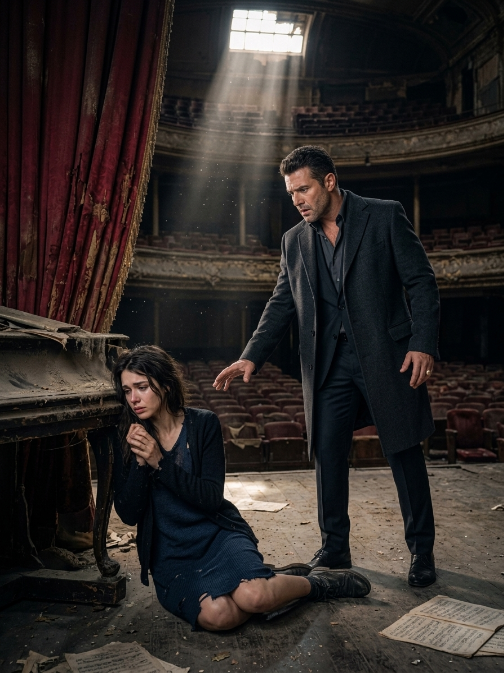
Dracott backed into the drum that had rolled earlier and went down on his knees before anyone told him to, hands beside his ears, and began talking without being asked. “She wasn’t my target. I inherited her. That workshop’s been in the ledger eight years. I bought the list — I bought this whole territory. I only took what other people left behind.” He said the fire had been an accident, old wiring, that these things happened, and that someone had simply given the trucks the wrong address, which happened too. He didn’t smile. That was the worst part — no cruelty in it at all, only the flat indifference of a man adding a figure to a column. “Her sister didn’t make it out,” he said, and across the room Marin’s hands never stopped moving over Corwin’s bandage, because that was the only thing they knew how to do while the world came apart around her.
Orin Ketch, one of Dracott’s men, began sobbing where he sat, hands bound behind him. *It wasn’t my idea. They said the chief was behind it. Envelopes every month — I delivered them myself.* Then, quieter: *I called her tonight. I didn’t know who else to call. She was the only one who ever came.* Marin looked up and recognized the voice — the panicked call two years earlier, 3:14 in the morning, this same building, a wound the official report blamed on a machine that hadn’t run in five years.
Rook took a cheap phone from his coat, gave an address and two sentences to someone on the other end, then walked to the dock’s edge and threw it into the bay. Federal sirens reached the main road eleven minutes later — longer, lower, more of them than the county patrol everyone in town knew by heart. He was already gone by then. Marin wasn’t. She stayed, finished with Corwin, moved to Dorsy, sat with Orin Ketch and told him to breathe out longer than he breathed in, so that when the first agents reached the loading bay, the first thing they found wasn’t a victim. It was a witness.
At mile marker forty, Silas Booth climbed into Rook’s waiting car believing the night was over — that August had torn up the papers, that Dracott understood, that Boston would swallow this town back into its fog like it always had. He didn’t know that forty minutes earlier Dracott had been talking on his knees to anyone who’d listen. Rook pulled onto the highway and said, without looking over, that Silas’s handwriting was better than he’d expected. Silas said nothing. Somewhere past the wipers’ one pass, Rook asked if seven thousand dollars had been her price. Silas said he had a daughter in Portland — Rook already knew, had signed her tuition checks three years running without ever mentioning it, and both men understood that was exactly why Silas was still breathing. The car stopped in the center of the empty highway. Silas folded his gloves on the dashboard like a man returning a set of keys, stepped out into the fog, and closed the door softly, the way you close a door on a room where someone’s sleeping. Fifteen years ended there. Rook drove south and didn’t look in the mirror.
Weeks later, the ice along the dock had melted. Marin drew a bow across her sister’s rebuilt instrument for a neighbor’s granddaughter, the tone dark and slightly choked where a nurse’s hands, not a luthier’s, had pieced it back together — but it made a sound, and for the first time in four years a child was allowed to run across the street after dark to hear it. Rook told her what the instrument was worth, and she told him it couldn’t be sold — the provenance papers had died with the fire and the debt both, leaving it priceless and untouchable at once, the very trap that had made her signature worth killing for in the first place. He asked why she kept it anyway. “Because they wanted it,” she said, “and it was the only thing I could refuse them.”
He told her, finally, about a hospital corridor in Boston, a mother dying slowly, a night nurse who’d never once told him her name and simply sat with him three hours a night for five weeks. He hadn’t driven three hours through fog to save a stranger. He’d come to see the damage, and never turned the car around, and now she understood exactly why.
The next morning she found the dog alone on her step, and her hand went looking for his pulse before she’d even decided to. Slow. Too slow. He was old, and dogs built like him didn’t get much older than this, and she understood, sitting beside him, that Rook hadn’t left her a protector. He’d left her his last patient, because he didn’t know how to sit with an ending — only how to find someone who did.
In Boston, a man stood beside an empty rug in a room over the harbor and waited for the phone to ring. They both already knew when it would.
THE END