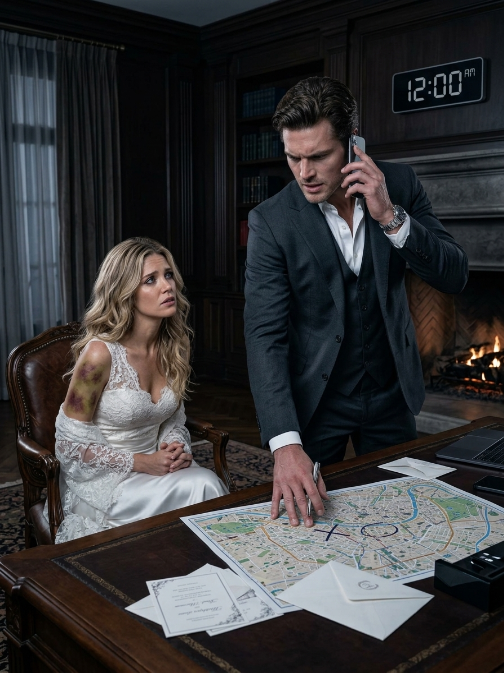
The Mafia Boss Saw Her Trembling in an Abandoned Theater—Then She Whispered She’d Never Been Touched

# PART 1
The night Mara Keane watched a man die, she didn’t scream.
She stood perfectly still in the broken dark of the old Aldridge Theater, fingers locked around her camera strap, the echo of a single muffled shot still vibrating in the hollow bones of the building. Below the stage, silence had replaced a desperate voice. And in that silence, she heard her own heartbeat announce something terrifying:
*He knows someone is up there.*
—
Mara had spent five years photographing the city’s forgotten places for the Boston Heritage Conservancy. Train depots swallowed by ivy. Chapels sealed by city orders. Ballrooms where dust had outlasted every dancer who ever crossed the floor.
She preferred ruins. Always had.
Not because she was morbid—though her brother Jamie had accused her of that more than once before he died—but because ruins told the truth. A collapsed ceiling didn’t pretend to be whole. A water-stained wall didn’t hide its damage. Broken things had a dignity that intact things sometimes lacked.
The Aldridge Theater on the edge of South Boston smelled like abandoned decades: velvet dissolving into mildew, plaster crumbling from cherub reliefs along the walls, the ghost of gaslight perfume soaked into floorboards that hadn’t supported a paying audience since 1974. Mara had been given forty minutes and a key card by the city’s preservation liaison. Her job was simple: document the mezzanine damage, capture the stage house geometry, and photograph the ornamental ceiling before the demolition consultants finished arguing about what they wanted to tear down.
She had been shooting the upper gallery when the voices began.
At first she assumed it was sound bleeding from the street. The Aldridge sat two blocks from a bar district, and the building’s acoustics had always been strange—she’d read that in the survey notes. But then one voice sharpened into words.
“You knew the terms, Richie.”
Cold. Precise. Not loud. The kind of voice that didn’t need volume because everyone in earshot already understood the consequences of ignoring it.
A second voice answered, hoarse and fractured. “I can fix it. Two days, Cael, that’s all I’m asking. Two days.”
*Cael.*
Mara pressed herself back against the gallery rail, camera clutched against her chest, lens cap in her pocket. She had made a career of being quiet in old buildings. She had never needed that skill the way she needed it right now.
“He’s been saying two days for three weeks,” a third voice offered, with the casual flatness of someone describing weather.
A pause.
Then: “I know.”
What followed was not dramatic. That was the worst part. No raised voice, no warning, no cinematic buildup. Just a muted crack—almost polite—and the sound of something heavy meeting the floor.
Mara’s finger moved on pure instinct.
The shutter clicked.
Below the stage, all other sound stopped.
“Someone’s up there.” The cold voice again. Calm as a locked door.
Her body understood before her mind caught up. She turned for the side stairs, misjudged the step in the dark, and went down hard against the gallery railing. Pain split up her knee. The camera swung forward and struck the iron balustrade with a sharp, echoing clang.
She grabbed the rail, pulled herself upright—
And a flashlight beam found her face.
He appeared at the top of the mezzanine stairs like something the building had assembled from its own shadows. Tall, wide-shouldered, dressed in dark wool that fit like it had been made for a different occasion than this one. His hair was pushed back from his face with the kind of disorder that happens when someone has been working too long at something that requires complete focus. There was something on the cuff of his white shirt that she refused to look at directly.
His eyes moved to her camera first.
Then to her face.
He didn’t raise a weapon. He didn’t shout. He simply stood at the top of the stairs and studied her with an expression that Mara would spend weeks trying to classify—not cold, exactly. More like absolute attention.
“You heard everything,” he said.
“I didn’t hear anything.”
“You’re braced against the rail like you’re going to run.”
“I tripped.”
His head tilted by a fraction of a degree. “What’s your name?”
She considered lying. Then she considered who she was lying to.
“Mara Keane.”
“Who knows you’re here, Mara Keane?”
The honest answer was *no one*. The liaison had sent the key card by email. She hadn’t told her roommate. She’d taken the bus.
She said, “Several people.”
His expression didn’t change. He had already calculated the same answer she had.
Behind him, the man with the flashlight appeared—younger, with a thin scar bisecting his left eyebrow—and said something low in Cael’s ear. Cael raised one hand. The other man went quiet.
“Give me the camera.”
Her hands shook as she lifted it from around her neck. He took it without touching her fingers—careful, deliberate, which terrified her more than roughness would have—and scrolled back through the image history. His face revealed nothing as he deleted files, removed the memory card, pocketed it.
“There’s nothing left,” he said.
“There was nothing to begin with.”
“That’s the second time you’ve denied something we both know is true.” He returned the camera. “Try a third time and I’ll stop finding it interesting.”
Mara’s mouth went dry. “Are you going to kill me?”
The man with the scar exhaled sharply, as if she’d asked something ridiculous.
Cael was quiet for a long moment.
“No,” he said.
“Why?”
He looked at her with an expression she couldn’t name—not kindness, not exactly. Something rawer than that. Something that looked, beneath the controlled surface, almost like recognition.
“Because you’re still here,” he said. “Someone who came to cause trouble would have run the moment I appeared.” A pause. “You stayed because you wanted to know if I was going to.”
Mara didn’t answer.
He stepped to the side of the staircase, clearing her path.
“Walk out the east exit. Don’t use your phone until you’re two blocks away. And Mara Keane—” He waited until she looked at him. “If anyone asks about tonight, you were alone in this building for forty minutes and saw nothing.”
“And your name?”
The scar-faced man muttered something under his breath.
Cael’s expression shifted—the smallest possible distance toward something almost human.
“Cael Morrow.”
She repeated it silently. Pressed it somewhere behind her sternum where she kept things she knew she shouldn’t keep.
Then she walked out of the Aldridge Theater into the cold October air, and didn’t stop moving until she reached a lit street corner four blocks away, where she sat on a bus bench and shook for a long time without making any sound.
—
*She didn’t know then that the name Cael Morrow would appear in three federal indictments, two city council investigations, and a sealed grand jury transcript.*
*She didn’t know that the dead man’s employer would spend the next six weeks tracing back every person who had entered the Aldridge that night.*
*And she didn’t know that the memory card in Cael Morrow’s pocket contained one photograph she had taken earlier in the evening—a wide shot of the stage—in which a face was visible in the far wing doorway. A face that would later prove to be worth more than any testimony.*
*But she would.*
—
# PART 2
Four days of ordinary life.
Mara went back to work. She catalogued photographs from a demolished rail depot on the harbor. She helped a graduate student locate nineteenth-century fire insurance maps. She answered emails. She made coffee. She stared at ceilings in the small hours of the morning and told herself the quiet crack of a single gunshot was just something her memory would eventually file away and forget.
On the fifth day, she looked up from the reference desk and found Cael Morrow standing in the reading room.
He wore a gray coat and no expression of apology for being there. His hands were in his pockets. He looked like he had walked into exactly the place he intended to go.
“You followed me here,” she said, keeping her voice low for the other readers.
“It’s a public institution.”
“You know what I mean.”
“I wanted to confirm you hadn’t spoken to anyone.” He scanned the room once, professionally, then looked back at her. “You didn’t.”
“I said I wouldn’t.”
“People say a great deal of things.”
“I don’t.” She kept her voice level through an effort that cost her. “Is this a warning?”
“It’s a question.” He studied her with that same quality of attention she remembered from the theater—complete, unnerving, not unkind. “Why didn’t you tell anyone?”
Because I was afraid, she almost said. And then: because you told me not to. But neither of those felt true enough.
“Because I gave my word,” she said.
Something moved through his expression. Not surprise, precisely. More like the careful attention of a man cataloguing something he hadn’t expected to find.
“Coffee,” he said.
“I’m working.”
“Your shift ends in twenty-two minutes.”
She stared at him.
“That’s—”
“Accurate.” A pause. “I’ll be outside.”
He turned and walked toward the exit.
Mara looked at the reference desk clock.
Twenty-two minutes.
She should have let him wait until closing. She should have walked out the staff entrance on the opposite side of the building. She should have done many things.
Instead, she appeared on the front steps at exactly the right time, and found him standing with his back to the door, watching the street with the posture of a man who had learned long ago that safety lived in knowing where everyone else was before they noticed you.
He turned when he heard her.
And for the first time since the theater, he looked at her without calculating something.
“You came,” he said.
“Don’t make it more than it is,” Mara told him. “I want answers. That’s all.”
He almost smiled.
“That’s enough.”
—
# PART 3
The coffee shop he chose was narrow, crowded, and smelled of cardamom and burnt milk—the kind of place where a man in an expensive coat looked conspicuously out of context. He chose the corner table with his back to the wall and both exits visible.
Mara sat across from him and said, “You always do that.”
“It keeps me alive.”
“Is that your version of small talk?”
“Yes.”
She wrapped both hands around her mug. “Tell me who that man was. In the theater.”
Cael was quiet for a moment. When he answered, his voice carried no performance—no defense or justification, just the flat architecture of fact.
“His name was Richie Farrell. He moved trafficking victims through the port district for the last four years. Twelve women that we confirmed. Probably more.” A pause. “He was given four opportunities to cooperate with people better positioned than me to handle it through legal channels. He declined each time and used the information to protect himself.”
Mara’s hands tightened around the mug. “And that makes you qualified to decide—”
“No,” Cael said. “It makes me the man who didn’t walk away when everyone else decided it was too complicated.” His voice didn’t harden. If anything, it became quieter. “I’m not asking you to call me righteous. I don’t think I am.”
She looked at him.
“Then what are you?”
He seemed to consider this genuinely, as if the question hadn’t occurred to him in a form that deserved a careful answer.
“I’m what happens when a city decides certain problems are acceptable losses.”
The room moved around them—the espresso machine grinding, a child laughing near the window, two women arguing quietly over a shared phone. Mara thought about her brother Jamie, who had been twenty-four years old and cycling home from a late shift when a truck ran a red light and removed him from the world in under a second. She thought about all the paperwork that followed. All the official language that had managed to describe his death without once suggesting it mattered.
“My brother was killed three years ago,” she said. “Cycling accident. The driver had three prior violations and a suspended license.”
Cael didn’t offer condolences. He waited.
“He kept getting warnings,” Mara said. “Kept getting chances. And they kept giving them to him until the night he killed someone who wasn’t a warning anymore.” She looked at her coffee. “I used to think the system just needed better people in it. Now I think some problems outlive the system’s patience for them.”
Cael said nothing for a long moment.
“I’m sorry about your brother.”
It landed differently than it usually did. Most people said it to close the conversation. He said it like he meant to open it.
“You?” she asked.
He turned his coffee cup slowly on the table. “My younger brother, Leo. He died because I trusted a woman named Vivian Ashby. She was working with a man named Greer—my primary rival, if that’s the right word for someone who wants to hollow out everything you’ve built. Leo found out she was passing information.” His jaw moved once. “He tried to protect me. He shouldn’t have had to.”
“You loved her.”
“I thought I did.” His eyes stayed on the window. “I’ve learned the difference since.”
That was how it started—not with attraction, exactly, though that came later. It started with two people who had each carried a specific grief alone for too long, recognizing the particular weight of it in someone else.
—
Over the following weeks, Mara told herself she was being careful.
She saw him four times before she admitted she was looking forward to it. He took her to the Fine Arts Museum because she’d mentioned Caravaggio in passing—she’d expected him to tolerate it. Instead, he stood in front of *The Sacrifice of Isaac* for eleven minutes without speaking, and when she finally asked what he was thinking, he said: “That the angel looks like he arrived just barely in time.”
She thought about that for days.
He was wrong-footed in ordinary places in a way she found genuinely endearing. At a cramped North End pizza counter she loved, he didn’t know how to order without a menu and had to ask her twice what *arrabbiata* meant. When the owner shouted at him for holding up the line, he stepped aside with the genuine startlement of a man who had never encountered a social context his authority couldn’t navigate.
“You’re completely useless here,” Mara observed.
“I’m learning.”
He was. She could see it in the careful way he asked questions—not to be polite, but because the answers actually interested him. He wanted to know why she found preservation meaningful, why she cared about photographing places most people walked past without seeing. She told him about Jamie, about the way grief had rearranged her sense of what was worth keeping. He listened without performing sympathy.
One evening outside her apartment building, he kissed her.
He asked first, which she hadn’t expected. The asking was slower than the kiss itself—deliberate, slightly uncertain in a way that felt nothing like the rest of him—and afterward she cried without meaning to, which mortified her completely.
He froze. “Did I—”
“No,” she said quickly. “No, it wasn’t—” She pressed the back of her hand to her mouth. “It’s just been a long time since anything felt that careful.”
He didn’t say anything clever. He didn’t fill the quiet.
He just waited with her in it until she finished.
—
The truth came from a colleague named Bea, who ran the archive desk and had a researcher’s compulsive need to identify everything correctly.
“Mara.” Bea appeared at her elbow one morning, holding her phone at a careful distance, the way people hold phones when they aren’t sure how the information will land. “I need to ask you something and I need you not to be angry at me for asking.”
The photograph on Bea’s screen was grainy—taken from a distance, probably a long lens—but clear enough. Mara leaving a restaurant. A man’s hand at the small of her back, guiding her through the door.
The headline below it read: *CALLAHAN SUCCESSOR? CAEL MORROW RESURFACES AFTER FEDERAL INQUIRY — SEEN WITH UNIDENTIFIED WOMAN.*
The room tilted slightly.
*Callahan successor.*
Mara read the article in four minutes while Bea watched her with the expression of someone who has already prepared several possible responses.
It wasn’t one article. It was a thread of them—court records, investigative pieces, a long feature in a regional magazine from two years ago that laid out the Morrow organization’s history with the careful language of documented allegation. Not suspected. Documented.
She had known he was dangerous. She had told herself that was different from knowing the shape of it.
She went to his apartment that evening.
He opened the door and his face did something complicated—relief, followed immediately by the recognition that relief was about to be taken from him.
“Come inside,” he said.
“Are you what those articles say you are?”
A pause that felt like a long time.
“Yes.”
The honesty of it was worse than a denial would have been. There was no bargaining in it, no attempt to manage her reaction.
“You let me—” She stopped. Started again. “I was falling in love with you.”
His expression fractured, briefly, in a way she’d never seen. “I know.”
“And you didn’t tell me.”
“I was going to.”
“When?”
“When I was sure you’d still be here after.”
The words fell between them like stones.
Mara thought about every evening, every conversation, every careful question he had asked her—not as manipulation, she believed that. But as something that had grown around the absence of a truth he’d kept to himself.
“I need to leave,” she said.
He stepped back from the doorway.
She left.
—
Three days later, Vivian Ashby came to the conservancy.
She was everything the name suggested—elegant, precise, occupying space with the confidence of someone who has decided that other people’s perceptions are resources to be managed. She said she was Cael’s former fiancée. She said she had information Mara deserved to have.
She said Cael Morrow collected innocent things because he needed something he could feel superior to. She said his brother’s death had not been an accident of betrayal but a consequence of choices Cael himself had made. She said: *You think he changed for you. He changes the way weather changes. It passes.*
Mara listened to all of it.
There was something technically correct in every sentence that Vivian said. But there was something underneath the technical correctness—a hunger that the careful words couldn’t fully contain.
“Why come to me?” Mara asked.
Vivian’s smile arrived half a second late. “Because someone should have come to me.”
Mara said nothing.
That night, Cael appeared at her apartment in the rain. He looked the way people look after a long time without sleep—not disheveled, exactly. More like the surface control that usually smoothed everything down had been rubbed thin by friction.
“Five minutes,” he said at the door. “If you want me to leave after, I’ll leave.”
She let him in because she hadn’t fully stopped loving him in three days, and she was honest enough with herself to know it.
He stood in the center of her living room and laid out the facts about Vivian Ashby the way he would have laid out documents. Not to convince her—he said that plainly. Because she deserved to know what she was deciding about.
Vivian had been working with Greer from the beginning. She had fed Leo information that was wrong on purpose. Leo had gone to confirm it personally because he hadn’t trusted her either and hadn’t told Cael—trying to protect him without worrying him—and Greer’s men had found Leo in the wrong place with the wrong knowledge.
Cael placed a flash drive on her coffee table.
“Bank transfers, calls, photographs. Give it to whoever you trust. A journalist. A federal contact. Don’t take my word for it.”
“You could have given this to someone yourself months ago.”
“I could have.” His voice was quiet. “I didn’t, because half the people who should have received it were already eating at Greer’s table. And I wasn’t—” He stopped. “I wasn’t in a position to care very much about what happened to me, before.”
Mara looked at the flash drive.
“Before what?”
He looked at her directly. “Before you.”
She cried again, which she was beginning to accept as simply what happened when he said true things in that particular tone of voice.
When she stepped toward him, he opened his arms around her carefully—the way he did most things with her, she realized. Not because she was fragile. Because she mattered.
—
The danger Mara had understood theoretically became specific two weeks later.
A man in a navy jacket approached her outside the conservancy entrance on a Wednesday morning, moving too fast, hand already inside his coat. Cael’s driver, a quiet man named Declan, stepped between them before she’d fully processed what was happening.
Afterward, Cael said she needed to move.
“I won’t disappear into your building,” Mara said.
“I’m not asking you to disappear. I’m asking you to be somewhere I can guarantee is safe.”
“Guaranteed by who? By the same organization that made you a target worth threatening?”
His jaw tightened. “Yes.”
“Cael.” She waited until he looked at her. “I understand the threat. I’m not dismissing it. But if I become only something you protect, I stop being the person you said you wanted to keep safe. I’m not willing to be a reason you keep making the same choices.”
The argument was long and left marks on both of them.
The compromise was this: she kept her work, her routines, her independence. Declan stayed nearby. Cael told her everything—no managed silences, no protective omissions. Whatever she was choosing, she would choose it with full information.
For two weeks, it held.
Then she needed to reshoot the Aldridge Theater mezzanine.
The city’s restoration funding had come through, and the original documentation file had gaps—Cael’s men had deleted more than just the photograph of the shooting when they’d cleared her card. She needed the spatial records for the preservation report.
“Send someone else,” Cael said.
“It’s my project. The measurements need my documentation to be valid.”
“I will have someone qualified—”
“Cael.” She kept her voice even. “This is the job. The job mattered before you. I need it to still matter, or we’re both pretending I’m something I’m not.”
He didn’t like it. She could see exactly how much he didn’t like it in the controlled stillness of his posture, the way he was very carefully not saying all the things he wanted to say.
“Thirty minutes,” he said. “Declan and two others inside with you.”
She agreed.
—
The Aldridge looked different in morning light. Less like the place where she’d heard a man die and more like what it actually was—a beautiful, damaged structure that deserved better than it had received.
Mara worked quickly. The mezzanine measurements. The ceiling details. The ornamental plasterwork along the upper walls. She had exactly what she needed and was capping her lens when the building’s lights went out.
In the sudden dark, Declan’s hand found her arm.
“Move,” he said, already pulling her toward the back wall.
The sound that followed was not a single shot. It was several, coming from below and from the rear corridor simultaneously, and in the space between them Mara heard glass breaking, smoke beginning to bite at the air, and Declan’s voice cutting through it all with sharp, direct instructions that she followed without thinking because there was no space for thought.
She ran.
She ran because Declan told her to run, because the exits were marked in her memory from the survey, because she had spent five years learning the geometry of old buildings and she knew exactly how many paces to the east stairwell.
She almost made it.
Hands caught her in the orchestra level, where the smoke was thickest. Something pressed over her face that tasted like chemicals and sweetness and the word *no* and—
Darkness.
—
She came back to consciousness in the theater basement.
The same space. The same pipes overhead, same rusted service door in the far wall, same smell of damp concrete and decades of sealed air. The symmetry of it was so complete it felt almost constructed—and then she realized it was.
Her wrists were bound behind the chair. Her ankles were secured. Her head ached at the base of her skull with a specific pain that told her she’d been moved unconscious.
Vivian Ashby stood in front of her in a white coat that looked like a provocation against the dirt.
“I thought you’d appreciate the location,” Vivian said.
“You’re very committed to a point,” Mara said. Her voice was hoarser than she expected. “What is it?”
“That everything comes back to where it started.” Vivian tilted her head. “You walked into this building and saw something you shouldn’t have. I’m giving you the opportunity to walk out with the story you should have told then—that you saw nothing, heard nothing, and Cael Morrow is a man you met in a library.”
From the deeper shadow near the service door, a voice said: “She’s not going to do that.”
A man stepped forward—silver-haired, wearing the kind of careful calm that comes from decades of being the most dangerous person in every room. Miles Greer. She recognized him from the articles.
“He’ll come,” Greer said. “He’ll bring what we need—accounts, transfers, the names of the people inside the federal investigation. Everything.” His eyes moved over her with professional disinterest. “For you.”
Mara breathed slowly.
She thought: *panic is only useful for the first three seconds.* She didn’t know where she’d heard that. She thought maybe Cael had said it once, offhandedly, as if it were simply true.
She looked at the room. The service door. The rusted pipe. The single support pillar. The shard of mirrored glass from a broken sconce near her chair leg—close enough that if she angled her wrists correctly—
“You hate him,” Mara said to Vivian. “I understand that. I do. But this isn’t about him anymore, is it?”
Vivian’s eyes sharpened.
“This is about proving you were the one who understood him first.” Mara kept her voice conversational, her hands working slow and steady against the mirror fragment behind her. “You made him into something harder and more careful and less likely to trust anyone. And then someone else came along and got the version you’d refined.”
Vivian’s face went very still.
“You don’t know what you’re talking about.”
“You came to my office to warn me off. That’s not what someone who hates him does. That’s what someone who still needs to win does.”
The slap snapped her head sideways. Her mouth filled with copper.
Mara turned back and smiled, because the second zip tie had just given way.
—
Cael came through the main entrance.
Alone. Carrying a black folder. His face was exactly as controlled as the night she’d first seen him—but she knew him now, and underneath the control she could read something she recognized: *he is prepared to burn down everything in this room.*
Greer kept his gun on her. Vivian took the folder, scanned it, confirmed the documents.
“This is everything we asked for,” Vivian said.
“Yes,” Cael said.
His eyes found Mara’s.
Not her face.
Her hands.
He saw what she’d done.
The smallest possible change moved through his expression—not quite relief, not quite pride. Something quieter and more specific.
“Let her go,” he said.
“I don’t think so,” Greer said. “I need you to understand that affection is a structural weakness. Letting her walk would rather defeat the lesson.”
“Then you should know,” Mara said, “that I’ve had several minutes to study this room.”
She was already moving when she said it.
The service door was unlatched—she’d seen that from the beginning. She threw herself sideways off the chair, hit the floor, rolled, and came up with the tripod she’d spotted against the far wall. Vivian was faster than Greer—she’d anticipated movement, was already cutting toward Mara with something in her hand—
Mara swung.
The impact was heavier than she expected. Vivian went down hard.
Cael crossed the room in three steps. Behind him, the service entrance burst open—Declan, moving fast, two others behind him.
The room became noise and smoke and shouting and the specific physical chaos of a plan falling apart from the inside.
Cael’s hands found her arms.
“I have you,” he said.
She leaned into him for exactly one second—enough to verify he was real and uninjured—and then straightened.
“The service door,” she said. “I noticed it when I first woke up.”
He looked at her with an expression she had never seen on him before.
“I know,” he said. “I saw.”
From the floor, Greer was surrounded. Vivian wasn’t moving.
Cael looked at Greer for a long time.
Mara watched his face. She watched the thing move through it—the history, the weight of Leo, the years of damage, all the accumulated permission to be exactly what this moment seemed to demand.
He looked back at her.
“Declan,” he said. “Call Agent Reeves.”
Declan blinked. “Cael—”
“All of it,” Cael said. “The accounts, the names inside the investigation, the properties, the Aldridge documentation. Everything.” His eyes stayed on Mara. “Everything.”
—
The federal case took eight months.
Cael did not emerge from it clean. Mara respected him more for not pretending he should. He gave testimony, transferred assets, exposed the network of protected complicity that had allowed the Morrow organization to exist unchallenged for years. Greer was convicted on eleven counts. Vivian Ashby, on seven.
Cael avoided prison by the margin of his cooperation and the scope of what that cooperation uncovered—corruption inside two city departments, a compromised federal liaison, three shell companies that had moved trafficking proceeds through legitimate real estate for nearly a decade.
He lost almost everything he’d built.
Mara found him outside the Aldridge Theater on the evening of its reopening, the marquee lit for the first time in fifty years, the restored plasterwork her photographs had helped preserve now visible behind clean glass doors.
“You’re thinking about Leo,” she said.
“I’m thinking about what he would have wanted.”
She took his hand. “What would he have wanted?”
Cael looked at the lit marquee for a long moment.
“A brother who stopped using grief as permission to become something worse.”
Mara leaned into his shoulder.
They stood there until the city moved around them, loud and indifferent and alive.
—
A year after that, Cael proposed in the reading room of the Boston Heritage Conservancy, between the reference shelves where he had once stood pretending to need a recommendation.
He got down on one knee with a gravity that made Bea, watching from the archive desk, press her hand silently over her mouth.
“You saw me clearly,” he said. “Not the version I performed, and not some future version I’d promised to become. The actual one, with everything unresolved.” His voice was careful and slightly rough. “You didn’t forgive what shouldn’t be forgiven, and you didn’t make it smaller than it was. You made me face it. And then you stayed while I chose what to do about it.”
Mara was crying, which she’d stopped being embarrassed about.
“I told you once I wanted to be the man who earns something. I meant that. I still mean it.” He looked up at her. “Choose me. Not because I’ve become harmless—I’m not sure that’s possible, and I won’t lie to you about it. But because I am trying, every day, to become worthy of the life you showed me I could have.”
“You already know my answer,” she said.
“I need to hear it.”
“Yes,” she said. “It’s always been yes. But this is the first yes I understand completely.”
—
They married in a small converted chapel outside the city, Bea crying openly, Declan standing at Cael’s side wearing an expression of extreme dignity that slipped twice.
Years later, when people asked Mara what had changed Cael Morrow—what had pulled him back from the edge of the thing he’d been becoming—she never gave the answer they expected.
She didn’t say it was love.
She said: “He made a choice in a basement when no one would have blamed him for making a different one. The choice was harder, and it cost more, and he made it anyway.” She’d pause. “That’s not love’s work. That’s his.”
Because love, she’d come to understand, doesn’t make people different.
It gives them a reason to choose differently.
And what they do with that reason—that is entirely their own.
—
*THE END*
—
—