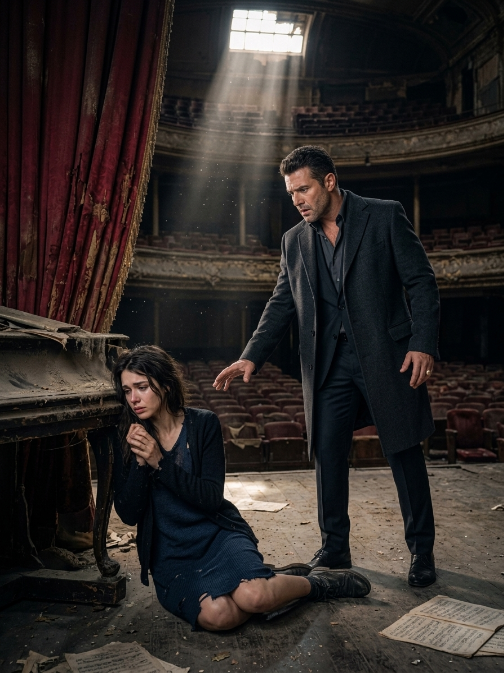
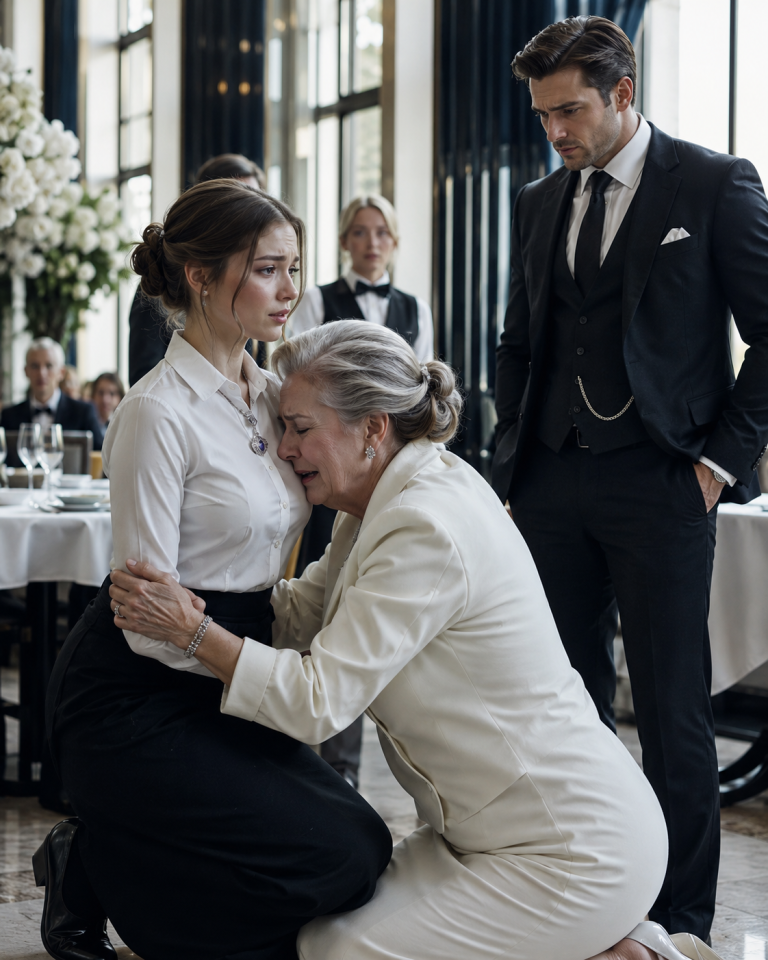
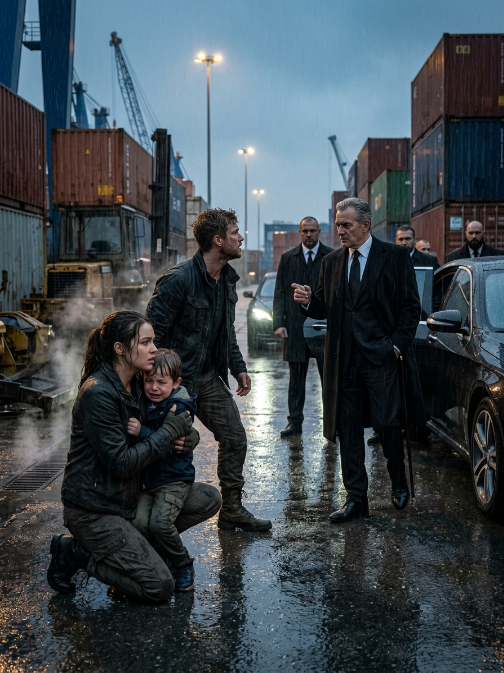
She Spoke One Sicilian Word—Then the Mafia Boss Knew She Was More Than a Translator

## PART 1
She had spent eleven years perfecting the art of being no one.
One sentence — four syllables in a language she had sworn she would never speak again — and it all unraveled in under three seconds.
Isabelle Cartier was twenty-seven years old, fluent in six languages, and invisible by design. She wore charcoal and cream to every assignment, kept her chestnut hair coiled at the nape of her neck, and cultivated the specific forgettability of a woman men looked past while they talked to each other. She was not furniture. She was air. She translated fortunes, brokered silences between powerful men, and left no trace. That was the contract she had made with herself at sixteen, standing over two graves in a suburb of Lyon, and she had not broken it once.
Until tonight.
—
The assignment had arrived through her firm the previous Tuesday: private investor dinner, Hôtel Barrière Le Fouquet’s, Paris. Client: Radovan Steele, an American tech magnate with the confidence of a man who had never once suffered real consequences. He was courting a consortium of European private equity partners, and he needed a cultural translator who could handle formal French, northern Italian, and what the brief coyly described as “assorted regional dialects.”
Isabelle had almost declined.
The consortium names, cross-referenced against the hotel’s reserved floor, belonged to a world she recognized from the inside.
She accepted anyway. The rent was due. She was disciplined. She would manage.
Radovan met her in the lobby, already slightly drunk, already explaining things she already knew. He wore his money loudly — a watch that cost more than most people’s cars, cufflinks the size of small moons. In the elevator, he told her to just relax and be natural because these guys were actually great once you got to know them.
Isabelle said nothing.
She stepped into the private dining suite.
And her body understood before her mind caught up.
The room smelled like old authority. Candlelight on crystal. Six men arranged with the casual precision of people accustomed to rooms organizing themselves around their presence. The man at the center of gravity sat slightly apart from the others, holding a glass of mineral water and wearing a suit so well-made it looked like architecture.
He had been introduced to Radovan as Rafaele Conti.
Isabelle knew his real weight in the world by the way the other men leaned infinitesimally toward him and then corrected themselves. By the way the sommelier brought a second bottle without being asked. By the way his hands, scarred at the knuckles, rested on the table without hiding anything.
She lowered her eyes.
She translated Radovan’s pitch into pristine northern Italian — the clean corporate register, no geography, no family in the vowels. She gave away nothing. She was air.
Then the young man came through the door.
Late twenties. Sweating despite the November chill. A disposable phone vibrating in his fist like something trying to escape. His eyes went straight to Rafaele with the particular desperation of someone delivering news that could not wait.
“Capo,” he breathed, and then seemed to realize, too late, the table full of civilians. He recovered poorly. “The line from the harbor. There’s a situation. If we miss the window—”
Rafaele’s gaze silenced him like a hand pressed over a flame.
“We are at dinner,” he said in English. Quiet. Final.
“I tried to silence it. It’s the backup frequency. The cargo—”
The phone slipped.
Isabelle watched it happen as though the moment had been engineered specifically to destroy her. The device hit the marble, slid on a diagonal path across twelve feet of floor, and stopped at her right shoe.
The vibration climbed up through her heel.
Radovan opened his mouth.
In the milliseconds between his intake of breath and whatever stupid, dangerous sentence was about to come out of it, Isabelle made a calculation. Not a conscious one. The kind that lives in the body, in the oldest part of the brain, the part that had crouched under floorboards at sixteen while men with guns moved overhead.
She bent. She picked up the phone. She answered it.
And she did not use Italian.
She reached through eleven years of careful forgetting and pulled out a voice that belonged to a dead childhood — the guttural, specific music of a Marseille waterfront dialect so obscure it hadn’t appeared in any linguistic database since before she was born.
“C’est brûlé,” she said. “Coupe tout. Le poisson dort.”
It’s burned. Cut everything. The fish is sleeping.
She ended the call. She removed the SIM card with a thumbnail, snapped it, and placed both pieces on the bread plate beside her setting as though this were a standard administrative task.
Then she turned back to Radovan.
“My apologies. A misdial from my service provider. You were discussing the infrastructure expansion?”
Radovan blinked. “Right. Right, the infrastructure—”
The table resumed.
But the room had changed.
Isabelle did not look at Rafaele Conti.
She didn’t need to.
She could feel his attention on the side of her face the way you feel a window open in a sealed room — sudden, directional, impossible to ignore.
He knew.
The Marseille waterfront dialect she had just used existed in approximately forty living speakers, all of them connected to a world of smuggling routes, harbor codes, and family names that predated the modern French state. Nobody learned it from a textbook. Nobody learned it at Georgetown or during a fellowship in Milan. You absorbed it the way you absorbed anything that lived in the walls of the house you grew up in.
And the phrase she had used — *le poisson dort* — was not street slang. It was operational cipher. A termination code for compromised shipments, used exclusively by the Côte network, last active when Isabelle was fourteen years old and answering to a different name.
She had spent eleven years being Isabelle Cartier.
In three seconds, she had spoken as Élodie Renaud.
Daughter of the accountant who turned informant.
Sister of the girl who didn’t survive what came after.
The woman the Conti network had been hunting, intermittently, for over a decade.
Dinner lasted two hours.
Isabelle translated with perfect composure. Her sea bass went cold. Her water glass was refilled twice and she touched it once. Across the table, Rafaele Conti drank nothing stronger than sparkling water, discussed Venetian architecture with an academic’s precision, and never once betrayed that he was conducting a parallel interrogation with his eyes.
When he addressed her directly, the table softened.
“Miss Cartier,” he said. Her alias sounded like something held up to light and examined for flaws. “Your Italian is remarkable. Where did you study?”
“Paris, then a residency in Genoa.” The lie was smooth from years of use. “I’ve always acquired languages easily.”
“Genoa,” he said, as though tasting the word. “And yet the regional specificity you demonstrated earlier — that was not Genoese. That was something much rarer.”
Radovan laughed too loudly. “Isabelle’s unreal. Like a human radio, picks up every frequency.”
“Precisely the right metaphor,” Rafaele said.
His eyes stayed on hers.
She understood the subtext perfectly.
He was telling her he knew. Not to threaten. To establish a truth between them that the table couldn’t hear.
At eleven, the dinner concluded. Radovan disappeared toward the hotel bar. Isabelle gathered her materials with practiced calm, said her professional goodbyes, and walked toward the suite’s main doors at a pace that was not running.
At the threshold, she allowed herself one look back.
Rafaele stood near the window, unhurried, while his young associate bent toward him with a tablet and a bloodless expression.
Rafaele glanced up.
He met her eyes across the room.
And smiled, for the first time all evening, with something that was not performance.
Isabelle walked into the corridor and kept walking.
Her heels were too loud on the marble. She turned toward the service stairs rather than the main elevator, shed her shoes at the landing, and ran.
*Think.*
Ditch the phone. Skip the apartment on Rue des Martyrs. Metro to Gare du Nord, then Brussels by Eurostar. There was a safety deposit box in Bruges she hadn’t touched in four years. Cash. A French-Canadian passport. Enough distance to disappear again.
She was three levels below the suite when the stairwell door above her opened.
She ran faster.
She was one floor above the underground parking garage when the door at the bottom opened.
Two men. Black coats. Hands visible, no weapons drawn.
She spun.
The door above her opened again.
Another man.
And then, last, unhurried — because men like Rafaele Conti had never needed to hurry toward anything in their lives — Rafaele himself descended three steps and stopped.
He looked at her with calm, complete attention.
“You used a Côte termination code,” he said. “At a table full of civilians who would not have survived whatever Radovan Steele was about to say. You protected people who don’t even know they needed protecting.” He tilted his head. “That is not the behavior of a frightened woman running.”
“It was instinct.”
“Exactly.”
Silence in the stairwell.
The distant sound of a saxophone from the hotel bar three floors up.
Isabelle’s back was against the railing. Her options had collapsed to zero.
“Whatever your file says about my family,” she said, her voice stripped of everything decorative, “I have no connection to that world. I have no ledgers. No contacts. No operational knowledge current enough to matter to anyone.”
Rafaele descended one more step.
“I know,” he said. “I read the file on Élodie Renaud three years ago and closed it. The Côte network is gone. The grievances are settled.” He paused. “That is not why I am here.”
“Then why?”
He looked at her with the directness of someone who had not needed to justify himself in a very long time and had chosen, for once, to try.
“Because you just demonstrated that under pressure, with nothing to gain and everything to lose, you used knowledge you have been hiding for a decade to prevent a catastrophe. And I have a catastrophe that requires exactly that kind of knowledge.” He extended one hand. Not to grab. To offer. “Come work for me. Voluntarily. With a contract, compensation, and the understanding that you may leave the moment the assignment ends.”
Isabelle stared at his hand.
“You’re asking.”
“I’m asking.”
She looked at the two men below her. The one above.
“And if I decline?”
Rafaele withdrew his hand slowly.
“Then I call off my men, you take the Eurostar to Brussels, and we pretend tonight was a very strange dream.” He looked at her steadily. “But Élodie. The man who ordered your father killed is still operating. He moved through Paris three weeks ago. He will be in Geneva next month.”
Her breath left her in a slow, controlled exhale.
Revenge. The oldest trap.
She looked at Rafaele Conti’s scarred hands and understood that she was being recruited, not captured. That the difference mattered. And that she was, against every wall she had built, tempted.
“What’s the assignment?” she asked.
The ghost of a smile.
“Let me show you.”
—
## PART 2
The penthouse on Île Saint-Louis was not a prison.
That was important to establish, Isabelle decided, as she stood at a window watching dawn break over the Seine. She had slept in a room with an unlocked door. Her shoes had been returned. The espresso on the kitchen counter was better than anything she owned. Luca — Rafaele’s second, compact and professionally silent — had provided her with a secure laptop, a clean phone, and the explanation that Mr. Conti would see her at nine.
She spent the hours before nine going through the files.
The operation was elegant in outline, brutal in implication. A man named Félix Orain controlled the northern European narcotics corridor through a network of legitimate shipping companies — cold storage logistics, wine distribution, a chain of pharmaceutical warehouses across Belgium and the Netherlands. Rafaele’s networks were losing routes. Not to violence but to paperwork — Orain had legislators, customs officials, and two Europol analysts on his payroll, and he was slowly legalizing his monopoly from the inside out.
But there was a fault line.
Orain’s communications with his eastern European suppliers were conducted in a layered cipher that mixed Walloon Belgian dialect, encoded shipping terminology, and a numeric overlay derived from mid-century French colonial tax records. Nobody in Rafaele’s organization had broken it. Three weeks of attempts had produced noise.
Isabelle read the transcripts for forty minutes.
Then she picked up the pen Luca had left beside the files and began writing.
Rafaele found her there when he arrived. He stood in the kitchen doorway watching her work — hair uncoiled, blazer abandoned, a page of transcripts in her left hand and four pages of decoded text in her right, muttering half-syllables to herself in three languages simultaneously.
When she looked up, she did not perform surprise.
“Orain’s pickup at Rotterdam is scheduled for the ninth,” she said. “Not the fourteenth. The cipher uses Flemish municipal calendar offsets — Catholic feast days. Your analysts were using Gregorian dates.”
Rafaele looked at the decoded page.
Then at her.
“Five days,” he said.
“Four, now.” She set the pen down. “That’s why you need me.”
“That,” he said, coming to the table and turning the page to read her work, “and a dozen other things I suspect you haven’t shown me yet.”
He was standing very close. Close enough that she could smell the cedar in his jacket.
She stepped back.
“We should discuss the terms of this arrangement.”
“We should,” he agreed, not moving. “But first — you decoded this in forty minutes. My team had three weeks.”
“Your team doesn’t speak Walloon.”
“Does anyone under sixty?”
“My grandmother did,” she said.
A beat.
Something shifted in his expression — not pity, something more careful than that.
“Tell me about her.”
Isabelle looked at him for a long moment.
“After the assignment,” she said.
He nodded, accepting the boundary the way a man accepts a locked door — acknowledging it, not forcing it.
“Rotterdam in four days,” he said. “We’ll need you in the field.”
“I’m a linguist. Not an operative.”
“You terminated a compromised harbor line under social pressure at a dinner table without blinking. You ran a five-story stairwell in your stockinged feet and assessed three exit routes before I finished descending.” He picked up the decoded pages. “Isabelle Cartier is a linguist. I think Élodie Renaud is something more complicated.”
She hated that he was right.
She hated more that he said it without using it against her.
“Fine,” she said. “But I set the parameters in the field. You don’t override my calls on language. And when this is done, I walk.”
Rafaele extended his hand again. Same gesture as the stairwell. Same patience.
“When this is done,” he said, “you walk. You have my word.”
She shook his hand.
His grip was firm and brief and completely without theater.
But it was warm.
She filed that information away and told herself it was irrelevant.
—
## PART 3
Rotterdam’s harbor at two in the morning smelled like diesel and cold salt and something chemical underneath that Isabelle associated with the memory of her father coming home from long trips, jacket reeking of the docks, pressing his forehead to her mother’s.
She shut the memory down.
“Walk me through Orain’s team positions,” she said into the earpiece.
Luca’s voice came back flat and efficient. “Three vehicles. Lead car near the warehouse entrance. Two flankers on the north perimeter. Orain himself will arrive with four private security, ex-military. The cargo transfer starts at 0230 when the cold storage handler clocks off.”
Rafaele sat beside her in the back of a black Volvo, checking a suppressed sidearm with the economy of motion of someone who had done this ten thousand times. He wore a dark wool overcoat, no tie. He looked, Isabelle thought, like a professor who had made one very specific career deviation.
“Your role,” he said, “is passive intercept. You will be inside the secondary warehouse with Luca. I need to know the moment Orain shifts from negotiation to contingency language with his suppliers. If he feels threatened, he uses a specific phrase.”
“*Le ciel se ferme,*” she said. “The sky closes.”
Rafaele looked at her.
“It’s in the transcripts,” she said. “It’s his abort signal. He uses it in three separate intercepts from the last six months. Different operatives, same phrase. It’s instinct language — the kind you default to when you’re running on fear rather than plan.”
“If you hear it—”
“I’ll say *red* in your ear and you’ll have approximately ninety seconds before his security shifts from protective to offensive.”
“Yes.”
“And if his suppliers respond in the eastern dialect variant—”
“You translate in real time and I adjust.”
They looked at each other in the close dark of the car.
“You’ve done this before,” he said. It was not an accusation.
“Once,” she said. “With my father. I was fourteen. He was trying to exfiltrate a ledger and he needed someone who could pass as a local vendor’s daughter.” She paused. “It worked. Until it didn’t.”
“What happened?”
“Someone in his network sold the timeline.” She looked at her hands. “He bought me enough time to run. He didn’t run with me.”
The silence that followed was not uncomfortable. It was the silence of two people who had both looked at the same kind of darkness from different sides of it.
“Orain’s network sold the timeline on your father,” Rafaele said carefully. Not a question.
Isabelle looked up.
“The man who ordered it,” Rafaele said, “is named Sébastien Marre. He runs the eastern Brussels corridor. He was operating under Félix Orain’s protection.” A pause. “He will be at the Rotterdam transfer tonight.”
The air left the car.
Isabelle had carried Sébastien Marre’s name like a splinter for eleven years. She had not known his name until three years ago, and knowing it had not helped. He was protected, invisible, operational.
Tonight he was at a warehouse two kilometers away.
“You knew,” she said. “Before you recruited me. You knew he’d be here.”
“Yes.”
“And you told me anyway. You didn’t use it as leverage in the stairwell.”
“I told you tonight,” Rafaele said, “because you have the right to know. Not because I needed it to compel you.” His eyes were steady. “What you do with that information is your choice. I won’t arrange it for you and I won’t stop you. I’m telling you because you deserve the truth before you walk into that building.”
Isabelle stared at him for a long moment.
“That’s either the most honest thing anyone has said to me in eleven years,” she said, “or a very sophisticated manipulation.”
“Perhaps both,” he said. “I have not been a good man. But I am trying to be a precise one.”
She looked at the warehouse beyond the rain-blurred windshield.
“Let’s go,” she said.
—
The secondary warehouse was cold and smelled of brine and machine oil. Isabelle wore a dark jacket and a wireless receiver disguised as a hearing aid. Luca positioned her behind a steel rack stacked with packing crates, line of sight to the central floor, acoustic clarity to the proceedings unfolding forty feet away.
Félix Orain arrived at 0228.
He was smaller than she’d imagined from the dossier. Compact, precise, with the manner of a municipal accountant who had discovered, somewhere in middle age, that violence was more efficient than spreadsheets. He moved through his security detail like water finding its level.
Behind him: Sébastien Marre.
Isabelle had been braced. She had told herself she was braced.
She was not braced.
He was sixty now. Gray-bearded. A little stooped. He wore a down jacket and carried a tablet, and he looked — this was the unbearable part — he looked ordinary. He looked like someone’s unremarkable uncle. He looked like a man who had ordered two people killed and then gone home and eaten dinner.
Her hands were shaking.
She pressed them flat against her thighs.
Rafaele’s voice in her ear: “I see Marre. Isabelle. Stay with me.”
She breathed.
The eastern suppliers arrived. Three men from a Gdańsk logistics company, speaking rapid-fire Polish-inflected German layered over something older and more coastal. Isabelle caught it inside the first two sentences — a Lithuanian port dialect, maritime vintage, the kind spoken by harbor workers who had been at sea since before the EU existed.
She began translating in a low murmur into the earpiece.
“They’re saying the shipment is thirty percent lighter than contracted. They’re blaming customs interference in Gdańsk but the phrasing — the verb they’re using for ‘interference’ — it’s the same verb they use for internal diversion. They shorted the delivery themselves.”
Rafaele’s voice: “Orain doesn’t know.”
“Not yet. He will when his people inventory the containers. He’ll think it was Orain’s network that shorted him and—”
“And a negotiation becomes a dispute.”
“In approximately four minutes, yes.”
A pause.
“Can you accelerate that timeline?”
Isabelle looked at Luca. He looked back with the expression of a man who had learned not to be surprised.
“If I speak into the room in the supplier dialect, I can introduce a phrase that suggests Orain’s team already flagged the weight discrepancy. It will make the suppliers defensive before Orain’s people have time to check.”
“Do it.”
“Rafaele. If they trace the voice—”
“They won’t trace it before my team has the building. Do it.”
Isabelle closed her eyes for two seconds. Reached back into the library of voices she kept locked behind eleven years of careful living. Found the one she needed — old, weathered, masculine, a harbor foreman’s cadence from a port she had visited once as a child when her father was running a contract.
She pitched her voice low and threw it toward the open floor.
“*Das Gewicht wurde schon gemeldet,*” she said, and under it, in the Lithuanian overlay: “*Wir wissen, was fehlt.*”
The weight has already been reported. We know what’s missing.
The effect was immediate.
The lead supplier spun. Orain’s head snapped toward his inventory manager. Two of Orain’s security raised their hands slightly — not drawing weapons, just shifting weight.
Orain looked at the supplier.
“*Le ciel se ferme,*” he said.
“Red,” Isabelle said.
Everything happened at once.
Rafaele’s team breached from the north and east doors — six men, disciplined, precise, the kind of precision that came from rehearsal not adrenaline. Orain’s security went for weapons. Two shots fired, both suppressed, both into the ceiling — warning shots.
Luca grabbed Isabelle’s arm and moved her back.
In the confusion, Sébastien Marre ran.
Not toward the exits his security was trained to use. Toward the back of the warehouse, toward a service corridor that presumably led to the harbor access. Isabelle had studied the building schematic. She knew where the corridor ended.
A locked door.
Without the harbor authority’s access card — which Marre did not have — it was a dead end.
Luca was occupied with one of Orain’s men.
Isabelle ran.
She was not a soldier. She translated words. She read patterns.
She also knew exactly where Sébastien Marre was going, and that he would reach it in thirty seconds, and that no one else in the building had that information.
She found him at the service corridor’s end, slamming his fist against a steel door that was not going to open. He spun at the sound of her footsteps.
He looked at her.
She watched him trying to place her. She was twenty-seven, dark-haired, rain-soaked, and pointing a compact sidearm at his chest that Rafaele had pressed into her hand six hours ago as an afterthought, the way you press a key into someone’s hand before a long trip.
“I don’t know you,” Marre said.
“No,” she said. “You knew my father.”
The specific quality of silence that follows a correct accusation.
His expression ran through several configurations before it settled on something she could only describe as the face of a man who has been carrying a weight so long he has almost forgotten what it feels like to set it down.
“The girl,” he said. “Renaud’s girl. You were—”
“Fourteen.”
“You were supposed to be dead.”
“People kept telling me that,” Isabelle said. “I kept not being dead.”
Her hand was steady. She had thought about this moment ten thousand times across eleven years. She had constructed it in her mind as a clean, final thing — a sentence with an ending.
Standing here, she found it wasn’t.
She found she was looking at a frightened old man in a warehouse in Rotterdam and feeling not the satisfaction she had imagined but a cold, exhausted clarity.
Death was a period. What she wanted was a reckoning.
“You have four minutes before this building is fully secured,” she said. “In four minutes, every ledger, every account, every network you and Orain have built for the past twenty years will be in Rafaele Conti’s hands and queued for submission to Europol’s financial crimes division. You will be arrested, extradited, and prosecuted in three jurisdictions.” She lowered the gun slightly. “Or you can tell me right now where the documentation of your arrangement with the Lyon network is stored. The documentation that includes the order for my father’s death. You give me that, I make sure it reaches the prosecutor’s office directly, and your cooperation is on the record.”
Marre stared at her.
“You’re offering me a deal.”
“I’m offering you the difference between dying in a Belgian prison in six years and dying in a French one in twenty.”
“Costa put you up to this.”
“Costa,” she said, “told me the choice was mine.”
A long silence. The sounds of the warehouse — shouting, footsteps, a brief scuffle that ended quickly — filtered down the corridor.
Then Marre told her.
She recorded every word.
—
Rafaele found her in the corridor five minutes later.
She was sitting on the concrete floor with her back against the service door, the gun beside her, her phone in her hands with a recording running and Marre zip-tied to a pipe three feet away.
He looked at Marre. At Isabelle. At the recording.
“You ran after him alone,” he said.
“Luca was occupied.”
“Isabelle.”
“He didn’t know who I was until I told him. And I needed him off-balance for the conversation.”
Rafaele crouched in front of her. His coat was marked from the operation. There was a graze on his jaw she hadn’t seen before and was not going to think about.
“Are you hurt?”
“No.”
“Are you—” He stopped. Searched for the right word. “Are you all right?”
It was a simple question. The simplest kind.
Isabelle thought about it honestly.
“I don’t know yet,” she said. “Ask me in a week.”
He looked at her for a moment, then sat down on the cold concrete beside her — not in front of her, beside her — and said nothing. He simply stayed.
After a while, she leaned her head back against the door and looked at the warehouse ceiling and breathed.
“The documentation is in a storage unit in Liège,” she said. “I have the address and the access code.”
“Good.”
“When your Europol contact receives it, my father’s case gets reopened.”
“I’ll make sure of it.”
“And when this is done,” she said, “I walk.”
“You walk,” he confirmed.
She turned her head to look at him.
He was looking at the same ceiling she was.
“Rafaele.”
“Mm.”
“You sat down on a warehouse floor in a very expensive coat.”
The corner of his mouth moved.
“I have other coats.”
She looked back at the ceiling.
The old grief was still there. It would not dissolve in one night. But it had shifted — from a locked room she circled endlessly to something more like a door she had finally walked through and come out the other side of, blinking, into cold air and the smell of harbor water and the strange warmth of a man sitting beside her without being asked to.
She thought about the word *walk.*
She had been walking away from things for eleven years.
She was, she realized, in no particular hurry.
—
Three weeks later, the Europol financial crimes division opened a multi-jurisdictional investigation into the Orain network. Félix Orain was arrested at his home outside Bruges on a Wednesday morning. Sébastien Marre’s cooperation agreement was formalized by a Lyon magistrate who had been handling the cold case of her father’s murder for seven years.
The case was no longer cold.
Isabelle Cartier attended the Lyon prosecutor’s preliminary hearing in a slate-gray blazer and sensible heels, looking, as ever, like a woman powerful men looked past while they talked to each other.
For the first time, she didn’t need them not to look.
For the first time, she was not building a fortress around herself.
She was simply there. Present. Real.
After the hearing, she walked out into a November afternoon that smelled like coffee and rain on stone, and she stood on the courthouse steps and did not plan her next disappearance.
Her phone buzzed.
One message. No signature. A Paris number.
*Dinner. Not a meeting. If you want.*
Isabelle looked at the message for a long time.
She thought about stairwells. About decoded transcripts. About a man who had sat down on a concrete floor beside her and said nothing and that had been exactly right.
She thought about how much easier it was to be forgettable than to be known.
She thought about how exhausting forgettable had become.
She typed back: *When?*
The reply was immediate.
*Tonight. Île Saint-Louis. I know you know the address.*
She put the phone in her pocket.
She descended the courthouse steps.
She did not vanish.
—
The woman who had spent eleven years as Isabelle Cartier — invisible, efficient, constructed from discipline and a dead girl’s grief — had answered a phone she shouldn’t have touched, in a language she had sworn never to speak, and destroyed the life she had built in three syllables.
She had been recruited. Compelled. Dragged back into the world she’d fled.
But Rafaele Conti had done something her enemies never had and her allies rarely managed.
He had asked.
He had given her the choice.
He had told her the truth she deserved rather than the truth that served him.
And in the end, the ghost who had learned to live in daylight discovered that the most dangerous thing was not being found.
It was finding, after everything, that she no longer wanted to be lost.
—