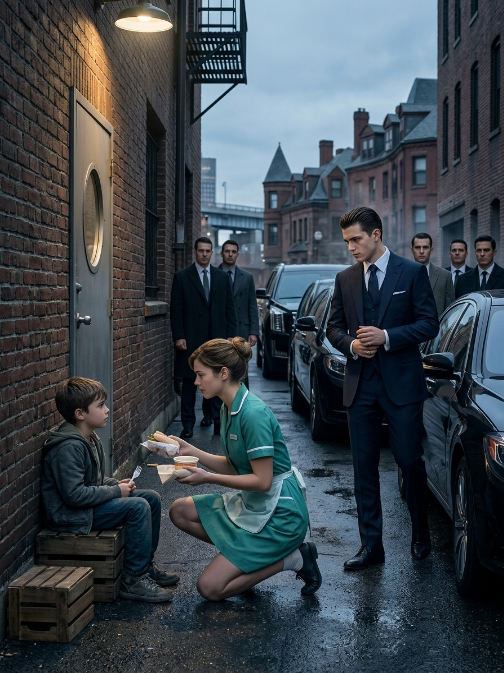
I Saved a Crying Boy From a Kidnapping—Then His Mafia Boss Father Arrived With a Deadly Warning

## PART 1
I remember the exact weight of the silence after the phone call ended.
Three seconds of breathing. Then a whisper so precise it felt rehearsed. *You never should have touched that boy.* Then nothing — just the dead screen glowing in my palm and Manhattan stretched forty floors below like scattered salt.
His name, I had learned, was Damian Reyes. And somewhere between last night’s rain and this morning’s cold light, I had become a person his enemies recognized by name.
Twenty-six hours earlier, I had been nobody worth noticing.
Elena Voss was what my coworkers at The Lantern called me — the one who showed up early, stayed late, never caused drama, and always knew which regulars drank to forget and which drank to celebrate. Twelve dollars an hour plus tips that ranged from generous to insulting, depending on the night and the moon. I was twenty-seven, behind on rent by eleven days, and the ceiling above my Queens apartment had developed a water stain shaped like a dog that I had privately named Gerald.
Nothing about me invited danger.
The last shift ended at twelve-forty. The rain had been falling for hours — not a polite drizzle but the kind of downpour that makes the whole city smell like wet stone and regret. I locked the side entrance, turned my collar up against nothing because my coat was too thin to make any difference, and started toward the subway with my head pulled into my shoulders like a turtle attempting urban survival.
New York at this hour was a different organism. Fewer people. Longer shadows. The particular loneliness of streetlights reflected in black puddles while the rest of the world slept warm.
I had my right earbud in and was three minutes from the subway stairs when I heard it.
Not crying, exactly. Something smaller. A sound crushed to almost nothing by rain and shame.
*Please.*
One syllable. A child’s.
Every sensible thought I owned told me to keep moving. This city had a thousand sounds after midnight and most of them were not my business. I was a woman alone. My phone was at fourteen percent. I had exactly enough energy left to get home and fall sideways onto my mattress.
I took out the earbud.
The sound came from the alley beside the old freight depot — a block-long shadow between two buildings that the city had given up on but not yet torn down. A dim orange security light flickered over the entrance like a bad omen wearing a disguise.
I stood still on the sidewalk. Rain soaked through my sneakers. A bus rolled past, its windows foggy and indifferent.
*Keep walking,* said the sensible part of me.
Then the child made the sound again, and the sensible part of me lost the argument.
The alley held two men and a cargo van with its side door open. One man leaned against the vehicle with his arms crossed, watching the street entrance. The other crouched near the open door, speaking in a low and urgent tone to whoever was inside.
I pressed against the brick wall behind a dumpster and looked.
A boy sat in the back corner of the van. He was small — six, maybe seven — with dark curly hair plastered flat by rain and both knees pulled to his chest. He was wearing a coat that cost more than my weekly paycheck. His face was pointed away from the man crouching at the door, jaw set in the stubborn silence of a child trying not to give anyone the satisfaction of seeing him afraid.
He was failing. His shoulders shook.
The crouching man reached in and grabbed his arm.
I don’t know what I picked up. I have reconstructed this moment many times and I still can’t account for the decision-making involved. What I know is that my hand found something metal near the base of the wall — a bar, a pipe, a section of scaffolding that had no business being there — and I threw it without aim or strategy at the side of the van.
The clang was spectacular. Both men spun.
I was already running.
Not toward the street. Toward the van. Because if I had run for safety, the boy would still be inside it.
*Police!* I shouted, which was a lie. *Step away!*
The man at the door stumbled back. The other one came at me from the left and I turned hard enough that he got a shoulder rather than a clean grab, and I hit the van door with my palm and it swung wide and the boy inside stared at me with enormous dark eyes like I was either rescue or catastrophe and he hadn’t decided yet.
*Come on,* I said. *Right now.*
He moved. Small, fast, trusting, his fingers locking around my wrist with a grip that surprised me with its strength. We ran. The rain closed around us like a curtain. I could hear one of the men behind us — feet slapping pavement, a shout in a language I didn’t recognize. I turned us down a side street, then another, running on instinct and the specific terror of a woman who understands exactly how badly wrong this could go.
The bodega on the corner of Halsey appeared like a miracle — fluorescent light blazing, an OPEN sign in the window, a man at the counter watching a telenovela on his phone.
We burst through the door.
The bell above it screamed.
The counterman looked up. Looked at us. Looked at the soaking wet child latched onto the soaking wet woman.
*What happened to you two?*
I tried to answer. My lungs weren’t cooperating.
The boy pressed against my side. I looked down at him. Rain had worked its way into the collar of his expensive coat. His jaw was still set in that determined way. But his eyes, when they finally met mine, were the particular shade of dark brown that looks almost black under fluorescent light, and they were full.
*I’m Milo,* he whispered.
*Elena,* I said. *You’re okay now.*
He thought about that for a moment. Then he nodded once, with the gravity of a child who has decided to believe something difficult.
The door opened behind us.
I turned, expecting the men from the alley.
Instead, a man in a charcoal overcoat stepped into the bodega, and the space around him changed the way a room changes when someone cuts the oxygen supply — not dramatically, not loudly, but in a way that rewrites every calculation you were making a moment before.
He was tall. Dark-eyed. The kind of controlled stillness that isn’t calm at all but rather the opposite of it.
Three men came in with him. They positioned themselves near the door and the window and the counter with the practiced subtlety of people who have memorized what subtlety is supposed to look like.
The counterman found something urgent to do near the floor.
The tall man’s gaze swept the room once. When it landed on Milo, something happened in his expression — a fracture, quickly sealed. He crossed the distance in four strides and crouched in front of the boy.
*Milo.*
*Papá.* The word cracked down the middle.
The man wrapped his hands around his son’s shoulders and held him at arm’s length, examining him, and for just a moment I saw beneath the controlled surface to what lived there: a kind of fear so large and private that witnessing it felt like trespassing.
Then Milo buried his face against his father’s neck, and the man closed his eyes.
When he opened them and looked up at me, the fracture was gone. What remained was a gaze like a door with the locks engaged.
*You took him out of the van,* he said. His voice was low. Accented slightly — Spanish, maybe, or somewhere adjacent to it.
*Yes.*
*Did they see your face?*
The question reached past my ribs and did something uncomfortable to my heartbeat. *I… yes. I think so.*
He stood to his full height. Milo stayed pressed against him. One of the men near the door said something low and the tall man answered without looking away from me.
*My name is Damian Reyes,* he said. *And I think you have a problem.*
He said it the way a doctor says *the test results came back* — not unkind. Just factual. Just the beginning of something you cannot unhappen.
*I don’t even know who you are,* I said.
His eyes didn’t change. *That is probably the last fortunate thing about your evening.*
—
—
## PART 2
By morning, I understood three things.
First: Damian Reyes was the kind of man other men checked the exits for when he entered a room.
Second: the people who had taken Milo from a street corner three blocks from his school were not random. They were connected to a family called the Sarralde — and they had chosen Milo specifically, deliberately, because hurting Damian directly was too costly.
Third: the phone call I received at two in the morning, in the guest room of the most expensively silent apartment I had ever stood inside, was not from one of Damian’s enemies.
The voice on the line belonged to a man named Rodrigo, who had been Damian’s most trusted counsel for eleven years.
I didn’t know that yet when I answered. I only knew the whisper: *You never should have touched that boy. Walk away now and we won’t follow you home.*
I sat with the phone dead in my hand for a long time.
Then I went to find Damian.
He was in the kitchen. Not sleeping, not eating, just standing at the window with a glass of water he hadn’t touched, watching the city drain in the dark. Without the overcoat he looked different — not smaller, exactly, but more specific. A scar below his left jaw. A tattoo at the edge of his wrist, half-covered by his sleeve, that I later learned was the name of a woman who had not survived a car accident three years ago.
*I got a call,* I said.
He turned.
*Someone told me to walk away.*
He set down the glass. *Tell me exactly what he said.*
I told him. His expression didn’t move, but something at the edges of it shifted — a tightening, an inward calculation.
*Did you recognize the voice?*
*No. Should I have?*
He didn’t answer immediately. That was its own answer.
*Damian.* I said his name like a demand, because I had decided somewhere in the last hour that fear would not make me quiet. *If someone inside your circle made that call, then whatever you’re protecting me from is already in the room.*
He looked at me for a moment with an expression I couldn’t fully read.
*You are perceptive,* he said.
*I’m a bartender. We read people for tips.*
A sound came from the direction of Milo’s room — small, frightened, a child calling out from inside a dream. Damian moved before I finished registering what I’d heard. I followed and stood in the doorway while he sat at the edge of his son’s bed and spoke in low Spanish until the boy’s breathing steadied and his grip on the blanket loosened.
When Damian came back to the hallway, his face had changed again. Softer in the way that specific grief is soft — like something abraded, not soothed.
*His mother used to do that,* he said. Not to me. To the air. *She had a particular voice for his nightmares.*
I didn’t respond. Some things don’t need a response. They just need to be heard.
*Her name was Camila,* he said. *She was better than this life. She believed she could keep Milo separate from it.*
*What happened to her?*
He looked at the closed door to Milo’s room.
*I was late,* he said. *That is what happened.*
—
—
## PART 3
The next three days unfolded with the particular logic of a world I had never been intended to enter.
Damian’s apartment occupied the top two floors of a building on the Upper West Side that had no visible address on the street and a lobby that required three separate clearances to traverse. The security staff wore suits and recognized no one who had not been there before. The kitchen was stocked by someone who was never there when I looked. The art on the walls was either expensive or significant or both, and I had no way to tell which.
Milo had a bedroom painted the color of deep ocean water, with telescopes aimed at the window and a wall of hand-labeled jars holding rock samples from what appeared to be a serious geological collection. He told me about each jar with the focused intensity of a child who has learned that knowledge is something no one can take from him.
He spoke about his mother the way children do when the loss is recent enough to still be fresh but old enough that they have developed the language for it — carefully, with pauses, as if the words are fragile.
*She liked rocks too,* he told me on the second morning, holding up a piece of rose quartz. *She said the earth keeps records.*
*That’s a beautiful way to think about it.*
He tilted the quartz to catch the light. *Do you think she can see us?*
I looked at the way the pink light moved across his hand. *I think if anyone could find a way to keep watching over the people she loved, it would be someone who believed the earth keeps records.*
He thought about this very seriously. Then he nodded and set the quartz back in its jar.
Damian appeared in the doorway a minute later and watched his son label the jar with fresh tape. His expression was the kind of careful that takes years to build — the careful of a man who has learned not to let his face show what it costs him to love something so much in a world that uses love as leverage.
But Milo caught him watching and grinned, and for just a moment, Damian’s careful face failed.
—
On the second night, I found the letter.
I was in the room Damian kept locked except for the hours he spent in it alone — I didn’t go inside intentionally. A door I believed led to a bathroom opened instead onto a small study with low shelves, a single lamp, and a desk occupied mostly by one framed photograph and a wooden box.
The photograph was of a woman with Milo’s eyes and a laugh that the camera had caught mid-construction, as if the photographer had clicked too soon and caught the moment before the smile was fully finished. She was beautiful in the way of someone who doesn’t know or doesn’t care, which is the best kind.
Camila.
I should have turned around. Instead I looked at the wooden box, because it was open and because human beings are helpless in the face of open boxes.
Inside, beneath a folded piece of paper in a woman’s handwriting, was a small recorder — the old kind, the kind you have to press a physical button to operate.
*Damian.* The voice from the recorder was hers. I knew it before I knew how I knew it. *If you’re hearing this, then what I was afraid of is already true. I hid this where the boys won’t look because boys never look in old wooden boxes. Rodrigo has been meeting with Sarralde people through the foundation accounts. I found records. I think they want Milo — not as a target but as insurance. Leverage against you and against what comes after you.* A pause. Breathing. *I don’t know if I’m wrong. I hope I’m wrong. But the last three times I’ve mentioned the Sarralde in front of Rodrigo, he has changed the subject in a way that only people with something to protect ever do. If I’m right—*
The door opened.
Damian stood in the frame with an expression I had never seen on him — not the controlled calm, not the grief-soft version, not the precise focus he wore when danger was immediate. This was older than all of those. Raw in the way of a wound that has been covered so long the covering has become its own wound.
He looked at the recorder in my hand.
*How long,* he said, *has she been trying to tell me.*
It wasn’t a question.
I set the recorder down carefully. *I’m sorry. I didn’t — the door was open. I shouldn’t have—*
*No.* He stepped inside, and the room seemed to rearrange itself around his presence the way rooms did when Damian Reyes entered them. *She hid it here because she knew I would find it eventually.* He looked at the photograph. *She was always better at patience than I was.*
He picked up the recorder. Pressed play. Heard her voice. And something in his face came apart in a way I had to look away from because it felt too much like watching something private and irreversible.
When it finished, there was a long silence.
*Rodrigo,* I said carefully. *That was the voice on my phone call.*
Damian set the recorder down on the desk beside Camila’s photograph, and I watched the grief become something else — not harder, exactly, but more specific. The face of a man who has located the wound and is now deciding what to do with the hand that made it.
*Yes,* he said. *I think so.*
—
Rodrigo had been with Damian since before Milo was born. He had stood beside Damian at Camila’s funeral. He had held Milo at the hospital when Milo was three hours old and Damian had been too terrified to hold him without someone steadying his arms.
He had also, Damian’s accountant confirmed within forty-eight hours, been funneling operational intelligence to the Sarralde through a network of charitable shell accounts that Camila had built in good faith and Rodrigo had quietly corrupted.
The night Camila died — a collision in a highway tunnel with the emergency lights killed by someone on the inside — Milo had been in the car. He had been four years old and strapped into his seat and Camila had shielded him with her body in the last second before impact. Milo had survived with a broken arm and nightmares that still woke him three years later. Camila had not survived at all.
Rodrigo had stood at the funeral and wept.
When Damian laid this out for me in the quiet of his study at three in the morning — methodically, without drama, the way a person recites something they have had to survive by not feeling — I watched his hands on the desk and thought about what it costs to be betrayed by someone who has held your child.
*You knew it wasn’t an accident,* I said. *The crash.*
*I knew someone arranged it. I thought they wanted me to—* He stopped. *I thought they wanted me to hurt. I didn’t understand until your recording that they wanted Milo.* A pause. *Camila understood before I did. She always understood before I did.*
*She recorded it so you’d have proof.*
*She recorded it so I’d know where to look.* He turned the recorder over in his hands. *She knew I would spend years looking for the wrong thing. She left me the right thing.*
I thought about a woman hiding a recorder in a wooden box that boys never look in, buying time for truth to survive her.
*She was protecting you from your own grief,* I said. *She knew you’d spend years blaming yourself for being late, and she wanted to make sure you eventually found out the real reason you were late.*
Damian went still.
*Someone delayed your convoy,* I said. *On purpose. So you couldn’t reach her.*
He didn’t answer. He didn’t have to.
*Rodrigo,* I said.
*Yes.*
The silence that followed was the particular kind that contains an entire history of trust being dismantled piece by piece.
—
They brought Rodrigo in the next morning.
I wasn’t supposed to be in the room. I was also, by that point, past the stage of accepting what I was and wasn’t supposed to do in Damian Reyes’s world, so I stood near the back wall and watched.
Rodrigo was a compact man in his mid-fifties with silver-streaked hair and the manner of someone who has spent decades being the reasonable voice in unreasonable rooms. He came in looking measured, a little concerned, ready to be useful.
Then he saw the recorder on the table.
The measured quality vanished.
*Camila,* he said. Like an accusation.
Damian didn’t move. *She was thorough.*
Rodrigo looked at the recorder for a long moment. Something shifted in his face — not guilt, exactly, but a kind of exhausted reckoning. *You don’t understand what I was protecting.*
*Tell me.*
*The family. The name. Everything you built and everything Milo will inherit.* He leaned forward. *Camila was going to take him from this. She had an attorney. She had a plan. She was going to raise your son to be soft and apologetic and then hand him to a world that would eat him alive.*
*She was going to raise him to be decent.*
*Same thing,* Rodrigo said.
The room became very quiet.
Damian said, *I’m going to ask you once. What did you tell them the night she died.*
Rodrigo looked at him. In his eyes was the particular sadness of a man who believes, still, that he was right. *I told them she would be alone. That the convoy would be rerouted. I thought—* His jaw tightened. *I thought they would take the boy. Cleanly. I thought you would be angry, and then you would see it was better, and Milo would grow up where he was supposed to grow up.*
*You thought they would take my four-year-old son.*
*I thought they would give him back when you agreed to the arrangement.*
*And Camila.*
Rodrigo’s voice dropped. *That wasn’t supposed to happen.*
Damian looked at him for a long time. Long enough that the men in the room began to shift slightly, the way people shift when they are preparing for the thing they have been told may be coming.
*She was afraid of you,* Damian said. *She hid the recorder because she was afraid that if she came to me directly, you would find out before I could act.*
*She overestimated the threat.*
*She was right and she died for it and you stood at her funeral.* His voice was still quiet. That was the worst part. The quiet. *You held her son.*
Rodrigo said nothing.
I found my voice from the back wall. *Why call me?* When Rodrigo looked at me, I pressed forward. *After I pulled Milo out of the van. You called my phone. You told me to walk away. Why?*
He considered me with the expression of a man who hasn’t decided yet whether I’m worth explaining things to. *Because Sarralde wanted you removed. You saw the men from the van, you could identify them, and they wanted the loose end closed.* A pause. *I called to give you the chance to remove yourself. It was a courtesy.*
*You were warning me off so the Sarralde could tidy up their own mess.*
*I was giving you an exit.*
*And if I hadn’t taken it?*
His answer was in the silence that followed.
Damian stood. *That will be the last decision you make in this family.*
—
What came next happened in the way of these things — not like a film, not with music or clarity, but in the messy and exhausting reality of evidence and calls and men arriving with briefcases and a federal contact Damian trusted perhaps slightly more than he trusted anyone, which was not much, but enough.
Camila’s recording was not alone. She had, it turned out, the patience of someone who knew she might not survive long enough to tell the story herself. There were financial records routed through the foundation’s servers. There were photographs. There was a series of encrypted messages Rodrigo had underestimated the existence of.
The Sarralde lost six men to federal charges within a week. Two more were connected to the tunnel incident. The charity accounts were frozen and then restructured under new oversight that Damian established with an attorney who was not Rodrigo and a board member from Camila’s original circle who had, it turned out, suspected something for years and never had the proof.
Rodrigo cooperated, in the end, in the specific way that men cooperate when the alternative is worse. He cooperated the way Damian had planned — through courts, through records, through the kinds of channels Camila had believed in and that Damian had spent three years doubting could be enough.
It was my suggestion. Or rather, it was a conversation we had in the kitchen at four in the morning while Milo slept and Damian stared at the recorder on the counter as if it were an artifact from a civilization he’d misunderstood.
*You could disappear him,* I said. *I know that’s the word people use. Or something like it.*
*Yes.*
*But Camila went to the trouble of building a case. She didn’t do that so it would end in a room with no windows.*
He looked at me.
*She built it for a courtroom,* I said. *She built it because she wanted Milo to grow up knowing his father chose something different.* I hesitated. *You told me she believed this life could be different. That was the argument between you. Let her be right about something.*
Damian was quiet for a long time. Long enough that I stopped hoping I’d landed it and started preparing for the version of this where I’d overstepped.
Then he said, *She was almost always right.*
*I know,* I said. *She hid a recorder in a wooden box and three years later it saved her son. That’s someone who was right.*
He looked at me with an expression I didn’t have language for yet. Not gratitude — something more complicated than that. Something more like recognition.
*You are impossible,* he said.
*I’ve been told.*
—
I went back to my apartment ten days later.
Gerald the water stain had been joined by a companion stain I named Gerald Junior. The super had left a note about the rent that I added to the collection on my refrigerator. The Lantern had called twice asking when I was coming back.
Everything was the same. That was the strange part — not that it had changed, but that it hadn’t. I had been through the kind of days that feel like they should leave marks on the physical world, and my apartment had simply waited for me with its cracked tiles and secondhand furniture and indifferent radiator, unchanged.
I made coffee. I stood at the window and watched the street below do its ordinary morning business. A woman walking a dog. A delivery truck backing into an alley. A kid on a scooter weaving between two people checking their phones.
My buzzer rang.
I looked at it for a moment. Then I pressed the button. *Who is it?*
*Milo says you left your good coffee mug at our house.* A pause. *I told him you probably had another one. He was offended on the mug’s behalf.*
I laughed before I could stop myself.
*I’ll buzz you up,* I said.
Damian arrived at my door with Milo, a paper bag from the bakery on 82nd Street, and an expression that was doing its best to look casual and not quite managing it. Milo was carrying my mug — the green one with the chipped handle — with both hands and the seriousness of a person completing a diplomatic mission.
*Your mug,* he announced.
*Thank you.* I took it with matching gravity. *Come in.*
They came in. Milo went immediately to the window, then to my bookshelf, then located my modest collection of rocks — three geodes, a piece of obsidian, a hunk of quartz I’d bought at a street fair — with the unerring instinct of a child encountering treasure.
*Elena.* His voice had gone hushed. *You have rocks.*
*I do.*
*Why didn’t you tell me?*
*I didn’t know you’d find it significant.*
He held up the obsidian. *This is volcanic. Did you know that?*
*I did not know that.*
*The earth made it from fire.* He turned it in his hands. *Mamá would have liked this one.*
Damian was standing near the door. I glanced at him. His face had done the thing again — the fracture, the sealing of it. But this time he let it stay a moment longer before he sealed it. Like he was practicing.
*There’s enough in the bag for three,* he said. *If you haven’t eaten.*
I looked at him. *Is this an invitation or a command?*
His mouth moved. Small. Brief. *I practiced the distinction.*
*Sit down,* I said.
We ate croissants at my kitchen table, the three of us, while Milo delivered a detailed geological history of obsidian and Damian listened with the particular attention of a father who has learned that his son’s voice is something to be gathered and kept. Outside, Brooklyn moved through its morning. The sun came through my east window and landed on the chipped edge of my mug and turned it briefly gold.
Milo looked up from the obsidian. *Elena, are you going to come back?*
I glanced at Damian. He looked at the table.
*Come back where?* I asked carefully.
*To us,* Milo said. With the complete simplicity of a child who has decided the complicated version isn’t worth his time.
The table went quiet. Damian was very still.
*I think,* I said, *that depends on what *us* means.*
Milo considered this. *It means Thursday dinners. And when I have the science fair. And—* he paused, working something out— *and when Papa has the bad face.*
*The bad face,* I repeated.
*When he looks like he forgot something important.* Milo set down the obsidian. *You make the bad face go away.*
I looked at Damian.
He was studying the middle distance with an expression that suggested he was considering whether forty stories of elevator was enough distance to escape this conversation. Then he looked at me, and the expression shifted into something I had no armor for — tired and careful and asking without words and trying to make it look like it wasn’t.
*I can’t promise the danger is done,* he said quietly.
*I know.*
*My world is not simple.*
*I noticed.*
*And you—* He stopped. Started again. *You threw a metal pipe at a van to save a child you’d never met. You are not—* Another stop. *You should not have to navigate this.*
*Probably not,* I agreed. *But Milo says you have a bad face sometimes.* I looked at him steadily. *And I’ve seen it. And I think I know what it means.*
The kitchen was very still.
*What does it mean?* he asked. Low.
*It means you’re still late,* I said. *Trying to arrive at something you keep almost reaching.*
He looked at me for a long moment. Something moved through his expression — slow, like weather changing.
*Camila would have liked you,* he said.
*Tell me about her sometime.*
*Yes.*
Not *maybe*. Not *I’ll think about it*. Just *yes* — simple and direct, the way he said the things he meant.
Milo had gone back to the rocks. He was making a careful row of them on my windowsill, organizing them by some internal taxonomy that made sense to him alone.
*Is it okay,* he asked the window, *if I come back Thursday?*
*Yes,* I said. *It’s okay.*
He nodded, satisfied. Set the obsidian at the head of the row, in the place of honor.
Damian watched his son for a moment. Then he looked at me across the table — this small table in this small apartment, the morning light between us and the city outside doing its ordinary business and Milo explaining to a piece of volcanic rock that it had a good home now.
*I’m learning,* Damian said quietly.
*To what?*
*To knock before entering.* His eyes held mine. *To ask instead of decide.* A pause. *To believe that a woman who throws pipes at vans might know something about courage I don’t.*
I wrapped my hands around my chipped green mug.
*You’re getting better at the invitation thing,* I said.
*I had a good example.*
*Camila?*
*Her too,* he said. *But I meant you.*
—
That was six months ago.
The investigation closed in stages. The Sarralde cases moved through federal channels slowly, the way these things do, with the grinding patience of institutions that were built to outlast urgency. Rodrigo’s cooperation shortened certain timelines and lengthened others. Damian’s attorney described the evidentiary picture as *robust*, which I gathered was the legal term for *Camila was extraordinarily thorough*.
The foundation was restructured with new oversight. Camila’s original mission — education funding for first-generation students in underserved neighborhoods — was preserved and expanded. Milo attended the reopening ceremony and wore a tie he’d chosen himself and stood very straight, the way children stand when they understand that something important is happening.
I still work at The Lantern on Wednesday and Friday nights. I kept the schedule because it’s mine, because I built it before any of this happened, because Gerald Junior is now accompanied by a third stain I haven’t named yet and my rent doesn’t care about organized crime.
Damian asked me once why I didn’t want him to fix the rent situation.
I told him because it was mine to fix.
He thought about that for a moment. Then he said, *All right.* And that was the end of it. That’s the version of him I’ve come to know — the man who is learning that *all right* is sometimes the most powerful thing he can say.
Milo brings me rocks.
Every Thursday he arrives at my door with some new geological acquisition and an explanation that has grown, over months, increasingly sophisticated. Damian stands in the hallway with the patient expression of a man who has learned to wait for his invitation and finds, gradually, that the waiting is its own kind of answer.
Some nights, after dinner, Milo falls asleep on my couch with his cheek pressed to the cushion and his geological notes still in his fist, and Damian and I sit at the table with cold coffee and talk about Camila — her patience, her records, the wooden box that boys never look in, the woman who built a case from love and made sure truth survived her.
The earth keeps records, she had told him.
She wasn’t wrong.
One evening last month, Milo woke from one of his nightmares. I was already in the kitchen when I heard him, and by the time Damian reached the doorway I was already sitting at the edge of Milo’s bed, my voice low, talking him back from whatever tunnel the dream had left him in.
When it was over, Milo looked up at the ceiling and said, *Mamá used to do that.*
*I know,* I said. *You told me.*
*She had a particular voice for nightmares.*
*What did it sound like?*
He thought about it. *Like the lights were already coming back on.*
I looked at the doorway. Damian was standing there, and his face — carefully maintained, carefully controlled — was not controlled at all.
He didn’t say anything. He didn’t have to.
Milo fell back asleep. I turned off the light and came out into the hallway, and Damian was still there, his back against the wall, looking at a spot on the floor.
*She would have—* he started.
*I know,* I said.
*I was going to say she would have been glad.*
We stood in the quiet hallway. The city made its distant sound below.
*I’m glad too,* I said. *For whatever that’s worth.*
He looked up. The hallway light caught the scar below his jaw and the tiredness around his eyes and the particular expression of a man who has been carrying something heavy for a long time and is only now, slowly, learning to set it down.
*It’s worth more than you think,* he said.
I thought about a woman in a photograph with an unfinished laugh. I thought about a pipe I threw at a van in a rainy alley because a child was crying and I recognized the sound. I thought about all the ways a story can begin — in danger, in loss, in the moment you do the thing you know you’re not supposed to do because something in you refuses to keep walking.
I thought about Milo telling the obsidian it had a good home now.
*Thursday?* I asked.
Damian’s mouth curved. Just slightly. The version of a smile that a man practices back into existence after years of forgetting how.
*Thursday,* he said.
Some doors you open not knowing what’s behind them.
Some of those doors lead to danger. Some lead to grief. Some lead to a little boy with his mother’s eyes who keeps geological records and leaves rocks on your windowsill like the world is worth remembering.
Some lead, eventually, to the thing you didn’t know you were walking toward — the way home, after a long time of believing you didn’t have one.
I still check my locks twice. I still look up when white vans drive too slowly. I still flinch sometimes at sudden darkness.
But the front door opens the way it should now. The lock is the good kind — installed by someone who learned that restitution means fixing what was damaged, not replacing what was yours.
And every Thursday evening, someone rings the buzzer from the street below, and I press the button, and I hear Milo’s voice say something about rocks in the intercom static.
And I buzz them up.
Every time, without hesitation.
Because the only thing the earth keeps better records of than loss is the moment someone decided to stay.