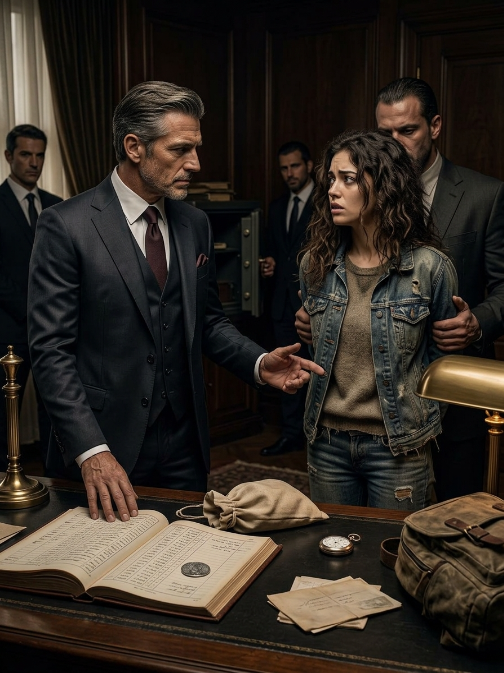
I Hid My Pregnancy for 5 Months—Then the Mafia Boss Found My Hospital Bills

# PART 1
Seven months into her pregnancy, Nadia Reeves still sat at conference room tables the same way she always had: spine straight, shoulders back, laptop positioned at a precise angle that forced anyone across from her to look at the screen before they looked at her.
The angle also hid her abdomen.
She had learned that trick in month four. Before that, she had relied on oversized blazers, strategic bag placement, and the particular invisibility that came to women who worked too hard and spoke too little in rooms full of people who had already decided what they were.
No one had asked.
No one ever asked, because asking required noticing, and noticing required the kind of attention most people directed elsewhere.
That was fine.
That was, in fact, exactly what she needed.
The man across the table was not most people.
—
Nadia had reviewed Luciano Ferrante’s financial records for three weeks before she met him. She had built an expectation of him from those records the way she always built expectations from data: carefully, in the language of transactions and gaps, in the grammar of what moved and what didn’t and why.
She had expected someone older. Harder at the surface. The obvious kind of money that needed to look like it had always been there.
Luciano Ferrante was thirty-six, sharp-featured, and composed in the way of people whose stillness is not absence but architecture. He wore a charcoal suit without a tie. His hands were unhurried. His eyes, when they landed on her, did not slide past.
That was the first warning sign.
People who dealt in complicated money either performed aggression or performed charm. They filled space. They managed perception. They chose a mode and deployed it.
He was simply present.
“Ms. Reeves,” he said. “Thank you for coming.”
“My senior partner typically handles initial client consultations.”
“I requested you specifically.”
“I’m aware.”
“Does that concern you?”
Nadia looked at him levelly.
“It depends on the reason.”
The briefest pause. Not calculation. Something closer to reassessment.
“I was told you were the analyst who noticed the shipping discrepancies,” he said. “Everyone else missed them for two review cycles.”
“The patterns were there.”
“Yes. You were the first to look long enough.”
She did not find this flattering.
She found it specific.
Clients who requested specific analysts during preliminary audits were usually trying to accomplish one of three things: intimidate, negotiate, or acquire. She had prepared files for each scenario.
She opened her laptop.
“The documented shipping volumes for your European imports exceed the recorded manifest weights by an average of nineteen percent across fourteen months.” She kept her voice neutral, her cadence professional. “Subsidiary payments in Malta and the Caymans do not correspond to any identifiable service rendering. Three art acquisitions in the past year have valuations inconsistent with comparable market sales. These patterns require documented explanation.”
He listened without interrupting.
That was also unusual.
“You are not accusing,” he said, when she finished.
“Forensic accounting identifies structure. It does not assign criminal intent. That is not my role.”
“What is your role, precisely?”
“To produce a complete and accurate picture of your financial activity and deliver it to the party who commissioned the audit. What they do with that picture is their decision.”
“The SEC.”
“Among others.”
One side of his mouth moved by a fraction.
“Most analysts soften that.”
“Softening accurate information is not a service. It is a liability.”
He looked at her with the focused quality she had already started to categorize as a personal trait rather than a tactic.
“You are very direct.”
“Numbers are direct. I try to match them.”
“Do you ever find that people—” He paused, as if selecting the word with care. “—resist that?”
“Frequently.”
“And?”
“And I document the resistance as part of the record.”
A genuine, brief silence.
“I am going to enjoy this audit, Ms. Reeves,” he said.
She closed her laptop one inch.
“That’s not a common reaction.”
“I imagine not.”
Behind him, two men stood near the door. Security. Not decorative—the real kind that positioned themselves to observe every exit and assessed every person in the room before the person had fully entered it. Nadia had noted them when she came in and filed them in the category of *relevant to threat assessment.*
Luciano’s business looked legitimate at the surface layer: Imported Italian specialty goods, art consulting, furniture imports, international distribution partnerships with European manufacturers. The kind of empire that wore respectability like a coat.
Underneath the coat were the patterns.
She had followed each one without reaching conclusions she couldn’t support. That was the practice: record, corroborate, refrain from dramatic inference. The dangerous work was not in the conclusions. The dangerous work was in the documentation itself.
Her abdomen tightened.
A low, gripping pressure that had been visiting her more frequently over the past week. She recognized it and used it as she always used inconvenient physical information in professional settings: she reached for her water glass with a movement smooth enough to serve as cover, breathed through it, and maintained her expression.
Luciano’s eyes moved.
Not to her stomach. To her hand. Then her face.
“Are you all right?”
“A cramp,” she said. “I’m fine.”
He didn’t press.
But he had noticed.
She filed that too.
The meeting lasted ninety minutes. He was the most capable client she had ever sat across from—not in the sense of sophistication or wealth, but in the sense of precision. He caught assumptions she embedded deliberately to test his familiarity with his own records. He corrected specific phrasing without overcorrecting. He offered explanations that were sometimes credible and sometimes designed purely to measure how far her documentation had already reached.
He never lied outright.
That told her more than lying would have.
When he stood to leave, he said: “I’d like weekly updates. Directly from you.”
“My senior partner—”
“Has already been contacted.” A pause. “He agreed.”
Of course he had. Arthur Prendergast had been managing partner for nineteen years and understood client retention the way surgeons understood anesthesia: you gave them just enough to keep them cooperative.
Luciano extended his hand.
She shook it.
His grip lasted one beat past professional.
“I have the feeling this will be an interesting relationship,” he said.
After he left, Nadia sat alone in the conference room and placed both hands flat on the table. The room was quiet except for the city noise through the glass. She looked at her reflection in the window—neat blazer, neat hair, the expression she had trained into something unreadable.
Under the table, the baby shifted.
“Ten more weeks,” she said quietly. “That’s the plan.”
It had always been a fragile plan. Finish the audit. Submit the report. Take her severance and her savings to somewhere cheaper, quieter, smaller. Find a hospital that didn’t know her name. Build a life with the child she hadn’t planned but couldn’t un-love.
Not a beautiful plan.
A functional one.
What she did not know—sitting in that conference room, watching afternoon light move across financial district glass—was that someone else had already found the pattern she was following.
And unlike her, they did not document.
They eliminated.
—
# PART 2
The following Tuesday, a black SUV followed her from the parking structure to her apartment building.
Nadia noticed it because she noticed everything. Three blocks, two turns, one lane change it had no reason to make. She clocked the plate, photographed it through her coat pocket with her phone, and walked the last two blocks in a different direction before doubling back through the lobby service entrance.
She did not sleep easily that night.
Two days later, Luciano arrived at their scheduled meeting with a man he introduced as Domenic, whose role he described as “operational security.” Large. Economical with movement. The kind of professional stillness that didn’t come from calm but from training.
“A general precaution,” Luciano said.
“For whom?”
“For anyone associated with my business whose work has become visible.”
“I am an auditor, not a business associate.”
“Currently, that distinction is not as clear as it should be.”
His phone was on the table between them, screen down.
“There is a family called the Flannery Group,” he said. “They control logistics along the eastern port corridor. They have wanted access to my import channels for four years. I have declined that relationship consistently.”
“And they’ve become adversarial.”
“They have damaged property, threatened suppliers, and in the past three months begun surveilling personnel connected to my business.”
He turned his phone over.
A photograph. Nadia outside her pharmacy. The dark jacket man she had noticed was visible in the background.
Her face stayed still.
Inside her ribcage, something cold moved.
“They believe you have documented evidence they can use as leverage against me,” Luciano said. “Proof of past structures they could use to force compliance.”
“Past structures you have been systematically dissolving.”
“Yes.”
“And they want to intercept my report.”
“Or intercept you.”
The room was quiet for a moment.
Nadia calculated.
She was seven months pregnant. She was the only person who knew it. She worked in a building with a parking structure that was badly lit after six p.m. She lived alone. She had one sister she hadn’t spoken to properly in two years.
She was the most vulnerable she had ever been in her life, and she had spent the past three months convincing herself that if she controlled the information carefully enough, no one would notice.
The Flannery Group had noticed.
“I want to transfer this audit,” she said.
Luciano’s expression did not change. “If you withdraw, they will assume you already found something significant enough to run from. That makes you more valuable to them, not less.”
“And if I stay?”
“Then you finish the most important piece of work currently in your field, under protection I can provide, and deliver a report that tells the truth.”
“I would be relying on a subject of investigation for my personal safety.”
“Yes.”
“That compromises the audit’s independence.”
“It also preserves the auditor’s life.” He met her eyes. “I am not asking you to change your findings. I am asking you to stay alive long enough to submit them.”
Nadia looked at him.
She thought about the pharmacy. The plate number. The service entrance.
She thought about ten more weeks.
“What does the protection look like?” she said.
And somewhere beneath her blazer, the baby kicked once, firmly, as if registering an opinion.
—
# PART 3
Luciano offered his secondary property—a private residence forty minutes from the city, walled, monitored, with a guesthouse that had its own entrance, its own kitchen, and its own deadbolt that she would hold the key to.
Nadia refused the first time he asked.
“Residing on your property while auditing your company is an independence violation.”
“Residing in your apartment while people photograph you through pharmacy windows is a safety violation,” he said.
“That is not how auditing standards work.”
“I am aware. I am suggesting you apply the standard that keeps you functional.”
She looked at him across the kitchen island of his office building’s private floor, where this particular discussion was happening at eight p.m. because she had refused to be driven anywhere until she had finished reviewing the Malta subsidiary records.
“I need a separate attorney,” she said. “One with no existing relationship to your firm.”
“Agreed.”
“Full documentation of every security decision—who is deployed, where, on what basis—shared with me in writing before implementation.”
“Agreed.”
“No decisions made about my movements, my communications, or my schedule without my explicit consent.”
“Agreed.”
She held the silence for a moment, testing whether he’d already started on the asterisks.
He didn’t reach for any.
“You agreed very quickly,” she said.
“You are not asking for unreasonable things.” He paused. “You are asking for the conditions under which a competent person can do their work without being controlled. Those are not concessions. They are basic.”
Nadia looked at the Malta files on her screen.
“Give me until tomorrow to decide.”
He nodded and left.
She stayed another two hours. Not because she needed the time. Because she needed to prove to herself that she was choosing, not reacting.
She moved to the guesthouse on a Wednesday.
Domenic drove her. She sat in the back with her laptop open and her audit files pulled up, because the thirty-eight minutes of transit were not time she was willing to waste on anything except work.
The house itself surprised her.
She had expected something calibrated for impression—the kind of property designed to communicate power rather than serve any actual human function. Instead it was warmer than that: deep-set windows, bookshelves with actual creases on the spines, a kitchen that smelled of coffee and old wood polish, a garden that had been planted by someone who intended to see it grow.
The guesthouse was separate, as promised. She checked the deadbolt, confirmed the emergency exit, and mapped the fastest route to the perimeter gate on foot before she unpacked a single item.
A woman named Elena—who worked as housekeeper and functioned as something closer to quiet household anchor—appeared with dinner without announcing it and withdrew without commentary.
That was the first night Nadia slept more than four hours in two weeks.
—
The audit proceeded from a corner of the guesthouse she converted into a workspace, surrounded by printed ledgers, flagged transaction summaries, and three monitors running simultaneously. She submitted weekly status updates to her firm. She communicated with her separate attorney, a forensic law specialist named Patricia Nwosu, in writing.
Luciano came by in the evenings.
Initially with questions about documentation methodology, discrepancies she had flagged, his father’s records from a decade prior that he could not fully account for. Then, gradually, the subject matter moved.
His father, Enzo Ferrante, had built the company’s original logistics arm on legitimate distribution contracts, then allowed parallel channels to grow when old associates pushed in. Not because he’d planned it—because he had been too proud to refuse, and then too deep to leave without catastrophic exposure for people who hadn’t chosen the arrangement themselves.
Luciano had inherited that weight at thirty-one.
“The employees,” he said one evening. “People who had worked there for fifteen, twenty years. Their families. None of them knew what was underneath the accounts they processed. If I had gone to authorities immediately, without managing the transition first, those structures would have collapsed onto the people least responsible for them.”
“That is a reasonable calculation,” Nadia said. “It is also the calculation every heir to illegal money makes to justify delay.”
“I know.”
“I’m not dismissing it. I’m telling you what the record will look like.”
“What will it look like?”
She turned her chair to face him.
“A man who inherited a compromised business, spent three years dismantling the compromised portions, closed offshore structures, paid retroactive tax liability, and is currently three to five years ahead of where most voluntary compliance cases typically reach.” She paused. “And who is simultaneously the subject of an audit triggered by federal investigators who received a tip from a competitor trying to use the process as a pressure mechanism.”
He was quiet for a moment.
“That is the truth.”
“It is also the most complicated version of the truth. Which means it will be attacked.”
“By the Flannery Group.”
“And by prosecutors who prefer simple narratives. Complex truth makes cases harder. People who make cases prefer simple truth.”
“And what do you prefer?”
She looked back at her screen.
“Accurate truth. Whatever shape it comes in.”
He was quiet again, but differently—not the pause of calculation. The pause of someone sitting with something that had actually landed.
“Your sister,” he said eventually. “Hailey.”
The name caught her mid-keystroke.
“You reviewed my background.”
“Standard due diligence for anyone working from my property.”
“That is a significant overreach.”
“It was,” he agreed. “I’m not defending it. I’m telling you because it would be dishonest to let you discover it.” He held her gaze. “You have not spoken to her in two years. She tried to contact you four months ago. You did not respond.”
Nadia turned back to her screen.
“This is not a relevant subject.”
“You are eight months pregnant, living in my guesthouse, auditing a case that has attracted people who are willing to follow you through a parking garage. The only family member who appears to care about you has been trying to reach you for months.” He paused. “I believe it is relevant.”
“What I do with my family relationships is my decision.”
“Yes.”
“You don’t get to make it for me.”
“I know.”
She kept her eyes on the screen for a long moment.
“She told me I had replaced everyone who loved me with work,” Nadia said finally. “At her wedding, two years ago. I left the reception early for a client emergency that probably could have waited.” A pause. “She was right. I was not ready to agree with her.”
Luciano said nothing.
“I am still not certain I can have that conversation,” she said. “With everything else—”
“You don’t have to have it now,” he said. “I just wanted you to know I know she exists. In case you needed someone to tell.”
That was such a precise and useless and somehow correct thing to say that Nadia had no response for it.
She went back to the Malta files.
But she thought about Hailey for a long time after he left.
—
The Flannery Group stopped being a background threat on the Thursday evening Nadia stayed late in the parking structure below her firm’s building, retrieving physical files the digital records referenced.
She had told Domenic she would be thirty minutes. She was fifty.
Three men appeared from between parked cars on the second level, moving with the coordinated purpose of people who had planned the approach and were not improvising.
Nadia did not scream.
She had learned, in the compressed period since this situation began, that screaming was a response to being overwhelmed. She was frightened—genuinely, physically, coldly frightened—but her mind did not shut down. It accelerated.
She was in the open.
The stairwell was twenty feet to her right.
The elevator was behind the approaching men.
She had her phone in her hand already because she had been about to call Domenic.
She called.
He picked up before the first ring finished.
“Level two,” she said. “Three men. Intercept.”
Then she moved toward the stairwell because standing still was not a strategy.
She never reached it.
Domenic and two others arrived in under ninety seconds—she timed it afterward because the numbers gave the fear a container. The confrontation was brief and extremely uncinematic. No speeches. No weapons drawn for display. Just professionals who were better prepared than the three men, and a situation that resolved before it became the thing she had been afraid it was going to become.
A woman from Luciano’s team—compact, dark-haired, fast—appeared at Nadia’s shoulder.
“Ms. Reeves. Are you injured?”
“No.”
Her hands were shaking.
She noted the shaking analytically, from the same distance she noted everything: *this is adrenaline, this is normal, this will pass in approximately eight to twelve minutes.*
“Can you walk?”
“Yes.”
“Then we should go.”
—
Luciano was at the guesthouse entrance when the car arrived.
He looked at her face before he looked at anything else.
“Are you hurt?”
“I keep answering that question.”
“I keep asking because I keep needing to know.”
She got out of the car carefully—her balance had shifted in the last week in ways she was still recalibrating—and stood in the driveway while the evening air did something useful to her nervous system.
“There is something you should know,” she said. “It affects the security protocol. It has always affected the security protocol, and I did not disclose it because I did not trust the information to remain controlled.”
He waited.
“I am eight months pregnant.”
Silence.
Not surprised silence. Not the kind that precedes a reaction. The kind that comes after someone has been holding a piece of information in consideration for some time and is waiting to see how the conversation will proceed.
“I know,” he said.
Nadia looked at him.
“Since approximately the third week you were here,” he said. “The way you moved coming down the foyer step. The prenatal supplements Elena noticed behind your toiletry bag. The appointments.” A pause. “I am observant, and I have been paying attention.”
“And you said nothing.”
“You were not ready to say it. Saying it first would have been—” He seemed to consider the word. “—pressure in the wrong direction. I was more useful as someone who already knew and was not going to use it as leverage.”
The rational part of her—the part that ran on documentation and controlled variables—catalogued this response and came up empty of objections.
The other part of her, the part that had been carrying this alone for eight months, did something she had not anticipated and couldn’t prevent:
It gave way.
Not dramatically. Nothing about Nadia Reeves was dramatic. But her eyes filled, and she had to press her teeth together for a moment before she trusted her voice.
“The father is not involved,” she said. “He is a stranger from a conference in Seattle, and I have no desire to locate him, and I have no family system in place, and my plan was to disappear quietly before anyone found out and start over somewhere smaller.”
“That was a survival plan,” he said.
“Yes.”
“And it has become insufficient.”
“Yes.”
He stepped aside from the entrance.
“You are staying here. You are safe here. Tomorrow, Domenic will coordinate with your attorney about what happened tonight, and we will address the Flannery Group through every available legal channel.”
She walked inside.
At the entrance to the guesthouse, she turned back.
“Luciano.”
“Yes.”
“Call Hailey.”
A pause.
“You’re certain?”
“No. Call her anyway.”
—
Hailey arrived the following evening with two large bags, a face full of suppressed terror, and the specific ferocity of someone who has been kept out of a crisis and has thoughts about that.
She walked into the guesthouse, took one look at her sister—seven months of carefully hidden pregnancy now impossible to hide, wearing a loose sweater and no blazer for the first time Hailey could remember—and went very still for a moment.
Then she set down the bags and crossed the room and held her sister carefully, accounting for the changed geography of her body.
“You absolute idiot,” she said. “I love you so much.”
Nadia held on to her with both hands.
“I know. I’m sorry. I should have called.”
“You should have called immediately. You should have called in Seattle. You should have called when you found out. You should have—” Hailey pulled back, still holding her arms. “How long ago did you find out?”
“Month three.”
“It is month eight.”
“I know.”
“Nadia.”
“I know.”
“You were going to do this entirely alone?”
“That was the plan.”
Hailey looked at her for a long moment.
“Your plans have always been structurally sound and emotionally catastrophic,” she said. “I am here now. I will help you build a better one.”
Nadia laughed.
It surprised her—the laugh. The specific quality of relief that came out of it, as if something that had been braced against pressure for months was finally allowed to move.
They sat at the guesthouse kitchen table until past midnight, rebuilding the plan with twice the components and half the secrecy.
—
The FBI interview happened by video link, eight days later.
Nadia conducted it from Luciano’s study, with Patricia Nwosu present in person, Hailey two rooms away, and Luciano himself elsewhere in the house by deliberate arrangement so that no one could later argue he had been present when she gave testimony.
Special Agent Caldwell was methodical and precise. Nadia appreciated that.
She answered every question in the same register she used for everything: complete, factual, undecorated.
Yes, the Ferrante company contained financial irregularities.
Yes, the majority traced to the prior management era.
Yes, current records demonstrated a measurable and documented shift toward compliance.
Yes, she had been followed and approached by individuals connected to the Flannery Group.
Yes, she believed the audit had been influenced by a competitor using federal investigative channels as leverage.
No, she would not modify her conclusions to support a simpler narrative in either direction.
No, she had not been asked by Luciano Ferrante to alter any finding.
When the interview ended, Patricia said: “Clean. Thorough. You gave them nothing that wasn’t true and nothing that wasn’t yours to give.”
Nadia nodded.
She had always known what good testimony looked like.
This was the first time she had given it under circumstances where the consequences were entirely personal.
—
The labor began at thirty-four weeks.
She had been sitting at the guesthouse desk at three in the morning—because the early morning hours were reliably the most productive, and the audit report had a deadline—when the first contraction arrived with the distinction of being something different from the Braxton Hicks she had been cataloguing for two weeks.
She timed the next three before she accepted the data.
Then she called Hailey, who had been staying in the main house.
Then she sat on the edge of the bed and did the thing she had not expected to do, which was to be frightened.
Not of the birth. She had read everything. She had prepared everything. She had a plan.
Frightened of the moment she had been delaying for eight months: the moment someone else in the room would look at her face in the specific way of people seeing through you, and she would have to stop performing fine.
Luciano drove.
Hailey held her hand in the back seat.
At the hospital, when the intake nurse asked about support persons, Nadia looked at Luciano and said: “He is a close associate.”
Luciano said: “I am her support person.”
The nurse moved on.
Nadia looked at the ceiling and thought: *associate* would have been accurate. *Friend* would have been premature. *The man who had access to every fact about her life and used none of them against her* was too long for an intake form.
*Support person* was, she decided, exact.
—
They gave her medication to slow the labor. Steroids for the baby’s lungs. Monitors that beeped in a rhythm she came to find grounding rather than alarming.
Luciano stayed.
She told him to go twice. He indicated he had heard her both times and remained.
“You have a company to manage,” she said.
“I have people who manage it.”
“You have an FBI investigation in progress.”
“Patricia has it handled.”
“You have—”
“Nadia.” He leaned forward slightly from the chair beside the bed, forearms on his knees, steady as he was in every room. “I am not going to leave. You can either accept that or spend the next several hours being irritated by it.”
She looked at the monitor.
“You’re being very unreasonable for a person with no formal relationship to this situation.”
“Yes.”
“You understand this baby is not your responsibility.”
“I understand that responsibility is not always assigned by prior relationship.” A pause. “Sometimes it simply becomes clear.”
She looked at him then—not at his professional composure, not at the controlled face she had been reading for months. At the thing underneath it that she had been taking careful note of without letting herself name.
“You terrify me,” she said.
“I know.”
“Not because of the company or the Flannerys or any of that.”
“I know.”
“Because you paid attention when no one was supposed to.” She looked back at the ceiling. “I have spent my entire career being invisible. I built that career on being invisible. And then you looked at me as if I had always been visible and you had simply been waiting to say so.”
He was quiet for a moment.
“Numbers never lie,” he said.
She turned her head toward him.
“You heard that?”
“It was in your firm biography. I read it before our first meeting.” He paused. “But I think what you have been learning is that numbers only tell part of the truth. The rest of it lives in the places you have been careful not to document.”
The monitor kept its rhythm.
Outside the room, the hospital moved in its quiet nighttime register—footsteps, soft voices, the precise sounds of a building organized around keeping people alive.
“I’ve been lonely,” she said. “For a long time. I turned it into methodology.”
“I know.”
“That is a very sad thing to admit to someone I met during a forensic audit.”
“It is also,” he said, “an honest one.”
—
The labor could not be stopped the second time.
At thirty-six weeks, in a room with spring light starting through the window, with Hailey holding one hand and Luciano standing quietly on the other side of the bed because he had asked where she wanted him and she had said *there*, Nadia delivered a girl.
Small. Red-faced. Deeply, emphatically alive.
The cry was immediate and indignant.
Nadia felt it move through her entire body.
Not metaphorically.
Literally—a physical reorganization, as if the eight months of architecture she had built around herself rearranged in an instant around something more permanent.
“She’s strong,” the doctor said.
*Strong.* The word landed.
Nadia held her for the brief window before the NICU team took her for monitoring, and pressed her lips against the top of her daughter’s head and said, quietly enough that no one else could hear: “You’re the only plan that ever worked out better than expected.”
Hailey was crying in the chair.
Luciano stood at the edge of the room, giving them space.
Nadia looked at him.
He did not look away.
She had built her career on reading financial records—on following the trail of what moved and what remained and what patterns meant when you followed them far enough. She had believed numbers were the most reliable language because people complicated everything they touched.
She had not, until recently, considered that *being seen clearly and not diminished by it* was also a kind of pattern.
And that when it appeared, you were supposed to document it.
—
Her daughter was named Iris.
She came home six days after birth, small and certain, with the NICU follow-up schedule and the feeding log and the pediatrician’s number programmed into three separate devices by three different people who had decided, without formal coordination, that she mattered.
The audit report was submitted the same week.
Complete. Accurate. Unmodified.
It found current operations within a documented transition to compliance. It flagged the historic structures precisely, with full sourcing. It noted the pattern of Flannery Group interference with federal investigative channels and provided a separate addendum with the evidence Nadia had collected during the months she had spent being followed.
Arthur Prendergast called to say the partners were relieved.
She told him she was opening her own practice and that if he needed references, he was welcome to use her work.
He sounded mildly affronted.
She hung up with a clean conscience and a baby on her shoulder.
—
The Flannery Group lost their port corridor access within eight months, after federal investigators followed the audit addendum into a broader investigation that produced three indictments and one significant asset seizure. It was not a dramatic conclusion. It was the conclusion that paperwork produced when it reached the right people and was too well-documented to dismiss.
Luciano’s company transferred the majority of its operations to Austin over eighteen months. Not quickly. Not cleanly. But steadily, in the particular way of genuine institutional change—which was not a single moment but a thousand decisions made incrementally in the same direction.
He asked Nadia twice if she would consider consulting on the transition.
She refused twice, for documented reasons she sent to him in writing.
The third time he asked, he also provided a proposed contract with terms that demonstrated he had read every objection carefully.
“You negotiated against yourself,” she said.
“You are very expensive when you have leverage.”
“Iris gives me leverage.”
“Iris gives you everything,” he said. “I notice she is using your shoulder to assess this conversation.”
“She has strong opinions about professional standards.”
“She comes by it honestly.”
Nadia looked at the contract.
Then at him.
“You understand this changes the dynamic significantly.”
“I understand that the dynamic has been changing for some time and that the contract is not the part that changes it.”
She looked back at the document.
“I need one additional clause. Clause nine, paragraph three. The reporting structure needs to be amended.”
“I’ll have the attorney revise it tonight.”
“And then,” she said, “maybe we discuss the other thing.”
He was very still for a moment.
“The other thing.”
“You have been patient for a long time,” she said. “I want to acknowledge that.”
“Patience was not difficult,” he said. “You were worth the clarity.”
It was, she thought, the most precise compliment she had ever received.
—
A year after Iris arrived, Nadia stood in a sunlit office in Austin reviewing the new compliance records with a cup of coffee she had not had to justify to anyone, while Iris—now steady on her feet, deeply interested in anything within reach—investigated the bottom drawer of the filing cabinet with the methodical focus of someone who had inherited her mother’s approach to documentation.
The work was good.
Not glamorous. Not dramatic. Complicated truth laid out in clean columns, the kind that took months to build and produced consequences that arrived slowly and lasted.
On the wall behind her desk was a single printed line:
*A pattern becomes a choice when someone is willing to read it all the way through.*
Hailey had called it pretentious.
Nadia had told her that was why it worked.
Iris found a binder clip at the back of the drawer and held it up with the expression of someone who had located something significant.
“Yes,” Nadia said. “Exactly right.”
She had spent her career believing that people lied and numbers didn’t. That facts were what remained after the human embellishment was stripped away. That the cleanest form of truth was the one that didn’t need anyone’s feelings to hold it together.
She still believed that about numbers.
She had revised it about everything else.
People were complicated. Truth was complicated. Justice arrived in paperwork and precedent and small indictments and companies dismantled at reasonable speed rather than in thunderclaps. Love arrived as evidence, accumulated over time, corroborated by behavior, resistant to the kind of easy dismissal that required ignoring the whole record.
She was, she had learned, the kind of person who needed to see the whole record before she trusted anything.
Luciano had understood that from the beginning.
He had let her build it.
That was not rescue.
That was respect.
And she had learned, in the slow and documented way she learned everything, that it was the more important of the two.
—
*THE END*
—
—