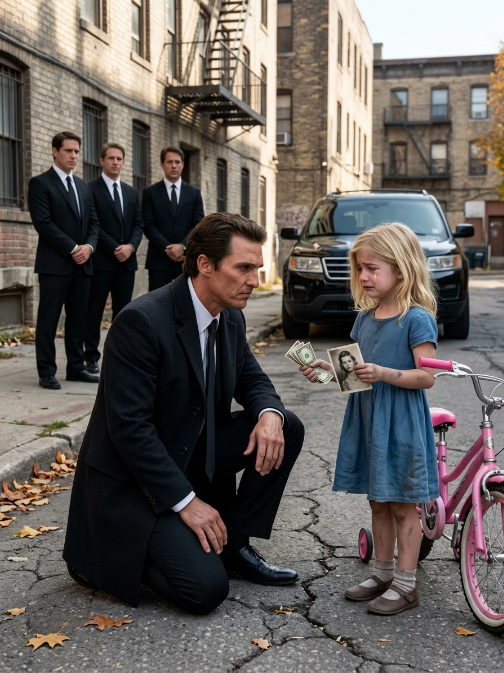
My Ruthless Boss Timed Every Second Of My Life — Then He Paid My Mother’s Hospital Bill And Broke My Heart To Save Me

**PART 1**
He looked at his watch before he looked at my face.
That was how I met Dominic Ferraro, the most feared man in the Baltimore business district.
For three months I thought he hated me — until the night he showed up outside my apartment and made my mother’s debt disappear with one phone call.
I did not take the file.
That was the first thing I said when they accused me. Not loudly. Not dramatically. Just the truth, standing in the middle of a glass office forty-seven floors above the harbor, with six executives staring at me like poverty had finally become proof of guilt.
“I didn’t take it,” I said again.
Dominic Ferraro looked at me from the head of the conference table. He didn’t raise his voice. He never needed to.
“Yes, you did,” he said. “I know you did.”
That was how this story almost ended. But it didn’t begin there.
It began months earlier, at 5:40 in the morning, with an alarm I didn’t need because I’d already been awake an hour.
Our apartment was still dark — the kind of dark that exists before work, before traffic, before people start pretending they’re fine. The kitchen light buzzed over a table covered in bills I’d learned not to look at before sunrise. White envelopes. Pink envelopes. Hospital notices. Late payment warnings. The kind of paper that feels heavier than it should because it’s really measuring how much longer a family can keep pretending.
My mother, Renee Bellamy, was asleep on the couch because lying flat made her cough. My little sister Josie was curled in her bed with a pillowcase clutched to her chest — she always slept like that, one small hand twisted into the fabric, as if afraid someone would take softness away while she slept.
I stood in the doorway and watched her breathe. Nine years old. Too young to know how often I counted money at midnight. Too smart not to know something was wrong.
I kissed her forehead, fixed the hair stuck to her cheek, and walked into the kitchen before I started crying.
Today was supposed to be the day everything changed. I’d been hired at Ferraro Holdings — entry-level financial administration assistant, reasonable salary, health benefits after probation, transit support, a real corporate badge with my name on it. Nora Bellamy. For the first time in months, my life had something that looked like a staircase instead of a hole.
I put coffee on the stove because our machine had broken two winters earlier and we’d never replaced it. The smell filled the tiny kitchen, strong and bitter, cutting through the stale odor of medicine bottles and old radiator heat.
My mother appeared in the doorway in her gray robe, hanging too loose on her now. “Did you sleep, Nora?”
“Yes.”
“Liar.”
I smiled, because if I didn’t, she’d see the fear. “Go back to bed, Mom.”
“I wanted to see you dressed.” She looked me over — the only white blouse I owned, a black pleated skirt from a thrift store, shoes that pinched my left little toe so badly I knew I’d hate them by noon. Her face lit up anyway. “You look beautiful.”
“Corporate America is not ready.”
“No,” she said, leaning against the frame. “But you are.”
I kissed her cheek, grabbed my old briefcase, and stepped into the cold Baltimore morning before doubt could follow me down the stairs.
The train came at 6:44. I knew the schedule by heart — it had been running my life for years: college classes at night, hospital visits in between, part-time jobs whenever I could get them, and now this.
Ferraro Holdings stood in the financial district like a blade made of glass. Forty-seven floors. Steel. Marble. Money polished until it reflected the people who owned it. Walking through the revolving door, the lobby made me feel small before anyone said a word — ceiling too high, floor too clean, every footstep sounding deliberate, people in suits moving like they’d never had to choose between medicine and groceries.
“First day?”
The voice came from behind the reception desk — a woman about my age, brown hair in a high ponytail, gold hoops, bright eyes, grinning too warm for that cold lobby.
I tightened my grip on the briefcase. “Is it that obvious?”
“You’re holding that thing like it owes you rent.”
I laughed before I could stop myself. She held out a hand. “Nadia. Reception. Also unofficial therapist, traffic coordinator, and rescuer of terrified new employees.”
“Nora Bellamy. Forty-seventh floor.”
Her smile paused. “Ferraro’s floor?”
“Yes.”
Her face changed the way faces change hearing a diagnosis they’d hoped wasn’t true. “Oh, friend.”
“That bad?”
“Worse.” She handed me my badge, leaned closer. “Rule one: take the right elevator. The one on the right goes to forty-seven. The middle stops at forty-five and then you climb two flights questioning all your life choices.”
“Got it.”
“Rule two: don’t talk loudly near his office.”
“His?”
“Dominic Ferraro. Your boss.” She winced. “Rule three: breathe before you answer him. Especially if he provokes you.”
“He provokes?”
Nadia looked toward the elevator bank. “He times people.”
I blinked. “What?”
“Go. You’re early, but he’ll know exactly how early.”
The elevator ride took forever. I watched the numbers climb in red light — twenty-one, thirty-two, forty, forty-seven — fixing my bun in the polished steel reflection, smoothing my blouse, practicing the professional smile I’d rehearsed in the bathroom mirror. It looked terrified.
The doors opened onto a floor that seemed to breathe differently from the rest of the building. Dark carpet. Smoked glass. Black desks. Muted phones. People typing as if every second had a price.
A woman in a pencil skirt intercepted me before I reached my assigned desk. “Nora Bellamy?”
“Yes.”
“Mr. Ferraro wants to see you before you sit.” Before I could ask why, she was already walking.
His office had double dark-wood doors with no nameplate. That alone told me everything — men who need no labels own the building in ways the rest of us never will.
She knocked once, opened the door, stepped aside. I walked in.
Dominic Ferraro stood in front of the glass wall with his back to me, the city spread behind him like something he’d already conquered and grown bored with. Dark gray suit. Broad shoulders. Black hair touched with silver at the temples. One hand in his pocket, the other near his watch.
He looked at that watch before he looked at me.
“It took you three minutes and forty seconds to get from the elevator to this door,” he said.
I swallowed. “I didn’t know I was being timed.”
“You’ve been timed since you entered the building.”
Then he turned, and I forgot the sentence I’d prepared. Not because he was handsome, though he was — not pretty handsome, not magazine handsome, something harder. A face built from discipline, grief, and money. Dark eyes that looked gray under the office light. A mouth that seemed to have forgotten casual kindness existed. A presence so controlled it made the room feel narrower.
“Sit.”
I sat. The chair was hard. I decided that was intentional.
He opened my file, looked through two pages, closed it. “Generic cover letter. Disorganized resume. Public university at night. Business administration. Half your credits completed. One semester delayed for family medical reasons.”
My hands tightened in my lap. “Yes.”
“Why are you here?”
“Because I need the salary.”
His eyes moved from the folder to my face. For one second there was something in them I couldn’t read. Then it vanished.
“Honest,” he said.
I didn’t know if that was praise or warning.
He pushed the folder toward me. “You’ll sit at the corner desk. Three spreadsheets are in your email. Reconcile them by noon. If one decimal point is wrong, I’ll know. If you waste five minutes in the hallway, I’ll know. If you’re late tomorrow, I’ll know.”
My cheeks burned. “Yes, Mr. Ferraro.”
He looked at me half a second too long. “You may go.”
**PART 2**
That was my first morning inside the glass hell. By noon I’d reconciled two spreadsheets and half the third while answering phones I didn’t yet understand, mispronouncing department names, and pretending not to notice people glancing over to see if I’d cry.
I didn’t cry.
At 12:07, Dominic replied to my email. *Line 412 missing. Redo.* Line 412 was not missing. I redid it anyway. At 2:31, another reply. *Third tab footnote incomplete. Redo.* The footnote was complete. I redid it anyway.
By 5:30, half the floor had emptied. My eyes burned. My shoes were murder. My stomach had stopped asking for food and moved on to quiet resentment. Dominic passed my desk without slowing.
“You’re still here.”
“I’m finishing.”
“Finish at home. The building closes at seven.”
“You said if I got one decimal point wrong—”
“I did.” He stopped just long enough to look at me. “I didn’t tell you to die in the chair.”
Then he left. I stayed forty more minutes, because that was what fear did — it turned every warning into a cage you built yourself.
When I got home, Josie ran down the hallway and jumped into my arms like I’d been gone for years. “You took forever.”
“I know, baby.”
“Did you bring bread?”
I had forgotten. Of course I had forgotten. Half a pack of pasta, nearly empty tomato sauce, a can of beans saved for a worse day. I made dinner anyway. Josie ate laughing. My mother ate three bites and told me it was delicious. I ate standing at the counter because sitting felt like surrender.
At 11:42, after dishes, medication schedules, unfinished homework, and a college chapter on budget analysis I barely understood, I sat at the kitchen table with my notebook. Four hours until morning. Four hours until the train. Four hours until Dominic Ferraro timed me again.
I decided I hated him. Hating him was practical. It gave the exhaustion somewhere to go.
For three months, I became very good at it.
**PART 3**
I hated the way he found errors no one else saw. I hated the way he watched the clock like time belonged to him. I hated the way my back straightened when he walked past my desk. I hated the way the whole floor shifted when his office door opened. And most of all, I hated that when he criticized my work, I wanted to prove him wrong more than I wanted to quit.
By December I knew the building better than people who’d worked there for years. The coffee on the twelfth floor was burnt; the coffee on the thirtieth was drinkable. The legal team liked files folded left to right. The waterfront project managers lied about deadlines. The right printer jammed whenever the humidity changed. Dominic Ferraro always wore the same onyx signet ring on his right hand and the same expensive watch on his left.
That Friday, I’d been awake until 3:00 a.m. finishing a quarterly report — every number checked in Excel, then by calculator, then by hand in a notebook under a dim lamp because Josie was asleep beside me and my mother needed quiet. The report was correct. I knew it was correct.
Dominic walked into the 9:40 meeting with the face of a man prepared to ruin someone’s morning. He picked up my report, turned three pages, stopped on the fourth. “Who prepared this?”
“I did.”
“Who reviewed it?”
“I did.”
He pushed the folder across the table. “Line seven, third column. Wrong.”
I looked down. Line seven was right. “Mr. Ferraro, I checked that number.”
“Check again.”
“I did.”
The room froze. No one breathed. Nadia later said the whole floor felt the temperature drop.
He looked at me. One second. Two. Three. “Redo it anyway.” Then he continued the meeting as if I no longer existed.
When it ended, I stayed in the chair because my legs refused to stand. Nadia appeared in the doorway immediately. “Come.”
“I have to—”
“You have to come with me before you explode all over the carpet.”
She dragged me one floor down to the archive room, long and cold, lined with steel shelves and old financial records, smelling like paper, dust, and secrets. The second she closed the door, I lost every ounce of professionalism I had left.
“He is unbearable,” I said. “Arrogant. Impossible. I checked that line three times. He knew it was right. He just wanted to make me redo it because he can.”
“Breathe.”
“No, I am tired of breathing. I show up early. I finish everything. I stay late. I do the work of two people because I need this job, and he still treats me like I’m one mistake away from being thrown out. He is a power-obsessed old man with an expensive watch and a personality made of ice.”
Nadia went pale. “Nora—”
“No, let me finish. He is an unbearable old man. A boring old man. An impossible old man who thinks the world revolves around his schedule, his watch, and his mood.”
Behind me, someone cleared his throat. Slowly. Low.
I closed my eyes. For a very long second I considered becoming a different person in a different city with a different name. Nadia whispered, “Sorry, friend,” and fled.
I turned around. Dominic Ferraro leaned against the archive door, one shoulder against the frame, hand in his trouser pocket, expression unreadable.
“Mr. Ferraro.”
“Go on.”
“I—”
“Unbearable old man,” he said.
My face burned. “Boring old man.”
“I did not mean—”
“Impossible old man.” Each word calm and precise, like he was placing them on the shelf beside us.
I backed into the steel shelving, cold against my spine. He took one step forward, then stopped — not close enough to touch, close enough to remind me I’d said the words.
“You think I find fault because I enjoy it,” he said.
“Do you not?”
His eyes sharpened. For the first time, I saw something like amusement move beneath the control. “Careful, Miss Bellamy.”
I lifted my chin. “Or what?”
“Keep calling me old,” he said quietly, “and see what happens.”
The words should have frightened me. They didn’t. They unsettled me — no threat in his voice, no vulgarity, no cornering, only a warning that something had shifted between us and neither of us yet knew what to do with it. Then he stepped back, opened the door, and left.
I stayed against the shelf several minutes. The room still smelled faintly of his cologne — dark wood, citrus, leather. I hated that I noticed.
—
The next week, he stopped picking on me. That was worse. No emails about imaginary errors, no cold comments at my desk, no timed hallway remarks. His silence felt like a new kind of pressure.
Nadia noticed immediately. “He looks at you now,” she said in the ground-floor café one rainy afternoon.
“He does not.”
“He looks in a way that makes the room lose two degrees.”
“You are inventing things.”
“I am narrating facts.” She stirred too much sugar into her coffee. “You are impossible. He is dangerous.”
Before I could answer, my phone buzzed. My neighbor’s name flashed on the screen. I answered and heard three words. “Your mother. Hospital.”
The coffee slipped from my hand. Nadia stood before I did, grabbed my bag, got me into a taxi, told the driver where to go, promised to cover the office. I don’t remember the ride — only the rain, the traffic, my hands twisting in my lap, the thought that I should have stayed home.
The cardiac ICU was on the fourth floor. I spent the night in a blue plastic chair under yellow hospital lights, my college notebook still open on my lap. At 2:40 a.m., I saw Vince.
Vince was Dominic’s shadow — officially security and operations, unofficially never far behind wherever Dominic went. He walked the corridor in a black coat, hands in his pockets, face expressionless. He didn’t greet me. He looked toward the ICU doors, then toward me, nodded once, and disappeared down the stairwell.
I sat frozen. Dominic knew. I didn’t understand how or why. But he knew.
—
The following Saturday I got a message from a number I didn’t recognize. *Urgent matter. Office. 10 p.m. Use side entrance. D.* I stared at it ten minutes, then went — not because he ordered me, but because there are moments when curiosity and fear become the same road.
The forty-seventh floor was empty. Only Dominic’s office was lit, warm yellow behind frosted glass. I knocked twice.
“Come in.”
He stood near the window in a white shirt, sleeves rolled, no jacket, no tie, the city dark and endless behind him. No urgent matter on the desk. No file. No agenda. I’d known there wouldn’t be.
“Sit,” he said. I sat. He remained standing a long time, then came around and sat on the desk’s edge, far enough for the conversation to stay professional, close enough to make the air feel too small.
“Your mother,” he said. “How is she?”
“Stable. For now.”
“You’ve been sleeping at the hospital.” Not a question.
“How do you know?”
“When Nadia said you’d left for the hospital, I sent Vince to make sure you were standing.”
“At 2:40 in the morning?”
“Yes.”
“Why?”
He looked at his ring, thumb moving over the dark stone like touching an old wound. “Because I needed to know you were standing.”
“You don’t owe me that.”
“I know.”
“Then why?”
For the first time I saw the man behind the suit — not the boss, not the feared executive, but a man who had lost someone young and built a life out of never needing anyone again.
“My father died when I was fifteen,” he said. “By sixteen I was sitting in rooms with men twice my age, pretending I understood what they wanted from my family. I learned early that loving people means giving the world something it can use against you.”
“That isn’t true.”
“No?”
“No. It only feels true when you keep loving the wrong people alone.”
The silence after that felt alive. Neither of us moved. Then he asked, “Your sister’s name is Josie?”
I nodded.
“Age?”
“Nine.”
He stored it the way he stored everything — quietly, completely. “When do you sleep?”
“When I can.”
“How much?”
“I said when I can.”
He nodded once, didn’t scold me, walked to the door, opened it, stood aside. “Go rest.”
In the lobby, a black car waited. Vince opened the rear door. “I’ll take the train,” I said.
“Not at this hour.”
“I always take the train.”
“Orders.” The only word he said.
I looked up at the forty-seventh floor. His office light was still on. I got in the car.
—
Two weeks later, everything changed. Josie called me at work just after five, her voice almost a whisper. “Nora. There’s a man at the door. He’s shouting Mom’s name.”
My blood went cold. “Where is Mom?”
“On the couch. She’s scared.”
“Lock the door. Do not open it. I’m coming.” I ran, left the spreadsheet open, my bag half-zipped, took the first cab I could find. Every red light felt personal. By the time I reached our building I heard Curt Malone shouting on the second-floor landing.
Curt was the loan shark my mother had borrowed from before the diagnosis, before we understood how bad her heart condition was, before hospital bills became the shape of our lives. I’d paid back most of it — enough that any decent person would have honored the extension he’d promised.
Curt wasn’t decent. He stood outside our door pounding it. “Renee, I know you’re in there.”
I reached the landing out of breath. “Get away from my door.”
He turned slowly. “Well, look who came home.”
“Leave.”
“Not till somebody pays me what I’m owed.”
“I paid two-thirds. You gave me more time.”
“I changed my mind, sweetheart.” He stepped toward me. I stepped back — not fast enough. His forearm pressed me against the hallway wall. Not full force. Just enough. That was how men like Curt communicated — pressure as punctuation.
Inside, Josie cried. “Take your hand off me,” I said quietly.
“Or what?”
Before I could answer, the hallway changed. Curt felt it too. He turned. Dominic Ferraro stood at the top of the stairs, Vince behind him. Dominic’s coat was open, his white shirt slightly rumpled, phone in one hand, the onyx ring catching the ugly hallway light. He didn’t look at me. He looked only at Curt.
“Do you know who I am?”
Curt went pale — actually pale. The pressure disappeared from my shoulder as if his body had suddenly remembered survival. “Mr. Ferraro. I didn’t know.”
“Didn’t know what?”
“That she was—”
“Say it.”
Curt couldn’t. Dominic dialed a number, spoke one sentence in Italian, then Curt’s name, then hung up.
“Your debt claim is now under legal review,” he said. “If you contact this family again before counsel contacts you, you’ll be reported for harassment, unlawful collection practices, and intimidation. If you appear near this building, her school, the hospital, or anyone in this family, you’ll be dealing with attorneys and police before you finish the first sentence.” He stepped closer. “And if you ever put your hands on her again, there will be witnesses, cameras, and consequences you cannot outrun.”
Curt left. Not gracefully. He half-ran down the stairs and slammed the front door hard enough to shake the walls.
I stayed against the wall five seconds, unable to move. Dominic approached slowly, still not touching. “You are okay.” Not a question. I nodded because speaking felt impossible.
“Josie?”
“Inside.”
I opened the apartment door. Josie was curled on the couch under a quilt, crying into her knees. My mother sat beside her, white-faced, one hand pressed to her chest. I went to Josie first. She jumped into my arms. I rocked her, told her it was over, though my body didn’t believe it.
When I looked up, Dominic was sitting on the floor in front of her — on the floor, in his expensive coat and pressed suit, at my sister’s eye level.
“Hi, Josie,” he said quietly.
She peered at him. “Are you her boss?”
“When I’m allowed to be.”
Even through fear, I almost laughed. Josie considered him. “She calls you the angry old man.”
“Josie.”
“Does she?”
“Sometimes.”
“What else does she say?”
“That you have a scary watch.”
This time, he laughed — a low, surprised sound. Then he stood and approached my mother with both hands visible, the way a person approaches someone frightened. “Mrs. Bellamy. My name is Dominic Ferraro.”
“I know.” Her voice was weak, but her eyes were clear.
“I’m going to make sure this is handled properly. No one should be knocking on your door like that.”
My mother studied him. “You have the eyes of a man who has already lost too much.”
Dominic lowered his head once. “Yes, ma’am.”
That was when my mother decided something about him. I could see it — not approval, not trust. Recognition.
—
Later, after Josie was asleep and my mother resting, I found Dominic in our tiny kitchen putting water on the stove like he belonged there. I pulled him onto the balcony, barely large enough for two, the city beyond ugly and familiar — brick walls, damp alleys, a strip of gray sky.
“Who are you really?” I asked.
“Say what you’re thinking.”
“You’re not just a CEO.”
“No.”
“You’re dangerous.”
“Yes.”
The honesty should have scared me away. Instead it made the ground steadier beneath me.
“Why did you come?”
“Because you didn’t ask.”
“I don’t understand.”
His jaw tightened. “I can’t explain it well.”
“Try.”
“Because I can’t not come.”
The sentence broke through every defense I had left. I stepped closer. He didn’t move. I placed my hand on his chest, felt his heart beating faster than expected. Then I kissed him — not because he saved me, not because he paid anything, not because I was grateful, but because for months I had hated him to stay safe, and somewhere inside that hatred, something else had been growing in silence.
He froze one second, then his hand rose slowly to my cheek, giving me every chance to pull away. I didn’t. The kiss was brief, careful, human. When we separated, he rested his forehead against mine.
“I have admired you since the first day,” he said. “Wanted you too. But I knew it was forbidden. Your boss. Too old. Too dangerous. Too much for the life you were holding together.”
“Unbearable old man,” I whispered.
He laughed again, softly.
That night he left a number under the sugar bowl. “Anything. Any hour. No explanation needed.” Then he slept in his car outside our building, Vince at the wheel, Dominic in the passenger seat, guarding the street without a speech about it.
In the morning I found the black car still parked at the curb. Josie saw it from the kitchen window. “Is the angry man still there?”
“Yes.”
“In the car?”
“Yes.”
She thought about that. “Then he is not so angry.”
I cried after she left the room.
—
The following week I learned my mother’s hospital bills had been paid — not just the overdue balance, but the upcoming tests, the specialist review, the medication gap. Everything.
I found Dominic outside the hospital leaning against the car, already knowing the conversation we were about to have.
“It was you,” I said.
He didn’t deny it.
“I don’t want to owe you.”
“You don’t.”
“Then what is it?”
His breath clouded between us in the cold. “It’s what I can do. And I’m not going to pretend I can’t just because your pride would rather suffer.”
I had four arguments prepared. None survived the look on his face. Instead of fighting, I stepped forward and rested my forehead against his chest. He wrapped one arm around me — not claiming, not trapping, just holding. I let him.
But the next morning I requested a meeting with Human Resources. Dominic didn’t like it. I didn’t care.
“I cannot remain your direct employee while this continues,” I told him.
He looked at me across his office, and for the first time I saw how hard it was for him to let someone else set terms. Then he nodded. “You’re right.”
The transfer happened within two days — new manager, same salary, clear documentation, a signed conflict disclosure, an independent HR adviser. The medical assistance for my mother moved through a formal patient-support fund managed by the hospital, not a private debt to Dominic. The issue with Curt Malone went through a lawyer, reviewed, challenged, documented. No secret favors. No invisible strings. That mattered. I loved him more because he accepted that it mattered.
—
Two weeks later, Dominic took me to see his house — a quiet tree-lined neighborhood across the city, dark brick, tall windows, a newly planted cherry tree in the front yard. Large but not ridiculous. Beautiful but not cold.
Inside, the kitchen was bigger than our entire apartment. I imagined my mother at the table, Josie doing homework by the window, a pot of coffee that didn’t taste like survival.
He showed me the living room, the porch, a downstairs bedroom for my mother, close to the kitchen, without stairs. Then we walked upstairs. He stopped before a door.
“This is Josie’s room.”
I stared. “What?”
He opened it. Soft yellow walls. A bed with a moon-shaped lamp. A low shelf of children’s books. A desk facing the window. A view of the cherry tree exactly at the height a child would see it standing on her toes.
My knees nearly gave out. “How did you know?”
“Nadia.”
“She told you?”
“I asked. She refused at first. Then I explained it was for a room, not control.”
“Two weeks,” he said. “You planned this for two weeks?”
“Yes.”
“Dominic.”
He took a key from his pocket, placed it in his open palm. “You bring your mother. Bring Josie. Or don’t. This isn’t a condition. Not a contract. Not a debt. It’s a place where Curt Malone can’t knock on the door, where your mother can sleep without hearing the neighbor shout, and where Josie can run in a garden.”
The key sat between us. Small. Ordinary. Impossible.
“I need to think.”
“Yes.”
“You won’t be angry if I say no.”
“No.”
“You won’t punish me.”
His face darkened. “Never.”
“You won’t turn this into something I owe.”
“No.”
I looked at the room again — the moon lamp, the books, the cherry tree outside. “Yes,” I said.
Dominic closed his eyes one second, then placed the key in my hand and folded my fingers around it.
—
Sunday morning, my mother arrived with Josie. Vince carried the suitcases without complaint. My mother stood in the entryway, one hand on the doorframe. She didn’t sob. She simply lowered her head while tears fell.
“Mom?”
“I’m fine, honey. It’s just been a long time since I walked into a house without fear.”
Josie ran past and discovered the cherry tree, hugging it like a person. My mother laughed. I hadn’t heard that sound in two years.
That day, the house filled with noise — boxes opening, dishes shifting, Josie testing every stair, Dominic making lunch beside my mother while she explained a family recipe like a classified document. His private phone rang once on the counter. He looked at it, then turned it face down. I noticed. He noticed me noticing. Neither of us said anything.
That night I stood in the garden while the city glowed far away. From there, Baltimore looked small enough to forgive. Dominic came up behind me and draped his coat over my shoulders, arms circling my waist. The first time he’d stood behind me, in the archive, I’d felt warning. Now I felt arrival.
For the first time in my life, everyone I loved was under one roof and safe. I should have known peace that sudden often arrives before the next storm. But I was tired. I was happy. I let myself believe the worst was over.
For a while, it almost was.
—
Dominic and I built something slowly — not perfectly, never easily. He was still impossible, still bossy, still prone to deciding things in his head before remembering I existed outside it. But he learned. When he wanted a nurse for my mother, he asked first. When he wanted Vince to drive Josie to school, he asked me, my mother, and Josie herself. When he wanted to pay my tuition balance, I made him sit through a meeting with the university’s financial office and my HR adviser. He hated every second. He did it anyway.
I returned to night classes. I worked in compliance under a manager who treated me like an employee, not a fragile charity case. Nadia became a regular at the house and declared the kitchen “too rich” until my mother taught her to make cheap soup taste like a holiday. Josie stopped sleeping with the pillowcase in her arms. That was how I knew she felt safe.
Then came Vivian Ashcroft.
Her name appeared first in an email: *Ferraro Holdings Annual Winter Investment Gala. Special remarks by Vivian Ashcroft, Ashcroft Group International.* I knew who she was. Everyone did — beautiful in a way that looked expensive even in photographs, old Baltimore family money, perfect blond hair, perfect posture, perfect ability to make a charity headline look effortless.
She and Dominic had been linked years before. Nadia told me with the delicate tone people use when information might become a bruise. “They dated?”
“Not exactly.”
“What does that mean?”
“It means families like theirs don’t always use words like *date.*”
I laughed, but it landed wrong.
The gala was held in a ballroom of glass chandeliers and winter flowers. I went in a navy dress Dominic hadn’t chosen, because I insisted on buying it myself. He looked at me when I came downstairs and, for once, didn’t immediately speak.
“What?”
“You look like a woman I don’t deserve to stand beside.”
“That is correct.”
A smile touched his mouth. “Unbearable.”
“Old man.”
He kissed my hand.
At the gala, everything was polished, too polished — board members, investors, lawyers, reporters, people who knew my name now and pretended not to know where I came from. Dominic kept one hand near my back but didn’t touch unless I leaned closer. He’d learned that.
Then Vivian arrived. The room noticed her. So did Dominic — not like a man in love, like a man recognizing danger. I felt it: a stiffness in his hand, a shift in Vince’s posture near the door, a glance between Warren Doyle and one of the board members.
Vivian walked directly toward us. “Dominic.”
“Vivian.”
Her eyes moved to me. “So this is Nora.”
I hated the way she said my name. Not cruelly. Politely. As if she already knew where I fit and was amused I didn’t. “It is,” I said.
Her smile sharpened. “Lovely to meet you.”
Dominic said nothing. That was the first crack. Not visible to anyone else. But I felt it under my feet.
—
Three days later, he changed. Not gradually. Overnight. Home late, then later, then not at all. His phone stayed face down more often. Vince stopped meeting my eyes. Warren called twice and hung up when I answered. When I asked Dominic what was wrong, he said, “Business.” Not an answer. He knew it. I knew it.
The morning everything broke, I found him in his home office before sunrise, the city blue and still outside, standing by the window in yesterday’s shirt.
“You need to tell me what’s happening,” I said.
He didn’t turn. “Nothing you need to carry.”
“That’s not your decision.”
His jaw tightened. Then he finally looked at me, and the expression on his face made my heart go cold before he spoke.
“You should leave.”
“What?”
“You, Renee, and Josie should return to the apartment.”
“That is not funny.”
“I’m not trying to be funny.”
“Dominic.”
His eyes were flat. The cold version of him. The version from the first day. The version I thought I’d learned to see past.
“I made a mistake,” he said.
The room tilted. “What mistake?”
“You were a distraction. A convenient one.”
The words were too clean. Too rehearsed.
“Do not do this,” I whispered.
He stepped away from the window. “I wanted you. I had you. It’s done.”
There are sentences that don’t sound real even while they’re killing you. That was one of them. I looked at the man who had slept outside my apartment, who had sat on the floor in front of Josie, who had listened to my mother’s recipes, who had folded a key into my palm and said *no debt.* And I knew, with a clarity that hurt worse than the words, that he was lying.
But I didn’t know why.
Two hours later, the headlines appeared. DOMINIC FERRARO AND VIVIAN ASHCROFT ANNOUNCE ENGAGEMENT AT PRIVATE INVESTOR EVENT. A photograph — Dominic in a black suit, Vivian in white satin, her hand on his arm, a ring flashing, his smile cold enough to cut glass.
The house went silent. My mother sat at the kitchen table, one hand over her heart. Josie stood confused in the doorway. Nadia called me seventeen times. I didn’t answer.
That afternoon, when I came home from the compliance office, Vivian was standing in my living room. In ivory. Her coat draped over the chair where Josie usually left her backpack. Dominic stood beside the fireplace, not looking at me.
Vivian looked at the suitcase near the stairs. “Oh,” she said softly. “This is awkward.”
I looked at Dominic. “Tell her to leave.”
He didn’t.
That was the moment something inside me broke. Not because I believed the lie completely. Because he was choosing to say it in front of her. In front of the house. In front of the life we’d built.
“Vince will take your things,” Dominic said.
“My things?”
“The locks are being changed tonight.”
My mother gasped. Josie began to cry. I stared at him. There was a flicker in his eyes — so fast I might have imagined it. Pain. Then gone.
“Do not make this harder,” he said.
I walked toward him. Vivian shifted back. Good. I stopped an arm’s length away. “Look at me.” He did. I lowered my voice. “You can lie to the entire city. You can lie to her. You can lie to your board. But do not insult me by thinking I don’t know what you sound like when you’re bleeding behind the words.”
“You know nothing.”
“Then why are your hands shaking?”
He looked down. For half a second he forgot to hide them. Then he put them in his pockets. That was the last gift he gave me before he destroyed the rest — proof that the lie was real enough to hurt him too.
—
We left with suitcases. Not everything. Just enough. Vince drove us to a furnished apartment arranged through a corporate housing program under my name, prepaid six months. Another contradiction. The locks changed, but the rent paid. He discarded me, but security stayed near Josie’s school. He announced an engagement, but my mother’s treatments continued. He said I was nothing, but someone kept making sure every door around my family remained protected.
For three weeks I hated him. Properly this time. Not first-day hatred, not archive-room hatred. Real hatred — the kind that wakes up with you, sits beside you on the train, turns every memory into evidence and every good thing into another wound.
Then Nadia came to my apartment with a folder, her face pale. “I was not supposed to show you this.”
“What is it?”
“Vivian Ashcroft’s father has leverage over Dominic.”
My heart stopped. She placed the folder on the table — copies of emails, board notices, threat assessments, legal memos. The Ashcroft Group had discovered irregularities in old Ferraro security contracts from before Dominic took over the company, contracts tied to men who’d once used debt, intimidation, and off-book pressure to control neighborhoods like mine. Contracts Dominic had been quietly cooperating with investigators to expose.
If the files went public before the investigation was ready, the people involved would know exactly who had betrayed them. And they’d go after witnesses. One name appeared in the witness appendix: Renee Bellamy. My mother. Another: Curt Malone. Another: Nora Bellamy.
My hands shook. “Why Vivian?”
Nadia swallowed. “Her father offered to bury the leak if Dominic announced the engagement and merged the companies before the audit finished.”
I closed my eyes. Some lies are made to deceive. Others are made to protect. But a lie can protect you and still destroy you.
I called Warren. Then Paige Sutton, the independent attorney who’d helped with the hospital fund and Curt’s case. Then HR. Then the investigator listed at the bottom of the memo.
Not Dominic. I did not call Dominic. If he had chosen to break me to protect me, then I would choose to protect myself by refusing to be moved like a chess piece.
—
Within forty-eight hours, the engagement became evidence — not romance, but evidence of coercive corporate pressure. Vivian’s father was investigated for obstruction and witness intimidation. The old Ferraro contracts were turned over under a court-sealed process. Dominic was questioned. So was I. So was my mother.
I didn’t see him until the preliminary hearing. He stood outside the courthouse in a dark coat, looking older than forty-four for the first time since I’d met him. When he saw me, he stopped.
“Nora.”
I almost broke at the sound of my name. Almost.
“You do not get to decide what breaks me,” I said.
“I know.”
“No. I don’t think you do.”
He looked down, then back at me. “I thought if you hated me, you’d leave fast enough to stay safe.”
“I did leave.”
“I know.”
“But I did not stay out of the truth.”
“No,” he said. “You never do.”
The courthouse doors opened behind us. Lawyers, reporters, witnesses — a city full of strangers who’d never understand that the worst betrayal of my life had begun as a terrible kind of love.
“I will testify,” I said.
“Nora—”
“No. You do not get to protect me from my own voice.”
He went silent, then nodded. “You’re right.”
It was not enough. It was a beginning.
—
The hearings took months. The Ashcroft engagement collapsed publicly. Vivian denied everything, then eventually provided documents showing her father had used her too, pushing her into an alliance she didn’t truly want because families like theirs preferred contracts over children.
Dominic stepped down from direct control of several divisions while independent compliance reviews continued. Curt Malone was charged with unlawful lending and intimidation. My mother testified about the debt. I testified about the night in the hallway. Nadia testified about the workplace pressure and the archive incident. That one made the judge raise an eyebrow.
Afterward, Nadia whispered, “Friend, your love story sounds legally concerning.”
“It was.”
“And yet?”
“And yet.”
She sighed. “I still reserve the right to use my cousin’s baseball bat.”
“Noted.”
—
Dominic and I did not return to each other quickly. That would have been too easy. Too pretty. Too false.
For a year we lived separate lives. I finished my degree. Josie stayed in school, made friends, started calling the cherry tree “our tree” even though we no longer lived in Dominic’s house. My mother recovered enough to cook again. I took a full-time role in financial compliance at another company. A clean job. My job.
Dominic sent letters through Paige. Not flowers. Not gifts. Letters. I read none of them for three months. Then one rainy night I opened the first.
*Nora, I thought breaking your heart was better than risking your life. That sentence is the most arrogant thing I have ever written. You were right. I mistook protection for control. I mistook sacrifice for consent. I made a decision about your pain because I could not tolerate my fear. I am sorry. I will not ask you to come back. I will only say that I am learning how to love without deciding. Dominic.*
I cried over that letter for an hour. Then I put it away. The second letter came a month later. Then another. Always short. Always honest. Never asking. That was how I knew he was changing — not because he loved me, but because he was finally learning that love was not a reason to reach without permission.
—
Two years after the first day I walked into Ferraro Holdings, I met him again in the lobby of the glass tower. Not as his employee. Not as his secret. Not as a woman he could protect by hurting. I was there as an independent compliance consultant hired by the board.
Nadia saw me first; her scream echoed across the marble. Dominic came out of the elevator. For one second we were back where it started. Glass. Marble. Cold air. His watch. My badge.
Only this time, when he looked at me, he didn’t look at the watch first. He looked at my face.
“Miss Bellamy.”
“Mr. Ferraro.”
Nadia made a choking sound from the desk. I smiled. Dominic did too. Small. Careful. Human.
Later, after the meeting, we stood in the archive room on the forty-sixth floor — same shelves, same cold metal, same old paper smell.
“You called me unbearable here,” he said.
“You were unbearable.”
“I was.”
“Old too.”
His mouth curved. “That part wounded me.”
“You survived.”
“Barely.”
We stood a few feet apart. That distance mattered.
“I want to ask you something,” he said.
“You can ask.”
“Dinner. Public place. You choose. No driver unless you request one. No assumptions.”
My heart beat hard. Not like fear. Not exactly.
“Dinner,” I said. “One hour.”
“Yes.”
“And if I leave early?”
“Then you leave early.”
“And if I decide I do not want more?”
“Then I will be grateful for one hour.”
I looked at him — at the gray at his temples, at the eyes my mother said belonged to a man who had lost too much, at the man who had hurt me trying to save me, then spent years learning that saving someone without their consent was only another kind of harm.
“Fine,” I said.
“Fine?”
“One hour, old man.”
His laugh was quiet. But this time it didn’t sound surprised. It sounded like home trying very carefully not to ask for too much.
—
We did not become perfect. No one does. But we became honest, and for people like us, honesty was harder than romance. We built from there — slowly, with boundaries, with therapy, with legal agreements when money touched anything, with my mother’s steady eyes watching him across dinner tables, with Josie demanding he attend her school play because “if you’re going to be dramatic in real life, you can watch drama on stage.” He did. Front row. No phone. No watch checking.
Years later, when people asked how I fell in love with the most feared man in Baltimore, I never told it like a fairy tale. It was not one. Fairy tales do not include hospital bills, unlawful debt, workplace power problems, corporate intimidation, or a man so terrified of losing people that he hurt them before the world could.
I told the truth. I hated him first because hatred was safer than wanting anything from him. Then I feared him because power always deserves caution. Then I trusted him only after he learned that my no mattered as much as my yes. And I loved him when I realized he was willing to stop being the man everyone feared if that was what it took to become someone my family could breathe beside.
The night before we moved back into the brick house with the cherry tree, I stood in Josie’s old room and touched the moon lamp. The tree outside was taller now. Strong enough to stand without the stake.
Dominic came to the doorway and stopped there. He did not enter until I turned and nodded.
“You still ask,” I said.
“Yes.”
“Good.”
He leaned against the frame. “Keep calling me old,” he said softly.
I smiled. “And see what happens?”
His eyes held mine. “What happens,” he said, “is I spend the rest of my life proving you were right to stay.”
I looked at the room prepared years ago for a child who had finally learned to sleep without clutching a pillowcase. At the hallway where my mother’s laugh carried up from the kitchen. At the man I had hated, loved, lost, and chosen again only after becoming whole enough to choose freely.
And I understood something I wish I had known on my first day in the glass tower.
Love is not the person who times your seconds. It is the person who learns to stop counting and simply stands there when your world collapses. It is not the person who pays every bill and calls that rescue. It is the person who makes sure help never becomes a chain. It is not the person who says, “I did it for you,” while taking away your voice. It is the person who finally understands that protecting someone means leaving the door open.
I took his hand. Not because I needed him. Not because he saved me. Not because I owed him. Because I had survived him, challenged him, left him, rebuilt myself, and still found my way back by choice.
And this time, when he looked at me, he did not look at his watch. He did not measure the seconds.
He simply stayed.
THE END.